Recent years have seen an expansion in the numbers of dairy farms that have converted to organic farming. Organic produce appeals to consumers concerned about their health, food quality, the effect of conventional agricultural systems on the environment and animal welfare (Huang, Reference Huang1996). Organic farming is based on principles which explicitly state that animal welfare is a high priority (Lund, Reference Lund2006). Organically farmed cows are fed with foodstuffs grown without pesticides and are subject to different EU regulations for housing standards and the use of veterinary medicines (CEC, 2004). Although both the principles behind organic production and many organic producer groups suggest that the level of animal welfare is higher on organic farms than on non-organic farms, independent research is required to address this issue (Sundrum, Reference Sundrum2001).
Diseases, such as mastitis, are major contributors to economic loss on dairy farms, and they have been and continue to be routinely treated with antibiotics on non-organic farms (Biggs, Reference Biggs1999). Organic principles suggest that diseases should be prevented by taking proactive measures to ‘enhance the immune defence’ (Lund, Reference Lund2006). In Europe, conventional medicines are not banned for organic livestock. Within the EU, regulations governing the frequency of antibiotic treatments allow individual cows to be treated up to three times during one lactation and still retain their organic status (CEC, 2004). Such treatment is discouraged by the imposition of increased milk withdrawal periods. Concerns have been raised that by not using the appropriate synthetic medicine to treat disease, cows may be suffering prolonged exposure to diseases, thereby reducing their welfare (outlined by Hovi et al. Reference Hovi, Sundrum and Thamsborg2003).
Additionally, EC Regulation (2092/91) on organic production specifies that disease prevention should be based on management systems that promote resistance to disease and recovery from infection (CEC, 2004). The Regulation also specifies minimum space allocations per head, with the aim of minimizing health problems. There is evidence that reducing stocking density may have a positive impact on dairy cow welfare (Kondo et al. Reference Kondo, Sekine, Okubo and Asahida1989). High stocking densities affect a cow's ability to access feeders and lying areas, although housing design also affects aggression and access to these resources.
Recent research papers have compared aspects of management and housing between small numbers of organic and non-organic dairy farms (for example in Norway, see Hardeng & Edge, Reference Hardeng and Edge2001; in USA, see Sato et al. Reference Sato, Bartlett, Erskine and Kaneene2005). This is the first comparison study carried out in the UK on a large sample of farms, located across the UK mainland. This paper aimed to describe management practices and farmers' perception of disease and treatment on organic and non-organic dairy farms and investigate differences between organic and non-organic dairy farms with a view to discussing the health and welfare implications of any differences. Additionally, winter housing was measured and described to investigate how organic regulations were affecting the provisions organic cows were given when housed as compared with their non-organic counterparts.
Materials and Methods
Recruitment and herd selection
Organic and matched non-organic farms (n=80) were recruited from dairy herds throughout the UK mainland. Recruitment methods differed between farm types (organic and non-organic). Organic farms were recruited from the membership lists of two organic producer groups (Organic Milk Suppliers Co-Operative and Scottish Organic Producers Association), and an organic certifier (The Soil Association). Organic farms had to be certified as organic for at least 2 years. A contact letter was sent to all the dairy farmers on these lists. Farmers who wished to participate in the study were sent a short form to fill in ensuring their farm fulfilled our criteria. Non-organic farms were recruited to the study via SAC dairy consultancy contacts, farms that had participated on a previous study (Haskell et al. Reference Haskell, Rennie, Bowell, Bell and Lawrence2006) and a dairy consultancy firm (Kingshay Farming Trust). All farms had to fulfil the following criteria: they had to undergo regular milk recording; the majority of the herd (>80%) had to be Holstein or Holstein/Friesian breed type; and the lactating animals had to have access to grazing over the summer.
Organic and non-organic farms were paired for housing type (i.e. cubicle or straw yard housing) and paired as far as possible for herd size, milk production traits and location within the UK. Farms were deemed to have matching genetic merit if their mean ‘Profitable Lifetime Index’ or ‘Profit Index’ values were within one sd (calculated using data from the national herd) of each other. Thirteen recruited farms were in Scotland (6 organic), 60 (29 organic) in England and 7 (5 organic) in Wales. There were 9 pairs of straw yard housing farms and 31 pairs of cubicle housing farms.
Farms were visited between September 2004 and May 2006. All farms were visited twice, once in autumn and once in spring. All pairs of farms were visited within 2 weeks of one another. Prior to the visits, the farmers were told what was to occur during the visit – including that a questionnaire on management and health practices would take place. During these 1-d visits, the face-to-face farmer questionnaire was carried out. In addition, during these visits, all of the milking cows underwent a locomotion score to assess lameness (Rutherford et al. Reference Rutherford, Langford, Jack, Sherwood, Lawrence and Haskell2008). A subset of twenty pairs of farms was visited on a further occasion during winter housing. On the 3-d winter visits assessments of the winter housing quality (hereafter ‘building audit’) and behavioural time-budgets (Langford et al. unpublished data) were carried out. These visits were carried out on a subset of farms owing to time constraints. The subset was selected from the forty pairs of farms as randomly as possible, while ensuring that there was a balance between cubicle- and straw-housed farms for statistical reasons.
Questionnaire
The questionnaire was developed with the assistance of a statistician and tested after consulting a panel of dairy industry experts and the project steering group (which consisted of government experts, dairy researchers, veterinary surgeons and dairy farmers). There were 144 questions, taking between 90 min and 2 h to complete. The questionnaire gathered information on housing, feeding, bio-security, fertility, calving routines, use of veterinary medicines and alternatives for prophylaxis and treatment of disease, incidence of lameness, mastitis, parasites, metabolic diseases and milk plant management. The majority of the questions were ‘closed’ questions with tick box choices, often followed by an ‘open’ question on the subject to get more information on the detail from the farmer. The interviewers (two people) had discussions before undertaking the face-to-face meeting with the farmers to ensure the meaning of the questions was understood. Definitions of particular terms (such as ‘cure’) were decided upon by the interviewers prior to commencing the face-to-face meetings. These definitions were given to farmers when asking the question to which they referred. Farmers were asked how many cows were affected by both mastitis and lameness on the day of the questionnaire. We asked the farmers to give us numbers affected by what they considered to be mastitis and/or lameness. Supplementary information, such as silage energy content and milk yields were taken from paper records including silage analyses and milk recorder data. Reference was made to the farm's health records for the preceding year where possible.
Building audit
Thirteen pairs of cubicle-housed farms and seven pairs of straw-housed farms were the subset of farms visited for the building audit. Milking parlour measurements included the length and breadth of the individual stations and the number of units and milking stations. On farms where all lactating cows were housed in one group, the housing section of the building audit was carried out for the whole herd. Where cows were housed in groups split by lactation stage, the measurements were made on only the high lactation group. The following measurements were recorded on all farms: group size; the area of passageways available to the cows; the flooring type; how much of the flooring was slatted concrete; the passageway scraping method and frequency; the length, height, head-space, type and number of feed-faces; and the number, surface area and height of the water troughs. Cleanliness and floor condition scores were recorded (see below). A building audit was carried out on any dry-cow housing (15 out of 20 for each of organic and non-organic farms).
On straw yard farms the length, width and total area of straw was measured and the number of straw bedded areas noted. The straw lying area was given a ‘cleanliness score’. For cubicle house farms the total number of available cubicles for the group of cows was counted. Type (Cantilever, Dutch Comfort, Newtonrigg or wooden) of cubicle was recorded. For each type of cubicle, five were measured for: width; lying length; lunge length; height of the crossbar; height of the step; and distance from the back bar to the end of the step. Bedding such as mats or mattresses was recorded, as was the presence of any additional bedding such as sawdust. The depth of additional bedding at the front of the cubicle was measured. The cubicles in the building as a whole were given a ‘cleanliness score’.
Cleanliness scores
The parlour, passageways, lying areas, ventilation system and water troughs were each assigned a subjective score for cleanliness. The scoring scheme ranged from 1 (extremely clean) to 5 (extremely dirty).
Floor condition scores
The collecting yard, feed-face passageways and any other passageways were assigned a floor condition score. This score was a subjective reflection of how slippery the floor surface was and ranged from 1 (well textured with a high level of grip) to 5 (smooth, slippery and difficult for the observer to walk across).
Statistical analysis
Data were tested for normality and continuous variables that were not normal were transformed using a log function. A mixed linear model was used to investigate the difference between continuous variables between organic and non-organic farms, with farm type as fixed effect and pair as a random effect. Discrete variables were analysed using a general linear model with the binomial distribution with farm type as fixed effect and pair as a random effect. Back transformed means are shown in the tables. All data were analysed in Genstat (8th edition, Lawes Agricultural Trust, VSN International Ltd, Oxford, UK).
Results
Farmer questionnaire
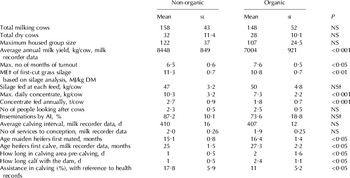
There were a number of differences between the farm types in relation to herd management, feeding and calving practices (Table 1). Milk yield was higher on non-organic farms than on organic farms. The maximum number of months a lactating cow could be grazing also differed by farm type, with organic cows grazing for longer than non-organic cows. The metabolizable energy of the main conserved forage (first-cut) was higher on non-organic farms compared with organic. The main conserved forage content differed with farm type: 37 organic farms fed grass or grass/clover silage, whereas 26 non-organic fed grass silage and 10 fed maize silage. Concentrate composition was highly variable within farm type with the majority (11) of organic farms fed beans and the majority (13) of non-organic farms fed wheat and commercial wheat-based mixes.
Herd sizes and management, feeding information and calving information for non-organic (n=40) and organic (n=40) dairy farms (back transformed means). All of the information was based on farmer estimates given during a face-to-face questionnaire, except where indicated

† A non-significant tendency 0·05⩽P<0·1
‡ Metabolizable energy
Organic heifers were older when first served, and consequently older when they calved. There were no farm-type differences in the farmers' perception of calving intervals, or number of services to conception. Management of calving also differed by farm type, organic cows were moved to the calving area earlier, and calves spent longer with their dams than on non-organic farms. Organic farmers stated that they assisted calving less often than non-organic farmers.
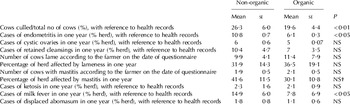
Culling rates were lower on organic farms than non-organic farms (Table 2). The most common reasons given by farmers for culling on both farm types were infertility, foot problems and mastitis.
Dairy farmer perceptions of on-farm health on non-organic (n=40) and organic (n=40) dairy farms (back transformed means). All of the information was based on farmer estimates given during a face-to-face questionnaire, except where indicated otherwise

† A non-significant tendency 0·05⩽P<0·1
Organic farmers reported a lower annual incidence of endometritis than non-organic farmers. Treatment (defined throughout as actively giving, or doing something to the cow to attempt to relieve symptoms or affect a cure) for endometritis did not differ by farm type, with the majority of farmers using ‘wash-outs’. The majority of non-organic farmers (31) used hormonal treatments for cystic ovaries; the rest used veterinary manipulation of the ovaries. Sixteen organic farmers used veterinary manipulation, 11 used hormonal treatments, 6 used homeopathy and the rest used targeted feed rations to treat cystic ovaries. The majority of non-organic farms (34) used hormones to treat non-cycling cows, whereas organic farms were more varied in the treatment options (9 massaged ovaries and waited for spontaneous healing, 8 used hormones, 8 used homeopathic preparations, and others used a combination of these treatments).
There was no difference in the farmers' perception of how many of their cows in their opinion had mastitis at the time of the questionnaire (Table 2). Thirty-one organic farmers said they used homeopathy or other alternative treatments to treat disease and all said that they had tried homeopathy. One non-organic farmer had tried homeopathy. Organic farmers treated high somatic cell count and the early stages of cases of mastitis with alternative remedies and did not use antibiotics unless the symptoms either became worse, or took too long to clear. Seven organic farmers used antibiotics at the first signs of mastitis and would cull the cow if she had three cases in a lactation. All non-organic farmers used antibiotics for cases of mastitis. Organic farmers perceived that a mean (±se) of 57·5% (±8·5%, range 0–100%) of mastitis cases were cured (free from mastitis symptoms and no reccurrence in the affected quarter or quarters within 1 month) without antibiotics. Non-organic farmers believed that mastitis cases could not be cured without antibiotics. Organic farmers' perception was that the average treatment duration for alternative therapies was 6·6±0·5 d (range 1–14 d). Farmer perception of the duration of antibiotic treatments for mastitis did not differ between farm type (organic 3·9±0·2 d v. non-organic 3·1±0·2 d).
The use and treatment regimes of alternative remedies were highly variable. Twelve different non-antibiotic treatments were used for mastitis, from mint-based creams applied to the udder, to belladonna bryonia & urtica (BBU), hepar sulph, and other homeopathic remedies. Six out of 40 farmers would have calves suckle from mild mastitis cases. Twenty out of the 40 organic farmers received any information on alternative treatments from their veterinary surgeon or local expert in alternative remedies. Sixteen farmers had received information directly from sales representatives from the major UK sellers of homeopathic products. When asked whether, in their opinion, farmers thought that their veterinary surgeon was sympathetic to their overall herd treatment strategies for diseases, most farmers claimed that their vet was sympathetic to their treatment strategies; however, five organic farmers claimed their vet ‘did not agree with’ or ‘was not happy with’ their use of homeopathy within their treatment regime.
Dry-cow therapies used to prevent and treat dry cow mastitis varied greatly across all farms. Twenty-one of the non-organic farms used a prophylactic antibiotic infusion alone on all quarters of all cows at dry-off. Nineteen non-organic farmers used a combination of antibiotics and internal teat sealants on all of their cows at dry-off. The exact combination often depended on a cow's history (e.g. antibiotic used in a recently diseased quarter and the remaining quarters teat sealed). Conversely, none of the organic farms ‘blanket-treated’ their cows with antibiotics alone at dry-off. The majority of organic farmers (29) used an internal teat sealant on all cows at dry-off. Additionally, most (25) of these farmers would also use an antibiotic infusion on all, or some quarters depending on the history of the cow. Four organic farmers always used external teat sealants, two also adding antibiotics for all cows (not acceptable under organic regulations within the EU). Seven of the organic farmers did not use any treatment to prevent dry cow mastitis – all of these cows were kept in cubicles during lactation. In total, ten organic farmers never used antibiotics to prevent mastitis during the dry period.
Farmer perception of lameness prevalence (cows lame in their opinion) at the time of visit or annual incidence did not differ by farm type (Table 2). All farmers reported that they inspected their cows' feet regularly (e.g. at dry-off). The majority of both farm types used foot baths (31 non-organics and 28 organics), most commonly on a weekly basis. The ingredients differed between farm types: formalin and antibiotic mixes were the most popular on non-organic farms; copper sulphate being the most popular on organic farms. All farms reported that they trimmed cows' feet and the majority of each type (28 non-organic and 23 organic) trimmed regularly at dry-off. Twenty-eight non-organic farmers and 34 organic farmers reported that there was somebody trained in foot-trimming on farm.
There were no farm-type differences in the farmers' perception of percentage incidence over a year of ketosis and displaced abomasum; however, organic farmers reported a lower annual incidence of milk fever in their herds than non-organic farmers.
Building audit
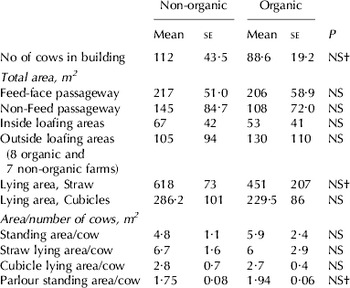
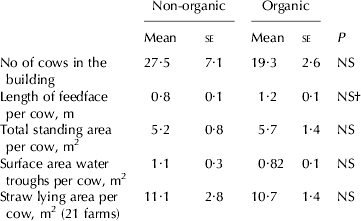
Eleven organic and 12 non-organic farms separated their cow housing into lactation-stage groups (Table 3). There were no differences between organic and non-organic farms in the total areas of the feed face passageways, other passageways, loafing areas, outside loafing space or in the overall standing area per cow.
Standing and lying areas of lactating cow housing on organic (n=20) and non-organic (n=20) dairy farms (back transformed means) measured during a building audit

† A non-significant tendency 0·05⩽P<0·1
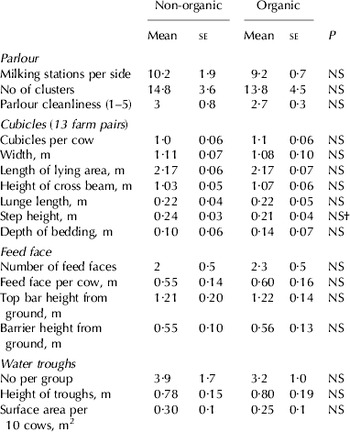
Parlour type, size and age varied greatly over all 80 farms, from five-cow abreast parlours to 44 station herringbone parlours. In the subset of 40 farms used for the building audit, there were no farm-type differences in parlour measures (Table 4).
Parlour, cubicle, feedface and water trough dimensions in lactating cow housing on organic (n=20) and non-organic (n=20) farms (back transformed means) measured during a building audit

† A non-significant tendency 0·05⩽P<0·1
Similarly, cubicle design and size varied between all of the 26 cubicle-housed farms in the building audit subset. The most common cubicle design for both organic and non-organic farms was the ‘Dutch Comfort’. Six organic farms and three non-organic farms had houses with more than one design of cubicle, with the ‘Newtonrigg’ the commonest design. Eight non-organic farms furnished their cubicles with rubber mats; four used mattresses and one had bare concrete with additional straw bedding. Four organic farms used rubber mats; five used mattresses and four had bare concrete with straw. All farms using mats or mattresses used additional sawdust bedding. Cubicle dimensions and cleanliness did not differ by farm type (Table 4).
There were no differences between farm types in feed face dimensions or cleanliness. Half of the farms had central passage feed faces. Feed-face passageways on six organic farms and five non-organic farms were scored as slippery (score ⩾4). Water trough number and dimensions did not differ by farm type. Water was scored as clean (score ⩽2) on three non-organic farms and seven organic farms. Ventilation cleanliness (i.e. presence of dust and cobwebs) did not differ by farm type. Grooming equipment was present on three organic farms and seven non-organic farms.
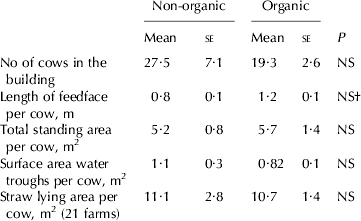
Thirty dry cow house building audits were undertaken (15 for each farm type). The majority of farms housed their dry cows on straw (9 organic and 12 non-organic farms). There were no farm-type differences in any of the building dimensions of the dry cow housing (Table 5). There were no differences in cleanliness between organic and non-organic farms. Cleanliness of dry cow passageways and lying areas was generally poor (only two farms of each type were scored as clean for either passageways or bedding).
Building dimensions in dry cow housing on organic (n=15) and non-organic (n=15) dairy farms (back transformed means) measured during a building audit
† A non-significant tendency 0·05⩽P<0·1
The study's sample size of farms using cubicle housing for dry cows was too small to robustly, statistically compare between organic and non-organic farms (6 organic and 3 non-organic farms). Across both farm types, the commonest form of cubicle was the Newtonrigg. The mean (±se) width of cubicles was 1·15±0·02 m, and the mean lying area of the cubicles was 2·27±0·08 m2. There was a mean of 1·38±0·12 cubicles per dry cow. Mats or mattresses were provided on four of the farms, all of which added sawdust. Five of the farms housed dry cows in cubicles with bare concrete, and unlike the lactating cow houses, bare concrete was bedded with sawdust rather than straw on four farms.
Discussion
This study was undertaken using a combination of a face-to-face questionnaire and measurements obtained by the experimenters, and as such does have limitations. Many of the data reported here relied on farmer recall and perception of management and health, so caution should be applied in interpreting the results. For example, it is possible that farmers could have either under- or over-reported disease incidence owing to ‘social desirability’ bias (Nederhof, Reference Nederhof1985). However, the data were collected anonymously to avoid such bias as much as possible – although some possibility for this type of bias remains. The respondents were aware of the broad subject area of the questionnaire before the face-to-face interview took place, and therefore most farmers had reviewed their health records prior to the interview date. We carried out the face-face questionnaire to attempt to get as much detail about the study farms as possible, while recognizing that relying on farmer recall for information on disease incidence will always harbour the issues of perception bias. Moreover, another part of the larger investigations surrounding this study, we recorded all of the health records from the farms for a year, and found them to be unreliable, difficult to interpret and extremely variable in quality (Haskell et al. unpublished data). The farmer questionnaire was adjudged to be less variable in quality than the records.
The clearest differences between farm types within this study were for milk production levels and amounts of concentrates fed, with organic cows being fed less concentrate and producing less milk. These differences were expected as EU regulations have restricted the amount of concentrates given in the organic dairy cow diet to 40% of the overall diet. In addition, since 2005, all feed offered on organic farms must be 95% organic in origin, moving towards 100% in 2007. Farmers in the present study were working towards this allowance, explaining the farm type differences in feed constituents (Sehested et al. Reference Sehested, Kristensen and Søegaard2003).
The farms differed in many aspects of reproduction and calving. Heifers were mated and first calved when older on organic farms, suggesting that cows were not managed to produce milk as early as non-organic cows. These differences in age at first calving may partially account for lower percentages of assisted calving on organic farms as heifers may be larger when calving at a later age (Swali & Wathes, Reference Swali and Wathes2006).
According to the questionnaires, cases of endometritis and milk fever (as a percentage of the herd) were lower on organic farms than non-organic farms with similar percentages to those found by Rozzi et al. (Reference Rozzi, Miglior and Hand2007). The slightly lower level of metabolic and reproductive disease may be linked to the lower milk yield and differences in diet (Roche, Reference Roche2006). Organic farmers had a non-significant tendency to perceive lower percentages of cows affected by mastitis compared with the perceptions of non-organic farmers. This suggests, especially when taking into account that perception could be biased towards socially acceptable answers, that there was not a fundamental difference in the level of mastitis between farm types. Other authors found higher levels of mastitis on organic farms (e.g. O'Mahony et al. Reference O'Mahony, Healy, O'Farrell and Doherty2006), no difference (e.g. Hovi & Roderick, Reference Hovi and Roderick2000) or lower levels (e.g. Rozzi et al. Reference Rozzi, Miglior and Hand2007), and our results showed substantial variation both between and within farm types. The present results are all based on the farmers' recollection of cases of mastitis, not clinical data, and therefore differences between organic and non-organic farms may be related to treatment recording and farmer perception rather than disease incidence (von Borell & Sørenson, Reference Von Borell and Sørensen2004; O'Mahony, et al. Reference O'Mahony, Healy, O'Farrell and Doherty2006). Furthermore, antibiotic treatments were not so readily used on the organic farms as on the non-organic farms. There were no differences in reported rates of lameness between the farm types. However, in a separate part of this study we carried out lameness scoring on each herd and found the lameness prevalence to be lower on organic farms than non-organic (Rutherford et al. Reference Rutherford, Langford, Jack, Sherwood, Lawrence and Haskell2008). The substances used in footbaths were the only farm-type differences in the methods used to treat and prevent lameness.
Conversely, treatment of other diseases was a major difference between farm types. All organic farmers had tried homeopathy compared with only one non-organic farmer. Organic farmers reported varied success rates for alternative treatments. As Vaarst et al. (Reference Vaast, Bennedsgaard, Klaas, Nissen, Thamsborg and Østergaard2006) found, some organic farmers who had tried homeopathy in the past and had a low success rate had returned to using antibiotics. Most organic farmers used alternative treatments for mastitis during lactation and believed that the majority of cases could be cured without using antibiotics. A similar pattern was seen in the use of preventative dry-cow therapy treatments at dry-off. All of the non-organic farmers used antibiotics, either alone in conjunction with teat sealants under prescription from their veterinary surgeon. EU organic regulations prohibit the routine use of antibiotic dry cow therapy (CEC, Reference Biggs2004) and none of the organic farmers treated all of their cows with antibiotics alone at dry-off. However, over half of the organic farmers did use dry-cow antibiotics in conjunction with teat sealants depending on cow history. One-quarter of organic farms did not use antibiotics for dry cow therapy. Two organic farmers were using antibiotics (in combination with external teat sealants) on all cows as they were dried off, in contravention of the EC regulation on preventative antibiotic use (CEC, Reference Biggs2004).
Around 12% of organic farmers were solely using alternatives to antibiotics on their farms, a similar figure to that found in Denmark by Vaast et al. (Reference Vaast, Bennedsgaard, Klaas, Nissen, Thamsborg and Østergaard2006). Organic certification regulations state that ‘homeopathic products … shall be used in preference to chemically synthesized allopathic veterinary medical products or antibiotics provided that their therapeutic effect is effective for the animal species and condition for which treatment is intended’ (e.g. Organic Farmers & Growers, 2006). Therefore, further research is required into the efficacy of commonly used alternative treatments, physical treatments and ‘self-cure’ rates from common diseases on organic farms (Løken, Reference Løken2001; Hektoen et al. Reference Hektoen, Larsen, Ødegaard and Løken2004). However, as there were twelve different non-antibiotic treatments used by farmers in this study for mastitis alone, identifying treatment regimes for research may be problematic.
Although most organic farmers were receiving information on alternative remedies through their veterinary surgeon or an expert in alternative treatment, many were gaining all the information on homeopathic remedies and other alternatives from sales representatives. This may not fulfil the organic regulations on expertise for the use of alternative treatments (CEC, 2004). However, we found that organic farmers who were interested in using alternative treatments were also interested in improving their own knowledge of such treatments by attending courses.
Almost all of the farmers were unanimous in the view that their vets were sympathetic to the disease treatment strategies used on farm for their cows. However like Vaast et al. (Reference Vaast, Thamsborg, Bennedsgaard, Houe, Enevoldsen, Aarestrup and de Snoo2003), a minority of organic farmers revealed that their vet was sceptical of the principles and prescribed standards of organic farming, especially regarding homeopathic treatments.
As also shown by Rozzi et al. (Reference Rozzi, Miglior and Hand2007), organic farms in this study had lowered culling rates than non-organic farms. Many of our organic farmers reported that they ‘did not push the cows’, so if a cow was not able to get back in-calf immediately she would remain in the herd for longer until she was back in-calf. This attitude was not reflected in the calving interval or the number of services to conception data collected.
It is clear from this study that some of the organic farms visited were not completely complying with the EC regulations on organic livestock production (CEC, 2004). Building space provision was the regulation mostly likely not to be followed, with 6 out of 20 organic farms not having the required space for the number of cows housed on the days of our visit. As the majority of sampled organic farms were within 10 years of conversion to organic farming, this may be because alterations in buildings require long-term commitment and funding and work had yet to be carried out. Three out of the 20 non-organic farms did not fully comply with the welfare codes on space provision on the days of our visit. Additionally, many of the non-organic farms exceeded the space allowance recommended in the welfare codes, contributing to the overlap in variation between organic and non-organic farm types (DEFRA, 2003).
There were no farm-type differences in the quality of dry cow housing. Although most dry cows had ample space, we would like to highlight the poor hygiene conditions that dry cows were in on many farms. Green et al. (Reference Green, Bradley, Medley and Browne2007) found that dry cow cubicle-housing hygiene factors were related to increased risks of mastitis in subsequent lactation. In the current study, dry cows were often housed in old buildings with damaged fittings and hygiene was not carried out to the same extent as the lactating animals.
Farms were highly variable and there was considerable overlap between organic and non-organic farms. However, we have shown that milk yield, concentrate feed, management of heifers and calving, and the use of ‘alternative treatments’ differed between organic and non-organic farms. In other respects there were no farm-type differences. The similarity between the organic and non-organic farms indicates that the aspects of welfare related to housing management and disease treatment on organic dairy farms are not compromised by the regulations. Equally, these results do not suggest that these aspects of cow welfare on organic farms are considerably better than on the farms of their non-organic counterparts.
The project was funded by the UK Department for the Environment, Food and Rural Affairs. We would like to thank the farmers and farm staff for allowing us onto their farms to collect data. Thanks also to the Soil Association, OMSCo, SOPA and Kingshay Farming Trust for their assistance. Statistical advice was provided by Ian Nevison, of BIOSS.