INTRODUCTION
Language is a powerful communicative tool in part because of conventionality; words have communicative value because the members within a particular linguistic community agree upon how words can be used to convey meaning (Clark, Reference Clark, Flavell and Markman1983; Reference Clark1993). To be effective communicators, then, children must acquire the linguistic forms that are most likely to be shared by the other members of their linguistic community (Clark, Reference Clark2007). Existing evidence suggests that children are sensitive to the conventional nature of language quite early in development. For example, infants aged 1 ; 1 assume that the meaning of a recently learned word is conventional, and thus expect new word meanings to be shared by the other members of their linguistic community (Buresh & Woodward, Reference Buresh and Woodward2007). However, in our daily lives there are likely to be situations in which a wholesale assumption of conventionality is not warranted because the speaker, for whatever reason, is unable or unwilling to provide a conventional word–referent link. Such situations could be particularly problematic for children acquiring language because learning unconventional word meanings could result in children experiencing difficulties in their communication with others (Clark, Reference Clark2007). In the present study, we examined parent–child talk in a semi-structured play session to gain insight into whether parents use conventional labels from the standpoint of ignorance and, if they do, how their use of such labels might differ from when they are knowledgeable of an object's name. If such differences exist, they might serve as a basis for understanding how children come to identify the instances in which they should suspend their assumption of conventionality.
A growing body of evidence suggests that young children are sensitive to the fact that other members of the linguistic community share knowledge of the meanings of the new words they acquire. To illustrate, in a study conducted by Henderson & Graham (Reference Henderson and Graham2005) children aged 2 ; 0 were taught the meaning of a new word and then asked to select the referent of the novel label either by the same speaker who taught them the meaning of the new word or by a second speaker who was not present during the learning phase. The findings revealed that the speaker administering the comprehension test did not matter; children expected the speaker to know the word–referent link even though she was not present when the link was learned. These findings have been replicated with children aged 1 ; 7 using a similar paradigm (Graham, Stock & Henderson, Reference Graham, Stock and Henderson2006) and infants aged 0 ; 9 and 1 ; 1 using a visual habituation paradigm (Buresh & Woodward, Reference Buresh and Woodward2007; Henderson, Woodward, Bonny, Smith & Perez Rojas, Reference Henderson, Woodward, Bonny, Smith and Perez Rojas2009). This evidence suggests that children assume conventionality – they expect individuals from the same linguistic community to share knowledge of a recently learned word–referent link and do so without needing any extra information.
There are a number of reasons why an assumption of conventionality might be particularly useful to children during word learning (Sabbagh & Henderson, Reference Sabbagh and Henderson2007). For instance, with such an expectation children would be able to rapidly attribute knowledge of a recently learned word–referent link to the other members of their linguistic community, and therefore would not have to wait to hear a speaker use the word to be certain that he or she shares knowledge of its meaning. However, there are several circumstances in which a conventionality assumption might not be appropriate. Consider a situation in which a curious preschooler requests the name for an object that their parent has never seen before (e.g. an object from a foreign country) or an object that does not have a conventional name (e.g. a craft at a craft show). In such cases, it is unlikely that the other members of the child's linguistic community will share knowledge of any label that their parent provides. Because little is known about how often caregivers provide labels in such circumstances, the first goal of the present study was to determine the extent to which this happens.
A second goal of the current study was to identify whether parents differentiate their use of unconventional labels from their use of conventional labels by marking them in some way. In considering how parents might mark unconventional labels, it is worth noting some relevant experimental findings. For instance, researchers have shown that children will not learn words from speakers who explicitly say that they do not know the conventional term (e.g. Sabbagh & Baldwin, Reference Sabbagh and Baldwin2001; Sabbagh, Wdowiak & Ottaway, Reference Sabbagh, Wdowiak and Ottaway2003), or speakers who, in the past, have shown that they do not label known items conventionally (Clément, Koenig & Harris, Reference Clément, Koenig and Harris2004; Koenig, Clément & Harris, Reference Koenig, Clément and Harris2004; Koenig & Harris, Reference Koenig and Harris2005). Taking these experimental findings into account, parents' use of labels would dovetail with children's abilities to appropriately avoid assuming conventionality if parents explicitly comment when they are ignorant or unsure of an object's conventional name. That is, children might be less likely to assume conventionality if parents mark the instances in which they are unsure about object labels.
In addition to providing information about their knowledge states, parents might distinguish between their use of conventional and unconventional labels in a number of ways. For instance, parents might be less likely to repeat labels that are unlikely to be conventional. Parents might also frame labels that are unlikely to be shared differently from how they frame labels that are likely to be shared. For example, parents might avoid using an ostensive frame (e.g. ‘This is a ____’) when providing new object labels that are unlikely to be conventional. Finally, parents might mark unconventional labels by offering atypical labels (e.g. place holders, onomatopoeic terms, deverbal nouns), as opposed to the appropriate adult form (i.e. common nouns). Some of these cues and patterns have not been explored in experimental research. However, determining whether they are present in parents’ conversations with their children is an important step towards understanding whether children's assumption of conventionality aligns with the information that is present in their linguistic environment, and when this assumption might be deployed or suspended in the service of word learning (also see Callanan & Sabbagh, Reference Callanan and Sabbagh2004).
To investigate whether parents supply and mark unconventional labels two-, three- and four-year-old children were videotaped with one of their parents while playing with objects for which parents and children were either knowledgeable or ignorant of the conventional names. There were two types of objects for which parents did not know the names. Some of the objects were professionally manufactured objects that looked like they should have a correct name that would be shared by the larger linguistic community. Other objects were clearly homemade, and thus were unlikely to have a name that anyone else would know. These two types of objects provided an interesting comparison because parents were ignorant of labels in both cases, but only manufactured-looking objects are likely to have labels that are shared by the other members of the linguistic community. Any differences in how parents use labels when referring to these objects would provide insight into whether parents' labeling is generally sensitive to their own ignorance, or a more specific goal of specially marking the labels that differ from already established conventions.
A final goal of this experiment was to investigate whether parents' use of conventional and unconventional labels differed with children's age. There is a large body of evidence suggesting that parents' speech is tailored to their child's developmental level (e.g. Bruner, Reference Bruner1983; Cleave & Bird, Reference Cleave and Bird2006; Fernald & Morikawa, Reference Fernald and Morikawa1993; Ninio, Reference Ninio1983; Ninio & Bruner, Reference Ninio and Bruner1978; Masur, Reference Masur1997). In the present context, parents of younger children might employ a simple strategy of not using labels at all when they are ignorant of the conventional forms. In contrast, parents of older children might use labels that are unlikely to be conventional, but do so with additional information suggesting that the labels might not be shared by the broader linguistic community. Given the advances children make in their understanding of others' mental states between the ages of two to four years, such a developmental pattern might be especially apparent for parents' discussions of their knowledge states.
METHOD
Participants
Thirty-six typically developing English-speaking children from three age groups and their parents participated in this study. Two-year-olds (n=12, 6 males) ranged in age from 1 ; 10 to 2 ; 2 (M=2 ; 0); three-year-olds (n=12, 7 males) ranged in age from 2 ; 10 to 3 ; 2 (M=3 ; 0); and four-year-olds (n=12, 6 males) ranged in age from 3 ; 10 to 4 ; 3 (M=4 ; 0). Participants were recruited from a database of families who were interested in volunteering for child development studies and were primarily of Caucasian, middle-class background from a university community in Southeastern Canada. Two additional children participated, but were not included in the final sample due to sibling interference. All children received a small prize for participating.
Materials
Objects
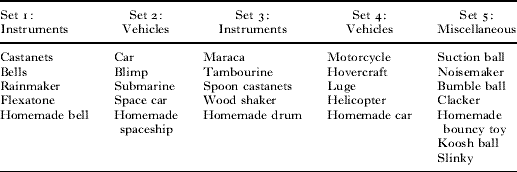
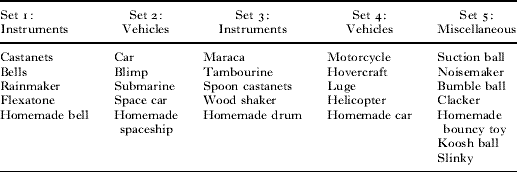
Twenty-seven objects were used in this study. Twenty-two of the objects had been purchased at local stores and five of the objects were handcrafted out of miscellaneous materials. Objects belonged to one of three categories: musical instruments (e.g. bells), vehicles (e.g. car), and miscellaneous toys (e.g. a slinky). For the play session, objects were split up into five different sets: two musical instrument sets, two vehicle sets and one set of miscellaneous objects. Objects classified as musical instruments and vehicles were separated into the two groups according to the following criteria: (i) there was at least one homemade toy in each set; and (ii) each set contained objects that were likely to be familiar to parents and their children and objects that were likely to be unfamiliar to parents and their children (see Table 1 for object sets).
Object names and the set to which each belonged
Data collection
Play sessions were videotaped using a camcorder that was mounted on a tripod and was situated unobtrusively in the corner of the testing room. A hand-held digital timer was used to time the length of each segment of the play session. Each set of objects was presented in a medium-sized gift bag.
Object Label Checklist
Parents completed a paper-and-pencil based Object Label Checklist in which they wrote down an object's name if the name was known by them or their child. Photographs of all of the objects were placed in a 0·5″ three-ring binder in a fixed random order. The images were approximately 2·5″×3·0″ each. Parents completed this checklist after the play session and their responses were utilized to designate objects to one of the four categories described in more detail below.
Design
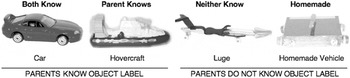
Parent–child dyads played with four categories of objects. As mentioned above, the category to which an object belonged was determined using each parent's responses on the Object Label Checklist, and thus was determined after the experimental session. The object categories were: (i) objects that both parent and child knew the names for; (ii) objects that only the parent knew the names for; (iii) manufactured objects for which neither the parent nor the child knew the names; and (iv) homemade objects for which no conventional names exist (see Figure 1). Using parents' responses on the Object Label Checklist to assign the objects to the above categories resulted in a valid assessment of whether the objects were known or unknown to parents and their children. On average, parents did not know the names of six of the twenty-two manufactured objects that were used in the study. Although assigning objects to each of the categories in this manner resulted in the unavoidable consequence of unequal numbers of objects in each object category across participants, we minimized the effects of this consequence by using proportion scores in our statistical analyses. Lastly, to ensure that any findings could not be attributed to the order in which parent–child dyads played with the toys, there were a total of twelve orders of object set presentation so that no child in each age group received the objects in the same order.
An example of the categories to which objects were assigned.

Procedure
Play session
After a brief warm-up period in which the experimenter played with the children while the parent gave informed consent, the experimenter told parents that they would be playing with their child in a playroom and would be given five different sets of objects. Parents were told that they would have 3·5 minutes to play with each set and were asked to use the toys and play with their child as they would at home. After answering any questions, the experimenter led parents and their children into the playroom and gave them the first set of objects. After 3·5 minutes, the experimenter entered the room and switched the old set of toys with a new set. This was repeated until parents and their children finished playing with the fifth set of objects. After the play session, parents completed the Object Label Checklist. Parents were asked to base their answers on their own and their child's knowledge of the objects' names as if they had not seen the objects that day. Parents completed the checklist after the play period in an effort to avoid having their responses on the questionnaire influence their labeling behaviors.
Coding
Three research assistants who were blind to the hypotheses of the study transcribed the video recordings of the play sessions. A fourth research assistant who was also blind to the hypotheses of the study transcribed a random sample (50%) of the transcripts and ensured that transcribers were accurate. After the play sessions had been transcribed, the lead investigator coded the transcripts according to the coding schemes outlined below. For each of the coding schemes, a second coder who was blind to the hypotheses of the study coded 25% of the transcripts to establish inter-rater reliability (reported for each coding scheme below). For the items within each of our coding schemes, we also report the probability of agreement between our coders (reported as percent agreement).
Every utterance offered by parents was coded along each of the following four dimensions. As this was the case, the coding categories were considered separate and analyzed accordingly.
(1) Label frame. This coding dimension was used to characterize how parents used labels when talking about objects (percent agreement=97%, Kappa=0·88).
a. Ostension: Utterances in which the name of an object was used explicitly in a direct manner. Examples: ‘This is a car’ and ‘Oh look, a blimp’. Percent agreement=84%.
b. In-action: Utterances in which the name of an object was used as a communicative tool casually throughout the course of play. Examples: ‘Shake the tambourine’ and ‘Throw me the ball’. Percent agreement=83%.
c. Similes: Utterances in which an object label was used in the form of a simile. Examples: ‘It is kind of like a boat’ and ‘It's like a car’. Percent agreement=93%.
d. Questions: Utterances in which an object label was used in the form of a question or with a rising intonation (see the ‘Paralinguistic cues of uncertainty’ coding described below). Examples: ‘Is this a car?’ and ‘This is a drum?’ Percent agreement=90%.
e. No label: Utterances that did not contain a label. Examples: ‘It rolls’ and ‘Oh neat’. Percent agreement=98%.
(2) Kind of label. Parents' labels were coded along the following dimensions (percent agreement=93·8%, Kappa=0·87).
a. Typical noun: Object labels that would be considered to be appropriate adult forms (e.g. a common noun such as plane or drumstick). Percent agreement=89%.
b. Atypical label: Object labels that would not be considered to be appropriate adult forms. Atypical labels included onomatopoeias (e.g. ‘ooh a zoomer’), place holders (e.g. ‘it's a thingamajig’, ‘it's a super rocket donker’, ‘boy that's quite the fancy gizmo’) and deverbal nouns (e.g. ‘It's a gobbler’, ‘It's a flier’, ‘this is a squisher’). Percent agreement=87%.
c. No label: Utterances that did not contain a label. Examples: ‘It rolls’ and ‘Oh neat’. Percent agreement=98%.
(3) Information about ignorance and uncertainty. This coding dimension was used to capture whether parents provided explicit information about their ignorance or uncertainty of an object's conventional name (percent agreement=99%, Kappa=0·81).
a. Ignorance or uncertainty: Any utterance in which parents explicitly stated their lack of knowledge or doubt of an object's name, what an object was or what an object did. Examples: ‘I don't know’, ‘I have no idea’, ‘I have never seen this before’, ‘Maybe’, ‘I think it is’, ‘It could be’ and ‘I'm not sure’. Percent agreement=80%.
b. No information about parents' ignorance and uncertainty: Any utterance that did not contain information about parents' ignorance or uncertainty regarding an object's name, what an object was or what an object did. Percent agreement=98%.
(4) Paralinguistic cues of uncertainty. Parents' utterances were also coded for the presence of paralinguistic markers of uncertainty (Clark & Fox-Tree, Reference Clark and Fox-Tree2002). A research assistant watched the videotaped sessions and marked in the transcripts when parents' utterances contained the following cues of interest (percent agreement=94%, Kappa=0·82).
a. Silent pauses: Utterances in which there was a break of silence greater than one second in duration. Pauses occurred before or during the parents' turn. Example: ‘It.. looks like a blimp’ or ‘.. it's an instrument’. Percent agreement=87%.
b. Filled pauses: Pauses with interjections such as ‘uh’, ‘um’ and ‘hmm’. Example: ‘This is.. um a spaceship’ and ‘it's for.. uh.. driving’. Percent agreement=100%.
c. Rising intonation: Utterances that ended with a rise in parents' pitch. Examples: ‘Is this a ↗car?’ or ‘You think it's a ↗bike?’ Percent agreement=74%.
d. No paralinguistic information: Any parent utterance that did not contain any of the paralinguistic markers of uncertainty described above. Percent agreement=96%.
To investigate whether parents' use of labels was related to children's interest in the names of the objects, the only utterances offered by children that were coded were those in which they requested an object's name (percent agreement=91%, Kappa=0·74). Examples: ‘What's this?’ and ‘What's this called?’
For every utterance, the object that was the topic of the utterance was also coded (percent agreement=81%, Kappa=0·81). After coding an entire transcript, the coder consulted the participant's Object Label Checklist and identified the category to which each object belonged. Inter-rater reliability was only calculated for the object that was the topic of the utterance because agreement on the object entailed agreement on the category to which it belonged. To illustrate, the utterance ‘This is a car’ would receive the following codes: ostension – typical noun – no ignorance – no paralinguistic – car (Both Know).
RESULTS
Preliminary analyses
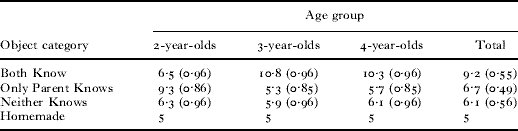
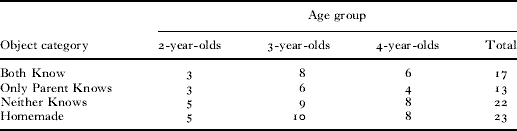
Our first analyses showed that there were no main effects of sex, nor did sex interact with any of the major variables of interest. Thus, all of the analyses were collapsed across sex. Next, we examined whether there were any significant differences between the age groups in the number of objects that had been assigned to each object category (see Table 2). A set of univariate ANOVAs showed that children's age was related to the number of objects for which both parent and child knew the names and the number of objects for which only the parent knew the names (F(2, 33)=6·00, p=0·006, partial η2=0·27 and F(2, 33)=6·62, p=0·004, partial η2=0·29, respectively). Post hoc tests (LSD, p<0·05) showed that parents of two-year-olds reported significantly fewer objects in the Both Know category and significantly more objects in the Only Parent Knows category than did parents of three- and four-year-olds. Given that the differences between age groups in the number of objects belonging to the Both Know and Only Parent Knows categories could influence the number of opportunities that parents would have had to talk about the objects, we statistically controlled for the number of objects in each category in the following analyses.
Mean number of objects in each object category (SE) for each age group
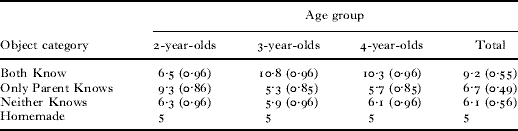
Note: All participants at all ages played with five homemade objects.
We also examined whether there were any significant differences between age groups and object categories in the number of objects in each category that parents discussed. The dependent measure was the proportion of objects that received a minimum of one utterance code out of the total number of objects available in each category for each dyad. A (3) age×(4) category mixed design ANOVA with category as a within-subject factor showed a significant main effect of category (F(3, 99)=6·30, p=0·001, partial η2=0·16), but no main effect of age (F(2, 33)=0·59, p>0·05, partial η2=0·03), nor an age by category interaction (F(6, 33)=1·04, p>0·05, partial η2=0·06). Although parents talked about most of the objects in a given category, post hoc tests (LSD, p<0·05) showed that parents talked about a greater proportion of objects in the Homemade category (M=0·94, SE=0·02) than in the Only Parent Knows (M=0·80, SE=0·04) and Neither Knows (M=0·84, SE=0·03) categories. Parents also talked about a greater proportion of objects in the Both Know (M=0·90, SE=0·02) category than in the Only Parent Knows category. Given these differences between object categories in the proportion of objects discussed, we controlled for the number of objects that were discussed in each object category in our focal analyses. For example, when looking at the number of objects in each category that received a label, we divided the number of objects labeled in each category by the number of objects that parents talked about in each category.
Focal analyses
The focal analyses consist of a series of analyses examining if and how parents used object labels differently when their labels were and were not likely to be conventional. The first analysis examined whether parents used labels less often when talking about objects they did not know. This analysis was followed by a series of analyses that examined specific differences in how parents used object labels that were and were not likely to be shared. These analyses lead up to the final analysis, which examined how often parents used object labels that were unlikely to be conventional without marking them in any way. Throughout the focal analyses, any significant differences between the objects in the Neither Knows category and the Homemade objects will be highlighted. This contrast is informative about parents' tendency to use labels that were unlikely to be shared when conventional labels likely do or do not exist.
Object labels
As noted above, parents talked about 84% of the objects in the Neither Knows category and 94% of the objects in the Homemade category, which suggests that they were interested in these objects, even though they were ignorant of their labels. To examine how often they used labels when talking about these objects, we computed the proportion of objects that parents used labels for per number of objects that they discussed in each category. This dependent measure was submitted to a (3) age×(4) category mixed design ANOVA with category as the within-subject factor. The ANOVA showed a significant main effect of category (F(3, 99)=20·28, p<0·001, partial η2=0·38), but no main effect of age (F(2, 33)=0·85, p>0·05, partial η2=0·05), nor an age by category interaction (F(6, 99)=0·88, p>0·05, partial η2=0·05). Post-hoc tests (LSD, p<0·05) showed that parents used proportionally more labels in the Both Know category (M=0·84, SE=0·03) than in all the other categories. Parents used proportionally fewer labels in the Neither Knows category (M=0·44, SE=0·04) than in the other categories (Homemade: M=0·57, SE=0·04; Only Parent Knows: M=0·66, SE=0·04). Thus, although parents could have presented a label in a variety of ways, they used labels less often specifically when they were referring to an unknown conventional object.
The next analysis examined whether parents' tendency to present labels for objects in the Neither Knows category less often than objects in the other categories was a result of children simply being less interested in the names of the objects in that category. For this analysis, the dependent measure for each participant was the proportion of children's requests for object labels per number of objects discussed in each category. A (3) age×(4) category mixed design ANOVA with object category as the within-subject factor showed a significant main effect of object category (F(3, 99)=3·85, p=0·012, partial η2=0·11), but no main effect of age (F(2, 33)=1·01, p>0·05, partial η2=0·06), nor an age by category interaction (F(6, 99)=1·18, p>0·05, partial η2=0·07). Post-hoc tests (LSD, p<0·05) showed that children provided a greater proportion of requests for labels per objects discussed in the Neither Knows (M=0·20, SE=0·05) and Homemade (M=0·26, SE=0·05) categories than in the Both Know category (M=0·11, SE=0·03), but not the Only Parent Knows category (M=0·19, SE=0·07). Most importantly, children showed no difference in their requests for names of the objects in the Neither Knows and Homemade categories, thus showing that parents' tendencies to use fewer labels when talking about objects in the Neither Knows category could not be attributed to children's lack of interest in the names of those objects.
Although parents were less likely to use labels to refer to objects when they were unaware of conventional labels, they did not completely avoid doing so. The next series of analyses explored differences in how parents used object labels when the labels were and were not likely to be conventional. Specifically, we examined whether parents: (i) used the same label multiple times (i.e. token–type ratio); (ii) offered label tokens in different ways; (iii) used typical nouns as labels; and (iv) highlighted their ignorance or uncertainty when they were using labels that were unlikely to be shared by the members of the larger linguistic community.
Token–type ratio
For this analysis, the dependent measure was the number of repetitions of the same label (i.e. tokens) out of the total number of different label types in each category for each participant. A (3) age×(4) category mixed design ANOVA with category as a within-subject factor showed a significant main effect of category (F(3, 99) =12·13, p<0·001, partial η2=0·27), but no main effect of age (F(2, 33)=0·90, p>0·05, partial η2=0·08), nor an age by category interaction (F(6, 99)=1·71, p>0·05, partial η2=0·09). Post-hoc tests (LSD, p<0·05) revealed that parents provided a greater number of tokens per label type in the Both Know (M=2·36, SE=0·20) and the Homemade (M=1·92, SE=0·22) categories than they did in the Only Parent Knows (M=1·50, SE=0·12) and Neither Knows (M=1·11, SE=0·10) categories. Most importantly, parents provided fewer tokens per number of label types in the Neither Knows category than in all of the other categories. Thus, parents were less likely to use the same label multiple times when they were ignorant, but only when the object appeared to have a conventional name.
Ostension, in-action, similes and questions
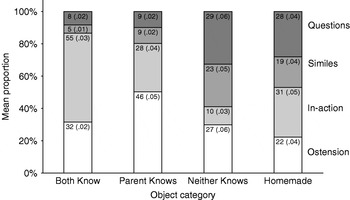
The next series of analyses were conducted to explore whether parents' use of object labels differed when providing labels that were and were not likely to be shared. Parents' use of labels was coded in four different ways: (i) ostension, (ii) in-action, (iii) simile and (iv) question. For each category, the dependent measure was the proportion of times a label was used each way (e.g. number of labels with ostension) per the total number of label tokens in each category. As a result, values on these dependent measures were not independent of one another (i.e. a participant with a high proportion of ostension necessarily had lower proportions of other kinds of labels). Thus, we conducted separate (3) age×(4) category mixed design ANOVAs (as above) for each dependent measure, while recognizing that the analyses are not completely independent of one another. These results are summarized in Figure 2.
Mean proportion of labels with ostension, in-action, similes and questions each out of the total number of label tokens for each category (SE) collapsed across age group (N=36).

Ostension
The ANOVA showed a significant main effect of category (F(3, 99)=6·30, p=0·003, partial η2=0·16), but no main effect of age (F(2, 33)=0·01, p>0·05, partial η2=0·00), nor an age by category interaction (F(6, 99)=0·31, p>0·05, partial η2=0·02). Post-hoc tests (LSD, p<0·05) showed that parents used a greater proportion of labels with ostension in the Only Parent Knows category than in all other categories. Interestingly, parents were no more likely to use labels with ostension for objects in the Both Know category than they were for the objects in the Neither Knows and Homemade categories. These findings suggest that, not surprisingly, parents used ostension most when they knew the conventional name of an object, but their child did not.
In-action
The ANOVA showed a significant main effect of category (F(3, 99)=24·45, p<0·001, partial η2=0·43), but no main effect of age (F(2, 33)=1·31, p>0·05, partial η2=0·07), nor an age by category interaction (F(6, 99)=1·29, p>0·05, partial η2=0·07). Post-hoc tests (LSD, p<0·05) showed that parents used a greater proportion of labels in-action for objects in the Both Know category than in all of the other categories. More importantly, parents used significantly fewer labels in-action in the Neither Knows category than in all others. Thus, parents restricted their use of labels in-action when labeling objects they did not know, but only when objects appeared to have a conventional name.
Similes
The ANOVA showed a significant main effect of category (F(3, 99)=8·02, p=0·001, partial η2=0·20), but no main effect of age (F(2, 33)=3·50, p=0·04, partial η2=0·13). However, the main effect of category was qualified by a significant age by category interaction (F(6, 99)=2·78, p=0·04, partial η2=0·14). To follow up the significant interaction, three repeated measures ANOVAs for each age group were conducted. The follow-up ANOVA for the two-year-olds approached significance (F(3, 33)=3·17, p=0·08, partial η2=0·22), as did the ANOVA for the three-year-olds (F(3, 33)=3·37 p=0·07, partial η2=0·23). However, the patterns were similar to the four-year-olds for which the follow-up ANOVA was significant (F(3, 33)=6·31, p=0·01, partial η2=0·37). Post-hoc tests (LSD, p<0·05) showed that parents of the four-year-olds used a greater number of labels as similes in the Homemade and Neither Knows categories than in the Both Know and Only Parent Knows categories. These findings show that parents, particularly those of four-year-olds, used similes for labels more often when they did not know an object's name. However, in contrast to the previous analyses, their use of similes did not distinguish homemade objects from objects that appeared to have a conventional label.
Questions
The ANOVA showed a significant main effect of category (F(3, 99)=8·31, p=0·001, partial η2=0·20), but no main effect of age (F(2, 33)=0·51, p>0·05, partial η2=0·03), nor an age by category interaction (F(6, 99)=1·39, p>0·05, partial η2=0·08). Post-hoc tests (LSD, p<0·05) showed that parents provided a greater proportion of question labels in both the Neither Knows and Homemade categories than in the Both Know and Only Parent Knows categories. These findings are similar to the simile findings; parents were more likely to use labels in a question form when they were using such labels from the standpoint of ignorance, regardless of whether an object was likely to have a conventional label.
Typical nouns as labels
Up until now, any label that parents used when talking about an object has been considered in our analyses. However, parents might use different kinds of labels for objects across the categories. To test this possibility, we compared parents' uses of what we called typical nouns across the categories, excluding uses of atypical labels (e.g. place holders, onomatopoeias, deverbal nouns). The dependent measure was the proportion of typical nouns parents used as labels out of the total number of label types in each category for each participant. A (3) age×(4) category mixed design ANOVA with category as the within-subject factor showed significant main effect of category (F(3, 99)=15·30, p<0·001, partial η2=0·32), but no main effect of age (F(2, 33)=1·80, p>0·05, partial η2=0·10), nor an age by category interaction (F(6, 99)=2·15, p>0·05, partial η2=0·12). Post-hoc tests (LSD, p<0·05) showed that, as expected, parents used a greater proportion of typical nouns to refer to objects in the Both Know category (M=0·90, SE=0·02) compared to all of the other categories. Parents also used a greater proportion of typical nouns to refer to the objects in the Only Parent Knows category (M=0·70, SE=0·05) than they did objects in the Neither Knows category (M=0·42, SE=0·07), but not the Homemade objects (M=0·65, SE=0·06). These findings show that parents were less likely to use typical nouns as labels only when they were ignorant of an object's conventional name.
In sum, the label analyses suggest that when parents did not know the labels for objects that looked like they should have conventional names, they avoided labeling them. However, when they did use labels for those objects, parents were less likely to do so casually ‘in-action’ and the labels were less likely to be typical ones. Nonetheless, 42% of the labels that children heard for the objects in the Neither Knows category were typical nouns. Thus, an important question is whether parents provided additional information that might signal that the labels they were using in these circumstances might not be appropriate. The following analyses were conducted to investigate whether parents signaled their ignorance or uncertainty when talking about or using labels to refer to the objects in the Neither Knows or Homemade categories.
Information about ignorance
Talk about ignorance
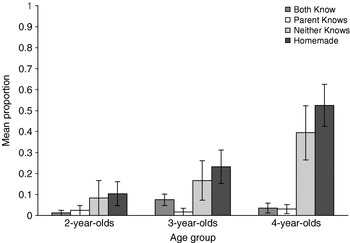
For this analysis, the dependent measure was the proportion of typical nouns parents used with signs of ignorance or uncertainty out of the total number of typical nouns parents provided in each category. A (3) age×(4) category mixed design ANOVA with category as the within-subject factor showed significant main effects of age and category (F(2, 33)=8·59, p=0·001, partial η2=0·34, and F(3, 99)=10·88, p<0·001, partial η2=0·25, respectively). These main effects were qualified by a significant age by category interaction (F(6, 99)=2·60, p<0·05, partial η2=0·14) (see Figure 3). To further investigate the significant interaction, three repeated-measures ANOVAs for each age group were conducted. The follow-up ANOVA for the two-year-olds was not significant (F(3, 33)=0·70, p>0·05, partial η2=0·06), and neither was the ANOVA for the three-year-olds (F(3, 33)=2·13, p>0·05, partial η2=0·16). However, the patterns were similar to the four-year-olds for which the follow-up ANOVA was significant (F(3, 33)=9·35, p<0·001, partial η2=0·46). Post-hoc tests (LSD, p<0·05) showed that parents of the four-year-olds used a greater proportion of typical nouns with expressions of ignorance in the Homemade and Neither Knows categories than in the Both Know and Only Parent Knows categories. These findings suggest that when parents of four-year-olds used typical nouns as labels from the standpoint of ignorance, they explicitly mentioned their ignorance and did so regardless of whether a conventional label was likely to exist.
Mean proportion of typical nouns that received an ignorance or uncertainty code out of the total number of typical nouns that were offered in each category (±1 SE) for two- (n=12), three- (n=12) and four-year-olds (n=12).

Silent and filled pauses
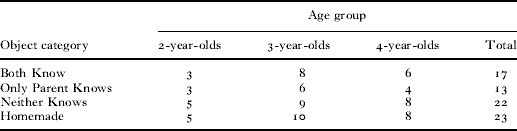
This analysis examined whether parents were more likely to provide silent and filled pauses when talking about objects in the Neither Knows or Homemade categories. Because there were some categories in which parents rarely provided silent or filled pauses, parents were grouped according to whether or not they provided at least one silent or filled pause for each object category (see Table 3). The analysis revealed a significant difference between object categories in the number of parents who provided at least one silent or filled pause and those who did not (Cochran's Q (df=3, N=36)=8·18, p=0·042, V=0·28). Follow-up McNemar tests revealed that significantly fewer parents provided at least one filled or silent pause when talking about objects in the Only Parent Knows category than in the Neither Knows (p=0·035) and Homemade (p=0·031) categories. Thus parents' use of silent and filled pauses showed a similar pattern to their explicit mention of ignorance while labeling.
Number of parents who provided at least one silent or filled pause in each age group and object category
Final analysis: When they do not know, do parents provide unmarked conventional labels?
Thus far, it has been shown that parents use labels differently depending on whether they know an object's conventional name, particularly when they were faced with objects that were likely to have a conventional name. Throughout the analyses, we controlled for trends in the data by using proportion scores as the dependent measures. However, for the final analysis we wanted to get a sense of how often parents used typical nouns when talking about objects they did not know without providing any additional ignorance or uncertainty information. To this end, we calculated the proportion of typical nouns parents used without any signs of ignorance or uncertainty out of the total number of objects in each category for each participant. A (3) age×(4) category mixed ANOVA with category as the within-subject factor showed a significant main effect of category (F(3, 96)=59·99, p<0·001, partial η2=0·65), but no main effect of age (F(2, 32)=2·83, p>0·05, partial η2=0·15), nor an age by category interaction (F(6, 96)=0·56, p>0·05, partial η2=0·03). Post-hoc tests (LSD, p<0·05) showed that parents provided a greater proportion of unmarked typical nouns in the Both Know (M=0·70, SE=0·04) and Only Parent Knows (M=0·41, SE=0·05) categories than in the Neither Knows (M=0·10, SE=0·03) and Homemade (M=0·17, SE=0·03) categories. Clearly, when talking about objects they do not know with their preschool-aged children, parents rarely used unmarked typical nouns as labels.
DISCUSSION
The present study was designed to investigate how parents used labels when talking about objects for which they were either knowledgeable or ignorant of their conventional names during conversations with their preschool-aged children. We were particularly interested in whether parents differed in their use of labels for manufactured objects they did not know versus homemade objects. Although parents were ignorant in both cases, only the manufactured objects might have been viewed as having an established conventional label. Lastly, we investigated whether parents' use of labels varied across children's development.
Our findings revealed that although parents were less likely to use labels when talking about objects they did not know, they did not completely avoid using labels when talking about them. Fortunately, parents rarely used typical nouns as labels from the standpoint of ignorance without marking them in some way. Interestingly, the ways in which parents marked such labels suggests that they are sensitive to their ignorance in general, as well as situations in which a label is likely to violate an already established convention. For example, when parents used labels for objects they did not know they were more likely to use similes and questions than they were when they were using labels for objects they knew. Furthermore, when parents used typical nouns as labels for unknown objects, they marked these cases by explicitly stating their ignorance or uncertainty (e.g. ‘I don't know, maybe it's a drum’). Although the pattern was the same across all age groups, this was particularly the case for parents of the four-year-olds. Parents' speech was more likely to contain paralinguistic cues of uncertainty (e.g. filled and silent pauses) when talking about unknown objects. Interestingly, when parents were using labels that were likely to violate an already established convention, they marked such labels in a number of additional ways. For instance, parents were less likely to use unconventional labels ‘in-action’ during the conversation, repeat the same label multiple times and use typical nouns as labels. Taken together, the findings of this research suggest that, when talking about known and unknown objects during conversations with their preschoolers, parents' speech contains information that children might use to determine when they should or should not assume conventionality.
Parents are sensitive to their ignorance when labeling objects
Overall, parents in the present study used labels from the standpoint of ignorance approximately half of the time they had the opportunity to do so. This labeling rate was significantly less than the rate at which they provided known labels, thereby suggesting some tendency to restrict their labeling when ignorant. Interestingly, when parents were ignorant of an object's name, they used object labels in particular ways. Specifically, parents were more likely to use labels in the form of a simile (e.g. ‘it's like a car’) or question (e.g. ‘Is it a car?’). Both of these ways of using labels have been observed in previous studies of parents' labeling behaviors with young children (e.g. Callanan & Sabbagh, Reference Callanan and Sabbagh2004; Fernald & Morikawa, Reference Fernald and Morikawa1993) and are intriguing for several reasons. From the adult perspective, these would not be considered labeling episodes at all, because the speaker does not explicitly provide – or perhaps even avoids – a category assignment. However, because we know of no research investigating how young children treat these kinds of labels, in the current study they were considered ‘labeling episodes’. If children do treat these as labels, per se, parents' systematic use of these kinds of labels in the cases in which they are ignorant could provide some clues to children that the labels are not likely to be shared by the broader linguistic community.
Parents also marked their ignorance directly through the use of explicit statements (e.g. ‘I don't know’) and paralinguistic information (e.g. filled pauses). Existing evidence suggests that by the time children are three years old, they are sensitive to information about a speaker's ignorance during word learning (e.g. Birch & Bloom, Reference Birch and Bloom2002; Sabbagh & Baldwin, Reference Sabbagh and Baldwin2001; Sabbagh et al., Reference Sabbagh, Wdowiak and Ottaway2003). Thus the present findings provide evidence that the skills that children show for adaptively suspending a conventionality assumption in the laboratory might have critical relevance in everyday scenarios. Unfortunately, less is known about the extent to which children guide their word learning in accordance with paralinguistic information about ignorance. Nonetheless, our finding that parents systematically and appropriately provide information in relevant circumstances may help children to identify these instances as marked cases, and guide their learning accordingly.
Parents' use of labels is sensitive to the possibility of violating an established convention
A key contrast in the present study was between the objects in the Neither Knows and Homemade categories. Parents were ignorant of the label in both cases, but the Neither Knows objects appeared to be more likely to have an established conventional label. Our findings suggest that parents were sensitive to this contrast. Specifically, parents were generally less likely to use object labels when talking about objects in the Neither Knows category. Moreover, when they did use labels for these objects, parents avoided the kinds of labeling practices that typically accompany their use of conventional labels. Specifically, parents avoided using the same label multiple times, using their labels in-action throughout the course of play and using typical adult forms as labels.
Although only some of these aspects of parents' labeling have been shown in previous studies examining how parents label familiar objects during conversations with their young children (e.g. Callanan & Sabbagh, Reference Callanan and Sabbagh2004; Fernald & Morikawa, Reference Fernald and Morikawa1993), each of these uses of object labels seem to be related to establishing the conventionality of a particular label. For instance, using a particular label multiple times might serve to clearly establish that the label is the usual way of referring to the object, just as using the label casually in the course of play might. Thus these indirect labeling episodes might provide children with evidence that a label is likely to be conventional; without that evidence (as in the case of the objects in the Neither Knows category) children might be more reluctant to assume conventionality. Additionally, the use of an atypical label, as opposed to a typical adult form, might be further evidence that a particular term is not conventional. Accordingly, parents' tendency to avoid using a typical conventional noun as a label might guide children to adaptively suspend an assumption of conventionality in much the same way we suggested that talk about ignorance might. That is, children might avoid learning a new word–referent link when the new word is a place holder term or an onomatopoeic label. Taken together, these findings suggest that parents' use of labels might guide children's use of the conventionality assumption by providing clues to when it both should and should not be deployed.
More generally, the differences in parents' use of labels for the Neither Knows and Homemade objects suggests that parents may be especially motivated to avoid teaching their children labels that may differ from already established conventional labels. Of course, this is somewhat speculative because there is no work directly demonstrating that adults believe that homemade objects are less likely to have conventional names than manufactured objects like those in our Neither Knows category. Nonetheless, the observed differences seem to support this speculation – that is, the differences we observed were exactly those that we expected to be related to conventionality, and not other dimensions of labeling. These findings provide confidence for our conclusion that parents, in addition to being sensitive to their ignorance when using labels, are especially sensitive to the instances in which they might teach their children ‘incorrect’ labels.
Parents' labeling patterns did not vary much with their children's age
With respect to our second goal, we found that, in general, the labeling practices described above were deployed similarly for children across the age ranges. That is, two-year-olds seemed to be getting quantitatively and qualitatively similar information to that of the four-year-olds. These findings are noteworthy insofar as the prior work investigating children's abilities to suspend the conventionality assumption in the case of new word meanings that might not be conventional has focused on children no younger than three years old (e.g. Sabbagh & Baldwin, Reference Sabbagh and Baldwin2001; Koenig et al., Reference Koenig, Clément and Harris2004). These findings provide the impetus for examining whether younger children are sensitive to the kinds of information provided by parents in this study that might guide children's use of the conventionality assumption during word learning.
However, we do not wish to conclude on the basis of these null effects that parents' labeling practices related to conventionality are insensitive to age. For one, it is possible that our small sample size, and thus low statistical power, affected our ability to detect relevant age differences. Second, developmental changes might be occurring outside of the age groups that we tested (i.e. prior to age two or after age four). Future research could examine whether parents of younger children provide similar kinds of information when they are using object labels that are unlikely to be conventional.
Nonetheless, there were two ways in which parents' use of object labels with respect to conventionality varied across children's age. Specifically, parents of four-year-olds were more likely to use labels in the form of similes and explicitly state their ignorance when using unconventional object labels than were parents of two- and three-year-olds. However, the results in both cases were similar across age groups. With respect to stating their ignorance, the findings are generally consistent with the notion that parents are sensitive to their children's social and cognitive abilities and adjust their speech accordingly (e.g. Bruner, Reference Bruner1983; Ninio, Reference Ninio1983; Ninio & Bruner, Reference Ninio and Bruner1978; Masur, Reference Masur1997). However, research has shown that children as young as three years old do not learn new words from speakers who express their ignorance at the time of labeling (e.g. Sabbagh & Baldwin, Reference Sabbagh and Baldwin2001). Thus parents might be conservative in their assessment of their children's facility with the concept of ignorance. The reasons why parents might underestimate their children's facility with concepts of ignorance are unclear, but some hint comes from research showing that three-year-olds talk about their own mental states far less often than do four-year-olds (Sabbagh & Callanan, Reference Sabbagh and Callanan1998). Thus it is possible that parents of three-year-olds might not have enough opportunities in their everyday interactions with their children to realize that their children might be able to understand their statements of ignorance.
Broader implications and future directions
Taken together, our findings suggest that children's linguistic environment contains information that might help them determine when they should or should not assume conventionality. Although there is some experimental evidence suggesting that children capitalize on the kinds of information parents provide (e.g. statements of ignorance), in other cases there is not (e.g. paralinguistic cues about ignorance). Thus additional research needs to be conducted to determine how effective parents' use of object labels might be in guiding children's selective application of the conventionality assumption.
The findings of this study also provide insight into the experiential foundations of the conventionality assumption itself. Parents used labels in different ways depending on whether their labels were or were not likely to be conventional. By marking the cases in which labels are unlikely to be conventional, parents might fuel the development of an expectation that unmarked cases are likely to be conventional. This proposal is similar to other researchers who propose that the distinction between marked and unmarked labeling episodes might support children's developing assumptions about how words are typically used, and the inferences that can be made based upon those starting assumptions (e.g. Callanan, Reference Callanan1985; Callanan & Sabbagh, Reference Callanan and Sabbagh2004; Cleave & Bird, Reference Cleave and Bird2006; Hall, Burns & Pawluski, Reference Hall, Burns and Pawluski2003; Ninio, Reference Ninio1983; Ninio & Bruner, Reference Ninio and Bruner1978). To examine the range of situations in which parents mark special instances, future work might be aimed at expanding our understanding of parents' motivation to provide conventional labels beyond situations that are defined by parents' knowledge or ignorance. For instance, specialized technical terms for objects might be known to some parents but are unlikely to be shared by the wider linguistic community, where a more basic term is used. Similarly, parents might know the names of objects that are prominent in other cultures, but not their own. Investigating whether parents modify their use of labels in these circumstances will offer further insight into parents' motivation to provide children primarily with the names for objects that will be shared by the other members of their child's linguistic community.
Lastly, it is important to note that the parents in our study were primarily middle class and all had previously expressed an interest in participating in studies investigating children's development. Given the large body of evidence documenting both qualitative and quantitative differences in the labeling behaviors of parents from different socioeconomic backgrounds (e.g. Hart & Risley, Reference Hart and Risley1995; Hoff, Reference Hoff2003; Hoff-Ginsberg, Reference Hoff-Ginsberg1991; Pan, Rowe, Singer & Snow, Reference Pan, Rowe, Singer and Snow2005), the extent to which these findings might generalize to the greater population remains unclear. Considering this, future work could be aimed at investigating whether the conventional nature of object labels plays a role in how parents from varying socioeconomic and cultural backgrounds use object labels in conversations with their children.
CONCLUSIONS
The present study is the first demonstration to date to reveal that parents use labels when talking about unfamiliar objects differently than they do familiar objects during conversations with their children. Overall, parents rarely used object labels that are unlikely to be conventional during conversations with their children without marking the label in some way or another. These findings suggest that children receive information in their everyday experiences that can provide guidance as to how a conventionality assumption should be most adaptively deployed. More generally, the findings suggest that children encounter information in their everyday word learning contexts that complements the cognitive tools that they use to learn new word meanings that will be useful for communicating with the members of their own linguistic community.