Introduction
Heavy rainfall events are very likely and tropical cyclones more likely than not to continue to increase throughout the 21st century with low-lying estuary deltas inundated more frequently (IPCC, Reference Stocker, Qin, Plattner, Tignor, Allen, Boschung, Nauels, Xia, Bex and Midgley2013). The resilience of seed quality in rice (Oryza sativa L.) to flooding is therefore of growing concern. Flooding of rice crops in the reproductive phase may result in visible damage to seed from pre-harvest sprouting, but might it also affect the post-harvest air-dry survival of the remaining intact (i.e. non-sprouted) seeds?
Flooding reduces rice yield by 10‒100% depending upon variety, growth stage, plant nutrition, crop practices, duration of submergence, and flood water conditions (Yoshida, Reference Yoshida1981; Reddy et al., Reference Reddy, Ghosh and Panda1985; Ram et al., Reference Ram, Singh, Singh, Singh, Singh, Setter, Singh and Singh1999; Sharma and Ghosh, Reference Sharma and Ghosh1999; Kotera et al., Reference Kotera, Nawata, Thao, Vuong and Sakuratani2005; Kotera and Nawata, Reference Kotera and Nawata2007; Das et al., Reference Das, Panda, Sarkar, Reddy and Ismail2009; Dar et al., Reference Dar, Janvry, Emerick, Raitzer and Sadoulet2013). Submergence early in the vegetative stage reduces crop establishment and numbers of tillers and panicles, panicle size, and indeed plant survival after flood waters recede (Devender-Reddy and Mittra, Reference Devender-Reddy and Mittra1985; Reddy et al., Reference Reddy, Ghosh and Panda1985; Sharma and Ghosh, Reference Sharma and Ghosh1999; Das et al., Reference Das, Panda, Sarkar, Reddy and Ismail2009; Singh et al., Reference Singh, Mackill and Ismail2009; Singh et al., Reference Singh, Mackill and Ismail2011). Flooding during the reproductive stage also damages yield, with pollen cell development, panicle formation or emergence, and progress to flowering impaired (Devender-Reddy and Mittra, Reference Devender-Reddy and Mittra1985; Reddy et al., Reference Reddy, Ghosh and Panda1985; Kotera et al., Reference Kotera, Nawata, Thao, Vuong and Sakuratani2005). Submergence shortly after panicle emergence may reduce seed set (Devender-Reddy and Mittra, Reference Devender-Reddy and Mittra1985; Kotera and Nawata, Reference Kotera and Nawata2007), whilst flooding during grain development disrupts yield accumulation (Kotera et al., Reference Kotera, Nawata, Thao, Vuong and Sakuratani2005). Finally, towards the end of seed development and maturation, pre-harvest sprouting due to flooding or heavy rainfall is a major factor worldwide affecting both yield and quality in cereal crops generally (Gelin et al., Reference Gelin, Elias and Kianian2006), particularly in rice. Pre-harvest sprouting of mature rice seeds coincides with wet and warm field conditions and leads to discoloured, cracked, lighter grains with poor cooking quality (Derera, Reference Derera and Derera1989; Mahbub et al., Reference Mahbub, Rahman, Khanam and Gomosta2005).
Seed quality (ability to germinate, desiccation tolerance, and air-dry seed storage longevity) in rice improves considerably during seed filling and maturation (Ellis et al., Reference Ellis, Hong and Jackson1993; Ellis and Hong, Reference Ellis and Hong1994; Ellis, Reference Ellis2011). The development of seed quality in rice can be limited in seed production environments subject to extreme temperature (Ellis et al., Reference Ellis, Hong and Jackson1993; Ellis and Hong, Reference Ellis and Hong1994; Rao and Jackson, Reference Rao and Jackson1996; Martínez-Eixarch and Ellis, Reference Martínez-Eixarch and Ellis2015). The effect of submergence in water during seed development and maturation on subsequent rice seed quality has been studied less than that of temperature. In some circumstances, certain aspects of seed quality may be improved by the temporary hydration of mature seeds ex planta, often known as priming (Heydecker et al., Reference Heydecker, Higgins and Gulliver1973; Heydecker and Gibbins, Reference Heydecker and Gibbins1978). Recent research in wheat (Triticum aestivum L.) showed that, in the absence of pre-harvest sprouting, the reduction in subsequent air-dry seed storage longevity caused by rainfall could be reversed if it was followed by desiccation in planta (Ellis and Yadav, Reference Ellis and Yadav2016; Yadav and Ellis, Reference Yadav and Ellis2016).
Seed dormancy declines as seeds mature with pre-harvest sprouting in many cereals under moist field conditions if dormancy is lost before seed is harvested (Bewley and Black, Reference Bewley and Black1994). Considerable differences in rice seed dormancy at maturity have been shown amongst different genotypes produced in the same field environment (Roberts, Reference Roberts1963). Japonica rice is more sensitive to seed production environment than indica (Chang, Reference Chang1991; Ellis et al., Reference Ellis, Hong and Jackson1993).
The Submergence1 (Sub1) gene has been introgressed into selected indica rice genotypes to improve submergence tolerance (Septiningsih et al., Reference Septiningsih, Pamplona, Sanchez, Neeraja, Vergara, Heuer, Ismail and Mackill2009; Wassmann et al., Reference Wassmann, Jagadish, Heuer, Ismail, Redona, Serraj, Singh, Howell, Pathak, Sumfleth and Donald2009). The introgression line IR64-Sub1 has the Sub1-A-1 allele conferring tolerance of complete submergence for about 2 weeks whereas cv. IR64 carries the intolerant Sub1-A-2 allele (Singh et al., Reference Singh, Dang, Vergara, Pandey, Sanchez, Neeraja, Septiningsih, Mendioro, Tecson-Mendoza, Ismail, Mackill and Heuer2010). Septiningsih et al. (Reference Septiningsih, Pamplona, Sanchez, Neeraja, Vergara, Heuer, Ismail and Mackill2009) reported that IR64-Sub1 endured submergence in the vegetative phase for up to 17 days and has inherited the grain quality of its recurrent parent cv. IR64. Such studies have been limited to submergence during vegetative growth (Septiningsih et al., Reference Septiningsih, Pamplona, Sanchez, Neeraja, Vergara, Heuer, Ismail and Mackill2009; Mackill et al., Reference Mackill, Ismail, Pamplona, Sanchez, Carandang and Septiningsih2010; Singh et al., Reference Singh, Mackill and Ismail2011); the resilience of seed quality in IR64-Sub1, relative to IR64, to plant submergence after anthesis has not been reported.
We tested the null hypotheses that flooding rice plants during seed development and maturation does not promote pre-harvest sprouting nor reduce seed dry weight, ability to germinate at harvest maturity, or subsequent longevity in air-dry storage. The latter was our principle objective, with the former variables determined to indicate the relative severity of treatments and vulnerability of plants. Flooding was simulated by submerging rice plants in water for different durations at different stages of seed development and maturation. Contrasting genotypes of indica and japonica rice were selected for study. Indica rices are the more likely to be flooded in cultivation. On the other hand, seed quality in japonica rices tends to be less resilient to environment whilst some (including cv. Gleva used here) are grown in coastal areas vulnerable to flooding from future sea level rise. Hence both types were selected in order to test the hypotheses rigorously with contrasting genotypes, particularly whether or not flooding affected the post-harvest longevity of non-sprouted seeds.
Materials and methods
Two experiments were conducted in successive years. The first, sown on 25 May 2012, consisted of plants of the japonica rice cv. Gleva submerged for two durations (3 and 5 days) at four different stages of seed development and maturation after anthesis (9, 30, 35 and 40 DAA) and a control (not submerged). The second, sown on 9 May 2013, consisted of plants of three genotypes (Gleva plus the indica rices IR64 and IR64-Sub1) submerged for 4 days, and so within the 2-week period that the Sub1 locus confers submergence tolerance (Singh et al., Reference Singh, Dang, Vergara, Pandey, Sanchez, Neeraja, Septiningsih, Mendioro, Tecson-Mendoza, Ismail, Mackill and Heuer2010), at four different developmental stages (10, 30 and 40 DAA) and controls. Durations from sowing to flowering are affected by photoperiod and temperature with rice genotypes varying in sensitivity (Summerfield et al., Reference Summerfield, Collinson, Ellis, Roberts and Penning de Vries1992). The quantitative phenological sensitivity of these three genotypes to photothermal environment was not known. Thus flowering could not be synchronized by adjusting sowing dates and so treatments were provided in relation to anthesis, not sowing date.
The plants were grown in pots in blocks (three in 2012, two in 2013) in a temperature and photoperiod controlled heated and vented glasshouse (6.4 × 8.6 m) with four adjoining dark compartments (each 3.5 × 2.1 × 2.1 m) at the Plant Environment Laboratory, Shinfield, UK (51°27’ N latitude, 00°56’ W longitude). The growing media consisted of steam-sterilized coarse sand, crushed gravel, peat compost and vermiculite in the ratio 2:4:1:4. Slow-release fertilizer (Osmocote Pro 3-4M, Everris International BV, The Netherlands) containing N:P2O5:K2O:MgO (17:11:10:2) was added at 3 kg m‒3. The 18 cm diameter (3 litre) plastic pots (with drain holes) filled with the media were pre-soaked with tap water and left to drain overnight. Seven seeds were sown per pot. These pots were placed on trolleys (four, each 2.8 × 1.1 m with 75 pots) in the dark compartments at a constant temperature of 25°C, initially. Temperatures were maintained at 28/20°C day/night (11 h/13 h) with synchronous thermoperiod and photoperiod (11 h day‒1) from seedling emergence onwards (7 or 10 days after sowing (DAS) in 2012 and 2013, respectively): the plants on trolleys were moved from the dark compartments into the adjoining glasshouse at 08.00 h and back at 19.00 h each day. Seedlings were thinned to four per pot at the four-leaf stage (16‒30 DAS, depending on cultivar). Pots were irrigated by hand with tap water until 14 DAS. Automatic drip feed irrigation (six times each day) was provided thereafter. The top of pots was 2 cm above the growing media and irrigation filled this gap on each occasion. The nutrient solution, derived from Yoshida et al. (Reference Yoshida, Forno, Cock and Gomez1976), contained 100 mg l‒1 inorganic nitrogen and was acidified to pH 5.0 ± 0.2. Savona (Koppert B.V., The Netherlands), an insecticidal soap containing 50% fatty acid from potassium salt, was used occasionally to control spider mites and aphids when detected.
Submergence, to simulate flooding, was carried out within a wooden tank (2.4 × 1.2 × 1.1 m) lined with black polythene in the same glasshouse, with air temperature maintained at 28°C and natural light (i.e. ambient photoperiod for the duration of submergence). The tank was filled with new tap water before each submergence treatment to avoid contamination. Water was circulated by a 180 W pump (RG25, Stuart-Turner, UK) and aerated with four 50-mm diameter, 14 W air-stones (Aqua One 12000, Precision Manufactured, Australia) at each corner throughout to avoid anoxia. Water temperature was associated with glasshouse air temperature, but not controlled directly, and during submergence plants differed slightly in temperature from those not submerged. All plants within a pot were staked to prevent lodging. Steam-sterilized gravel was added on top of the growing media to avoid the latter being dislodged during submergence. Submerged panicles were covered by water up to 80‒95 cm deep controlled to 2 cm above the highest panicle. After submergence, plants were returned to their previous position on the trolley in the glasshouse and irrigation resumed.
Irrigation ended 2 days before seed harvest. Seeds were collected at harvest maturity (panicles yellow, grains firm). This was 47 DAA in 2012 and 46 DAA in 2013. Harvest date varied amongst genotypes in 2013 because of differences in flowering date. Empty seed were discarded and filled seed threshed from panicles by hand. Blocking was maintained throughout plant growth, submergence, harvest, and subsequent laboratory investigations.
Seed samples were air dried in the laboratory at 22 ± 2°C and changes in seed equilibrium relative humidity monitored (Humidat IC1, Novasina, Switzerland, in 2012; Aqualab, 3TE, Decagon Devices, Inc. Pullman, USA, in 2013). This regime was selected to provide a comparatively benign drying environment for seed quality (FAO/IPGRI, 1994). In hindsight, it avoided possible improvements that may occur in selected high-temperature regimes (Whitehouse et al., Reference Whitehouse, Hay and Ellis2015, Reference Whitehouse, Hay and Ellis2017). The seeds dried to 11‒12% moisture content over 14 days in 2012. In 2013 the seeds were wetter at harvest than in 2012 and more variable (because there were three cultivars). Most of these samples dried to 12‒14% moisture content over 14 days, but this period was extended to 20 days where necessary to dry to this value. Sprouted seeds (enlargement of micropyle, or emergence of radicle and/or shoot) were identified, separated, counted and maintained as discrete sprouted seed samples. Subsamples were then drawn for the immediate tests. The remaining seeds were sealed in laminated aluminium foil bags (Retort laminate, Moore and Buckle Ltd, St Helens, UK) and stored at 2‒4°C until experimental seed storage began.
The moisture content of mature seed was determined on two replicates of 2.5‒3.0 g by the high constant temperature oven method (ISTA, 2013) with ground seed (Laboratory Mill 3303, Perten Instruments Ab, Stockholm, Sweden) and calculated on the fresh weight basis. The two-stage procedure with pre-drying (ISTA, 2013) was used for less mature seeds harvested during seed development: one panicle from each block was selected with loss in moisture on pre-drying overnight at 30 ± 2°C determined as the first stage, the pre-dried samples ground, and the second-stage loss determined by the high constant temperature oven method.
Thousand seed weight was determined by counting 800 seeds at random (ISTA, 2013) from samples of known moisture content and weighing using a balance to 0.1 mg (Mettler Toledo, AE160, Greifensee, Switzerland).
The ability of (non-sprouted) seeds to germinate after harvest was estimated with two replicates of 50‒70 seeds each between rolled paper towels (Kimberley Clark Professional 6803 HOSTESS, Natural, 24 × 35 cm, Greenham Sales, UK) moistened with deionized water, in an alternating temperature regime of 34/11°C (16 h/8 h) for 21 days, as recommended to break dormancy in rice (Ellis et al., Reference Ellis, Hong and Roberts1983). The criterion of germination was normal seedling development (ISTA, 2013). In 2012, samples of dried, sprouted seeds (11‒12% moisture content) were also tested to assess their capability to germinate upon dehydration and reimbibition, with four replicates and a total of 200‒280 seeds per sample.
Samples were stored in order to determine the effects of submergence on the longevity of non-sprouted seeds. The moisture content of samples was first determined and then adjusted to about 15% by humidification above water or by drying over silica gel at 20°C (depending upon whether increase or reduction in moisture content was required). Seeds were left within sealed containers at 2‒3°C for 2‒3 weeks for moisture to equilibrate. Seed equilibrium relative humidity was then determined at 20°C to estimate moisture content, and moisture content further adjusted towards 15%. The moisture content of each seed sample was then determined by the high constant temperature oven method.
After moisture equilibration, 10‒15 sub-samples of seed (150‒200 seeds each) from each seed sample were sealed within laminated aluminium foil bags (Moore and Buckle Ltd, St Helens, UK), stored hermetically in a heated incubator at 40 ± 0.5°C with 15.1 ± 0.2% (2012) or 14.7 ± 0.2% (2013) moisture content, sub-samples withdrawn at different periods of storage, and tested for ability to germinate (three replicates of 50‒70 seeds). Seed survival curves (criterion, ability to produce normal seedlings) were fitted to the observations by probit analysis in accordance with the equation:
 $$v = K_{\rm i} - p/\sigma, $$
where v is probit percentage viability after period p (days) in storage in a constant environment, K i is the seed lot constant, and σ (days) is the standard deviation of the frequency distribution of seed deaths in time (Ellis and Roberts, Reference Ellis and Roberts1980). The product of K i and σ is the period of storage (days) for viability to decline to 50% (p 50). This derived parameter was also selected to compare seed survival curves.
The progress of seed development and maturation was also compared amongst the genotypes Gleva, IR64 and IR64-Sub1 in 2013. Destructive serial harvests (one panicle taken at random from each of six non-submerged pots, threshed separately) were taken every 3‒5 days from 8 DAA until harvest maturity at 47 DAA. Seeds were threshed from these panicle samples and mean seed weight and moisture content determined. In addition, for Gleva and IR64 only, the development of the ability of freshly harvested seeds to germinate normally was determined. These germination tests comprised smaller samples of 24‒70 full seeds (i.e. unfilled seeds were not tested). Seed covering structures were removed from seeds that remained firm after 21 days in test and the test extended to 28 days to promote loss in dormancy.
Analysis of variance, restricted maximum likelihood analysis, regression analysis, and probit analysis were applied to investigate the results using Genstat (13th edition, VSN International Ltd, Hemel Hempstead, UK). Multiple comparisons of means for pre-harvest sprouting were performed using Tukey's test.
Results
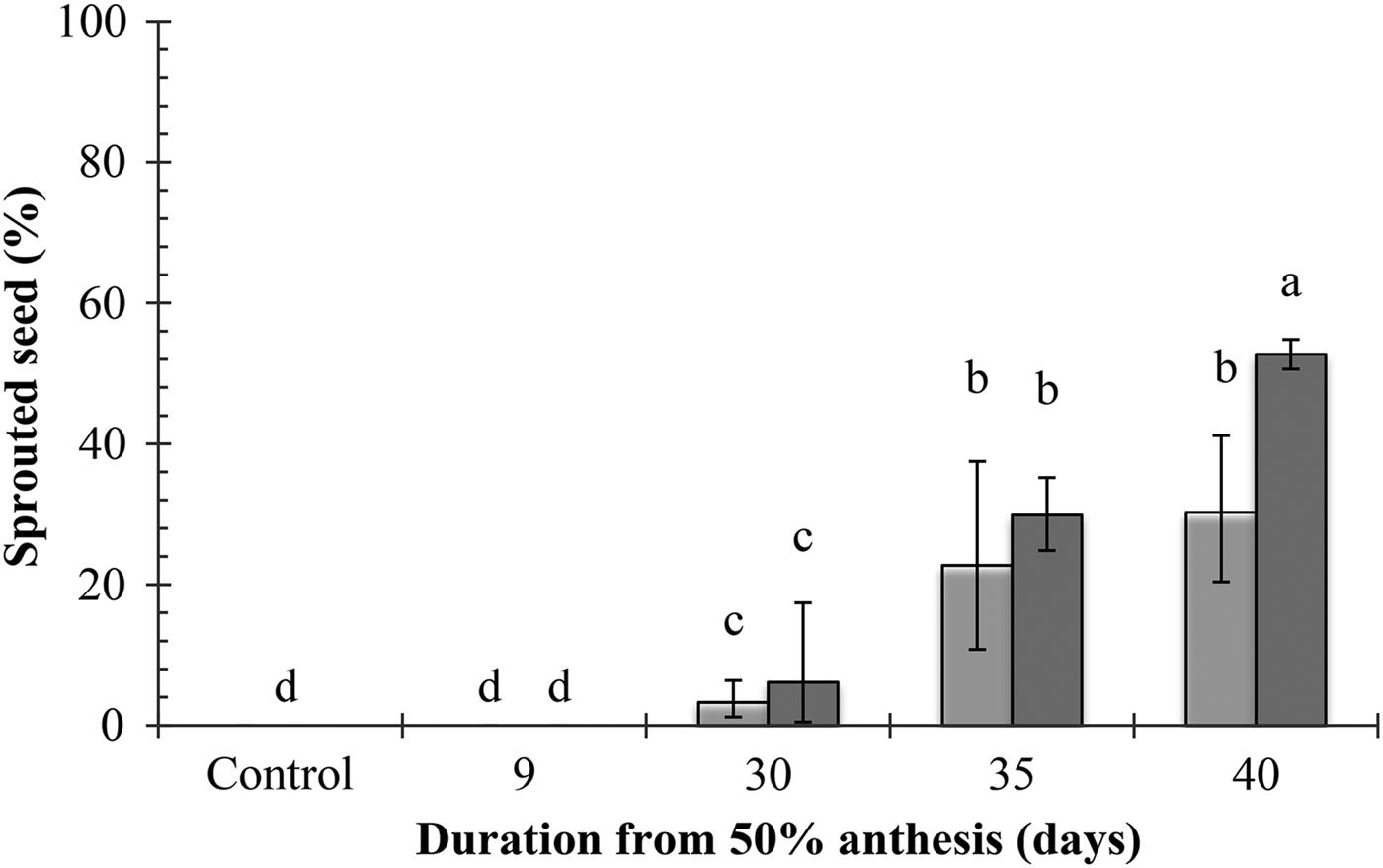
Submergence resulted in considerable pre-harvest sprouting of seeds of Gleva produced in 2012 (Fig. 1). Pre-harvest sprouting was affected by duration (P < 0.001), plant developmental stage at submergence (P < 0.001), and their interaction (P < 0.05). It was greatest following 5 days submergence 40 DAA and lower the earlier and briefer the submergence treatment, with no pre-harvest sprouting following submergence at 9 DAA.
Pre-harvest sprouting (vertical bars represent ± SE) in response to 3 days ( ) or 5 days (■) submergence of plants of japonica rice cv. Gleva in water at different stages of development (Control = no submergence). Pre-harvest sprouting was assessed in samples harvested 47 DAA (harvest maturity) and first dried to 11–12% moisture content. Columns with a different letter indicate a significant difference (P < 0.05) using Tukey's multiple range test.

The moisture content of non-sprouted seeds at 47 DAA (harvest maturity) varied only between 17.9 and 21.7%. This was significant (P < 0.05), with the control providing the wettest and 5 days submergence at 40 DAA the driest seeds.
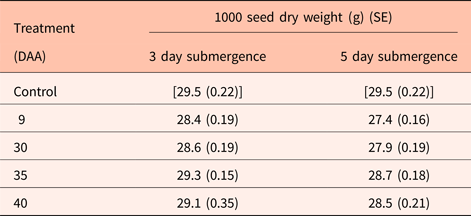
Variation in thousand seed dry weight of non-sprouted seeds at harvest maturity was limited (Table 1) but significant (P < 0.001). All submerged plants provided seeds lighter than the control; 9 DAA were the lightest, and 5 days submergence provided consistently lighter seeds than 3 days submergence.
Thousand seed dry weight (0% moisture content) of non-sprouted rice cv. Gleva at harvest maturity (47 DAA) after submergence for 0 (control, repeated in both columns), 3 or 5 days at different seed developmental stages

The germination of freshly harvested non-sprouted seed (data not shown) did not differ (P > 0.05) from that of dried-non-sprouted seeds. There was a tendency, however, for the fresh seeds to germinate more slowly than those dried before the test. This difference appeared to be accentuated with longer or later submergence.
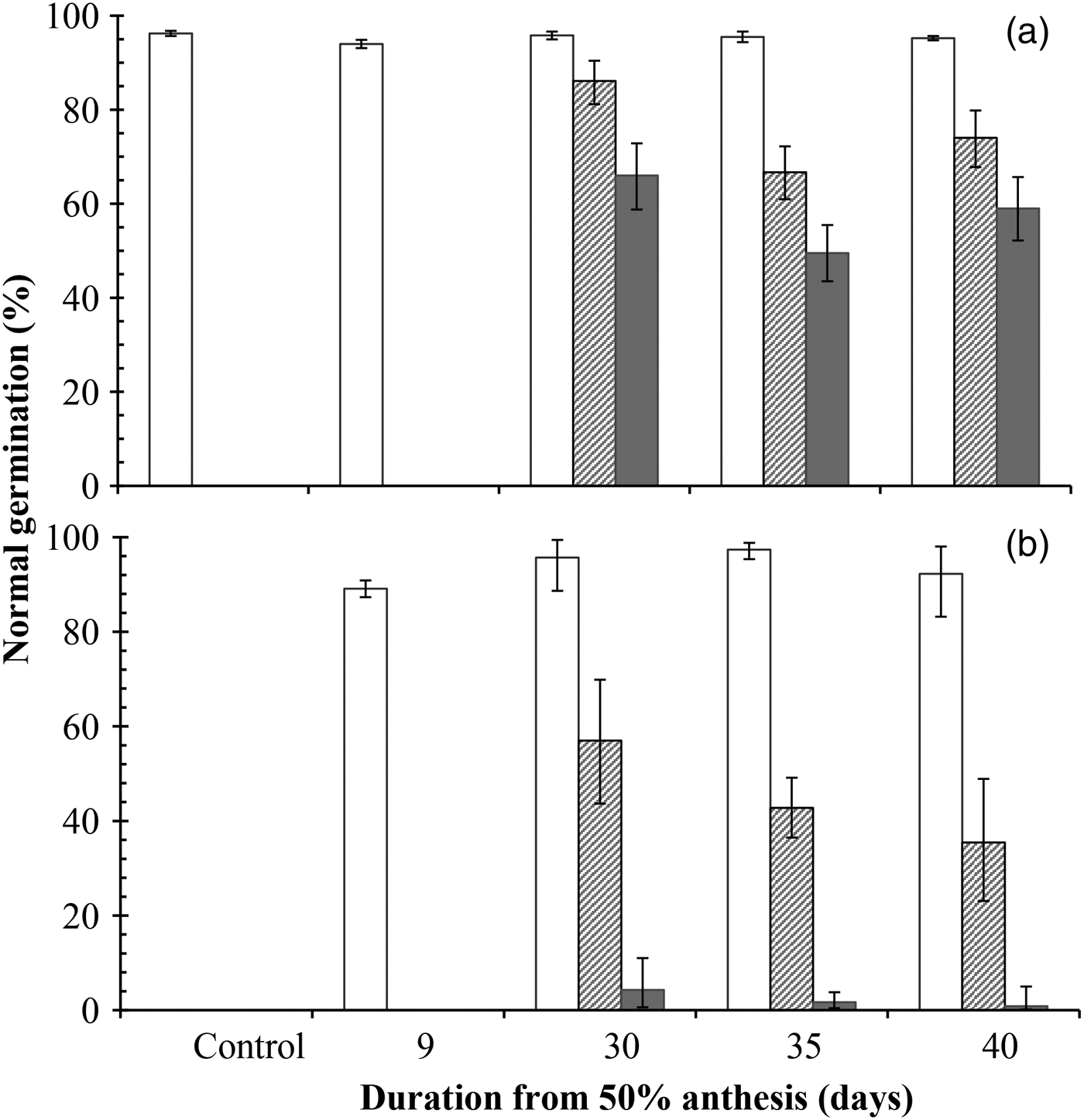
Non-sprouted seeds achieved 89 to 97% normal germination in tests after desiccation to 15.1 ± 0.2% moisture content and rehydration (Fig. 2). The two lowest values were following 5 days submergence at 9 or 40 DAA, but differences amongst treatments were not significant (P > 0.05).
Ability of dried seeds, harvested 47 DAA, of cv. Gleva to germinate (non-sprouted seeds, □) or re-germinate (pre-harvest sprouted seeds, ■) normally (vertical bars represent ± SE) after previous submergence of plants in water for 3 days (a) or 5 days (b) at 9, 30, 35 or 40 DAA (Control = no submergence; combined population of pre-harvest sprouted or not seeds,  ).

Dried, pre-harvest sprouted seeds showed reduced ability to germinate (Fig. 2). The reduction was greater the longer and later submergence occurred (P < 0.001). About half of the pre-harvest sprouted seeds were able to germinate normally with 3 days submergence at 30‒40 DAA following desiccation and rehydration (49‒66%, Fig. 2a), but few (<5%, Fig. 2b) of those submerged for 5 days. Close examination indicated that the least pre-harvest sprouted seeds (only the micropyle open at harvest) were more likely to germinate normally subsequently than those with radicle already emerged. Seeds with root and shoot already emerged were rarely able to germinate normally.
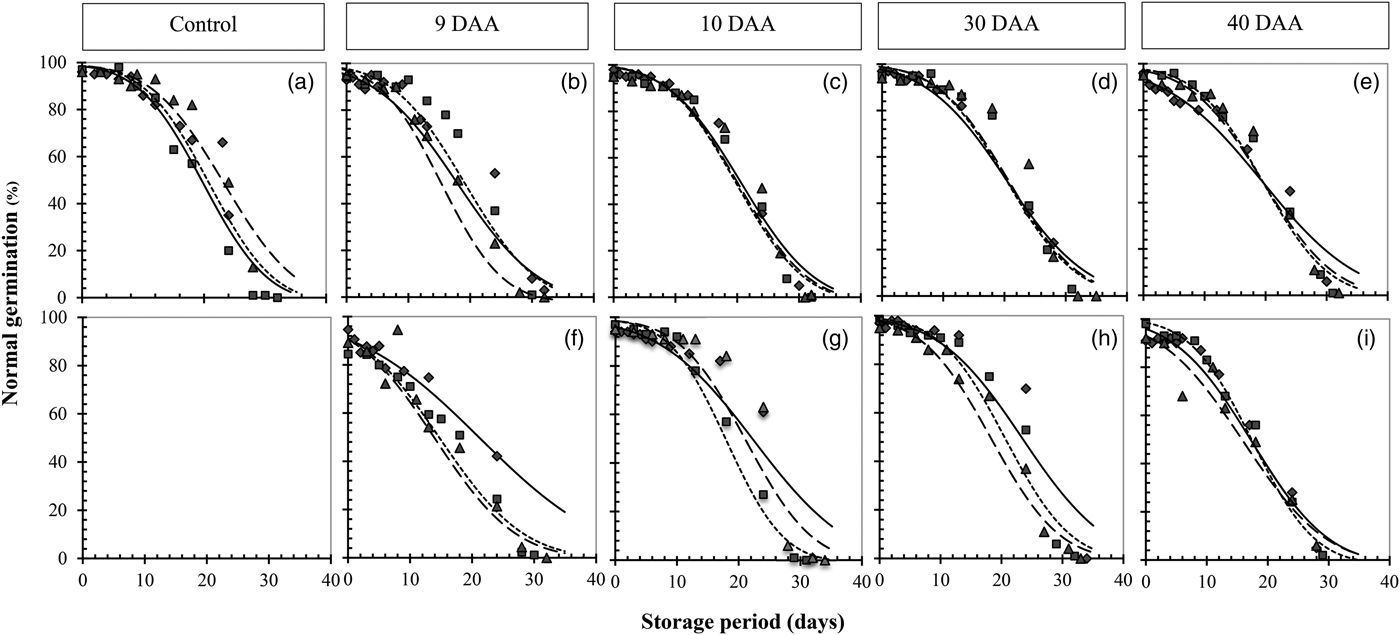
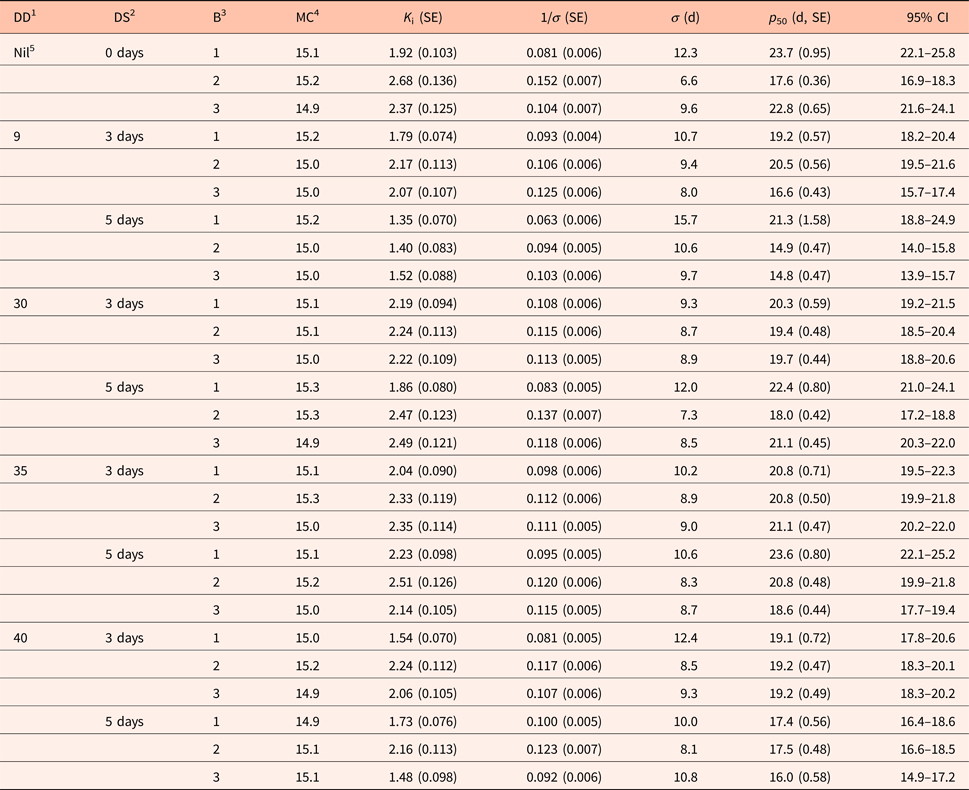
Seeds lost viability during hermetic storage at 40°C with 14.9‒15.3% moisture content with high ability to germinate initially declining in a negative sigmoid to zero (or almost) after 32 days (Fig. 3). The differences in these sigmoidal patterns of seed survival amongst blocks within a treatment or amongst treatments generally appeared small. The 27 different fitted curves are shown in Fig. 3, however, as they could not be constrained to a common curve, common slope, or common origin (P < 0.001). The survival curves for 5 days submergence at 9 DAA provided the lowest estimates of K i (Table 2), and so the lowest initial viability and the least ‘shoulder’ before loss in viability was detected (Fig. 3f), whilst K i was greatest in the control. The observations for ability to germinate were close to zero in all 27 seed lots for the longest durations of storage. They were below the fitted values provided by the negative cumulative normal distributions in each case.
Seed storage survival (% normal germination plotted against period in hermetic storage at 40°C with 15.1 ± 0.2% moisture content) of non-sprouted seeds of japonica rice cv. Gleva harvested at 47 DAA (harvest maturity) from plants not submerged (Control, a), or submerged in water for 3 days (b–e) at 9 (b), 30 (c), 35 (d), or 40 DAA (e), or for 5 days (f–i) at 9 (f), 30 (g), 35 (h), or 40 DAA. Observations are shown for seed lots from each block (1, ♦; 2, ■; 3, ▲) together with the fitted negative cumulative normal distributions (1,  ; 2,
 ; 3,
 ). The latter are quantified in Table 2.

Seed longevity (parameters of seed viability equation, fitted by probit analysis) of japonica rice cv. Gleva, harvested at 47 DAA (harvest maturity) in 2012 after submergence in water for 0 (control), 3 or 5 days at 9–40 DAA, in hermetic storage at 40°C with moisture contents shown. The 95% cofidence intervals (CI) are shown for p 50

1DD, duration of development until submergence (DAA); 2DS, duration of submergence (days); 3B, block; 4MC, moisture content of storage (%); 5control treatment (plants not submerged).
Paired F-tests were used to clarify any differences in p 50 resulting from the main treatment factors. Duration of submergence had no detectable effect on p 50 (P > 0.25), whereas developmental stage did (P < 0.05), with p 50 shortest following submergence at 9 or 40 DAA and greatest in the control or submergence at 30 or 35 DAA.
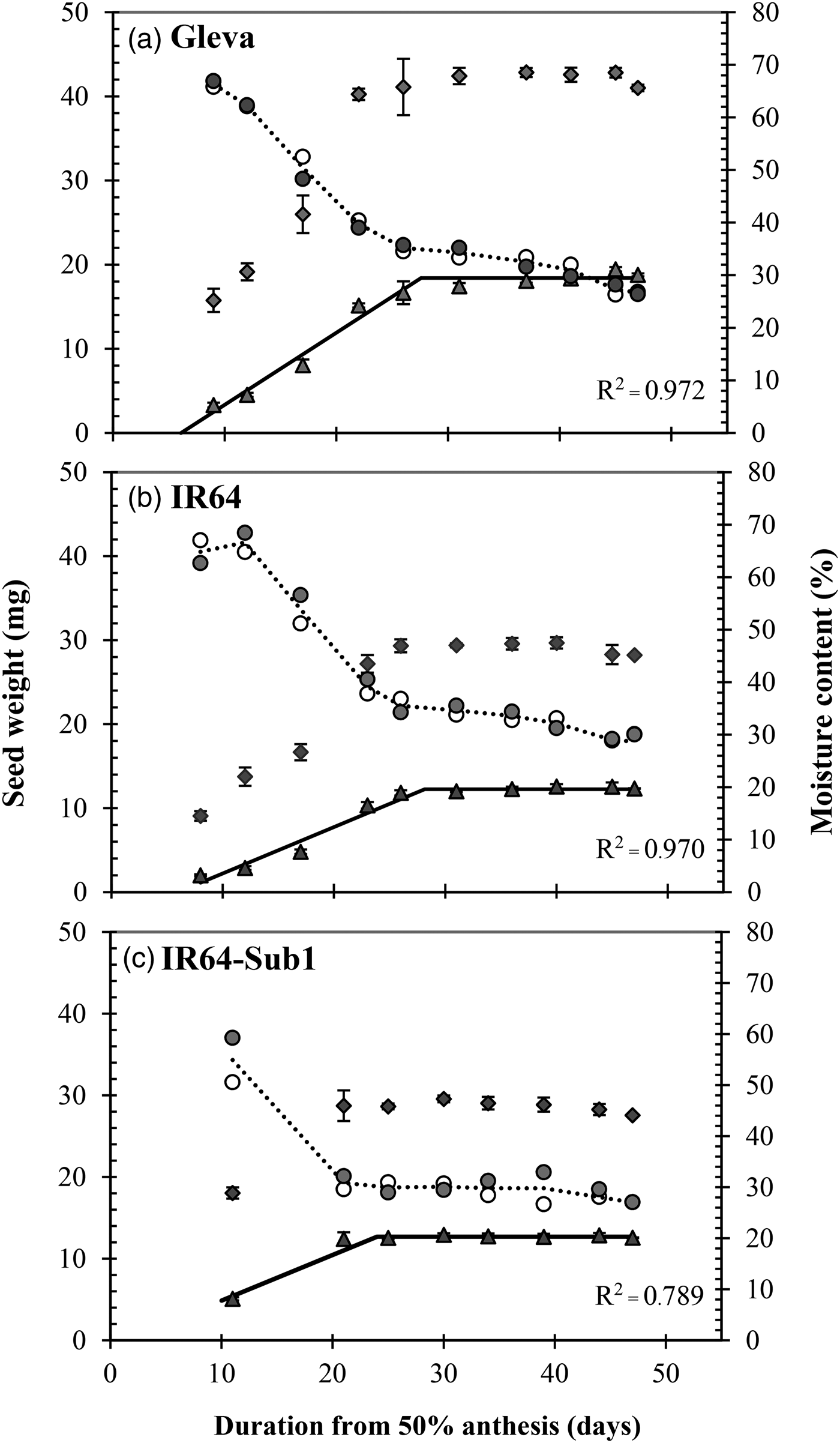
Flowering date differed amongst the three genotypes in 2013, with 50% anthesis earlier in Gleva (73 DAS) than IR64 (87 DAS) and IR64-Sub1 the latest (93 DAS). Accordingly, dates (but not durations from anthesis) of submergence and also harvest maturity varied amongst genotypes. When compared from anthesis onwards, the temporal changes in seed weight and moisture content were broadly similar amongst genotypes (Fig. 4). Final mean seed dry weight in Gleva (29.5 mg, SE 0.34) was much greater than the similar values recorded for IR64 (19.6 mg, SE 0.26) and IR64-Sub1 (20.3 mg, SE 0.31). Seed moisture contents at harvest maturity were similar amongst all three at 26.7 (Gleva), 28.2 (IR64), and 27.6% (IR64-Sub1).
Fresh (♦) and dry (▲) weight (mean ± SE) and moisture content (Block 1, ●; Block 2, ○) of seeds from control (non-submerged) plants of japonica rice cv. Gleva (a), and the indica rices IR64 (b) and IR64-Sub1 (c) grown at 28/20°C (11 h/13 h). The intersect of the continuous lines represents the end of grain filling [mass maturity, i.e. 27.6 (SE 1.17), 27.5 (SE 1.21), or 24.0 (SE 3.10) DAA in a, b, c respectively]; R 2 values shown are for these interrupted regression lines.

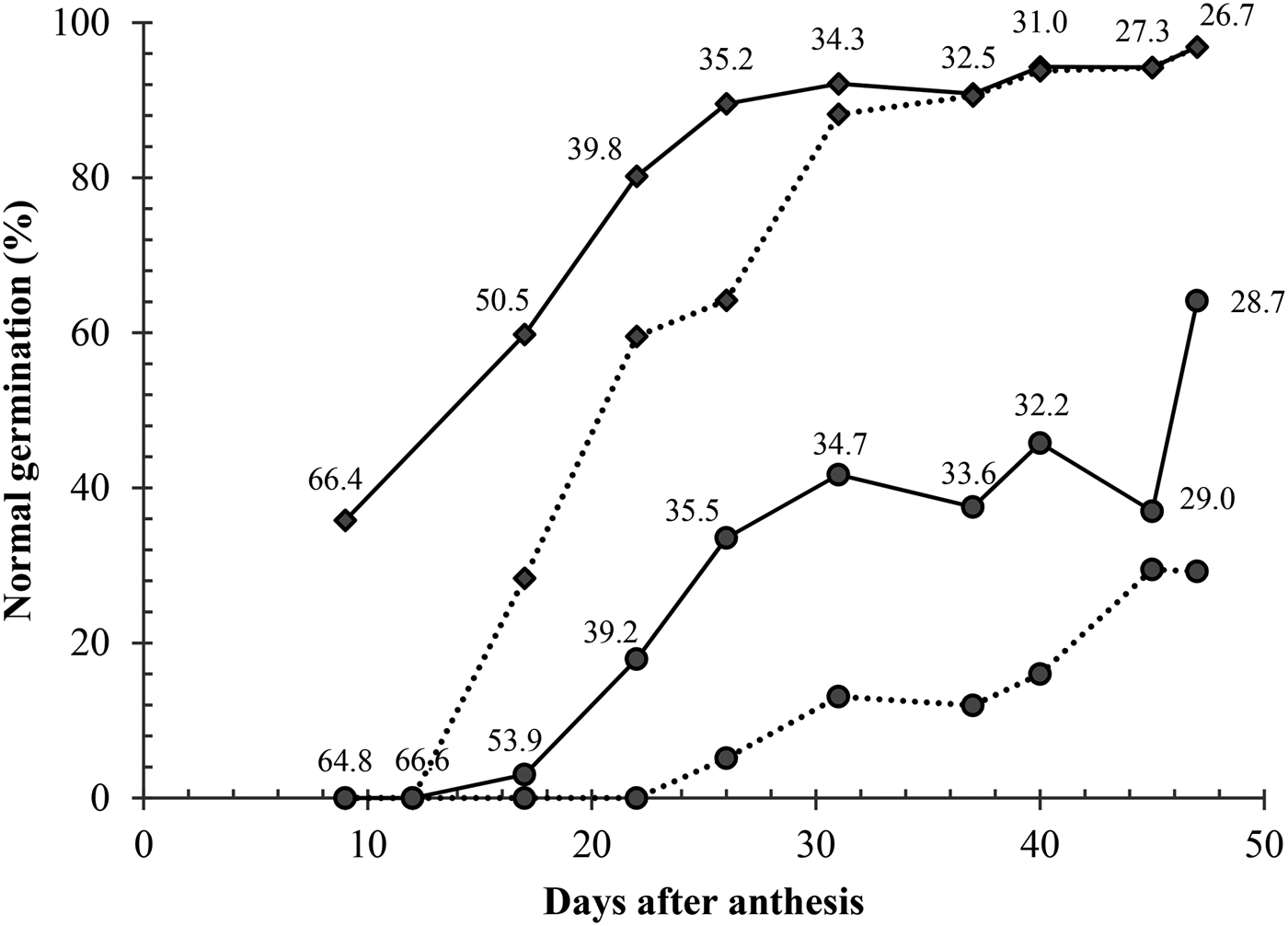
Ability to germinate increased with developmental duration and was promoted by extending test durations and removing seed covering structures, particularly early in development (Fig. 5). Its development was delayed in IR64 relative to Gleva. Moreover, ability to germinate was promoted more in IR64 than in Gleva by longer test durations and seed covering structure removal. These differences persisted with only a third of seeds of IR64 but almost all of those of Gleva able to germinate within 21 days when freshly harvested, intact seed were tested from the final harvest at harvest maturity (47 DAA, Fig. 5).
Ability to germinate normally of fresh (i.e. not dried) seed of cvs Gleva (♦) and IR64 (●) harvested serially during seed development and maturation, from plants grown at 28/20°C (11 h/13 h), after 21 days in test () at 34/11°C (16 h/8 h), or when combined with subsequent removal of seed covering structures from ungerminated seeds and tested for an additional 7 days (——). Seed moisture content (%) at harvest is shown for each observation.

Pre-harvest sprouting was detected (P < 0.001) at harvest maturity as a result of plant submergence in 2013. The majority of treatments resulted in no sprouting. The exceptions were principally in seed from plants of Gleva submerged at 30 or 40 DAA with 8 (SE 2.5) or 67% (SE 2.5) of seeds sprouted, respectively; fewer than 1% of seed from IR64 and IR64-Sub1 plants submerged at 40 DAA sprouted (and none from earlier treatments). Two-way analysis of variance confirmed an interaction between submergence at different developmental stages and cultivar (P < 0.001) on pre-harvest sprouting.
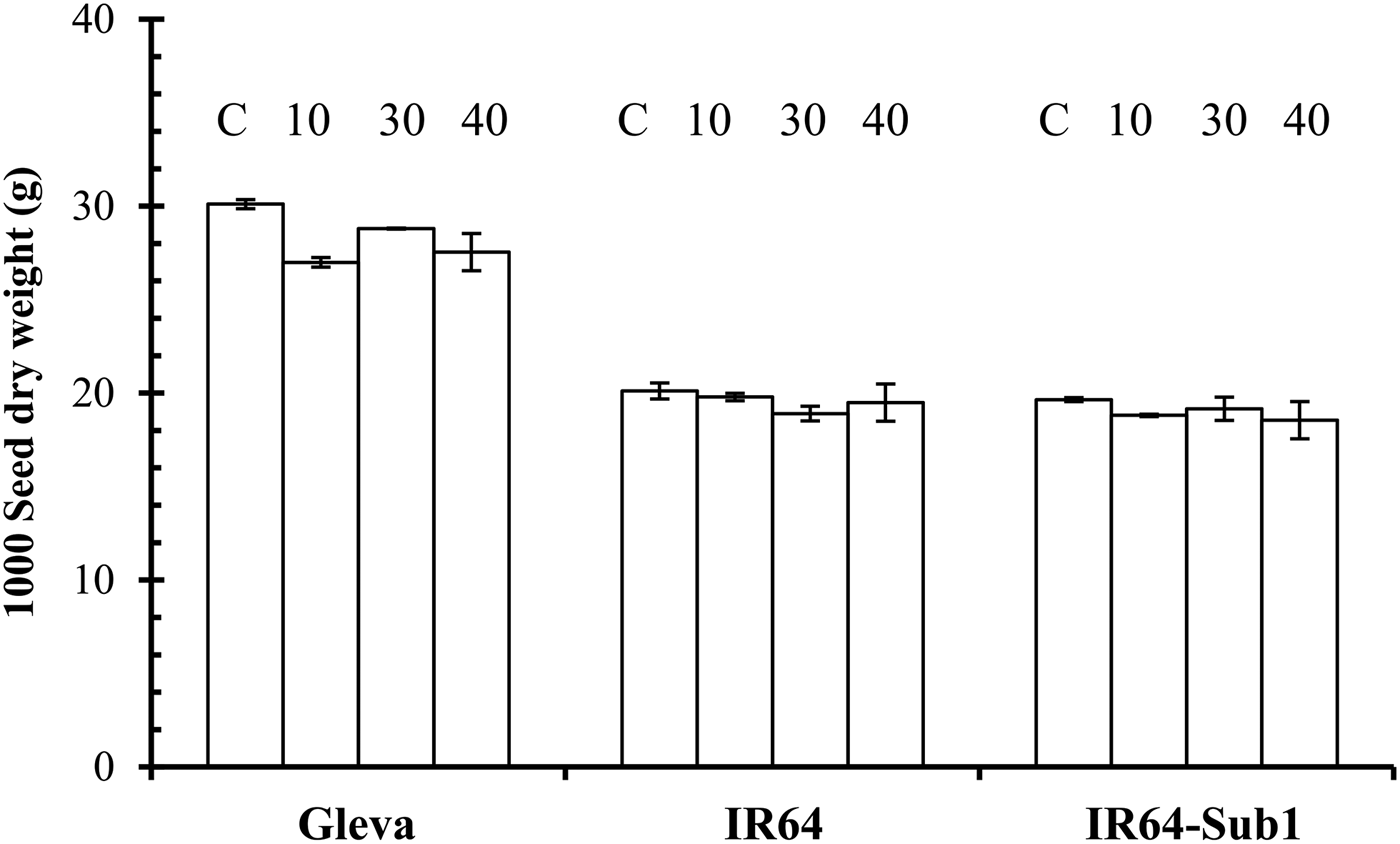
Submergence of plants of Gleva or IR64-Sub1 reduced (P < 0.05) thousand seed dry weight of non-sprouted seeds, but not in IR64 (P > 0.05) (Fig. 6). Hence thousand seed dry weight was subject to interaction between genotype and submergence treatment (P < 0.001). Within Gleva, the differences amongst submergence at 10, 30 or 40 DAA were not significant but all these seeds were lighter than the control (P < 0.05). No differences were detected within IR64, but the small decline in thousand seed dry weight with submergence in IR64-Sub1 was significant (P < 0.05).
The effect of submergence for 4 days in water at 10, 30 or 40 DAA (C = control, no submergence) of rice plants: rice cvs Gleva, IR64 and IR64-Sub1 on subsequent 1000 seed dry weight (0% moisture content; vertical bars represent ± SE) for non-sprouted seed samples harvested 46 DAA (harvest maturity).

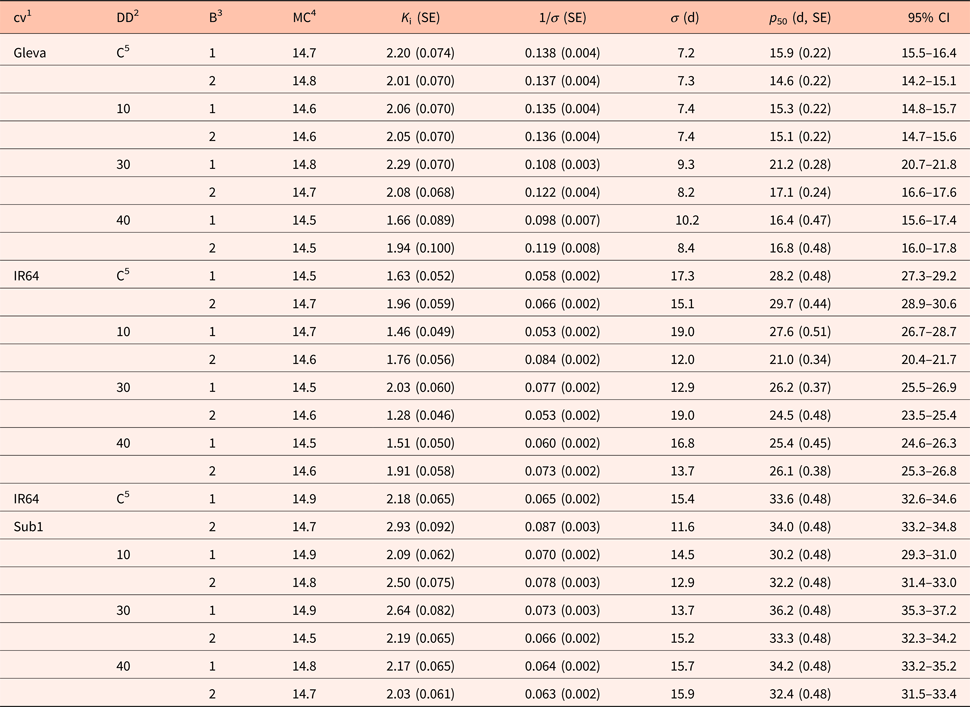
Ability to germinate normally in all seed lots (non-sprouted seeds) declined in a sigmoidal pattern during hermetic storage, such that all or almost all seeds of Gleva, IR64 and IR64-Sub1 had lost viability after 30, 44 and 41 days in storage, respectively. Seed survival curves, fitted by probit analysis to each seed lot separately, differed considerably amongst treatments (Table 3). The principal difference was amongst genotypes, with Gleva providing the smallest estimates of both σ and p 50 (Table 3, Fig. 7). Estimates of σ were similar between IR64 and IR64-Sub1, but those for K i and p 50 were greater for IR64-Sub1 than for IR64.
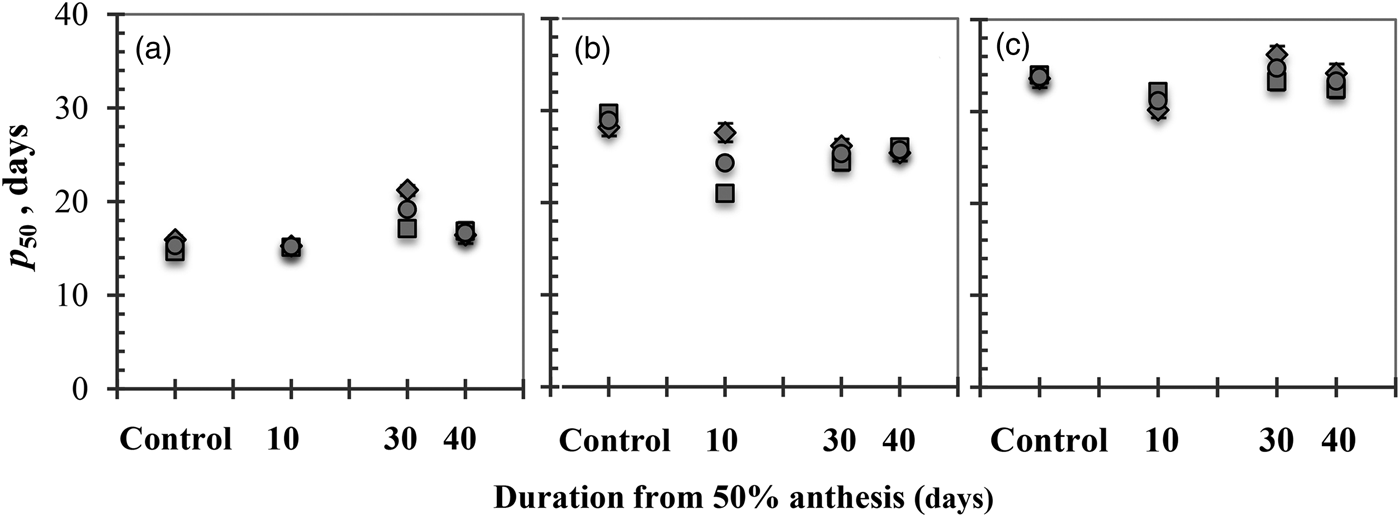
Effect of submergence of plants of rice cvs Gleva (a), IR64 (b), and IR64-Sub1 (c) in water for 4 days at 10, 30 or 40 DAA on the subsequent longevity (p 50; vertical bars represent ± SE) of seeds harvested at harvest maturity (46 DAA) and stored hermetically at 40° C with 14.7 ± 0.2% moisture content for each block (1, ♦; 2, ■) and the mean value (●). Further information on the fitted seed survival curves is provided in Table 3.

Seed longevity (parameters of seed viability equation, fitted by probit analysis) of rice cvs Gleva, IR64 and IR64-Sub1 harvested at harvest maturity in 2013 after submergence in water for 0 (control) or 4 days at 10–40 DAA, in hermetic storage at 40°C with moisture contents shown. The 95% confidence intervals (CI) are shown for p 50

1cv, cultivar; 2DD, duration of development until submergence (DAA); 3B, block; 4MC, moisture content of storage (%); 5control treatment (plants not submerged).
These differences were confirmed by the analyses. There were no differences in K i, σ or p 50 within each genotype (P > 0.05), that is submergence was not damaging to the longevity of non-sprouted seeds, but estimates of σ differed amongst genotypes (P < 0.05), with Gleva shorter lived than IR64 and IR64-Sub1 (Table 3), as did p 50 (P < 0.001) with Gleva (15‒19 days) less than IR64 (24‒29 days), which was less than IR64-Sub1 (31‒35 days) (Fig. 7). Note, however, that there was no difference (P > 0.05) between the controls (no submergence) for IR64 and IR64-Sub1.
Discussion
Simulated flooding of rice plants damaged seed, with substantial pre-harvest sprouting the longer the duration of submergence and the closer to harvest maturity it occurred (Fig. 1). The japonica rice Gleva was more sensitive to such damage than the indica rices, confirming that japonica cultivars are the more vulnerable to flooding damage (Fukao et al., Reference Fukao, Xu, Ronald and Bailey-Serres2006, Reference Fukao, Harris and Bailey-Serres2009; Xu et al., Reference Xu, Xu, Fukao, Canlas, Maghirang-Rodriguez, Heuer, Ismail, Bailey-Serres, Ronald and Mackill2006; Hattori et al., Reference Hattori, Nagai, Furukawa, Song, Kawano, Sakakibara, Wu, Matsumoto, Yoshimura, Kitano, Matsuoka, Mori and Ashikari2009; Bailey-Serres et al., Reference Bailey-Serres, Fukao, Ronald, Ismail, Heuer and Mackill2010; Mickelbart et al., Reference Mickelbart, Hasegawa and Bailey-Serres2015).
Seed dormancy delays or prevents germination (Bewley et al., Reference Bewley, Bradford, Hilhorst and Nonogaki2013) and is regulated by the genetics of the mother plant, developing embryo, and by environment (Bewley and Black, Reference Bewley and Black1994; Taiz and Zeiger, Reference Taiz and Zeiger2006; Sugimoto et al., Reference Sugimoto, Takeuchi, Ebana, Miyao, Hirochika, Hara, Ishiyama, Kobayashi, Ban, Hattori and Yano2010). The mechanisms include restraint by seed covering tissues which delays imbibition and physically obstructs embryo growth, and embryo growth restriction by endogenous abscisic acid (Hilhorst, Reference Hilhorst1995; Sugimoto et al., Reference Sugimoto, Takeuchi, Ebana, Miyao, Hirochika, Hara, Ishiyama, Kobayashi, Ban, Hattori and Yano2010; Bewley et al., Reference Bewley, Bradford, Hilhorst and Nonogaki2013). Developing seeds of Gleva declined in dormancy sooner than IR64 with seed covering structures playing a role in delaying germination, but this diminished as harvest maturity approached in Gleva (Fig. 5). This was to be expected: the longer the delay to harvest, the lower the dormancy (Pili, Reference Pili1968); and japonica cultivars tend to be less dormant than indica cultivars and so more susceptible to pre-harvest sprouting (Sugimoto et al., Reference Sugimoto, Takeuchi, Ebana, Miyao, Hirochika, Hara, Ishiyama, Kobayashi, Ban, Hattori and Yano2010).
Pre-harvest sprouting damages seeds because the further germination progresses the less likely the seed or seedling is to survive considerable desiccation and later rehydration (Hong and Ellis, Reference Hong and Ellis1992). This was the case here (Fig. 2), but what are the consequences of plant submergence on seeds which did not sprout?
The reduced dry weight of non-sprouted seeds showed damage to seed physical quality following submergence at 9 < 30 < 35 = 40 DAA < control, and similarly submergence for 5 days < 3 days (Table 1). While reduced photosynthate supply under water (Das et al., Reference Das, Panda, Sarkar, Reddy and Ismail2009; Singh et al., Reference Singh, Mackill and Ismail2009) cannot be ruled out as a factor in the lighter non-sprouted seeds at 9 DAA, it does not explain the effect of submergence after seed filling ended. Cellular respiration after imbibition (Woodstock and Grabe, Reference Woodstock and Grabe1967; Footitt and Cohn, Reference Footitt and Cohn1995; Tung and Serrano, Reference Tung and Serrano2011) may have caused dry matter loss for submergence from 30 DAA onwards. The strong interaction for thousand seed dry weight between genotypes and seed developmental stage at submergence in 2013, where cv. Gleva showed the greatest sensitivity to damage, combined with the lower dormancy of Gleva suggest activation of germination sensu strictu (Bewley et al., Reference Bewley, Bradford, Hilhorst and Nonogaki2013) was the major cause of reduced seed dry weight.
The potential air-dry survival of seed that had sprouted was reduced at harvest maturity (Fig. 2). Hence, seed storage survival curves were determined only for non-sprouted seeds to avoid confusing air-dry survival results for the two cohorts. The effect of plant submergence on subsequent seed longevity was nil (Fig. 7c) or small (Figs 3, 7a,b) in the context of differences in longevity amongst different seed lots stored in the similar environments (e.g. Ellis and Roberts, Reference Ellis and Roberts1981), or between japonica rice seed produced at different temperatures (Ellis et al., Reference Ellis, Hong and Jackson1993), or between blocks within treatments here (Figs 3 and 7).
In Gleva, for example, longevity was only reduced substantially after 5 days submergence at 9 or 40 DAA in 2012 and only increased substantially after 4 days submergence at 30 DAA in 2013 (Fig. 3, Tables 2, 3). Close examination of the survival curves for Gleva submerged for 5 days at 9 DAA in 2012 (Fig. 3f) indicates a reduction in initial viability and more rapid loss in viability (Table 2). This treatment had not resulted in any pre-harvest sprouting (Fig. 2). It is possible that germination sensu strictu might have occurred, however (for example, given the lighter thousand seed weight, Table 1), and subsequent air-dry survival therefore reduced in some seeds. However, longevity was not reduced in the closest parallel treatment (4 days submergence at 10 DAA) in 2013 (Fig. 7a). On the other hand, the small improvement to seed longevity after submergence such as 4 days at 30 DAA in the same genotype (Fig. 7a) might be ascribed to priming. Priming can benefit aged or immature seed (Burgass and Powell, Reference Burgass and Powell1984; Demir and Ellis, Reference Demir and Ellis1992; Powell et al., Reference Powell, Yule, Jing, Groot, Bino and Pritchard2000; Butler et al., Reference Butler, Hay, Ellis and Smith2009a, Reference Butler, Hay, Ellis, Smith and Murrayb). However, we suggest that neither damage nor benefit occurred in non-sprouted seeds to any great extent in the current study: rather, subsequent air-dry seed survival was remarkably resilient to submergence for 3–5 days in water for seeds resistant to pre-harvest sprouting.
The improved seed viability equation (Ellis and Roberts, Reference Ellis and Roberts1980) estimates the value of σ for seed lots in a known constant, hermetic, air-dry storage environment. Ellis and Hong (Reference Ellis and Hong2007) provided two sets of estimates for the constants for rice: analysis of rice data alone; or including data from other species to provide a common temperature response. Seed storage moisture contents ranged from 14.5 to 14.9% in 2013 (Table 3). Assuming storage temperature ranged from 39 to 41°C, then the improved seed viability equation and viability constants for rice provides estimates of σ for storage at 41°C, 14.9% down to 39°C, 14.5% of 11.1 to 17.2 days (rice data model) or 10.7 to 16.5 days (common temperature model). These ranges overlap with observations from the current research (Table 3) for the indica rices IR64 (σ = 12.0‒19.0 days) and IR64-Sub1 (σ = 11.6‒15.9 days). Hence the independent estimates (Ellis and Hong, Reference Ellis and Hong2007) provide good agreement with the current study for the indica rices.
In contrast, the observations for the japonica rice Gleva in 2013 (σ = 7.2‒10.2 days, Table 3) were below the independent estimates above. This difference was less in 2012, where seed storage moisture contents ranged from 14.9 to 15.3% (Table 2): estimates of σ at 39°C, 14.9% to 41°C, 15.3% are 9.9‒15.3 days (rice data model) or 9.6‒14.7 days (common temperature model), with observations of 6.6‒15.7 days in 2012 (Table 2), and so more variable than in 2013. Chang (Reference Chang1991) reported that japonica cultivars possess intrinsically poorer seed storage characteristics, whilst Ellis et al. (Reference Ellis, Hong and Jackson1993) reported estimates of σ were ranked indica > javanica > japonica rice. The seed viability constants for rice (Ellis and Hong, Reference Ellis and Hong2007) therefore overestimated longevity in japonica cultivars, but provided good predictions in indica cultivars.
Differences between seeds produced by the indica rice IR64-Sub1 and its parent IR64 were negligible. Both were highly resistant to submergence in the reproductive phase, with almost no sprouted seeds detected, even in the extreme treatment of 4 days submergence at 40 DAA (<1%). Neither was subsequent seed longevity affected by submergence (Fig. 7). Hence, introgression of the Sub1 gene into cv. IR64 has not reduced resilience of the seed to submergence late in seed development and maturation; and the much greater dormancy of seed of IR64 and IR64-Sub1, compared with Gleva, provides this resilience. The Sub1 introgression was reported to provide yield advantage in completely flooded conditions imposed to seedlings only 14 days old (Septiningsih et al., Reference Septiningsih, Pamplona, Sanchez, Neeraja, Vergara, Heuer, Ismail and Mackill2009; Singh et al., Reference Singh, Mackill and Ismail2009; Sarkar and Bhattacharjee, Reference Sarkar and Bhattacharjee2011) and this was more evident with flooding for 7‒14 days than shorter durations (Dar et al., Reference Dar, Janvry, Emerick, Raitzer and Sadoulet2013). Hence, whilst no benefit to seed was detected from the Sub1 introgression after flooding late in ontogeny here, a longer duration of flooding might have exposed differences.
IR64-Sub1 may have provided slightly greater longevity than IR64 under the same production and same storage environment but there was no difference amongst the controls (Fig. 7). Mapping of QTLs has revealed associations between ability to germinate under anoxia, maintenance of normal seedling growth, seed dormancy and longevity caused by the co-location of QTLs in rice (Miura et al., Reference Miura, Lin, Yano and Nagamine2002; Sasaki et al., Reference Sasaki, Fukuta and Sato2005; Angaji et al., Reference Angaji, Septiningsih, Mackill and Ismail2010; Septiningsih et al., Reference Septiningsih, Ignacio, Sendon, Sanchez, Ismail and Mackill2013). Hence, further investigation of the longevity of seed of IR64 and IR64-Sub1 produced under the same conditions is warranted.
In conclusion, sprouting was the greatest consequence of plant submergence. Where dormancy prevented sprouting, there was only a small reduction in seed dry weight, and little or no impact on subsequent seed longevity. Thus dormancy in rice seed provides resilience to damage from flooding in planta for post-harvest air-dry survival as well as pre-harvest sprouting.
Acknowledgements
We thank the Royal Thai Government Scholarship, Thailand, for a scholarship to Sujittra Tejakhod, Dr Tran D. Hong and Dr M. Martínez-Eixarch for advice, and Laurence Hansen, Caroline Hadley and Liam Doherty for technical support. We thank the International Rice Research Institute (IRRI) for seeds of cvs IR64 and IR64-Sub1, and the Institute of Agri-food Research and Technology (IART), Barcelona, for those of cv Gleva.
Financial support
R.H.E. was employed by and used facilities at the University of Reading; S.T. received a Royal Thai Government Scholarship.