Introduction
Functional impairment is a core symptom of Alzheimer's disease (AD), significantly impacting the quality of life of the person with AD, as well as his or her family members and caregivers (Andersen et al., Reference Andersen, Wittrup-Jensen, Lulk, Andersen and Kragh-Sørenson2004). The most accurate indicator of functional impairment is the decline in performance of activities of daily living (ADL). Several scales have been used to measure ADL in geriatric and AD populations, including the Disability Assessment for Dementia (DAD) (Gauthier, et al., Reference Gélinas, Gauthier, McIntyre and Gauthier1997; Gélinas et al., Reference Gélinas, Gauthier, McIntyre and Gauthier1999). The DAD consists of 17 items that measure the changes in basic ADL (bADL) and 23 items for instrumental ADL (iADL) and leisure activities. bADL are assessed within the subdomains of hygiene, dressing, undressing, continence, and eating. iADL and leisure activities are evaluated within the subdomains of meal preparation, telephoning, going on an outing, finance and correspondence, medication, and leisure and housework.
Reported average annual rates of decline in DAD scores include –11.6 (Feldman et al. (Reference Feldman2001) and –15.1 points per year (Suh et al., Reference Suh, Ju, Yeon and Shah2004). In addition, Suh et al. (Reference Suh, Ju, Yeon and Shah2004) observed that iADL are impaired in the early stage of AD, while bADL remain intact until severe cognitive impairment.
Functional decline is a hallmark of AD; previously, a general conceptual relationship with cognitive status has been described (Feldman and Woodward, Reference Feldman and Woodward2005). Using the Mini-Mental Status Exam (MMSE) and the Blessed Dementia Rating Scale, Galasko et al. (Reference Galasko, Edland, Morris, Clark, Moh and Koss1995) reported that during the course of AD the inability to perform iADL exhibited a hierarchy or sequential order, and proposed that activities that rely on recent memory may be affected earlier in the course of disease than items that were considered “overlearned.” While substantial individual variation was observed, the authors considered an MMSE score of <10 a “high-risk milestone.” An MMSE score of 16 was reported as the transitional point between loss of most iADL and the initial loss of bADL (Feldman et al., Reference Feldman, van Baelen, Kavanagh and Torfs2005). The domains related to iADL, and considered as the most complex (e.g., finances), are the first lost as the disease progresses, while domains related to bADL (e.g., hygiene and toileting) are lost at more severe stages of the disease. However, an individual's progression is variable, with specific order of DAD items lost varying by patient (Suh et al., Reference Suh, Ju, Yeon and Shah2004).
We aimed to expand on these earlier efforts by further exploring the correlation between cognitive status and functional ability at the individual item level within DAD to the MMSE. Characterizing disease progression by evaluating the impact to ADL (both iADL and bADL) based on cognitive thresholds/levels will provide a framework to further assist in the evaluation, care, and design of intervention studies in AD. Understanding the interrelationship between cognition and functional performance may assist caregivers and healthcare providers with both short- and long-term planning of patient needs. Similarly, identifying the temporal interrelationships between cognition and functional performance may assist in developing interventions to design measures that expand the characterization of specific functional domains at more specified intervals.
The objective of this analysis was to describe the progressive loss of specific functional capabilities of daily activities expressed by the level of cognitive ability in patients with AD.
Methods
Study design
The data for these analyses are from ELN-AIP-901, a non-interventional observational study of cognitive progression in participants with AD, with mild cognitive impairment (MCI), or who are cognitively normal (CN). The study is described in McLaughlin et al. (Reference McLaughlin2010). The study was conducted at 39 centers in the United States (22 centers) and Europe (17 centers) from 2006 to 2009. All assessments were conducted at study enrollment, baseline, and at six-month intervals for up to two years.
Standard protocol approvals, registrations, and patient consents
The study was conducted in accordance with the International Conference on Harmonization Tripartite Guidelines on Good Clinical Practice and in compliance with the Declaration of Helsinki 1964 as modified in October 2000. The study protocol, the Informed Consent Form (ICF), and printed participant information materials were reviewed and approved by the Independent Ethics Committee (IEC) or Institutional Review Board (IRB) for each site before any study procedures were performed. Any subsequent protocol amendments or informed consent revisions were approved by the IRB or IEC before any changes were initiated. Each participant's written informed consent to participate in the study had to be obtained before any study-specific procedures were performed. The principal investigator or a medically qualified member of the study team provided the participants with a full explanation of the nature of the study, along with the aims, methods, anticipated benefits, potential risks, and any discomfort participation could entail. Participants who agreed to participate in the study signed and dated an ICF. The ICF was also signed and dated by designated site personnel. The original (and any amended) signed and dated ICFs were retained at the site, and copies of these forms were provided to the subjects.
Participants
The study included male and female participants in three clinical groups: AD (n = 196), MCI (n = 70), or CN (n = 75). Eligible participants were aged 50 to 85 years, inclusive, had a Rosen Modified Hachinski Ischemic score of ≤4, and had a study partner with ≥10 h per week of contact with the study participant and who could accompany the participant to the clinic for all study visits. Participants were receiving stable doses of medications for non-excluded medical conditions for ≥30 days before screening; if the participant was taking cholinesterase inhibitors and/or memantine, the dose(s) must have been stable for ≥60 days before screening and for the duration of the study. Per a protocol amendment, an additional 20 healthy volunteers between the ages of 76 and 85 years were enrolled into the CN group in an effort to ensure a comparable mean age among the three study groups. For the AD and MCI groups, participants had a verified memory complaint and abnormal memory function based on the Logical Memory II Subscale (Delayed Paragraph Recall), defined as ≤8 for ≥16 years of education; ≤4 for 8–15 years of education; and ≤2 for 0–7 years of education. In addition, participants in the AD group had Clinical Dementia Rating of ≥0.5, an MMSE score of 16–26 inclusive, and a diagnosis of probable AD (McKhann et al., Reference McKhann, Drachman, Folstein, Katzman, Price and Stadlan1984), while participants in the MCI group had a Clinical Dementia Rating of 0.5 with a Memory Box score of ≥0.5, an MMSE score of 24–30 inclusive, and sufficient general cognition and functional performance at screening to preclude a diagnosis of AD. For the CN group, participants had memory complaints no greater than those common to other normal participants of that age range, normal memory function according to the Logical Memory II Subscale (Delayed Paragraph Recall: ≥9 for ≥16 years of education; ≥5 for 8–15 years of education; and ≥3 for 0–7 years of education), Clinical Dementia Rating of 0 with a Memory Box score of 0, an MMSE score of 24–30 inclusive, and no significant impairment in cognitive functions or ADL. Participants were excluded for significant neurological diseases other than AD or major psychiatric disorders; history of stroke or seizures; Hamilton Psychiatric Rating Scale for Depression (17-item) score of >12; current use of anticonvulsant for seizures, anti-Parkinson's, anticoagulant (excluding the use of aspirin ≤325 mg/day), and narcotic medications; or current use of prescription or nonprescription agents for cognitive enhancement other than cholinesterase inhibitors or memantine.
Assessments
The study included numerous assessments as fully described in McLaughlin et al. (Reference McLaughlin2010). Two assessments were included in these analyses: (1) the MMSE, and (2) the DAD.
The MMSE, consisting of tests on orientation, memory, organization, attention, language, and visual constructional praxis, was administered at baseline and every six months to the participants by a trained clinical rater. Scores range from 30 (no impairment) to 0 (complete impairment).
The DAD scale was administered via caregiver interview at baseline and every six months. The DAD includes 40 items and is scored as a percentage of items answered that were performed without help or reminder, giving a range of 0% to 100%, with lower scores indicating greater impairment (Gauthier et al., Reference Gauthier, Gélinas and Gauthier1997; Gélinas et al. Reference Gélinas, Gauthier, McIntyre and Gauthier1999).
Analysis
Baseline and demographic data were summarized using descriptive statistics, Chi-square, and 1-way analysis of variance, to evaluate differences between groups, for categorical and continuous factors, respectively. Hierarchical regression was used to separately estimate the annual change in the DAD and MMSE. Separate models were estimated for the DAD and MMSE. Each participant's individual rate of change was first estimated using linear regression of the outcome (DAD or MMSE score) on the time in study. The second model fit the outcome, separately for the DAD and MMSE, to estimate the annual change controlling for the effect of each individual's baseline characteristics, diagnosis of AD, MCI, and CN, age in years, ethnicity, and gender. For the AD group, the relationship of the individual items of the DAD (a measure of ability to perform ADL) to cognitive status by the MMSE (a measure of cognition) was estimated using the Kaplan–Meier analysis with an MMSE score representing the “time” dimension. The Kaplan–Meier analysis estimated the median, 25th, and 75th MMSE scores when each item in the DAD transitioned to inability to perform. At enrollment, some participants were unable to perform some of the DAD items and were left censored. For the Kaplan–Meier analysis, these participants were excluded, but this exclusion may have introduced a bias. To assess the sensitivity of the Kaplan–Meier technique, an accelerated failure time model was utilized to explore the impact of left censoring on the median estimates of transition to inability to perform. No substantive changes were observed after the sensitivity analysis (Supplemental Table 2; available as supplementary material attached to the electronic version of this paper at www.journals.cambridge.org/jid_IPG). Analyses were performed in SAS version 9.2 (SAS Institute Inc., 2008).
Results
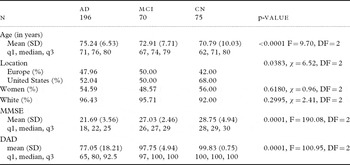
A total of 341 patients were enrolled in the study. At enrollment, 196 participants had AD, 70 had MCI, and 75 were CN (Table 1). Patients with mild to moderate AD were slightly older (age 75.24 ± 6.53 years) than patients with MCI (age 72.91 ± 7.71 years) and those who were CN (age 70.79 ± 10.03 years) (p < 0.001). As expected, mean MMSE scores were statistically different across groups (p < 0.0001), with an MMSE score of 21.69 ± 3.56 for patients with AD, 27.03 ± 2.46 for patients with MCI, and 28.75 ± 4.94 for those who were CN. Corresponding DAD scores were 77.05 ± 18.21, 97.75 ± 4.94, and 99.83 ± 0.75, and were statistically different across groups (p < 0.0001). The proportion of participants from Europe and the United States demonstrated statistically significant difference across groups (p = 0.0383). The mean follow-up time was 1.50 years (±0.75) for the AD group, 1.86 years (±0.76) for the MCI group, and 1.84 years (±0.73) for the CN group, which also differed statistically across groups (p = 0.0001; F-statistic = 9.44; degrees of freedom [DF] = 2).
Demographics and baseline information

AD: Alzheimer's disease; CN: cognitively normal; DF: degrees of freedom; F: F-statistic; MCI: mild cognitive impairment; MMSE: Mini-Mental State Exam; SD: standard deviation; q1: first quartile (25th percentile); q3: third quartile (75th percentile).
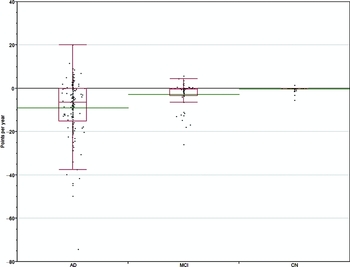
Annual change in DAD scores is presented in Figure 1. For the AD group, the annual rate of change was –8.80 (±12.76) DAD points/year; more than a quarter (27%) demonstrated no decline in functional ability. For age, gender, baseline MMSE, and baseline DAD, no differences were observed between those who exhibited a decline in the DAD score compared with those who did not. For the MCI group, the annual rate of change for the DAD was –2.64 (±5.75) points per year; for the CN group, –0.19 (±0.82) points per year, with 48% and 87% demonstrating no decline respectively. For the MCI group those who exhibit a decline in their DAD score had a lower baseline DAD score of 92.95 (± 9.54) than those who did not exhibit a decline, 98.79 (± 2.76), no differences were observed for age, gender, or the baseline MMSE score. The annual decline in DAD scores was statistically significantly different across the three groups (p < 0.001; F-statistic = 21.94; DF = 2).
Box plot of the annual change in Disability Assessment for Dementia score (points per year) by participant group. AD: Alzheimer's Disease group; MCI: Mild Cognitive Impairment group; CN: Cognitively Normal group. Green: mean for group; gray: mean for all three groups; red (from bottom line): 2 × IQR (interquartile range), 75th percentile, median, 25th percentile, 2 × IQR.

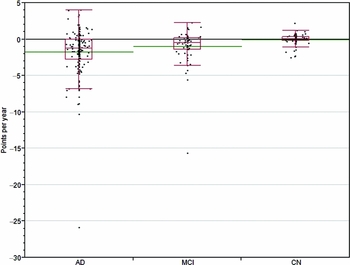
Annual change in MMSE scores is presented in Figure 2. For the AD group, the annual rate of change was –1.74 points per year (±3.06), with a median of –1.24; nearly a quarter (24.9%) exhibited no decline or improvement. For the MCI group, the annual rate of change for the MMSE was –0.95 points per year (±2.33), with a median of –0.46; for the CN group, –0.04 points per year (±0.78) with a median of 0.04, and 34% and 61% demonstrating no decline respectively (Figure 2). These annual rates were significantly different statistically across the three groups (p < 0.0001; F-statistic = 11.38; DF = 2).
Box plot of the annual change in Mini-Mental State Exam (MMSE) score (points per year) by participant group. AD: Alzheimer's Disease group; MCI: Mild Cognitive Impairment group; CN: Cognitively Normal group. Green: mean for group; gray: mean for all three groups; red (from bottom line): 2 × IQR (interquartile range), 75th percentile, median, 25th percentile, 2 × IQR.

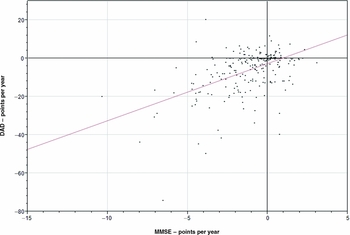
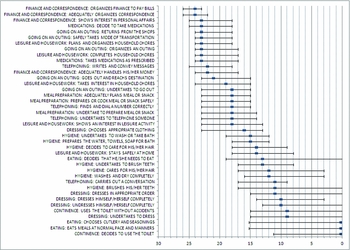
Based on the results of the hierarchical regression analysis for the AD group, a 1-point change in the MMSE score was associated with a 3-point change in the DAD score (2.79; 95% CI: 1.97–3.63) (Figure 3). Patients with AD were unable to perform activities for all items of the subdomains for finance, medication, and outings at higher MMSE scores than for items in all other subdomains; the lowest median MMSE observed was 18. Thus, functional performance was impaired for all these domains for more than half of the AD group when cognition declined to a score of 18 on the MMSE. The specific activities “organize finance” and “adequately organize correspondence” exhibited the highest MMSE score; in other words, they were “lost” earlier in the course of the disease at a higher level of cognition, with a median MMSE between 23 and 24. The inability to perform items in the subdomains of personal hygiene, dressing, eating, and continence occurred at the lowest MMSE scores; that is, these activities were “lost” at the later stages of AD progression. Seven items “lost” late in the course of the disease (lowest median MMSE score) were from three of the ten subdomains; specifically, dressing (three items), eating (two items), and continence (two items) (Supplemental Table 1; available as supplementary material attached to the electronic version of this paper at www.journals.cambridge.org/jid_IPG). For some specific items, such as the one measuring initiation for continence (“decided to use the toilet at appropriate times”), half of the AD group was estimated to never lose this ability; an MMSE of zero (0) was estimated as the median level of cognitive function when ability was impaired.
For the Alzheimer's disease group, plot of the annual change in Disability Assessment for Dementia (DAD; points per year) by the annual change in Mini-Mental State Exam (MMSE) (points per year). Line: linear fit with no covariates, (DAD points per year) = 2.80 × (MMSE points per years) –4.65.

Among patients with AD, a hierarchy of functional impairment is observed, with the iADL generally being impaired prior to bADL (Figure 4, data in Supplemental Table 1; available as supplementary material attached to the electronic version of this paper at www.journals.cambridge.org/jid_IPG). However, substantial individual variation is observed with respect to the impairment during the course of the disease, and also to the relative order by which individual items of functional performance are impaired.
Alzheimer's disease participant's Kaplan–Meier analysis. Disability Assessment for Dementia (DAD) loss of ability by Mini-Mental State Exam (MMSE) score: 75th, median, and 25th percentile. Box plots of MMSE score by DAD item (Plot, 75th, median, and 25th percentile; left interpolated).

Discussion
Alzheimer's disease and its progression are clinically defined by the patterns of gradual and nearly unremitting decline in cognition and functional ability with accompanying neuropsychiatric symptoms (Gauthier and Ballard, Reference Gauthier and Ballard2009). The concept of disease progression in AD is a decline in cognitive ability preceding detectable declines in physical function, with behavioral neuropsychiatric symptoms waxing and waning throughout the course.
A modified six-item version of the DAD has been developed that demonstrated some ability to distinguish between MCI patient and healthy controls (de Rotrou et al., Reference de Rotrou2012). The abbreviated instrument modifies the iADL portion of the DAD. These data further indicate that a subset of the iADL may be more characteristic of early change, specifically the domains of finance and correspondence, going on an outing and leisure, and housework. Thus, further evaluation of specific domains and items along with alternative scoring algorithms may improve the ability to distinguish between diagnostic categories and improve prediction of subsequent decline.
The study was performed over a two-year interval, which restricts the ability to generalize the rate of change throughout the course of disease. Slightly more than a quarter of AD patients did not exhibit any decline in functional ability over the course of the study, with no difference from those who exhibited a decline for demographic factors. Other unmeasured factors may be predictive of decline. As the population was selected to mimic those in clinical trial and was relatively homogenous with minimal comorbidities, this selection toward a somewhat uncomplicated AD patient may contribute to the proportion not exhibiting any decline in functional ability or the study period. In addition to the selection criteria, the population enrolled was mostly white, over 90%, which may restrict any generalization to other populations.
The findings indicate that ADL are impacted in a progressive and hierarchical manner associated with cognitive decline. Inability to perform iADL that are more complex, specifically finance and medications or outings, occurred earlier in the course of the disease, as measured by MMSE score, than bADL. Each 1-point decline in MMSE score was associated with a 3-point change in DAD. These results are in agreement with other studies that have investigated the patterns of changes in functioning activities in AD (Galasko et al., Reference Galasko, Edland, Morris, Clark, Moh and Koss1995; Suh et al., Reference Suh, Ju, Yeon and Shah2004). This study also provides further light on the relationship between cognitive deterioration and the rate of decline in functional abilities through the course of the disease. Using the MMSE, DAD items exhibit a hierarchical loss-progression associated with cognitive decline. These findings support the use of DAD items that correlate with AD progression as a method for characterizing benefit and risk.
The implications for this are several fold: (1) Different stages of AD may require different levels and amount of care; (2) treatment intervention trials may consider enrollment criteria to incorporate aspects of functional impairment either globally or at the domain level to improve the assessment of benefits; (3) additional detail around measure of function may be useful to characterize fine levels of impact, which may improve the focusing of care needs and the design of intervention trials; and (4) domains and even items may be useful to characterize functional progression in selected patient populations. While DAD, as designed, is a useful instrument to characterize progression in the middle of the course of the disease, some potential ceiling and floor effects are observed. For studies of AD at onset and into the prodromal AD area, additional functional measures may be warranted. At the more severe stage, floor effects begin to emerge, and the development of other functional measures may be useful to properly characterize the patient's functional state to assist in assessing and evaluating the patient's care needs.
Conclusions
Enrollment criteria are similar to randomized clinical trials of interventions in AD (Salloway et al., Reference Salloway2009) and the Alzheimer's Disease Neuroimaging Initiative (Petersen et al., Reference Petersen2010). The patients with AD present a subgroup with less comorbidity than the broad AD patient population; therefore, the findings should not be generalized to all patients with AD. Prevalent patients with AD are enrolled and result in “left censored” information, meaning some functions are impaired, i.e. “lost,” prior to study enrollment, and the cognitive level at this transition is unknown. The study's enrollment requirement for patients with AD required the initial MMSE score to be between 16 and 26 inclusive.
In summary, as measured by MMSE score, inability to perform iADL occurred earlier in the course of the disease than bADL. Furthermore, by MMSE, DAD items exhibit a hierarchical loss progression associated with cognitive decline.
Conflicts of interest
This study was sponsored by Janssen Alzheimer Immunotherapy Research & Development, LLC and Pfizer Inc. Editorial support was provided by Elizabeth Yepez at Phase Five Communications Inc., and was funded by Pfizer Inc. and Janssen Alzheimer Immunotherapy Research & Development, LLC.
H. M. Arrighi discloses he is an employee with Janssen Alzheimer Immunotherapy Research & Development, LLC, and a stockholder in Elan Corporation, Inc. J. Buchanan is an employee of Buchanan Biotech, who is a paid contractor to Janssen Alzheimer Immunotherapy Research & Development, LLC for the development of this manuscript. S. Gauthier discloses consultancy with Wyeth Pharmaceuticals, Elan Corporation, and Pfizer Inc. I. Gélinas discloses consultancy with Janssen Alzheimer Immunotherapy Research & Development, LLC. T. McLaughlin discloses status as employee at Janssen Alzheimer Immunotherapy Research & Development, LLC during the conduct of the study.
Description of the author's roles
H. M. Arrighi designed the study, performed the analysis, and wrote the paper; I. Gelinas oversaw the design, reviewed the analysis plan, and wrote the paper; T. P. McLaughlin assisted with study design, analysis, and writing of the manuscript; J. Buchanan wrote the paper; and S. Gauthier reviewed the findings and wrote the paper.
Acknowledgments
The authors wish to acknowledge the efforts of Dr. Michael Grundman, an employee of Global R&D Partners, who is a paid consultant to Janssen Alzheimer Immunotherapy, and Dr. Ron Black, of Pfizer, for their initial work on the ELN-AIP-901 study and subsequent reviews of the manuscript. We would also like to thank the patients and their caregivers who generously volunteered for the study, as well as the ELN-AIP-901 investigators, Drs. Georg Adler, Niels Andersen, Tony Bayer, Serge Belliard, Roger Bullock, Rachelle Doody, P. Murali Doraisway, Ranjan Duara, Warachal Faison, Lutz Froelich, Pedro Gil Gregorio, Joshua Grill, M. Saleem Ismail, Roy Jones, Marvin Kalafer, Alexander Kurz, Joel Kramer, Allan Levey, Crystal Flynn Longmire, Juan Jose Lopez, Scott Losk, David Ira Margolin, Manual Fernandez Martinez, Lennart Minthon, Jacobo Mintzer, Leslie Moldauer, Ruth Mulnard, Pierre-Jean Ousset, Eric Pfeiffer, Anne Remes, Dorene Rentz, John Ringman, Marwan Sabbagh, Carl Sadowsky, Amanda Smith, Hilkka Soininen, Paul Solomon, Louise Taber, Bruno Vellas, David Watson, Myron Weiner, Charles Wilcox, and David Wilkinson.