Implication
High-producing cows cannot satisfy their energy requirements from grazing alone but grazing situations more favourable to sustain high performances are identified. There is also considerable scope to improve animal performances at grazing while achieving a full exploitation of the grassland area. They include strategies of supplementation with concentrates or association of part-time grazing and conserved forages provided in limited amount, increasing leaf blades mass at the bottom of the sward by appropriate grazing management in early spring and the more systematic use of legumes.
Introduction
Grassland-based dairy systems can combine economic and environmental performances. The comparisons made at the world level show that the total cost of milk production decreases when the proportion of grass in the annual diets of the cows increases (Dillon et al., Reference Dillon, Hennessy, Shalloo, Thorne and Horan2008). From an environmental point of view, several reports, directives, regulations and initiatives challenge high-input dairy systems. Increasing the proportion of grassland in arable land linearly decreases the utilisation of pesticides (Raison et al., Reference Raison, Chambault, Le Gall and Pflimlin2008). Grasslands can also contribute to preserve various components of biodiversity although the practices of management largely influence botanical diversity and that of insects and small fauna (Millennium Ecosystem Assessment, 2005). The risks of nitrate leaching are more uncertain, but Ledgard et al. (Reference Ledgard, Schils, Eriksen and Luo2009) have shown that the amount of leached N under can remain below 50 kg/ha per year. It is also noticeable that total consumption of non-renewable energy is reduced in grassland-based systems (Le Gall et al., Reference Le Gall, Béguin, Dollé, Manneville and Pflimlin2009) from 5.0 MJ/kg milk for intensive dairy farms in the Netherlands to 3.1 for Irish systems based on fertilised ryegrass pastures and 1.4 for NZ (New Zealand) farms.
Milk production is largely dependent upon the factors controlling herbage intake and ruminal digestion. Indeed, high genetic merit cows produce much less milk when grazing than when fed on total mixed ration in confinement (29.6 v. 44.1 kg/day; Kolver and Muller, Reference Kolver and Muller1998). Moreover, grazing also suffers from difficulties of management and the quantity and quality of feed resource is not constant during the season with large inter-annual variability. Animal performance may therefore fluctuate and this is not well accepted by farmers. The objective of the present paper is to review the factors that can affect nutrient supply for dairy cows at grazing in order to point out areas with scope for improvement of efficiency in animal production while maintaining efficient pasture utilisation per hectare (ha). Particular focus is done on the interaction between type of cows (requirements), type of swards (quality), grazing management partly determining intake (pasture and time availability) and concentrate supplementation level. Besides information from the literature the paper is based on meta-analysis and modelling of published results on intake and digestion.
Variation of nutrient supply at grazing relative to animal requirements
The question of the management of nutrient supply in grazing dairy cows is directly related to the proportion of the requirements that are met by herbage intake and subsequent ruminal digestion.
Requirements and intake capacity of dairy cows
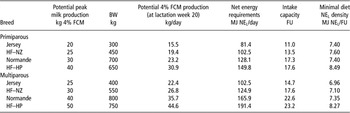
Energy intake of unsupplemented cows is determined by a combination of animal characteristics, pasture quality and grazing management factors, but cow's characteristics are of primary importance. Cows are characterised by their energy and protein requirements, and by their ability or motivation to eat, that is, their voluntary intake capacity, that constrains possible energy intake. Energy and protein requirements are determined by maintenance, milk production, growth (young animals) and gestation (for pregnant cows) (Faverdin et al., Reference Faverdin, Delagarde, Delaby and Meschy2007). Intake capacity is driven by parity, potential milk production, body weight (BW) and body condition score, stage of lactation, stage of gestation and age (Faverdin et al., Reference Faverdin, Baratte, Delagarde and Peyraud2011). The ratio between energy requirements and intake capacity defines the minimal diet energy density (MED) necessary to meet requirements (Institut National de la Recherche Agronomique (INRA), 2007). Energy requirements are expressed in MJ of NEL/day, and intake capacity in Fill Units (FU; INRA, 2007), therefore, MED is expressed in MJ NEL/FU. A standard cow producing 25 kg of milk and weighing 600 kg has a standard intake capacity of 17 FU, because she will voluntary eat 17 kg DM of a standard pasture of 1 FU/kg DM.
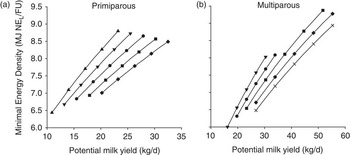
It is noteworthy that energy requirements increase faster than intake capacity when potential milk production increases, making it more difficult to meet requirements of high-producing cows. On the contrary, requirements increase slower than intake capacity when BW increases, making it easier to meet requirements of heavy cows for a given potential milk production. As a consequence, the ratio of potential milk yield (PMY) : BW is crucial in determining MED, explaining high difference between breed, strain, parity and lactation stage in the ability of cows to meet requirements when fed on a given diet. Some typical values of energy requirements, intake capacity and MED for different types of cows are given in Table 1 and MED for a range in BW and potential milk is shown in Figure 1. High genetic merit cows with intermediate BW (North America or European Holstein–Friesian type) clearly need a higher MED than smaller cows (Jersey or NZ Holstein) or heavier cows with lower milk potential (Normande; Table 1). The range in MED is from 6.0 to 9.5 MJ NEL/FU, which is a 50% range of energy density (ED) required to meet requirements between types of cows (breed, strain, stage of lactation).
Simulated effect of parity, breed and strain on energy requirements, intake capacity and minimal energy density of the diet to meet energy requirements in mid-lactation dairy cows

FCM = fat corrected milk; BW = body weight; NEL = net energy; FU = Fill Units; HF–NZ = Holstein–Friesian New Zealand type; HF–HP = Holstein–Friesian North America type.
Simulated effect of potential milk yield (kg 4% fat corrected milk/day) and BW (▴, 300 kg; ▾, 400 kg; ●, 500 kg; ▪, 600 kg;  $$$$
, 700 kg; ×, 800 kg) on the minimal diet NE density to meet NE requirements in dairy cows. Simulations are performed at 20 weeks of lactation. Diet NE density is the ratio between NE requirements and intake capacity expressed in Fill Units (Institut National de la Recherche Agronomique, 2007).

Higher-producing cows have a greater nutrient demand and this is reflected in increased grass intake. The incremental increase of herbage intake averages 0.18 kg/kg of peak milk (Peyraud et al., Reference Peyraud, Comerón, Wade and Lemaire1996; Kennedy et al., Reference Kennedy, Dillon, Delaby, Faverdin, Stakelum and Rath2002) on good quality pasture. Over the grazing season, milk yield (MY) was 2 to 3 kg higher with high genetic merit cows than for those of medium genetic merit, which may lead to an extra milk output of 800 to 1200 kg/year per cow (Buckley et al., Reference Buckley, Dillon, Rath and Veerkamp2000) thus indicating that relatively high milk production is achievable at grazing with high genetic merit cows.
Fresh forages fed alone cannot sustain energy requirements of high-producing dairy cows
Pasture nutritive value depends on the net energy (NEL) and the metabolisable protein (MP) concentration, expressed per kg DM, but it also depends on the voluntary DM intake that is called ingestibility. Forage ingestibility is its ability to be eaten when given ad libitum indoors with at least 10% of refusals. Ingestibility is expressed relative to a reference fresh forage with a voluntary intake of 140 g/kg metabolic weight (expressed in FU). To maximise energy (and protein) intake, forage should have the highest nutrient concentration and the highest ingestibility. ED, defined as the ratio between pasture NEL content and forage fill value is a good predictor of the effective nutritive value (INRA, 2007) and to the ability of the forage to meet the requirements of dairy cows.
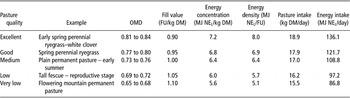
Organic matter digestibility (OMD) is a crucial factor determining nutritive value and ED because of its multiplicative effect on both net energy concentration and ingestibility. Table 2 shows the high range of variation of OMD, net energy concentration, fill value and ED for several typical pastures around the world. From a pasture OMD range of 0.85 to 0.65, ED of 8.0, 6.9, 6.4, 5.7 and 5.1 MJ NEL/FU can be considered as excellent, good, medium, low and very low, respectively. Lower nutritive value can be found in senescent or tropical pastures with lower digestibility and ingestibility (Moran and Croke, Reference Moran and Croke1993; Aroeira et al., Reference Aroeira, Lopes, Deresz, Verneque, Dayrell, de Matos, Maldonado-Vasquez and Vittori1999). The range of pasture intake (PI) between excellent and very low-quality pastures is 3 to 4 kg DM/day for a standard cow (Table 2), but this leads to a much greater range in energy intake (87 to 136 MJ NEL/day), explaining a larger difference in milk production (7 to 8 kg milk/day). Loosing 1 percentage point of OMD on grass offered (age of regrowth, season and variety) involves a reduction of 1 kg/day of MY. Moreover, OMD is negatively related to average temperature during regrowth, with −0.006 OMD/°C in both temperate and tropical pastures (Wilson et al., Reference Wilson, Deinum and Engels1991). This explains why cow performance is lower during summer and warm weather conditions than in spring or colder weather conditions. Voluntary DM intake of legumes is 10% to 15% greater than that of grasses of similar digestibility. These differences are attributed to both a lower resistance of legumes to chewing and a higher rate of particles breakdown, digestion and clearance from the rumen (Steg et al., Reference Steg, Van Straalen, Hindle, Wensink, Dooper and Schils1994).
Nutritive value of several typical pasture types and subsequent voluntary intake and energy supply in ad libitum fed standard dairy cow (600 kg LW, 25 kg potential milk production)

LW = live weight; OMD = organic matter digestibility; FU = Fill Units; DM = dry matter; NEL = net energy.
Because feed intake capacity increases less rapidly than energy requirements with increasing potential milk production, the diet ED should increase to meet the cows NE requirements (Figure 1). The required ED is most often higher than the ED of good quality fresh forages.
Effect of grazing management: trade-off between animal performance and efficient pasture utilisation
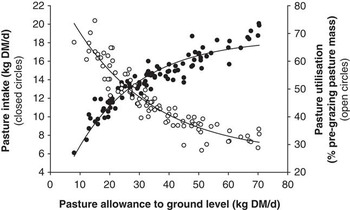
Under rotational grazing, pasture availability is mainly determined by daily pasture allowance (PA, in kg pasture DM/cow per day) but also by pre-grazing pasture mass (PM). When a high range of PA is tested, the PI/PA relationship is generally curvilinear or exponential, with PI reaching a plateau for PA above 50 kg DM/cow per day at ground level (Delagarde and O'Donovan, Reference Delagarde and O'Donovan2005). When considering PM and PA above 4 to 5 only, and due to the high PM below 4 to 5 cm (i.e. 2.0 to 2.5 t DM/ha), the plateau is reached at a PA of 20 to 25 kg DM/cow per day (Baudracco et al., Reference Baudracco, Lopez-Villalobos, Holmes and McDonald2010; Delagarde et al., Reference Delagarde, Valk, Mayne, Rook, González-Rodríguez, Baratte, Faverdin and Peyraud2011b). At this level of PA, grazing conditions are not limiting for PI, and intake can be considered equal to voluntary intake indoors. At lower PA, daily PI is limited by PA and cows do not achieve their intake capacity. Within the typical range of PA in grazing systems, PI increases on average by 0.15 kg/kg PA at ground level and by 0.20 to 0.25 kg/kg PA above 5 cm. This means that the marginal pasture utilisation rate when increasing PA is very low (15% to 25%), explaining why individual cow intake and performance is much less sensitive to PA than cow intake and performance per ha. From a literature review of PI/PA relationship (Delagarde et al., Reference Delagarde, Prache, D'Hour and Petit2001a; Figure 2), it can be calculated that decreasing PA by 20% from 40 to 32 kg DM/cow per day decreases PI/cow by 8% and increases PI/ha by 15%. These short-term results are fully consistent with milk production responses to long-term changes in stocking rate (McCarthy et al., Reference McCarthy, Delaby, Pierce, Journot and Horan2011). These authors have shown that any increase in stocking rate by one cow/ha results in a 7% decrease of MY/cow (i.e. −1.2 kg/day or 202 kg/cow during the trials) and a 20% increase in MY/ha (+1657 kg). In absolute values, the variation of MY/ha is thus eight times more than the variation of MY/cow.
Relationship between pasture allowance, pasture intake and pasture utilisation (literature review from Delagarde et al., Reference Delagarde, Prache, D'Hour and Petit2001a).

The implication is that grazing management designed to maximise individual animal performance is inefficient in maximising pasture utilisation and MY/ha. Moreover, lenient grazing in spring to increase PA and cow performance results in sward quality deterioration in mid and late seasons and in a reduction in animal performance in subsequent grazing rotations (Hoogendoorn et al., Reference Hoogendoorn, Holmes and Chu1992). Thus, the possibility to increase PI by increasing PA is rather limited on a long-term basis and alternative strategies must be developed to increase nutrient supply at grazing. Limiting PA to feed the cows only at 90% of their voluntary intake level can be a good grazing guideline to reach a good equilibrium between per cow and per ha milk production. As PA is not so easy to manage at farm level, this can be achieved through management of post-grazing sward height expressed in proportion of pre-grazing sward height, which is a good indicator of PA and PI (Delagarde et al., Reference Delagarde, Peyraud, Parga and Ribeiro Filho2001b; Faverdin et al., Reference Faverdin, Delagarde, Delaby and Meschy2007).
The PA effect on PI is an additional factor limiting intake capacity, thus increasing the importance of MED compared to ad libitum feeding situations. Under severe grazing management, MED should be 10% to 20% higher than for the indoors ad libitum situation, explaining why milk response to concentrates is often high at grazing. It is noteworthy that PA affects mainly PI and not pasture quality because of sward morphological adaptation and relative constancy of the quality of the defoliated strata at each grazing rotation (Stockdale et al., Reference Stockdale, Cohen and Doyle2001).
Range of energy balance in grazing dairy cows according to animal characteristics, pasture quality and management
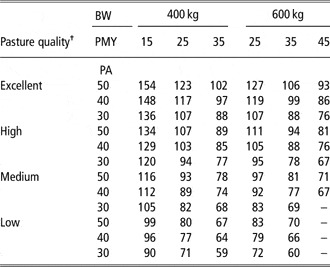
Combining animal requirements, intake capacity with pasture quality and grazing management practices highlights secure combinations and combinations leading to very negative energy balance considering potential milk production (Table 3). These simulations show that grazing cows could produce their PMY until 35 kg 4% fat corrected milk (FCM) but only on excellent quality pasture with very high herbage allowance that precludes rational grassland management. In almost all situations, high-producing cows will not meet their requirements and achieve their potential milk production with grazing alone. It is also clear that PA can only marginally be used as a tool to reduce the gap between energy requirements and energy supply from pasture in grazing dairy cows. Similarly, theoretical net energy balance of medium-producing cows (i.e. close to 25 kg of potential 4% FCM) is highly dependent on pasture quality, energy requirements being not met in a standard grazing situation. Low-producing cows appear able to meet requirements in broader range of pasture quality and grazing management (Table 3). Nonetheless, although grassland-based systems prevent high genetic merit cows for fully expressing their milk potential, several trials have shown that relatively high milk production (i.e. 7000 kg/lactation; Buckley et al., Reference Buckley, Dillon, Rath and Veerkamp2000) is achievable.
Theoretical net energy balance, expressed in percentage of theoretical net energy requirements, of unsupplemented grazing multiparous dairy cows varying in BW and PMY (kg 4% FCM/day at 20 weeks of lactation) according to pasture quality and PA, (in kg DM/day at ground level)

FCM = fat corrected milk; NE = net energy; BW = body weight; PMY = potential milk yield; PA = pasture allowance.
†See definitions in Table 2.
Simulations are done from the GrazeIn model (Faverdin et al., Reference Faverdin, Baratte, Delagarde and Peyraud2011; Delagarde et al., Reference Delagarde, Faverdin, Baratte and Peyraud2011a) with dairy cows grazing a paddock at a pre-grazing pasture mass of 4 t DM/ha and with 125, 100 and 75 m2/day at high, medium and low PA, respectively.
High-quality fresh forages are highly fermentable
A series of experiments was conducted (Peyraud, Reference Peyraud1993 and unpublished results) to study the ruminal digestion of fresh grasses or white clover (WC). Ruminal pH rapidly decreases with the level of intake for grasses and averages 6.3 and 5.8 for 15 and 20 kg DM intake, respectively. At the same time, volatile fatty acid (VFA) concentration increases from 110 to 135 mM/l and the acetate-to-propionate ratio rapidly declines from 3.4 to 2.6 between 15 and 20 kg DM intake. High ruminal VFA concentration have also been reported by Stakelum and Dillon (Reference Stakelum and Dillon2003). At grazing, Delagarde and Peyraud (Reference Delagarde and Peyraud2000), Stakelum and Dillon (Reference Stakelum and Dillon2003) and McEvoy et al. (Reference McEvoy, Delaby, Murphy, Boland and O'Donovan2010) showed that the average pH of the rumen became <6 approximately 3 to 4 h following allocation of a new paddock and remained <6 during at least 12 h. Ruminal pH around 5.5 is frequent at the end of the day on leafy swards. Therefore, high-producing dairy cows exhibits intensive ruminal fermentation with grasses. However, none of the risk associated to low rumen pH is reported (McEvoy et al., Reference McEvoy, Delaby, Murphy, Boland and O'Donovan2010). This suggests that the cow and the rumen can tolerate low pH and high VFA production without the negative impacts that are generally associated with grain-based diets. This might be primarily related to the low rate of intake at grazing and frequent meals that prevent both initial rapid drop of pH and further fluctuation of rumen pH. Moreover, the high K content of fresh forage compared to maize silage or cereal concentrates (30 to 40, 10 and 5 g/kg DM, respectively) should prevent metabolic acidosis because the absorption of K increases blood bicarbonate concentration. Blood bicarbonate is then undoubtedly partly recycled into the rumen to limit the decrease of pH (Apper-Bossard et al., Reference Apper-Bossard, Peyraud, Faverdin and Meschy2010).
Rumen pH is hardly affected by the level of intake with WC and the mean value is higher than for grasses (6.5). However, VFA concentration also increases with level of intake for WC. Therefore, WC is more efficient than grasses to buffer ruminal fluid. This can be related to the lower sugar content and to the greater crude protein (CP) content of WC compared to perennial ryegrass. The high calcium content of WC can also contribute to buffer the rumen fluid.
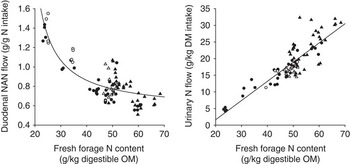
Ruminal N losses in ruminants that are fed fresh forages are often high due to the unbalanced level of degradable N and fermentable energy in the forage. This leads to an inefficient utilisation of forage N and high urinary N excretion (Figure 3). Duodenal N flow is lower than N intake as soon as the forage N content is higher than 35 g/kg Digestble OM (DOM; i.e. 120 g CP/kg DM). It averages 75% of N intake with WC compared to 93% for grasses even though duodenal N flows is higher for WC compared to grasses (41.9 v. 33.7 g/kg DOM). WC increases N excretion relative to grasses from 20.1 to 29.8 g/kg DM intake. The data also show that considerable reflux in N to the rumen is possible when cows are fed on low N forages either because the level of N fertilisation is reduced or because the age of regrowth is increased. Consequently, the supply of metabolic protein is always much less affected than expected considering the variation in forage protein content.
Relationship between fresh forage N content and non-NH3 N (NAN) flow entering the duodenum or urinary N flow on dairy cows fed on fresh forages (●, grasses (perennial ryegrass or cocksfoot); ○, grasses + concentrate; ▴, white clover, ▵, white clover + concentrate).

Solutions to manage variations in nutrient supply under grazing
As described previously, the most important limiting factor is herbage intake. Therefore, solutions must focus on the way to increase nutrient intake.
Supplementation with concentrates
The effects of feeding supplement on grazing dairy cow performance has been reviewed extensively (Peyraud and Delaby, Reference Peyraud and Delaby2001; Baudracco et al., Reference Baudracco, Lopez-Villalobos, Holmes and McDonald2010). In high genetic merit Holstein cows, efficient response of 1 kg of milk/kg of concentrate is achieved up to a concentrate supplementation level of 6 kg/day. Milk response to concentrate however largely depends on the type of cow and genetic merit that determines partition of energy between milk and body reserves. The efficiency of concentrate supplementation at grazing is closely related to energy balance of the cows and substitution rate, thus increasing in high-producing cows, low-quality pasture and low PA (Faverdin et al., Reference Faverdin, Dulphy, Coulon, Vérité, Garel, Rouel and Marquis1991; Stockdale, Reference Stockdale2000). Concentrate supplementation also increases milk protein content and decreases milk fat content (+0.2 g/kg and 0.6 g/kg per kg DM of concentrate, respectively).
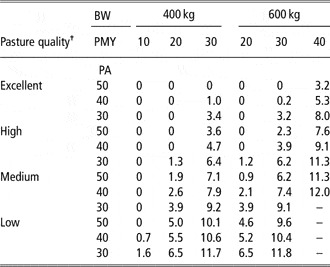
Recent predictive models can be used to simulate the interactions between cows, sward quality, grazing management and supplementation (Delagarde et al., Reference Delagarde, Faverdin, Baratte and Peyraud2011a). Concentrate level to meet net energy requirements of grazing dairy cows can be calculated for the large range of feeding situations described in Table 3. These simulations show that 0 to 12 kg DM concentrate are needed to meet energy requirements, concentrate level being maximal (>10 to 12 kg DM) in high-producing cows at low pasture quality and low PA. The implication is that high-producing cows should be fed only in high-quality pasture to achieve a high per-cow performance without high concentrate use. When given concentrate levels lower than the values reported in Table 4, MY/cow is lower than the potential milk production. With an average milk response of 1 kg of milk/kg of concentrate, milk production of unsupplemented cows can be predicted from Table 4. As an example, ∼12 kg concentrate are needed at medium pasture quality and medium PA for cows to reach the 45 kg PMY, indicating that these cows will produce ∼33 kg of milk without concentrate. The corresponding figure for PMY of 35 and 25 kg are 7 and 2 kg of concentrate, thus indicating ∼28 and 23 kg MY produced without concentrate, respectively. Finally, increasing concentrate level is the only way to achieve high MY/cow of high genetic merit, even at high PA and high-quality pasture (Tables 2, 3 and 4). Therefore, feeding concentrate is a very efficient tool to maintain a high stocking rate and good sward management for achieving high milk yield per cow and per ha.
Concentrate supplementation level (kg DM/day) to meet net energy requirements of unsupplemented grazing multiparous dairy cows varying in BW and PMY (kg 4% FCM/day at 20 weeks of lactation) according to pasture quality and PA (in kg DM/day at ground level)

DM = dry matter; BW = body weight; PMY = potential milk yield; FCM = fat corrected milk; PA = pasture allowance.
†See definitions in Table 2.
The conditions of the simulations are described in Table 3.
Energy source (starch or fibre, rate of starch degradation) has little effect on milk production, milk composition and PI particularly at moderate concentrate level. Compared with wheat, fibrous concentrate slightly increased milk fat content (+1.3 g/kg) and decreased milk protein content (−0.5 g/kg; Delaby and Peyraud, Reference Delaby and Peyraud1994). The nature of energy does not appear to affect the substitution rate when fresh grass is fed indoors (Schwartz et al., Reference Schwartz, Haffner and Kirchgessner1995). Under severe grazing conditions, source of energy has no effect on herbage intake and MY (Delagarde et al., Reference Delagarde, Peyraud and Delaby1999). The implication of this result is that there is little improvement to be expected by modifying the nature of energy at grazing at low-to-moderate concentrate level whatever the grazing conditions. However, the effect of highly fermentable carbohydrates increases at high supplementation level. Sayers et al. (Reference Sayers, Mayne and Bartram2000) compared high-starch and high-fibre concentrates, either at 5 or 10 kg DM/cow per day. They reported a great fall in milk fat content with increasing amount of starch (29.9 v. 36.6 g/kg), but not with increasing amount of fibre (36.2 v. 39.4 g/kg). This effect is probably associated with modifications in ruminal fermentation profile, observed at high supplementation level (van Vuuren et al., Reference van Vuuren, van der Koelen and Vroons-De Bruin1986).
Increasing the content of low degradable protein meal in the concentrate did not affect herbage intake on swards with a CP concentration of >150 g/kg DM (Delagarde et al., Reference Delagarde, Peyraud and Delaby1997) but increased herbage intake and MY when cows grazed on low fertilised grasses with CP content well below 130 g/kg DM (+0.8 and +2.1 kg/kg concentrate, respectively, for DM intake and MY; Delagarde et al., Reference Delagarde, Peyraud and Delaby1999). This effect could be related to a better N nutrition status of the animal as duodenal N flow was sharply increased. Although of apparently small magnitude (i.e. 5%; Peyraud and Astigarraga, Reference Peyraud and Astigarraga1998), the decrease in metabolic protein supply on low fertilised sward is not negligible for MP supply in high-producing cows. The positive effect on intake could also be related to an alleviation of a shortage of degradable protein in the rumen (from recycling urea) as both ruminal NH3 and fibrolytic activity increased in this study.
Part-time grazing associated to forage supplementation
In many situations, cows have access to grazing only for few hours daily. The reasons for short daily access time to grazing are numerous, including low pasture availability in autumn or winter, wet conditions with high risk of fouling, legislation constraints in Northern Europe and cow welfare improvement or manure management. In practice, daily access time at pasture could also be used as a grazing management tool if a time constraint would allow increasing grazing efficiency through manipulation of foraging behaviour (Chilibroste et al., Reference Chilibroste, Soca, Mattiauda, Bentancur and Robinson2007). If short-term behavioural adaptation following feed deprivation is well known (Chilibroste et al., Reference Chilibroste, Soca, Mattiauda, Bentancur and Robinson2007), the extent to which time availability affects dairy cow performance and intake, as well as behavioural adaptation mechanisms have been recently studied in various situations at daily scale.
In recent studies, it has been reported that, with low-to-medium supplementation levels, MY is generally reduced when daily time at pasture, given in one grazing session daily, is <8 h (Kristensen et al., Reference Kristensen, Oudshoorn, Munksgaard and Soegaard2007; Delaby et al., Reference Delaby, Peyraud, Pérez-Ramírez and Delagarde2008). It is clear that dairy cows can react to a time constraint at grazing through an increase in the proportion of time spent grazing and in PI rate (Kennedy et al., Reference Kennedy, McEvoy, Murphy and O'Donovan2009; Pérez-Ramírez et al., Reference Pérez-Ramírez, Peyraud and Delagarde2009). In these studies, with restricted access time, 90% to 95% of time is spent grazing and PI rate can increase by 30% to 40% when compared to full-time grazing. Finally, grazing efficiency, defined as DMI per hour of access, can increase from 0.4 kg (full-time access) to 1.5 kg (8 to 9 h access) and up to 2.0 to 2.5 kg (one 4-h grazing session or two 3-h grazing sessions per day). To maximise cow behavioural adaptation and grazing efficiency, it can be recommended to split access time into two sessions per day, that is, after milking times, particularly at low supplementation level where high PI is expected. In fact, cows seem unable to maintain a high rate of grazing activity during one daily grazing session of 8 to 9 h (Pérez-Ramírez et al., Reference Pérez-Ramírez, Peyraud and Delagarde2009; Pérez-Prieto et al., Reference Pérez-Prieto, Peyraud and Delagarde2011), but can maximise proportion of time spent grazing and PI rate during two grazing sessions of 3 to 4 h (Kennedy et al., Reference Kennedy, McEvoy, Murphy and O'Donovan2009; Pérez-Ramírez et al., Reference Pérez-Ramírez, Peyraud and Delagarde2009). PA or sward height, partly determining PI rate, have also been shown to affect the ability of ruminants to adapt to a time constraint (Pérez-Ramírez et al., Reference Pérez-Ramírez, Peyraud and Delagarde2009).
Part-time grazing combined with restricted indoor feeding should be considered as an interesting alternative to reduce the amount of conserved forages, which are always expensive to produce, and to stabilise MY/ cow. By combining the results of recent experiments, recommendations of minimal access time for grazing dairy cows can be proposed according to supplementation level and pre-grazing sward height in order to maximise grazing efficiency (Table 5), cows achieving ∼90% of their maximal intake and producing only 1 to 2 kg milk/day less than a full-time grazing. To maximise per-cow performances, 2 h of access time (or 5 kg of maize silage) can be added to the values reported in Table 5. The amount of supplementary forage must be adjusted to the access time to maximise MY/cow. When access time is restricted to 4 h, 15 kg of maize silage are required to achieve high animal performance. When access time is 8 h, milk response to silage supplementation reached a plateau for 10 kg of maize silage (Delaby et al., Reference Delaby, Delagarde and Peyraud2009).
Recommended minimal access time for grazing dairy cows according to indoors supplementation level and pre-grazing sward height

DM = dry matter.
†At low supplementation level, splitting access time into two grazing sessions allows a reduction in total access time by 1 to 2 h/day compared to reported values without adverse effect of animal performance.
Increasing the proportion of green material within the sward
In a rotational system, the proportion of green leaf in the grazed horizons is partly determined by grazing management. Wade et al. (Reference Wade, Peyraud, Lemaire and Comerón1989) first concluded that PI and milk production increased with the proportion of green leaves in the bottom of the sward when the animals cease to eat. This was further demonstrated by Parga et al. (Reference Parga, Peyraud and Delagarde2000) showing that herbage intake increases on leafy swards at similar PA. Therefore, increasing leaf blades mass at the bottom of the sward by appropriate grazing management in early spring may play a major role in improving sward quality and increasing herbage intake while maintaining a low residual sward height over the entire grazing season. O'Donovan et al. (Reference O'Donovan, Delaby and Peyraud2004) compared grassland utilisation and milk production on swards that were previously allowed to graze in March (6 h, day 1) with swards not grazed before mid-April. Delaying spring grazing leads to large accumulation of herbage that can be difficult to graze and make grazing management more difficult in subsequent rotations. On early grazed plots, MY/cow increased by 1 kg/day, with also an increased grass utilisation.
Increasing age of regrowth increases the proportion of sheath at the expenses of green leaf material. Herbage intake of grazed ryegrass falls by 2.2 kg/day between the vegetative and the reproductive stage (Greenhalgh et al., Reference Greenhalgh, Reid, Aitken and Florence1966). Some effect of age of regrowth is also reported in the case of vegetative swards. Parga et al. (Parga J and Hoden A; unpublished results) showed a 1.5 kg DM fall in daily intake between 20 and 40 days of regrowth, the effect being more important in June than in early spring. The detrimental effect of age of regrowth on intake is worsened in terms of inputs of nutrients by the reduction of the nutritive value of grasses.
Changing the botanical composition of the sward
The original work of Demarquilly (Reference Demarquilly1963) showed some reproducible variations in MY when cows grazed different grasses and legumes species. Herbage intake and MY were both reduced by 1 to 2 kg/day when cows grazed on cocksfoot rather than on perennial ryegrass swards (Greenhalgh and Reid, Reference Greenhalgh and Reid1969). Therefore, an extra amount of 2 kg of concentrate must be provided to maintain MY on a cocksfoot sward (Hoden and Peyraud, unpublished results). Tetraploid ryegrass varieties can increase intake and production relative to diploid varieties (Hageman et al., Reference Hageman, Lantinga, Schlepers and Neuteboom1993).
At grazing, herbage intake is markedly higher (+15% to +20%) with pure legume relative to pure grass pastures (Alder and Minson, Reference Alder and Minson1963). The beneficial effects of WC on animal intake and performance within a WC–grass pasture have been demonstrated by Wilkins et al. (Reference Wilkins, Gibb, Huckle and Clements1994). The difference increases with the clover content and reaches a maximum when clover content averages 50% to 60% (Harris et al., Reference Harris, Auldist, Clark and Jansen1998). Mixed pastures steadily increased PI and MY (on average 1.5 kg/day) whatever the level of herbage allowance (Ribeiro-Filho et al., Reference Ribeiro-Filho, Delagarde and Peyraud2005). In addition to the positive effect of WC on voluntary intake, it is also probable that leaves of legumes are more favourable for prehension than stems and sheaths of grasses. Ribeiro-Filho et al. (Reference Ribeiro-Filho, Delagarde and Peyraud2003) reported that higher intake on WC–grass pastures is mediated through a higher rate of intake on mixed pastures compared to pure grass pastures. A series of experiments conducted in Rennes with fistulated dairy cows (Peyraud, Reference Peyraud1993 and unpublished results) also showed that WC increases OMD (0.80 v. 0.78 kg/kg) and the amount of non-NH3 N entering the intestine (28.9 v. 24.3 g/kg DM intake), which reflected the supply of metabolisable protein compared to perennial ryegrass.
One of the most decisive advantages of WC is that the rate of decline of nutritional quality throughout the plant-ageing process is less than for grasses. For example, Peyraud, (Reference Peyraud1993) and Delaby and Peccatte (Reference Delaby and Peccatte2003) reported digestibility higher than 0.75 after 7 weeks regrowth or at flowering stage during the first growth of WC. At grazing the difference in DM intake between pure grass pastures and WC–grass pasture increases with increasing age of regrowth. Ribeiro-Filho et al. (Reference Ribeiro-Filho, Delagarde and Peyraud2003) showed that herbage DM intake declined by 2.0 kg/day on perennial ryegrass (PRG) pasture compared to 0.8 kg/day on mixed pastures. This makes mixed pastures easier to manage than pure grass pastures. Age of regrowth can be increased without adverse effects on quality.
WC–grass pastures with low or no N fertiliser rarely produce almost as much as heavily fertilised pure grasses. Trials carried out over several years concluded that the performances on a per-ha basis are comparable between the two types of pastures (Peyraud et al., Reference Peyraud, Le Gall and Lüscher2009) even though short-term trials have demonstrated a clear advantage for WC–grass mixtures. Beyond the binary mixtures, a positive effect of the specific diversity of the swards on the productivity on a per-ha basis might appear. Some well-adapted species are adequate without it being necessary to seek very complex mixtures, which are more difficult to manage. However, a pan-European experiment carried out at 28 sites in 17 countries across Europe showed strong benefits of grass-clover mixtures containing four species when compared to these species sown in monoculture (Lüscher et al., Reference Lüscher, Finn, Connolly, Sebastià, Collins, Fothergill, Porqueddu, Brophy, Huguenin-Elie, Kirwan, Nyfeler and Helgadottir2008). In a North American context, Deak et al. (Reference Deak, Hall, Sanderson, Rotz and Corson2010) showed that botanically diverse pastures have lower variability and DM yield from year to year and they produce more than simple mixtures in dry years. They have therefore the ability to attenuate the inconsistent pasture production with weather fluctuations. Nonetheless, recent results in the United States do not demonstrate a clear advantage of plant diversity on performance on a per-cow basis (Soder et al., Reference Soder, Rook, Sandeson and Goslee2007) and more studies are needed to assess performances on a per-cow and per-ha basis of grazing systems based on mixed swards of several grasses, legumes and forbs.
Changing the biochemical composition of the sward
Because of the poor conversion of forage N into milk N in grazing cows, a large amount of research has been devoted to improve N utilisation through manipulating plant composition. Lowering the levels of N fertilisation is a very efficient mean for reducing N losses in ruminants. Most N-balance measurements indicate a marked reduction of N excreted via urine, which is fully explained by variations in urea-N excretion which in turn is primarily attributable to an ample decrease of N losses in the rumen (Peyraud and Astigarraga, Reference Peyraud and Astigarraga1998). However, reducing N fertilisation dramatically reduce DM yield and alternative strategies must be considered to reduce harmful N emissions to the environment.
In Wales, the potential of using perennial ryegrass with enhanced levels of water-soluble carbohydrates (WSC) was investigated in dairy cows using experimental perennial ryegrass varieties bred to contain a high concentration of WSC (Miller et al., Reference Miller, Moorby, Davies, Humphreys, Scollan, McRae and Theodorou2001; Moorby et al., Reference Moorby, Evans, Scollan, Macraet and Theodorou2006). The concept is that provision of readily available energy can have a significantly positive influence on N utilisation efficiency and animal performance. Increased WSC content is generally associated to a decrease in N content, particularly when N fertilisation level is reduced (Peyraud and Astigarraga, Reference Peyraud and Astigarraga1998). In the above-cited studies, however, increasing WSC decreased NDF and did not affect N content. It also increased OMD, MY and forage DM intake, and slightly reduce the proportion of dietary N excreted in urine. In these experiments, the protein content of ryegrass was very low (<11%) that might have been impaired OM and NDF digestion, which remained rather low. Tas et al. (Reference Tas, Taweel, Smit, Elgersma, Dijkstra and Tamminga2005) and Taweel et al. (Reference Taweel, Tas, Smit, Elgersma, Dijkstra and Tamminga2005) compared six cultivars of perennial ryegrass, the largest difference between cultivars being the WSC content (ranging from 90 to 160 g/kg DM), and protein content being higher than 150 g/kg DM. They did not observe significant effect of WSC content on herbage intake, MY and N metabolism. In these studies, urinary N was more closely related to N content in the grass than to WSC content. Therefore, the benefits of increasing WSC are yet questionable. At grazing, it may be also relevant to consider the comparative performance of livestock grazed on a per-ha basis by trials carried out over several years to assess both the ability of varieties rich in WSC to sustain high productivity while reducing the risk of harmful losses to the environment. Indeed, perennial ryegrass is an already known species for its high sugar content. It would be interesting to lead such studies on other species like tall fescue or cocksfoot.
The utilisation of condensed tannins to reduce the ruminal degradability of forage protein has been extensively studied. Condensed tannins are polyphenols of high molecular weight widely distributed through legumes species. It is now well established that condensed tannin increase duodenal N flow per unit of N intake, the higher is the condensed tannin (CT) concentration, the higher is the effect (Min et al., Reference Min, Barry, Attwood and McNabb2003). The efficiency of CT however differs among legumes. Until now there is no obvious demonstration of a positive effect of tannin-rich legumes on MY in EU conditions perhaps because the OMD of tannin-rich legumes is lower than for high-quality grasses or WC. Moreover, some legumes rich in CT are not well adapted to most temperate regions of Western Europe. In New Zealand, feeding Lotus corniculatus increases both herbage intake and MY in dairy cows compared to ryegrass (Woodward et al., Reference Woodward, Auldist, Laboyrie and Jansen1999). The other advantage of tannin-rich legumes is their anthelmintic effect for sustainable control of internal parasites, especially for small ruminants (Hoste et al., Reference Hoste, Jackson, Athanasiadou, Thamsbord and Hoskin2006) and reducing bloat risk. In addition, CT might also reduce methane emission per kg of milk produced in grazing dairy cows (Woodward et al., Reference Woodward, Waghorn and Laboyrie2004). However, at grazing the risk of nitrate leaching largely depends on the stocking rate and it may be more relevant to consider the comparative performance of livestock grazed on a per-ha basis.
Conclusion
Grazed pasture is the cheapest source of nutrients for dairy cows and should form the basis of profitable low inputs animal production systems in Europe. Therefore, management of high-producing animals at pasture is becoming a major challenge in most countries. The objective is to achieve a high efficiency of grassland utilisation. High-producing cows cannot satisfy their energy requirements and express their genetic merit for milk production from grazing alone but grazing situations more favourable to sustain high animal performance are identified. Recent results show that high-producing cows can still achieve satisfactory levels of performance with only a moderate supply of concentrate. There is also considerable scope to improve animal performance at grazing given recent developments in our understanding of sward and nutritional factors influencing PI and digestion. Strategies of supplementation with concentrates or association of part-time grazing and conserved forages provided in limited amount are very efficient to manipulate the amount of nutrient intake. Increasing leaf blade mass at the bottom of the sward by appropriate grazing management in early spring combined with short age of regrowth on pure grass swards allow to increase digestible energy intake per animal while maintaining a low residual sward height that facilitate grazing management. The more systematic use of legumes in WC–grass pasture or in more diverse mixtures is also a promising strategy to increase nutrient inputs and to attenuate the variations of pasture production with weather fluctuations. Further investigations are required to better control abundance of individual species. Finally, developing new varieties with enhanced levels of WSC and lower protein content might be a useful alternative for reducing the risk of harmful N emissions to the environment while maintaining a high level of production per animal and per ha.