Engineered nanomaterials: Production and uses
Engineered nanomaterials (ENMs) are substances purposefully manufactured with dimensions in the nanoscale (10–9 m). Their small size, chemical composition, and structure give them distinct and sometimes unique properties (high-surface-area-to-volume ratio, enhanced reactivity, optical and electrical properties, among others), Reference Wang, Lombi, Zhao and Kopittke1 which make them ideal for a wide variety of uses. Estimates indicate that silicon dioxide (SiO2) and titanium dioxide (TiO2) are the most produced ENMs worldwide, with production up to 95,000 and 88,000 metric tons/year, respectively. Iron oxides (FeO x ), aluminum oxides (AlO x ), and zinc oxide (ZnO) are also produced in large quantities, with amounts between 34,000 and 42,000 metric tons/year, while production of cerium dioxide (CeO2) is estimated to be approximately 10,000 metric tons/year. Reference Keller, McFerran, Lazareva and Suh2 The increasing production rates of these materials have raised concerns about environmental release of ENMs and its implications. Reference Rizwan, Ali, Qayyum, Ok, Adrees, Ibrahim, Zia-ur-Rehman, Farid and Abbas3 Figure 1 shows the estimated global flow of ENMs in 2010, including (left) production (metric tons/year) and applications, and (right) destination and organisms that could be affected.
(Left) Engineered nanomaterials (ENMs) world production in metric tons/year and their applications; (right) estimated environmental release and organisms that could be affected. Reference Keller, McFerran, Lazareva and Suh2

Uptake and translocation of ENMs by plants
Predictions about the environmental accumulation of ENMs have motivated the scientific community to study their possible effects on soil-cultivated plants. Plants take up elements and other nutrients from the soil solution, but questions regarding root uptake and translocation of ENMs are still under investigation. Since 2008, several studies have reported the uptake and translocation of ENMs. Reference López-Moreno, de la Rosa, Hernández-Viezcas, Castillo-Michel, Botez, Peralta-Videa and Gardea-Torresdey4,Reference Zuverza-Mena, Martinez-Fernandez, Du, Hernandez-Viezcas, Bonilla-Bird, Lopez-Moreno, Komarek, Peralta-Videa and Gardea-Torresdey5 Two research questions have been of particular interest. The first is whether uptake of ENMs was occurring, and second, whether the ENMs remained in the nanoform after traversing biological membranes. An overview of recent findings about the mechanisms of uptake and translocation of TiO2, CeO2, and ZnO ENMs is discussed here.
Plant uptake and transport of elements
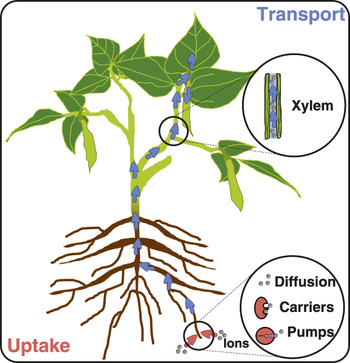
In order to understand the movement of elements within plants, we will refer to two processes—uptake, which is the root acquisition of elements from soil, and transport, or translocation of elements from roots to aboveground tissues ( Figure 2 ). It is worth noting that not all elements taken up by roots are translocated into upper tissues by the same mechanisms. Figure 3a shows how roots take up elements as ions (charged atoms) and transport them through the extracellular spaces of adjacent cells (apoplastic pathway). In another route, the ions are carried across cell membranes by specific transporters (carriers and pumps) and moved through the cytoplasm from cell-to-cell (symplastic pathway). Particulate matter appears to also be absorbed via these pathways. Inside the root, elements/particles are transported up to the endodermis (a layer of cells surrounding the plant transport system, also called the vascular system), which has a barrier called the Casparian strip. This barrier limits the entrance of water and solutes into the xylem, which is the plant tissue responsible for transporting water and dissolved nutrients (Figure 3a–d). Once substances pass across the endodermis, the long-distance upward movement to the aerial system occurs via the xylem, where specialized tissues carry both water and mineral salts to the leaves. Reference Jones6,Reference Taiz and Zeiger7
General mechanism of plant uptake and transport of ions. The uptake of ions from the soil by the root system occurs by simple diffusion via intercellular spaces or by carriers and pumps that facilitate their passage through the cell membrane. Ions are further transported to aboveground plant parts through a specialized tissue responsible for the transport of water and dissolved nutrients (xylem).

(a) Diagram of the root structure showing the apoplastic (through the cell walls, nonliving tissues) and symplastic (through the cell plasma membranes, living tissues) pathways for solutes’ transport. Reference Taiz and Zeiger7 (b) Confocal image of corn root treated with fluorescein isothiocyanate-labeled CeO2 engineered nanomaterials (ENMs). (c) Aggregates of CeO2 distributed through cell walls in the cortex. (d) CeO2 ENM aggregates within the xylem. (c–d) Magnifications of the squares in (b). Reference Zhao, Peralta-Videa, Varela-Ramirez, Castillo-Michel, Li, Zhang, Aguilera, Keller and Gardea-Torresdey12 Note: NP, nanoparticle.

Titanium dioxide ENMs translocated to aboveground plant tissues
TiO2 ENMs are present in sunscreens, surface disinfectants, solar cells, food coloring, paints, and other products. TiO2 has been estimated to be one of the most abundant ENMs released into the environment. Reference Zuverza-Mena, Martinez-Fernandez, Du, Hernandez-Viezcas, Bonilla-Bird, Lopez-Moreno, Komarek, Peralta-Videa and Gardea-Torresdey5 Several reports have shown insights into TiO2 ENMs interactions with plants. It has been stated that the observed effects of TiO2 in plants are due to the ENMs, not to the titanium (Ti) ions released from the nanomaterial.
Although studies performed in hydroponics showed root uptake and translocation of TiO2 ENMs in wheat, Arabidopsis, cucumber, tomato, rapeseed, and soybean, Reference Zuverza-Mena, Martinez-Fernandez, Du, Hernandez-Viezcas, Bonilla-Bird, Lopez-Moreno, Komarek, Peralta-Videa and Gardea-Torresdey5,Reference Du, Tan, Peralta-Videa, Gardea-Torresdey, Ji, Yin and Guo8 this section will focus on soil studies. Root-to-fruit translocation of TiO2 ENMs in soil-grown cucumber plants was first demonstrated in 2013. Reference Servin, Morales, Castillo-Michel, Hernandez-Viezcas, Munoz, Zhao, Nunez, Peralta-Videa and Gardea-Torresdey9 Synchrotron micro-x-ray fluorescence (μ-XRF) imaging, which has been widely used in the analysis of metals in plant tissues, showed the presence of Ti inside plant tissues.
Figure 4 shows the fluorescence map of a cross section of cucumber fruit grown in soil amended with TiO2. Figure 4a is the μ-XRF image of the cucumber tissue, which shows Ti in red, calcium (Ca) in blue, and potassium (K) in green. Since this image only confirmed the presence of Ti inside the tissue, the authors used x-ray absorption near-edge structure (XANES), which can provide information regarding the chemical structure of the analytes, to determine if Ti was in nanoparticulate form. As shown in Figure 4b, the XANES analysis was performed in two spots on the cucumber (iii, iv) and compared against TiO2 in two different crystal structures, anatase (i) and rutile (ii), which served as reference materials. XANES confirmed that the Ti found in cucumber tissues was in the form of TiO2. As can be observed, spot 1 (spectrum iii) resembles that of TiO2 rutile (spectrum ii), while spot 2 (spectrum iv) resembles spectrum i, corresponding to TiO2 anatase. Reference Servin, Morales, Castillo-Michel, Hernandez-Viezcas, Munoz, Zhao, Nunez, Peralta-Videa and Gardea-Torresdey9 The data addressed the two research questions—cucumber plants were able to take up the TiO2 ENMs from the soil and translocated them all the way to the fruit without transformation.
(a) Tricolor μ-x-ray fluorescence image of cucumber fruit treated with TiO2 engineered nanomaterials. Red color stands for titanium, green for potassium, and blue for calcium. (b) X-ray absorption near-edge structure spectra (i, ii) of TiO2 reference materials compared with (iii, iv) two spots of interest in the cucumber obtained from (a). Spectrum (iii) resembles that of (ii) TiO2 rutile and spectrum (iv) resembles that of (i) TiO2 anatase. Reference Servin, Morales, Castillo-Michel, Hernandez-Viezcas, Munoz, Zhao, Nunez, Peralta-Videa and Gardea-Torresdey9

In another study, a tomato plant was grown in soil containing TiO2 ENMs. Similar to the previous results, Ti was found in the different tissues in the following concentration sequence—stems > roots > leaves > fruits. Reference Raliya, Nair, Chavalmane, Wang and Biswas10 Results of this study confirmed that the TiO2 remained in the nano-size within tissues.
Cerium dioxide, a nanomaterial with low uptake and translocation
Nanoparticulate CeO2 is mainly used as a catalyst in common applications, such as diesel fuel, and it is found in automotive exhaust. Interestingly, a few reports point out that exposure to low concentrations of CeO2 increases plant production. Reference Zuverza-Mena, Martinez-Fernandez, Du, Hernandez-Viezcas, Bonilla-Bird, Lopez-Moreno, Komarek, Peralta-Videa and Gardea-Torresdey5,Reference Barrios, Rico, Trujillo-Reyes, Medina-Velo, Peralta-Videa and Gardea-Torresdey11 This suggests that it could be intentionally applied as a nanofertilizer. Nevertheless, some results are contradictory, so conclusive information regarding CeO2 ENM effects in plants still needs to be elucidated.
Interactions between CeO2 ENMs and plants have been evaluated through exposure of several crop plants, including corn, soybean, tomato, cucumber, and bean. Reference Zuverza-Mena, Martinez-Fernandez, Du, Hernandez-Viezcas, Bonilla-Bird, Lopez-Moreno, Komarek, Peralta-Videa and Gardea-Torresdey5,Reference Du, Tan, Peralta-Videa, Gardea-Torresdey, Ji, Yin and Guo8 The general conclusion concerning the uptake is that a small amount of the CeO2 taken up by roots enters the xylem and is translocated to aboveground tissues. The mechanisms of Ce uptake have been assessed through hydroponic studies. Reference Zhao, Peralta-Videa, Varela-Ramirez, Castillo-Michel, Li, Zhang, Aguilera, Keller and Gardea-Torresdey12–Reference Zhang, Ma, Zhang, He, Zhang, Guo, Tai, Zhao and Chai14
One-month-old corn plants were exposed to CeO2 ENMs stained with fluorescein isothiocyanate, a commonly used fluorescent dye, and the tissues were observed with a confocal microscope (Figure 3b–d). Reference Zhao, Peralta-Videa, Varela-Ramirez, Castillo-Michel, Li, Zhang, Aguilera, Keller and Gardea-Torresdey12 The images showed most of the CeO2 ENMs in the intercellular spaces of the epidermis and cortex (the two external layers of the root tissue) (Figure 3a, c), while a few particles of CeO2 reached the xylem (Figure 3d). In addition, by using μ-XRF images, the presence of Ce in the vascular tissues was confirmed; however, the amount of Ce translocated to leaves and cobs was not significant.
Bean plants were later exposed to a suspension of CeO2 ENM, and by using μ-XRF and XANES, it was found that most of the Ce in the roots was in the form of tetravalent Ce [Ce(IV)], the oxidation state of Ce in the CeO2 ENM, along with small amounts of ionic Ce (trivalent form) released from the ENM. Reference Majumdar, Peralta-Videa, Bandyopadhyay, Castillo-Michel, Hernandez-Viezcas, Sahi and Gardea-Torresdey13 Furthermore, results showed that CeO2 particles were able to cross the material-blocking Casparian strip at the emission sites of secondary roots, before the strip is formed, reaching the xylem for further transportation (Figure 3a).
Another study of cucumber exposed to a solution of CeO2 ENMs, showed Ce as CeO2 and cerium phosphate (CePO4) in roots, while in shoots, it was in the form of CeO2 ENMs and cerium carboxylates. Reference Zhang, Ma, Zhang, He, Zhang, Guo, Tai, Zhao and Chai14 This suggests that CeO2 ENMs undergo biotransformation due to the organic acids and reducing substances present in the plant/soil. Once the ions are transformed, they can form different complexes during the translocation to upper tissues, Reference Zhang, Ma, Zhang, He, Zhang, Guo, Tai, Zhao and Chai14 but the toxicity of the complexes toward plants and animals remains unknown.
Finally, a soil study in soybean plants also confirmed that CeO2 ENMs were taken up from the soil and translocated from roots to pods and seeds, with a small amount being biotransformed to trivalent Ce. Reference Hernandez-Viezcas, Castillo-Michel, Andrews, Cotte, Rico, Peralta-Videa, Ge, Priester, Holden and Gardea-Torresdey15 Overall, findings demonstrate effective plant uptake of CeO2 with little biotransformation to ionic Ce and negligible translocation to aboveground tissues.
Zinc oxide, an ENM that undergoes biotransformation on/in the plants
ZnO ENMs are well known for their broad-spectrum ultraviolet absorption properties, which make them good materials for use in sunscreens; thus, these ENMs are widely incorporated in cosmetics. They are also found in supplements, ceramics, and paints, among others.
Hydroponics and soil-grown plants exposed to ZnO ENMs have shown Zn uptake and translocation to all plant tissues in a dose-dependent trend, but the ZnO ENMs did not remain in the original form. Mesquite plants exposed to ZnO ENMs in hydroponics were analyzed with μ-XRF and XANES. μ-XRF showed the presence of Zn in roots and leaves, while XANES indicated that the Zn present in tissues was in ionic form (Zn2+), with a spectrum resembling zinc nitrate. Reference Hernandez-Viezcas, Castillo-Michel, Servin, Peralta-Videa and Gardea-Torresdey16 These results indicated that ZnO ENMs undergo dissolution once they are in contact with the soil, Reference Wang, Menzies, Lombi, McKenna, Johannessen, Glover, Kappen and Kopittke17 and in fact, they may behave similarly to ionic Zn.
Results from hydroponic studies were confirmed with a study performed in farm soil with soybean. Reference Priester, Ge, Mielke, Horst, Moritz, Espinosa, Gelb, Walker, Nisbet, An, Schimel, Palmer, Hernandez-Viezcas, Zhao, Gardea-Torresdey and Holden18 Electron microscope images with energy-dispersive x-ray spectroscopy of soybean seeds harvested from plants exposed to ZnO ENMs are shown in Figure 5 . The seed coat and the embryonic primary leaf, named cotyledon, fundamental elements of the seed structure (left), are depicted in Figure 5a. Figure 5b is a magnification of the box in Figure 5a, where a high-resolution electron microscope image shows unusual bright nano-sized Zn accumulation within cells (arrows). Figure 5c is an untreated seed, where the electron-dense regions do not appear as in the treated seed (Figure 5b), and no nano-sized accumulation was detected. This study confirmed the ZnO ENM transformation and Zn translocation to the bean seeds.
Electron microscope images of soybean seeds grown in soil with added ZnO engineered nanomaterials. (a) Illustrates the seed coat (SC) and cotyledon (C) tissues, and (b) is a magnification of (a), where high-electron-density regions (triangle) show Zn enrichment and the arrows represent nanozinc accumulation. (c) Control soybean, whose electron-dense regions are not apparent as in (b), and nanozinc accumulations are not visible. Reference Hernandez-Viezcas, Castillo-Michel, Andrews, Cotte, Rico, Peralta-Videa, Ge, Priester, Holden and Gardea-Torresdey15

Summary
Experimental results have shown that some ENMs such as TiO2 are taken up from soil by roots and translocated to aboveground plant tissues without transformation. ENMs like CeO2 are taken up and undergo little transformation within plants, while others, like ZnO, are transformed in the soil/root resulting in tissue Zn enrichment.
Evidence indicates that some ENMs have the potential to accumulate in edible plant tissues. However, there is still the need to elucidate how alterations in the surface chemistry or the aging of ENMs modify their interactions with plant systems. Further challenges to better understand the impacts of ENMs in plants include full life-cycle studies in soils with different pH, organic-matter content, and composition. In addition, information concerning the interactions of ENMs with plant macromolecules, such as nucleic acids, proteins, and carbohydrates, is needed.
Acknowledgments
We would like to acknowledge the NSF/EPA Agreement No. DBI-1266377, the NIH 2G12MD007592, USDA Grant No. 2016–67021–24985, and the NSF CHE-0840525 and DBI-1429708 Grants. Partial funding was provided by the NSF ERC on Nanotechnology Enabled Water Treatment (EEC-1449500). I.A. Medina-Velo acknowledges the Consejo Nacional de Ciencia y Tecnología, Mexico.

Illya A. Medina-Velo is a doctoral candidate in the Department of Chemistry at The University of Texas at El Paso, performing environmental research with the University of California Center for Environmental Implications of Nanotechnology. She obtained her BS degree in food chemical engineering from the Autonomous University of Chihuahua, Mexico, and her M.Ed. degree from the Monterrey Institute of Technology and Higher Education, Mexico. She is a volunteer at the Sustainable Nanotechnology Organization. Her current research interests include science education. Medina-Velo can be reached by phone at (915)-747-8855 or by email at iamedinavelo@utep.edu.

Jose R. Peralta-Videa is a researcher specialist in the Department of Chemistry at The University of Texas at El Paso. He obtained his BS degree in agronomy from the National Agricultural University of Nicaragua in 1975; his MS degree in agricultural sciences from the Tropical Agricultural Research and Higher Education Center, Costa Rica, in 1978; his PhD degree in genetics and plant breeding from the Chapingo Postgraduate College, Mexico, in 1983; and his PhD degree in environmental science and engineering from The University of Texas at El Paso in 2002. He has published more than 200 papers and currently serves as associate editor of the journal Nanotechnology for Environmental Engineering. His research interests include the study of the physiological and biochemical effects of engineered nanomaterials in plants and the phytoremediation of heavy metals. Peralta-Videa can be reached by phone at 915-747-8998 or by email at jperalta@utep.edu.

Jorge L. Gardea-Torresdey is chairman of the Chemistry Department and the Dudley Professor of Chemistry and Environmental Science and Engineering at The University of Texas at El Paso, and associate editor of the journal Environmental Science & Technology. He obtained his MS and PhD degrees in analytical chemistry from New Mexico State University. He has authored over 400 publications. His research interests include environmental chemistry, phytoremediation, XRF, XAS, and the bioproduction and phytotoxicity of metal nanoparticles. He has received numerous honors and awards. His research achievements are highlighted in the Lawrence Hall of Science at the University of California, Berkeley. Gardea-Torresdey can be reached by phone at 915-747-5359 or by email at jgardea@utep.edu.