1 Introduction
The pronunciation of the vowel in words such as bath, slant and past, labelled the bath set after Wells (Reference Wells1982: xviii–xix), is one of the most salient social and geographical markers of English English varieties. Traditional varieties of the southwest of England are distinguished by having a front or central bath vowel where RP has a back vowel, yet this feature is relatively understudied in these varieties. There are questions in the literature about the phonological status of this and related vowels, such as whether the vowel of bath is a different phoneme to that of trap in these varieties as in traditional varieties of the southeast. Regardless, there is good reason to expect disruption of the traditional systems and change towards the southeastern form in recent decades.
This article presents an investigation into the trap, bath and related vowels in Bristol English, an urban variety of the southwest of England. In broad terms, the research question is whether and how the vowels of these words are changing in Bristol English: is the traditional dialect maintained? Is the influence of eastern varieties being felt? Do the trap and bath lexical sets align with the variation we find, or do we need to distinguish additional groups of lexical items? Since the historical situation is poorly understood, in order to pose these questions precisely we must first survey past studies in detail. The historical processes affecting the vowels in question in English English varieties are summarised in section 2.1. The traditional dialect in Bristol is described in section 2.2. Sociolinguistic studies of these vowels in related varieties are discussed in section 2.3 before we return to our research questions in section 3. The methodology of this study is summarised in section 4; data from Bristol are presented in section 5, followed by discussion (section 6) and conclusions (section 7).
2 Background
2.1 History of Middle English /a/
The reflexes of Late Middle English short /a/ are subject to a great deal of variation between and within varieties of Modern English. Anderson (Reference Anderson1987: 12–20) attempts to explain the variation by just two changes:
• loss of rhoticity in historical nonprevocalic /ar/ with compensatory lengthening (and sometimes backing) of the vowel, and
• the trap–bath split, by which historical /a/ lengthens and backs in some words to merge with the reflex of historical /ar/.
From these two changes are derived a typology of four dialect types. RP and varieties of the southeast of England are characterised by both of the changes, giving them two phonemes: long, back /ɑː/ in bath and start vs short, front /a/ or /æ/ in trap. The traditional dialects of Lancashire, Northumberland and the West Country have neither change, giving them just one phoneme in all three sets. Other Englishes of the north of England have loss of rhoticity but no trap–bath split, giving them one vowel in trap and bath and a different vowel in start. Anderson (Reference Anderson1987: 20) categorises no dialects into the fourth type, with the trap–bath split but retaining rhoticity to give three distinct sets. However, since West Country dialects fall south of the trap–bath split isogloss but retain rhoticity, they seem likely candidates.
The reality is far more complex than this simple picture, both because these changes must be broken down into subparts which can occur independently and because other more limited processes must also be acknowledged. Restricting ourselves to traditional British English varieties, we can enumerate at least the following changes and processes:
1. the sequence /al/ becomes /au/;
2. /au/ from this and other sources usually becomes a long, low, rounded monophthong (thought) (Anderson Reference Anderson1987: 21), but becomes unrounded in certain lexical items such as palm, command etc. (the palm set) (Beal Reference Beal2002: 105);
3. /a/ is sometimes lengthened preceding /ðəɹ/ and /ðz/ (father, rather, lather, paths; here labelled the father set) (Beal Reference Beal2002: 107);
4. /a/ is lengthened preceding various fricatives and nasal clusters (with lexical exceptions), potentially merging with the palm and father sets: _f#, _#ft, _θ#, _s#, _sk, _sp#, _st, _ʃ, _v#, _mpəl, _nd, _nt, _nʧ, _ns (the bath set);
5. /a/ is backed before /r/ (the start set) (Anderson Reference Anderson1987: 14);
6. /a/ is lengthened before /r/ (the start set);Footnote 2
7. nonprevocalic /r/ is lost (start);
8. in varieties which, as a result of (some of) these sound changes, now have distinct long and short front /a/ phonemes, the long phoneme is backed (bath, palm, father);
9. in varieties with distinct phonemes, foreign words may be borrowed with the long (sometimes back) phoneme (lava, drama, etc.) or the short (usually front) phoneme (anorak, alfalfa, etc.) (Beal Reference Beal2002: 105–6; also cf. Boberg Reference Boberg2009);
10. /a/ is lengthened in certain trap words, particularly preceding /d/, apparently without producing a phonemic split (the ‘bad–lad split’ (Kettig Reference Kettig2015); lengthened ‘short a’ (Piercy Reference Piercy2011));
11. there is lexical variation within varieties with the trap–bath split, with perhaps a gradual tendency to move words into the trap set (plastic, Atlantic, trans-, alas, masculine, blasphemy, chaff, plaque, mass etc.) (see Wells Reference Wells1982: 295–6; Beal Reference Beal2002: 108–9).
Different combinations and orderings of these derive a large potential dialect space, much of which is instantiated by traditional British dialects. Shifts in the distribution of these processes continue to be a site of dialectal change today (Piercy Reference Piercy2011; Britain et al. Reference Britain, Leemann, Blaxter, Wanitsch, Kolly and Grossenbacher2016; Blaxter, Leemann & Britain Reference Blaxter, Leemann and Britain2017).
2.2 The traditional dialect
2.2.1 Studies of Bristol English
To investigate ongoing changes in unrounded low vowels in Bristol English we must first describe the traditional system which we assume as the starting point. There is good reason to expect Bristol English to be distinct from the dialects of the surrounding countryside. The city is an old urban centre (founded in the early eleventh century) and port which has long functioned as a centre for international trade (in particular, it played a key role in the triangular slave-trade in the first half of the eighteenth century). As such, it had a different contact situation to the rural dialects nearby, raising the possibility of unique substrate features, and the population density needed to sustain its own dialect. Nevertheless, work on Bristol English is thin on the ground. Weissmann (Reference Weissmann.1970) presents a description of the phonology of Bristol English from recordings of male speakers between the ages of 21 and 32 made in 1961–2. Wakelin (Reference Wakelin1986: 197–205) presents broad transcriptions of recordings with dialect speakers and a brief description of major features of the dialect. Kester's (Reference Kester1979) master's thesis presents an investigation into Bristol English on the basis of interviews with three generations of speakers from three families living in Bedminster. Wells (Reference Wells1982) presents a brief description of the phonology of Bristol English in the context of a longer discussion of West Country Englishes. Hughes, Trudgill & Watt (Reference Hughes, Trudgill and Watt2012) list some major features of Bristol English on the basis of a transcribed recording of a 30-year-old woman from the Bristol area. These sources are summarised in Coates (Reference Coates and Wright2018).
These studies of Bristol English give us a conflicting picture. Wakelin (Reference Wakelin1986: 198) writes: ‘I take /ɑː/ (= Bristol [ɑː]~[aː]~[æː]) in, e.g., dance, last, to be a separate phoneme from /a/.’ This would suggest that Bristol English has the trap–bath split and palm patterns with bath (since dance < ME daunce; see OED). By contrast, Hughes, Trudgill & Watt (Reference Hughes, Trudgill and Watt2012: 88) state that in Bristol English ‘there is no /a/ ~ /ɑː/ contrast’ and summarise that in the whole of the West Country and West Midlands this contrast is ‘absent or in doubt’Footnote 3 (Reference Hughes, Trudgill and Watt2012: 63). Kester (Reference Kester1979: 16, 27) likewise assumes that trap and bath have the same phoneme /a/, sometimes subject to subphonemic lengthening in words such as man. Wells (Reference Wells1982: 345–9) takes an intermediate position, stating that in most of the West Country the trap–bath distinction is not maintained, due to both frequent lengthening of trap and shortening of bath and palm, but that in Bristol it is. However, exactly what this opposition in Bristol English is is unclear: Wells initially suggests a length distinction (‘the opposition between trap and bath is retained, as gas [gæs] vs grass [græːs ~ graːs]’ (Reference Wells1982: 345–6)), but later claims that there are no phonemic length distinctions in Bristol English and suggests the opposition is one of /a/ vs /æ/ (Reference Wells1982: 348–9). Weissmann (Reference Weissmann.1970: 161), too, claims that there is a phonemic distinction but that it is one of place: ‘half-open’ /æ/ in pat, cam, cash, man and bad vs ‘open’ /a/ in calf, halve, Calne, pass and bra. Both have long, half-long and short allophones with complex conditioning (Reference Weissmann.1970: 163–8); crucially, /a/ is short only when unstressed, whereas /æ/ has short allophones in some stressed contexts. Note that Weissmann's /a/ vs /æ/ distinction does not entirely correspond to the trap–bath split, since grant, chance, can't, shan't and dance are assigned to the /æ/ set (Weissmann Reference Weissmann.1970: 164); palm words fall under /a/.
2.2.2 The Survey of English Dialects: qualitative approach
Moving beyond these studies which look directly at traditional Bristol English, we can try to infer the situation in Bristol from the better-studied surrounding dialects. The Survey of English Dialects (Orton & Dieth Reference Orton and Dieth1962) did not visit Bristol since it did not cover most urban varieties, but it did visit locations in the Bristol area, and it may be worth examining the SED's characterisation of the dialect surrounding Bristol.
There are good reasons to expect much noise in SED data. Firstly, phonetic transcriptions cannot ever be perfectly accurate. Subtle phonetic distinctions may reflect different decisions by transcribers on borderline phones. We should be especially sceptical of transcriptions of vowel length, since vowel length in natural speech is influenced by a host of factors unrelated to phonemic length distinctions. Forms we find in the published volumes of the SED result from the idiosyncratic approaches of individual fieldworkers tempered by editorial mentoring, normalisation and interpretation; as a result, if we draw isoglosses between individual points, we may really be drawing isoglosses between fieldworkers (see Payne Reference Payne2017; Hotzenköcherle Reference Hotzenköcherle1962; Mathussek Reference Mathussek, Knooihuizen and Nerbonne2016). Secondly, many features of interest are likely to have been subject to sociolinguistic variation. In such cases we cannot draw strong conclusions from a single token and would be better served by a sample of several tokens of the same lexical item from the same speaker, but the SED is not geared towards providing such data: additional tokens of the same word from elsewhere in the interview are often cited, but only where they are phonetically different. Accordingly, we can sometimes give a list of productions for a given word from a speaker, but have no idea of their relative frequencies. More often, a lexical item was only elicited in one question so we must work with just one token. Complicating things further, Payne (Reference Payne2017), examining the SED fieldworker notebooks, shows that the idealised relationship between speakers and localities in the SED (each locality is represented by a single speaker and each speaker represents a single locality) is sometimes violated: in a few localities, part of the survey was answered by one speaker and part by another; in many localities, the speakers’ wives or other family members (who did not necessarily fit the expected demographic or regional profile) supply incidental forms; in at least one case, a single speaker was recruited to represent more than one locality.
Payne thus questions the entire ‘concept of an identity for the locality … in favour of the importance of considering the speech of an individual’ (Payne Reference Payne2017: 49). Nevertheless, in the absence of detailed analysis of the phonetic features of the city dialect before Weissmann (Reference Weissmann.1970), this older material is all we have to go on and will have to serve, warts and all, as the historical basis for any analysis of the current urban accent.
For these reasons, we present two analyses of SED data here. Firstly, we follow an approach close to that of Maguire (Reference Maguire2012), examining a large number of lexical items with historical /a/ at the SED survey points near Bristol. This allows us to describe the phonological systems of a small number of dialect speakers from this region in the 1950s as fully as possible. Secondly, taking a small number of lexical items, we smooth the data and generalise across multiple nearby speakers; this, we suggest, is the best way to draw isoglosses from SED data and so describe regional norms.
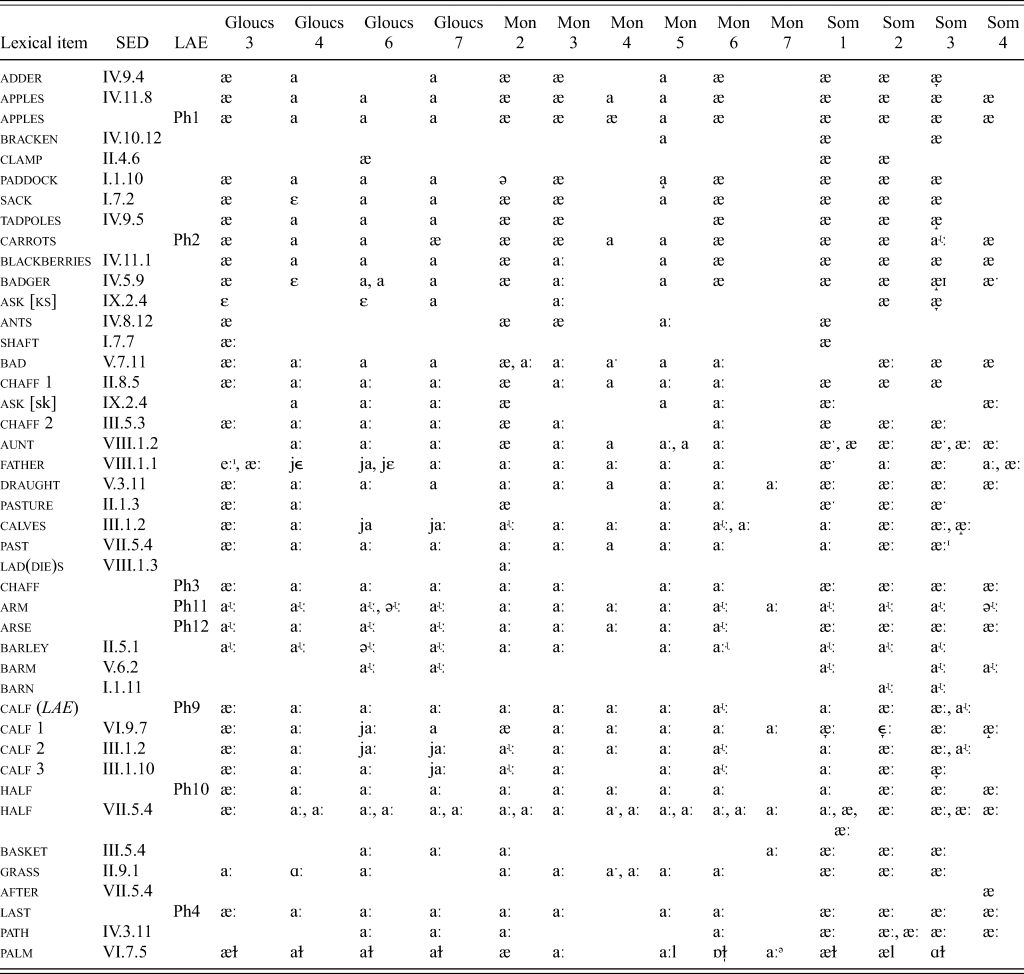
Words in the SED relevant to the reflexes of Middle English /a/ are the following: adder, ants, apples, arm, arse, ask, aunt, bad, badger, barley, barm, barn, basket, black(berries), bracken, calf (3 instances), calves, carrots, chaff (2 instances), clamp, draught, father, grass, after + half + past (seven), lad(die)s, last, paddock, palm, pasture, path, sack, shaft, tadpoles. The full dataset is presented in the Appendix. Of these, apples, arm, arse, calf, carrot, chaff, half and last have been mapped in the Linguistic Atlas of England (LAE) (Orton, Sanderson & Widdowson Reference Orton, Sanderson and Widdowson1978). man and walk are not relevant because of well-understood regional influences of the following [n] and the preceding [w] respectively. wrong and among are not considered because the short vowel in these is retained universally, and is subject to unrelated rounding and transfer to other lexical sets.
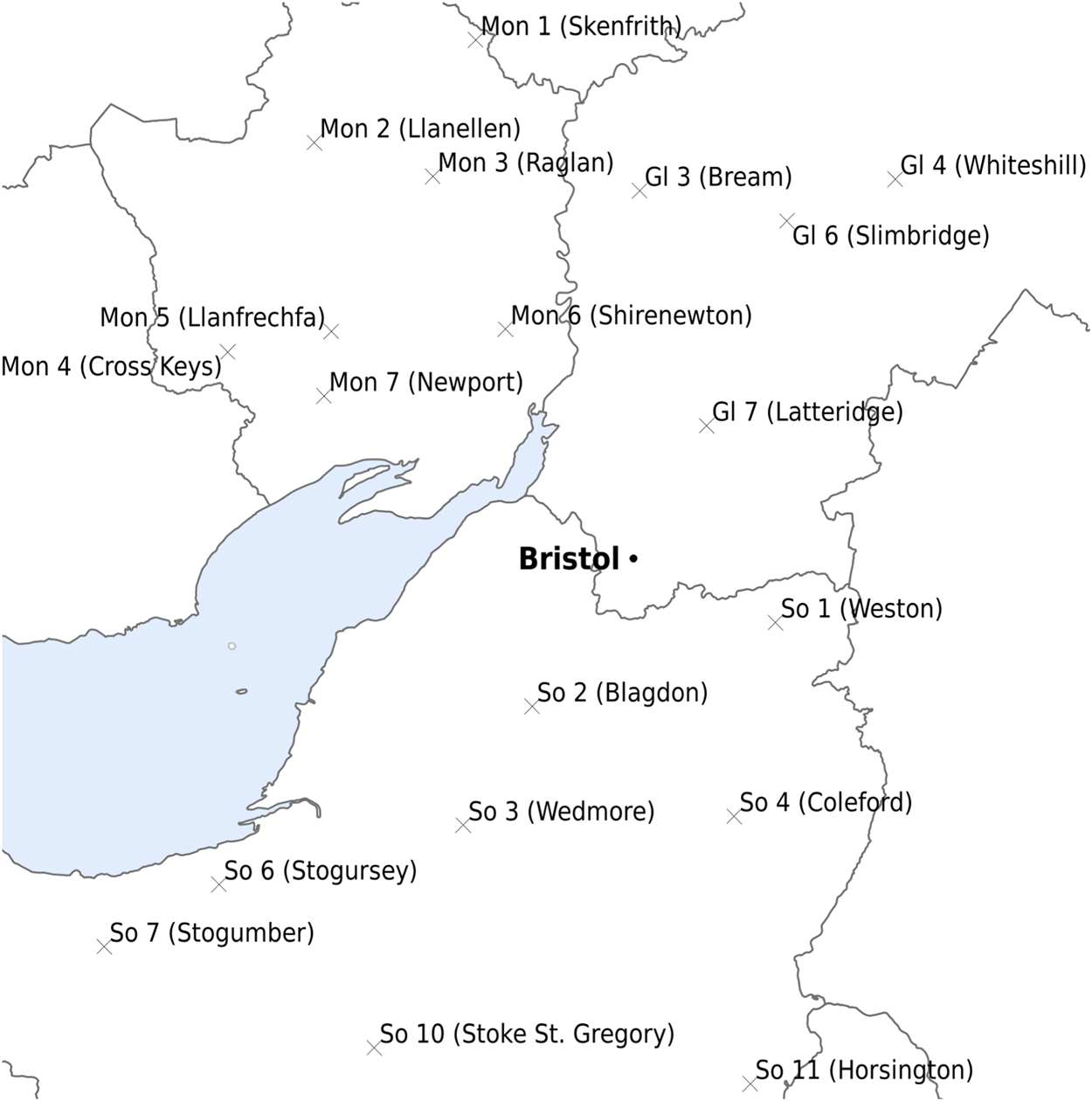
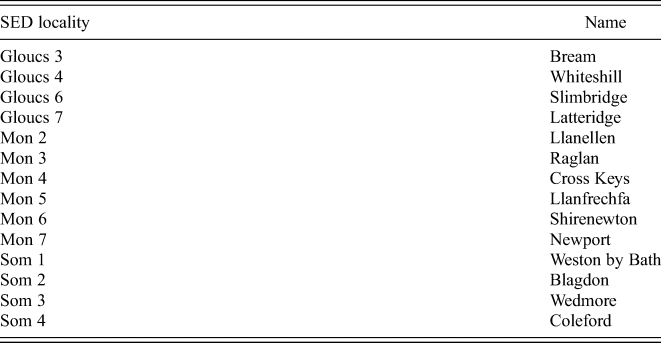
The SED localities relevant to the study of Bristolian in Gloucestershire (Gloucs) and Somerset (Som) are as follows. In Gloucestershire, in order of distance from central Bristol: 7 Latteridge, 3 Bream, 6 Slimbridge and 4 Whiteshill,Footnote 4 though note that Bream is on the western side of the Severn and Whiteshill is some 25 miles from Bristol. In Somerset, in order of distance from central Bristol: 2 Blagdon, 1 Weston by Bath, 3 Wedmore and 4 Coleford; note that Coleford is some 20 miles from Bristol. Some attention is paid to places in the closer parts of Monmouthshire (Mon), now in Wales but subject to competing political claims before 1974. The relevant points: 6 Shirenewton, 7 Newport, 5 Llanfrechfa, 4 Cross Keys, 3 Raglan, 2 Llanellen (Llanelen). The situation in this county may differ radically from that in either Gloucestershire or Somerset, for instance through lengthening of [a] in man. These survey points are shown in figure 1.
SED survey localities around Bristol

In what follows, diacritics indicating raising or lowering compared with the cardinal vowels are omitted. Half-length is implicitly equated with length.
Late Middle English /a/ appears before (/m/ +) a voiceless plosive, or before a voiced plosive in a disyllable, in adder, apples, badger, black(berries), bracken, clamp, paddock, sack and tad(poles). These lack lengthening triggers and no lengthening is recorded except in badger and black(berries) which have [aː] at Mon 3 and badger which has half-long [aˑ] at Som 4 and a diphthong [æɪ] at Som 3. [æ] appears at Gloucs 3 in all relevant words; [ε] appears at Gloucs 4 in badger and sack. Otherwise [a] prevails in Gloucs. Som has [æ].
Late Middle English /a/ appears before a voiced plosive in a monosyllable in bad and lads. Lengthening is found in bad at Gloucs 3 and 4, Som 2 and 6, and Mon 3 and 6, with half length at Mon 4 and variable [bæd], [baːd] at Mon 2. Mon 2 has lengthening in the only instance of lads. The higher vowel [æ] is found at Gloucs 3 and Som 2, 3 and 4.
Late Middle English /a/ appears before a voiceless fricative in chaff, grass and path. Lengthening is universal in grass and path. chaff lacks pre-fricative lengthening in many accents which have it in other words. Som and west Mon keep the short higher front vowel [æ] (with [a] at Mon 4), whilst Gloucs and the rest of Mon have lengthening, with [aː] except at Gloucs 3 (west of the Severn). Lengthening is found in chaff 2 but not in chaff 1 at Som 2 and 3.
Late Middle English /a/ appears before a voiceless fricative cluster in after, ask, basket, draught, past, pasture and shaft. basket shows lengthening wherever it is recorded. draught shows lengthening everywhere except Gloucs 7 and Mon 4. past shows lengthening everywhere except at Mon 4, where the short vowel might be attributed to unaccented position in ‘half past seven’. last has a long vowel consistently, with Somerset and Gloucs 3 (west of the Severn) having [æː] and the rest of Gloucs and Mon having [aː]. pasture shows lengthening except at Mon 2; Som 1 has half-long. shaft has a short vowel at Som 1 and long at Gloucs 3, the only points where it is recorded. ask is problematic since metathesis of /sk/ occurs at Gloucs 3, 6 and 7, Som 2 and 3 and Mon 3; /a/ remains short at these points, with the exception of Mon 3 with [aː]. At the remaining points, a short vowel is found at Gloucs 4 and Mon 2 and 5; lengthening occurs at Gloucs 6 and 7 (varying with metathetic forms), Som 1 and 4 and Mon 6. Where variation is encountered, one might suspect that in using the non-metathetic form the speaker was ‘talking posh’. We discount the evidence of after since it occurs only at Som 4 and there only in forms in which the fricative is lost and the plosive voiced. Regarding vowel height, [æ] is found in these words in Som, and [a] in Gloucs except at Gloucs 3. Mon has [æ] where short at Mon 2, otherwise [a].
The case of /a/ in father is complex and not generalizable. It always has a long vowel (half-long at Som 1), or rising diphthong [ja] or [jε].
Late Middle English /a/ appears before historic /l/ + a consonant in calf 1 2 3, calves, half and palm. calf and half are expected to show [l]-loss and compensatory lengthening, and the SED data is consistent on this point. Lengthening is universal in words of English origin except in calf 1 at Gloucs 7 and Mon 2, and variably in half at Som 1. /l/ is retained without lengthening in the loanword palm in Som and Gloucs. /l/ is lost at Mon 2, 3 and 7, but retained at Mon 5 and 6; crosscutting this, lengthening is found at Mon 3, 5 and 7. Accents having a higher vowel [æː] in English words are those of Gloucs 3 and Som 3 in calf and half, and those of Som 2 and 4 only in half, with [aː] in all other relevant cases except at Mon 7 where nothing is recorded for either word. In palm, we find [æ] at Gloucs 3, Som 1 and 2 and Mon 2, with [pɑlm] at Som 6 and [pɒlm̩] at Mon 6.
Late Middle English /a/ appears before /nt/ in ants and aunt. ants is recorded at five points, always with [æ]; only at Mon 5 does lengthened [aː] appear, where the influence of aunt might be suspected. aunt has a long vowel Som and Gloucs (half-long where the word elicited was auntie), except at Gloucs 2 with [nænt]. Mon has a short vowel at Mon 2 and 4, long at Mon 3 and 6, and variable at Mon 5. As usual, Somerset has [æ]; ants is not recorded from Gloucs except at Gloucs 2 as noted.
Late Middle English /a/ appears before /r/ in arm, arse, barley, barm and barn. All localities show a long vowel in these words. Rhoticity is universally preserved east of the Severn in arm, and is found also at Mon 6, whilst the rest of Mon is non-rhotic, as is also the case with arse. In Gloucs, /r/ is retained in the form of rhotic colouring of a long vowel of variable quality; an unusual variant [əʵː] is found in arm at Gloucs 6 in variation with [aʵː], and at Som 4 instead of [aʵː]. In Som, rhoticity is retained in barley, barm and barn, with no quality variation. However, arse is non-rhotic [aːs] at Gloucs 4, the point furthest from Bristol and near the boundary of Wiltshire which also is largely non-rhotic in this word. At all four Som localities we find the higher vowel [æː] in arse, with the loss of [ɻ] found widely in other words where any type of /r/ occurs before [s] such as horse, curse. In Mon [aː] is general, and, only Mon 6, the point nearest Bristol and Gloucs, has [aʵː]. In Mon, barley is recorded but not barm or barn; in this word the vowel is also long, but all trace of /r/ is lost except at Mon 6 which, as with arm and arse, goes with Gloucs. It is notable that the variant [æ] prevalent in other environments in Somerset is absent before /r/ except in derhotacised arse, where the lengthening is not compensatory because the rhotacised variant in other counties is always long.
Hypercorrect rhotacised [aʵː] is found in calf 2, calf 3 and calves at Mon 2 and 6 (though calves only variably at Mon 6), and calf 2 variably at Som 3. In each case this is within a zone where non-rhotacised forms are general. half does not show this phenomenon.
According to the SED, outside the environments discussed above, [æ] is found in Somerset and [a] in Gloucestershire. The exception is Gloucs 3 west of the Severn, where [æ] prevails. The situation in Monmouthshire as represented for example by apples does not tie up in a geographically neat way with this; 5 and 4, the more westerly points, go with Gloucs, and 2, 4 and 6, the more easterly points, with Som. There is considerable lack of pattern at county level in other records from Mon.
carrots, also a word with no lengthening trigger, has [æ] except at Gloucs 4 and 6 and Mon 4, 5 and 7, where we find [a]. [aʵː] is found in this word only at Som 3, a small town on the Somerset Levels with no historic easy transport links to Bristol.
In summary:
1. /a/ (whether [a] or [æ]) remains unlengthened in adder, apples, bracken, carrots, clamp, paddock, sack and tadpoles, and usually in black(berries).
2. /a/ is variably lengthened before a voiced plosive.
3. /a/ is lengthened before a fricative in chaff north of Bristol but not in the area of Somerset relevant to the study, and is lengthened before a fricative cluster as in last in all areas. /a/ is most often [aː] in Gloucs and [æː] in Som.
4. /a/ is lengthened in words such as calf and half in which [l] is lost. The resulting vowel is often higher in Som than in Gloucs east of the Severn except at Som 1 which goes with Gloucs in both words.
5. [ɻ] is lost in words in which a fricative follows, exemplified by arse, south of Bristol but not north of Bristol. Otherwise [ɻ] is maintained except in the westernmost parts of Mon.
The SED shows little variation with respect to these generalisations. Short [æ] in chaff is found in an island consisting of Som 1, 2 and 3, and once in the far west of Mon at Mon 4. [æː] varies with [aʵː] in calf at Som 3. [aʵː] varies with [əʵː ] at Gloucs 6, but is isolated and well away from the other recorded instance of this phone at Som 4. bad is both [bæd] and [baːd] at Mon 2. Ahistoric rhotacism appears variably in calf 2 at Som 3 and in calves at Mon 6. half appears with variable length at Som 1.
2.2.3 The Survey of English Dialects: geospatial approach
In the second approach to the SED data, the following methodology has been employed. Kernel density estimations have been calculated for the variants of the vowel in each word examined using a Gaussian kernel with bandwidth of 35km.Footnote 5 Where multiple pronunciations are recorded for a single speaker, these have all been included and weighted equally: thus, if one token was recorded for a speaker it was weighted 1, if two tokens were recorded for a speaker then each was weighted 0.5, and so on. Voronoi polygonsFootnote 6 were drawn around the points and dissolved according to the majority variant in the KDE, giving regions with isoglosses. Finally, these isoglosses were smoothed with the snakes algorithm (Steiniger & Meier Reference Steiniger and Meier2004) using GRASS (GRASS Development Team 2017) in QGIS mapping software (Quantum GIS Development Team 2016).
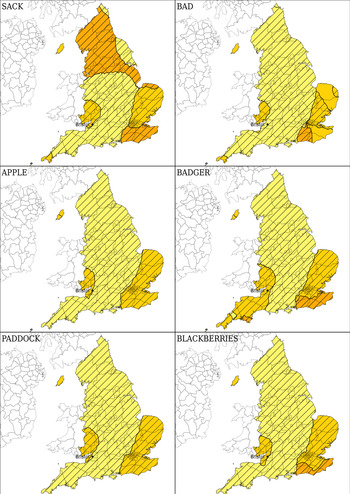
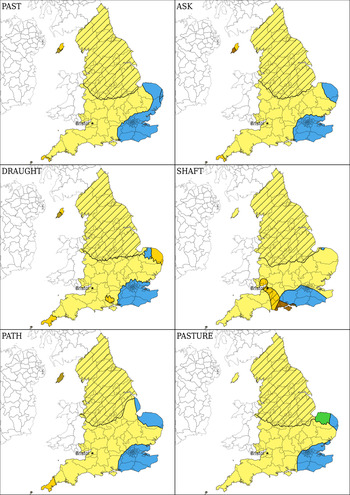
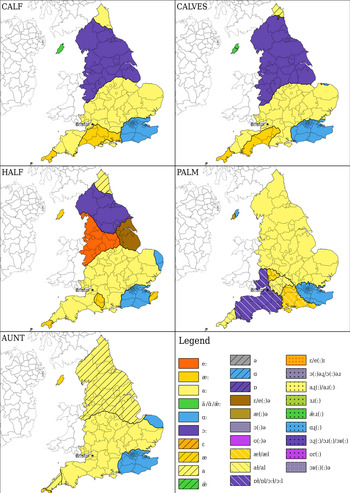
Six words in the trap set were examined and are visualised in figure 2: ‘sack’, ‘bad’, ‘apple’, ‘badger’, ‘paddock’ and ‘blackberries’. Nine words in the bath set were examined and are visualised in figures 3 and 4: ‘past’, ‘ask’, ‘draught’, ‘shaft’, ‘path’, ‘pasture’, ‘chaff’ and ‘grass’. The word ‘father’ is visualised in figure 4. Two words in the start set, ‘barley’ and ‘barm’, and one in the north set, ‘corn’, were examined and are included in figure 4. Finally, four words in the palm set were examined and are visualised in figure 5: ‘calf’, ‘calves’, ‘half’, ‘palm’ (the key to all the figures is also given in figure 5); ‘aunt’, which had LME /ɔː/ and so might be expected to pattern with palm but in fact patterns with bath, is also included here.Footnote 7, Footnote 8
Vowels in trap words in the SED

Vowels in bath words in the SED

Vowels in bath, start and north words and father in the SED

Vowels in palm words in the SED

Looking first at the trap vowel, we see a consistent pattern across most words in our area of interest: Bristol falls at the southern edge of an area including North Somerset, Gloucestershire and Monmouthshire with a raised [æ] vowel in trap, differing from [a] elsewhere. The one exception is ‘badger’ for which the [æ] region is much larger (presumably due to the following postalveolar), but this has no implications for Bristol specifically. Turning to bath, we find that Bristol is always in the lengthening area, and except in the case of the word ‘shaft’ (as noted in the qualitative approach), always has the lower quality [aː] in these words. Thus we can infer that the traditional local rural dialect maintained the trap–bath split with both a length and quality distinction: [æ] vs [aː]. Turning to the palm set and father, although we see quite different patterns to bath or trap across the country as a whole (with many northern Englishes treating palm with thought or face), for the SED region around Bristol palm and father clearly pattern with bath and are produced with long /aː/. The one exception is the word ‘palm’ itself, which, unlike ‘calf’, ‘calves’ and ‘half’, tended to retain its lateral and be produced with a short vowel in the Bristol area. This common patterning of the disparate sets palm, bath and father demonstrates that the /æ/ vs /aː/ split must have been phonemic. The start vowel was not backed, as is demonstrated by the maps for ‘barley’ and ‘barm’, but had the same quality as the bath vowel; note that, since Bristol fell in an area with unrounded and fronted north, this implies a merger of start and north.
Thus it can be seen that both approaches to the SED data suggest, in agreement with Wakelin (Reference Wakelin1986) but contra Hughes, Trudgill & Watt (Reference Hughes, Trudgill and Watt2012), that the traditional dialect of Bristol had the trap–bath split and that this was both a length and quality distinction but without backing of bath: /æ/ vs /aː/. palm and father patterned with bath, and start was rhotic and front. Of course, it must be reiterated that the SED did not cover Bristol and it is possible that the city dialect was, in fact, quite different to that of the surrounding countryside in some relevant respect. Nevertheless, without any specific good evidence for this, and given that what direct evidence we have for the traditional city dialect is equivocal, we should assume by Occam's Razor that traditional Bristol dialect resembled the surrounding dialects recorded in the SED.
2.3 Modern changes
There are no detailed studies of variation in the trap–bath split in Bristol English, but there are studies of related varieties from which we can infer the expected stages of change. Fudge (Reference Fudge1977) reports a study of the putative bad–lad split in the trap vowel in Hampshire English on the basis of introspection and casual observation, and covers the relative realisations of trap, bath and start. Although Hampshire English is not a very closely related variety, it does fall into the same dialect region for bath, as we have seen. Piercy (Reference Piercy2011) reports a study of the trap–bath split in Dorset English from interviews with forty speakers.
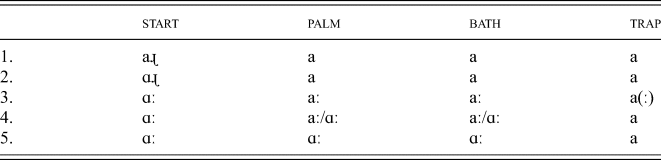
In Fudge's (Reference Fudge1977: 55–6) account of start, trap and bath in Hampshire English, variable loss of rhoticity without backing occurs in start (giving [aʴ] or [aə]) and lengthening always occurs in bath but backing only sometimes (giving [æː] or [ɑː]). Thus working-class Hampshire speakers have st[aʴ]t vs tr[æ]p vs b[æː]th and middle-class speakers have st[aə]t vs tr[æ]p vs b[ɑː]th. Fudge argues for a phonemic bad–lad split, so that an additional set with [æː] must also be distinguished. The stages of change observed by Fudge would thus be as given in table 1.Footnote 9
Stages of change in low unrounded vowels in Hampshire English according to Fudge (Reference Fudge1977)

Piercy, differing from Fudge's assumptions for Hampshire English and contradicting arguments made here from the SED, finds that some Dorset speakers have no quality or length distinction in start, bath, palm and trap, with an /a/ of variable length in all these sets; Piercy takes such speakers to represent the traditional dialect situation. From these speakers through to those with a system closest to the southeastern standard, Piercy (Reference Piercy2011: 160) proposes five stages:
1. no length or backness contrast in unrounded low vowels;
2. start is backed, no contrast among trap, palm and bath;
3. start is backed and non-rhotic, palm and bath are lengthened, trap is variably lengthened;
4. start is backed and non-rhotic, palm and bath are long and variably backed;
5. trap is front, start, palm and bath are long and back.
Piercy observes that the backing of start appeared to be taking place by neogrammarian sound change: for transitional speakers, start tokens were further back (and closer) on average than trap tokens but with overlapping distributions. By contrast, backing of bath was taking place by lexical diffusion, with certain words usually exhibiting a back vowel for a given speaker even when most words in the set had a front vowel. The specific lexical items Piercy mentions in this regard, half and rather (Piercy Reference Piercy2011: 161), are not actually members of the bath set but of the palm and father sets. Nevertheless, it seems a priori very plausible that the first change (backing of start) would progress by regular sound change but that all subsequent changes would be by lexical diffusion, since these subsequent changes involve the transfer of lexical items between existing sets (see table 2).
Stages of change in low unrounded vowels in Dorset English according to Piercy (Reference Piercy2011)

The English Dialect App (EDA) (Britain et al. Reference Britain, Leemann, Blaxter, Wanitsch, Kolly and Grossenbacher2016) gives us a rather different window on ongoing change in dialects of the southwest of England. Using a smartphone app, this project surveyed over 41,000 speakers of English in the British Isles, asking them (among other questions) whether they used a long or short vowel in ‘last’. The results show much variation between long and short vowel in the West Country, with high numbers of respondents reporting a short vowel in the West Midlands, around Bristol and Gloucestershire, and in Cornwall, which was interpreted as evidence for southward movement of the trap–bath isogloss (Blaxter, Leemann & Britain Reference Blaxter, Leemann and Britain2017). An alternative interpretation is that the trap–bath split was not phonemic in traditional dialects of the southwest of England, and so is identified only inconsistently in self-reported usage data; yet another is that it is an artefact of this method of data collection.
3 Research questions
We have built up a complex and contradictory picture of the unrounded low vowels in Bristol English. There is good reason to assume that the traditional dialect of Bristol had two phonemes differentiated at least by length, /æ/ vs /aː/. These distinguished the trap vs bath lexical sets; most palm words also fell into the bath set. However, the evidence is not unequivocal, and it is possible that the [æ] vs [aː] distinction was non-phonemic. start was rhotic and front. In recent decades, we might expect dialect levelling: change away from the traditional system and towards the southeastern standard. Loss of rhoticity is indeed taking place in Bristol English (Blaxter et al. Reference Blaxter, Beeching, Coates, Murphy and Robinsonforthcoming), and we might also expect: backing of start; lengthening of bath, palm and father if not already long; and backing of bath, palm and father. All three of these changes are reported in Dorset and Hampshire, although the evidence of the EDA complicates the picture for the bath vowel.
For the remainder of this article, we will investigate a new set of data for Bristol English. On the basis of the picture we have built up above, we can ask the following questions of these data:
• do palm, father, bath and loanwords which pattern with bath elsewhereFootnote 10 have a distinctively longer vowel than trap?
• is backing of start, palm, father, bath and bath loanwords taking place?
• does backing of start occur before loss of rhoticity (as in Piercy's study of Dorset) or after (as in Fudge's account of Hampshire)?
• does backing of start occur before backing of other sets (as in Dorset) or after (as in Hampshire)?
• do palm, father, bath and bath loanwords behave as a group, or do they undergo backing separately?
• does the backing of these words progress by neogrammarian sound change or by lexical diffusion?
4 Methodology
Twenty-five native speakers who lived and were born in Bristol were recorded in unstructured sociolinguistic interviews; these comprised 12 speakers born between 2000 and 2003 all but one of whom was interviewed in school, 12 speakers born between 1920 and 1949, and one speaker born in 1971. These were 16 female speakers and 9 male speakers. For more details on these recordings, see Blaxter et al. (Reference Blaxter, Beeching, Coates, Murphy and Robinsonforthcoming). Fifteen tokens of each of trap, bath and start were identified from the transcriptions and extracted from the recordings; where some of these had to be excluded (due to background noise, reduction by fast speech processes, etc.), additional tokens were added to reach 15 wherever possible. In addition, all tokens of father (‘father’, ‘rather’ and compounds), palm (most often the word ‘half’) and loanwords which have the same vowel as words of the bath set in RP were extracted. The total number of tokens was 1,650. For each token, F1 and F2 values and vowel length were measured using Praat and rhoticity was coded auditorily. F1 and F2 values were normalised as a proportion of values taken to be the centre of the vowel space, the method proposed by Bigham (Reference Bigham2008).Footnote 11 Vowel length was normalised as a proportion of mean non-prepausal vowel length for that speaker.Footnote 12
For each speaker, vowel backness (normalised F2) for each set of tokens (bath, bath loans, palm, father and start) was compared to backness for trap tokens with a two-sided t test in R (R Core Team 2018) to determine whether each showed significant evidence of backing (p < 0.05). The same procedure was followed for normalised vowel length for bath, bath loans, palm and father. This gives us a crude, initial measure of whether each speaker has the trap–bath split (their bath should be significantly backer and/or longer than trap) and start backing (start should be significantly backer than trap). Speakers were categorised as retaining rhoticity if at least 75 per cent of their start tokens were rhotic, as having lost rhoticity if 25 per cent or fewer start tokens were rhotic, and as having variable rhoticity otherwise.
5 Results
5.1 Major lexical sets
start tokens were found to be significantly further back than trap tokens for all speakers. The other changes affecting the major lexical sets start and bath varied between speakers.
5.1.1 Loss of rhoticity
Speakers exhibited a wide range of rates of rhoticity in start, from rhoticity on all tokens examined (s23, s28) to none of the tokens examined (s20, s3, s8, s5, s9). These are visualised in figure 6. As expected from the more in-depth study of rhoticity across other vowels (Blaxter et al. Reference Blaxter, Beeching, Coates, Murphy and Robinsonforthcoming), there is a clear trend towards loss of rhoticity in apparent time: older speakers show higher rates of rhoticity than younger speakers.
(Colour online) Rates of rhoticity on start tokens

5.1.2 Bath lengthening
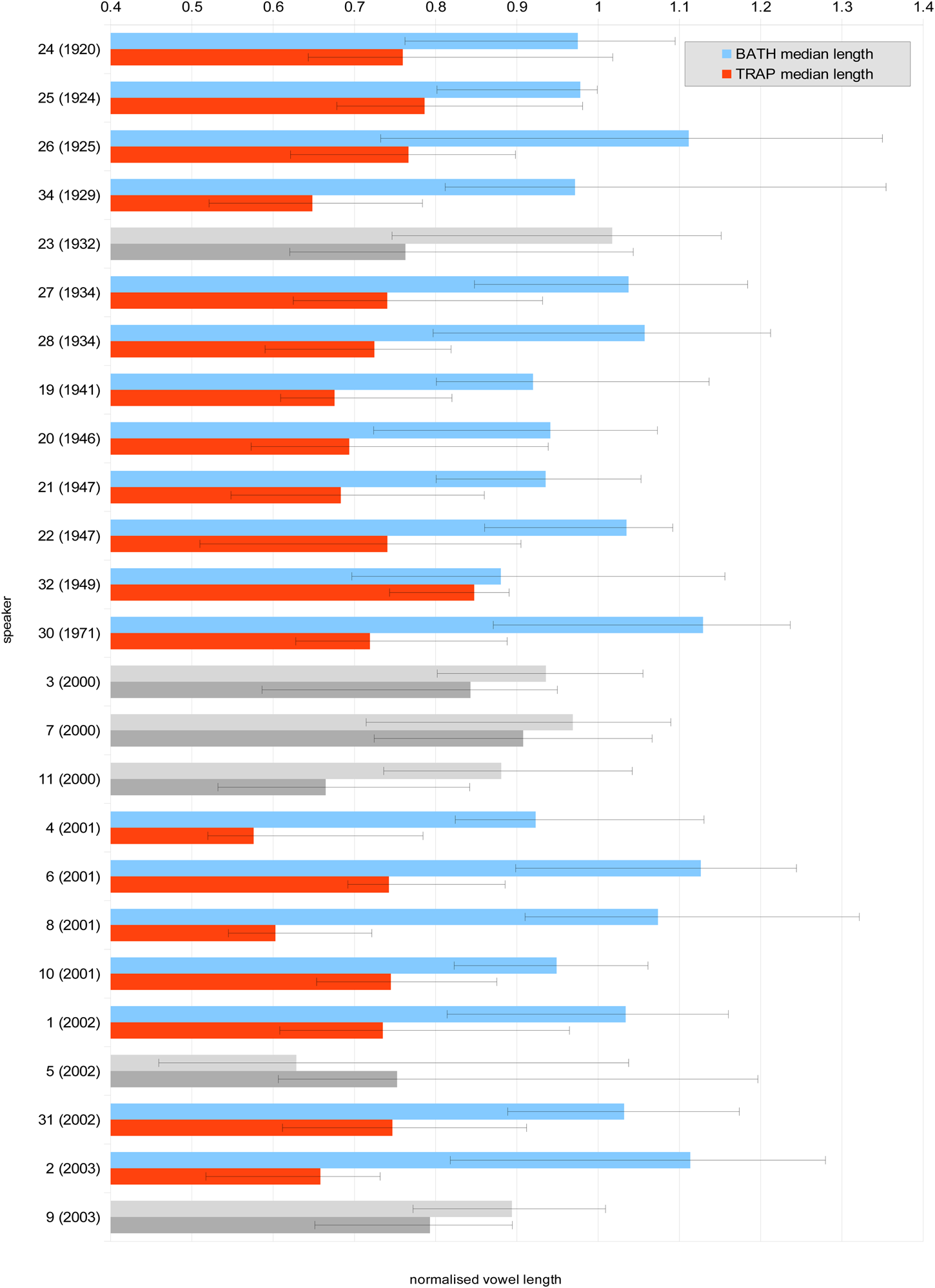
For 19 speakers (s24, s25, s26, s34, s27, s28, s19, s20, s21, s22, s32, s30, s4, s6, s8, s10, s1, s31 and s2), bath tokens were significantly longer than trap tokens on average, although for two of these (s25 and s32) this was only the case if function words were excluded since can't was consistently short. For the six remaining speakers (s23, s3, s7, s11, s5 and s9), bath tokens were not significantly longer than trap. The median normalised lengths of bath and trap vowels per speaker are visualised in figure 7 (error bars show the upper and lower quartiles; the bars are grey for speakers for whom the length difference is non-significant).
Comparison of bath and trap length by speaker

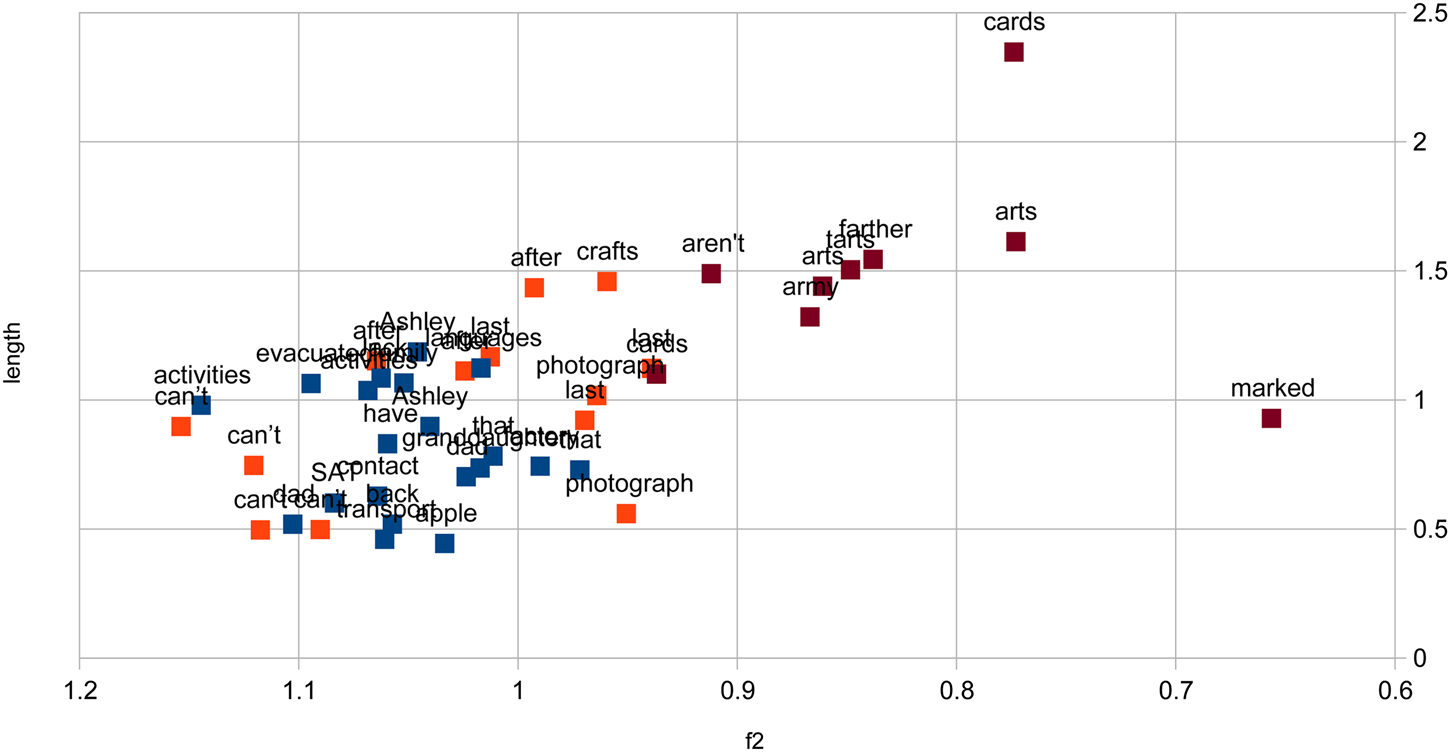
Piercy observed for Dorset that the traditional system lacked any distinction and that the southeastern style trap–bath split with both length and backness was spreading. If this held for Bristol, we would expect to see change in apparent time: the speakers with no length distinction would be the most conservative and so should be among the oldest, and the length distinction should be increasing in magnitude among younger speakers. This does not fit the impression from figure 7. Instead, five out of the six speakers who lack a length distinction were born in 2000 or later. It is worth examining the single older speaker for whom there is no significant length difference between trap and bath, s23. The normalised length and F2 values of s23's tokens are visualised in figure 8.Footnote 13 Here we can see that this speaker produced relatively few tokens of bath and that most of the shorter bath tokens are indeed tokens of the function word can't. If, instead of excluding all function words from consideration, we only exclude tokens of can't (since after seems to pattern with other bath words and not with can't) we find that the length difference is significant. Thus, all of the speakers we can confidently say lack a trap–bath length distinction are younger speakers. The trap–bath split appears to be receding in apparent time, in line not with Piercy's findings for Dorset but with the findings of the EDA.
Normalised length and backness of tokens for s23

A caveat is that if we look only at those speakers with a significant length distinction, the magnitude of this distinction appears to be increasing in apparent time: older speakers with the split have largely overlapping distributions, with many trap tokens as long as typical bath tokens, whereas younger speakers like s2, s31 and s6 have well-separated distributions, with bath tokens nearly always longer than trap tokens. Examining individual speaker plots, this appears to be due to a general increase in the length of bath tokens and decrease in the length of trap tokens, rather than a loss of lengthening for certain trap lexical items (the ‘bad–lad split’).
5.1.3 Bath backing
For 12 speakers (s24, s34, s28, s19, s20, s22, s11, s4, s6, s10, s1 and s9), bath tokens had significantly lower normalised F2 than trap tokens; for the remaining 13 (s25, s26, s23, s27, s21, s32, s30, s3, s7, s8, s31, s5 and s2), there was no significant difference. If function words are excluded, we do find a significant difference for three of these speakers (s23, s5, and s31). The median normalised F2 values of bath and trap vowels per speaker are visualised in figure 9 (error bars indicate the upper and lower quartiles, and the bars are grey for speakers for whom the difference is non-significant).
Comparison of trap and bath backness by speaker

Here, we see no evidence of change in apparent time. Six of the 12 speakers born in 2000 or later have a trap–bath backness distinction; six of the 13 born between 1920 and 1971 have this distinction. If we exclude function words then the numbers are 8/12 and 7/13.
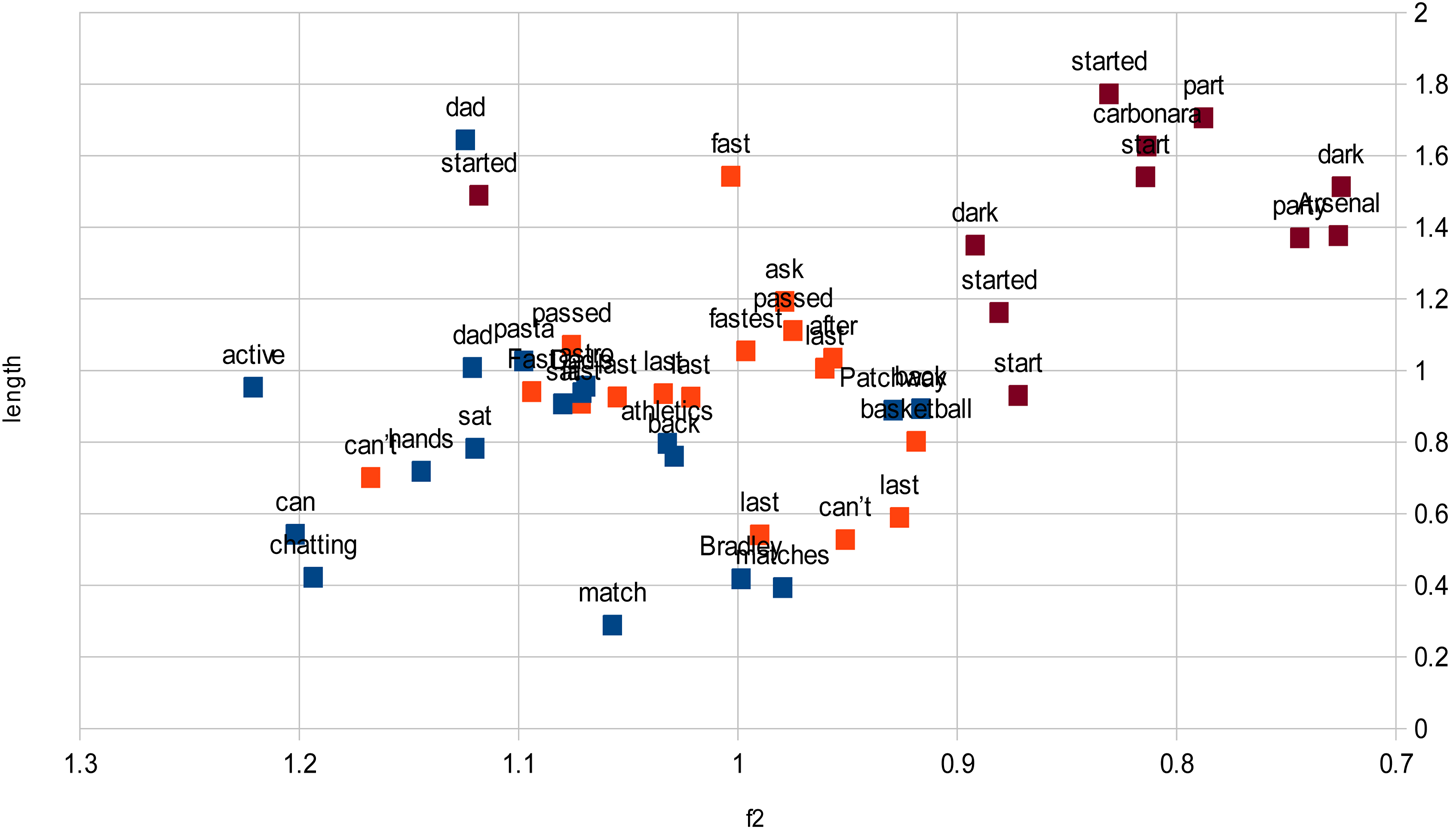
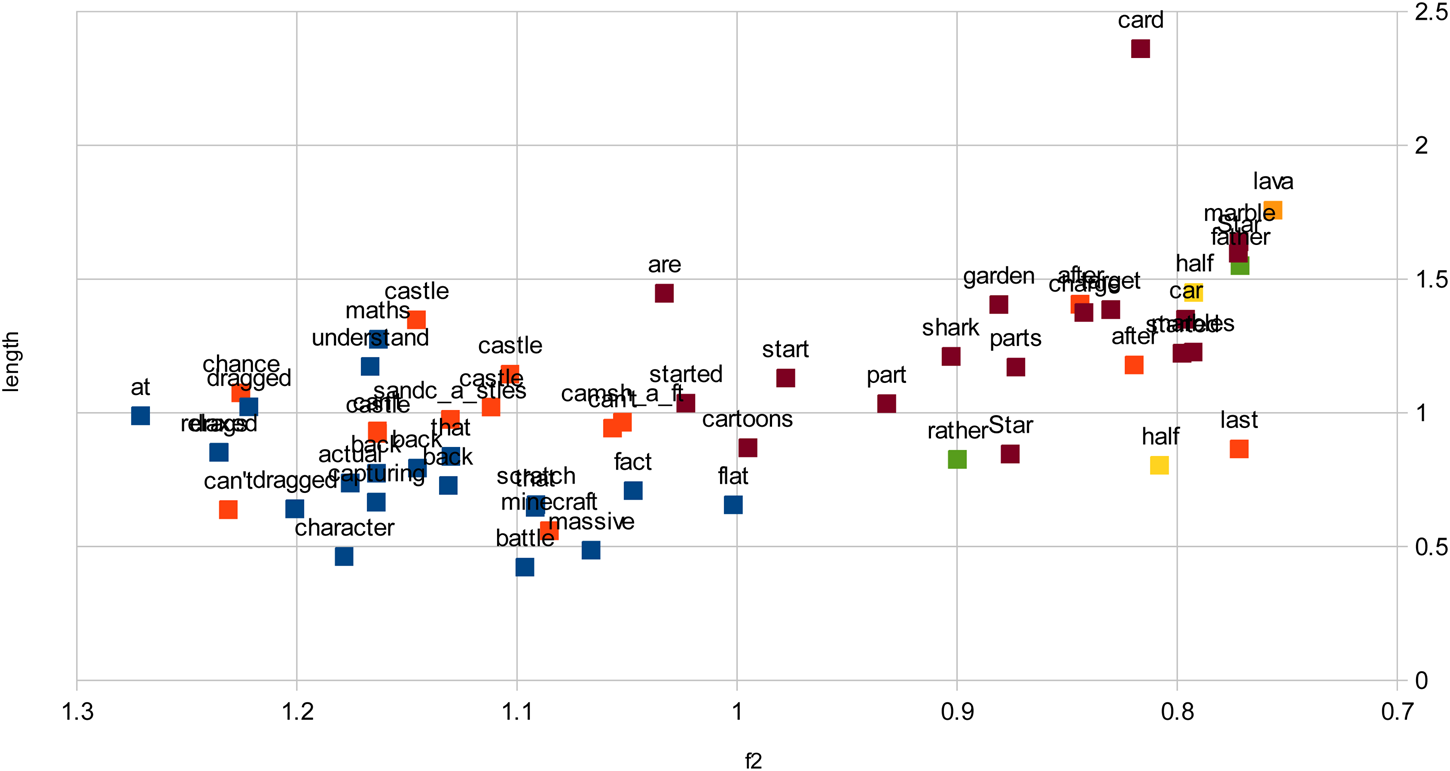
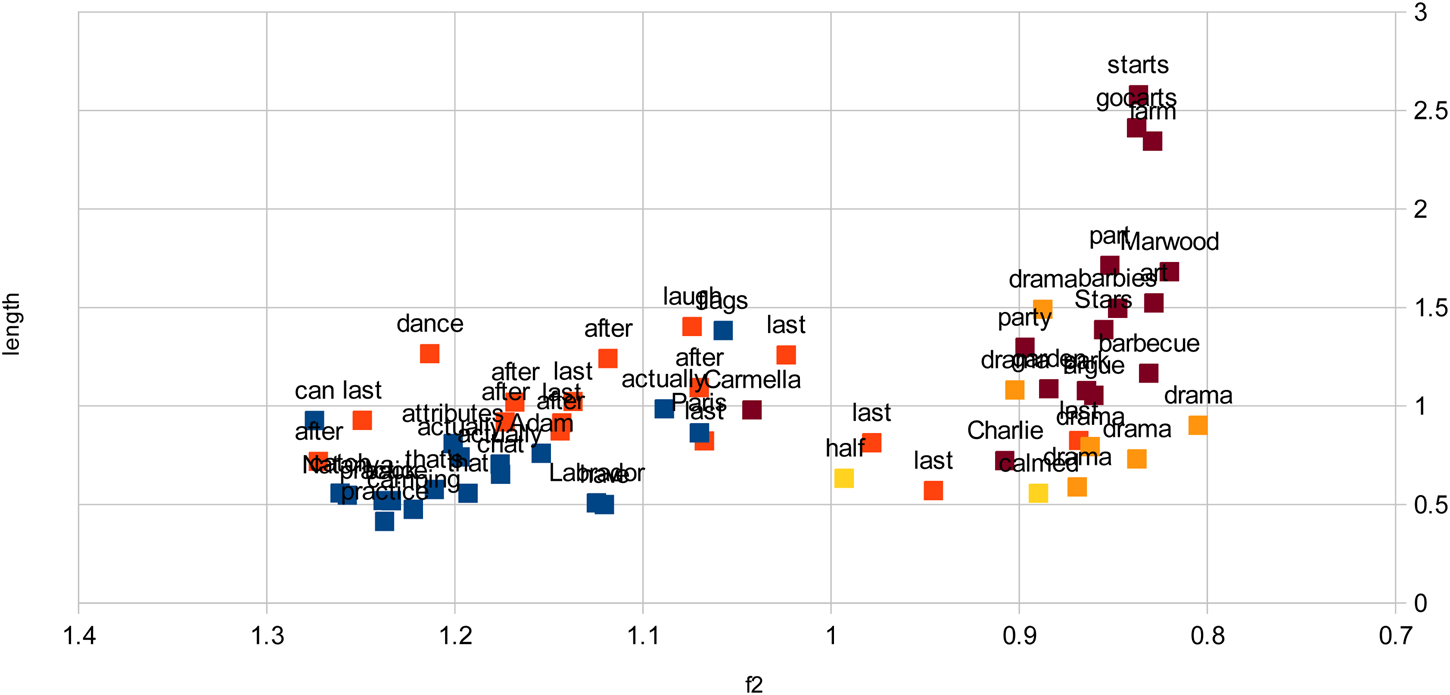
Turning to how this distinction manifests, we find a variety of patterns. s34 (see figure 10) is a speaker with a system that resembles Southern Standard British English (SSBE) / Received Pronunciation (RP): trap and bath are well separated by backness, with bath largely overlapping with start. Speaker s3 (see figure 11) exhibits an intermediate system: trap and bath are relatively well separated by backness, but start is further back than bath again. This suggests the trap–bath backness split advances by neogrammarian sound change, with the realisation of all bath tokens moving gradually back in the vowel space towards start. Figure 12 for s10 suggests otherwise, however: for this speaker, trap and bath are overlapping and start is well separated, but three isolated bath tokens (two after and one last) are realised in the start area. This suggests instead that the mechanism of the trap–bath split is lexical diffusion, with individual bath words moving one-by-one from the trap lexical set to the start set.Footnote 14
If we categorise speakers’ trap–bath backness split in this impressionistic way, we find:
• eight speakers (s2, s7, s8, s21, s26, s27, s30 and s32) with no evidence of a split, and
• one speaker (s3) for whom there appears to be the beginning of neogrammarian backing of bath although the difference is not statistically significant;
• eight speakers (s1, s4, s9, s11, s19, s20, s22 and s31) who have a partial split that appears to be progressing by neogrammarian sound change;
• two speakers (s6 and s10) for whom the split appears to be progressing by lexical diffusion (for s6, can't and class are backed while other bath tokens are front; for s10, after and last are backed while other bath tokens are front);
• two speakers (s28 and s34) with basically completed changes with remnant evidence of lexical diffusion (one token of glass is front for s28, two tokens of can't for s34);
• and three speakers (s5, s23 and s24) for whom the split appears to be progressing by neogrammarian sound change (that is, the mean of bath is shifted back but overlaps with trap) with some idiosyncratic behaviour by particular lexical items (for all three, can't is often front; for s24, so is dancing).
Overall, then, it is difficult to formulate a generalisation that fits every speaker. The best we can do is to say that the trap–bath backness split appears to take place by a gradual backward shifting of realisations of the bath vowel but that there are often idiosyncratic lexical patterns in addition to this. These idiosyncrasies can be bath words which appear to pattern with trap for a given speaker (particularly the function word can't) or bath words which are very backed for a speaker who has generally front realisations of bath. There is no evidence for change towards back realisations of bath in apparent time, nor for age-related patterns in the mechanism behind the split.
Normalised length and backness of tokens for s34

Normalised length and backness of tokens for s3

Normalised length and backness of tokens for s10

5.1.4 Interim summary
In order to assess how these variables interact, it is useful to develop a coarse classification of speakers for each variable. Firstly, we can classify all speakers according to whether they have some significant bath backing and lengthening compared with trap, as discussed in sections 5.1.2 and 5.1.3. Then, for those speakers with these distinctions, we can classify the magnitude of the split on the basis of the degree of overlap of the interquartile ranges of bath and trap: if the overlap of interquartile ranges of trap and bath normalised F2 is less than 25 per cent, then the backness split is classed as completed ([bath + back]); otherwise it is classed as in progress ([bath ± back]). Likewise if the overlap of the interquartile ranges of trap and bath normalised lengths is more than 25 per cent, then the length split is classified as marginal ([bath ± long]); otherwise it is classed as full ([bath + long]). This gives the classification in table 3.
Classification of speakers according to bath backing and lengthening

Table 3 confirms the observations made above: younger speakers (underlined) are less likely to have a length distinction between trap and bath, but if they do, the difference between trap and bath is greater; older speakers are more likely to fall into the ‘marginal’ category for the length distinction.
Table 4 divides this classification again according to rhoticity, with speakers with ≤25 per cent rhoticity in start tokens classed as having lost rhoticity, those with ≥75 per cent as retaining rhoticity, and the remainder as showing change in progress. We might expect to see a relationship between bath backing and loss of rhoticity in start, since once rhoticity is lost in (backed) start, it merges with backed bath. However, no such relationship is visible.
Classification of speakers by bath lengthening and backing and start loss of rhoticity

5.2 Minor lexical sets
Having outlined the distribution of the major variables we now turn to the smaller lexical sets palm and father, and the treatment of loanwords which get the vowel /ɑː/ in RP. All of these are typically rather less well evidenced than bath, trap and start since they are less frequent in connected discourse. Nevertheless, we often have enough tokens to get some idea of how a given speaker treats these groups of words.
5.2.1 palm
For six speakers (s34, s19, s21, s22, s10 and s1), palmFootnote 15 is significantly further back than trap; all of these speakers also have backing of bath. For nine speakers (s26, s20, s32, s11, s7, s4, s8, s9 and s2), palm is not significantly further back than trap. For all remaining speakers, there were one or zero tokens of palm, so no comparison was possible.
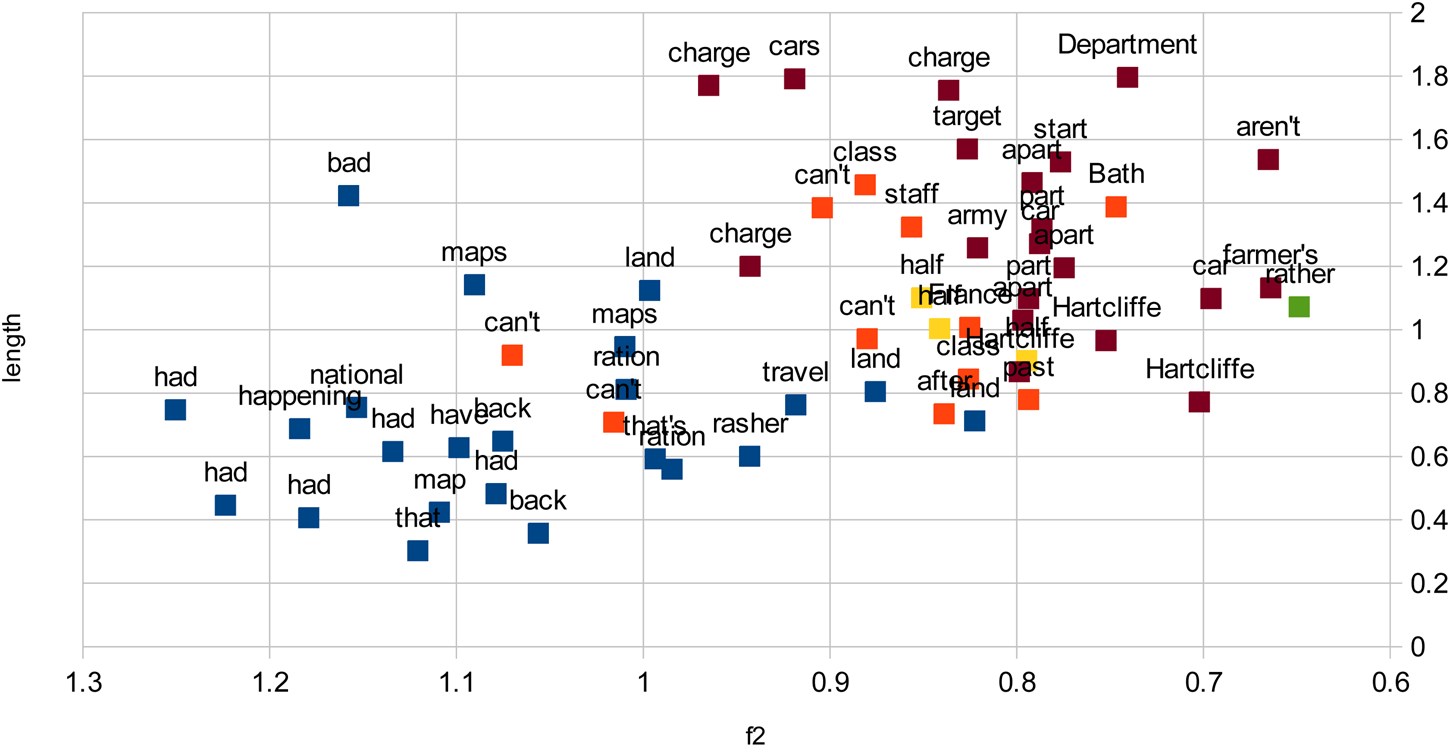
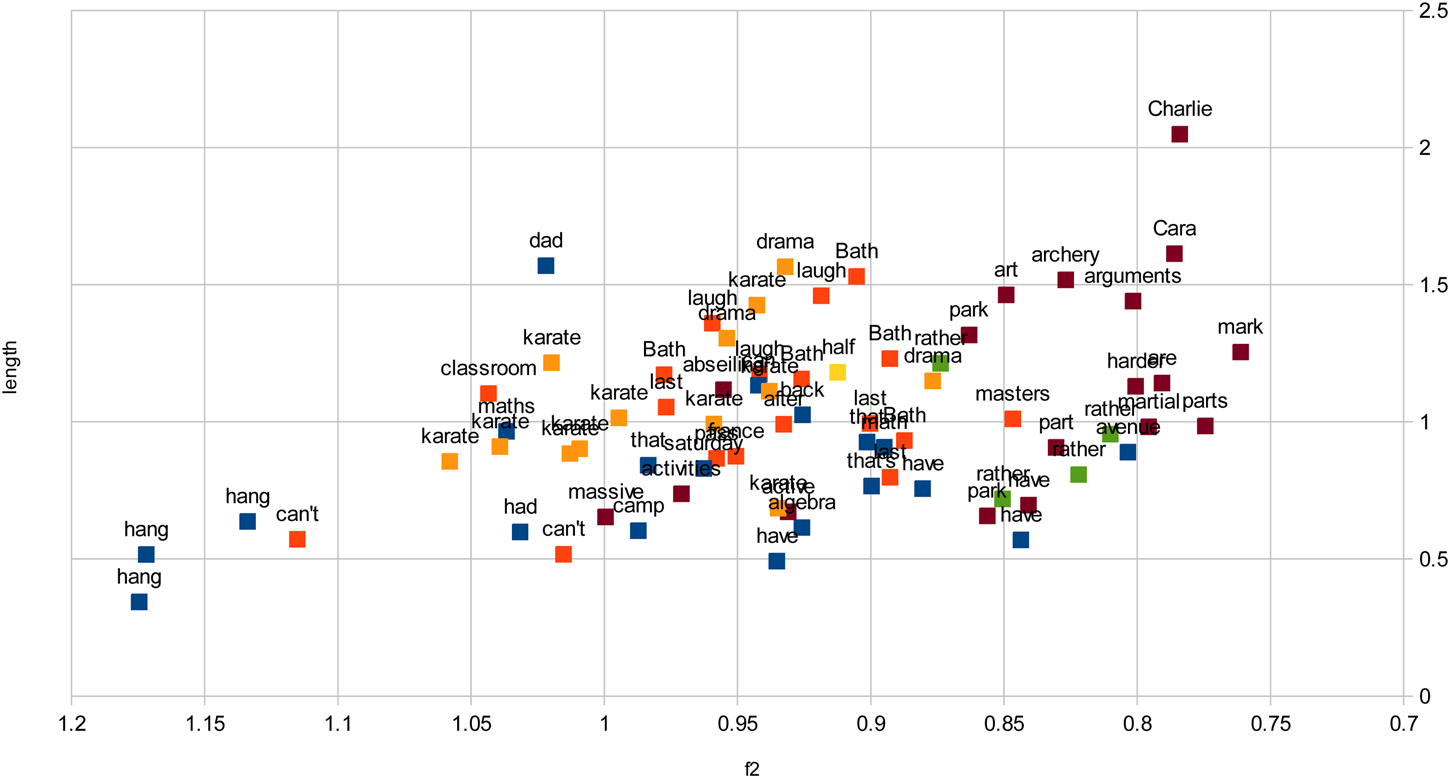
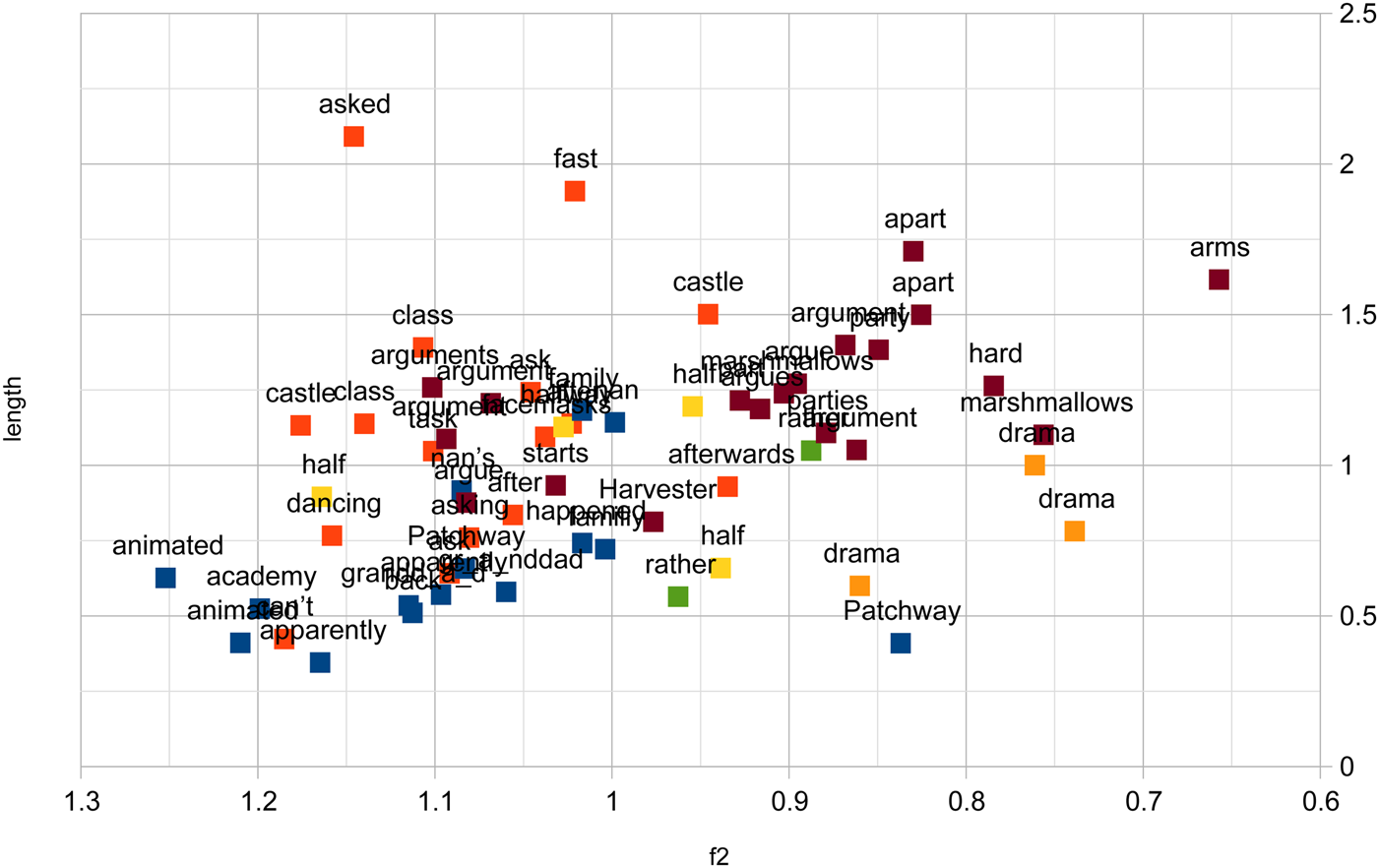
One interesting group is those speakers who have backed bath but don't appear to have backed palm, since these speakers seem to show a new split between palm and bath: s20, s11, s4 and s9. However, an examination of the data demonstrates that this is simply a result of low token counts in each case. This is exemplified by s4 in figure 13: the two tokens of palm (of ‘half’ and ‘calmed’, displayed in yellow) are nearly as far back as the tokens of start; the lack of significance in the difference between them and trap is merely due to the fact that there are only two of them. Conversely, there is sometimes evidence for palm tokens being realised further back or more consistently back than bath tokens. For example, see figure 12 for s10. Here we seem to have backing of bath by lexical diffusion, and our two tokens of palm pattern with the back set.
Normalised length and backness of tokens for s4

5.2.2 father
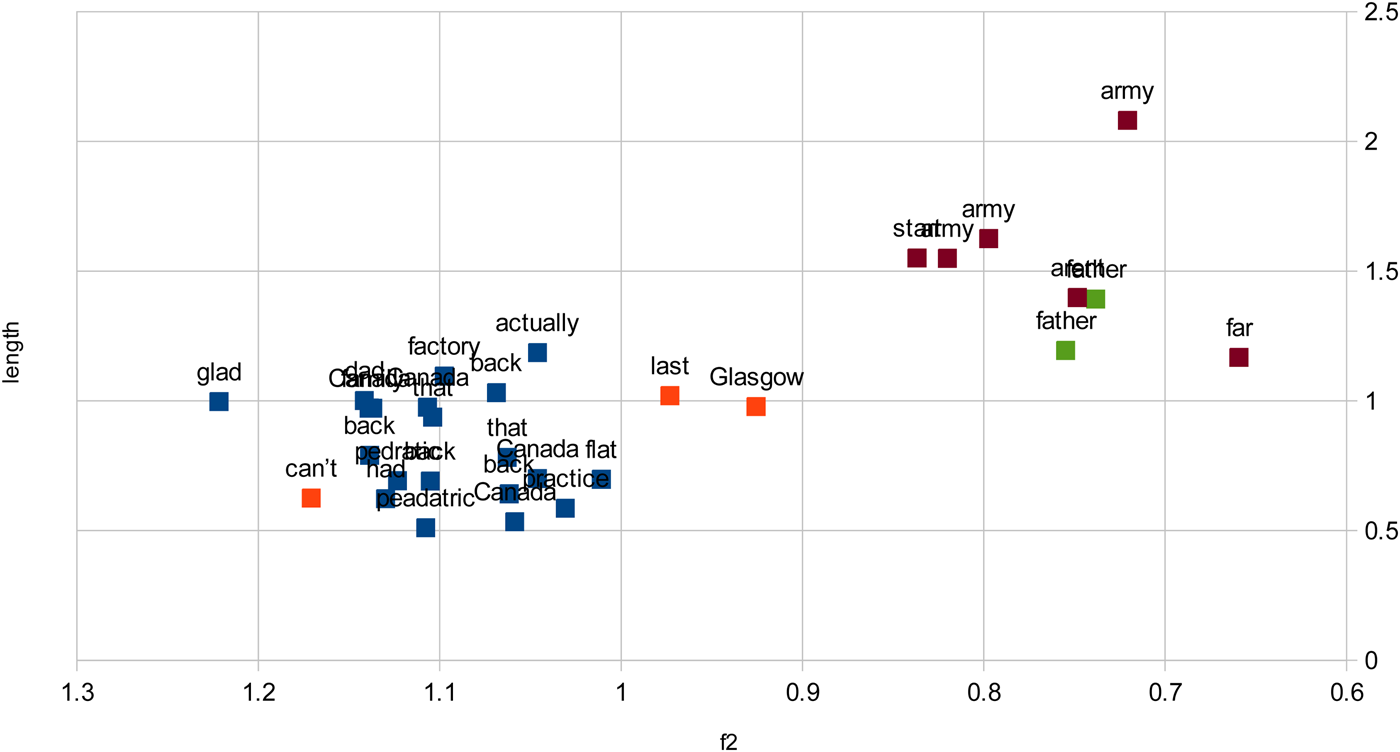
The words father and rather (and compounds with father), here labelled the father lexical set, sometimes seemed to exhibit distinctive behaviour. This set was significantly further back than trap for six speakers (s24, s25, s28, s20, s22 and s31) of whom one (s25) had front bath. s25 produced particularly few tokens of bath over the course of the interview; this can be seen in figure 14. Nevertheless, it is striking that the two tokens of father this speaker produced were as far back as their tokens of start. This pattern was also typical for better-evidenced speakers. Consider figure 15 for s31. Here, bath backing is incipient: bath tokens are further back than trap tokens on average, but the difference is marginal and the distributions largely overlap. By contrast, father tokens are always almost as far back as start tokens. The evidence of the SED (see figure 4) suggests that these words had the same phoneme as bath words in traditional West Country dialects, so this split would have to be recent and induced by dialect contact.
Normalised length and backness of tokens for s25

Normalised length and backness of tokens for s31

5.2.3 bath loanwords
Finally, we should consider the status of loanwords which have /ɑː/ in RP/SSBE. These are often high-register or technical words which speakers are likely to learn from SSBE speakers (such as schoolteachers), and might be more likely to show backed and lengthened bath vowels than higher frequency bath words. This is precisely what we find. Of speakers with more than one token of this ‘bath loanword’ set, for six (s28, s19, s11, s4, s5 and s2) these vowels are significantly further back than trap. This includes two speakers (s5 and s2) for whom bath is not significantly further back than trap. To illustrate this, consider the tokens produced by s2 in figure 16: the distributions for backness for trap and bath overlap entirely, but the three tokens of drama are as far back as start. This effect can also be seen for speakers who have significantly backed bath. Consider the tokens produced by s19 in figure 17: bath tokens are further back than trap on average but largely overlap; however, the three tokens of vases are outliers for both length and backness.
Normalised length and backness of tokens for s2

Normalised length and backness of tokens for s19

6 Discussion
In section 3 we set up a number of research questions. A strand throughout section 5 has been the difficulty of arriving at unequivocal answers: there is inter- and intra-speaker variation along nearly every axis we investigate and it rarely corresponds neatly with any single hypothesis. In this section we will review each question and finding in order to build up as clear a narrative of the variation and change in the unrounded low vowels in Bristol English as is possible. In order to remain true to the data we must resist the temptation of simple and reductive explanation; we will return to this point at the end.
Firstly, we asked whether words in the bath set have a distinctively longer vowel than those in trap: the evidence of surrounding dialects recorded in the SED suggested that they did, but accounts of traditional Bristol dialect were equivocal on this point. The data investigated here confirm the difficulty of answering this question. Older speakers either have a clear length distinction or a marginal one, but never lack it entirely. Younger speakers, by contrast, seem to have a clear length distinction or none at all, but rarely a marginal distinction.
One possible account from these data is as follows. The traditional dialect of Bristol had a length distinction between the vowels of trap and bath, but the phonetic difference was relatively small with somewhat overlapping distributions; we remain agnostic on whether or not this difference was truly phonemic (as suggested by the common behaviour of palm and bath words) or whether this was merely an incipient split (of the sort identified for the bad–lad split by Kettig (Reference Kettig2015), and which must have been the chronological precursor of the phonemic trap–bath split); this small phonetic difference explains the disagreements of earlier researchers. We now see two competing changes operating on this traditional system. For some speakers, the split is increasing, with the difference in length between the two sets growing in order to maintain the distinction. Other speakers are undoing the incipient split by shortening bath, presumably under the influence of the northern system.Footnote 16 This might seem surprising in light of a broader story of levelling towards SSBE, yet this finding was prefigured by the EDA. We might explain this by noting that a long bath vowel is a salient marker of ‘southern’ English English and as such is sometimes negatively stereotyped as ‘posh’.Footnote 17 Alternatively, we might see this as neutral change in the vicinity of an isogloss in the terms of Kauhanen (Reference Kauhanen2017): learners are exposed to some speakers without the split and so this variant gradually increases without any differential valuation.
Secondly, we asked about backing of the bath vowel. Here, the evidence is equivocal in a different way. There is clear evidence for backing: for more than half of speakers, bath has a backer vowel on average than trap. However, there was no clear pattern in apparent time and so no direct evidence for ongoing change. Considering the typology of community and individual patterns of change proposed by Labov (Reference Labov2002: 83), we have two possible interpretations. Either bath backing is in stable variation in Bristol English, or it is undergoing ‘communal change’, whereby members of the speech community of various ages implement a change in concert rather than incrementing it generation by generation. From a social point of view, either seems plausible. bath backing is a highly salient social variable, to the point of being a stereotype. Accordingly, it seems likely that it might be subject to adult change at the individual level, as would be necessary for communal change to be taking place at the level of the speech community. It also seems likely it might be manipulated for stylistic purposes. However, communal change is usually reported not for phonological but for lexical and syntactic variables (Labov Reference Labov2002: 84). Accordingly, our best guess from these data is that bath backing is subject to stable sociolinguistic variation in Bristol English. We repeat what we have said elsewhere in this article – the lack of previous work on this variety makes a categorical answer difficult, and continued scrutiny of this dialect may allow future researchers to answer this question more definitively.
We also asked about backing of the start vowel: this was front in nearby dialects at the time of the SED, but reportedly undergoing backing in Piercy's study of Dorset English and Fudge's study of Hampshire English. In Dorset English, this preceded loss of rhoticity and backing of other sets (bath, palm), whereas in Hampshire English it came later. From these data, we can confidently say that backing of start took place early in Bristol English: indeed, unlike any of the other changes considered here, it seems to be largely complete. Accordingly, we can conclude that in Bristol English as in Dorset English, backing of start occurs before loss of rhoticity and before the backing of other lexical sets (bath, palm).Footnote 18
Turning to our other research questions, we asked whether the minor lexical sets identified on the basis of reported changes and dialect distributions at the time of the SED (palm, father, bath loanwords) patterned as part of the bath set or separately. From these data, we can say that, for some speakers, these words clearly do behave distinctively. bath loanwords and father may sometimes be backed even when bath is not, and are usually further back than bath. The explanation in each case must have to do with contact, although the exact dynamics are different. In the case of father, this presumably simply reflects the fact that speakers are exposed to more backed and lengthened tokens from speakers of other dialects, since father has a different vowel to trap for many speakers of northern Englishes that otherwise lack the trap–bath split (Beal Reference Beal2002: 110). In the case of bath loanwords, this must instead reflect the status of most of these words as learned or high-register loans that speakers usually acquire in formal contexts associated with SSBE/RP.
Finally, we can turn to the question of whether these changes are taking place by lexical diffusion (as proposed by Piercy for bath backing) or by neogrammarian sound change. The answer in one sense is unequivocally lexical diffusion: bath, father, palm and presumably bath loanwords all had the same vowel in traditional West Country dialects at the time of the SED, so any differences we now see in these groups must point towards lexical diffusion. We do also see evidence for neogrammarian sound change, however, with bath showing a slightly backed but overlapping distribution compared with trap for many speakers. This conflicting evidence perhaps points to the complexity of the processes that must be invoked to explain variation in these vowels in Bristol English. With internal change (the increasing length split in trap–bath, perhaps backing of start), external change due to contact with SSBE (the backing of bath) and external change due to local diffusion (the loss of the trap–bath split) in addition to various processes affecting smaller lexical groups all interacting, it is no surprise that it is impossible to neatly characterise the variation as resulting from one class of process or another.
7 Conclusion
Looking forward, there is scope for much further research on these vowels in Bristol and related dialects. A real-time investigation, whether a panel study or restudy, might help determine definitively whether the variation in bath backness reflects communal change or stable variation; a synchronic study with a larger sample of speakers might also help to differentiate these possibilities. More work is also needed to link the patterns observed here to the semi-phonemic length split observed for the trap vowel in some varieties (Blake Reference Blake1985; Kettig Reference Kettig2015) and to work on the allophonic variation that developed into the trap–bath split in British dialects and (æ)-tensing in American dialects (e.g. Labov Reference Labov2007; Piercy Reference Piercy2011). Seeing the length distributions of trap, bath, palm and father vowels in traditional Bristol dialect (and other West Country dialects) as a third independent development of this allophonic variation might offer us insight into the complex array of constraints we see at work in these data; this was proposed by Piercy (Reference Piercy2011: 161–3) for Dorset English. Since the number of contexts involved is very great, this calls for further study with a larger dataset.
The most striking fact about the data presented in this study is their complexity. In much linguistic research we strive to find maximally simple explanations to account for complex data, yet it is important not to allow this approach to blind us to the rich and contradictory realities of language use. Since theory provides us with discrete conceptual categories with which to describe sociolinguistic situations (ongoing change vs stable variation, external vs internal change, neogrammarian change vs lexical diffusion), we may be tempted to settle for the concept that best explains the data and dismiss all evidence to the contrary as a statistical anomaly or problem to be solved in future work. Yet to give the best account of this dataset possible, we must resist these temptations and acknowledge the diversity of language use we see: broad patterns on which most speakers agree such as the backing of start sit alongside tendencies such the lengthening of bath which defy neat categorisation as stability or as monotonic change; and in every case we also find idiosyncrasies of particular speakers and lexical items which can reinforce or run contrary to community patterns.
We appeal to the idea that the individual speaker should have primacy as the object of study and this is far from new. As Hermann Paul remarked in 1880, ‘Nothing has real existence except the particular individuals … Species, genera, classes are nothing but arbitrary summaries and distinctions of the human mind’ (Paul Reference Paul1880; cited in Weinreich, Labov & Herzog Reference Weinreich, Labov, Herzog, Lehmann and Malkiel1968: 106 n.13). A comparison of idiolects yields a certain ‘average’ or Sprachusus (language custom) in Paul's terms, but it is nonetheless recognised that this ‘average’ is an abstraction, an artefact of the linguist. Language changes ‘through the summation of a series of shifts in idiolects moving in the same direction’ (Weinreich, Labov & Herzog Reference Weinreich, Labov, Herzog, Lehmann and Malkiel1968: 108). The data from the ongoing changes in the Bristol vowel system are a reminder that nineteenth-century thinking still has its relevance today.
Appendix
SED data in localities near Bristol

SED localities mentioned