INTRODUCTION
The World Health Organization (WHO) and the Latin American Association of Palliative Care (ALCP) have identified healthcare professionals' education in palliative care as one of the main priority areas of palliative care development (Stjernsward et al., Reference Stjernsward, Foley and Ferris2007; ALCP, 2013; Pastrana et al., Reference Pastrana, Wenk and De Lima2016). During the last 20 years, training in PC has been included at the basic, intermediate, and highest levels of educational programs at a wide range of academic institutions, professional societies, and associations.
Adequate training in palliative care improves healthcare professionals' communication with patients and caregivers, facilitates the delivery of patient-centered treatment, improves symptom control, and encourages the inclusion of psychosocial, cultural, and spiritual elements in the care offered to patients and their family members (Bugge & Higginson, Reference Bugge and Higginson2006; Centeno et al., Reference Centeno, Ballesteros and Carrasco2016; Brown et al., Reference Brown, Jecker and Curtis2016). Training in palliative care also has positive effects on healthcare professionals' work experience, as it increases their confidence and ability to manage patient symptoms, take part in difficult conversations, and provide support to family members (Shipman et al., Reference Shipman, Burt and Ream2008; Luxardo et al., Reference Luxardo, Vindrola-Padros and Tripodoro2014).
Even though great progress has been made in the development of palliative care in Latin America, training opportunities for healthcare professionals are lacking, palliative care courses are not routinely integrated into undergraduate and postgraduate curricula for medical and nursing students, and there are few continuing-education courses available to update knowledge or provide further specialization (De Simone, Reference De Simone2003; Nervi et al., Reference Nervi, Guerrero and Reyes2004; Wenk & Bertolino, Reference Wenk and Bertolino2007; Lynch et al., Reference Lynch, Connor and Clark2013). This situation has tangible consequences for the quality of the care delivered to patients and their families as well as for the working conditions of healthcare professionals. When education programs on palliative care are developed, the lessons learned from implementing these programs are rarely shared with other academic institutions or healthcare organizations, thus preventing further development in this area (Nervi et al., Reference Nervi, Guerrero and Reyes2004; Leon et al., Reference Leon, Florez and De Lima2010). The aim of our review was to systematically examine the literature on the delivery of palliative care education in Latin America in order to describe the programs currently in operation, identify gaps in the availability of educational opportunities, document barriers encountered during their implementation, and ascertain recommendations for future programs.
METHODS
Design
This is a systematic review of the literature, including peer-reviewed academic articles and grey literature. The Preferred Reporting Items for Systematic Reviews and Meta-Analysis (PRISMA) statement was used to guide reporting of our methods and findings (Moher et al., Reference Moher, Liberati and Tetzlaff2009). The review was registered with PROSPERO (ref. no. CRD42016053273).
Research Questions
The research questions guiding the review were: (1) What is the content of palliative care programs implemented in Latin America? (2) What is the main method of delivery of education? (3) What levels of education (e.g., undergraduate, postgraduate) include palliative care courses? (4) What are the target populations (i.e., professional groups) for PC education programs? (5) How are education programs evaluated? (6) What are the barriers encountered when designing and implementing palliative care education programs in Latin America? and (7) What are the recommendations for development of future education programs?
Search Strategy
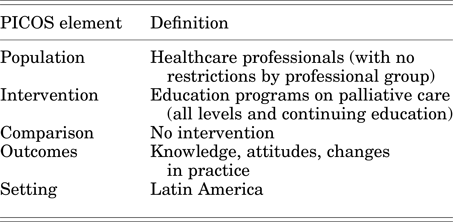
We used the PICOS framework (Robinson et al., Reference Robinson, Saldanha and McKoy2011) to develop the search strategy (Table 1). We conducted a review of published literature using multiple databases: CINAHL Plus, Embase, the Web of Science, and Medline. The details of the online search strategy can be found in Appendix 1. Searches were conducted during June of 2016. Our results were combined into RefWorks, and duplicates were removed. The reference lists of included articles were screened to identify additional relevant publications.
PICOS framework used to develop the search strategy

Descriptions of education programs for healthcare professionals are not frequently published in peer-reviewed academic articles. In order to address this potential gap in our review, we also searched grey literature in the form of global and regional directories and reports. Grey literature is considered a valuable source of information in systematic reviews, as it can be employed to increase knowledge in areas where scholarship is underdeveloped, draw attention to new topics of inquiry, and/or corroborate existing academic findings (Adams et al., Reference Adams, Smart and Sigismund Huff2016).
We consulted four main sources of grey literature:
-
1. International Association for Hospice and Palliative Care's (IAHPC) Global Directory of Education in Palliative Care (IAHPC, 2017)
-
2. The Worldwide Hospice Palliative Care Alliance's (WHPCA) lists of palliative care resources (WHPCA, 2017)
-
3. The Latin American Association for Palliative Care's training resources (ALCP, 2017)
-
4. The Latin American Atlas of Palliative Care, a regional atlas that describes general resources in PC (Pastrana et al., Reference Pastrana, De Lima and Wenk2012)
Selection
Peer-Reviewed Articles
Two authors (C.V.P. and R.M.) screened the articles in three phases (title, abstract, and full-text) based on the following inclusion criteria: (1) they were focused on describing education programs at the undergraduate and postgraduate levels as well as continuing education, specializations, and clinical rotations (when these were linked to wider programs); (2) they were aimed at healthcare professionals (not limited by professional group); and (3) the program was implemented in a Latin American country (defined as all the countries that are part of Latin America and the Caribbean; see the search strategy in Appendix 1 for a complete list). Disagreements were discussed until a consensus was reached. We did not apply any restrictions in terms of language or date of publication.
Grey Literature
One of the authors (C.L.) searched the four databases to retrieve programs on palliative care for healthcare professionals in Latin America. These searches were crosschecked by a second author (R.M.). We applied the same inclusion criteria as with the peer-reviewed articles.
Data Extraction and Management
In the case of the peer-reviewed articles, the included articles were analyzed using a data extraction form developed in REDCap (Research Electronic Data Capture). The categories utilized in the data extraction form are summarized in Appendix 2. The form was developed after initial screening of full-text articles. It was then pilot-tested independently by two researchers (C.V.P. and R.M.) using a random sample of five articles. Disagreements were discussed until a consensus was reached. The form was changed based on the findings of the pilot test.
In the case of grey literature, the included education programs were imported into a spreadsheet that included the categories presented in Appendix 3. The programs were imported by two authors (C.L. and R.M.). A third author (C.V.P.) crosschecked this spreadsheet with the data extraction forms developed for the peer-reviewed articles so as to avoid duplication.
Data Synthesis
Data were exported from REDCap, and the main article characteristics were synthesized. These data as well as the programs captured in the spreadsheet were employed to answer the research questions cited above.
Risk of Bias
Assessment of the risk of bias is an important component of systematic reviews (Higgins et al., Reference Higgins, Altman and Gotzsche2011), but due to the aim of our review and the nature of the reviewed articles (most were editorials or commentaries), we did not assess the hazard of risk involved in the included studies.
RESULTS
Identification of Articles
The initial search yielded 710 published articles (Figure 1). These were screened based on title and type of article, leaving a subtotal of 164. Screening based on abstracts left 71 articles for full-text review. This phase of screening resulted in 14 articles. The bibliographies of these 14 studies were reviewed, and 2 additional articles were identified. A total of 16 articles were thus included in our review. Three of these did not focus on specific programs but were included because they included general reflections on the development of palliative care programs in Latin America (Bishop et al., Reference Bishop, Mele and Koppman2009; Wenk et al., Reference Wenk, De Lima and Mutto2016; Pastrana et al., Reference Pastrana, Wenk and De Lima2016).
Study selection procedure for peer-reviewed articles.

We excluded articles that focused on students' knowledge of or attitudes about palliative care but did not present information on education programs. We also excluded conference abstracts. We included literature reviews, editorials, and commentaries if they described education programs. No limits on language or date of publication were applied during the search.
Identification of Programs from Grey Literature
Our initial search yielded 39 potential programs, but only 21 were included in the review. We excluded programs that were duplicates of those discussed in the peer-reviewed articles, programs that only included palliative care training as a small component of a course on other topics, and those where we did not have enough information to answer our research questions. We did not limit this search based on language or the date of advertisement of the course.
Characteristics of Included Articles
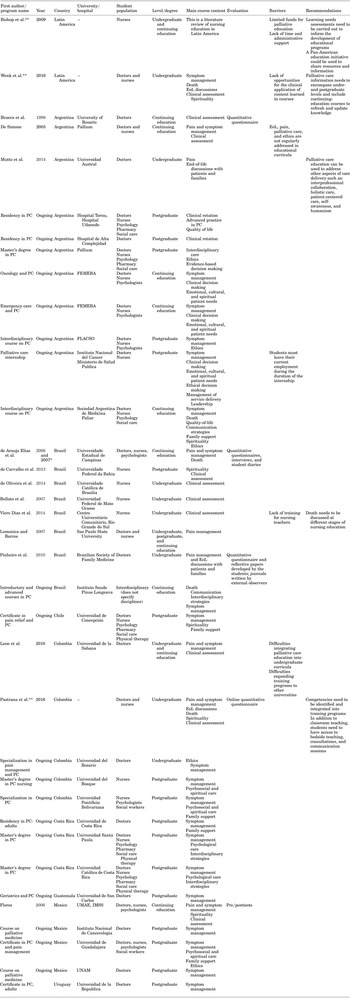
The characteristics of the 16 articles and 21 programs included in our review are presented in Table 2. Two of the articles focused on the entire region of Latin America, 11 described programs in Argentina, 8 in Brazil, 1 in Chile, 5 in Colombia, 3 in Costa Rica, 1 in Guatemala, 4 in Mexico, and 1 in Uruguay. Six of the programs were directed at nursing students, 10 at doctors, 5 at both doctors and nurses, and 14 were designed for interdisciplinary teams (mainly including doctors, nurses, psychologists, social workers, pharmacists, and physiotherapists).
Description of articles and programs included in the review

* Two articles presented data from the same study.
** Do not describe a specific educational program but offer general reflections on the development of PC programs in Latin America.
Level of Training
The majority of programs (16) were taught at the postgraduate level, 8 were included in undergraduate programs, and 10 were continuing-education courses. Only one article discussed programs that spanned the undergraduate and postgraduate levels and included a continuing-education component.
Course Content and Method of Delivery
The topics discussed in the courses are summarized in Table 2. The clinical assessment of patients and symptom management were the main areas included in the training programs. Some topics that were covered less frequently included spirituality, bioethics, and communicating with patients and family members. Almost half of the articles described programs that were delivered over the course of one semester: one course was delivered over a year, four were master's programs, three granted postgraduate certificates, one lasted for three days, and the rest of the programs did not specify course duration. Most of the training took place in a classroom (with the exception of five online courses and one that combined face-to-face sessions with online training) and combined lectures with small-group discussions, roleplay exercises, and problem-based learning. Five of the courses included a mandatory clinical rotation component that allowed students to apply their learning to actual cases.
Evaluation of Education Programs
In the case of the peer-reviewed articles included in our review, we were able to explore the tools used to evaluate the programs. Only six of the articles so described included information on evaluations. Four of these studies used quantitative questionnaires (either printed or online), while the other two combined quantitative and qualitative methods. The qualitative methods that were used were: interviews, student diaries or reflective essays, and observations carried out by external assessors. The evaluations were carried out to assess knowledge and student satisfaction with the course. Some of the articles also reported using the findings of the evaluation to make changes in course content and method of delivery.
Barriers to Implementation of Education Programs
Only five of the articles included in our review reported barriers encountered during implementation of the education programs. An important barrier was a lack of importance attributed to palliative care training. This meant that other areas of development were prioritized in the education curriculum. Associated with this point, some of the authors indicated that funding for this type of training was limited and that it was difficult to find teachers with palliative care expertise to deliver such training. One article reported that the course took place mainly in a classroom, thus limiting students' chances of learning in a clinical context.
Recommendations for Future Education Programs
All of the articles that provided recommendations agreed that palliative care needs to be routinely integrated into the education curriculum. Student competencies need to be identified and used to guide the design of education programs. These programs need to encompass the undergraduate, postgraduate, and continuing-education levels.
DISCUSSION
We carried out a systematic review of the literature on palliative care education programs in Latin America. We found articles describing programs in eight countries: Argentina, Brazil, Chile, Costa Rica, Colombia, Guatemala, Mexico, and Uruguay. This means that PC training is only offered in about 30% of the nations in the Latin American region. The programs included in our review were mainly aimed at interdisciplinary teams and delivered at a postgraduate level. Barriers to the delivery of palliative care education were mainly related to the lack of recognition and prioritization of this field in medical and nursing training programs, which in turn led to the unavailability of funding allocated for palliative care courses. Lynch et al. (Reference Lynch, Clark and Centeno2009) found a similar trend in other regions of the world and argued that lack of funding leads to inconsistencies in palliative care training and, consequently, a reduction in the quality of care that these healthcare professionals are able to offer patients.
We also found that a significant amount of the training is classroom-based and that students are not always exposed to practice-based methods or have the opportunity to participate in clinical rotations. In a recent review on the efficacy of methods used to deliver training to healthcare professionals on palliative and end-of-life care, Pulsford et al. (Reference Pulsford, Jackson and O'Brien2011) found that classroom-based methods should be combined with practical experience in order to improve learning. Participation in a clinical rotation delivered as part of a wider training program, no matter how brief, can help students improve their skills in symptom management and communication with patients and family members (Goldberg et al., Reference Goldberg, Gliatto and Karani2011; Pastrana et al., Reference Pastrana, Wenk and De Lima2016).
We find it difficult to comment on the effectiveness of the courses described in the articles included in our review, as few of them provided details about the evaluation of these courses, either in terms of knowledge assessment or documentation of students' and teachers' experiences with the course. In cases where the authors deemed the courses successful, they often encountered difficulties when attempting to integrate them into standard curricula or deliver them at other universities.
Our review has a series of limitations. The literature search for academic articles was carried out in June of 2016, so any articles published after this date were not included. Furthermore, though we employed multiple broad search terms, it is possible that we missed articles that did not use these terms. Most of the articles were descriptions of education programs in the form of editorials or commentaries. Therefore, we were unable to carry out a quality assessment of the articles included in our review. The grey literature search took place in January and February of 2017, so any courses published after that were not included in our study. When compared to the peer-reviewed articles, the information available in the grey literature sources was limited, mainly in relation to course content, delivery methods, and evaluation tools. Any ongoing courses in Latin America that were not published in the directories or described in peer-reviewed publications are also missing from this review.
CONCLUSIONS
Our review has pointed to a wide range of education programs on palliative care delivered to healthcare professionals in Latin America, but it also highlights the lack of training opportunities in most of the region. Significant work needs to be done to integrate these existing courses into medical and nursing training programs and guarantee that training is available at the undergraduate level as well as in the form of continuing education. Furthermore, greater attention needs to be paid to evaluation of existing courses and their dissemination to other universities. A Latin American platform could be created to share experiences of successful education programs that could be replicated in countries where this type of training is absent. This platform could also be employed to create a consensus on educational standards and competencies so as to reduce variability across the region and develop training courses for future palliative care educators.
ACKNOWLEDGMENTS
We would like to thank Rebeca Anijovich for her contributions to the design of the review.
DISCLOSURES
The authors hereby declare that they have no conflicts of interest to disclose.
SUPPLEMENTARY MATERIALS
To view the supplementary materials (Appendices 1–3) for this article, please visit https://doi.org/10.1017/S147895151700061X.