INTRODUCTION
The Galápagos Islands and their surrounding Marine Reserve are situated in the eastern Pacific Ocean, 1000 km to the west of mainland Ecuador covering a total area of approximately 138,000 km2. The islands are located at the confluence of three major ocean currents that show a strong seasonal variation in intensity and direction (Chavez & Brusca, Reference Chavez, Brusca and James1991). From May to November the cool Humboldt Current predominates establishing a cool, dry season known as garua, while from December to May its intensity decreases and it is the warm Panama Current that prevails, creating a warm rainy season (Banks, Reference Banks, Danulat and Edgar2002). This complex environmental setting is reflected in five distinct biogeographical regions for subtidal reef communities (Edgar et al., Reference Edgar, Fariña, Calvopiña, Martínez, Banks, Danulat and Edgar2002) and an extraordinarily important and diverse marine reserve, recognized by UNESCO as a World Heritage Site (Heylings et al., Reference Heylings, Bensted-Smith, Altamirano, Danulat and Edgar2002).
Galápagos fish biodiversity has been studied and reviewed by different authors (McCosker & Rosenblatt, Reference McCosker, Rosenblatt and Perry1984; McCosker, Reference McCosker1987; Grove & Lavenberg, Reference Grove and Lavenberg1997). Long-term subtidal ecological monitoring programmes, local fishers and scientific expeditions have been some of the most important sources of new information. In the last published review the number of shore-fish species recorded in Galápagos stood at 550, including 30 shark species belonging to ten different families (McCosker & Rosenblatt, Reference McCosker and Rosenblatt2010).
The smalltooth sandtiger shark Odontaspis ferox (Risso, Reference Risso1810) is reported as having a circumglobal but fragmented distribution between 40°N and 40°S, mostly in warm-temperate and tropical waters (Compagno, Reference Compagno and Compagno1984; Bonfil, Reference Bonfil1995). Odontaspis ferox is an offshore shark of deep waters, observed or caught mainly near the seabed, close to continental shelves and upper slopes at depths ranging from 10 to 883 m (Fergusson et al., Reference Fergusson, Graham and Compagno2008). The size of O. ferox at maturity differs in sexes, with ~275 cm for males and 365 cm total length (TL) for females, with the largest recorded size of a female measuring 450 cm TL (Compagno et al., Reference Compagno, Fowler and Dando2005). Similar to Carcharias taurus, O. ferox is presumed to have a very low reproductive capacity, producing only two pups every two years and possibly practises uterine cannibalism in the form of oophagy (Compagno, Reference Compagno and Compagno2001). This shark is fished with bottom gill-nets, line gear and bottom trawls principally in Japan, the Mediterranean Sea and southern Africa off Madagascar (Abe et al., Reference Abe, Isokawa, Misu, Kishimoto, Shimma and Shimma1968; Cooke, Reference Cooke, Marshall and Barnett1997). Although O. ferox is mostly discarded or utilized by-catch, there is a demand for its large oily liver in Japan (Abe et al., Reference Abe, Isokawa, Misu, Kishimoto, Shimma and Shimma1968). The likely low reproductive capacity and natural small numbers of this species makes it potentially sensitive to local extinction, even at small capture rates (Fergusson et al., Reference Fergusson, Graham and Compagno2008), and it is listed as Vulnerable in the International Union for Conservation of Nature and Natural Resources' Red List of Threatened Species (IUCN RL). This is the first record of O. ferox in the waters of Galápagos.
Mustelus albipinnis was described by Castro-Aguirre et al. (Reference Castro-Aguirre, Antuna-Mendiola, González-Acosta and De la Cruz-Agüero2005) as being one of two un-named species of smoothhound shark known to be found from the Gulf of California to Ecuador (P. Heemstra in Compagno, Reference Compagno1988 and in McCosker & Rosenblatt, Reference McCosker and Rosenblatt2010). Smoothhound sharks are generally found on the continental shelves in temperate and tropical waters around the world, yet M. mento and Triakis maculata are both also reported as present in the Galápagos Islands (McCosker & Rosenblatt, Reference McCosker and Rosenblatt2010). As a recently-described species, little is known about its biology and ecology. It is thought to be benthopelagic, with a reported depth distribution of 30–281 m (Pérez-Jiménez et al., Reference Pérez-Jiménez, Sosa-Nishizaki and Castillo-Geniz2005). Both males and females mature at 90–100 cm TL, and the largest reported size was a 118 cm TL female caught in the Gulf of California (Pérez-Jiménez et al., Reference Pérez-Jiménez, Sosa-Nishizaki and Castillo-Geniz2005). Its reproduction mode is by placental viviparity, with brood sizes ranging from 3 to 23 pups (Pérez-Jiménez et al., Reference Pérez-Jiménez, Sosa-Nishizaki and Castillo-Geniz2005). This species is caught in the Gulf of California, where smoothhounds may represent 79% of the total catch by the local artisanal shark fishery (Márquez-Farias, Reference Márquez-Farias2000), but due to lack of proper identification until the recent description of the species, its status has not been assessed. This shark was previously recorded in Galápagos as Mustelus sp. (McCosker & Rosenblatt, Reference McCosker and Rosenblatt2010) but has now been identified to species level.
The leaf-scale gulper shark, Centrophorus squamosus (Bonnaterre, 1788), is a deep-water squaloid species which is found in the eastern Atlantic Ocean, the Indian Ocean and the western Pacific Ocean, where it has been recorded from Japan to New Zealand (Girard & Du Buit, Reference Girard and Du Buit1999; Compagno et al., Reference Compagno, Fowler and Dando2005; Veríssimo et al., Reference Veríssimo, McDowell and Graves2012). This benthopelagic shark inhabits the continental slopes at depths between 230 and 2400 m (Compagno & Niem, Reference Compagno, Niem, Carpenter and Niem1998). Size at maturity is greater in females (124 cm TL) than in males (86 cm TL) (Girard & Du Buit, Reference Girard and Du Buit1999). It is a lecithotrophic viviparous species, according to the recent classification proposed by Hamlett et al. (Reference Hamlett, Kormanik, Storrie, Stevens, Walker and Hamlett2005). Centrophorus squamosus is an important component of deep-water longlining and bottom trawling fisheries in the eastern Atlantic Ocean due to the value of its liver and flesh (Severino et al., Reference Severino, Afonso-Dias, Delgado and Afonso-Dias2009). Catches have decreased significantly during the last decade and this shark is listed as Vulnerable in the IUCN RL (White, Reference White2003). This first record of C. squamosus in the Galápagos Islands extends its known range into the eastern Pacific.
This paper contributes to the development of the Species Checklist of the Charles Darwin Foundation—an attempt to establish a complete biodiversity catalogue for the Galápagos Islands (Bungartz et al., Reference Bungartz, Herrera, Jaramillo, Tirado, Jiménez-Uzcátegui, Ruiz, Guézou and Ziemmeck2009). It also highlights the contribution that citizen science can make, in the form of photographs and specimens provided by local residents, fishers and tourists.
MATERIALS AND METHODS
Each shark species was observed in a different biogeographical region: Wolf Island in the far north (Odontaspis ferox), San Cristóbal Island in the centre-south (Mustelus albipinnis) and Fernandina Island in the west (Centrophorus squamosus). Shark length was estimated visually for O. ferox and M. albipinnis, but measured in the case of C. squamosus.
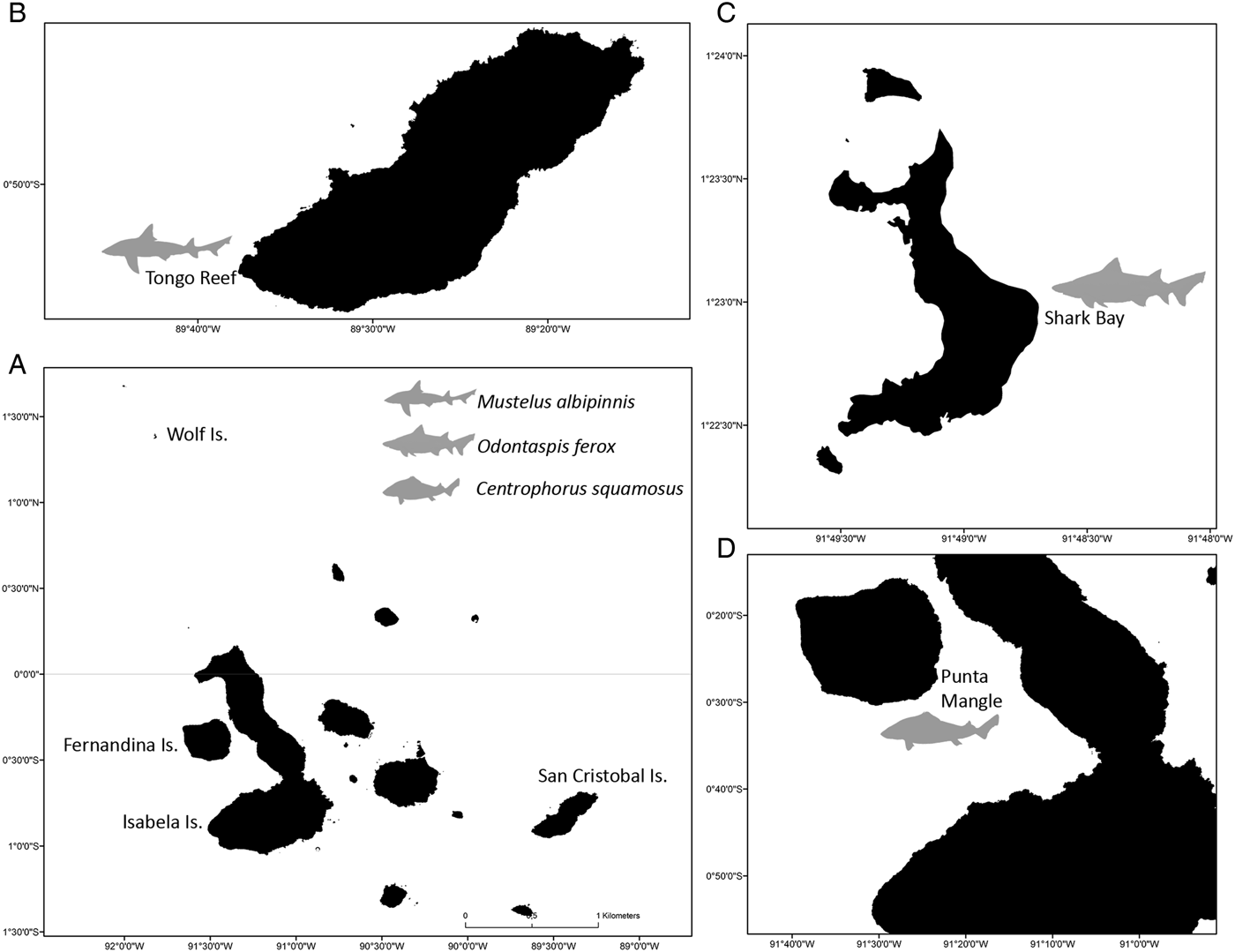
Shark Bay (1°23.04′N 91°48.46′W) is located at the east of Wolf Island (Figure 1). It is a rocky reef exposed to the predominant south-east current with a shallow narrow platform followed by a steep drop-off to about 600 m. The seabed here is mainly composed of big boulders with small sandy patches and abundant coral formations. Photograph and video footage were taken during the only sighting recorded so far.
(A) Map of the Galápagos Archipelago with the islands of Wolf, San Cristóbal, Fernandina and Isabela indicated; (B) map of San Cristóbal Island showing the location of the Mustelus albipinnis new record at Tongo Reef; (C) map of Wolf Island showing the location of the Odontaspis ferox new record at Shark Bay; (D) map of Fernandina and Isabela Islands showing the location of the Centrophorus squamosus new record south to Punta Mangle.

Tongo Reef (0°54.19′S 89°37.51′W) is a shallow flat rocky platform that extends to about 300 m off the coast at the west corner of San Cristóbal Island (Figure 1). The border of this platform drops suddenly to depths over 50 m. The site of the encounters is less than 100 m from the coastline. Photograph and video footage were taken during the first sighting.
On 14 January 2012, one specimen of Centrophorus squamosus was caught off the east coast of Fernandina Island (0°33.38′S 91°24.23′W). The shark was captured at approximately six miles south of Punta Mangle, at the south-eastern side of Fernandina Island (Figure 1) using a 200 hundred hooks' longline set near the bottom, at 600 m depth. The bait used was black-striped salema (Xenocys jessiae). This information was provided by the fisherman and obtained using a depth-sounder. The shark was brought to the Charles Darwin Research Station, where it was identified and examined by biologist David Acuña.
RESULTS
SYSTEMATICS
Order LAMNIFORMES
Family ODONTASPIDIDAE Müller & Henle, 1839
Genus Odontaspis Risso, 1826
Odontaspis ferox Risso, Reference Risso1810
One unknown shark was observed in the late afternoon on 22 November 2010 by dive tourists Martin Krammer and Martin Schlifski at Sharks Bay, Wolf Island, Galápagos (1°23.04′N 91°48.46′W). Both divers videotaped and photographed the shark because of its uncommon appearance (Figures 2 & 3). The individual was a female of ~400 cm TL, swimming from deep waters towards the surface along the rocky bottom with sandy patches in a protected area. The encounter lasted approximately two minutes and the shark was swimming slowly away when divers approached it. The divers reported that it may have been pregnant, given its distended abdomen. Photographs and videos were shared with dive guides Lenin Barrera and Ruben Intriago, and given to the Charles Darwin Foundation (CDF) where scientists Johanna Zimmerhackel, Cesar Peñaherrera and David Acuña identified the specimen as the smalltooth sandtiger shark Odontaspis ferox due to the following features: (i) anal fin present; (ii) two dorsal fins and five gill slits; (iii) eyes situated over mouth; (iv) caudal fin asymmetrical without keel; (v) subterminal mouth with large bladelike anterior teeth; and (vi) long conical snout and first dorsal fin closer to pelvic fin than to ventral fin. The identification is additionally supported by previous personal sightings by the author (D.A.), who observed this species several times in the ‘Mar de las Calmas Marine Reserve', Hierro Island, Canary Islands, Spain.
Individual of Odontaspis ferox observed at Shark Bay, Wolf Island (photograph extracted from video footage filmed by Martin Krammer and Martin Schlifski during a diving trip to the Galápagos northern islands).

Detail of the long conical snout and large bladelike teeth of the Odontaspis ferox observed at Shark Bay, Wolf Island (photograph extracted from video footage filmed by Martin Krammer and Martin Schlifski).

Order CARCHARHINIFORMES
Family TRIAKIDAE Gray, 1851
Genus Mustelus Linck, 1790
Mustelus albipinnis Castro-Aguirre, Antuna-Mendiola, González-Acosta & de la Cruz-Agüero, Reference Castro-Aguirre, Antuna-Mendiola, González-Acosta and De la Cruz-Agüero2005
Local student Jens Mayorga reported seeing an unusual shark while SCUBA diving off the coast of San Cristóbal, undertaking a study of shark presence at Tongo Reef, where fishers regularly clean their catch. He reported three encounters: the first took place on 11 September 2010; the second on 11 September 2011; and the third on 10 April 2012. Each encounter was with a single, apparently female individual, which he estimated to be between 150 and 200 cm TL (significantly larger than the reported maximum length for this species), swimming slowly in approximately 10 m depth (significantly shallower than the shallowest depth reported for this species). All three encounters took place around dusk, and the first occurred ten minutes after a fishing boat started to clean its catch at the site. The first encounter lasted over twenty minutes, with the shark showing signs of curiosity towards the diver, who at that time was alone. It slowly circled the diver several times over this period. During the remaining two encounters, when the diver was accompanied by a buddy, the shark appeared more active, and only circled the divers once. Photographs (Figure 4) and video stills (taken during the first encounter) were sent to John McCosker (California Academy of Science) and Phil Heemstra (South African Institute for Aquatic Biodiversity), both of whom identified the shark as Mustelus albipinnis. Mustelus albipinnis can be distinguished visually by the white outline of its dorsal, pectoral, pelvic and anal fins, being the only known houndshark with this feature (Castro-Aguirre et al., Reference Castro-Aguirre, Antuna-Mendiola, González-Acosta and De la Cruz-Agüero2005).
Mustelus albipinnis swimming in shallow water at Tongo Reef, San Cristóbal Island (photograph extracted from video footage filmed by Jens Mayorga).

Order SQUALIFORMES Compagno, 1973
Family CENTROPHORIDAE Bleeker, 1859
Genus Centrophorus Müller & Henle, 1837
Centrophorus squamosus Bonnaterre, 1788
Identification as Centrophorus squamosus was made by the following main features: (i) body cylindrical and low; (ii) five pairs of gills and spiracles present; (iii) no anal fin, fin spines present on both dorsal fins and caudal fin with subterminal notch; (iv) bladelike unicuspidate teeth in upper and lower jaws, with lowers much larger; and (v) rear tips of pectoral fins broadly angular and not strongly extended. A set of pictures of the shark were sent to Alberto Brito (University of La Laguna, Spain) who confirmed the species identification as Centrophorus squamosus (A. Brito, personal communication, 2012) (Figure 5). The individual examined was a mature female, measuring 95 cm TL, and weighting 5.2 kg. Five yolk balls were found within the uterus and embryos were not distinguished.
Specimen of Centrophorus squamosus captured south of Fernandina Island being examined at the Charles Darwin Research Station (photograph: David Acuña).

DISCUSSION
Odontaspis ferox and Centrophorus squamosus constitute two new records of shark species in the Galápagos Marine Reserve and two new families not previously registered: Odontaspidae and Centrophoridae. The species listed until now as Mustelus sp. (McCosker & Rosenblatt, Reference McCosker and Rosenblatt2010) is ultimately identified as Mustelus albipinnis.
Since the description of the smalltooth sandtiger shark Odontaspis ferox by Risso in Reference Risso1810, there is an increasing occurrence of records of this species in tropical waters around the globe. The site of the encounter concurs with previous records, stating that O. ferox is known to occur at insular locations that shelve steeply into depths of several hundred metres (Fergusson et al., Reference Fergusson, Graham and Compagno2008). The observed female of ~400 cm TL was encountered in 10 m depth. The total length of the shark and its depth are within the range of previous records (Fergusson et al., Reference Fergusson, Graham and Compagno2008). However, the fact that the first sighting of O. ferox took place at a frequently used dive spot, suggests that the presence of this species in this site and depth is fairly unusual. Although there is no official report on pregnant females in shallow waters, there have been reasonably frequent sightings of pregnant individuals in depths from 0 to 10 m in protected bays around the Canary Islands for more than a decade (between July and September from 1999 to 2010) (D. Acuña, personal communication, 2012). Even though there is no certainty that the female shark observed in the Galápagos was pregnant, these observations point to the hypothesis that O. ferox may give birth in shallow waters. While this is the first confirmed record of this species in the waters of Galápagos, O. ferox has been recorded in other insular locations of the Tropical Eastern Pacific, such as Malpelo Island, Colombia, and recently there are unconfirmed but reliable sightings of O. ferox from the Cocos Island National Park (Fergusson et al., Reference Fergusson, Graham and Compagno2008) strengthening the assumption that this species is present around the whole Galápagos volcanic province. Thus, the sighting of the specimen in the Galápagos is reasonable and expected. Individuals of O. ferox show a regional colour variation (Seigel & Compagno, Reference Seigel and Compagno1986). The observed individual from Galápagos was characterized by pigmentation similar to the smalltooth sandtiger sharks from Malpelo, Cocos and New South Wales. Those show moderately spotted and brownish-grey pigmentation, while specimens from the Mediterranean tend to have uneven, black oval blotches (Fergusson et al., Reference Fergusson, Graham and Compagno2008).
In the case of Mustelus albipinnis it is likely, given the history of reports for this species, and the three encounters over an 18-month period, that this species is resident at the Galápagos Islands, but that it is rarely found due to its reported preferred habitat in deeper waters and the absence of a trawl fishery or other human activities. It seems likely that the organic residues thrown regularly to the sea by fishermen at the site of the sightings may have caused the shark to ascend to shallow waters where the encounters occurred. The estimated size of the specimen is significantly greater than the maximum size registered for this species (Pérez-Jiménez et al., Reference Pérez-Jiménez, Sosa-Nishizaki and Castillo-Geniz2005). This difference in sizes may be explained by the recent description of the species and the limited number of individuals (N = 42).
Centrophorus squamosus is an important component of deep-water fisheries in the north-eastern Atlantic Ocean, being captured at depths between 500 and 1300 m with bottom trawl, longline and fixed bottom nets (Compagno, Reference Compagno and Compagno1984; Bañón et al., Reference Bañón, Piñero and Casas2006; Figueiredo et al., Reference Figueiredo, Moura, Neves and Gordo2008; Severino et al., Reference Severino, Afonso-Dias, Delgado and Afonso-Dias2009). Sex-ratio changes significantly depending on the catch depths, with males dominant at shallower depths and females in deeper waters (Clarke et al., Reference Clarke, Connolly and Bracken2001). There is evidence that this species displays complex migratory patterns associated with its reproduction (Figueiredo et al., Reference Figueiredo, Moura, Neves and Gordo2008). Size at 50% maturity was 125 cm TL for females, with the smallest mature female at 110 cm TL (Girard & Du Buit, Reference Girard and Du Buit1999; Bañón et al., Reference Bañón, Piñero and Casas2006; Figueiredo et al., Reference Figueiredo, Moura, Neves and Gordo2008). While depth of capture and fishing gear match what has been reported for C. squamosus, the specimen captured in Galápagos, a gravid female measuring 95 cm TL, is significantly smaller than the smallest mature female registered in the north-eastern Atlantic. A different size range for the eastern Pacific or the lower latitude of the specimen captured in Galápagos in comparison with the catches analysed in the north-eastern Atlantic could explain these differences, but more data are needed to verify these hypotheses. The presence of a gravid female at low latitudes concurs with the latitudinal gradient observed in the north-eastern Atlantic for C. squamosus females, with an increase of pregnant specimens further south (Bañón et al., Reference Bañón, Piñero and Casas2006). This first record of C. squamosus in the eastern Pacific Ocean extends its previously known distribution range from the Atlantic, Indo-Pacific and western Pacific to circumglobal.
ACKNOWLEDGEMENTS
We especially thank Franklin Arreaga, Lenin Barrera, Ruben Intriago, Martin Krammer and Martin Schlifski for providing the specimen and/or the information, photographs and video footage of the three species recorded in this paper. Without their actions and interest in conservation these three shark species would remain unknown in Galápagos. We thank Dr Alberto Brito (Animal Biology Department, University of La Laguna), Dr John McCosker (Department of Aquatic Biology, California Academy of Sciences) and Dr Phillip Heemstra (South African Institute for Aquatic Biodiversity) for corroborating the species identification. Special thanks go to Shark Savers Germany. Their support of the shark research and conservation project is greatly appreciated. We thank Aggressor Fleet and Beluga Reisen for their efforts in putting us in contact with two of the observers. This publication is contribution number 2069 of the Charles Darwin Foundation for the Galápagos Islands.