INTRODUCTION
Many conservation agencies and projects have sought to gain local support by promoting community-based conservation (CBC). Such initiatives seek to provide communities with incentives to conserve biodiversity (Wells & Brandon Reference Wells and Brandon1992; Hackel Reference Hackel1999, Terborgh & van Schaik Reference Terborgh, van Schaik, Terborgh, van Schaik, Davenport and pp2002; Naughton-Treves et al. Reference Naughton-Treves, Holland and Brandon2005; Robinson Reference Robinson2006). One incentive-based approach in which donors and conservation agencies have invested particularly heavily are integrated conservation and development projects (ICDPs). These seek to promote CBC around protected areas (PAs) in order to complement strategies for strengthening law enforcement inside PAs. However, the social impact and lasting legacy of ICDPs have rarely been evaluated independently through well-designed studies that use appropriate social, economic or biological indicators. Without such evaluations, lessons cannot be learnt about successes and, as importantly, failures of investments made in ICDPs (Robinson Reference Robinson2006). Given the high profile and cost of many ICDPs, it is particularly important to evaluate their performance and cost-effectiveness, both from conservation (Linkie et al. Reference Linkie, Smith, Zhu, Martyr, Suedmeyer, Pramono and Leader-Williams2008) and development perspectives.
The India Eco-Development Project (IEDP), an ICDP that ran in and around seven Indian PAs during the mid 1990s, at a total cost of US$ 61.0 million, was implemented through a loan-cum-grant from the World Bank, Global Environment Facility (GEF), with part funding from the Indian Government (World Bank 2004). Each PA within the overall IEDP was implemented on the ground by the relevant state forest department, through locally formed Eco-Development Committees (EDC). The overall aims of IEDP were to protect flagship species, including tigers (Panthera tigris) and elephants (Elephas maximus), and to conserve wider biodiversity by: (1) improving the capacity of PA managers to increase opportunities for local participation in PA management and decision making; (2) reducing the negative impacts of local people on biodiversity and, conversely, of PAs on local people by increasing collaboration with local people in conservation efforts; (3) developing more effective and extensive support for eco-development around PAs; (4) ensuring effective management of this project; and (5) preparing for future biodiversity projects (World Bank 1996). However, the performance and legacy of the IEDP has not been independently evaluated, either in whole or for any of its constituent PAs. Here, we undertake a post-hoc evaluation of the US$ 6.0 million component of the IEDP around Periyar Tiger Reserve (PTR) in southern India.
The PTR-IEDP spent US$ 2.7 million (43.2% of its project budget) on community development schemes, such as the creation of alternative livelihoods, provision of access to natural resources, and building infrastructure to serve as community assets and protect crops. Previous assessments carried out during the implementation or immediate closure phases, either by the PTR-IEDP itself or by consultants appointed under the IEDP, concluded that the project had been ‘successful’ overall (World Bank 2002; JPS Associates 2004; Sharma et al. Reference Sharma, Kabra, Kinhal, Panwar, Sharma, Upadhyay, Mohan and Upadhyay2004; World Bank 2007). However, these assessments did not use an appropriate project design or quantitative research methods to suitably evaluate project success. Furthermore, the assessments were unable to assess the lasting legacy of the community development initiatives that were intended to be a central feature of project. Therefore, this study aims to independently evaluate the effectiveness of the incentive-based CBC initiatives sponsored by the PTR-IEDP, through a counterfactual design that uses treatment and control groups.
How best to measure the effectiveness of a conservation project is still debated (Salafsky & Margoluis Reference Salafsky and Margoluis1999). Direct evidence-based evaluation of changes in densities of plant or animal communities can provide biologically-based indices to assess the success of CBC or ICDP projects. However, such approaches are time-consuming and require considerable investment in biological monitoring. Furthermore, some biological indicators change relatively slowly over time and biological approaches require baseline data against which to compare change (Ferraro & Pattanayak Reference Ferraro and Pattanayak2006). In contrast, short-term evaluations can be carried out through analysis of process-based measures that might equally well illuminate the success or otherwise of CBC or ICDP projects.
In this study, we chose to use quantitative techniques based on questionnaire surveys administered to treatment (n = 90) and control (n = 90) groups two years after the project ended, supplemented by on-site visits. Specifically, our study had three aims. First, to compare the attitudes towards conservation of a treatment group who had participated in and benefited from the IEDP, with those of a control group who had not participated in the IEDP. Second, to examine possible variables that might best explain the attitudes of the local community towards conservation including: participation in the IEDP; past history of negative interactions such as eviction from PTR; current conflicts with the Forest Department; and receipt of household and/or community development incentives. Thirdly, to investigate whether or not the infrastructure and benefits provided as development incentives under the IEDP were being maintained and used two years after the project had ended. In summary, we sought to question whether the investments made by the World Bank and the Government of India in the PTR-IEDP had left behind a lasting legacy of improved attitudes towards conservation in PTR, and/or useful infrastructure to promote livelihoods or mitigate human-wildlife conflicts.
METHODS
Study area
The 777 km2 Periyar Tiger Reserve is located in the state of Kerala in southern India (9°16'–9°40' N and 76°55'–77°25' E). PTR forms part of the Western Ghats, which supports an exceptionally rich but highly threatened biodiversity (Myers et al. Reference Myers, Mittermeier, Mittermeier, da Fonseca and Kent2000). PTR falls under the management of wildlife wing of the Kerala Forest Department (KFD), through which the IEDP was implemented locally. In PTR, the wide altitudinal range (750–1500 m above sea level), together with the high rainfall (2500 mm), humidity (60–85%) and temperature (15–31°C), create the dominant habitat types of tropical evergreen and semi-evergreen (74.6%) and moist deciduous (12.7%) forests (KFD 2001, 2003a). Eucalyptus (Eucalyptus grandis) plantations occupy about 7.1%, and the manmade reservoir of Periyar Lake built in 1895 occupies 3.5% of PTR (KFD 2001, 2003a).
The PTR boundary is 220 km in length and includes a 90 km interstate boundary with the state of Tamilnadu. Human settlements lie on the fringes of PTR and these comprise forest-dwelling communities who were shifted to the periphery of PTR during 1890s and 1940s (Arun et al. Reference Arun, Jayasankar and Abraham2001; KFD 2002; Gurukkal Reference Gurukkal2003; KFD 2003b). An estimated 225 000 people live within 2 km of the PTR boundary (KFD 2001), at a population density of 252 people km−2 (Government of Kerala 2004). These communities depend, to varying degrees, and both directly and indirectly, on the natural resources of PTR, including through illegal harvesting of non-timber forest products (NTFPs), wildlife poaching, timber smuggling, livestock grazing, thatching grass collection and narcotic cultivation, and through legally sanctioned tourism and pilgrimage management (World Bank 1996). Much of the land surrounding PTR is intensively farmed, mostly as cash crop plantations for tea, rubber, cardamom and coffee.
Data collection
A total of 58 144 villagers, or some 26% of the estimated 225 000 people living within 2 km of the boundary of PTR, were targeted to participate as beneficiaries under the IEDP (Sharma et al. Reference Sharma, Kabra, Kinhal, Panwar, Sharma, Upadhyay, Mohan and Upadhyay2004). To implement project activities, 72 EDCs were formed, based on their resource use patterns and social structure (Uniyal & Zacharias Reference Uniyal and Zacharias2001). However, we excluded two types of EDC from our study, comprising six pilgrimage management EDCs, as many of their members were also part of other neighbourhood EDCs, and three EDCs that were formed exclusively for Forest Department staff who could potentially hold biased views through their role of administering the IEDP. The eco-development and community development activities within the remaining 63 EDCs originated from micro-plan recommendations drawn up through participatory rural appraisal exercises in focal villages or communities, who were then given the responsibility of maintaining the community benefits provided under the IEDP (KFD 2003c; Sharma et al. Reference Sharma, Kabra, Kinhal, Panwar, Sharma, Upadhyay, Mohan and Upadhyay2004). Equal representation was given to women, and to members of lower social strata, to manage the EDCs and so ensure social equity and gender empowerment (KFD 2002).
We predicted that people who had participated in, and benefited from, the IEDP would hold more positive attitudes towards PTR, and to biodiversity conservation in general, than those who had not participated in or benefited from the IEDP. Therefore, we administered questionnaire surveys that included open and fixed response questions to both a treatment group of people who had participated in, and benefited from, the IEDP, and a control group who had not participated in the IEDP. Sampling of both treatment and control groups took place during May–July 2006, and was conducted at the household level, the basic unit of shared economic production and resource use around PTR, and the unit used for EDC membership within the IEDP.
A list of all 4962 households in the 63 focal EDCs was obtained from IEDP micro-plans, from which we randomly selected a total of 90 respondents using PopTools version 2.6.7, a free non-commercial MSExcel add-in (CSIRO, Canberra, Australia). This treatment sample represented 1.8% of household heads from the 63 EDCs. We also randomly selected, from village lists, a control sample of 90 respondents who were dependent on, or resided next to, PTR, but had not participated in IEDP.
Prior to the administration of the questionnaires, respondents were informed that the study was part of an academic, rather than a Forest Department, research project from which respondents would accrue no financial benefits. A pilot study of 10 respondents was conducted to check the clarity of the questionnaire. Questions were subsequently modified where necessary, and answers from the pilot study were discarded. All interviews were conducted with the full willingness of respondents, who were assured of their anonymity in order to increase the chances of genuine answers (Henerson et al. Reference Henerson, Morris and Fitz-Gibbon1987). Questionnaires were administered during an interview that took between 20 and 40 minutes, conducted either in the local Malayalam language or in Tamil for those from the neighbouring state of Tamilnadu, with the help of an interpreter who was aware of conservation issues. Some of the questions were indirectly repeated to triangulate responses.
Demographic and socioeconomic information, including gender, age, origin, occupation, land holding deeds, land tenure system and agricultural practices were collected for all respondents. The origin of respondents whose first language was not Malayalam, who had themselves or whose parents had migrated from other states, were categorized as ‘migrants’. Household locations of all respondents were recorded using a Garmin 12 XL global positioning system (Garmin Corporation, Olathe, KS, USA) and the distance of each household to the PTR boundary (Survey of India maps 1:50 000 scale) extracted using MapInfo geographical information system (GIS) software (MapInfo Corporation, Troy, NY, USA).
To assess whether the treatment group understood the primary objectives of the IEDP and to assess their perceptions of the IEDP, three open-ended questions were administered.
• Why were you given benefits under IEDP? Responses were categorized as either ‘correct’ or ‘incorrect’, based on their match with the objectives of the IEDP.
• What is your perception of the project? Responses were categorized as either ‘positive’ or ‘negative’.
• What were the problems with the IEDP?
Similarly, we administered three questions to the control group.
• Were you aware of the existence of the IEDP? Responses were categorized as either ‘yes’ or ‘no’.
• What was your perception of IEDP? Responses were categorized as either ‘positive’ or ‘negative’.
• Would you be willing to participate in a future IEDP, what reasons would you have for participation, and what social benefits would you like to request?
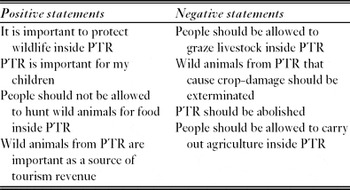
All respondents from both treatment and control groups were asked to rank up to three of the worst problems that they had experienced from living near to PTR, to understand if these problems might influence their attitudes to conservation. To quantify local attitudes, respondents from treatment and control groups were asked whether they ‘agreed’, ‘disagreed’ or ‘did not know’ to four positive and to four negative statements about natural resource or species conservation in PTR (Table 1). Agreeing to a positive statement received +1 point, whilst agreeing to a negative statement received −1 point, and vice versa for disagreeing to these two statements. A ‘do not know’ to either type of statement received a zero score. Attitude scores were then totalled for each respondent. The highest attainable score that showed the strongest support for conservation was +8 points, while the lowest possible score was −8 points.
Fixed response statements to assess conservation attitudes.

Finally, two questions were administered to the treatment group only, both to determine their understanding of the linkages between the conservation and development objectives of IEDP and to evaluate whether the development incentives provided under the IEDP had left a lasting legacy.
• What community benefit(s) has your EDC received and what is their current utility and usage?
• What direct benefit(s) did your household receive under the IEDP and do they still continue to use these benefits?
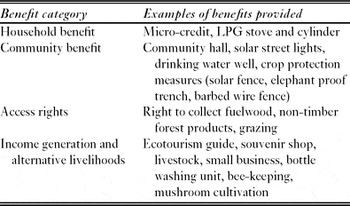
Benefits received under the IEDP were categorized as either a ‘household benefit’, restricted for use at the household level; a ‘community benefit’, provided for the use of the entire community; an ‘access rights benefit’, when access was granted to harvest natural resources from PTR; or an ‘alternative livelihood benefit’, when livelihood initiatives were supported under the IEDP (Table 2). The treatment group was also asked to list the community benefits that they received under IEDP, which were further categorized as ‘community utility’, ‘crop protection’ or ‘income generation’ benefits.
Benefits provided under the IEDP.

Post-project legacy was assessed by investigating whether EDC members had maintained and/or still used the community infrastructures that were provided by the IEDP, two years after the project had ended. Furthermore, we made site visits to a random selection of 55 community benefits. Wildlife crop raiding mitigation schemes, such as electric fences, barbed wire fences and elephant proof trenches, were surveyed on foot for 500–2000 m along the infrastructure, and we assessed their current states of use, whether used or not used, and of repair, whether maintained or not maintained.
Statistical analyses
All data were imported to SPSS v.14.0 statistical software (SPSS Inc., Chicago, IL, USA) for analysis. Firstly, we compared the understanding of the IEDP objectives among the treatment group with 14 independent variables, namely: gender; origin, whether local or migrant; age; level of formal education; current occupation; occupational dependency on PTR; whether or not possesses agricultural land; distance of the respondent's house to PTR boundary; whether or not previously affected by human-wildlife conflict; whether or not office bearer of EDC; household benefit received from IEDP; community benefit received from IEDP; access rights benefits received to PTR resources from IEDP; and alternative livelihood provided under the IEDP.
Next, we tested, and where necessary controlled, for non-independence (collinearity) between variables. Binary logistic regression analyses were performed to determine which variables, individually or in combination, best explained: whether respondents in the treatment group understood why they were given benefits under IEDP; and their perceptions towards IEDP. These candidate models were ranked by their delta Akaike Information Criterion values adjusted for small sample sizes (ΔAICc) and by their Akaike weights (wi) (Burnham & Anderson Reference Burnham and Anderson2002). The most parsimonious model, with fewest parameters and lying within two ΔAICc units of the top ranked model, was selected as the final model for the observed data. The performance of the final model was evaluated by calculating the area under the curve (AUC) of the receiver operating characteristics plot (Swets Reference Swets1988; Pearce & Ferrier Reference Pearce and Ferrier2000).
Finally, a linear regression analysis was performed to investigate the variables that best explained the attitudes of respondents in both treatment and control groups towards conservation. The analysis followed that outlined above, but included six additional variables: whether or not a respondent's occupation was legal; their personal experience of hunting wildlife in PTR; whether or not a respondent had experienced conflicts with the Forest Department; whether or not their ancestors had been resettled from PTR; benefits they derived, whether tangible, intangible, aesthetic or none, from PTR; and whether or not they had benefited from the IEDP.
RESULTS
Response rate and socioeconomic background
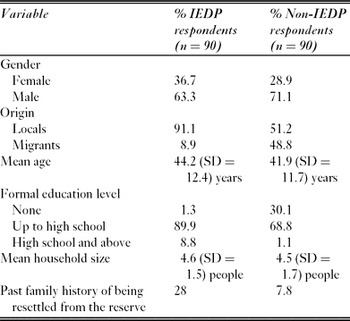
There was a 97.9% response to the questionnaire survey. Of 187 people contacted for the questionnaire survey, only four people declined to take part. Of the remaining 183 questionnaires, three were not used as the data were incomplete. Thus our final sample comprised 90 respondents in the treatment group and 90 respondents in the control group. The socioeconomic backgrounds of both IEDP and non-IEDP respondents were determined (Table 3).
Respondents' socioeconomic details.

Current dependency on PTR
Among the treatment group, 63.3% of respondents depended on PTR for their primary occupations, compared to only 41.1% of respondents in the control group. Since all respondents in the treatment group were issued verbal permits by the Forest Department to harvest specific resources, such as NTFPs, fuelwood and thatching grass, from PTR, their occupations were all legally sanctioned. In contrast, among respondents in the control group who depended directly on PTR, 70% of their occupations were not legally sanctioned by the Forest Department, including timber smuggling, NTFP, fuelwood and thatching grass collection, and wildlife poaching.
Respondent's understanding of IEDP objectives and their perceptions
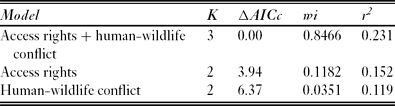
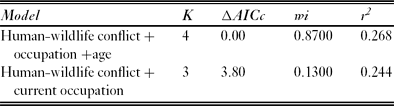
Among the treatment group, 71.1% of respondents were aware of the core objective of the IEDP, which was to reduce negative impacts of communities on PTR. However, only 42.2% held a positive view of the IEDP, while 57.8% held a negative view. Reasons given for holding these negative views included cancellation or reduction of micro credit schemes (31.1%), frequent change of government officials leading to poor understanding of project objectives (17.7%), and mismanagement of EDC funds (16.6%). Respondents who held positive views towards the IEDP were less likely to rely on access rights to PTR, or to have experienced human-wildlife conflicts (Table 4).
Logistic regression model best explaining views of beneficiaries towards the India Eco-Development Project (n = 88). The final regression model explained 69.3% of the original observations and had an AUC value of 0.732.

Among the control group, 80% of respondents were aware of the existence of IEDP. Of these 72 respondents, 25.5% held a positive view of the IEDP while 23.3% held a negative view. However, 51.1% of these 72 respondents did not have a view of the IEDP, because they were unaware of its objectives. Among the control group, 80% of respondents would be willing to participate in a similar future project. Key reasons cited for future participation included: to gain access to alternative livelihood benefits (45.8%); to benefit from legal access rights to PTR resources (33.3%); and to gain household benefits (11.1%). However, no respondents in the control group cited community benefits as a reason for future participation. When the 72 respondents willing to participate in a similar future project were asked why they should be given benefits, 62.5% wished for alternative livelihoods, 20.8% wished to reduce their dependency on PTR and 15.2% were unsure.
Problems experienced living near PTR
Among the treatment group, 45.5% of respondents reported no problems from living near to PTR. Of the remaining 49 respondents, 75.5% reported crop damage by wildlife as their main problem, while other less common problems included fear of elephants (8.1%) and lack of development because this was difficult to achieve inside PTR (6.1%). Similarly, 54.5% of respondents in the control group reported no problems from living near to PTR. Of the remaining 41 respondents, 34.9% reported crop damage by wildlife, 30.2% reported restricted access to natural resources and 23.2% reported harassment by the Forest Department.
Of the 52 respondents in both treatment and control groups who had experienced crop raiding as their main problem, 26.8% suggested an electric fence, 15.3% suggested an electric fence combined with a trench and 11.5% suggested trenches alone, as the best way to mitigate crop raiding. The remaining 46.4% respondents had no suggestions. Among 15 respondents in the control group who cited restricted access to PTR as their main problem, 62.5% suggested that they should be allowed to harvest certain natural resources from PTR, for example fuelwood and NTFPs, such as black damar (Canarium strictum), Malabar tamarind (Myristica spp.) Indian gooseberry (Phyllanthus indofischeri), amla (Emblica officinalis) and Asiatic honey (Apis sarana indica).
Attitudes to conservation
Scores of attitudes to conservation showed that 148 respondents fell in the positive range with scores of 0 to +8, while 32 respondents fell in the negative range with scores of −1 to −8. More positive attitude scores were best explained by respondents who worked as ecotourism guides, were younger and who had not experienced conflict with wildlife (Table 5), with no effect from the other variables. This shows that being a beneficiary of the IEDP did not improve respondents' conservation attitudes.
Linear regression model best explaining conservation attitude scores amongst India Eco-Development Project (IEDP) and non-IEDP respondents in and around Periyar Tiger Reserve (n = 180).

IEDP development assistance and its linkage to conservation
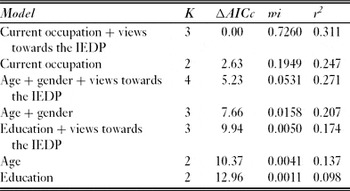
Among the treatment group, 47.7% of respondents reported that they had received only household benefits, 7.7% had received only alternative livelihoods, while 47.7% reported they had received both and 1.1% were unsure whether they had received any benefits. Among the treatment group, 71.1% of respondents understood that they had been given benefits under the IEDP to reduce their impacts on the natural resources of PTR, and this understanding was related to occupation and perception towards the IEDP (Table 6). The respondents most likely to make the connection between the benefits they received and the expectation that they should reduce their impacts on PTR, were working as ecotourism guides and had a positive perception towards IEDP.
Logistic regression model best explaining respondents' understanding of why they received benefits from the Periyar Tiger Reserve-India Eco-Development Project (n = 90). The final regression model explained 78.4% of the original observations and had an AUC value of 0.799, indicating an accurate model fit.

Among the treatment group, 53.3% of respondents were aware of the types of community benefit that their community or village had received under the IEDP. Of these respondents, 37.7% said that they found the community benefit useful, whilst 10.0% did not and 5.6% had no opinion. Furthermore, among these respondents, 43.9% reported that they often used these community benefits, while 27.0% of respondents used it occasionally, 16.6% rarely used it and 10.4% did not use it.
Despite claims by respondents to make regular or irregular use of the community benefits provided by IEDP, 35 (63.6%) of 55 sets of infrastructure sampled during this study were no longer used or maintained. In particular, none of 19 community benefits installed to protect crops were in use or maintained. In contrast, 52.9% of 17 community utility benefits such as community halls, EDC offices and provision stores were still used and maintained, while 57.9% of 19 income generation benefits were still used and maintained. Of the income generation benefits that were still used and maintained, 63.6% depended directly for their use on tourism and pilgrimage activities, such as ecotourism activities, tribal heritage museum, souvenir shop and toilets.
DISCUSSION
Formal and independent evaluations to determine whether or not ICDPs have met their conservation and/or development targets are uncommon (Linkie et al. Reference Linkie, Smith, Zhu, Martyr, Suedmeyer, Pramono and Leader-Williams2008). Our study showed that most of the community benefits provided through PTR-IEDP were not in use two years after the project had ended. Furthermore, the treatment group who had participated in, and received benefits from, IEDP were no more positive towards conservation than the control group who had not participated in the IEDP, suggesting that the PTR-IEDP has left relatively little lasting legacy in terms of improved attitudes to conservation or useful infrastructure that has continued to assist communities in their development needs. Nevertheless, the PTR-IEDP does deserve credit for addressing several concerns and issues raised previously by critics of ICDPs, such as failure to adopt participatory approaches, social equity, lack of co-management decisions, providing infrastructure without consulting local communities and gender empowerment (Ghirmire & Pimbert Reference Ghirmire and Pimbert1997; Sanjayan et al. Reference Sanjayan, Shen and Jansen1997; Larsen et al. Reference Larson, Freudenberger and Wyckoff-Baird1998; Brandon et al. Reference Brandon, Redford and Sanderson1998; Mahanty Reference Mahanty2002; Wells et al. Reference Wells, McShane, Dublin, O'Connor, Redford, McShane and Wells2004; World Bank 2007). Yet, despite attempting to address these concerns, the PTR-IEDP subsequently made little effort to monitor and evaluate its development impact, and none whatsoever to evaluate its conservation impact. Our findings have important implications for ensuring the success of future ICDP initiatives in India and elsewhere. In particular, ICDPs should seek to more effectively build the capacity of local communities to maintain the community benefits they receive. Furthermore, ICDPs should be continuously and independently evaluated to ensure appropriate adaptive management of such projects.
Understanding and meeting the ICDP objectives
Reasons commonly cited for the failure of ICDPs include that intended beneficiaries poorly understand project objectives and that linkages between incentives and conservation are weak or poorly explained (Sanjayan et al. Reference Sanjayan, Shen and Jansen1997). This was clearly not the case with the PTR-IEDP because most beneficiaries were aware of project objectives, even two years after the project had ended. However, the extent to which respondents understood IEDP objectives was best explained by their occupation. Ecotourism guides generally showed the best understanding, and involvement in ecotourism appears to be one initiative that was successfully promoted among those included in the IEDP. However, at PTR, ecotourism provided a source of primary occupation for only 43 households or 0.8% of the 5540 households targeted.
A key objective of the IEDP was ‘to provide a firmer base of public support for PAs and increased understanding of PA biodiversity, local people, and their interactions’ (World Bank 1996). Nevertheless, the attitudes towards PTR and conservation of respondents in the treatment group who benefited from IEDP did not differ from respondents in the control group who did not participate in IEDP. Those respondents who were part of the IEDP-sponsored ecotourism enterprise held the most positive attitudes to conservation, presumably because they benefited financially from involvement in ongoing conservation education activities, which also provided them with a better understanding of conservation issues in PTR. Although access rights were provided to some community groups for both commercial and subsistence extraction of NTFPs, these groups held unexpectedly negative views of IEDP. The granting of access rights may have unrealistically raised community expectations of the benefits that they would receive (Ite & Adams Reference Ite and Adams2000; MacKinnon Reference MacKinnon2001). Given these contrasting findings, it might be tempting to further promote well-managed ecotourism as a way of bringing in more revenue and providing sustainable livelihoods for additional communities. Nevertheless, it might be impractical and unwise to further expand tourism activities, as PTR is relatively small and its carrying capacity for tourists might be quite low, at least without detrimental impacts on its biodiversity (KFD 2003a).
The long-term legacy of community and household benefits
Attitude surveys can be a useful surrogate measure with which to assess community interest in conservation (Arjunan et al. Reference Arjunan, Holmes, Puyravaud and Davidar2006). However, questionnaire surveys alone cannot measure whether or not communities actually follow the practices they claim in interviews. Therefore, while some respondents may have claimed to use the community and household benefits provided under IEDP, we also chose to make site visits to determine whether these benefits had left a lasting legacy.
Many respondents in both treatment and control groups cited crop damage by wildlife as the main problem that they experienced living close to PTR. Therefore, the IEDP was sensible to follow the requests of communities and provide infrastructure to guard crops (World Bank 2004). The community invested in these schemes through providing their labour and time in building and subsequently guarding these crop protection measures. Nevertheless, our site visits two years after IEDP ended showed that none of this infrastructure was being maintained by the village community groups (EDCs) responsible for their repair, even though recipient communities still perceived human-wildlife conflict to be a major problem.
The infrastructure requested to protect crops, such as electric fences, may have been neglected because it was too complicated or expensive for communities to maintain (Thouless Reference Thouless1994; Thouless & Sakwa Reference Thouless and Sakwa1995). Also, community investment in the infrastructure may have been insufficient, or unequally spread, to generate a real sense of ownership. The crop protection measures provided indirect, intangible benefits that may have led the communities to perceive these benefits as being insufficient and therefore not warranting maintenance. Before investing in these schemes, it might have been prudent to identify community perceptions of the most important crop pests, and to identify the spatio-temporal patterns of crop raiding by the actual crop pests, in order to develop more cost-effective mitigation measures (Naughton-Treves et al. Reference Naughton-Treves, Treves, Chapman and Wrangham1998; Naughton-Treves & Treves Reference Naughton-Treves, Treves, Woodroffe, Thirgood and Rabinowitz2005; Treves et al. Reference Treves, Wallace, Naughton-Treves and Morales2006; Linkie et al. Reference Linkie, Dinata, Nofrianto and Leader-Williams2007). In India, the failure of electric fencing in deterring crop pests has been documented previously from similar large multi-donor funded projects (Jeyasingh & Davidar Reference Jeyasingh and Davidar2003; Arjunan et al. Reference Arjunan, Holmes, Puyravaud and Davidar2006). The IEDP might therefore have considered promoting alternative low-cost, low-tech methods (Thouless & Sakwa Reference Thouless and Sakwa1995; Mishra et al. Reference Mishra, Allen, McCarthy, Madhusudhan, Bayarjagal and Prins2003; Osborn & Parker Reference Osborn and Parker2003; Sitati & Walpole Reference Sitati and Walpole2006).
Reducing dependency on protected area resources
To increase their chances of success, ICDPs might consider focusing on reducing dependency on forest-based products and activities. Thus, ICDPs could promote alternatives livelihoods, such as private sector jobs that themselves do not rely on forest products (Gunatilake Reference Gunatilake1998). Nevertheless, the activities promoted under the PTR-IEDP that did not depend on forest-based activities and products, such as the bottle washing unit, shop-keeping, bee-keeping and mushroom cultivation, were not continued by local communities. Instead, the only community benefits that were maintained and remained in use two years after the IEDP had ended were those generating income through tourism activities.
Nevertheless, the tourism industry that most profits from PTR contributes relatively little towards its conservation, and has provided few livelihood benefits to local communities. In general, nature-based tourism provides little benefit to local communities and the local attractions that are the source of tourist interest (Gossling Reference Gossling2002). The same is likely true of re-investment in conserving PTR. Therefore, urgent steps should be taken to encourage the tourist industry, including hotel and resort owners, restaurants, souvenir shops, travel agents and all others benefiting directly or indirectly from PTR, to contribute towards conservation efforts through setting up a separate PTR conservation tax under the local municipal administration that could later be transferred to PTR.
Our results also suggest that formal education opportunities might be successful in reducing the dependence of communities on natural resources in PTR. Indeed, education appears a key area in which the rural development activities promoted in ICDPs should focus, because higher levels of formal education are conducive to individuals gaining better paid, typically off-farm, jobs that do not depend on natural resources. Similar studies in Sri Lanka and have suggested that education would reduce community dependency on forest resources (Gunatilake Reference Gunatilake1998; Hegde & Enters Reference Hegde and Enters2000).
Rural development activities need to provide distinctive skills and expertise, and promote highly motivated and committed individuals. To ensure longer-term success of CBC activities such as the IEDP, eco-development activities should be implemented by individuals with specialist skills in rural development and organizations and departments who have social acceptability. Any such eco-development investments would need regular assessments by independent agencies to increase their chances of success.
Evaluating conservation goals
Besides evaluating their development goals, ICDPs, such as the PTR-IEDP, also need to focus on monitoring the components of biodiversity that they intend to protect. Whilst the IEDP did address the important elephant conservation issue of mitigating crop raiding, it ignored the possible threats posed to tigers and their prey by the overharvesting of NTFPs and the disturbance and competition from livestock grazing inside PTR (Gubbi Reference Gubbi2006; Gubbi & MacMillan Reference Gubbi and MacMillan2008). Whilst the monitoring of socioeconomic indicators is essential for measuring project success or failure, placing too much emphasis on the socioeconomic indicators could detract from the project's conservation focus, and further reduce its integrated balance towards a development project. Since tigers and elephants are flagship species that influenced the selection of PTR as one site in IEDP, the monitoring of these species inside PTR should have been included as a verifiable indicator of the success or otherwise of the PTR-IEDP.
CONCLUSIONS AND FUTURE DEVELOPMENTS
The Government of India has requested funding from the Global Environment Facility for a new ICDP entitled ‘The Biodiversity Conservation and Rural Livelihoods Improvement Project’ costing US$ 47.1 million (Global Environment Facility 2007), based on perceived successes with the IEDP model assessed in this study. Nevertheless, there has not been a full and independent quantitative evaluation of the performance of previous investments in ICDPs in India, from either conservation or rural development perspectives. Therefore, it is vital that this new project learns from past IEDP experiences. Future investments by donors in ICDPs, or in any similar development project that seeks to incentivize conservation, need to have a sound social and economic justification. In India and elsewhere, such projects place a major burden on the taxpayers who will have to repay loans of tens of millions of US$ over the next several decades.
ACKNOWLEDGEMENTS
We thank all the respondents who participated in the survey. We also thank all those who helped with the study. K.U. Karanth, S. Kumar, A. Kumar, S. Srinivas, B. Hegde of Wildlife Conservation Society-India Program, V. Gopinath, B. Thomas, P. Mahanti, M.L. Thomas, J. Zacharias, S. Francis of Kerala Forest Department, R. Pillai, M. Balasubramaniam, A. Veeramani, A. Bashir, Sebastain, M.B. Anil, Sasikala and Jaya of Periyar Foundation all provided information and logistical support. M.D. Madhusudhan and K. Karanth provided useful inputs. Funding was provided through a WCS Graduate Fellowship and C.V. Starr Graduate Fellowship in Tiger Conservation, Wildlife Conservation Society-India Program, and Centre for Wildlife Studies, 21st Century Tiger and DICE. Kerala State Forest Department provided necessary permission and support.