


Introduction
Humanity is currently facing one of the greatest challenges of its entire history: improving the living standards of an ever-growing global population and ensuring that nobody is left behind, while protecting the environment that sustains its existence. The solution for this challenge was identified and formalized by the Brundtland Commission three decades ago (World Commission on Environment and Development 1987). The Commission stated that creating a more prosperous, just and secure world requires a shift in the way in which societies improve their overall well-being. Instead of following the conventional development model based on the pursuit of endless economic growth and the assumption of an infinite resource base, modern societies must decouple improvements in human well-being from environmental degradation by adopting the sustainable development model (for an alternative view, see Demaria & Kothari Reference Demaria and Kothari2017). This model enables societies to meet the needs of the present without compromising the ability of future generations to meet their own needs (World Commission on Environment and Development 1987).
Human development requires infrastructure, a broad term that denotes all elements (ecological, physical, social, economic and technological) of interrelated systems that provide goods and services essential to enabling, sustaining or enhancing societal living conditions. The different systems that comprise infrastructure can be grouped into two major types: socio-economic (or grey) and ecological (or green). Socio-economic infrastructure is the combination of all assets or capitals (human, manufactured, social, economic and knowledge) required by social sectors (e.g., justice, education, health and culture) and economic sectors (e.g., finances, energy, water and sewage and food and agriculture) to provide essential human-made services for people (Silva & Prasad Reference Silva and Prasad2019). In contrast, ecological infrastructure is a network of natural, semi-natural and restored areas designed and managed to conserve biodiversity, mitigate greenhouse gas emissions, enable societal adaptations to climate change and deliver a wide range of other ecosystem services that are essential to human prosperity and security (Silva & Wheeler Reference Silva and Wheeler2017). Ecological infrastructure aims to protect the ecological capital (sensu Barbier Reference Barbier2016) of a society and encompasses all types of ecosystems (marine, freshwater and terrestrial) and settings (urban and rural) (Maes et al. Reference Maes, Barbosa, Baranzelli, Zulian, Batista e Silva and Vandecasteele2015).
Because the territory available to a society is finite, pursuing sustainable development requires finding a balance between socioeconomic and ecological infrastructures (Gao & Bryan Reference Gao and Bryan2017). This balance can be achieved through adaptation (i.e., improving current conditions without creating a rupture with the dominant socioeconomic system) or through transformation (i.e., improving current conditions by promoting substantial changes in the dominant socioeconomic system). The importance of these two processes for sustainable development is a subject of intense academic debate. On the one hand, proponents of the ecological modernization theory suggest that adaptation through the adoption of environmentally friendly and sustainable sociotechnical systems, institutions, policy arrangements and social relations is enough to harmonize ecological and socioeconomic infrastructures (e.g., Mol et al. Reference Mol, Spaargaren, Sonnenfeld, Lockie, Sonnenfield and Fisher2013). On the other hand, the theory of treadmill production posits that reconciling social gains and environmental protection is not possible without a rupture with the capitalist production model. The proponents of this theory indicate that the constant search for economic growth, which is intrinsic to the capitalist production system, leads to national economies being stuck on a ‘treadmill’, a state in which well-being is not improved and environmental impacts are not reduced (Gould et al. Reference Gould, Pellow and Schnaiberg2015, Curran Reference Curran2017). Between these two extremes, there is also a suggestion that although adaptation can generate some progress, societies will soon reach a ‘glass ceiling of transformation’, defined by Hausknost (Reference Hausknost2020) as a system boundary that may be shifted within certain dynamic parameters, but not transgressed without first transforming the fundamental structure and identity of the system itself.
The tension between adaptation and transformation also exists within the modern conservation movement. For example, Sandbrook et al. (Reference Sandbrook, Fisher, Holmes, Luque-Lora and Keane2019) found that the transformation approaches of a people-centred conservation (i.e., recognizing the role of people as beneficiaries, participants and stakeholders of the conservation process) and science-led eco-centrism (i.e., advocating for the use of science to design conservation strategies based on eco-centric thinking) have widespread support across the conservation community. However, the adaptation approach of conservation through capitalism (i.e., using market-driven conservation mechanisms that align conservation with the dominant socioeconomic system) was a contentious issue.
In addition to these divergent approaches, other challenges have caused the conservation movement to currently find itself at a crossroads. The Convention on Biological Diversity, the conservation movement’s fundamental global agreement, needs to define a new set of global conservation goals after countries failed twice to fulfil their commitments to reduce biodiversity loss (Butchart et al. Reference Butchart, Di Marco and Watson2016). These successive failures have generated widespread scepticism within the conservation movement about the ability of national governments to set and implement policies that protect species and ecosystems, especially those facing large-scale environmental changes associated with the expansion of human activities around the world (Howes et al. Reference Howes, Wortley, Potts, Dedekorkut-Howes, Serrao-Neumann and Davidson2017). However, this scepticism should be considered cautiously because some advances in policies have been made (e.g., Lewis et al. Reference Lewis, MacSharry, Juffe-Bignoli, Harris, Burrows, Kingston and Burgess2019, Whitehorn et al. Reference Whitehorn, Navarro, Schröter, Fernandez, Rotllan-Puig and Marques2019), and as noted by McConnel (Reference McConnell2015), “Policy failures are intensely political because of conflict over whether a particular set of policy outcomes constitutes failure, and what (if anything) caused failure in the first place.”
In this paper, we review the literature from several disciplines to outline a positive agenda for the global conservation movement. We combine the strengths of the people-centred and science-led conservation approaches to develop a framework that emphasizes the importance of ecological infrastructure for the long-term prosperity of human societies in an ever-changing world. We organize our arguments in four sections. In the first, we review the connections between sustainable development, ecological infrastructure and development pathways. In the second and third sections, we discuss the policy challenges associated with the design and implementation of ecological infrastructure at the national level, respectively. In the final section, we provide suggestions for the advancement of the common goals of the conservation movement.
Sustainable development, ecological infrastructure and development pathways
Sustainable development can be approached from an analytical or a normative perspective (Sachs Reference Sachs2015). The analytical view is used to understand the world as a super-system composed of all nation-states, its relationships (whether economic, cultural and/or political) and its interactions with the global environment or ecosphere (Bunge Reference Bunge1979). It is the focus of modern sustainability science (e.g., Matson et al. Reference Matson, Clark and Andersson2016). In contrast, the normative or ethical view of sustainable development is a way to define the objectives of a well-functioning society – one that ensures the well-being of its current and future citizens (Sachs Reference Sachs2015). Henceforth, we use the normative approach, which is more appealing to practitioners, to demonstrate the centrality of biodiversity conservation in the long-term maintenance of well-being and the connections between sustainable development, ecological infrastructure and development pathways.
We define sustainable development as a political process by which human societies improve the well-being of their members by simultaneously promoting economic prosperity, social inclusion and effective public governance, while protecting the environment (Sachs Reference Sachs2015). Because this general definition includes several supporting concepts, we will clarify the meaning of each one.
We consider sustainable development to be a political process because it requires the participation of all components (i.e., individuals and groups) of a human society to make and execute collective decisions. Following Bunge (Reference Bunge1979), we define human societies as concrete systems composed of people who share an environment and deliberately transform portions of it, hold social relations and communicate among themselves, are divided into social groups and constitute a self-reliant unit. Because human societies are concrete systems, they can be nested within one another at different levels. For instance, local societies are nested within nation-states, and nation-states are nested within the global society. Human well-being is a contested concept, but based on the most recent assessments (OECD 2011), we define it as a state in which a person is able to: (1) meet all basic needs (e.g., food, lodging, healthcare); (2) pursue individual goals; (3) thrive in society; and (4) feel satisfied with life.
A society is economically prosperous if and only if all of its members can afford to consume goods and services other than those necessary for their survival, within the carrying capacity of their immediate environment. Similarly, a society is inclusive when all of its members are able to participate in it, including those disadvantaged based on identity (World Bank 2013). Public governance refers to the governmental exercise of civic authority to produce, facilitate and otherwise influence outcomes that enhance civil welfare (Andrews Reference Andrews2014). Thus, a society has effective public governance when its government is able to appropriately mobilize internal and external resources to advance solutions to public problems and ultimately enhance the society’s overall well-being (Andrews Reference Andrews2014). Furthermore, environmental protection is defined as the long-term maintenance or restoration of the ecosystems in which a society is embedded.
Human societies require effective socioeconomic and ecological infrastructures to prosper (Silva & Prasad Reference Silva and Prasad2019). Socioeconomic infrastructure is required to advance economic prosperity, social inclusion and public governance and depends on ecological infrastructure to be fully functional. Ecological infrastructure, which is needed to advance environmental protection, is essential because it underpins human well-being by providing ecosystem services that are valuable to humans through interactions with socioeconomic infrastructure (Collados & Duane Reference Collados and Duane1999, Silva & Prasad Reference Silva and Prasad2019). Accordingly, the overall well-being of a society can be conceptualized as a function of the services provided by the interactions between its socioeconomic and ecological infrastructures (Collados & Duane Reference Collados and Duane1999).
If the well-being of a society is a function of the services provided by its socioeconomic and ecological infrastructures, then it is possible to create a bi-dimensional space in which the location of a society is given by a pair of numbers representing the quality of its ecological (y-axis) and socioeconomic (x-axis) infrastructures (Fig. 1). Thus, the location of a society within the bi-dimensional space corresponds to its development state at a given time. Because ecological infrastructure can be restored and socioeconomic infrastructure can be created or restored, societies can change their locations in the bi-dimensional space over time (Fig. 1). If the indicators of both infrastructures do not change over time, a society remains in the same development state. However, if the indicator of at least one of the infrastructures changes, a society changes its development state. Over time, the successive development states of a society in the bi-dimensional space collectively represent its development pathway or trajectory (Collados & Duane Reference Collados and Duane1999).
Societies (dots) at different development states based on the quality of their infrastructures at a given time. The Brundtland Quadrat represents the set of development states that are considered sustainable. Because these societies are outside of it, they all correspond to unsustainable states.
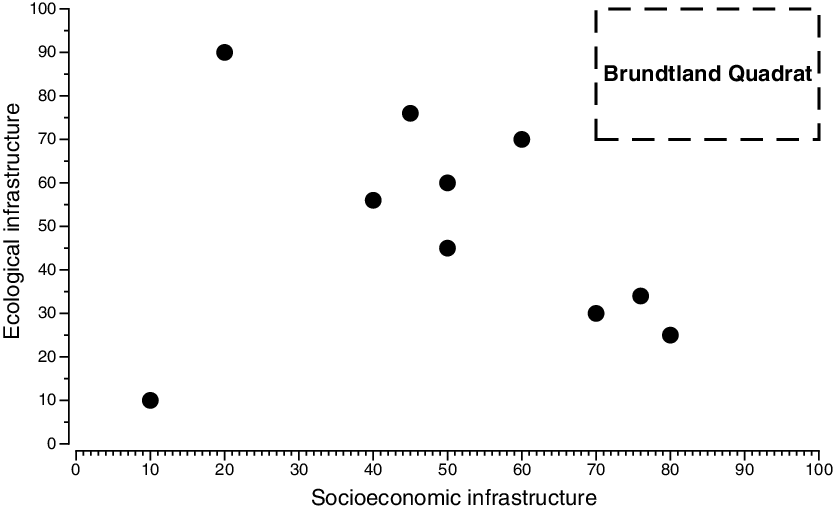
Because of the global consensus in favour of committing to the sustainable development agenda (Sachs Reference Sachs2015), it is expected that the long-term aim of every modern society is moving towards a sustainable state, in which the balance between ecological and socioeconomic infrastructure ensures long-term security and prosperity for all. We posit that there is a portion of the bi-dimensional space that represents this balance and thus the best combination of the two types of infrastructure. We term this portion of the bi-dimensional space the ‘Brundtland Quadrat’ (Fig. 1). Societies within this quadrat are considered sustainable, while those outside of the quadrat are considered unsustainable. Societies moving towards the Brundtland Quadrat correspond to a sustainable development pathway and otherwise correspond to an unsustainable development pathway. We call the movement of all human societies towards the Brundtland Quadrat the ‘Great Global Convergence’.
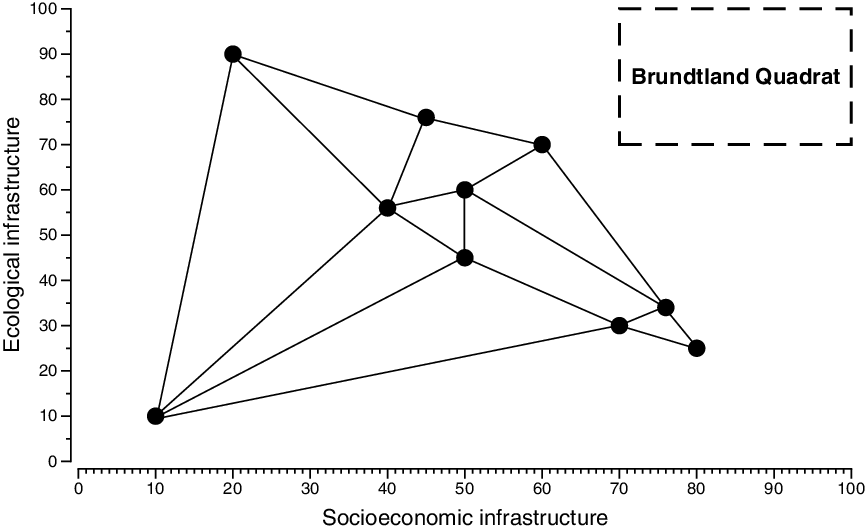
Because modern societies are not isolated, they are all parts of networks (Fig. 2) that are formed by their interactions (e.g., trade, political agreements and cultural exchanges). These connections enable societies to influence each other’s development pathways, as changes in the development state of one society impact the development states of all other linked societies (Fig. 2). The impact is positive if it moves the affected society towards a more sustainable pathway and is negative if it does otherwise. Thus, it is possible for a society to move towards the Brundtland Quadrat at the expense of another society, which can consequently move away from a sustainable development pathway. This process is described by the theory of ecologically unequal exchange (Givens et al. Reference Givens, Huang and Jorgenson2019). Ultimately, a society’s development pathway is determined by how it uses its assets and how it interacts with other societies. Therefore, assessments of development pathways can only be considered comprehensive and accurate if they account for both ecological and social impacts imposed upon other societies (Hull & Liu Reference Hull and Liu2018, Boillat et al. Reference Boillat, Martin, Adams, Daniel, Llopis and Zepharovich2020).
Societies (dots) at different development states based on the quality of their infrastructures at a given time. All of them represent unsustainable states because they are outside of the Brundtland Quadrat, which represents sustainable development states. Because societies are linked through their interactions, they form networks. Thus, changes in the state in one society can influence the development states of other societies.
The strategy that a society will adopt to move towards the Brundtland Quadrat in its quest towards sustainable development depends on the current effectiveness (i.e., ability to produce the goods and services required by the society) of its ecological and socioeconomic infrastructures, which are therefore path-dependent. Societies that have effective ecological infrastructures but limited socioeconomic infrastructures should focus on advancing economic prosperity, social inclusion and public governance. On the other hand, societies that have effective socioeconomic infrastructures but limited ecological infrastructures should focus on advancing large-scale environmental conservation and restoration. Some societies have limited ecological and socioeconomic infrastructures and cannot move away from this unsustainable trap without help from other societies to simultaneously restore both infrastructure types. Finally, the few societies that are within the Brundtland Quadrat and have achieved the balance between their ecological and socioeconomic infrastructures should strive to maintain this state in order to avoid moving towards an unsustainable space.
Designing ecological infrastructures for sustainable development
To move along a sustainable development pathway, societies must maintain or enhance their ecological infrastructures because biodiversity conservation is indispensable to the long-term improvement of all dimensions of well-being (i.e., health, education, income, politics and the environment). Just like all other activities in the broad sustainable development agenda (currently consolidated under the United Nations Sustainable Development Goals), designing and implementing ecological infrastructure is a multi-level political process. Accordingly, at the global level, the standards and commitments for national-level ecological infrastructure are set by the Convention on Biological Diversity. Then, these global standards and commitments are translated into national policies that are implemented at the local level. Therefore, national-level policies serve as the link between global and local priorities.
National policies determine the mechanisms by which countries design and implement ecological infrastructures that fulfil societal needs. Policies on ecological infrastructures will more likely emerge from the consolidation or upgrading of pre-existing legislations that define natural ecosystem use, such as protected area policies. In fact, protected areas are the building blocks of national ecological infrastructures (Soulé & Terborgh Reference Soulé and Terborgh1999, Maes et al. Reference Maes, Barbosa, Baranzelli, Zulian, Batista e Silva and Vandecasteele2015, Dias et al. Reference Dias, Cunha and Silva2016). Nevertheless, even though most countries have national laws on protected areas, fewer countries have legislation that incorporates them into comprehensive, representative and effectively managed conservation systems (Dudley et al. Reference Dudley, Mulongoy, Cohen, Stolton, Barber and Gidda2005). Thus, specific legislations are required to enable the integration of protected areas with other public or private regions that collectively constitute a country’s ecological infrastructure (Slätmo et al. Reference Slätmo, Nilsson and Turunen2019). Although several countries have land-use policies and plans, most were designed to organize the expansion of socioeconomic infrastructures, rather than building effective ecological infrastructures (OECD 2017).
We believe that national policies on ecological infrastructure can evolve in three ways: (1) upgrading national land-use and sea-use legislation by establishing the conservation of biodiversity and ecosystem services as fundamental goals; (2) upgrading protected area legislation by integrating protected areas into a national-level system and creating management standards for the entirety of the ecological infrastructure of a country, including all corresponding public and private lands, rivers and seas; and (3) designing and approving specific new legislation that consolidates all policies regulating the use of a country’s lands, rivers and seas. This range of possibilities demonstrates that designing national policies that enable the establishment of ecological infrastructure will continue to be a major challenge for the conservation movement.
Moreover, national policies that guide ecological infrastructure are multi-sectorial (i.e., involve several sectors of the government that impact natural ecosystems) and require multi-level governance (i.e., an administrative system in which responsibilities are distributed and shared horizontally and vertically among the different levels of government, from local to national, and with considerable interaction among the parts). One of the main obstacles to advancing multi-sectorial and multi-level policies for ecological infrastructure is that they lead to changes in longstanding policies that were designed and implemented over several years, by different actors and under different political circumstances. The alignment and consolidation of these policies into new legal frameworks that account for ecological infrastructure require long negotiations with several stakeholders, including those with conflicting needs and those resistant to change. Because conflicts between national policies are the norm in all countries (Peters Reference Peters2018), they serve as significant impediments to the establishment of effective ecological infrastructure worldwide.
In order to achieve sustainable development, ecological infrastructure needs to be designed when national policies are set. A recurrent and relevant question that policymakers ask conservationists is how much of a society’s territory should be allocated to ecological infrastructure (Tian et al. Reference Tian, Xie, Barnosky and Wei2019). There is not a single answer to this question because the appropriate proportion of a territory that should be set aside for conservation depends on the spatial distribution of the ecological attributes that are to be protected (Margules & Pressey Reference Margules and Pressey2000, Watson et al. Reference Watson, Grantham, Wilson, Possingham, Ladle and Whittaker2011). Hence, the response to this question needs to be discovered through a context-specific process of participatory conservation planning that includes scientists, citizens and policymakers (review in Lacher Reference Lacher, Dellasala and Goldstein2017). This was the approach used by the Brazilian Government, under the leadership of Minister Marina Silva, to design a general map of conservation priorities for the entire country (areasprioritarias.mma.gov.br). Because the science behind conservation planning has evolved significantly in recent decades, the use of a participatory approach has become increasingly attainable for societies. After beginning with a sole emphasis on species and ecosystems (Rodrigues et al. Reference Rodrigues, Akcakaya, Andelman, Bakarr, Boitani and Brooks2004), the methods have grown to include ecosystem services (Liquete et al. Reference Liquete, Kleeschulte, Dige, Maes, Grizzetti, Olah and Zulian2015, Maes et al. Reference Maes, Barbosa, Baranzelli, Zulian, Batista e Silva and Vandecasteele2015), economic costs (Naidoo et al. Reference Naidoo, Balmford, Ferraro, Polasky, Ricketts and Rouget2006) and climate change scenarios (Reside et al. Reference Reside, Butt and Adams2018). Currently, the conservation community has access to several methods that allow for the integration of physical, ecological, cultural and socioeconomic data to produce conservation plans and scenarios that can be assessed and discussed by all stakeholders in carefully designed participatory processes.
In addition to the advances made in participatory conservation planning, the modern conservation movement has access to information that was not available only a few decades ago. Some of the most remarkable global achievements in information accessibility are: (1) the Global Biodiversity Information Facility (GBIF) making more than 1 billion occurrence data of several groups of species publicly available, which generated more than 4000 scientific papers and facilitated the broad adoption of species distribution models for conservation purposes; (2) high-resolution satellite images that are available at a fraction of the cost compared to a few decades ago, which enable the accurate mapping of ecosystems and flows of some ecosystem services; (3) although knowledge gaps still persist (Hortal et al. Reference Hortal, Bello, Diniz-Filho, Lewinsohn, Lobo and Ladle2015), scientists know more about the biology of individual species than ever before; (4) the International Union for Nature Conservation (IUCN) has assessed the conservation status of more than 115 000 species and all information derived from this effort is publicly available; and (5) initiatives such as the Millennium Ecosystem Assessment (2005), The Economics of Ecosystems and Biodiversity (TEEB 2010), the System of Environmental-Economic Accounting (Hein et al. Reference Hein, Bagstad, Obst, Edens, Schenau and Castillo2020) and the Intergovernmental Platform on Biodiversity and Ecosystem Services (Pascual et al. Reference Pascual, Balvanera, Díaz, Pataki, Roth and Stenseke2017) have substantially improved the understanding of the values of nature’s contributions to societies. The integration of this accessible information allows societies to design effective ecological infrastructures.
Implementing ecological infrastructures for sustainable development
Policy implementation is the process by which policies that have been agreed upon are put into effect. In general, there are two approaches to implementing policies: a top-down approach and a bottom-up approach (Sabatier Reference Sabatier1986). The top-down approach consists of governmental agencies delivering the outputs and outcomes of policies that are only specified by policymakers. In contrast, the bottom-up approach consists of interactions between local stakeholders and the public agents responsible for policy execution and the adaptation of policies to local circumstances. The effectiveness of each approach in the implementation of policies depends on the national context (Koontz & Newig Reference Koontz and Newig2014). Generally, the bottom-up approach is the most recommended for implementing ecological infrastructure because political processes leading to conservation are context-dependent (Young et al. Reference Young, Thompson, Moore, MacGugan, Watt and Redpath2016) and conservation cannot be achieved without the support of local societies because of the risks and uncertainties associated with policy implementation. In fact, experiences in the last three decades show that implementation plans designed with local society participation have greater legitimacy than those only developed by experts (e.g., Andrade & Rhodes Reference Andrade and Rhodes2012). Because the maintenance and implementation of ecological infrastructure are mainly the responsibilities of local stakeholders, local participation and public support throughout the entire implementation process secure the long-term stability of conservation outcomes by guaranteeing local stakeholders’ desire for, understanding of and ability to sustain the ecological infrastructure (Bragagnolo et al. Reference Bragagnolo, Malhado, Jepson and Ladle2016).
In general, local public support for national policies is a consequence of the alignment between priorities at multiple government levels (Hudson et al. Reference Hudson, Hunter and Peckham2019). If such priorities are aligned, then policy implementation is steady and successful. Otherwise, delays and failures are the most likely outcomes. The reactions of local societies to global and national priorities depends on the socio-political contexts in which local societies are embedded (Happaerts Reference Happaerts2012). Thus, a set of strategies that is successful in one society does not necessarily deliver the same results elsewhere. Conflicts between national and local governments can be avoided if national governments proactively set policies that provide incentives for local governments to deliver portions of the country’s commitments to global agreements (Wamsler Reference Wamsler2013). Hence, roadmaps to implementing effective ecological infrastructures must include national governments setting innovative policies that are integrated into local development plans.
The implementation of ecological infrastructure across all political levels also requires strong governmental organizations, with sufficient human and financial resources to execute national policies and local plans (Coad et al. Reference Coad, Watson, Geldmann, Burgess, Leverington and Hockings2019). The conservation community has years of experience building capacity for managing conservation systems. With the advancement of online education and Internet access for peer support, capacity building cannot be considered as an important bottleneck, as it was decades ago. Accordingly, we can state that the most important impediment for the establishment of an effective global ecological infrastructure is the availability of financial resources.
Biodiversity conservation has always been challenged by notable financial gaps (e.g., Balmford et al. Reference Balmford, Gaston, Blyth, James and Kapos2003). James et al. (Reference James, Gaston and Balmford2001) estimated that a comprehensive global biodiversity programme, with a representative and well-managed reserve system at its core (US$28 billion) and biodiversity conservation measures carried out throughout the wider landscape (US$289 billion), would cost c. US$317 billion annually, of which less than 1.8% was actually available. Since then, progress in financial resource allocation to conservation has been mixed worldwide. While countries worked together to establish a network of protected areas (Natura 200) covering 1.2 million km2 at the cost of US$6.3 billion a year in Europe (Campagnaro et al. Reference Campagnaro, Sitzia, Bridgewater, Evans and Ellis2019), a state-owned protected area system of the same size received less than 32% of the needed US$1.1 billion to cover minimal management costs in Africa (Lindsey et al. Reference Lindsey, Miller, Petracca, Coad, Dickman and Fitzgerald2018). Furthermore, at the global level, the Global Environmental Facility (GEF), the main funding facility that supports ecological infrastructures, only invested US$0.7 billion annually for 22 years (https://www.thegef.org/about/funding), a budget that falls well below the estimated minimum required to consolidate an effective global ecological infrastructure.
Despite the apparent eagerness of the private sector to contribute to the management costs of a global ecological infrastructure via market-driven solutions, these expectations were not fulfilled (Hein et al. Reference Hein, Miller and de Groot2013). In reality, the private sector continued to use its political power and influence to convince governments everywhere to maintain existing subsidies for activities that undermine the global ecological infrastructure and take public resources away from it (e.g., Myers & Kent Reference Myers and Kent2001, Oosterhuis & ten Brink Reference Oosterhuis and ten Brink2014, Sumaila et al. Reference Sumaila, Lam, Le Manach, Swartz and Pauly2016). For example, from 2016 to 2018, the agricultural policies of 53 countries provided a total of US$705 billion per year in subsidies to their agricultural sectors (OECD 2019). This is detrimental because most investments in ecological infrastructure are currently made by national governments (Hein et al. Reference Hein, Miller and de Groot2013). Moreover, in recent decades, national governments substantially increased the global coverage of protected areas (Watson et al. Reference Watson, Dudley, Segan and Hockings2014). However, if the budgets of the national protected areas did not increase at the same rate as their coverage, then it is possible that most protected areas around the world are receiving less investments per square kilometre than they received in the last century (Silva et al. Reference Silva, Castro Dias, Cunha and Cunha2019).
The amount of financial resources allocated by national governments to ecological infrastructure depends on the decisions made during government budgeting, a process that continues to be overlooked by the conservation movement. Government budgeting is a complex political process that involves competition among budget stakeholders and scarce public resources (Hallerberg et al. Reference Hallerberg, Scartascini and Stein2019). Thus, the budgeting process demonstrates the relative power of budget actors within the government and the importance of interest groups and political parties in defining budget priorities (Rubin Reference Rubin2019). Because some politicians view ecological infrastructure implementation as an opportunity cost, especially where competition with other land uses is high (Cunha et al. Reference Cunha, Souza and Silva2019), investments in ecological infrastructure are much smaller than those in socioeconomic infrastructure (Ruggeri Reference Ruggeri2009, Medeiros et al. Reference Medeiros, Young, Pavese and Araújo2011). If these interpretations are correct, then, based on the recurrent limited resources allocated to the establishment of national ecological infrastructure, we can infer that groups that support biodiversity conservation are relatively powerless when compared to other interest groups.
The path forward
We demonstrated that one of the major goals of the conservation movement (enhancing global ecological infrastructure to end species and ecosystem loss) remains central and irreplaceable within the broad sustainable development agenda. Then, we showed that the conservation community is now more prepared than ever to support societies in designing the ecological infrastructure they need to move towards more sustainable states. Reaching a sustainable state is the only way that societies can ensure that no one is left behind and that improvements in well-being are maintained in the long term. With the right scientific tools and information, conservationists can become more efficient policy entrepreneurs, defined by Roberts and King (Reference Roberts and King1991) as “those that, working from outside the formal government, introduce, translate, and help implement new ideas into public practice.” Because it is where global and local priorities meet, the national level is where impactful changes can be made through adaptation approaches, transformation approaches or perhaps a combination of both. We pointed out two priorities for the conservation movement for the next decade: (1) substantially increasing the amount of financial resources dedicated to conservation; and (2) advancing the next generation of national policies for ecological infrastructure.
The wide financial gap in conservation exists because the conservation community is ambitious about its outcomes, but unassertive about the budget required to achieve them. This mismatch between ambition and assertion is the explanation for the successive failures of countries in achieving the conservation targets that they set for themselves under the auspices of the Convention on Biological Diversity (Butchart et al. Reference Butchart, Di Marco and Watson2016). Like any other societal goals, biodiversity conservation is neither free nor cheap. Therefore, investments to consolidate a global ecological infrastructure must be made at the same magnitude as the challenge (i.e., the current environmental crisis). To accept less means downplaying the central importance of biodiversity conservation in sustainable development. We suggest that the conservation community should use the US$317 billion a year proposed by James et al. (Reference James, Gaston and Balmford2001) as the minimum fundraising target for a global campaign aiming to build a comprehensive global ecological infrastructure.
Establishing a global partnership with the global banking system could serve as a potential mechanism to accomplish this fundraising target. Because the global banking system recognizes that environmental degradation poses a major risk to its performance (Deloitte 2019), a global partnership could address the financial gap that currently inhibits the implementation of a global ecological infrastructure. Even though the global banking system has demonstrated insufficient environmental performance (BankTrack 2019), some banks are committed to improving the condition of the environment, but they use a corporate responsibility perspective rather than a risk management perspective. Therefore, a voluntary contribution of their annual profits to a global fund that is distributed among countries as results-based funding (Eichler et al. Reference Eichler and Levine2009), as well as a significant reduction of their investments in economic activities that degrade the environment, could be transformational.
In addition to working towards a more ambitious funding goal, the conservation movement should make a concerted effort to map and understand the public and private financial flows made towards ecological infrastructure. This is a longstanding idea that has never been pursued consistently. For instance, Emerton et al. (Reference Emerton, Bishop and Thomas2006) indicated that a permanent financing information system should be put in place to track conservation investments by different stakeholders (i.e., governments, corporations and non-profit organizations). This system, according to the authors, could help governments, donors, scientists and conservationists track and assess the effectiveness of the financial resources allocated to protecting species and ecosystems worldwide. Thirteen years later, Silva et al. (Reference Silva, Castro Dias, Cunha and Cunha2019) indicated that the lack of a global system to track financial flows made towards conservation, especially after so many years of being identified as a global priority, is unfortunate and surprising, given the importance of financial transparency as a means to improve policies, governance, accountability and, consequently, ecological infrastructures.
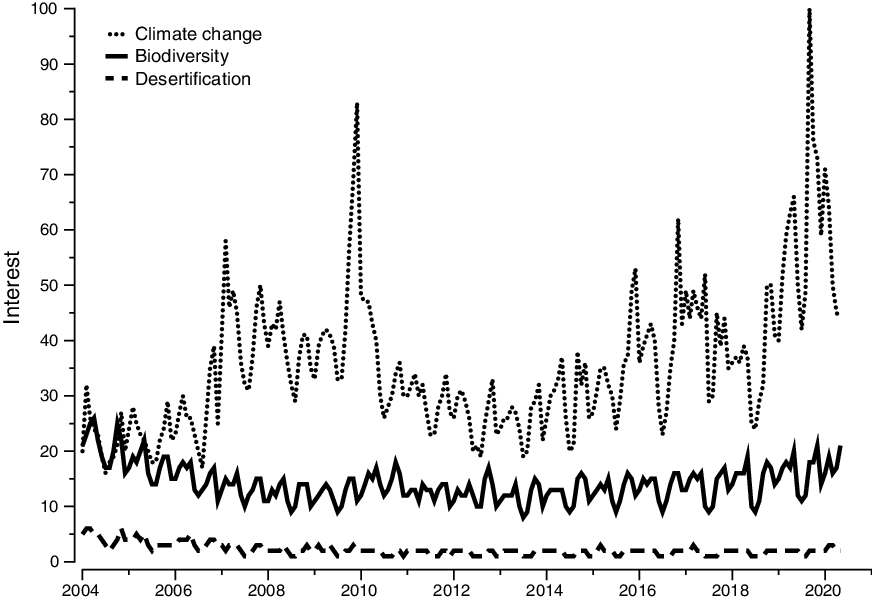
The advancement of a new generation of policies that establish ecological infrastructure also requires general public interest and support (Bragagnolo et al. Reference Bragagnolo, Malhado, Jepson and Ladle2016, Cunha et al. Reference Cunha, Souza and Silva2019). Thus, we compared the worldwide public interest in the names of three major environmental conventions (biodiversity, climate change and desertification) by using Google Trends (Fig. 3), and the result is clear. Until 2004, biodiversity and climate change inspired approximately the same amount of public interest. However, since 2006, the interest in climate change has increased significantly overall, whereas the interest in biodiversity initially decreased and then remained relatively stable (Fig. 3). These data demonstrate that from 2004 to 2020, the worldwide interest in climate change has consistently exceeded that of biodiversity. Therefore, the conservation community should not take societies’ interest and support of biodiversity conservation for granted. Conservationists need to reshape their message to the general public in a way that transcends all disciplines and adapts to contemporary trends, priorities and issues.
Worldwide interest in three major environmental conventions (biodiversity, climate change and desertification) from 2004 to 2020 based on normalized Google Trends data (trends.google.com). These data are indexed to 100, where 100 is the maximum search interest from 2004 to 2020.
In a world where risks are high and unpredictable and people are concerned about their freedom and security (Bauman Reference Bauman1997, Beck Reference Beck2009), the conservation movement needs to create a new narrative around these two essential human values. In order to be effective, this narrative must use primary metaphors, especially those drawn from concrete bodily experiences, because human thinking is structured around them (Lakoff & Johnson Reference Lakoff and Johnson2008). Among all existing primary metaphors, the journey metaphor is the one that is found in the diverse languages, cultures and religions of the world (Knepper Reference Knepper2019) – it is perhaps the most suitable to describe the concept of sustainable development as an ongoing political process, which, like the journey of life, reaches its destination after overcoming many obstacles. Based on these concepts, we suggest that the conservation movement could promote the narrative that harmonizing ecological and socioeconomic infrastructures is a journey that all societies need to take to reach the Brundtland Quadrat, a state where all gains in well-being are equitably distributed and maintained in the long term and everyone can enjoy high standards of living, freedom and security. We believe that this narrative is powerful and compelling enough to prompt the interdisciplinary action required to find the balance between ecological and socioeconomic infrastructures and thus achieve sustainable development across spatial and temporal scales. Likewise, it can be used as an antidote for the popularity of political movements that have gained control of some of the world’s largest democracies through the promotion of anti-environmentalist and anti-scientific agendas (e.g., Ferrante & Fearnside Reference Ferrante and Fearnside2019). Furthermore, this narrative once and for all refutes the false dichotomy between conservation and development that has hitherto separated conservation and social movements worldwide. Because conservation is indispensable to all dimensions of well-being, in our view, conservation is development and development is conservation.
Acknowledgements
José Maria Cardoso da Silva thanks John Swift for discussing some of the ideas and concepts presented in this paper. We thank Professor Nicholas Polunin and three anonymous reviewers for suggestions that significantly improved the manuscript.
Financial support
José Maria Cardoso da Silva and Julie Topf were supported by the Swift Action Fund.
Conflict of interest
None.
Ethical standards
None.



