1. INTRODUCTION AND BACKGROUND
In Mexico the stratification of society is a serious problem. Flores and Telles (Reference Flores and Telles2014) argue that skin colour, indigenous ethnicity and class origins are important determinant factors in social disadvantage and class clearage. This situation has a direct repercussion on the educational system: this social inequality has a major impact on the lower layer of the social spectrum, generating educational disadvantage and low learning outcomes (Backhoff, Contreras and Baroja Reference Backhoff, Contreras and Baroja2019: 14). The same paper states that Mexican society possesses a particularly rigid class system based on family and class origin. Children of white-collar workers are 3.5 times more likely to obtain a higher or same level job as their parents than children of blue-collar workers (Flores and Telles Reference Flores and Telles2014: 2). This rate of class disadvantage is the highest in the Americas. All these issues are reflected in the educative sector.
Approximately 13 in 100 people who start primary school finish an undergraduate degree in Mexico (Narro, Martuscelli and Barzana Reference Narro, Martuscelli and Barzana2012: 17). The largest cities in the country have improved education rates compared to rural areas. According to Juárez and Rodríguez (Reference Juárez and Rodríguez2016), educative rural environments are characterised by lack of equity and equality in the delivering of education, with the main obstacle being the lack of access to schools. Some 57 per cent of the population in this sector of the society have not completed primary school, representing 32 million people in Mexico (Narro et al. Reference Narro, Martuscelli and Barzana2012: 17).
As stated above, the lack of access, equity and equality is a major issue to be addressed, particularly for artistic education. The deficiency of mechanisms to train teachers in artistic subjects has created obstacles in the delivery of artistic programmes at basic education levels (González-Moreno Reference González-Moreno2010: 188).
The aim of this research is to promote access to electroacoustic music in a community with educational disadvantage and to investigate the appreciation of electroacoustic music in a rural medium.
The Ministry of Public Education (SEP 2017: 467) stipulates that artistic work in the classroom favours adaptation to change: the exploration of the uncertain, the resolution of problems in an innovative manner, the application of flexible judgement in the interpretation of various phenomena, teamwork, respect, order and harmonious coexistence. Likewise, artistic education allows for the transference of knowledge structures to other subjects and areas, explicitly linking them with purposes, themes and contents with other fields of academic, personal and social spheres (SEP 2017: 468). For the Ministry of Public Education, learning about art is of vital importance. Art can develop critical thinking skills that allow the student to develop in different spheres of their life. Unfortunately, in many cases the educational disadvantage in artistic training outside of large cities or large urban centres is still high.
Turning to music education more specifically, educational efforts in Mexico have been performed by charities, NGOs and public institutions. This is the case with the government institution Sistema Nacional de Fomento MusicalFootnote 1 (National System of Musical Promotion) and the charity Esperanza AztecaFootnote 2 (Aztec Hope), whose main objectives are to promote the development of children and young people through the study of classical choral and orchestral music. Both institutions work with socially and economically disadvantaged communities. The only programme in the country that promotes access to new forms of music is Acercamientos SonorosFootnote 3 (Sound Encounters) by the Mexican Center for Music and Sonic Arts CMMAS. So far, however, there has been little research carried out about the study of electroacoustic music in rural areas in Mexico.
In other parts of the world several researchers have been addressing music education for children; this is the case with Burnard, Boyack and Howell (Reference Burnard, Boyack, Howell, Burnard and Murphy2013) who highlight the need for music composition at basic educational levels. According to these authors, music composition can develop cognitive skills in children as well as promote positive educational and social outcomes. Birmingham Contemporary Music Group developed the Music MazeFootnote 4 programme that aims to deliver opportunities to play an instrument and create music for children aged 8 to 11 years old. Another example of children working with music is the project Eersteklasconcerten by Musica, Impulse Centre for Music in Belgium, which enables primary school children to have close contact with performers in the context of a music hall with the objective of familiarising the children with contemporary music (Regenmortel Reference Regenmortel2017: 93).
Research consistently underlines the importance of music education for children’s development. The study of music in groups or social contexts helps to develop social skills such as active participation and creative problem-solving skills (Barbosa Reference Barbosa2002: 3). Moreno and Bidelman (Reference Moreno and Bidelman2014) find that music training provides behavioural advantages to perceptual abilities and higher-order aspects of cognition such as working memory and intelligence. Moreover, Kniffin, Yan, Wansink and Schulze (Reference Kniffin, Yan, Wansink and Schulze2016) indicate that music promotes cooperative behaviour and serves as a bond within groups.
To date, several studies have used music technology to develop children’s skills or knowledge about abstract concepts related to electroacoustic music. Landy (Reference Landy2012) wrote a key text to facilitate creative activities in sound-based music; in this book the author proposes strategies for educators on the creative processes of sound generation, manipulation and organisation in an educational context. This major work is reinforced by Landy’s online pedagogical EARS 2 with its accompanying software,Footnote 5 Compose with Sounds. Antle, Droumeva and Corness (Reference Antle, Droumeva and Corness2008) used an interactive sound-making environment to create musical sound sequences. Masu, Conci, Core, Angeli and Morreale (Reference Masu, Conci, Core, Angeli and Morreale2017) developed an interactive music system for children with the aim of helping the children to create polyphonic compositions through the manipulation of musical parameters. Tobias (Reference Tobias, McPherson and Welch2018) states that the use of smart devices helps with opportunities to engage with new music and these new literacies should be taken into account to develop music courses.
Taken together, these studies support the notion that music education contributes to the development of creative skills and the enhancement of social integration. Analysis and decision-making are fundamental parts of the creation of art. All these projects suggest that the use of music technology in the classroom has the potential to engage young students in music fields and can provide an important opportunity for the development of creativity in children, as well as a being a pedagogical tool for teachers in delivering their music teaching. The use of these technologies in music pedagogy has not been widely explored in Mexico.
2. THE PROJECT
The purpose of the research described in this article is the use of technological tools as a means of initiation into the creative process, or, more specifically, to investigate the use of electroacoustic music as an approach to developing creative skills and enhancing social integration in an underserved community in Tumbisca, Morelia, Mexico. It explores the adoption of music technology as an educative tool to engage children and teenagers with new music and allow them access to music more generally.
There is a debate about whether art can influence human behaviour and affect social relationships; authors such as Gutierrez Castañeda (Reference Gutierrez Castañeda and Cuéllar2017) question this kind of practice. On the other hand, there are studies that affirm that the execution of an artistic activity favours the development of emotional and interpersonal abilities in people who play music; for example, studies show that musical training changes brain plasticity by modifying high-level cognitive processes such as memory, attention, verbal intelligence, planning and the processing of emotions (Moreno and Bidelman Reference Moreno and Bidelman2014: 84).
In order to explore this, we formed an interdisciplinary group with the students of three undergraduate programmes of ENESFootnote 6 Morelia: Music and Artistic Technology, Technology for Information in Science, and Social Studies and Local Management. The aim of this was to engage our students with real-life situations in order to attend to local needs, with each of these programmes contributing different perspectives to this research: social/educational, creative and technological.
The project was divided into two phases. During the first, an app and interactive systems were developed at ENES over a period of six months. The second phase was the implementation of the technological tools in a programme in the rural area during a period of four months. The tasks of the ENES team were distributed according to each student’s field of knowledge. Students from Technology for Information in Science developed the mobile phone app, whilst those from Music and Artistic Technology created the graphic interfaces and interactive system and helped to deliver the programme. Social Studies and Local Management students had the task of establishing the contact with the rural community, operating administrative permissions with the schools and university and co-ordinating transport, sessions, facilities and technical requirements.
3. WORKING WITH NEW MUSIC IN RURAL AREAS: TUMBISCA, MICHOACÁN
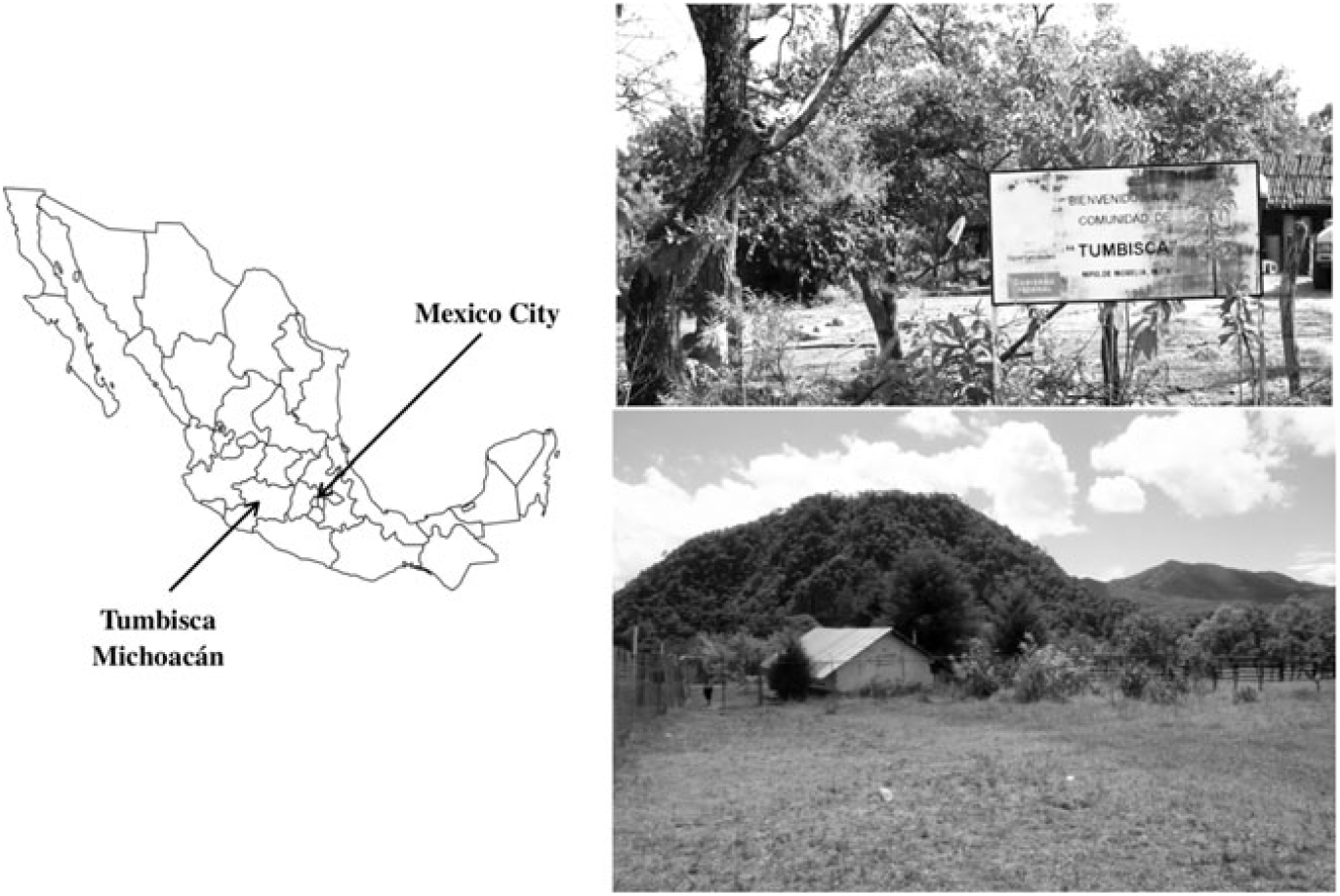
Tumbisca is a small community that is located 35 kilometres from Morelia in the mountains of the Trans-Mexican Volcanic belt (Figure 1). The National Institute of Statistics and Geography INEGI estimates that the population of Tumbisca is around 200 people, and that 25 per cent are children aged between 5 and 15 years old. The main economic activities are related to forestry operations (INEGI 2015). The same government agency declared that, compared to the national average, the degree of marginalisation of the locality is high and the degree of social disadvantage is medium. These findings are based on the grounds that the households do not have telephone landlines, computers or internet access. Moreover, Tumbisca is accessible only by a winding, unpaved road through mountainous terrain and the water supply is obtained through the use of hoses from a nearby stream.
Tumbisca location and surroundings.

The locality provides education from kindergarten to community high school. There is no music education or other artistic expression in the educational provision in these schools, despite the fact that, according to the national curriculum, artistic education is compulsory for primary and secondary schools. Teachers do not have artistic training, resulting in the replacement of music programmes with other types of practices. These circumstances of social disadvantage have created a music educational gap in the community. For all these reasons we selected Tumbisca as the area from which to develop our research.
Another factor that contributes to the educational disadvantage is the so-called multigrade schools. In this scheme it is expected that one teacher must deliver all the subjects in the curriculum to several school levels at the same time and in the same classroom (INEGI 2017: 372). This is the case with Tumbisca’s primary school, where only one teacher is assigned to the 1st to 6th grades, without the help of ‘special teachers’ who are specialised in subjects such as sports, arts, languages and IT. According to official data, 43.2 per cent of primary schools in rural areas are in this situation and 20.6 per cent of secondary schools are working under this scheme (INEGI 2017: 374). This issue generates a variety of logistical and pedagogical problems in the classroom.
Bringing new music to communities in this situation is a very difficult task to perform. The lack of facilities and basic resources led this project to the adoption of low-tech resources that could be used in this community and the development of pedagogy concerning the processes of new music appreciation and the use of these low-tech resources.
The teachers of this locality have been trying to solve the lack of artistic education by involving several local musicians and teachers from folk and pop music to classical music. Nevertheless, these efforts have not been successful due to the lack of continuity in the programmes and the appreciation of musical languages. Usually, these artists only go to Tumbisca a few times over the course of a year, provoking a lack of enthusiasm and commitment in the children. The musical languages that have been more accepted are folk and popular music, whereas academic music has been difficult to incorporate.
The processes described above led us to reflect on the mechanism of music appreciation in this community. During the first visits to Tumbisca, we noticed the way in which the students approached music. An active and collective participation was observed. This is not surprising due to the fact that music in this community is a social act; people sing, play and dance in social gatherings. Corporality is very important; the collective is fundamental. Teaching methods that do not address this social aspect have difficulties with regards to pedagogical implementation. This socially active approach to music-making contrasts with the more typical approaches of teaching where music is studied passively and not through direct contact with sound.
It is important not to impose a relationship of artistic–aesthetic power or invalidate musical genres in a manner of musical evangelisation. Although electroacoustic music is also foreign for the community, the elements that compose it are not. The way that the music programme is delivered and taught tries to establish a horizontal dialogue among the participants through the sounds that we can hear in the environment. Furthermore, the advantage of electroacoustic music in these kinds of contexts (rural areas) lies in the fact that the pupils can discover music from the sounds of their environment: in electroacoustic music any sound can be a musical material, it can be processed and organised to create a musical discourse. On the other hand, the disadvantage is the lack of facilities and resources that electroacoustic music needs in order to be created. This research tried to avoid the imposition of aesthetic criteria, which allowed the students to explore their own sound worlds and creativity.
This resulted in a series of activities designed not only to allow the children to recognise the sounds of the environment but also to address how artistic creation can affect other spheres of our lives. A series of reflections about these issues was conducted with the students.
4. APPRECIATION OF NEW MUSIC: DESIGNING A PEDAGOGY
As a result of what has been described above, we developed an educative-technological programme that could bring the study of electroacoustic music into a close relationship with the students without the imposition or adaptation of aesthetical values. Paulo Freire (Reference Freire1969) makes a differentiation between adaptation and integration in education, saying that adaptation is a passive concept where the human is not capable of transforming reality, but needs to alter themselves in order to adapt, with people treated as objects. Integrating is an active concept; it is the capacity to adjust reality and transform it, with people treated as subjects (Freire Reference Freire1969: 34).
This vision of education by Paulo Freire influenced us to develop an approach to teaching which aimed to avoid an imposition of aesthetic values on music. It is important to note that we found the younger students to be more open to new music whereas pupils in the last levels of secondary school were not as widely open, as they tended to have pre-conceived concepts about music, especially about contemporary music. This music style preference has been studied by Hargreaves (Reference Hargreaves1982), who suggested that younger children may be more ‘open eared’ to music in comparison to adults.
A first approach to sound art was given through observing different types of listening: causal, semantic and reduced (Chion Reference Chion1990: 25). We performed several activities using the modes of listening as a starting point or introduction to a sound world. An example of a lesson plan on how to approach types of listening is described below.
In a lesson the children were asked to listen to the sound environment of the classroom in order to recognise sound sources and take notes about sounds that they listened to. A basic classification was made using broad categories such as:
nature
animal
human sounds
mechanical sounds.
After that, the students were asked to note information about timbre, pitch, duration, intensity and direction. This activity was followed by a discussion of their findings and an analysis of the sound properties that they discovered.
A second lesson example about listening involves the use of sound in order to deliver information (semantic listening). For example, the community uses a whistle code in order to convey messages during their work in the mountain (i.e. key sounds which signify pay attention, danger, leaving, etc.). Students were asked to discuss these whistle codes and the way that they use sound in different situations.
A third example is the lesson about ‘reduced listening’. This lesson requires more preparation due to the fact that this kind of listening is tied to a fixed medium: the sounds must be reproduced again and again in order to catch the details. For this activity soundscapes were recorded, reproduced and analysed in order to gather information regarding physical, semantic, figurative or evocatory properties.
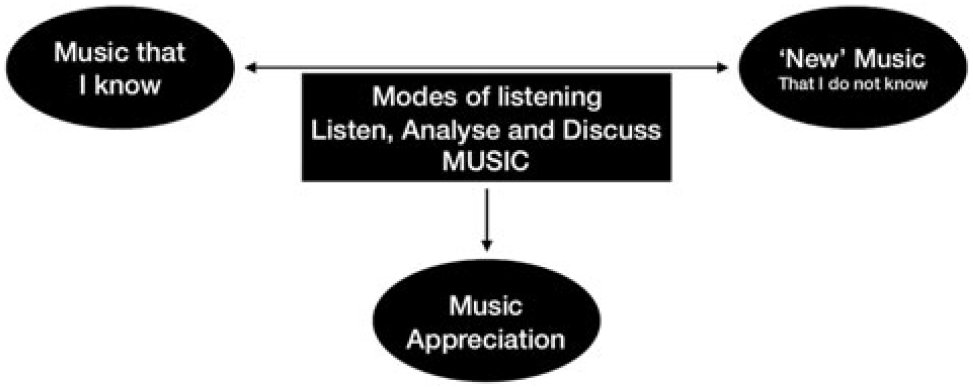
These lessons helped us to open a deeper way of listening to sounds and also to music. Students were asked to perform these modes of listening to everyday sounds and music that the students were already familiar with and also to new music. This methodology was used in order to introduce new music to the students and to engage with them. Figure 2 describes this process.
Listening system approach.

4.1. Pedagogy of the EA programme
To begin the process of working in the community, the ENES Social Studies and Local Management students identified the target group of school children and teenagers aged from 6 to 15 years old. A questionnaire was given to the children in order to know more about their relationship with music and technology. A total of 100 per cent of the participants manifested their interest in the study of music. Also, the same amount said ‘yes’ to the question ‘Do you think music is important to your day to day life?’ Some of them stated: ‘Music is very important because it can help you when you are sad or in trouble’, ‘Music can help you to share your feelings’, ‘It entertains and distracts you’ and ‘ It makes you a better person.’
To develop the syllabus and contents for the course, two types of pedagogical models were used: on the one hand, the concepts of Paulo Freire; on the other, the constructivist methodology of knowledge construction. Freire’s model helps to address the social and collective aspect of the project – the active relationship mode described above.
Freire speaks about a dialogic education in which the student is not a passive object that receives instructions from the teacher, but instead proposes an active learning system, a horizontal education in which the students are not treated as objects, but instead both teacher and student are active subjects in the educational process (Freire Reference Freire1969). Freire states that people can speak and write about their reality and experiences through the use of generative words or themes. These generative words encourage people to start using their own voice to express these situations. We transfer this idea to a concept of generative sounds or sound themes that contain an extra-musical significance for the student. By using these generative sounds, students can construct an organisation of sounds to create a musical discourse about their experience.
Constructivism was the second pedagogical model that influenced our design. This is a teaching and learning theory where the individual actively constructs knowledge based on previous experiences and in interaction with other individuals. According to Mario Carretero (Reference Carretero1993), constructivism is a process that creates meaningful learning between new knowledge and previously existing knowledge. Through this method abstract concepts are developed from previous knowledge and experiences in order to build more complex learning. This process is shown in Figure 3. The first point of contact in this method is sound listening. Through experience, sound qualities can be recognised and definitions for sound parameters can be established, which will help to develop a graphic notation for more complex music creation.
EA pedagogical model based on constructivism.

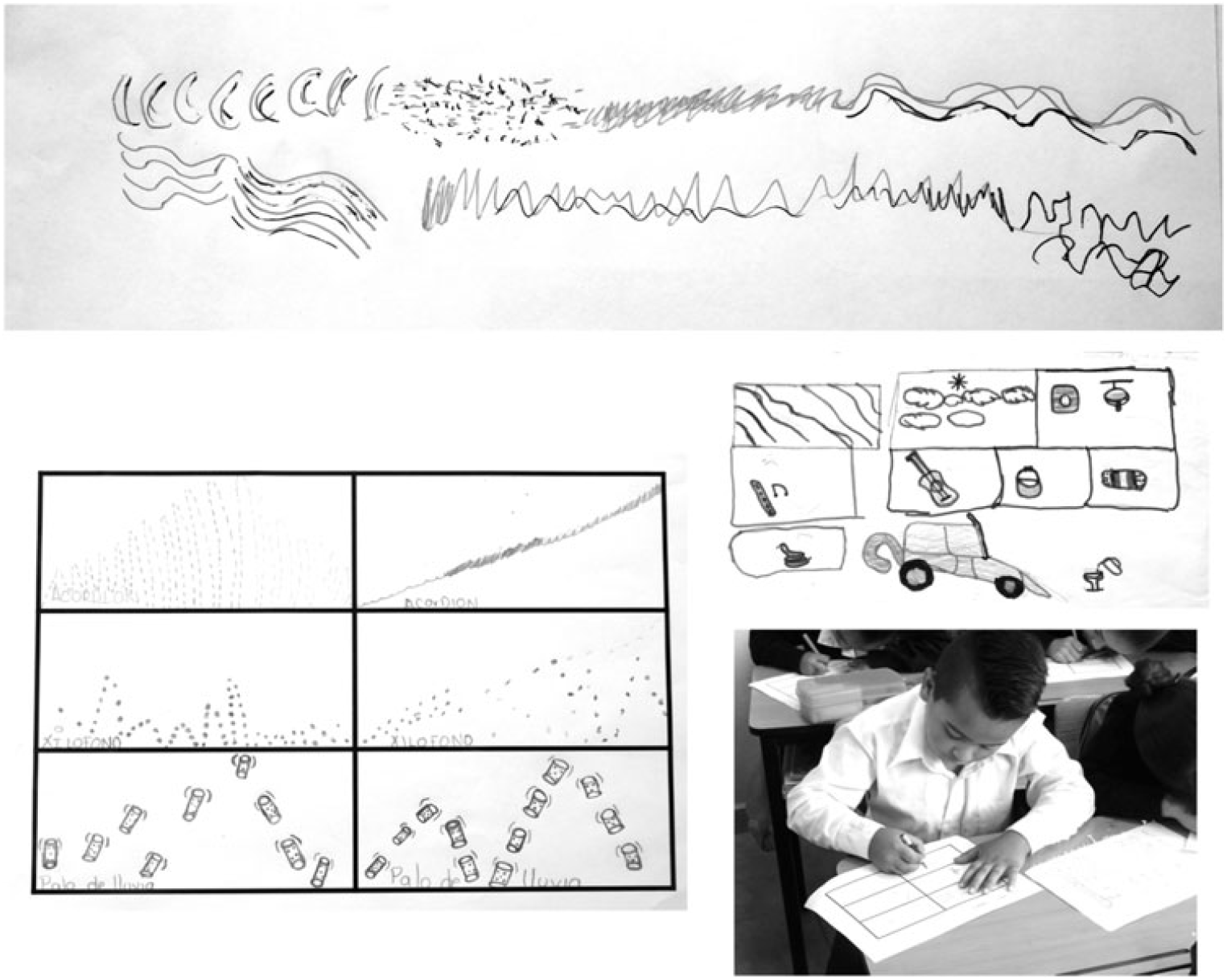
One practical example is the use of soundscapes during the listening stage to allow students to become aware of sound properties and organisation in their environment. Pupils were asked to listen to and analyse individual sounds in these soundscapes and basic questions about duration, dynamic, timbre, frequency and direction were asked. Students proposed several notations and drawings to portray their soundscapes. This activity, led by collective participation, helped to deliver the teaching of musical parameters, concepts that are very abstract and challenging for children to imagine. However, guided listening, technology and collective participation can help to develop knowledge of such concepts. Figure 4 displays some examples of the pupils’ graphic notations.
Graphical notation developed by children.

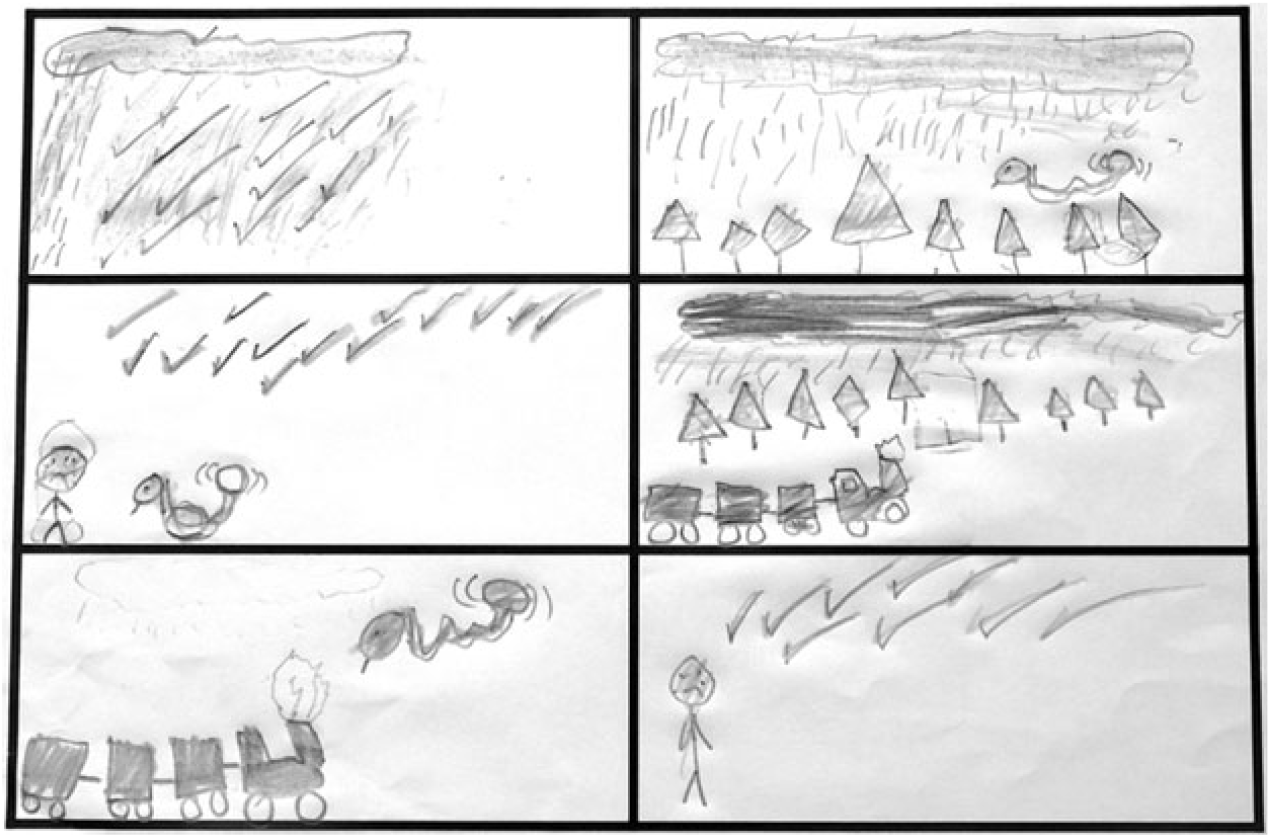
As stated above, generative sounds can help to trigger extra-musical ideas and concepts. After the former concepts were understood and verbalised, students were asked to select a few sound collections that could have an extra-musical meaning for them. They were then asked to organise them into small sound stories using their imagination and listening experience. In this process, we did not have sound recorders to capture these ideas; instead students notated these sounds onto paper and performed them using their voices, bodies or found objects. Figure 5 shows a sound story.
Example of a sound story.

4.2. Designing the interactive system
The use of smart devices can be exploited in the context of music education and artistic training in the rural areas outside of large urban centres. Mobile devices are currently mitigating economic and technological backwardness (Ruelas Reference Ruelas2014: 105). In many cases, the mobile phone replaces fixed telephony and tablets replace computers. The reason for this can be found in the way that these devices are acquired. Usually, pay-as-you-go mobile technology is easier to acquire than fixed contracts with an expensive company. In addition to this, in some cases, large telecommunications companies do not offer service plans in some rural areas. The use of these gadgets could be exploited for music education purposes and could inspire children to have an interest in electroacoustic music in rural areas where this mobile technology is currently used.
In the questionnaire described above we also asked about the participants’ internet access. In primary school level, 100 per cent of the children do not have access, whilst half of the secondary school students use internet for social media such as Facebook and WhatsApp. Some 29 per cent of the children in primary school have smart devices where as 90 per cent of the secondary school students have mobile phones or tablets.
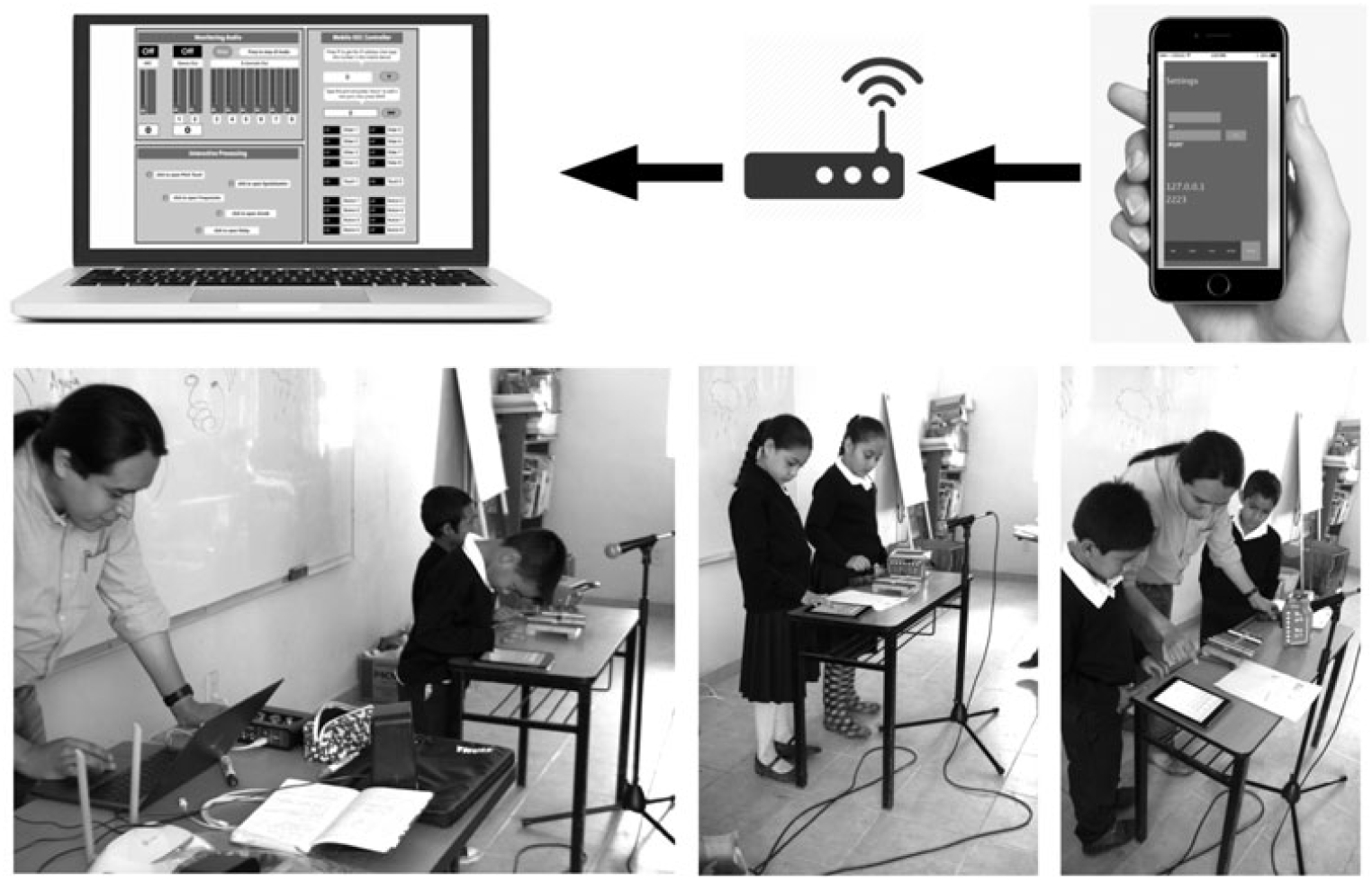
Our project makes use of a smartphone app in order to control and process musical parameters implemented in a MaxMSP interface using OSC and UDP protocols for data manipulation. This music system allows for interaction (creation and interpretation) with electroacoustic music to promote the acquisition and development of aesthetic and artistic skills in an educational programme with a social responsibility focus.
The ENES Technology for Information in Science and Music & Artistic Technology teams carried out an operational analysis of mobile devices and external controllers with the purpose of creating a protocol of transmission and reception of raw data by OSC messages. Once the protocol was established, an interactive system comprising a mobile phone app and a GUI in MaxMSP was developed to control and manipulate the spatialisation of sounds and their interaction with other musical parameters such as timbre, pitch and duration.
In electroacoustic music, sound is the main creative element and any sound can be transformed into music. When there is a lack of conventional musical instruments, technology can replace them, or, where there is a musical instrument, technology can enhance the sound possibilities. The mobile app controller is used to trigger previously recorded sounds and to process them in real time in order to create electroacoustic miniatures. The app was used in combination with musical toys such as an accordion, a rain stick and a xylophone to cover some musical components (gesture, texture, melody, harmony and rhythm). Children explored sound possibilities using this interactive system (Figure 6).
Interactive music system (above), implementation in the classroom (below).

4.3. The use of music technology in the creative process
The educational programme was delivered during a period of four months in weekly sessions of 45 minutes to 1 hour in two schools: primary school 20 de Noviembre and secondary school Simón Cortez Vieyra.
As we stated above, these schools are called ‘multigrade schools’, which means that one teacher has to deliver lessons to all the grades at the same time. This particular situation meant that we had to teach all the grades together in one session in each school. This circumstance was problematic because we had to deliver this programme in a manner appropriate for children aged from 6 to 13 years old in the primary school and 13 to 15 years old in the secondary level. The same topics were covered in both schools due to the fact that the secondary students had not received any prior music education.
The interactive music system was implemented in the following music programme for children and teenagers; the ENES Music and Artistic Technology team helped in this area. This programme was carried out in four stages (musical parameters, improvisation, composition and performance), using music technology as a tool to deliver basic concepts of musical parameters, as well as notions of gesture, texture and structure. The app helped to instruct students with topics that were new to them and that may have been challenging to understand at that age. Moreover, this technological tool helped us to develop sound materials to start making music in the community. This process is described below and sound results are given.
4.3.1. Stage one: musical parameters (understanding sounds)
Children are naturally curious about everything. The combination of toy musical instruments (pitched and non-pitched) and a gadget immediately catches their attention and we took advantage of this in order to explain concepts such as timbre, pitch, duration, volume and space. The students were asked to select sounds from the following instruments: rain stick, xylophone, flute, clarinet, accordion, piano and guitar. After this step we used the interactive system modules and the app as a controller to transform the sound materials, linking them back to the abstract concepts:
pitch – pitch shifting
timbre – filters
duration – time stretching
space – panning
dynamic – gain control sliders.
After this stage, children could incorporate these concepts when working practically. Students were also asked to create graphic notations in order to develop conceptual frames of musical parameters.
4.3.2. Stage two: improvisation (playing with sounds)
The second step in the process was to improvise using the instruments and modify these improvisations using the OSC controller. Several exercises were carried out and notated on the whiteboard of the classroom using the graphic notations previously created. We recorded and selected material that would be used for their compositions. We started to develop concepts of texture and gesture from a practical perspective. For example, pupils were asked to improvise over the rain stick sounds in order to give a background layer; these granulated sounds provided the context from which to develop other musical materials. Another activity was to form sound teams which involved one or two children playing instruments while one student was playing/controlling through the controller app. This social component was fundamental because they were more comfortable working in teams than working individually.
4.3.3. Stage three: exploring composition (organised sound)
The third phase of the programme was to explore electroacoustic composition. The participants analysed their own recordings of the improvisations. We introduced concepts of gesture and texture and discussed the function of these in their recordings in order to organise them to create musical structures. Collectively materials were classified and arranged in a ternary form (ABA) in a Digital Audio Workstation (DAW). As examples we will look at two miniatures created by primary and secondary school pupils.
Miniature A (sound example 1) was created by primary school children. As stated above a ternary structure was used. Section A features granulated sounds produced by a rain stick and key clicks from the accordion and clarinet. Section B employs long sustained pitched notes and white noise in order to create textures as a basis for the short accordion and clarinet gestures. The third section of the piece is a recapitulation of the sound materials from section A.
Miniature B (sound example 2) was developed by secondary school pupils. It follows the same ternary structure. Section A incorporates time-stretched high xylophone frequencies, Section B uses sustained mid and low frequencies and the final section aims to blend all the materials together.
It was the community’s first experience of approaching sound creation in this way. These two miniatures were performed in a concert in the community at the end of the educative programme.
4.3.4. Stage four: performance (sound in action)
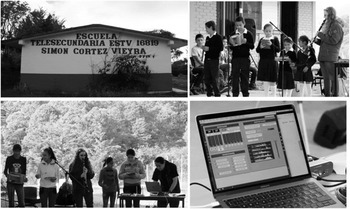
The result of the previous stage was a variety of electroacoustic miniatures that served as a basis for the final part of the programme, where students performed the composed EA pieces in a concert in the community (Figure 7). Extra layers of improvisation were added using the instruments and the OSC controller was used as an electroacoustic instrument that triggered pre-recorded sounds, gestures and textures during the performance.Footnote 7
Final concert of the educational programme in Tumbisca, Michoacán.

5. DISCUSSION
This article has presented an interactive music system that was used in an electroacoustic music programme in a primary and secondary school. The same programme was delivered to both primary and secondary students; the topics and learning outcomes covered were the same. The reason that we did not make a differentiation between primary and secondary school was that the former had not received any prior music education. The only difference between the schools was that the primary school lessons were shorter.
During the programme we found that the use of instruments was a good starting point to enter from something familiar to the unknown. The instruments provided human contact in contrast to the digital world. Students were able to explore sounds and then used the OSC controller to modify these. In the following stages, the participation of a performer helped to introduce the performance aspect of the activity, where communication through sound is very important. Participants were able to interact in different levels of the musical activity. In the last part of the project the OSC controller worked as a digital instrument.
It is important to note that listening critically provided a framework for musical thinking to develop perception about sound and music. It also allowed for discussion and debate between the students, providing an opportunity to develop listening and communication skills. These competences had to be used during the improvisation and performance stages of the project. It was very important that the children were conscious about their sounds and their participation during the performances.
When working in a school environment, it is always challenging to engage children with activities that cannot be extended for longer periods of time. We tried to set each activity between 10 and 15 minutes and to offer a variety of activities. In this way, technology is a good aid in the classroom because students are attracted to technology and the learning process is carried out with the help of devices that they use in everyday life. For future work the OSC controller needs to be more intuitive and some extra functions such as sound recordings and some basic sound processing need to be added.
Nowadays there is a debate about the use of smart devices in the classroom with regards to the amount of screen time that some children are exposed to during the day and the impact that this has on academic performance (Hawi and Samaha Reference Hawi and Samaha2016: 83). In this research we tried to take advantage of children’s interest and curiosity in smart devices, creating an attractive learning environment in order to deliver teaching more easily and effectively. Some of the students could have been distracted and tempted to use the devices for other purposes, but by including clear instructions and ensuring an active leading role of the teacher during the activities, such behaviours were generally avoided. This project attempted to explore the smart device as another educative resource in the school like a computer or an instrument. In this respect the mobile phone is regarded as an educative tool of learning rather than an object of mass consumption.
Another of the objectives of this research was to insert students from ENES into real-life situations in order to contribute to the solution of a problem in the community. This multidisciplinary research group provided different perspectives to aid with the development of the project. From the beginning of the project their different skills were used to tackle specific tasks related to their own particular fields of knowledge. Sometimes the students came across communication challenges due to their lack of experience of working with people from other areas using different terminologies and vocabularies, but this issue was quickly solved.
In general, the tasks given to Music and Artistic Technology and Social Studies & Local Management students were sorted out smoothly. The students of Technology for Information in Science who helped to develop the interface had more paths to explore and came across difficulties when creating the app. For all the team, the project provided a new experience to share skills and knowledge in a concrete situation.
Tumbisca is a small community and we had to face some problems and difficulties related to infrastructure, facilities, transport and organisation. As we stated above, we wanted to organise the children by age group but that was very difficult to achieve due to the fact that there is one classroom where children aged from 6 to 13 years old receive lessons from one single teacher. We had to organise the lesson plans to cover a wide target group and give different tasks according to their ages in order to avoid distraction and loss of interest in the children. This was the main issue we came across during the research. In the secondary school we could work with a different approach, giving separate lessons for each age group; however, the window of time given by the school was very small, 20 to 30 minutes per grade depending on the activities of the school and community. These issues led us to deliver very concise and substantial activities in the educative programme.
It is important to recognise that this research was conducted in a small community with a small sample of students, 40 children from 6 to 12 years old, and 20 teenagers from 13 to 15 years old. At the end of the project a questionnaire form was given to the students to receive feedback and collect information about the use of technology in music education. Some 85 per cent of the participants said that this project helped them to approach and appreciate electroacoustic music better, while 7.5 per cent said ‘more or less’, 5 per cent replied ‘no’ and 2.5 per cent did not reply to the questionnaire. Some 92.5 per cent replied that they would like to participate in projects involving electroacoustic music and technology.
This community has specific social features related to level of education, economic activities and social organisation. On the one hand, the research given in this article cannot be generalised or applied to other social contexts such as those of larger cities where it could be easier to access music education. On the other hand, this research could be taken into account to help to develop educative programmes or strategies in communities with similar socio-economic contexts.
6. CONCLUSIONS
This article has argued that the use of music technology in the classroom is an important element that can help teachers to deliver musical concepts. Technology opens up new possibilities for students to approach electroacoustic music composition and performance.
This research has shown an interactive music system composed of an OSC controller app and a GUI in MaxMSP. This system permitted the processing of sound in real time and allowed interaction using OSC and UDP protocols. This interactive music system was implemented in an electroacoustic music programme in primary and secondary schools in Morelia, Mexico.
The feedback received at the end of this research indicates that the use of technology and mobile phones and tablets attracts children and teenagers to electroacoustic music composition and performance. A questionnaire form was used to collect the feelings and thoughts of the children; they pointed out that it was easy to understand music and discover new things about music by playing with the devices.
Younger aged students are more open to new forms of music and show a natural curiosity. During the development of this research, listening critically was found to be very important as it provided skills that were later used to develop composition and performance abilities.
Further research might explore the use of a more intuitive graphic user interface which incorporates sound recording and basic sound processes in the app. Moreover, we need to develop a teacher training course which addresses how to use the intuitive app so that teachers could then independently implement the tool in their classes without an external agent.
Continued efforts are needed to make electroacoustic music more accessible to age groups and populations where it is difficult to access this kind of music. Projects like this one demonstrate some directions that may prove useful in these efforts.
Acknowledgements
Comunidad de Tumbisca, Municipio de Morelia, Michoacán de Ocampo.
Escuela Primaria 16DPR 0979B “20 de Noviembre”, Profra. Eloísa Campos.
Escuela Secundaria ESTV 16819 “Simón Cortez Vieyra”, Professors: Sigfrido Lara, Nahúm Ramírez y Leonardo Chávez Juárez.
We would also like to show our gratitude to Dr Emma Wilde who provided insight and expertise that greatly assisted the research. We are also grateful to Mtra. Carla Suárez and Lic. Nallely Torres Ayala from Laboratorio de Estudios Sociales Aplicados LESA, ENES Morelia UNAM.
‘Este texto es parte del proyecto de investigación apoyado por el programa de becas posdoctorales en la UNAM del Programa de Fortalecimiento Académico de la DGAPA. Este texto es parte del proyecto de investigación apoyado por el programa PAPIIT IA401218 (ENES, Morelia, UNAM). Este proyecto fue realizado gracias al apoyo del Programa de Apoyo a la Docencia, Investigación y Difusión de las Artes PADID 2018 (CENART – FONCA).’ (This research was supported by the postdoctoral scholarship programme of DGAPA, UNAM. This research is part of the PAPIIT IA401218 programme ENES Morelia, UNAM. This project was funded by PADID 2018 CENART, FONCA.)