Emotion regulation is a transdiagnostic construct that plays a central role in the development and maintenance of psychopathology (Aldao, Gee, Reyes, & Seager, Reference Aldao, Gee, Reyes and Seager2016; Cicchetti, Ackerman, & Izard, Reference Cicchetti, Ackerman and Izard1995; McLaughlin, Hatzenbuehler, Mennin, & Nolen-Hoeksema, Reference McLaughlin, Hatzenbuehler, Mennin and Nolen-Hoeksema2011). Developing adaptive emotion regulation skills is a core developmental task of adolescence that promotes well-being and social competence. Emotion regulation is the ability to change the expression, perception, and experience of affective responses (Gross, Reference Gross1998). A process model of emotion generation and regulation argues that individuals can change the experience and expression of emotions in any of the following ways: (a) changing the prompting event(s) of an emotion, (b) shifting attention away from the emotion or the prompting event, (c) reappraisal of the prompting event, (d) or changing how one responds to the emotion (Gross, Reference Gross2002). In contrast, the inability to engage in effective emotion regulation, often referred to as emotion dysregulation or disruptions in emotion regulation, occurs when strategies to change emotions reduce distress in the short term but compromise well-being, productivity, relationships, or future achievements (Cole, Hall & Hajal, Reference Cole, Hall, Hajal, Beauchaine and Hinshaw2017). Cole et al. (Reference Cole, Hall, Hajal, Beauchaine and Hinshaw2017) present four primary ways in which emotion dysregulation can be distinguished from emotion regulation patterns that serve longer term functioning. First, emotions endure, and attempts to regulate are ineffective. In essence, one does not feel the way that one desires to feel despite efforts to change one's emotional states. With extended sustainment or heightened intensity, emotions may begin to interfere with functioning and lose their value of aiding in problem solving or healthy interpersonal relations. Attempts to regulate may be ineffective because of insufficient knowledge or skill, deficiencies in biological regulatory systems, or reward gained from emotion sustainment. Second, disruptions in emotion regulation can involve emotions that interfere with adaptive behavior. Behavior may begin as effective but can negatively impact functioning if it becomes a stable pattern that interferes with intra- or interpersonal functioning (e.g., emotional numbing after a trauma). Third, emotions are context inappropriate in that expression is undercontrolled, overcontrolled, atypical, or unresponsive. It should be noted that function and developmental level should be considered alongside context: although individuals may differ in their response to a particular situation, some situations have typical responses, and the ability to fully comprehend context will likely impact emotion response. Fourth, emotion dynamics that change too quickly or slow emotional recovery deviates from the normative processes of the time course of emotion generation and resolution. Compared to the typical flow of emotions, emotion dysregulation may present with a pattern of emotions that “linger” or resist change or emotions that change quickly or frequently. There are patterns that reflect psychopathology symptomology. Rapid changes in emotion are associated with both internalizing and externalizing symptoms and social difficulties (Jacob, Suveg, & Whitehead, Reference Jacob, Suveg and Whitehead2014; Kim-Spoon, Cicchetti, & Rogosch, Reference Kim-Spoon, Cicchetti and Rogosch2013; Sobanski et al., Reference Sobanski, Banaschewski, Asherson, Buitelaar, Chen, Franke and Stringaris2010). Resistance to emotional change is characteristic of mood disorders (e.g., prolonged sadness/irritability in childhood depression) (Cole et al., Reference Cole, Hall, Hajal, Beauchaine and Hinshaw2017; Kashdan & Rottenberg, Reference Kashdan and Rottenberg2010).
Disruptions in emotion regulation are also thought to play a critical role as a mechanism linking exposure to stress with internalizing psychopathology (Gross, Reference Gross and Gross2014). However, there is a paucity of research integrating multiple dimensions of emotion regulation in order to identify precise mechanisms through which environmental experiences influence emotion regulation and internalizing problems. Here, we integrate multiple self-report and task-based measurements across several dimensions of emotion regulation (i.e., emotional reactivity, and cognitive and behavioral regulation) to evaluate how disruptions in emotion regulation may contribute to the link between stressful life experiences and subsequent internalizing problems. Specifically, we examine the role of emotion regulation as a mechanism linking peer victimization with depression and anxiety symptoms in adolescents. Exposure to peer victimization is associated with elevations in internalizing problems during adolescence in both cross-sectional and longitudinal studies (for meta-analyses see Hawker & Boulton, Reference Hawker and Boulton2000; Schoeler, Duncan, Cecil, Ploubidis, & Pingault, Reference Schoeler, Duncan, Cecil, Ploubidis and Pingault2018). Being victimized explains 4%–9% of the variance in internalizing psychopathology in youth after accounting for shared method variance (Hawker & Boulton, Reference Hawker and Boulton2000). Determining how peer victimization leads to subsequent internalizing problems is an important priority in order to prevent and intervene with the development of anxiety and depression. Emotion regulation has been suggested as a putative mechanism underlying this association (McLaughlin, Hatzenbuehler, & Hilt, Reference McLaughlin, Hatzenbuehler and Hilt2009).
Peer experiences can influence developing emotional processes. Youth who report victimization experiences report strong negative emotions, including anger, sadness, and contempt, and youth who are the victims of peer aggression exhibit high levels of emotional arousal and reactivity (Deater-Deckard, Reference Deater-Deckard2001; Mahady Wilton, Craig, & Pepler, Reference Mahady Wilton, Craig and Pepler2000) and report higher levels of emotion dysregulation (Morelen, Southam-Gerow, & Zeman, Reference Morelen, Southam-Gerow and Zeman2016) relative to youths who have not experienced victimization. Peer victimization may also influence neurobiological systems related to emotion reactivity and regulation across neural (Jankowski et al., Reference Jankowski, Batres, Scott, Smyda, Pfeifer and Quevedo2018; Miller, Prinstein, Munier, Machlin, & Sheridan, Reference Miller, Prinstein, Munier, Machlin and Sheridan2018; Rudolph, Miernicki, Troop-Gordon, Davis, & Telzer, Reference Rudolph, Miernicki, Troop-Gordon, Davis and Telzer2016) and psychophysiological levels (Rudolph, Troop-Gordon, & Granger, Reference Rudolph, Troop-Gordon and Granger2011; Stroud et al., Reference Stroud, Foster, Papandonatos, Handwerger, Granger, Kivlighan and Niaura2009). Further, a prior longitudinal study found that peer victimization was associated with subsequent disruptions in emotion regulation as measured by a composite of emotional awareness, rumination, and behavioral expressions of anger and sadness (McLaughlin et al., Reference McLaughlin, Hatzenbuehler and Hilt2009). Taken together, peer victimization elicits strong negative emotions and may influence adolescents’ ability to effectively manage emotional responses.
Internalizing problems are characterized by avoidance, low positive affect, and persistent negative affect (Fang & Asnaani, Reference Fang and Asnaani2012). Ineffective regulation of negative affect and positive arousal are key features of internalizing psychopathology (Thompson, Reference Thompson, Vasey and Dadds2001; Tone, Garn, & Pine, Reference Tone, Garn, Pine and Cicchetti2016), and disruptions in multiple emotion regulation processes may increase risk for internalizing problems in children and adolescents (for reviews, see Aldao et al., Reference Aldao, Gee, Reyes and Seager2016; Kring & Sloan, Reference Kring and Sloan2009; McLaughlin, Garrad, & Somerville, Reference McLaughlin, Garrad and Somerville2015). Heightened emotional reactivity (characterized by the speed, pattern, and intensity of an individual's emotional response to an event) is associated with internalizing problems, including anxiety and depression (Pine, Cohen, & Brook, Reference Pine, Cohen and Brook2001; Shapero, Abramson, & Alloy, Reference Shapero, Abramson and Alloy2016). Cognitive aspects of emotion regulation can involve reappraisal or other strategies that alter the meaning of an emotion-eliciting situation or direct attention toward or away from an emotional stimulus (e.g., rumination or distraction; Moyal, Henik, & Anholt, Reference Moyal, Henik and Anholt2014). Some cognitive responses to distress, such as rumination, prolong and exacerbate negative affect, and habitual use of rumination increases risk for concurrent and subsequent anxiety and depression (e.g., Abela & Hankin, Reference Abela and Hankin2011; Klemanski, Curtiss, McLaughlin, & Nolen-Hoeksema, Reference Klemanski, Curtiss, McLaughlin and Nolen-Hoeksema2017; McLaughlin & Nolen-Hoeksema, Reference McLaughlin, Hatzenbuehler, Mennin and Nolen-Hoeksema2011; Nolen-Hoeksema et al., Reference Nolen-Hoeksema, Wisco and Lyubomirsky2008). Finally, behavioral aspects of emotion dysregulation, including negative urgency and distress tolerance, are defined as the perceived or actual inability to tolerate negative emotions and discomfort (Leyro, Zvolensky, & Bernstein, Reference Leyro, Zvolensky and Bernstein2010). Adolescents with high levels of urgency engage in reflexive actions aimed at immediately relieving negative emotions; negative urgency has been associated with internalizing problems in several studies (King, Feil, & Halvorson, Reference King, Feil and Halvorson2018; Smith & Cyders, Reference Smith and Cyders2016). A recent meta-analysis documents associations of small to moderate effect sizes between emotion regulation and internalizing problems in children and adolescents (Compas et al., Reference Compas, Jaser, Bettis, Watson, Gruhn, Dunbar and Thigpen2017). Taken together, diverse processes of emotion regulation impact the development of internalizing problems of anxiety and depression.
Emotion regulation is a multilevel phenomenon expressed at neural, cognitive, behavioral, and social levels (Gross, Reference Gross and Gross2014; Gross & Thompson, Reference Gross, Thompson and Gross2007). Disruptions in emotion regulation can occur at multiple stages of the emotion generation process ranging from attention deployment and appraisals of emotion-eliciting stimuli to strategies intended to modulate the intensity or duration of an emotional response once it has been generated (Gross, Reference Gross and Gross2014; Gross & Thompson, Reference Gross, Thompson and Gross2007). Given the wide range of behaviors that encompass emotion regulation, measurement of emotion regulation strategies often includes self-report, other informants (e.g., parent, teacher, or peer), physiological/biological indicators, observational approaches, and behavioral tasks (for reviews, see Adrian & Berk, Reference Adrian, Berk, Beauchaine and Crowell2018; Beauchaine, Reference Beauchaine2015). Due to the large number of emotion regulation processes and the wide variability in assessment of emotion regulation strategies across studies, little consensus has emerged regarding the underlying structure of emotion regulation strategies or whether specific domains of emotion regulation have particularly strong associations with psychopathology. More specifically, although disruptions in emotion regulation may mediate the association of peer victimization with internalizing problems (e.g., McLaughlin et al., Reference McLaughlin, Hatzenbuehler and Hilt2009), prior work has evaluated either global maladaptive strategies into one latent construct of emotion regulation (e.g., McLaughlin et al., Reference McLaughlin, Hatzenbuehler and Hilt2009) or specific indices of emotion regulation in isolation (e.g., Doyle & Sullivan, Reference Doyle and Sullivan2017). It is unknown whether specific aspects of emotion regulation play a particularly important role in the association between peer victimization and internalizing problems. Uncovering these mechanisms may help to inform strategies to prevent the development of internalizing problems among children who have experienced peer victimization.
Current Study
The current study examines the latent structure of emotion regulation across both survey and task-based measures to evaluate whether distinct components of disrupted emotion regulation explain the association between experiences of peer victimization and internalizing psychopathology. Because different components of emotional reactivity and regulation develop and change during adolescence (McLaughlin et al., Reference McLaughlin, Garrad and Somerville2015), it is important to evaluate if different specific emotional processes mediate the association between peer victimization and internalizing problems. We sought to examine two primary research questions. First, we examined the latent structure of emotion regulation to evaluate whether a one-factor, two-factor, or three-factor model reflecting emotional reactivity and cognitive and behavioral regulation would best characterize the multiple components of disrupted emotion regulation. We further explored whether task-based measures of cognitive and behavioral aspects of emotion regulation loaded onto these latent constructs. Second, we evaluated whether different components of emotion regulation are influenced by peer victimization and, in turn, associated with internalizing problems. Third, we evaluated whether disruptions in specific aspects of emotion regulation served as mechanisms linking peer victimization to increases in internalizing problems over time.
Method
Participants
Data were drawn from a larger study of self-regulation and sensitivity to peer context as risk factors for adolescent psychopathology in a community sample of 16- and 17-year-old adolescents (N = 287) from three major cities in the United States (Boston, MA; Seattle, WA; and Pittsburgh, PA). We recruited English-speaking 16- and 17-year-olds for participation. Exclusion criteria included pervasive developmental disorders and psychosis. Participants were recruited with community flyers and were on average in 11th grade. Approximately half of the sample was female (n = 156; 54%), and 21% of the sample identified as Black (n = 59), 6.3% as Hispanic/ Latino (n = 18), 11.1% as biracial (n = 32), 16.0% as Asian (n = 46), and 40.8% as White (n = 117). A further 2.1% of participants reported as members of other racial/ethnic groups (n = 6), while 2.5% (n = 7) declined to report race/ethnicity status. See King, McLaughlin, Silk, and Monahan (Reference King, McLaughlin, Silk and Monahan2018) for full details of this study.
Procedure
The study involved two assessments 4 months apart. In Session 1 (i.e., baseline visit), adolescents completed peer victimization, emotion regulation, and internalizing symptom questionnaires and tasks to assess emotion dysregulation. In Session 2 (i.e., follow-up visit), adolescents completed only internalizing symptom questionnaires.
Measures
Peer victimization
The Peer Victimization Questionnaire is an 18-item modified version of the Revised Peer Experiences Questionnaire (Prinstein, Boergers, & Vernberg, Reference Prinstein, Boergers and Vernberg2001). Participants are asked to rate how often an overt, relational, or reputational aggressive behavior was directed toward them in the past year. Overt victimization was defined as being hit, pushed, or receiving threats to be beat up. Relational and reputational victimization were defined as having a child's relationship with another teen, or their friendship status, used as a way of inflicting social harm (e.g., purposefully being excluded from social activities, being threatened to have friendship withdrawn, or having rumors or gossip spread about them). We calculated a total score by summing responses across the 18 items. Internal consistency was good (α = 0.86, 18 items).
Emotion regulation
Emotional reactivity
The Emotional Reactivity Scale (ERS; Nock, Wedig, Holmberg, & Hooley, Reference Nock, Wedig, Holmberg and Hooley2008) is a 21-item self-report measure designed to assess individuals’ experience of emotion reactivity. The subscales of the ERS are emotion sensitivity, intensity, and persistence. Participants are asked to rate how much the statement is like them on a 4-point Likert scale (1 = not at all like me; 5 = completely like me). The ERS subscales measure the extent to which an individual experiences emotions (a) in response to a wide array of stimuli (i.e., emotion sensitivity), (b) strongly or intensely (i.e., emotion intensity), and (c) for a prolonged period of time before returning to baseline level of arousal (i.e., emotion persistence). We calculated a total score by summing responses across the 21 items. The ERS demonstrated good reliability in the present sample (α = 0.93) and has been validated in adolescents (Nock et al., Reference Nock, Wedig, Holmberg and Hooley2008).
Cognitive regulation
Inhibition of emotional information
The emotional Stroop task is based on the classic Stroop task, a color–word paradigm used for studying nonemotional response conflict (i.e., inhibitory control; MacLeod, Reference MacLeod1991; Stroop, Reference Stroop1935). Subjects are asked to identify the emotional expression of the faces while ignoring the words, which are either congruent or incongruent with the facial expression. Incongruent stimuli are thus associated with response conflict that arises from an emotional incompatibility between task-relevant and task-irrelevant stimulus dimensions (e.g., a fearful expression with the word “happy”; Etkin, Egner, Peraza, Kandel, & Hirsch, Reference Etkin, Egner, Peraza, Kandel and Hirsch2006). An initial incongruent stimulus engages neural processes associated with conflict detection, which in turn activates a conflict resolution system that biases information processing and promotes correct responding. Several studies have shown that this conflict resolution system, by remaining active, facilitates response to a subsequent incongruent stimuli trial; that is, responses to an incongruent trial are facilitated when they are preceded by an incongruent trial. This facilitation, or “adaptation,” is implicit, because individuals are not aware of it, but the effect can be captured by a speeded reaction time to incongruent trials that were preceded by an incongruent trial. The adaption to emotional conflict score was calculated by subtracting the mean reaction time on incongruent trials preceded by a congruent trial from the mean reaction time on incongruent trials proceeded by an incongruent trial. Thus, high scores indicated poorer adaptation. This adaptation effect is a measure of automatic emotion regulation as it occurs outside of conscious awareness (Egner, Etkin, Gale, & Hirsch, Reference Egner, Etkin, Gale and Hirsch2008; Gyurak, Gross, & Etkin, Reference Gyurak, Gross and Etkin2011).
Rumination
The Children's Response Styles Questionnaire (CRSQ; Abela, Brozina, & Haigh, Reference Abela, Brozina and Haigh2002) was used to assess the extent to which children respond to sad feelings with rumination (e.g., “Think about a recent situation wishing it had gone better” and “Think why can't I handle things better?”). For each of the 13 rumination items, youths are asked to rate how often they respond in that way on a 4-point Likert scale. We calculated a total score by summing responses across the 12 items. The reliability and validity of the CRSQ have been demonstrated in samples of adolescents (Abela et al., Reference Abela, Brozina and Haigh2002). The CRSQ rumination scale demonstrated good reliability in this study (α = 0.89).
Behavioral regulation
Distress tolerance
The paced auditory serial addition task (PASAT; Gronwall, Reference Gronwall1977) has been deployed as a performance-based measure of distress tolerance (Lejuez, Kahler, & Brown, Reference Lejuez, Kahler and Brown2003). For this task, numbers were flashed sequentially on a computer screen and participants were instructed to add the presented number to the previously presented number before the subsequent number appeared on the screen using the computer mouse to click on the correct answer. Numbers presented typically ranged from 0 to 20, with no sum greater than 20, in order to not confound mathematical ability. Participants completed three blocks with decreasing latencies between number presentations. In Block 1, the latency between stimuli was 3 s (60 trials), in Block 2, 2 s (72 trials), and in Block 3, latency was 1 s (92 trials). Shorter latencies between stimuli increase the difficulty of the task. Participants were told that they could terminate the task at any time once they reached the final block of the task. Participants were unaware of the task length. Willingness to tolerate emotional distress is indexed by latency in seconds to task termination, consistent with prior research (Daughters, Sargeant, Bornovalova, Gratz, & Lejuez, Reference Daughters, Sargeant, Bornovalova, Gratz and Lejuez2008). Distress tolerance was measured as latency (in seconds) to task termination in the third round as a continuous measure, with the maximum possible score of 420 s reflecting high levels of distress tolerance/persistence. Prior work indicates that the PASAT-C has high internal validity and test–retest reliability (Tombaugh, Reference Tombaugh2006) and induces negative affect (Holdwick & Wingenfeld, Reference Holdwick and Wingenfeld1999).
Negative urgency
The 12-item negative urgency scale of the Urgency, Premeditation, Perseverance, Sensation Seeking, Positive Urgency, Impulsive Behavior Scale (UPPS) was used to assess the tendency to act impulsively when emotionally dysregulated. Five response options were presented on a Likert scale (1 = not at all; 5 = very much). A total score was created by calculating the mean response across the 12 items. The UPPS negative urgency subscale demonstrated good reliability in the present sample (α = 0.86), and has demonstrated good validity and reliability (Zapolski, Stairs, Settles, Combs, & Smith, Reference Zapolski, Stairs, Settles, Combs and Smith2010).
Depression symptoms
Depression symptoms were assessed using the Children's Depression Inventory (CDI; Kovacs, Reference Kovacs1992). The CDI is a widely used self-report measure of depressive symptoms in children and adolescents. The CDI includes 27 items consisting of three statements (e.g., “I am sad once in a while,” “I am sad many times,” and “I am sad all the time”) representing different levels of severity of a specific symptom of depression. The item pertaining to suicidal ideation was removed. The 26 remaining items were summed for a total score. The CDI has demonstrated adequate reliability in this sample (α = 0.86).
Anxiety symptoms
The Multidimensional Anxiety Scale for Children (March, Reference March1997) assesses physical symptoms (tense/restless and somatic/autonomic), social anxiety (humiliation/rejection and public performance fears), harm avoidance (perfectionism and anxious coping), and separation anxiety. On a 4-point Likert scale, participants responded to 39 items of various situations and affective statements and were asked to indicate how often these items occur. A total score was created by calculating the mean response across the 39 items. The Multidimensional Anxiety Scale for Children had good reliability in this sample (α = 0.89).
Data analytic plan
We used confirmatory factor analysis (CFA) to determine whether a one- (emotion regulation), two- (emotion reactivity and cognitive regulation), or three-factor (emotion reactivity, cognitive regulation, and behavioral regulation) model of emotion regulation best fit the data. For all CFA models, we entered item-level data from the ERS, CRSQ rumination, and UPPS negative urgency scales along with the Stroop effect, Stroop adaptation, and PASAT time to quit task (PASAT quit time) variables as continuous indicators.
Structural equation modeling was then used to perform mediation analyses examining the indirect effect of peer victimization on depression and anxiety symptoms at the longitudinal follow-up through emotion regulation. Latent variables representing dimensions of emotion regulation as determined by the CFA analysis were entered simultaneously in order to examine the relative contribution of each indirect effect while accounting for the shared association among the emotion regulation latent factors (Hayes, Reference Hayes2013). Baseline depression and anxiety symptoms and sex were entered as covariates in each mediation model.
Model fit across CFA and structural equation model analyses was assessed using a combination of chi-square and several relative fit indices that are transformations of chi-square such as the comparative fit index (CFI), root mean square error of approximation (RMSEA), and standardized root mean square residual value (SRMR; Hooper, Coughlan, & Mullen, Reference Hooper, Coughlan and Mullen2008). CFA and mediation analyses were conducted using R 3.4.1 with the package “lavaan” version 0.5–23 (Rosseel, Reference Rosseel2012).
Missing data
Missing data at baseline were from the following sources: incomplete or low performance for the Stroop (n = 3) and PASAT (n = 6) tasks, and missing item-level responses on emotion regulation questionnaires due to participant error (ns ranging from 4 to 8 across all items). Therefore, complete data for CFA analyses was available for n = 254 participants. Participant retention between the baseline and follow-up visit was 83% (n = 237 of 287); attrition was solely due to the inability to contact participants to come in for the follow-up assessment. Both baseline and follow-up data were missing at random (Little's missing completely at random test p > .05). Therefore, all analyses were conducted both with and without full information maximum likelihood (FIML; Schafer & Graham, Reference Schafer and Graham2002).Footnote 1
Results
Preliminary analyses
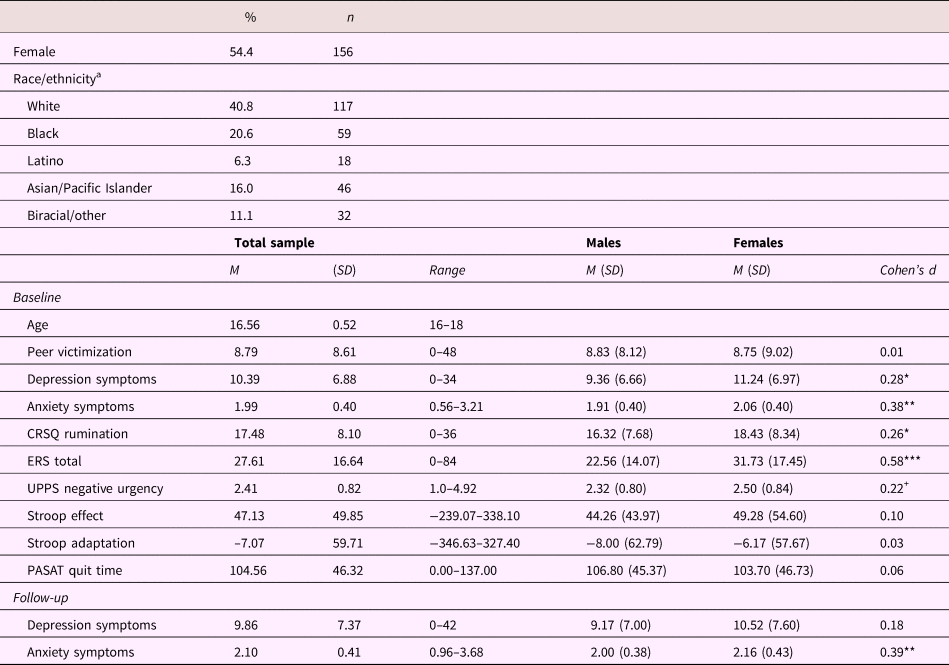
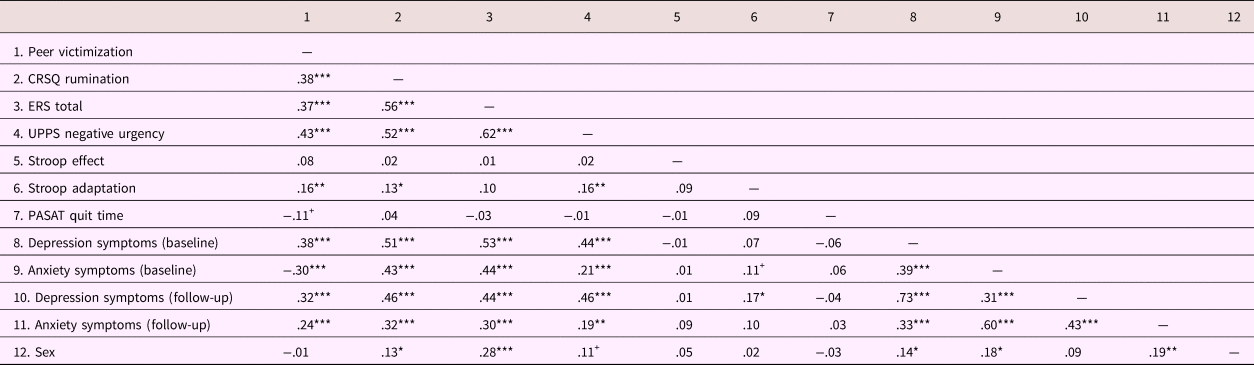
Means and standard deviation of all measures at each time point are displayed in Table 1. Primary variables of interest (victimization, emotion regulation, and psychopathology) were also stratified by sex. One-way analysis of variance demonstrated females reported higher depression and anxiety symptoms at baseline and higher anxiety symptoms at follow-up, and higher scores on the rumination and emotional reactivity questionnaires. Table 2 provides the zero-order correlations among all study measures. As expected, peer victimization was positively associated with depression and anxiety symptoms at baseline and follow-up and all emotion regulation self-report measures, which were in turn positively associated with one another. Task-based measures were not associated with either peer victimization or depression and anxiety symptoms with the exception of the Stroop adaptation measure, which was positively associated with both peer victimization at baseline and depression symptoms at follow-up.
Distribution of sociodemographics and peer victimization, psychopathology, and emotion regulation measures stratified by sex

Note: aFifteen adolescents had missing data on this variable. CRS, Children's Response Style Questionnaire. ER, Emotion Reactivity Scale. UPP, Urgency, Premeditation, Perseverance, Sensation Seeking, Positive Urgency, Impulsive Behavior Scale. PASA, Paced Auditory Serial Addition Test. *p < .05. **p < .01. ***p < .001. +p < .10.
Correlations among demographic variables, peer victimization, emotion regulation, and internalizing psychopathology symptoms

Note: CRSQ, Children's Response Style Questionnaire. ERS, Emotion Reactivity Scale. UPPS, Urgency, Premeditation, Perseverance, Sensation Seeking, Positive Urgency, Impulsive Behavior Scale. PASAT, Paced Auditory Serial Addition Test. ***p < .001. **p < .01. *p < .05. + p < .10.
CFA
CFA was used to determine whether a one-, two-, or three-factor structure of emotion regulation best fit the data. The one-factor model was composed of one emotion regulation factor that included all survey and task-based measures of emotion regulation, χ2 (1127) = 4259.410, p < .001; CFI = .93, RMSEA = .105, SRMR = .101. When testing the one-factor model, none of the task-based indicators loaded meaningfully onto the emotion regulation factor (i.e., standardized factor loadings <.40, meaning the latent factor explained <16% of the variance in the indicator), so were removed from the latent factor but retained as covariates in all subsequent models. The two-factor model included an emotional reactivity latent factor comprised of the UPPS negative urgency, ERS items, and PASAT task score and a cognitive regulation factor that included all of the CRSQ rumination subscale items, and Stroop effect and adaptation scores, χ2 (1126) = 3313.221, p < .001; CFI = .951, RMSEA = .088, SRMR = .089. Results showed a three-factor solution that included emotion reactivity, cognitive regulation, and behavioral regulation as separate latent factors best fit the data, χ2 (1115) = 2420.955, p < .001; CFI = .971, RMSEA = .068, SRMR = .081. Observed variables loading onto the latent factors were as follows: the emotion reactivity latent factor included all items of the ERS scale, the cognitive regulation latent factor included all items of the CRSQ rumination scale, and the behavioral regulation latent factor included all items from the UPPS negative urgency scale. None of the task-based indicators loaded meaningfully onto the emotion regulation factors across all three models (i.e., standardized factor loadings <.40, meaning the latent factor explained <16% of the variance in the indicator), so final model fit statistics reflect a three-factor model with the task data removed and retained as covariates (see Supplementary Table 1).
Latent variable mediation analyses
Depression
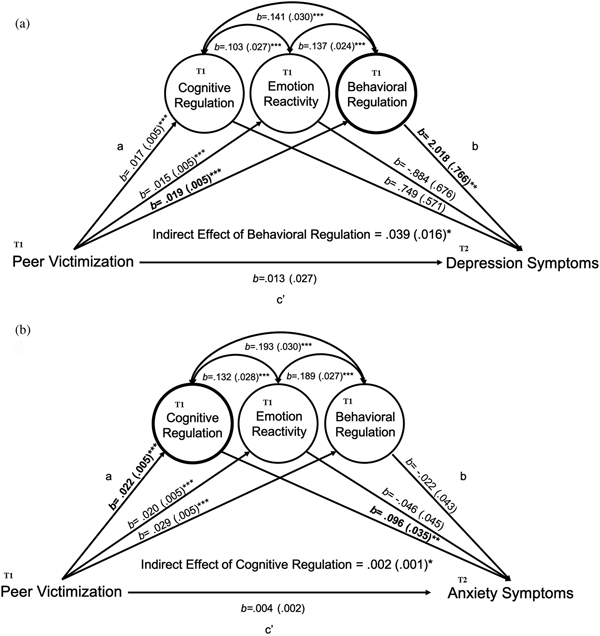
The three emotion regulation latent factors were examined simultaneously as mediators of the association between peer victimization at baseline and depression symptoms at follow-up, controlling for baseline depression symptoms and sex. In the mediation model, baseline peer victimization was no longer a significant predictor of depression symptoms at follow-up after adjusting for emotion regulation (b = .013, p = .633, 95% confidence interval; CI [–.041, .067]; c’ path; Figure 1a). We observed a significant indirect effect of peer victimization on depression symptoms through behavioral regulation (b = .039, p = .016, 95% CI [.007, .071]). Model fit indices indicated that the model adequately fit the data, χ2 (1162) = 3512.767, p < .001; CFI = .887, RMSEA = .098, SRMR = .090. No other latent emotion regulation factor mediated the association between peer victimization and depression symptoms.
Mediational model representing the indirect effects of (a) behavioral regulation and (b) cognitive regulation on internalizing problems.

We next conducted multiple mediation analyses utilizing the task-based measures of emotion regulation to determine whether these measures also functioned as a mediator of the association between peer victimization and depression symptoms. In the mediation model, baseline peer victimization no longer predicted depression symptoms at follow-up (b = .035, p = .389, 95% CI [–.044, .114]). While Stroop adaptation continued to be positively associated with both peer victimization and depression symptoms, it did not mediate the association between the two (indirect effect = .016, p = .086, 95% CI [–.002, .035]). No other task-based measures were associated with peer victimization or depression symptoms at follow-up (ps > .131), and no indirect effects of peer victimization on depression were observed through the other task-based emotion regulation measures (ps > .72). Model fit indices indicated the model was not a good fit for the data, χ2 (4) = 40.672, p < .001; CFI = .829, RMSEA = .207, SRMR = .098.
Anxiety
The three emotion regulation latent factors were examined simultaneously as mediators of the association between peer victimization at baseline and anxiety symptoms at follow-up, controlling for baseline anxiety symptoms and sex. In the mediation model, baseline peer victimization was no longer a significant predictor of anxiety symptoms at follow-up (b = .004, p = .115, 95% CI [–.001, .008]; c’ path; Figure 1b). A significant indirect effect of peer victimization on anxiety symptoms was observed through cognitive regulation (indirect effect = .002, p = .019, 95% CI [.0001, .004]). Model fit indices indicated that the model adequately fit the data, χ2 (1162) = 2909.557, p < .001; CFI = .939, RMSEA = .084, SRMR = .086. No other latent emotion regulation factor mediated the association between peer victimization and anxiety symptoms.
We next conducted multiple mediation analyses utilizing the task-based measures of emotion regulation to determine whether these measures also function as a mediator of the association between peer victimization and anxiety symptoms. In the mediation model, baseline peer victimization no longer predicted anxiety symptoms at follow-up (b = .004, p = .105, 95% CI [–.001, .009]). While Stroop adaptation continued to be positively associated with peer victimization, no other task-based measures were associated with peer victimization or anxiety symptoms at follow-up (ps >.12), nor did any task-based measures mediate the association between peer victimization and anxiety symptoms (ps > .494). Model fit indices varied as to whether the model was an adequate fit for the data, χ2 (4) = 23.054, p < .001; CFI = .879, RMSEA = .150, SRMR = .072.
Discussion
The primary goal of this study was to examine the underlying structure of a variety of task-based and self-report measures of emotion regulation and evaluate whether disruptions in these aspects of emotion regulation mediated the association between peer victimization and internalizing problems in adolescence. A three-factor model of emotion regulation representing emotional reactivity, cognitive regulation, and behavioral regulation best fit the data. No task-based measures of emotion regulation meaningfully contributed to the emotion regulation latent factors. The association between peer victimization and subsequent depression symptoms was mediated by poor behavioral regulation, whereas the association with subsequent anxiety symptoms was mediated by disruptions in the cognitive regulation of emotion. These findings point to potential targets for interventions aimed at preventing the onset of internalizing problems for adolescents who experience peer victimization.
Emotion regulation is a complex construct that encompasses a variety of cognitive and behavioral processes that serve to modulate the intensity and duration of emotional responses (Gross, Reference Gross and Gross2014). The underlying structure of emotion regulation during adolescence has rarely been examined. Prior work using self-report measures of emotion regulation observed a one-factor structure in early adolescence, composed of poor emotional awareness, difficulties regulating the expression of negative emotions, and rumination (McLaughlin et al., Reference McLaughlin, Hatzenbuehler, Mennin and Nolen-Hoeksema2011). In contrast, we found that a three-factor model, representing emotional reactivity, cognitive regulation, and behavioral regulation as separate latent factors, best fit the data. Although the measures used across the two studies were not identical, they did tap into similar types of cognitive and behavioral emotion regulation strategies. The discrepancies could reflect that emotion regulation processes become more distinct from one another across adolescence, such that in early adolescence, youths who have difficulty with one form of emotion regulation are likely to also exhibit problems with other emotion regulation strategies. By late adolescence, emotional reactivity, cognitive regulation, and behavioral regulation of emotion are overlapping but distinct constructs, with only moderate associations with one another. Our findings are in line with Naragon-Gainey, McMahon, and Chacko's (Reference Naragon-Gainey, McMahon and Chacko2017) recent meta-analysis evaluating the structure of self-reported emotion regulation strategies in adults. When an exploratory approach was taken, evaluating up to four factors, a three-factor model characterized by disengagement (behavioral avoidance and distraction), cognitive perseveration (worry and rumination), and adaptive engagement (problem solving and mindfulness) best fit the data (Naragon-Gainey et al., Reference Naragon-Gainey, McMahon and Chacko2017). This pattern is consistent with the idea that emotion regulation processes become more distinct from one another across development, and by adulthood reflect only partially overlapping constructs.
Consistent with extensive prior research (Hawker & Boulton, Reference Hawker and Boulton2000; Schoeler et al., Reference Schoeler, Duncan, Cecil, Ploubidis and Pingault2018), peer victimization was associated with higher levels of depression and anxiety symptoms both cross-sectionally and across the longitudinal follow-up. Here, we provide evidence that distinct aspects of emotion regulation are potential mechanisms underlying the associations of peer victimization with depression and anxiety. Behavioral regulation (specifically, high negative urgency) mediated the association between peer victimization and subsequent depression symptoms, whereas cognitive regulation (specifically, high habitual use of rumination) mediated the association of peer victimization with anxiety symptoms. These findings provide novel evidence for a role of negative urgency, characterized by reflexive action when distressed, in the link between peer victimization and depression symptoms. Although behavioral dysregulation has been long associated with externalizing behavior including risk taking, substance use, and conduct problems (Settles et al., Reference Settles, Fischer, Cyders, Combs, Gunn and Smith2012), recent meta-analyses implicate negative urgency is associated with a broad range of psychopathology with the urgency aspect of impulsivity demonstrating stronger associations with psychopathology than other dimensions of impulsivity such as sensation seeking, lack of premeditation, and lack of perseverance (Berg, Latzman, Bliwise, & Lilienfeld, Reference Berg, Latzman, Bliwise and Lilienfeld2015). Carver, Johnson, and Joormann (Reference Carver, Johnson and Joormann2008) and Carver, Johnson, and Timpano (Reference Carver, Johnson and Timpano2017) suggest a two-mode model of processing (one reflexive, automatic, quick, and bottom-up and the other reflective, planful, effortful, and strategic) to account for the shared contribution of aspects of impulsivity with depression and aggression. Specifically, Carver et al. (Reference Carver, Johnson and Joormann2008, Reference Carver, Johnson and Timpano2017) suggest that the reflexive mode processing is a shared vulnerability factor for both depression and externalizing problems because it produces high levels of negative urgency (i.e., reacting quickly to emotions and taking actions without consideration of consequences) and interferes with reflective, goal-oriented processing during salient negative emotion states. Our findings suggest that impulsive actions taken to alleviate distress when experiencing strong negative emotion states may be an important factor linking peer victimization with depression symptoms during adolescence. Impulsive responses to negative emotion may be more common during periods characterized by high levels of stress as this process requires fewer resources compared to more deliberate and reflective strategies for emotion regulation, despite having longer term consequences of increased depressive symptoms (Carver et al., Reference Carver, Johnson and Timpano2017).
Our findings also suggest a specific pathway in which peer victimization influences anxiety symptoms through increased engagement in rumination. There is a high rate of co-occurrence between symptoms of depression and anxiety, and rumination contributes to this co-occurrence, leading to its conceptualization as a transdiagnostic factor underlying multiple forms of internalizing psychopathology (McLaughlin & Nolen-Hoeksema, Reference McLaughlin, Hatzenbuehler, Mennin and Nolen-Hoeksema2011; Nolen-Hoeksema & Watkins, Reference Nolen-Hoeksema and Watkins2011; Olatunji, Naragon-Gainey, & Wolitzky-Taylor, Reference Olatunji, Naragon-Gainey and Wolitzky-Taylor2013). Consistent with numerous prior studies (McLaughlin & Nolen-Hoeksema, Reference McLaughlin, Hatzenbuehler, Mennin and Nolen-Hoeksema2011; Nolen-Hoeksema, Reference Nolen-Hoeksema2000; Nolen-Hoeksema, Stice, Wade, & Bohon, Reference Nolen-Hoeksema, Stice, Wade and Bohon2007; Nolen-Hoeksema et al., 2008), rumination was associated with anxiety and depression both cross-sectionally and longitudinally. However, rumination emerged as a mechanism linking peer victimization only to anxiety, and not depression symptoms. At first glance, this might appear surprising given the strong and well-established association of rumination with depression symptoms (e.g., Nolen-Hoeksema, Reference Nolen-Hoeksema2000; Nolen-Hoeksema et al., 2008). However, this finding is consistent with a prior longitudinal study of adolescents demonstrating that rumination was a mediator of the longitudinal association between stressful life events and anxiety symptoms among adolescents and adults; although rumination predicted increases in depression over time, it was not a mechanism linking stressful life events and depression until adulthood (Michl, McLaughlin, Shepherd, & Nolen-Hoeksema, Reference Michl, McLaughlin, Shepherd and Nolen-Hoeksema2013). We replicate this basic pattern here in relation to peer victimization. It may be that ruminative thoughts engendered by peer victimization focused on the causes and consequences of distress produce fear that victimization experiences will occur again, contributing to anxiety. Peer victimization experiences are often experienced chronically over time, and rumination about the causes and consequences of the resulting distress may contribute to the emergence of anxiety.
The task-based behavioral regulation (i.e., PASAT performance) and cognitive regulation measures (i.e., emotional Stroop performance) did not meaningfully contribute to any of the latent factors across all models. The factor analysis results supported the structure of the validated questionnaires’ measuring of emotional reactivity, cognitive regulation, and behavioral regulation. Perhaps this is not surprising given the prior development and evaluation of the tools; however, it is notable that these questionnaires were not evaluated with respect to other dimensions of emotional processes, and thus the findings add to the discriminant and incremental validity of these questionnaires. It is also possible that the findings are related to methodological artifacts, or otherwise stated, an unintended consequence of having the same source of information (self-report) informing both predictor and outcomes variables resulting in inflated estimates of their association (Hunsley & Meyer, Reference Hunsley and Meyer2003).
The emotional Stroop measures inhibition of responses to emotional stimuli and adaptation to emotional conflict, and is interpreted as an automatic form of emotion regulation (Etkin et al., Reference Etkin, Egner, Peraza, Kandel and Hirsch2006). Although the emotional Stroop data did not meaningfully load onto the emotion dysregulation factors, or mediate the association between exposure to peer victimization and internalizing problems, the emotional Stroop adaptation score was associated with both peer victimization and depression symptoms, consistent with prior research (Etkin & Schatzberg, Reference Etkin and Schatzberg2011; Lambert, King, Monahan, & McLaughlin, Reference Lambert, King, Monahan and Mclaughlin2017). The distress tolerance PASAT task did not load onto the latent factors of emotion regulation and was not associated with peer victimization or internalizing problems. Previous studies have similarly not found an association between questionnaire measures and the behavioral measures of distress tolerance (Iverson, Follette, Pistorello, & Fruzzetti, Reference Iverson, Follette, Pistorello and Fruzzetti2012; McHugh et al., Reference McHugh, Daughters, Lejuez, Murray, Hearon, Gorka and Otto2011; Schloss & Haaga, Reference Schloss and Haaga2011). This lack of convergence across task- and survey-based measures could reflect low external validity of the task, or different processes associated with the development of internalizing as opposed to externalizing problems.
It is also possible that reaction time tasks (such as the emotional Stroop and PASAT) do a poor job of capturing reliable individual differences. Many behavioral tasks are designed to maximize an experimental effect (such as the difference in reaction times to emotional stimuli), which minimized between-individual differences (Enkavi et al., Reference Enkavi, Eisenberg, Bissett, Mazza, Mackinnon and Marsch2019; Hedge, Powell, & Sumner, Reference Hedge, Powell and Sumner2018; Rouder & Haaf, Reference Rouder and Haaf2018; Weafer, Baggott, deWit, & deWit, Reference Weafer, Baggott, de Wit and de Wit2013). Hedge et al. (Reference Hedge, Powell and Sumner2018) highlight important issues for the use of experimental tasks in the study of individual differences. Specifically, experimental tasks aim to characterize an average response to environmental manipulation, and the tasks that have been developed and selected for these replicable and robust effects are at odds with goals of correlational approaches that seek to find individual differences. Experimental tasks require low variability between individuals and may be incompatible for the use of exploring individual differences, which requires high variability. Evaluation of interclass correlations of variability in task performance reveals low between-participant variability, which limits their contribution to paradigms that explicitly seek to discover individual differences (Hedges et al., Reference Hedge, Powell and Sumner2018). In short, in spite of the popularity of behavioral tasks, poor psychometric properties may undermine their use as measures of between-individual differences. Future research evaluating the divergence between the conceptualization and measurement of distress tolerance and its relationship to emotion regulation and psychopathology are needed as the present study's findings suggest that task-based and self-reported emotion dysregulation variables do not share sufficient variance to be considered measurements of the same construct.
This study utilized a longitudinal design with a diverse sample of adolescents over time to understand multiple dimensions of emotion regulation as a mechanism by which peer victimization impacts later internalizing problems. Several limitations are worth noting. First, peer victimization was evaluated broadly and incorporated both relational and overt victimization into one construct due to the high level of overlap in the subscales. It is possible that different pathways could be associated with overt and relationship victimization processes and collapsing into an overall victimization construct obscured these differences. Second, the longitudinal time frame was a short period in an adolescent's life consistent with prior work demonstrating emotion regulation pathways linking peer victimization and internalizing problems in adolescents (McLaughlin et al., Reference McLaughlin, Hatzenbuehler and Hilt2009); future research is needed to replicate these findings over longer time frames. Third, although we utilized a multiple-method approach for emotional regulation, the task data did not load onto latent factors of emotion regulation. Thus, shared method variance for the self-report variables in the mediational model as well as the inability to account for within-person variance over time are limitations of this study. Fourth, alternative models may be explored as peer victimization and emotion regulation processes reciprocally influence one another. As such, several investigations have highlighted that youth's emotional reactivity and behavioral aspects of emotion regulation place them at risk as targets of victimization (Kim & Cicchetti, Reference Kim and Cicchetti2010; Rosen, Milich, & Harris, Reference Rosen, Milich and Harris2012; Schwartz, Reference Schwartz2000; Schwartz & Proctor, Reference Schwartz and Proctor2000; Shields & Cicchetti, Reference Shields and Cicchetti2010; Shields, Ryan, & Cicchetti, Reference Shields, Ryan and Cicchetti2001). Unfortunately, our study design did not allow for evaluation of alternative models given the time frame of the assessments as peer victimization and emotion regulation variables were measured at the same time point: the peer victimization questionnaire assessed victimization experiences occurring in the past year and the emotion regulation questionnaires queried current strategy use.
Peer victimization is a significant social stressor for adolescents, and our data indicate that peer victimization can lead to difficulties in multiple forms of emotion regulation, including heightened emotional reactivity and both behavioral and cognitive forms of emotion regulation. The tendency to engage in rash action to modulate strong emotions mediated the association of peer victimization with future depression symptoms, whereas high habitual use of rumination explained the association of peer victimization with subsequent anxiety symptoms. These findings highlight specific forms of emotion regulation as potential targets for prevention and intervention with youths who have experienced peer victimization.
Supplementary material
The supplementary material for this article can be found at https://doi.org/10.1017/S0954579419000543.
Acknowledgments
We would like to thank Kevin King for his generosity in consulting regarding the data analyses.
Financial support
Funding for data collection and analysis was provided by the Jacobs Foundation through a research grant awarded to Katie Anne McLaughlin, Kevin King, and Kathryn Monahan. The preparation of this article was supported in part by the Agency for Healthcare Research and Quality Grant K12HS022982 (to M.A.) and the National Institute of Mental Health Grants K23MH112872 (to J.L.J.) and F31MH117827 (to K.S.K.).