Much of the debate in SLA theory concerns the extent to which the native language (L1) plays a role in the acquisition of a second (L2) or foreign language. The present article aims to contribute to this debate by presenting new empirical data from a closely related language pair, Swedish and German, for the domain of information structure in verb second (V2) declaratives.
Certain approaches assume that the L1 grammar initially plays no role in SLA but that learners make use of a universal base or so-called canonical word order (subject [S]-verb [V]-object [O], with the possibility of another element [X] in the third position; e.g., Clahsen & Muysken, Reference Clahsen and Muysken1986; Klein & Perdue, Reference Klein and Perdue1992; Pienemann, Reference Pienemann1998). Such approaches predict that L2 learners with different L1s acquiring the same L2 show the same developmental sequence. For L2 German, the following universal path of grammatical development has been proposed (e.g., Pienemann):
(1)


However, this allegedly universal developmental sequence has also been criticized: Although L1 Romance and L1 English speakers may exhibit the developmental sequence illustrated in (1) in their L2 German, L1 Turkish and L1 Korean learners of German do not; they start to produce OVnonfinite right away (Schwartz & Sprouse, Reference Schwartz, Sprouse, Hoekstra and Schwartz1994; Vainikka & Young-Scholten, Reference Vainikka, Young-Scholten, Hoekstra and Schwartz1994). Because Turkish and Korean are OV languages, but Romance and English are VO languages, the L1 grammar appears to exert a crucial influence on the L2, such that L2 learners with typologically different L1s who are acquiring the same L2 show different developmental sequences. Based on these findings, Schwartz and Sprouse (Reference Schwartz, Sprouse, Hoekstra and Schwartz1994, Reference Schwartz and Sprouse1996, Reference Schwartz, Sprouse and Archibald2000) developed a transfer model of SLA, according to which learners initially transfer their entire L1 syntax—lexical as well as functional categories—and produce and process L2 utterances through the L1 grammar. Only after this initial state may learners change their interlanguage syntax by abandoning L1 rules (constraints, parameter settings), acquiring new rules, constraints, and parameter settings—which may or may not be those of the target language—and eventually converging or not converging on a targetlike L2 grammar. Schwartz and Sprouse's (Reference Schwartz, Sprouse, Hoekstra and Schwartz1994, Reference Schwartz and Sprouse1996) model is well known, and its explicitness (full transfer) makes it easy to test against empirical data from beginning learners.
What about Swedish learners of German? Swedish is typologically, grammatically, and lexically very close to German (with an estimated 80% of Swedish words cognate with German words). Syntactically, both Swedish and German adhere to the V2 constraint that requires the finite verb in declaratives to be the second constituent. In non-subject-initial main clauses, so-called inversion of the subject and the verb (XVS) is required, and verb third (V3) is generally ungrammatical (for exceptions, see Bohnacker, Reference Bohnacker, den Dikken and Tortora2005).Footnote 1 The position to the left of the finite verb is called the prefield (German Vorfeld, Swedish fundament; see, e.g., Drach, Reference Drach1937; Reis, Reference Reis1980); this is also almost always the clause-initial position.Footnote 2 In principle, the prefield in Swedish and German may be occupied by almost any type of constituent, irrespective of syntactic category, complexity, and semantic function; what is fixed is the verb in second position.
A full transfer approach would predict that Swedish learners of German should master V2 word order right away. However, Håkansson, Pienemann, and Sayehli (Reference Håkansson, Pienemann and Sayehli2002) claimed that Swedish natives violate V2 in their L2 German, following the sequence illustrated in (1). Our experience as German teachers at schools and universities in Sweden prompted the empirical investigation of this issue. In Bohnacker (Reference Bohnacker, den Dikken and Tortora2005, Reference Bohnacker2006), Swedes learning German were shown to productively use V2 in oral narratives after only 4 months of exposure; these findings are summarized in the next section. Here, we also present new written data from Swedish beginning learners of German who have little difficulty with V2. We interpret these results as indicative of transfer of the V2 property from L1 Swedish to L2 German. However, whereas learner productions may have targetlike word order (syntax), these productions are not necessarily adequate in the context in which they occur. This brings us to the major aim of this article, which is to investigate syntactically targetlike V2 clauses with regard to information-structural (i.e., discourse-pragmatic) adequacy. We will argue that nonnative learners of German transfer not only L1 syntactic properties but also L1 information-organizational principles to the L2.
Rosén (Reference Rosén2006) found that the very same Swedish learners of German who produce targetlike V2 clauses appear to be organizing and structuring information in a way that disturbs German readers and listeners. In a pilot study, she asked native speakers of German to assess advanced L2 productions, which they described as choppy, textually incoherent, and simply as “it does not sound German.” When asked to make the L2 texts sound more German, native speakers unpromptedly homed in on the beginning of sentences and consistently changed them in certain ways.
Why would changing the beginnings of sentences make texts less choppy and more German? The prefield is especially important for communication, as it anchors the clause in discourse. At the intersentential level, the prefield contributes to textual coherence by linking up with preceding discourse; at the intrasentential level, it often establishes the topic (i.e., what is being talked about), followed by the comment. Moreover, the prefield typically contains given information: the theme (i.e., an element of low informational value). New information, known as the rheme, is usually provided later, after the finite verb in V2 clauses.Footnote 3 Alternatively, the prefield can also be used to focus or contrast constituents.
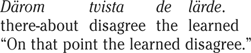
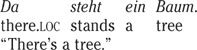
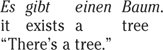
By comparing native German and native Swedish corpora, we point to quantitative and qualitative differences in the way these two V2 languages make use of the prefield. For instance, Swedish appears to have a much stronger preference for rheme later, in which the prefield contains an element of no or low informational value (e.g., an expletive or a thematic element) and in which rhematic information is realized further to the right in the clause. These language-specific differences in information structure, we believe, lie at the heart of why native Germans change the beginnings of sentences in L2 texts to make them sound more German. Consider (2)–(4), which illustrate that German speakers prefer to start the sentence with a rhematic constituent (underlined), whereas Swedish speakers prefer to do so with a thematic subject or an expletive (in boldface).
(2)
(3)
(4)


Having contrasted prefields in native German and native Swedish corpora, we will compare these with oral and written L2 German productions. We will show that the learners largely apply the information-structural and word-order frequency patterns of their L1 Swedish to German, which results in an unidiomatic, nonnative discourse structure. We will suggest that L1 transfer is found not only in the domain of syntax but also in the domain of information structure and information organization and that such L1 influence persists at high L2 proficiency levels.
We first present a quantitative analysis of prefield constituents in native Swedish and native German by surveying existing corpus studies and analyzing new L1 corpora (Rosén, Reference Rosén2006). Second, we undertake a detailed, qualitative investigation of how the prefield is used for organizing and structuring information in the two languages (concerning subjects and expletives, adverbial så “so,” objects, pronominal adverbs, and other adverbials). After providing background information on informants and data collection, Bohnacker's (Reference Bohnacker, den Dikken and Tortora2005, Reference Bohnacker2006) findings on verb placement (V2) in oral L2 German and new findings from written L2 data (Rosén) are summarized. The frequencies of prefield constituents in the learner data are then compared to those of native controls. Finally, results from Rosén's study in which native Germans rated, commented on, and rewrote L2 texts are included in the discussion of the qualitative analysis of the learner's prefields.
COMPARISON OF SWEDISH AND GERMAN PREFIELDS: QUANTITATIVE DIFFERENCES
Earlier Corpus Studies of Swedish and German
Swedish and German prefield constituents can vary in syntactic category and complexity: They can be phrasal or clausal, argumental or nonargumental, phonologically heavy or light (including unstressed object pronouns) and can have almost any semantic function, although subjects predominate in both languages. Because, in principle, virtually any constituent (some modal particles excluded) can be placed in the prefield of German and Swedish V2 declaratives (e.g., Erdmann, Reference Erdmann1886; Herling, Reference Herling1821; Teleman, Hellberg, & Andersson, Reference Teleman, Hellberg and Andersson1999; Zifonun, Hoffmann, & Strecker, Reference Zifonun, Hoffmann and Strecker1997), the two languages are often—tacitly or explicitly—assumed to behave alike concerning the frequency and function of prefield constituents. For instance, according to Håkansson (Reference Håkansson and Söderbergh1997), 60% of all declaratives in Swedish, German, Dutch, and Icelandic begin with a subject, whereas 40% are non-subject-initial. However, Håkansson provided no empirical evidence for this claim, and contrastive corpus studies of V2 languages are few and far between. Even single-language corpora are difficult to compare because they are often of different genres, and genre has been shown to influence the frequencies of the types of items in the prefield. For instance, in a 25,000-word corpus of colloquial spoken German collected between 1955 and 1963, Engel (Reference Engel1974) found 51% subject-initial and 35% adverbial-initial main clauses, but these averages varied significantly for near-monological narratives (24–36% SVX, 49–60% Adv-VS) versus more interactive dialogue data (54–68% SVX, 17–32% Adv-VS).
As far as we know, there are no contrastive corpus studies of German and Swedish that focus on the prefield. However, a survey of existing single-language corpora suggests that subject-initial clauses are considerably more frequent in Swedish than in German, especially if genre is kept constant, and that object-initial clauses are less frequent than in German. For instance, for an 18,000-word corpus of German newspapers, Fabricius-Hansen and Solfjeld (Reference Fabricius-Hansen and Solfjeld1994) reported 54% subject-initial and nearly 7% object-initial main clauses. For Swedish, by contrast, Westman (Reference Westman1974) found 64% subject-initial and only 2% object-initial main clauses in an 87,000-word corpus of newspaper articles and other nonfiction texts from high school textbooks, magazines, and brochures issued by the authorities between 1962 and 1971 (Table 1). A very similar distribution is found in Hultman and Westman's (Reference Hultman and Westman1977) study of essays written by Swedish students as part of their 1970 studentexamen (Swedish A-levels, written exams in the final year of grammar school). In this 88,000-word corpus, main clauses are 66% subject-initial and 3% object-initial. Westman's (Reference Westman1974) figures also match those of a more recent study by Nordman (Reference Nordman1992). In 45,000 words of Swedish technical, scientific, and scholarly prose, she found 61% subject-initial and 2% object-initial clauses. Swedish fiction and Swedish law texts have an even higher proportion of subject-initial clauses: Benson (Reference Benson1974) reported 68% in drafts for new legislation, Teleman and Wieselgren (Reference Teleman and Wieselgren1970) reported 70% in fictional prose, and Jörgensen (Reference Jörgensen1976) also reported 73% subject-initial and 1.6% object-initial main clauses for written Swedish read aloud on the 1974 radio news. Comparing such formal radio news with more informal spoken genres, Jörgensen found a decrease in subjects and an increase in objects in the prefield in the more colloquial genres: He reported 60% subject-initial and 9% object-initial clauses for a corpus of informal conversations and debates between native Swedish academics (8 informants, 3 hr of recording, collected in 1968) and 62% subject-initial and 14% object-initial clauses for a large corpus of informal interviews of thirty-two 30–45-year-olds (collected in 1968, 8–9 hr of recording). However, even in such colloquial speech, Swedish appears to have more subject-initial declaratives than German does, as illustrated by a comparison with two separate 25,500-word corpora of colloquial spoken German. In Engel's (Reference Engel1974) recordings of the 1960s, declaratives are 51% subject-initial, 9% object-initial, 35% adverbial-initial, and 4% other. Bohnacker (Reference Bohnacker2007) reported similar figures for a colloquial German 25,300-word corpus recorded in the late 1990s: 52% subject-initial, 10% object-initial, 37% adverbial-initial, and 1% other.
Constituents in the prefield in written German (newspaper articles), based on Fabricius-Hansen and Solfjeld (Reference Fabricius-Hansen and Solfjeld1994, pp. 101–102), and in written Swedish (newspapers, textbooks, brochures), based on Westman (Reference Westman1974, p. 155)

Second most frequent in both languages are adverbial-initial declaratives (see Table 1). The types of adverbials may vary depending on genre, but temporal adjuncts often appear to predominate (e.g., Westman, Reference Westman1974). In German, the prefield is said to mostly host locational or temporal adverbials as well as a range of other adjuncts (e.g., Carroll & von Stutterheim, Reference Carroll, von Stutterheim and Ramat2003; Zifonun et al., Reference Zifonun, Hoffmann and Strecker1997). Least frequent in the two languages are object-initial declaratives. The corpus studies reviewed thus far suggest, however, that objects in the prefield are much rarer in Swedish than in German, especially in the written modality.
Results From the Native Corpora
To verify and further investigate these language-specific tendencies, we collected new informal written L1 corpora from native speakers matched for age and text type. These written control corpora of 17,500 words (Swedish) and 28,500 words (German) comprise 150 compositions (informal letters, summaries, short stories) by 80 native Swedes and 70 native Germans, who were 15-year-old pupils and 20–25-year-old university students—the same ages as the L2 learners in this study.
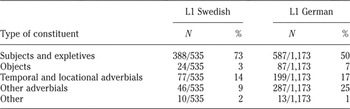
Table 2 shows the results for the informal letters written by the 20–25-year-old L1 informants; the data collected from the 15–16-year-olds in the form of informal letters and stories look very similar (see Rosén, Reference Rosén2006). Clear differences emerge in the frequencies of constituent types in the prefield: Swedish has a stronger subject-initial preference (73%) than German (50%), objects are fronted more often in German (7%) than in Swedish (3%), and adverbials other than temporal and locational are fronted more frequently in German (25%) than in Swedish (9%).Footnote 4
Constituents in the prefield, written L1 adult data (informal letters)

LANGUAGE-SPECIFIC WAYS OF STRUCTURING INFORMATION: QUALITATIVE DIFFERENCES
Subjects in the Prefield
Both Swedish and German have a tendency to start declaratives with a subject. Both languages also tend to let the subject, a grammatical category, coincide with the information-structural categories of theme and topic (e.g., Lambrecht, Reference Lambrecht1994; Reinhart, Reference Reinhart1982; but see Chafe, Reference Chafe and Li1976, and Jacobs, Reference Jacobs2001, for wider definitions). Both languages also have a tendency to place theme before rheme and therefore a tendency to place the thematic information in the clause-initial position (e.g., Beneš, Reference Beneš and Moser1971; Daneš, Reference Daneš1970; Ekerot, Reference Ekerot and Hyltenstam1979; Hoberg, Reference Hoberg1981; Teleman et al., Reference Teleman, Hellberg and Andersson1999). Theme here stands for what the speaker or writer may assume the listener or reader to know (i.e., given information), because it has previously been explicitly mentioned or is inferable with recourse to the linguistic discourse or the discourse situation. Rheme stands for what the speaker or writer assumes to be new information for the hearer or reader, thus it is of higher informational value.
Furthermore, corpus data suggest that Swedish has a stronger tendency than German to keep informationally new (i.e., rhematic or focal) material out of the clause-initial position and instead place it further to the right (i.e., in postverbal position). This structural organization can be achieved by filling the prefield with the theme or with an element of no informational value, such as an expletive subject, or by leaving the prefield empty, as in verb initial (V1) declaratives (which will not be discussed here). One might thus say that Swedish linear syntax more faithfully follows the information-structural principle of rheme later. Moreover, Swedish seems to have a stronger tendency than German to start the sentence with a phonologically light element; we observed this tendency in our written control corpora, and results from written Norwegian versus German corpora point in the same direction (e.g., Benthien, Reference Benthien1990; Fabricius-Hansen & Solfjeld, Reference Fabricius-Hansen and Solfjeld1994). One would need to investigate this more in depth for spoken corpora of the same genre in the two languages. It is unclear whether it is the light phonological weight that promotes thematicity or vice versa (i.e., whether it is the phonology that influences information structure or the other way around), but the two tendencies seem connected.
The principle of rheme later is first presented for rhematic subjects. Swedish declaratives that contain a rhematic subject typically have an expletive subject, det “it,” in the prefield, as shown in (5a) and (6a). The proper subject (många studenter “many students,” mycket “much”) occurs postverbally. Alternatively, an element encoding new information, like the rhematic subject många studenter “many students” or the locational adverbial i Växjö “in Växjö,” could be placed in the prefield, as shown in (5b) and (6b). Although such sentences are grammatical in Swedish, they are dispreferred by native speakers and rarely occur in the control corpus.
(5)
(6)


By contrast, German tends not to use an expletive subject in sentence-initial position but starts the clause with a phonologically heavier, rhematic element, as illustrated in (7a) and (8a). We could paraphrase the sentence in (7a) and (8a) by using an expletive as exemplified in (7b) and (8b), but such constructions are dispreferred in German and rare in the control corpus. (However, such constructions will be shown to be common in the L2 data.)
(7)
(8)


Thus, subtle differences exist between Swedish and German in the linguistic means used for introducing referents and other new information. These crosslinguistic differences are not categorical (grammatical vs. ungrammatical) but rather tendencies, and their mastery is an integral part of language competence (cf. Carroll, Murcia-Serra, Watorek, & Bendiscioli, Reference Carroll, Murcia-Serra, Watorek and Bendiscioli2000; Carroll & von Stutterheim, Reference Carroll, von Stutterheim and Ramat2003).
The informational value of individual constituents is not affected by where they are placed in the clause. However, fronting or not fronting an element and using or not using a clause-initial expletive can induce a change in thematic progression as a whole. Swedish has a range of constructions with an element of low informational value in the prefield. Consider, for instance, the presentational sentences (i.e., existential constructions and clefts) in (9) and (10), which begin with the expletive det “it” and a copula verb. Rhematic information, such as the proper subject and temporal, locational, or other adverbials, is introduced postverbally (cf. Ekberg, Reference Ekberg, Håkansson, Lötmarker, Santesson, Svensson and Viberg1997; Teleman et al., Reference Teleman, Hellberg and Andersson1999).
(9)
(10)


German has corresponding constructions, but these are less common in naturalistic discourse; the preferred way of expressing the equivalent of (9) and (10) in German is not to start with an expletive, as shown in (11) and (12).
(11)
(12)


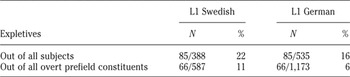
Table 3 provides quantified data to show that the expletive det “it” in the prefield is indeed much more frequent in Swedish than the expletive es “it” in German. In Rosén's (Reference Rosén2006) corpora of informal letters, 22% of all subject-initial sentences begin with an expletive in native Swedish, but only 11% do so in native German.Footnote 5
Expletive subjects in the prefield, informal written data, letters

Adverbial så “so” in the Prefield
Another typically Swedish construction is the unstressed connective så “so” in clause-initial position. Så “so” in the prefield, like the expletive det “it,” is of low informational value and allows rhematic information to be placed after the verb. Connective så “so” conjoins clauses and can indicate temporal succession, simultaneity, or consequence (“and,” “and then,” “so [then]”) but is often simply a coordinator with no particular temporal interpretation. Så “so” is very frequent in colloquial spoken Swedish (e.g., Ekberg, Reference Ekberg, Håkansson, Lötmarker, Santesson, Svensson and Viberg1997; Eriksson, Reference Eriksson1997), and when declaratives are coordinated, så “so” is one of the most common ways to introduce the second conjunct in combination with the conjunction och “and,” as illustrated in (13a) and (14a).Footnote 6 German has an adverb, so, cognate with Swedish så “so,” but it cannot be used as a connective in the same way. As a result, literal translations of the så construction into German are marginal at best, as shown in (13b) and (14b), and unattested in the native controls (but found in the L2 data).
(13)
(14)


Objects in the Prefield
The tendency to start Swedish sentences with an element of low informational value—which also often happens to be phonologically light—manifests itself in the case of fronted objects as well. Recall that object-initial declaratives, although generally uncommon, are more frequent in German than in Swedish (see Table 2). Swedish speakers typically front objects that are themes. They do so mostly in the form of the anaphoric definite inanimate pronoun det “it” or “that.” Because of its thematic anaphoric function, object det “it” in the Swedish prefield enhances textual cohesion.Footnote 7 Object det “it” is much more frequent in the native control corpora than its German equivalent (das/es “it” or “that”): Swedish det “it” makes up 82% of all fronted object pronouns, but German das “it” makes up only 24% (Rosén, Reference Rosén2006). This distribution, where most objects in the prefield are det “it,” need not hold across all genres of Swedish, but we believe that it is typical of the informal written texts produced by young people in the 21st century and that it is also a feature of informal spoken Swedish. In recordings from 1968, Jörgensen (Reference Jörgensen1976) found 14% fronted objects in informal interviews and 9% in conversations and debates between academics but only 1.6% in radio news that consisted of read-aloud formal writing.Footnote 8 It is interesting to note that Jörgensen's examples indicate that fronted objects in colloquial Swedish nearly always take the form det “it.” Teleman (personal communication, November 24, 2006), who is very familiar with the corpora used by Jörgensen, confirmed this and pointed out frequently occurring semiformulaic utterances of the type in (15).
(15)

The German equivalent of Swedish det “it,” das “it/that,” is less frequent in the prefield. German speakers regularly front a much wider range of objects, both pronominal and lexical (e.g., mir “me,” ihr “[to] her,” der “[to] her, to this”).Footnote 9 They also place rhematic objects in clause-initial position, as illustrated in (16).
(16)

Pronominal Adverbs in the Prefield
German native speakers make use of so-called pronominal adverbs (Pronominaladverbien, proadverbials) for reference maintenance. These are thematic elements composed of a locational adverb (typically, da “there”) and a preposition. Whereas da “there” on its own functions as a deictic or anaphoric adverb that is primarily locational, da as part of a pronominal adverb can be quite vague in the space it denotes; its primary function is anaphoric. The morphological complexity of pronominal adverbs makes them informationally more specific than simple thematic das “it” or da “there.” Pronominal adverbs maintain a referent in spatial, temporal, and other terms and are thus a means to establish textual coherence. In (17), for example, the rhematic information of the first clause, Autofahren lernen “learning how to drive,” is turned via damit “with that” into the theme of the second clause. Further examples of pronominal adverbs in German include dazu “there-to/with that,” damit “there-with/with that,” and davon “there-of/about that,” among others.Footnote 10
(17)

Other Adverbials in the Prefield
Apart from pronominal adverbs, there are many other adverbials that can be used in the prefield to improve textual cohesion—in particular, sentence adverbials such as logical connectives and speaker-attitude adverbials.Footnote 11 These other adverbials are much more frequent in the prefield in native German than in native Swedish (see Table 2). It would be interesting to see whether this surprising difference could be verified for larger corpora and corpora of other text types, because the Swedish language has no shortage of sentence adverbs or logical connectives in general. According to Jörgensen and Svensson (Reference Jörgensen and Svensson1986) however, such adverbials tend to be placed in the medial or final position in Swedish declaratives (i.e., to the right of the finite verb), and Altenberg (Reference Altenberg, Johansson and Oksefjell1998) provided empirical evidence for this tendency by comparing the placement of connective adverbials in Swedish and English original texts and in translations thereof (he does not discuss German). In Altenberg's corpus of English original texts, 74% (624/845) of the adverbial connectors occur sentence-initially as opposed to 37% (441/1,191) in the Swedish original texts. Connectives in other positions are rare in English but common in Swedish, where 27% occur in the medial position (between the subject and the main verb) and 29% occur postverbally. Altenberg also showed that in professional English translations of Swedish texts, originally noninitial connectives are fronted, whereas in Swedish translations of English texts, clause-initial connectives are postponed. This is illustrated in (18a) and (18b).
(18)

In Swedish texts and Swedish translations, then, the expression of logical relations is generally signaled not in the prefield but much later in the sentence (Altenberg). As far as we know, no such tendency has ever been reported for German. It is thus possible that German tends to place speaker-attitude adverbs and logical connectives in the prefield, whereas Swedish places them more often postverbally and largely reserves the prefield for other, thematic, elements; compare (19) and (20).
(19)
(20)


THE LEARNER DATA
Oral Data
Our oral L2 production data come from Swedish L1 teenagers learning German as a foreign language at a secondary school in Sweden and from Swedish L1 adults taking evening classes in German as a foreign language for beginners (Bohnacker, Reference Bohnacker, den Dikken and Tortora2005, Reference Bohnacker2006). Data were elicited from all learners with the same narrative task: the telling of a monologue on a given topic (as described in Bohnacker, Reference Bohnacker, den Dikken and Tortora2005, Reference Bohnacker2006).
The twenty-three 16-year-old teenagers were tested once, at the end of their third year of German (i.e., after approximately 800 hr of classroom German). They will be referred to as intermediate. Their recordings comprise approximately 12,500 words. The adults, six 60–70-year-old pensioners, were tested twice, after 4 months (i.e., 45 hr of classroom German) and after 9 months (after 90 hr of classroom German). They will be referred to as beginners. Their recordings comprise approximately 17,500 words. Three adults did not know any language other than Swedish before taking up German, whereas the other three, and the teenagers, had learned English at school.
Written Data
Our written L2 data consist of texts produced by teenage and young adult Swedish learners of German at secondary schools and universities in Sweden. The informants had all learned English at school before studying German.
We collected 245 L2 German compositions, including informal letters, essays, and summaries, for a total of about 100,000 words, between 1999 and 2005 (for details, see Rosén, Reference Rosén2006). There were 55 L2 beginners (14-year-olds), who had had approximately 200 hr of classroom German, and 55 L2 intermediates (17-year-olds), with approximately 830 hr of classroom German. Moreover, we collected 135 advanced L2 productions from 20–25-year-old university students, who had had about 6 years of classroom German.
Here, the terms beginner, intermediate, and advanced are simply used as shorthand for the varying lengths of exposure the learners had to the foreign language. No independent measure of proficiency was used. The learner data were compared to the written L1 control corpora of 80 native Swedish and 70 native German speakers (Rosén, Reference Rosén2006).
L2 RESULTS
V2 Word Order
Before we can investigate how the learners use the prefield to structure information, we need to establish that they indeed have a prefield, insofar as they adhere to the V2 constraint and are able to produce non-subject-initial V2 declaratives. In the same oral corpora used here, Bohnacker (Reference Bohnacker, den Dikken and Tortora2005, Reference Bohnacker2006) showed that Swedish learners of German produce subject-initial and non-subject-initial V2 declaratives at the beginner level. For the pensioners (after 4 months of training), she found that those informants who did not speak English fully adhere to the V2 constraint in their L2 German, producing 68% SVX, 32% XVS, and 0% nontargetlike V3.Footnote 12 Bohnacker (Reference Bohnacker, den Dikken and Tortora2005, Reference Bohnacker2006) interpreted this as indicative of L1 transfer. The pensioners who spoke English were found to adhere to the V2 constraint only partially in their third language (L3) German, producing SVX, targetlike XVS, and nontargetlike V3. This suggests that they, too, transfer V2 from their L1, but that prior knowledge of a non-V2 language, such as English, can have a detrimental effect, slowing down full mastery of V2 in the L3 (however, this is incidental to the present study).Footnote 13 For individual results, raw figures, and detailed discussion, see Bohnacker (Reference Bohnacker, den Dikken and Tortora2005, Reference Bohnacker2006).
In the written L2 data, word-order distribution is very similar. For reasons of space, we only present the results from the least advanced group—the 14-year-olds who have had 200 hr of German training. They produce 81% (796/984) subject-initial and 19% (188/984) non-subject-initial declaratives (see Bohnacker & Rosén, Reference Bohnacker, Rosén, Anderssen and Westergaard2007a, Reference Bohnacker, Rosén, Belikova, Meroni and Umeda2007b). Crucially, 153 of the 188 non-subject-initial clauses are XVS, including 16% targetlike V2 and only 3% V3. The group is homogeneous in that every learner produces both targetlike XVS clauses and between zero and three instances of nontargetlike XSVO.Footnote 14
In earlier studies, L2 learners whose L1 is non-V2 were reported to acquire V2 late (e.g., Clahsen & Muysken, Reference Clahsen and Muysken1986; du Plessis, Solin, Travis, & White, Reference du Plessis, Solin, Travis and White1987; Pienemann, Reference Pienemann1998; Schwartz & Sprouse, Reference Schwartz, Sprouse, Hoekstra and Schwartz1994; Vainikka & Young-Scholten, Reference Vainikka, Young-Scholten, Hoekstra and Schwartz1994, Reference Vainikka and Young-Scholten1996). Additionally, Håkansson et al. (Reference Håkansson, Pienemann and Sayehli2002), in a study of Swedish teenagers learning German as a L3 (after English), reported that their learners were not able to produce any XVS at first. However, their elicitation method and the small-sized database do not enable us to draw strong conclusions about V2 (as discussed in Bohnacker, Reference Bohnacker, den Dikken and Tortora2005). By contrast, Bohnacker's and our Swedish learners of German produce XVS declaratives early on, and we are thus in a position to compare their use of the prefield in V2 clauses to that of native speakers.
Quantification of Constituents in the Prefield
The frequencies of constituents in the prefield in the L2 German data differ substantially from those of L1 German but resemble those of L1 Swedish. Figure 1 illustrates this for the written text type of informal letters. Solid black bars show the percentage of non-subject-initial clauses out of all V2 declaratives for L1 Swedish (29%, 157/535) and for L1 German (50%, 586/1,173). Compare this with the written L2 productions (the white bars): For the fifty-five 14-year-old L2 beginners, the prefield contains a constituent other than the subject only 16% of the time (88/544); for the intermediate learners (17-year-olds) 21% (291/1,371); and for the advanced learners 35% (403/1,122). Thus, for the learners, non-subject-initial clauses become more common with increasing proficiency, but even the most advanced group has not reached nativelike levels after 6 years of German.
Percentage of non-subject-initial V2 declaratives in L2 learners and L1 controls (letters).

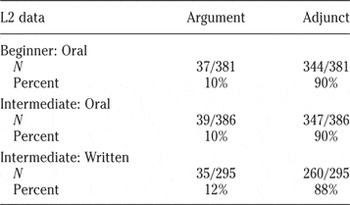
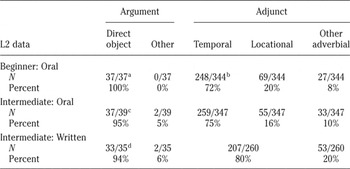
The non-subject-initial clauses of the learners can be broken down further by constituent type. This is done in Tables 4 and 5 for the L2 beginners (oral), the intermediate learners (oral), and the age-matched intermediate learners (written). Their figures are strikingly similar.Footnote 15 Fronted arguments (objects) are rare (10–12%) and largely take the form of object pronominal das “it/that.” Adjuncts in the prefield are frequent (88–90%), but mostly temporal, especially in the oral narrative data (72–75%, with a preponderance of dann “then”). Locational adverbials also occur (16–20%), whereas other adverbials (e.g., modal, speaker attitude, and connective adverbs) are less frequent, especially in the oral data.
Constituents in the prefield of non-subject-initial declaratives: Arguments and adjuncts by participant group and task

Note. The beginner data are combined from six adults performing a narrative task after 4 and 9 months; the oral intermediate data are from twenty-three 16-year-olds performing a narrative task after 3 years; the written data are letters from fifty-five 17-year-olds after 3 years.
Constituents in the prefield of non-subject-initial declaratives: Detailed analysis of arguments and adjuncts by group and task

Note. The beginner data are combined from six adults performing a narrative task after 4 and 9 months; the oral intermediate data are from twenty-three 16-year-olds performing a narrative task after 3 years; the written data are letters from fifty-five 17-year-olds after 3 years.
a All are instances of das.
b Includes 146 instances of dann.
c Includes 22 instances of das.
d Includes 16 instances of das.
Qualitative Analysis of Learner Prefields and Discussion
A Rating and Rewriting Experiment
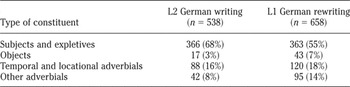
Results from a rating and rewriting experiment (Rosén, Reference Rosén2006) bolster the quantitative differences we found concerning constituents in the prefield. Three groups of adult native speakers of German (58 university students, language teachers, and others, including mainly dentists and other professionals) rated the written L2 data (see Rosén for details). Moreover, 20 of them, the 20–25-year-old university students, were asked to rewrite 20 advanced L2 texts produced by learners their own age, to make them sound more German. They unpromptedly made changes in the prefield (Table 6).Footnote 16 Rewritings resulted in a reduction of clause-initial subjects and expletives from 68% to 55%, a doubling of the figures for objects (from 3% to 7%), and a strong increase in adverbials other than temporal and locational (from 8% to 14%). Thus, the distribution of constituent types in the rewritten texts became very similar to the distribution independently found in the L1 German control corpus (Table 2). This strongly suggests that the differences between the groups cannot be dismissed as stylistic variation in the sense of idiosyncratic preferences of individuals but that they are in fact consistent, language-specific differences.
Constituents in the prefield, L2 German versus L1 German rewritings

Subjects
In contrast to the native Germans, the L2 learners rarely start their V2 clauses with a rhematic element; rather they begin with an element of no or low informational value. Particularly striking is their propensity to produce expletive-subject-initial clauses as illustrated in (21)–(23). These are dispreferred in native German but correspond to the expletive-initial constructions typical of Swedish.Footnote 17
(21)
(22)
(23)


This pattern of overusing clause-initial subjects and expletives was also confirmed when native speakers rewrote or commented on the L2 texts, pointing out zu viel esam Satzanfang “too many es in clause-initial position,” eswirkt sehr undeutsch “very un-German es constructions,” zu viel es gibt “too many it is/it exists,” and zu oft Subjekte am Satzanfang “too many clause-initial subjects.”
Native speakers prefer to use alternative ways of connecting sentences, for instance by fronting an adverbial, as shown in (24b)–(26b), which are the rewritten versions of the L2 sentences in (24a)–(26a), or by adding a connective adverbial. Apart from providing paraphrases that sound more German, the native raters suggested es könnte gut mal auch ein Verb oder ein Objekt nach vorn gestellt werden “why not front a verb or an object for a change” and advised using connectives eines Gebrauchs von z.B. außerdem, jedenfalls “why not use e.g. außerdem ‘moreover,’ jedenfalls ‘anyway/in any case.’”
(24)
(25)
(26)


So and Så
The Swedish tendency of starting sentences with an element of low informational value not only appears via the many subject-initial and expletive-initial declaratives in the L2 data but also in unidiomatic so-initial V2 clauses, like (27) and (28). These are presumably due to transfer from L1 Swedish: Recall that the cognate of German so, Swedish unstressed så “and (so),” allows rhematic information to be placed after the verb. German native raters commented on this point, for instance Ungewöhnliche Satzbindungen mit sokommen vor “unusual ways of linking sentences with so are found,” merkwürdige[r] Gebrauch von so, “strange use of so,” sehr undeutsch “very un-German.”
(27)
(28)


Objects
The L2 learners rarely produce an object in the prefield, but when they do, they predominantly front pronominal das “it/that” (80%), and this das “it/that” is always thematic, as illustrated in (29)–(31). Recall that the Swedish equivalent of das (det “it/that”), is the most common object to be fronted in native Swedish, where its anaphoric nature may serve to enhance textual cohesion.
(29)
(30)
(31)


The native German raters of the L2 texts reacted to the learners' disproportionate fronting of das “it/that” and stated, for instance, zu viele Sätze fangen mit dasan “too many sentences start with das,” übertriebener Gebrauch von Das/ Es-Sätzen “exaggerated use of Das-/Es-clauses.” Fronted object das “it/that” as produced by the L2 learners is not ungrammatical in native German, but it is less common in the control corpora. It is noteworthy that the learners rarely front other objects, be it pronouns or lexical noun phrases. Moreover, they do not use pronominal adverbs in the prefield.
Pronominal Adverbs
Pronominal adverbs serve to maintain a referent in spatial, temporal, and other terms. The native German controls front pronominal adverbs in their writing; consider the example in (32), in which preverbal dazu links up with schöne Ecken “nice spots” in the preceding clause.
(32)

Pronominal adverbs in the prefield are not very frequent in the German control data (20 instances; i.e., 4% [20/514] of all non-subject-initial clauses) but are certainly much more common than in the learner data. None of the L2 learners use pronominal adverbs in their writing at the beginner level, and only a few L2 learners do so at the intermediate level, and then rarely (1%, 4/291). Even at the advanced level, pronominal adverbs in the prefield remain rare (1%, 3/403). Pronominal adverbs in the prefield are also exceedingly rare in the oral L2 data. The six beginners do not use them at all, and the 23 intermediate learners only produce one clause-initial pronominal adverb (0.3%) and a total of four pronominal adverbs in the entire corpus of 12,500 words. Therefore, the differences between the native controls and the L2 learners are presumably due not only to L1 influence on information structure but also to a vocabulary deficit: Learners can only place a pronominal adverb in the prefield if they have in fact learned the relevant lexical item. Because the beginning learners and most of the intermediate learners are not using pronominal adverbs in other, postverbal, positions, it may be surmised that they have not yet added these items to their lexicons, although a larger database would be needed for each individual learner to verify this claim.Footnote 18 For those advanced L2 learners who use pronominal adverbs but rarely do so in the clause-initial position, we believe that the overall principle of information organization that warrants their use is not yet fully established.Footnote 19
Other Adverbials
The L2 learners in this study also underuse other adverbials, such as speaker-attitude adverbials and connectives, in the prefield, as demonstrated by the fact that when advanced L2 texts were rewritten by native Germans, the number of other adverbials increased from 8% to 14% (Table 6). The German native speakers sometimes moved a connective adverbial from the postverbal position to the prefield as in (33b), the rewritten version of (33a), or, more commonly, added a logical connective, as in (34b).Footnote 20
(33)
(34)


Native raters also repeatedly characterized the L2 texts as un-German, criticizing a lack of adverbials in the clause-initial position: Adverbiale am Satzanfang fehlen “clauses should more often begin with an adverbial,” es gibt zu wenig kommentierende Wörter wie leider, zum Glücketc. am Satzanfang “there are not enough commentary words like leider ‘unfortunately,’ zum Glück ‘fortunately,’ etc. in clause-initial position,” Es gibt keine Verbindungen zwischen den Sätzen oder den Absätzen “there are no links between sentences or paragraphs,” Der Gebrauch von Dadurch, Deshalbetc. würde den Text flüssiger machen “using dadurch, deshalb etc. would improve textual coherence.” Our impression of the L2 texts is that cohesion-building adverbials are not only rare in the prefield but also relatively rare in other clausal positions (although we have not quantified them there). Therefore, a lack of coherence is presumably attributable not only to L1 influence in the domain of information structure but also to lexical deficits for both connective adverbials and pronominal adverbs.
CONCLUSIONS
In this article, we have pointed to some diverging tendencies in the way the prefield in V2 declaratives is employed for structuring information and organizing text in Swedish and German, and we have investigated how Swedish-speaking learners of German make use of the prefield. On the basis of corpus data, we have suggested that Swedish has a stronger tendency than German to fill the prefield with a (thematic) subject or a phonologically light all-purpose element of low informational value (the expletive subject det “it,” the thematic pronominal object det “it/that,” the adverbial så “and [then/so],” etc.) to establish texual coherence. German also allows these options but often places rhematic subjects—as well as phonologically heavier object and adverbial constituents, including morphologically complex thematic pronominal adverbs and a range of connective and sentence adverbials—in the prefield. We have tried to link these prefield constituent patterns to a principle of information structure that we called rheme later, where informationally new material is kept out of the clause-initial position and is placed further to the right (i.e., postverbally) instead. We have claimed that this principle is stronger in Swedish than it is in German. Crosslinguistic research has shown that languages may choose to implement quite different information-structural principles. Swedish and German, which are typologically close, implement information-structural principles that are not diametrically opposed but only slightly different from each other: Rheme later, as we have argued, is stronger in Swedish than in German, and L2 learners must learn to relax this information-structural principle.
In the L2 German data, V2 syntax is largely targetlike, but the word-order frequency and information-structural patterns in learners' V2 clauses resemble those of Swedish and not those of native German. L2 learners may master pure syntax long before they are able to put that syntax to appropriate use. The learners tend to fill the prefield with elements that are different in form and function than those used by the native controls: The L2 learners overuse subject-initial and expletive-es-initial clauses and the fronted thematic object das “it/that” as well as constructions with så/so “so”—structures typical of and frequent in their L1 Swedish. They underuse constructions typically used to introduce sentences in German: objects other than pronominal das “it/that,” specific pronominal adverbs, and a range of connective adverbials.
The results indicate that the learners, both at lower and higher proficiency levels, have problems with the acquisition of the German-specific linguistic means that have an impact on information structuring. Some of these problems may be due to vocabulary deficits, but most of them can be traced back to the language-specific tendencies of structuring information in Swedish: the learners' L1. We thus propose that L1 transfer is found not only in the domain of syntax but also in the domain of information structure and information organization and that such L1 influence persists even at high L2 proficiency levels. L1 constraints on information structure are not relaxed, even though they are too restrictive for the L2, resulting in texts that are unidiomatic and not fully cohesive from the perspective of a native speaker.