1 Introduction
In the current society, information plays a crucial role that brings competitive advantages to users, when it is managed correctly. However, due to the vast amount of available information, users cannot cope with it, and therefore new methods and approaches based on Natural Language Processing (NLP) are essential to process all the information in an effective and efficient manner. Applications such as Information Retrieval (IR), Question Answering (QA), or Text Summarisation (TS) can help users to access the information more easily, on the one hand, reducing the time they have to spend dealing with the information, and on the other, selecting the information most useful for them. However, issues such as the nature of the different sources, together with the fact that the same information can be repeated across different documents (redundancy), are great challenges for the above-mentioned applications. In particular, the aim of TS is to process, synthesise, and present the information to users, avoiding the arduous task of having to read everything, as well as facilitating the process of guiding the user to what is important in texts.
This paper is focused on TS, and its main goal is to present a TS tool, compendium, which is able to produce different types of summaries from different domains and textual genres. For specifying the types of summaries, we follow the taxonomy suggested in Spärck Jones (Reference Spärck Jones, Mani and Maybury2009). In this way, concerning the input, compendium can either take one or several texts, and produce single- or multi-document summaries. Regarding the purpose of the resulting summaries, these can be generic, query-focused, or sentiment-based, and their aim is to provide information about the source document(s), thus being informative. As output, the final summaries can be extracts or abstractive-oriented summaries (i.e. a combination of extractive and abstractive information). Finally, it is important to mention that compendium is a mono-lingual TS tool, working only for one language, i.e. English.
As far as the architecture of compendium is concerned, an architecture based on specific stages is proposed. In particular, compendium relies on five core stages that constitute the backbone of the TS process (surface linguistic analysis; redundancy detection; topic identification; relevance detection; and summary generation) together with a series of additional stages that can be integrated into the core ones, thus enhancing the capabilities of compendium, generating also query-focused, sentiment-based, or abstractive-oriented summaries. Specifically, the additional stages are query similarity; subjective information detection; and information compression and fusion. With respect to its architecture, the main contributions of compendium are (i) the use of textual entailment for avoiding redundant information in the summaries; (ii) the combination of statistical and cognitive-based techniques for detecting relevant information; and (iii) the generation of abstractive-oriented summaries.
In order to assess that compendium is appropriate for a wide range of domains and textual genres, we conduct an intrinsic evaluation using different types of documents. The results obtained show that compendium performs very well, and therefore it is a suitable TS tool for generating summaries of multiple purposes, domains, and textual genres.
The structure of the paper is as follows. Section 2 puts in context the summarisation task by explaining the types of existing summaries (Section 2.1), as well as the common approaches and techniques for TS (Section 2.2). Also, it remarks the novelties of our TS tool with respect to the existing ones. Section 3 describes our proposed TS tool: compendium. In this section, we first provide an overview of its main characteristics and architecture (Section 3.1), and then we focus on the stages it comprises (Sections 3.2 and 3.3, for the core and additional stages, respectively).
The evaluation of compendium is provided in Section 4. Section 4.1 contains the description of the different corpora used, whereas Section 4.2 shows the experiments and the results obtained in a wide range of domains and types of texts, comprising newswire, image captions, blogs, and medical research papers. Finally, the main conclusions together with future research lines are explained in Section 5.
2 Related work
Although it started in the late 1950s, TS has experienced a great development in recent years, and a wide range of techniques and systems have been proposed in this research field (Lloret and Palomar Reference Lloret and Palomar2011b). However, to produce a summary automatically is very challenging. Issues such as redundancy, temporal dimension, coreference, or sentence ordering, to name a few, have to be taken into consideration, especially when summarising a set of documents (multi-document summarisation), thus making this field even more difficult (Chali and Hasan n.d.). Moreover, research attempting to overcome the lack of coherence that summaries often present has been fuelled in the last years, resulting in combined approaches that identify relevant content and merge it into new fragments of information (Barzilay and McKeown Reference Barzilay and McKeown2005; Zajic, Dorr and Lin Reference Zajic, Dorr and Lin2008). In order to adapt to new society requirements, the types of summaries have increased in recent years. For instance, the Web 2.0 (social web) has led to the emergence of new types of websites, such as blogs, forums, or social networks, where anybody can express his/her opinions towards a topic, entity, product, or service. This has resulted in a new type of summaries with the purpose of summarising users' opinions (sentiment-based summaries). Therefore, when carrying out research into this area, it is essential to be aware of previous TS approaches and systems so that new or improved methods can be suggested in order to tackle the different types of summaries and their requirements.
In this section, we provide a general overview of the TS task. In this manner, we first explain the most important types of summaries (Section 2.1); and then we focus on the process of TS from a computational point of view, explaining the most common approaches for TS, as well as outlining the differences with respect to our proposed tool (Section 2.2).
2.1 Common factors for classifying summaries
A wide range of summaries can be generated depending on different factors, such as the type of input/output, the purpose of the summary, or the type of reader, which makes the TS especially challenging in NLP. In the literature, three main taxonomies can be found (Hovy and Lin Reference Hovy and Lin1999; Mani and Maybury Reference Mani and Maybury1999; Sparck Jones Reference Spärck Jones, Mani and Maybury1999) that group summaries from different perspectives.
Taking as a basis the aforementioned taxonomies and the TS approaches, we can depict the most common summary types in Figure 1.
Summarisation types according to the most common factors.

As it can be seen in the figure, although it has traditionally focused on text (Yu et al. Reference Yu, Reiter, Hunter and Mellish2007), the input to the summarisation process can also be multimedia information, such as images (Fan et al. Reference Fan, Gao, Luo, Keim and Li2008); video (Dumont and Mérialdo Reference Dumont and Mérialdo2009), or audio (Liu and Liu Reference Liu and Liu2009), as well as on-line information or hypertexts (Steinberger, Jezek and Sloup Reference Steinberger, Jezek and Sloup2008; Tigelaar, Op Den Akker and Hiemstra Reference Tigelaar, Op Den Akker and Hiemstra2010). Furthermore, we can talk about summarising only one document (single-document summarisation) (Svore, Vanderwende and Burges Reference Svore, Vanderwende and Burges2007) or multiple ones (multi-document summarisation) (Haghighi and Vanderwende Reference Haghighi and Vanderwende2009). Regarding the output, a summary may be an extract (i.e. when a selection of “significant” sentences of a document is shown) (Zhang and Fung Reference Zhang and Fung2009); abstract, when new vocabulary is added (Ou, Khoo and Goh Reference Ou, Khoo and Goh2007), or even a headline (or title) (Sarkar and Bandyopadhyay Reference Sarkar and Bandyopadhyay2005; Hennig Reference Hennig2009). It is also possible to distinguish between generic summaries and query-focused summaries (also known as user-focused or topic-focused). Examples of approaches that generate these types of summaries can be found in Schilder and Kondadadi (Reference Schilder and Kondadadi2008) or Zhao, Wu and Huang (Reference Zhao, Wu and Huang2009). The first type of summaries can serve as a surrogate of the original text, as these may try to represent all relevant facts of the source text. In the latter, the content of a summary is biased towards a user need, query, or topic. Concerning the style of the output, a broad distinction is normally made between two types of summaries. Indicative summaries are used to indicate what topics are addressed in the source text. As a result, these can give a brief idea of what the original text is about. The other type, informative summaries, are intended to cover the topics in the source text and provide more detailed information. It is also possible to combine both types, as in the approach suggested in Saggion and Lapalme (Reference Saggion and Lapalme2002). In recent years, new types of summaries have appeared. For instance, the birth of the Web 2.0 has encouraged the emergence of new types of textual genres, containing a high degree of subjectivity, thus allowing the generation of sentiment-based summaries. A lot of approaches have been proposed for tackling these types of summaries (Balahur et al. Reference Balahur, Lloret, Boldrini, Montoyo, Palomar and Martinez-Barco2009; Bossard, Généreux and Poibeau Reference Bossard, Généreux and Poibeau2009; Lerman, Blair-Goldensohn and McDonald Reference Lerman, Blair-Goldensohn and McDonald2009). Furthermore, update summaries are other examples of new summary types. These assume that users already have a background and they only need the most recent information about a specific topic (Nastase, Filippova and Ponzetto Reference Nastase, Filippova and Ponzetto2008). Finally, concerning the language of the summary, it can be distinguished between mono-lingual, multi-lingual, and cross-lingual summaries, depending on the number of languages dealt with. The cases where the input and the output languages are the same lead to mono-lingual summaries, as in El-haj and Hammo (Reference El-haj and Hammo2008). However, if different languages are involved, the summarisation approach is considered multi-lingual or cross-lingual (Kabadjov et al. Reference Kabadjov, Atkinson, Steinberger, Steinberger and Van Der Goot2010; Lehmam Reference Lehmam2010; Litvak, Last and Friedman Reference Litvak, Last and Friedman2010).
2.2 The process of summarisation from a computational perspective
The types of summaries mentioned previously have to be created following a summarisation process, thus allowing to transform the source document or documents into a summary. According to the summarization chapter in (Mitkov, Reference Mitkov2003), the following three stages have to be taken into account for producing a summary from a computational point of view:
• Topic identification. It consists of determining the subject of the document. It is usually approached by assigning each unit (words, sentences, phrases, etc.) a score which is indicative of its importance. In the end, the top score units, up to a desired, length are extracted.
• Interpretation or topic fusion. During this stage, the topics identified as important are fused, represented in new terms, and expressed using a new formulation, which includes concepts or words not found in the original text. This stage is what distinguishes extractive from abstractive summarisation, because in the former, the interpretation stage is almost inexistent in most of the approaches, as they only select and extract important sentences for building the final summary. In contrast, for abstractive approaches, this stage is crucial, since the relevant information is generalised and merged.
• Summary generation. In this stage, the final summary is built. When dealing with abstractive summarisation, natural language generation techniques are generally included as part of this process. In the case of extractive summarisation, in this stage, it is important to pay attention to the ordering of sentences in the summary, and the coherence between them.
However, most of the systems focus on extractive summarisation, and as a consequence they only take into account the first stage of the process.
Next, we are going to explain the most common techniques that are employed for generating summaries, distinguishing between statistical-based, topic-based, graph-based, discourse-based, and machine-learning-based approaches. Within each of these groups, existing TS systems are going to be described as well.
• Statistical-based approaches.
These approaches determine the relevance of a sentence based on statistical methods, such as term frequency (TF), or tf*idf. Whereas term frequency is solely based on how many times a word appears in a document, the idea behind tf*idf is that frequent terms in a document are important only if they are not very frequent in the whole collection.
In McCargar (Reference McCargar2005), several statistical approaches were analysed, as well as the potential problems that these types of features may have. It was claimed in Filatova and Hatzivassiloglou (Reference Filatova, Hatzivassiloglou, Moens and Szpakowicz2004) that these methods might not be sufficient for building high-quality summaries; however, a deeper review of statistical techniques conducted in Orăsan, Pekar and Hasler (Reference Orăsan, Pekar and Hasler2004) and Orăsan (Reference Orăsan2009) showed that these techniques are appropriate for building good summaries. In addition to term frequency and tf*idf, mutual information, information gain, and residual inverse document frequency were also analysed. Mutual information is used to measure the dependency or the common information between two words, whereas information gain is a good metric for deciding the relevance of an attribute, and in this case, it could be perfectly applied to the terms or sentences in a document. Residual inverse document frequency is a variant of the inverse document frequency, which computes the term frequency according to a probabilistic distribution. The approach suggested in Mori (Reference Mori2002) also employs information gain for determining the weight of document terms, and then use it for summarising documents successfully. The idea is to first build clusters of documents according to the similarity among them, and then compute the weight of each word in the clusters. The final summary is produced by selecting the highest scored sentences on the basis of the weight of their words, previously computed using information gain.
• Topic-based approaches.
These approaches rely on the identification of key words (topics) for establishing the relevance of the sentence. This is the case of the topic signatures suggested in Lin and Hovy (Reference Lin and Hovy2000), where it is assumed that the topic of a document can be represented using a set of terms. Following this idea, in Harabagiu and Lacatusu (Reference Harabagiu and Lacatusu2005), it was analysed how the structure of a document is characterised in terms of topics' themes, which are representations of events that are reiterated throughout the document collection, and therefore represent repetitive information. Furthermore, in Teng et al. (Reference Teng, Liu, Ren, Tsuchiya and Ren2008), a single-document summarisation approach is suggested, which combines local topic identification with term frequency. The proposed methodology first computes the sentence similarity, and then performs the topic identification by doing sentence clustering. In a second step, sentences from local topics are selected according to the term frequency value. Moreover, not only topic words are used to detect relevant information within a document, in the approach suggested in Kuo and Chen (Reference Kuo and Chen2008), informativeness and event words are also taken into consideration for producing multi-document summaries. The underlying idea is that these types of words indicate important concepts and relationships, and can be used to detect relevant sentences within a set of documents.
As it can be seen, each technique establishes a manner of assigning weights to the words included in the document, and then sentences are scored based on these weights in order to determine their relevance.
• Graph-based approaches.
The use of graph-based ranking algorithms has also been shown to be effective in TS. Basically, the nodes of the graph represent text elements (i.e. normally words or sentences), whereas edges are links between those text elements, previously defined (for instance, semantic relations, such as synonymy). On the basis of the text representation as a graph, the idea is that the topology of the graph will reveal interesting things about the salient elements of the text, for example concerning the connectivity of different elements. LexRank (Erkan and Radev Reference Erkan and Radev2004) is an algorithm used in the MEAD system (Radev et al. Reference Radev, Allison, Blair-Goldensohn, Blitzer, Celebi, Drabek, Lam, Liu, Otterbacher, Qi, Saggion, Teufel, Topper, Winkel and Zhang2004), in which all candidate sentences that can be potentially included in the summary are represented in a graph. In this graph representation, two sentences are connected if the similarity between them is above a predefined threshold. Then, once the network is built, the system finds the most central sentences by performing a random walk on the graph. In Mihalcea (Reference Mihalcea2004), an analysis of several graph-based algorithms is carried out, evaluating also their application to automatic sentence extraction in the context of TS.
The SummGraph system (Plaza Reference Plaza2011) uses concepts identified with Wordnet (Fellbaum Reference Fellbaum1998) and is-a relationships for building a graph representation of each sentence in a document. This method has been proved to work successfully in the newswire, biomedical, and tourist domain.
• Discourse-based approaches.
The Rhetorical Structure Theory (RST), proposed in Mann and Thompson (Reference Mann and Thompson1988), served as a basis for the summarisation approach developed in Marcu (Reference Marcu, Mani and Maybury1999). In this approach, the rhetorical relations are extended, and this kind of discourse representation (nucleus and satellite relations, depending on how relevant the information is) is used to determine the most important textual units in a document. In Khan, Khan and Mahmood (Reference Khan, Khan and Mahmood2005) the RST is combined with a generic summariser in order to add linguistic knowledge to the summarisation process. Although the results obtained for this mixed approach did not improve the ones obtained by the generic summariser, it was claimed that the drawback of this approach was mainly due to parser, which could not detect all the RST relationships, otherwise linguistic knowledge could have improved the overall summarisation performance. Furthermore, in Cristea, Postolache and Pistol (Reference Cristea, Postolache and Pistol2005) an approach similar to the RST is described, differing from the previous ones in the lack of relation names and the use of binary trees. This summarisation approach is intended to exploit the coherence and cohesion of a document.
Cohesion and coherence are two of the main challenging issues for TS. Some approaches rely on the identification of such relations in order to improve the quality of the generated summaries. In Gonçalves, Rino and Vieira (Reference Gonçalves, Rino and Vieira2008), coreference chains are used to deal with referential cohesion problems that are frequent in the extractive summarisation approach. A post-processing system is developed in order to rewrite referential expressions in the most possible coherent way, and it is applied after the summary is generated, obtaining considerable improvements in comparison with the original summaries. In order to guarantee the coherence of a summary, a widespread approach is to use lexical or coreference chains. However, the use of coreference chains is not novel in TS. The first approaches can be found in Baldwin and Morton (Reference Baldwin and Morton1998) and Azzam, Humphreys and Gaizauskas (Reference Azzam, Humphreys and Gaizauskas1999). The main assumption is that the longest coreference chain indicates the main topic of the document, and shorter chains represent subtopics. Therefore, one possible strategy for building summaries is to select only those sentences which related to the longest chain. This strategy helps to maintain the coherence of the text. A similar idea is to use lexical chains, which consist in determining sequences of semantic related words (e.g. by concept repetition or synonymy relations). By using lexical chains, the main topics of a document can also be detected. This technique has been widely used in summarisation, and the approaches like the ones described in Barzilay and Elhadad (Reference Barzilay, Elhadad, Mani and Maybury1999), (Medelyan Reference Medelyan2007), or Ercan and Cicekli (Reference Ercan and Cicekli2008) exploit them to produce summaries.
• Machine-learning-based approaches.
The high amount of techniques that can be used in TS led to the necessity of combining all of them in an optimal manner in order to come up with the sentence relevance. In regard to this, a wide range of machine-learning techniques can be used for TS. For instance, NetSum (Svore et al. Reference Svore, Vanderwende and Burges2007) bets on single-document summarisation and produces extracts from newswire documents based on neuronal nets, using RankNet (Burges et al. Reference Burges, Shaked, Renshaw, Lazier, Deeds, Hamilton and Hullender2005) as a learning algorithm to score the sentences and extract the most important ones. Besides the common features based on keywords and sentence position, a new set of features based on WikipediaFootnote 1 and query logs are also used in a way that, for example, sentences containing query terms or Wikipedia entities are indicative of important content. In Schilder and Kondadadi (Reference Schilder and Kondadadi2008), a query-focused multi-document summariser is presented, named as FastSum, where sentences are ranked using a machine-learning technique called Support Vector Regression (SVR), and Least Angle Regression for feature selection. SVR was used in summarisation before, in the approach described in Li et al. (Reference Li, Ouyang, Wang and Sun2007), where word-, phrase-, or semantic-based features, as well as sentence position or name entities were used to train the classifier automatically. Further on, the extracted features were combined, and then sentences were scored. In Wong, Wu and Li (Reference Wong, Wu and Li2008), an extractive summarisation approach is presented, employing supervised and semi-supervised learning methods. The features involved are grouped into different types – surface, content, relevance, and event features – which include sentence position, number of words in a sentence, centroid and high frequent terms, or similarity between sentences, among others. Regarding the supervised approach, a Support Vector Machine (SVM) algorithm is used, whereas for the semi-supervised approach, a probabilistic SVM and a Naïve Bayesian classifier are co-trained to exploit unlabelled data. SVM technique was also used in Fuentes, Alfonseca and Rodríguez (Reference Fuentes, Alfonseca and Rodríguez2007) to detect relevant information to be included in a query-focused summary, where structural, cohesion-based, and query-dependent features were used for training.
compendium, our proposed TS tool, is not based on machine-learning techniques. It partially relies on statistical techniques, and it differs from the already existing TS sytems in three aspects, mainly as follows: (i) It specifically address the redundancy problem analysing a novel method for such purpose (i.e. textual entailment); (ii) sentence relevance is determined taking into account cognitive-based techniques in addition to statistical ones; (iii) it faces the challenge of abstractive summarisation by proposing an hybrid approach that produces abstractive-oriented summaries combining extractive and abstractive techniques.
In the next section, the architecture of compendium is explained.
3 Architecture of COMPENDIUM
In this section, compendium TS tool is described in detail. The aim of compendium is to produce different types of summaries automatically. Therefore, in Section 3.1 we first explain the main characteristics of the summaries generated, as well as an overview of its proposed architecture. Then we go into detail and explain its stages, distinguishing between a set of core ones that are the most important in compendium (Section 3.2), and the additional stages (Section 3.3), which are used to generate summaries for multiple purposes (query-focused, sentiment-based, and abstractive-oriented summaries).
3.1 COMPENDIUM's overview
Taking the schema depicted in Figure 1 as a basis, the summaries generated with compendium according to the proposed factors (media, input, output, purpose, and language) can be characterised. Next, each of these factors are explained in the context of compendium.
• Media. Concerning this factor, at the moment, compendium deals only with text documents.
• Input. Regarding this factor, compendium takes one or several texts, thus being able to produce single- and multi-document summaries.
• Output. The types of summaries generated can be either extracts (i.e. the most important sentences are selected) or abstractive-oriented summaries (in our case, information is compressed and fused to generate new sentences different from the original ones, and then these sentences are combined with the previously extracted ones).
• Purpose. The summaries generated with compendium aim at being substitutes for the original documents. Therefore, they must contain the most relevant facts, thus being informative. In addition, specific purposes according to user's interests are taken into account. This leads to generic, query-focused, and sentiment-based summaries. Generic summaries provide a general overview of the document; query-focused summaries are biased towards a user need, question, or topic; and finally, sentiment-based summaries contain a high degree of subjective information, reflecting the opinions of users about a topic.
• Language. compendium is a mono-lingual TS tool, which work with English, both for the input and the output.
In addition to all these factors, it is worth stressing upon the fact that the summaries generated by compendium are not of a fixed length. In contrast, their length can be configured depending on the interest of the user (either in a compression ratio or in number of words), thus being a factor that could be included within the output or purpose characteristics of the TS tool.
Concerning the stages of compendium, five core stages that constitute the backbone of the TS process are distinguished. These stages are as follows:
• Surface linguistic analysis, which pre-processes the input text.
• Redundancy detection, which identifies and removes repeated information.
• Topic identification, which determines the main topics of the document/s to be summarised.
• Relevance detection, which identifies the most relevant sentences of the document/s.
• Summary generation, which extracts the most relevant sentences, and presents them maintaining the same order as in the source document.
It is worth noting that the order of the proposed stages is not arbitrary. We rely on Van Dijk's theory (Van Dijk Reference Van Dijk1980) concerning the macrostructure of a text. The macrostructure represents the global meaning of discourse, and it is the result of the reading and comprehension process performed by humans. Therefore, this is related to the summarisation process, in the sense that a summary is the explicit representation of the macrostructure of a text (i.e. its overall meaning) (Álvarez Angulo Reference Álvarez Angulo2002). Moreover, the macrostructure of a text can be obtained through the application of a set of macrorules, which can have both a reductive nature (to remove unnecessary information), and a constructive nature (allowing certain elements to be combined in new and more complex units of information). Specifically, the macrorules are deletion, strong deletion, generalisation, and construction. The former for deleting redundant information and trivial details, and the latter for generating new information. As it can be seen, the proposed stages in compendium are directly related to these macrorules.
Furthermore, we suggest three additional stages in order to increase the capabilities of compendium, allowing it to generate query-focused, sentiment-based, or abstractive-oriented summaries. Specific stages for achieving each of these types of summaries are as follows:
• Query similarity, needed for generating query-focused summaries.
• Subjective information detection, necessary for identifying subjective information and producing sentiment-based summaries.
• Information compression and fusion, crucial for generating new information that will appear in the summary, thus resulting in an abstractive-oriented summary, rather than an extract.
Figure 2 depicts the general architecture of compendium.Footnote 2 In this figure, the core stages are represented within a big rectangle with rounded borders, whereas dotted rectangles correspond to the additional stages. By applying only the core stages, the resulting summaries are single- or multi-document generic informative extracts. In contrast, by taking into consideration the additional stages, query-focused or sentiment-based extracts, as well as abstractive-oriented summaries from a single or several documents can be generated. The remaining of this section focuses on the explanation of the core and additional stages.
Overview of compendium's architecture.
3.2 Core stages
As aforementioned, the core stages are (a) surface linguistic analysis; (b) redundancy detection; (c) topic identification; (d) relevance detection; and (e) summary generation. Next, we explain each of the stages in detail.
3.2.1 Surface linguistic analysis
This stage aims at carrying out a basic linguistic analysis on the input document, thus preparing it for further processing. In order to carry out this analysis, external state-of-the-art tools and resources are used. In particular, for this stage we propose the following:
• Sentence segmentation. The text is split into sentences, which are the textual units considered for generating the summary. For this purpose, the sentence segmentation tool provided at DUC evaluation campaignsFootnote 3 is used.
• Tokenisation. A tokeniser allows us to identify each word in the document, since we will need to compute, for instance, the frequency of each word, or distinguish between stop words and non-stop words in later stages. In order to be able to identify each word of the text, a tokeniser is used. In particular, we employ Word Splitter.Footnote 4
• Part-of-speech tagging. A part-of-speech tagger assigns each word with its corresponding morphological category (noun, verb, adjective, preposition, adverb, determiner, pronoun, and conjunction). This process is useful for distinguishing different types of words, since some of them (e.g. nouns or verbs) can be more important than others (e.g. determiners). This tool will be used in the additional stages of information compression and fusion. In particular, TreeTaggerFootnote 5 was used as a part-of-speech tagger, because it is very easy to use, and it can be used for different languages, not only for English.
• Stemming. This process consists in reducing words to their stem form. It is very useful in the cases where there is no need to differentiate between two inflected words that belong to the same family (e.g. running and runs, both come from the verb run). The Porter Stemmer Footnote 6 is employed for performing this task, which will be necessary for considering all terms sharing a common stem as a single one, for later computing their frequency.
• Stop word identification. Stop words are words that appear very frequently in documents, but they do not carry any semantic information. They are normally not used for further processing, because they are not relevant (e.g. articles: the, a; conjunctions: and, or, etc.). In our case, this process is essential, and consequently we tag them in order not to take them into consideration when performing the remaining stages of the TS process. For instance, when computing the frequency of a word for determining the topic of a document (please see the topic identification stage), words such as “and”, “is”, or “the” could be wrongly identified as document's topics if they are not identified as stop words and treated as normal terms. For carrying out this task, a list of stop words is needed. In particular, we use an English stop word list.Footnote 7
We would like to note that this version of compendium does not include any coreference resolution module within the Surface Linguistic Analysis stage. Although we think it is an essential part of the process and should be incorporated in the short-term future. However, this is not a trivial task. State-of-the-art results in coreference resolution, and more concretely, in anaphora resolution, are around 65% on average (Delmonte et al. Reference Delmonte, Bristot, Boniforti and Tonelli2006). Therefore, before including a step focusing on the coreference, we would like to analyse in depth, which anaphora or coreference resolution system would be the most appropriate to be used for our purposes.
3.2.2 Redundancy detection
The aim of this stage is to identify redundant information in the source documents in order not to include it in the summary. For this purpose, we propose Textual Entailment (TE) as a technique to detect redundancy. On the one hand, attempts to study the influence of TE on TS have been focused for the evaluation of summaries (Harabagiu, Hickl and Lacatusu Reference Harabagiu, Hickl and Lacatusu2007) to determine which candidate summary, among a set of these, better represents the content in the original document depending on whether the summary entails it or not. On the other hand, TE has been combined with TS to generate a summary directly from the entailment relations found in a text (Tatar et al. Reference Tatar, Tamaianu-Morita, Mihis and Lupsa2008), or by extracting the highest scored sentences of a document, where the score of each sentence is computed as the number of sentences of the text that are entailed by it. However, in none of the already existing approaches, TE has been employed for identifying and removing repeated information, thus being novel in this sense.
Textual entailment is a suitable technique for detecting redundant information because its aim is to determine whether the meaning of a text snippet, also known as hypothesis (H), can be inferred from another one, called the text (T) (Glickman Reference Glickman2006). In order to illustrate this objective, we provide the following examples, taken from the RTE corpora.Footnote 8 As it can be seen, the first example shows a true entailment relation, whereas the second example shows a false entailment.
Pair id = 50 (entailment = true)
T: Edison decided to call “his” invention the Kinetoscope, combining the Greek root words “kineto”(movement), and “scopos” (“to view”).
H: Edison invented the Kinetoscope.
Pair id = 18 (entailment = false)
T: Gastrointestinal bleeding can happen as an adverse effect of non-steroidal anti-inflammatory drugs such as aspirin or ibuprofen.
H: Aspirin prevents gastrointestinal bleeding.
Taking the rationale behind TE, the manner in which it is employed for detecting redundancy within our summarisation process is next explained. We can compute the entailment relationship between two sentences, discarding the second one, if they both contain a true entailment. This means that the meaning of the second sentence is already embedded in the first one, thus stating the information only once. Therefore, if we repeat the process with all the sentences in a document, those sentences whose meaning is already contained in other sentences can be discarded, as the information has been previously mentioned. As a result, by applying TE we can obtain a set of sentences from the text that do not hold an entailment relation with any other, and then keep this set of sentences for further processing.
It is worth stressing upon the fact that the order in which the entailment relationships are computed is the same order that the sentences have in the original documents. In this manner, we ensure that the coherence of the resulting summary is not highly affected after this stage. Moreover, we only perform TE in one direction to avoid a very high computational cost.
Specifically in our research work, we used the TE approach presented in Ferrandez (Reference Ferrández2009) for computing the entailment relations within a document. This TE system relies on lexical (cosine similarity, Leveshtein distance), syntactic (dependency trees), and semantic measures based on WordNet (Fellbaum Reference Fellbaum1998), and although its performance is around 60%, it has been shown in previous research (Lloret et al. Reference Lloret, Ferrández, Muñoz and Palomar2008a, Reference Lloret, Ferrández, Muñoz and Palomar2008b) that this technique is appropriate for detecting redundant information when addressing summarisation.
3.2.3 Topic identification
The objective of this stage is to identify the main topics of a document, so we can later use them to determine which sentences are more important. In Section 2.2 we reviewed the most common techniques for generating summaries, including the topic-based approaches. The term frequency calculation is one of the most employed techniques for achieving this goal, as it has been shown in previous work (Montiel Soto and García-Hernández Reference Montiel Soto and García-Hernández2009). Moreover, it has been proven that frequent terms are very likely to appear in human-written summaries (Nenkova, Vanderwende and McKeown Reference Nenkova, Vanderwende and McKeown2006).
Following these ideas, in compendium summariser, the topics of a document are represented by the frequency of the terms it contains. In this manner, we assume that the most frequent terms of a document will be indicative of the topics included in it, and therefore, as we have previously stated, we will reward the sentences containing the topics (i.e. frequent terms) in the Relevance Detection stage. However, it is important to note that stop words, which were previously identified in the stop word identification stage, are not taken into consideration for calculating the frequency of a document, thus not forming part of the topics of a document.
3.2.4 Relevance detection
The relevance detection stage assigns a weight to each sentence, depending on how relevant it is within the text. Then we will be able to distinguish between the sentences that carry important information and those that do not.
For tackling the TS task, we wanted to study and analyse a discourse theory that has not been applied before for this purpose. Therefore, in this stage, we take into consideration a feature with a cognitive background, The Code Quantity Principle (CQP) (Givón Reference Givón1990), which is related to how humans understand and retain the information they read, and it has been proven to hold true in written texts (Ji Reference Ji2007). Specifically, this theory states that (1) a larger chunk of information is given a larger chunk of code; (2) the less predictable information, the more coding material; and (3) the more important information, the more coding material. This means that when an item provides a specific information within a text, it has to be assigned with a coding that it would be more or less stressed according to the relevance degree of such information within the text. In other words, the most important information within a text will contain more lexical elements, and therefore it will be expressed by a high number of units (for instance, syllables, words, or phrases) (Becker Reference Becker2002). This is also in line with The Code Quantity, Attention and Memory Principle (Givón Reference Givón1990), where it is stated that there is a proportional relation between the relevance of information and the amount of quantity through which it is coded, since the more salient and different coded information in a text, the more easily the reader's attention will be caught. As a result, readers will retain, keep, and retrieve this kind of information more efficiently.
On the basis of this, a coding element can range from characters to phrases. We decided to analyse noun-phrases, because a noun-phrase is the syntactic structure that allows more flexibility in the number of elements it can contain (pronouns, adjectives, or even relative clauses). Moreover, it is able to carry more or less information (words) according to what the writer wants to express (Becker Reference Becker2002). Furthermore, previous research (Mittal et al. Reference Mittal, Kantrowitz, Goldstein and Carbonell1999) has shown that the average length of complex noun-phrases in summary sentences was more than twice as long than those in non-summary sentences. In addition, Lloret and Palomar (Reference Lloret and Palomar2009) carried out a preliminary study of the percentage of noun-phrases contained in both source documents and model summaries of a corpus of a newswire and another one of fairy tales. This analysis showed that words belonging to noun-phrases were predominant over other types of words in the documents as well as in the summaries, representing on average more than 70% of all content words (i.e. without taking stop words into account), and approximately 30% of the total words of documents.
S 1: The Spanish Academy of Motion Pictures Arts and Sciences presented an honorific award for the best actor.
S 2: The Academy presented an honorific award.
In this case, S 1 contains more information than S 2. Although at first sight, the second sentence might be more appropriate for TS, since it reflects the same facts as that of the first one, but in a shorter manner the first one contains more details, and this would lead to more informative summaries, which is the purpose of our TS process.
Therefore, to consider noun-phrases as coding elements for our approach based on CQP seemed appropriate.
For computing the relevance of a sentence in compendium, we assume that when an author writes a document, he or she writes it following the CQP principle, i.e. emphasizing the most important information by means of larger coding material. Therefore, we will analyse to what extent this principle is useful for detecting relevance and generate automatic summaries. As it was shown in Lloret and Palomar (Reference Lloret and Palomar2009, Reference Lloret and Palomar2010), computing the relevance of a sentence focusing only on the length of the noun-phrases it contained should not be always appropriate since the terms contained may not be relevant. Therefore, we took into consideration the topics identified in the previous stage, and the relevance of each sentence was computed by combining CQP and the weight assigned to each term through the term frequency calculation, as it can be seen in Formula 1.
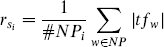 \begin{equation}
\label{formula1}
r_{s_{i}}=\frac{1} {\#NP_i} \sum_{w\in NP}|tf_{w}|
\end{equation}
rsi = the relevance of sentence i,
#NPi = number of noun-phrases contained in sentence i,
tfw = frequency of word w that belongs to the sentence's noun-phrase.
In order to identify noun-phrases within a sentence, the BaseNP Chunker,Footnote 9 is employed. One important aspect to take into consideration is that the use of a chunker (as well as any other NLP-based tool) can introduce some error rate. This tool achieves recall and precision rates of roughly 93% for base noun-phrase chunks, and 88% for more complex chunks (Ramshaw and Marcus Reference Ramshaw and Marcus1995), thus being suitable for our purposes.
3.2.5 Summary generation
The objective of this stage is to generate a summary of a specific length. This length can be expressed in words or in the form of the compression rate (i.e. the percentage of information the summary contains with respect to the source document). However, the way this stage is carried out strongly depends on the summary type and purpose we want to produce. Consequently, four main types of summaries can be distinguished: (1) generic; (2) query-focused; (3) sentiment-based; and (4) generic abstractive-oriented. Type 1 is directly produced when the core stages of compendium are applied, whereas for types 2, 3, and 4, the additional stages of query similarity, subjective information detection, and information compression and fusion are also required, respectively.
Next, we briefly explain each of these strategies for generating the final summary.
(1) Generic summaries (COMPENDIUME). Once the final score of a sentence is computed by means of the relevance detection stage, the most important sentences (i.e. the ones with the highest scores) are selected and extracted to form the final summary up to a desired length or compression rate. In this case, the final summary is a generic extract.
(2) Query-focused summaries (COMPENDIUMQE). Having computed the two different weights for each sentence (its relevance – rsi–, and its similarity with regard to the query – qSimsi –, in the relevance detection and query similarity stages,Footnote 10 these two values are combined within the same formula (Formula 2), which is based on the F-measure calculation. As it can be deduced, β does not have a fixed value. In contrast, it can be assigned different weights between 0 and 1, so that the TS tool is more flexible, and let the user determine the importance given to the generic relevance of sentences or to the query-related sentences,
where:(2) \begin{equation}
\label{formula2}
Sc_{s_{i}}=(1+\beta^{2})\frac{r_{s_{i}}*qSim_{s_{i}}} {\beta^{2}*r_{s_{i}}+qSim_{s_{i}}}
\end{equation}
Scsi = the score associated to sentence i,
rsi = the relevance of the sentence i,
qSimsi = the similarity between the query and sentence i.
Taking into account the size restrictions, the top-ranked sentences will be selected and extracted, forming the final query-focused extract.
(3) Sentiment-based summaries (COMPENDIUMSE). For generating these types of summaries, the same strategy as for the generic ones is followed. The main difference between these is that in this case we only focus on subjective information, which is identified and processed in the subjective information detection stage.Footnote 11 As a result, extracts containing only subjective information are produced.
(4) Generic abstractive-oriented summaries. These summaries (COMPENDIUME-A) combine extractive and abstractive TS strategies, and as a consequence, the sentences of the final summary are selected following a strategy that maximises the similarity between each of the new sentences generated in the information compression and fusion stage (Section 3.3), and the ones that have been selected as most important in the relevance detection stage, given that the similarityFootnote 12 between them is above a predefined threshold. In the cases where a sentence in the extract has an equivalent in the set of the new generated sentences, the former will be substituted for the latter; otherwise, the sentence as it appears in the extract will be kept. The resulting summaries are abstractive-oriented.

Additional stages
Apart from the core stages, there are three additional stages (query similarity, subjective information detection, and information compression and fusion) that, when integrated with the former, enhance the capabilities of compendium. These stages allow the generation of other types of summaries (i.e. query-focused, sentiment-based, and a abstractive-oriented summaries). Each of these additional stages are described below.
3.3.1 Query similarity
When query-focused summaries have to be produced, a query is usually associated to the source documents in order to specify the kind of information the user is interested in. From an extractive point of view, the summary should contain the most relevant sentences in the document that also contains the information in the query. Therefore, the goal of this stage is to take into account the information expressed in a given query to tailor the contents of the final summary to such information.
In order to determine which sentences may be potentially related to the given query, the cosine similarity between each sentence and the query is computed, using the Text Similarity package.Footnote 13 Formula 3 shows how the query similarity, through cosine similarity, is calculated:
 \begin{equation}
\label{formula0}
qSim_{S_{i}}=cosine(Q,S_{i}) = \frac{\sum_{j=1}^{n}{w_{j,Q}*w_{j,S_{i}}}}{\sqrt{\sum_{j=1}^{n}{w_{j,Q}}^{2}}*\sqrt{\sum_{j=1}^{n}{w_{j,S_{i}}}^{2}}}
\end{equation}
Q = the query,
si = the sentence i in the document,
wj,Q = the weight of term j in the query, and
wj,Si = the weight of term j in the sentence i.
3.3.3 Subjective information detection
The objective of this stage is to detect and process subjective information, with the purpose of producing sentiment-based summaries. This has to be performed before the relevance of sentences is assigned. In order to be able to carry out such task, a tool capable of analysing and classifying the sentiment associated to a fragment of text (e.g. words, sentences, documents, etc.) is necessary. This manner, it is possible to know whether a fragment of text is subjective or objective, and, in addition, whether it is positive, negative, or netural about a specific topic, entity, product, etc. In particular, compendium uses the external opinion mining tool described in Balahur-Dobrescu et al. (Reference Balahur-Dobrescu, Kabadjov, Steinberger, Steinberger and Montoyo2009), which relies on opinion lexicons for identifying positive and negative words and expressions. Then it computes the number of positive and negative words in sentences and, depending on the resulting value, it assigns to each sentence in the document one of these three different scores: (i) score > 0 if the sentence has a positive nature; (ii) score < 0 if it has a negative nature; and (iii) score = 0 if the sentence is neutral (i.e. its an objective sentence). Once all the sentences have been analysed according to their associated polarity, we discarded the neutral sentences for further stages so that only those which have been identified as positive or negative according to the opinion mining tool are taken into consideration. In this manner, the resulting summary will contain the different opinions people have towards a topic, product, etc., thus being a sentiment-based (or subjective) summary.
3.3.3 Information compression and fusion
This stage aims at generating new sentences in one of these forms: either a compressed version of a longer sentence, or a new sentence containing information from two individual ones. The main steps involved in this stage are as follows:
• Word graph generation. For generating new sentences, we rely on word graphs adopting a similar approach to the one described in Filippova (Reference Filippova2010). Specifically in our approach, we first generate an extractive summary in order to determine the most relevant content for being included in the summary, and then we apply this stage for compressing and merging relevant information, since it has been proven that this approach is the most appropriate one (Lloret and Palomar Reference Lloret and Palomar2011a).
Therefore, taking as input the generated extract, it is represented as a directed weighted DG = (V,E), where V = vi, v i+1, . . ., vi+n is the set of nodes corresponding to document's words, and E = e i,i+1, e i+1,i+2, . . ., ei-n,i+n is the set of edges, which consists of adjacency relations between the words. Two words are mapped into the same node only if they have the same part of speech tag. However, it is important to stress that stop words are not mapped together; otherwise, the real meaning of the sentence could be changed when generating the new sentence. The weight of each edge is calculated based on the inverse of the frequency of co-occurrence of two adjacent words, taking also into account the importance of the nodes they link through the Pagerank algorithm (Brin and Page Reference Brin and Page1998). For implementation we used Python-graph library.Footnote 14
Once the extract is represented as a word graph, a pool of new sentences is created. In order to produce a new sentence, we employ Dijkstra's algorithm (Dijkstra Reference Dijkstra1959) to find the shortest paths between an initial node and the remaining ones that are directly or indirectly connected with it. The initial node corresponds to the first word in each sentence, since this manner, we ensure that for each sentence in the extract, we have one derived sentence, so the whole content of the extract is covered. Moreover, we chose the shortest path algorithm because on the one hand, it has been shown to be appropriate for compressing sentences in previous work (Filippova Reference Filippova2010), and on the other hand, the shortest path will also look for minimal-length sentences that contains information from several ones, thus allowing them to include more information.
• Incorrect paths filtering. By applying the Dijkstra's algorithm over the graph we obtain all possible shortest paths between one node and the remaining ones. This leads to a high number of resulting sentences, which are not equally good. In fact, some of the sentences might be completely incomprehensible and not correctly formed. Therefore, in order to guarantee the completeness and correctness of a new sentence, this stage is needed to discard the invalid paths (i.e. generated sentences). For instance, some of them may suffer from incompleteness. Consequently, in order to reduce the number of incorrectly generated sentences, we define a set of rules, so that sentences not accomplishing all the rules are not taken into account. Three general rules are defined after analysing manually a set of generated sentences derived from a small data set, which are as follows:
— The minimal length for a sentence must be three words.Footnote 15
— Every sentence must contain a verb.
— The sentence should not end in an article (e.g. a, the), a preposition (e.g. of), an interrogative word (e.g. who), or a conjunction (e.g. and).
Once the incorrect sentences have been removed, we can use the new sentences instead of the original ones (see “generic abstractive-oriented summaries” in the summary generation stage). It is important to stress upon the fact that, in compendium, this stage takes place after the relevance detection and before the summary generation stages. This is because we need to be aware of the most relevant sentences of the document first.
4 Evaluation environment
The aim of this section is to present an intrinsic evaluation of compendium. In order to assess its performance, a number of experiments with various corpora from a wide range of domains and different text genres are conducted.
ROUGEFootnote 16 was selected as the tool for automatically evaluating our summaries, since it is a widespread TS evaluation tool that has been shown to correlate well with human evaluations (Lin and Hovy Reference Lin and Hovy2003). It is able to evaluate how informative an automatic summary is by comparing its content to one or more reference summaries. Such comparison is made in terms of n-gram co-occurrence. The best-known ROUGE metrics are ROUGE-1 and ROUGE-2, which compute the number of overlapping unigrams and bigrams, respectively; ROUGE-SU4, which measures the overlap of skip-bigrams and automatic summary, contains with respect to model one, a maximum distance of four words between them; and finally, ROUGE-L, which calculates the longest common subsequence between two summaries.
Conducting a manual evaluation is very costly and time-consuming; however, it is useful for knowing what real users think about the automatic summaries. Therefore, in the cases where we do not have model summaries, we perform a manual evaluation, taking into account different criteria concerning the quality of the generated summaries, such as grammaticality, redundancy, or focus. In other cases, the user satisfaction is evaluated in order to determine the usefulness of an automatic summary from a human point of view. In these cases, we establish a rating scale where different degrees of goodness are analysed. For instance, a 3-level scale may comprise the values “low”, “medium”, and “high”, whereas in a 5-level Likert scale the degrees to measure the agreement with respect to a specific issue are established (“strongly agree”, “agree”, “neither agreee nor disagree”, “disagree”, and “strongly disagree”).
In this section, we first describe the corpora used (Section 4.1), and then we focus on the experiments and results obtained (Section 4.2). A discussion for each experiment is also provided together with the results.
4.1 Corpora
As corpora, we use several data sets belonging to different textual genres, depending on the experiment performed and the type of summary we want to evaluate. In this manner, compendium can be assessed from a broader perspective by focusing on the newswire, tourist, Web 2.0, and scientific domains. In particular, compendium is evaluated using the following corpora:
• Newswire. It consists of a collection of English newswire documents provided by DUC.Footnote 17 On the one hand, we use the news documents within the DUC 2002 conference. These are 567 documents grouped in fifty-nine clusters, where each cluster represents a set of topic-related documents. Moreover, model summaries for each news are also provided. Specifically, for each document, the number of reference summaries range from 1 to 2 (1,112 model summaries in total). This data are appropriate for carrying out single- and multi-document generic TS. On the other hand, for multi-document summarisation, the data provided in DUC 2003 and DUC 2004 are also suitable. They consist of thirty and fifty clusters of news documents, for DUC 2003 and 2004, respectively, containing approximately ten documents each, and four model summaries for each cluster.
• Image captions. This corpus was created by Aker and Gaizauskas (Reference Aker and Gaizauskas2010), and it contains 308 different images with manually assigned place names. Each image has ten documents in English related to it that have been retrieved using a search engine, where the name of each place has been set as the query. In addition, each image has up to four model summaries (932 in total), which were manually created using the on-line social site, VirtualTourist.Footnote 18 This corpus is especially suitable for generating query-focused summaries of multiple input documents.
• Blogs. This corpus consists of fifty-one blogs together with their comments extracted from the web. In particular, these were manually selected using TechnoratiFootnote 19 website, which allows us to specifically search for blogs and comments. Since we wanted to cover general topics, we chose among different blogs related to economics, science and technology, cooking, society, and sports. The blogs and their corresponding comments are written in English and all of them have the same structure: The authors create an initial entry containing a piece of news and their opinion on it, and subsequently bloggers reply expressing their opinions about the topic. Since we wanted to build the corpus for generating summaries, the criteria for selecting blogs were the length and the number of comments they contained. After computing some statistics about our corpus, each blog had on average thirty-four comments associated to the main entry, and they had in total more than 5,500 words on average. We use this corpus for generating sentiment-based summaries.
• Medical research papers. This corpus consists of a collection of fifty research papers from specialised journals of medicine that were gathered directly from the web.Footnote 20 Each paper contains a human-written abstract, that can be considered as a model summary. This collection of journal papers are appropriate to perform single-document summarisation.
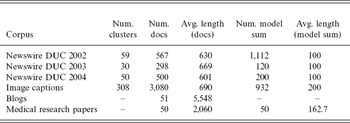
Table 1 shows an overview of all the data sets we have worked with. In addition, some properties are also provided. In particular, for each corpus, the table shows the number of clusters, the number of total documents within each corpus, the average size of the documents (in number of words), the number of model summaries available for each corpus, and finally the average length of the model summaries (in number of words, as well).
Overview of the corpora used and their properties

4.2 Experiments
In this section, the experiments conducted for evaluating the types of summaries compendium is able to generate are described. In particular, we evaluate single- and multi-document summaries; generic, query-focused, and sentiment-based summaries; and extracts and abstractive-oriented summaries.
Our aim is to analyse whether the techniques proposed within compendium are appropriate for generating the most common types of summaries, and being applied to different text genres of different domains (newswire, image captions, blogs, and medical research papers). The results obtained will be compared with other TS systems in order to determine the performance of compendium with respect to the state-of-the-art.
We grouped the different evaluations conducted with respect to the type of textual genre analysed (newswire, image captions, blogs, and medical research papers). We next described in detail the experiments performed and the results obtained. For clarity reasons, each textual genre is in a separate section.
4.2.1 Newswire corpus
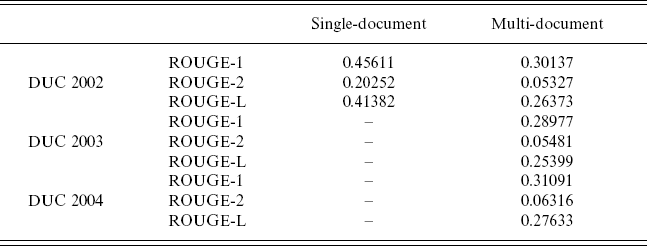
Using the different DUC corpora for news, compendiumE is evaluated for single- and multi-document summarisation. For both evaluations, we use ROUGE-1, ROUGE-2, and ROUGE-L, and we report the values for F-measure (β = 1). On the one hand, for single-document summarisation, we use the DUC 2002 corpus, on the other hand, this corpus together with the ones for DUC 2003 and DUC 2004 are used for generating multi-document summaries.
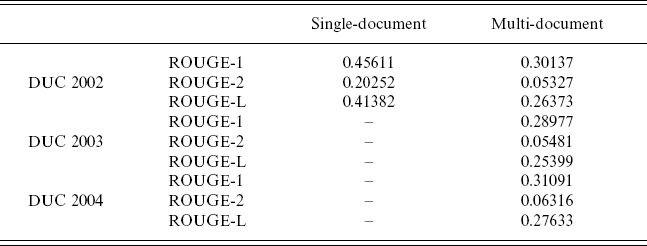
Table 2 shows the results that compendiumE obtains for different newswire corpora. As it can be seen, single-document summaries achieve better results (around 45% for ROUGE-1) than multi-document ones (30% on average). The difference in performance may be due to the fact that we do not employ any specific technique for tackling multi-document summarisation. In contrast, we merge all related documents into a single one, and this is used as input for compendiumE.
compendiumE results for single- and multi-document summarisation for the newswire domain, F-measure (β = 1)
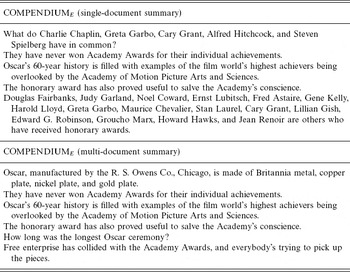
An example of a single- and a multi-document summary generated by compendiumE is shown in Table 3.Footnote 21
Single- and multi-document summaries generated by compendiumE for document AP880325-0239 (DUC 2002, cluster d078b)

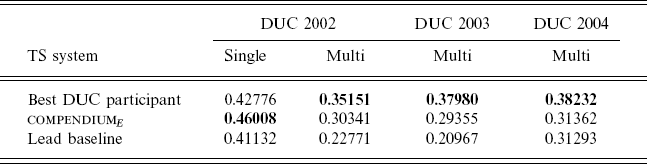
Furthermore, we carry out a comparison of our results with respect to the best scoring system in the respective DUC editions, as well as a Lead baseline that builds the summary taking the first sentence of each document in the case of single-document summarisation, and it takes the first sentence of the first document, then the first sentence of the second document, and so on, for multi-document. In these cases, we report the recall value for ROUGE-1. Table 4 shows such comparison.
Comparison of compendiumE's performance with other text summarisation systems (recall value)
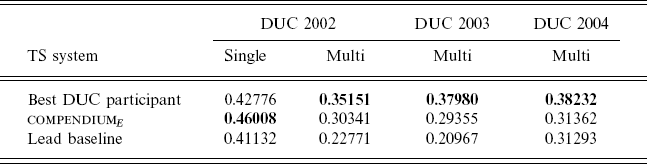
The single-document summaries achieve very good performance compared with the best system at DUC 2002, and the Lead baseline. In this case, compendiumE outperforms the best system by approximately 8% (0.46008 vs. 0.42776 – please see Table 4), and an increase of 12% is obtained over the baseline (0.46008 vs. 0.41132). On the contrary, results for multi-document summarisation are not as good. The Lead baseline is improved by 33% and 40% for the DUC 2002 (0.30341 vs. 0.22771) and DUC 2003 data (0.29355 vs. 0.20967), respectively, but there is a marginal increase for DUC 2004 (0.2%, 0.31362 vs. 0.31293). Despite these improvements, the performance of compendiumE for multi-document summarisation does not surpass the best system at DUC. This difference is due to the fact that we approach multi-document summarisation as a single-document summarisation where all related documents are considered as a single one. This is an indication that this type of summarisation may require a more elaborate processing instead.
4.2.2 Image caption corpus
Generic and query-focused summaries were produced using compendiumE and compendiumQE, respectively. For the query-focused summaries generated by compendiumQE, it was experimentally established that, for this research and this corpus, the optimal value for the parameter β was 0, thus meaning that the sentences related to the query were considered more important to build the summary. As far as the generic summaries (compendiumE) are concerned, the query similarity stage was not taken into consideration.
In total, 308 summaries of 200 words each were generated, and to evaluate both approaches, we use ROUGE-2 and ROUGE-SU4. These metrics allowed us to compare the automatic summaries against the model summaries also provided in this corpus.
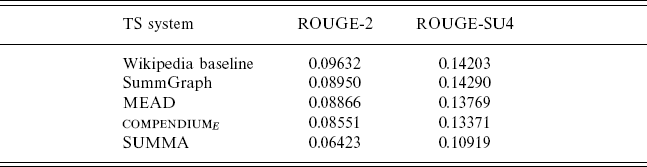
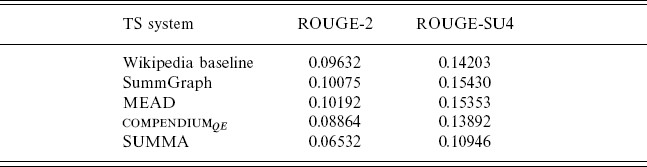
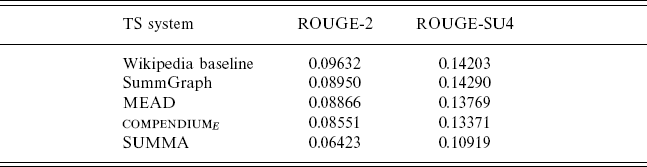
Furthermore, as baseline the first 200 words of the Wikipedia article describing each image were selected. Also, for comparison purposes, we generated summaries employing different state-of-the-art TS systems. In particular, these were SummGraph (Plaza, Díaz and Gervás Reference Plaza, Díaz and Gervás2008), MEAD (Radev et al. Reference Radev, Allison, Blair-Goldensohn, Blitzer, Celebi, Drabek, Lam, Liu, Otterbacher, Qi, Saggion, Teufel, Topper, Winkel and Zhang2004), and SUMMA (Saggion Reference Saggion2008). In this way, the performance for generic and query-based summarisation for such systems was also compared. The results are given in Tables 5 and 6, respectively.
Results for generic summarisation in the image caption corpus (recall value)
Results for query-focused summarisation in the image caption corpus (recall value)
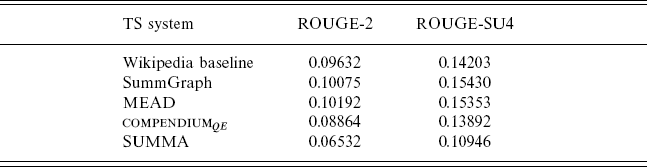
From the results obtained, we can conclude that query-focused summarisation is more appropriate for these types of data. If we observed the results for the summarisers, all ROUGE scores in Table 6 (query-focused summaries) are higher than the scores in Table 5 (generic summaries). Moreover, the Wilcoxon signed-rank test is computed for assessing the significance of the results. For all summarisers, except SUMMA, the query-focused summaries are significantly better than the generic ones.
Regarding our TS approach, compendium, the results for the query-focused approach (compendiumQE) increase by approximately 4% on average with respect to the generic one, compendiumE (0.08864 vs. 0.08551 for ROUGE-2 and 0.13892 vs. 0.13371 for ROUGE-SU4), thus proving that query-focused summaries are the most appropriate ones for these type of documents.
On the other hand, Wikipedia summaries are a difficult goal to achieve, as it can be seen from the results where only two summarisers, when producing query-focused summaries (SummGraph and MEAD), obtain higher results. The reasons why it is so difficult to perform better than the Wikipedia baseline are as follows: (1) These articles have been created by humans; (2) the first paragraph in a Wikipedia article is usually a summary of the entire document content; and (3) Wikipedia articles almost exclusively contain salient information to the subject matter, and do not present other information somehow related to the topic but not important (e.g. nearby hotels, or transport services).
Although the results achieved by compendium are comparable to the best performing systems, we try to elucidate the reasons why compendium performs a bit lower than SummGraph and MEAD.
Analysing the types of documents and the resulting summaries, we realised that one of the main problems in these specific types of documents resides in the nature of the corpus, which contained some noisy information, in the sense that they included a lot of noun-phrases within the documents as categories for the objects (e.g “Mahogany, Maple, crown mouldings, multiple Viking ovens, Sub-Zero refrigerators, antique. . .”). In these cases, the method proposed in compendium for detecting relevant information did not perform as it would be expected. The reason is that, according to the CQP feature, our method gives more importance to those sentences which contains longer noun-phrases, and consequently, these types of sentences are scored higher. Therefore, they are wrongly considered as relevant, and they are final incorporated in the summary. In the end, this leads to the fact that the quality of the final summaries is directly affected by these sentences, and as a consequence, the content of the generated summary will show greater differences in comparison to the sentences extracted by other summarisers. In order to improve our results, we could have classified which of the noun-phrases may be related to the topic and which may not be.
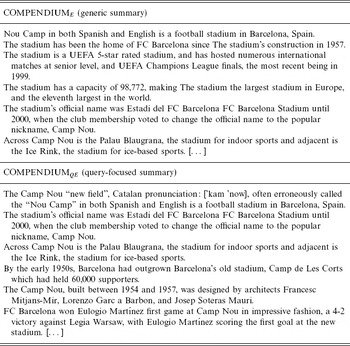
Nevertheless, the resulting summaries are good enough to provide an idea of the most important facts about a location, as it is illustrated through the two fragments of summaries related to “Nou Camp” shown in Table 7.Footnote 22 The summary at the top corresponds to a generic summary produced using compendiumE, whereas the one at the bottom is a query-focused one (compendiumQE).
Generic and query-focused summaries generated by compendium for the place Camp Nou

4.2.3 Blog corpus
The comments associated to each blog in the corpus are used to produce sentiment-based summaries (compendiumSE). Different from the previous experiments, instead of generating summaries of a fixed length, we experimented with three different compression rates (10%, 15%, and 20% of the document).
The evaluation conducted also varies from the previous ones in the sense that ROUGE is not employed. Instead, a qualitative evaluation is conducted, where summaries are evaluated manually. It is worth stressing upon the fact that we focus more on the quality of the summaries rather than on their content, since the content would depend on the specific need a user has at a particular moment. Moreover, for this corpus we do not have model summaries, and to produce them manually is a very difficult and time-consuming task.
In particular, the criteria proposed for evaluating the opinion summaries are the following: redundancy, grammaticality, focus, and difficulty. Redundancy measures the presence of repeated information in a summary. Grammaticality accounts for the number of spelling or grammatical errors that a summary presents. Focus evaluates whether it is possible or not to understand the topic of the summary, that is, the main subject of the text; and finally, difficulty refers to the extent to which a human can understand a summary as a whole or not.
If we have a look at the criteria proposed in DUC and TAC conferences, we will realise that we adopt more or less the same, except the difficulty criteria which is non-conventional. The reason why this criterion is included is that it provides an idea of the summary as a whole, regarding its readability.
Furthermore, three different degrees of goodness are established for each evaluated criteria. These were non-acceptable, understandable, and acceptable. In this classification, acceptable means that the summary meets the specific criterion and therefore is good, whereas non-acceptable means that the summary would not be good enough with respect to a criterion. When assessing the difficulty, the summaries were classified with regard to high, medium, and low, being low, the better.
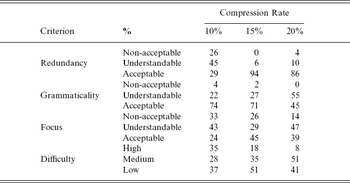
Table 8 shows the results for this evaluation.
Results for compendiumSE within the blog corpus

Analysing the results obtained, a set of interesting conclusions can be drawn. As far as the grammaticality criterion is concerned, the results show a decrease of grammaticality errors as the size of the summary lowers. We can see that the number of acceptable summaries varies from 74% to 45%, for a compression rate of 20% and 10%, respectively. This is obvious because the longer the summary, the more chances there are for containing orthographic or grammatical errors. Due to the informal language used in blogs, we thought a priori that summaries would contain many spelling mistakes. Contrary to our expectations, generated summaries are quite well written, only 4% of them, at most, being non-acceptable. Another important fact that can be inferred from the results is related to how the summaries deal with the topic. According to the percentages shown in the tables previously presented, the number of summaries that have correctly identified the topic and have therefore been evaluated as acceptable, change considerably with respect to the different summary sizes, increasing when we changes from 10% to 15%, but decreasing when changing from 15% to 20%. However, as a general trend, we can see that when taking into account the number of summaries that have not performed correctly in the focus parameter, there is a decreasing trend, reducing the incorrect summaries from 33% to 14%. This means that for longer summaries, the topic may be stated along the summary, although not necessarily at the beginning of it, whereas for shorter summaries, there is no such flexibility, and as a consequence if the topic does not appear at the beginning, the most probable thing is that it does not appear in the summary at all. Finally, regarding redundancy, results indicate that summaries of 15% and 20% contain less repeated information than shorter ones. What can be seen from the results is that the summaries of 20% compression rate obtain the best results on average over the rest of the size experimented with. This is due to the fact that this compression rate achieves higher percentage (for the understandable and acceptable degrees of goodness) in two (grammaticality and focus) out of the three criteria proposed. Only the 15% compression rate summaries obtained better results in the redundancy criterion. On the other hand, as far as the difficulty criteria is concerned, results are also encouraging. According to the evaluation performed, the longer the summaries, the easier they are to be understood in general. Grouping the percentages of summaries, we obtained that 65%, 86%, and 92% of the summaries of size 10%, 15%, and 20%, respectively, have either medium or low level of difficulty, which means that they could be understood as a whole without serious difficulties. Again, for this criterion, 20% summaries achieve the best results. This has also been proved by previous research work, which demonstrated that this compression rate is more suitable for an acceptable quality of summaries (Morris, Kasper and Adams Reference Morris, Kasper and Adams1992). It is worth mentioning that this criterion is rather subjective and depends to a large extent on different factors, such as the knowledge the person who reads the summaries, the number of grammatical errors the text contains, or the connectedness of the sentences. Moreover, it is reasonable to think that long summaries can be more difficult to understand, but our experiments show that it is actually the other way around, because longer summaries may contain more information than shorter ones, which allows the user to have more awareness of the content and what the summary is about.
In general terms, while evaluating the summaries obtained, we noted some recurrent mistakes. The first one is the punctuation; in some cases we noted some commas missing or instead of having a comma, contain a full stop (e.g. “So. One option. . .”). Also, in some cases, apostrophes are missing, in examples such as dont. The second error is that in some cases the summaries start with a sentence containing a coreference element that we cannot resolve, because the antecedent has been deleted or sentences that imply some concept previously mentioned in the original text have not been selected. It is also worth mentioning that some of the grammatical errors are due to users' misspellings, for example “I thikn”. The third error concerns the spelling mistakes found in the summaries, which are directly transferred from the initial blog posts, which also contains such kind of errors (e.g. calender). Finally, we also found some void sentences, that do not contribute to the general meaning of the summary as for example, “I m an idiot”, “Just an occasional visitor”, or “welcome back!!!”.
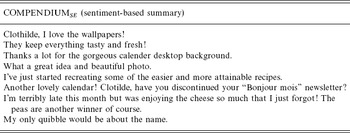
Table 9 shows an example of an automatic summary for blog 29 with a compression rate of 10%.Footnote 23 In this case, the summary contains mostly positive opinions, having only the last sentence a negative charge (“My only quibble would be about the name”).
Sentiment-based summary generated by compendiumSE for blog 29

As it can be seen, only opinions have been considered and these are presented grouped into positives, on the one hand, and negatives, on the other. We considered it as good due to the fact that there are no objectives or useless sentences. The system presents subjective sentences with an emotional charge, and as a consequence this summary meets our purposes.
4.2.4 Medical research papers corpus
With this set of documents, we want to analyse the capabilities of compendium for generating abstractive-oriented summaries. In this particular evaluation, we generate summaries of 162 words because this was the average length of the abstracts included in the medical papers (please see Table 1), and we wanted to use them as model summaries. Therefore, since our goal is to analyse to what extent the resulting automatic summaries are valid, we set up a comparison between compendiumE and compendiumE-A, considering as model summaries the ones included in the medical papers.
Table 10 shows an example of two summaries generated with compendiumE and compendiumE-A, respectively.Footnote 24 It is worth mentioning that these approaches produce generic summaries, and for generating them neither the keywords of the original paper nor the information in the titles or the abstracts were taken into consideration. As it can be seen, both summaries share some of the sentences, whereas others have been shorten in the latter.
Example of summaries generated with compendiumE and compendiumE-A for the medical corpus

Specifically, we set up two types of evaluation. In the first one, we use the model abstracts of the papers and we compare these with the ones generated by compendiumE and compendiumE-A, for our extractive and abstractive-oriented approach, respectively. The second evaluation aims at assessing the summaries with regard to user satisfaction with respect to a 5-level Likert scale. Next, each of these types of evaluation is explained in more detail.
• Comparison with human abstracts. In this evaluation, the summaries generated by compendiumE and compendiumE-A are assessed with respect to the human abstracts provided in the original papers. We use ROUGE-1 and report the values of recall, precision, and F-measure (β = 1). We also compare the results obtained with the state-of-the-art summariser: MS-Word 2007 Summarizer,Footnote 25 and we run a t-test to account for statistical significance of the results at a 95% confidence level (statistical significant results are marked with a star).
Table 11 shows the results for the first evaluation. In this evaluation, compendiumE-A summaries are evaluated with respect to the human abstracts, and compared to compendiumE and MS-Word 2007.
Table 11.ROUGE-1 results for compendiumE-A and its comparison with other TS approaches
As it can be seen, our both TS approaches are comparable with respect to the state-of-the-art TS tool (i.e. MS-Word 2007 Summarizer). Regarding compendiumE-A, it is worth mentioning that the precision obtained is higher and statistically significant compared with the remaining approaches, thus meaning that the information contained is the right one. However, its recall is lower, so in the end the final value of F-measure is negatively affected, being compendiumE statistical significant with respect to compendiumE-A for these specific measures. This is due to the fact that for this TS approach we rely on the sentences detected as important in the relevance detection stage, and we compress or merge some information within them. Therefore, the resulting summaries are shorter than the extracts, and since no extra information is added, the recall value will be never higher than it is for compendiumE. One possible solution to address this issue would be to rely on the source document and generate new sentences from it instead of the most relevant sentences. Another strategy would be to include in the compendiumE-A summary the next highest ranked sentence in the document according to the relevance detection stage that was not included in the extract because of summary length restrictions. Regarding compendiumE, it achieves slightly better results than MS-Word 2007; however, there are no statistical differences between them. Only statistically significant results are obtained with respect to compendiumE-A.
• User satisfaction study.
In the last evaluation, we aim at assessing the user satisfaction with respect to the generated summaries. For this purpose, we perform a qualitative evaluation and asked ten humans to evaluate our summariesFootnote 26 according to a 5-level Likert scale (1= strongly disagree . . .5 = strongly agree). For each summary, humans were asked to respond to three questions concerning the appropriateness of the summaries. The questions asked, as well as the percentage of summaries for each question in scales 1 to 5 are shown in Tables 12 and 13, respectively.
Table 12.Qualitative questions to evaluate the summaries
Table 13.User satisfaction results for the different text summarisation approaches
As it can be seen from the results shown in Table 13, our abstractive-oriented approach (compendiumE-A) obtains better results than the extractive one (compendiumE). Although the evaluation concerning the information contained in the summaries generated with compendiumE-A was not as good as for the extractive approach, taking into consideration their quality from a human point of view, the abstractive-oriented summaries are much better than the extractive ones. When we have a look at the different percentages of summaries that have been rated in one of each categories, we observe that there is a higher percentage of abstractive-oriented summaries that humans agree with, compared with the extractive summaries for the same rating. Moreover, it is worth stressing upon the fact that, analogously, the percentage of summaries with lower ratings (strongly disagree and disagree) also decreases when compendiumE-A is employed.
Furthermore, concerning the average individual scoring results (between 1 and 5), compendiumE-A achieves at most 3.37 for Q2 and 3.1 for Q1 and Q3, whereas the maximum average value for compendiumE is 2.83 for Q2, the remaining questions obtaining values lower than 2.60. In light of the results obtained, it has been proved that the combination of extractive and abstractive techniques is more appropriate and leads to better summaries than extracts.



5 Conclusion and future work
This paper presented compendium, a TS tool that is able to generate informative summaries for different purposes (generic, query-focused, sentiment-based, extractive, and abstractive-oriented), and it can deal with documents pertaining to a wide range of domains and textual genres (newswire, image captions, blogs, and medical research papers).
The architecture of compendium is divided into two kinds of stages (core and additional stages), depending on the types of summaries one would like to generate. In light of the techniques employed within this architecture, three main contributions can be remarked that allow compendium to be distinguished with respect to the state-of-the-art TS systems:
• The use of textual entailment as a redundancy detection method. This method combines lexical, syntactic, and semantic information in order to detect entailment relationships between sentences. Although textual entailment and TS had been used before to generate and evaluate summaries, this technique was not employed for dealing with the problem of redundancy in TS. Therefore, in this paper, we showed that textual entailment can be used for discarding sentences whose content has been already stated in previous sentences, thus avoiding repeated information in the summaries.
• The combination of statistical and cognitive-based techniques, the latter directly related to how humans remember the information. We analyse to what extent the Code Quantity Principle combined with the frequency of terms is appropriate for detecting relevant information in texts, and we showed that this combination led to good summaries in most of the cases.
• Generate abstractive-oriented summaries through the combination of extractive and abstractive techniques. A pool of new sentences (either compressed or fused) is created from an extract, and then these sentences are used to substitute those sentences in the extract that express the same information. In the cases where no equivalence is found, the sentences are not replaced. From the quantitative evaluation performed, we showed that this approach is appropriate, since it is able to keep the most relevant information. Moreover, from the user evaluation carried out, we confirmed that this approach generated better summaries than the extractive TS approach.
The proposed features and contributions of compendium have lead to acceptable results, as it is proven from the extensive evaluation conducted. Specifically, an intrinsic evaluation was performed, whose goal was to assess the capabilities of compendium for generating different types of summaries belonging to different domains and textual genres, as well as to compare it to the state-of-the-art TS systems. Therefore, the suitability of compendium as a TS tool is shown.
However, from this research we have identified a number of issues that we have to work on in the future. As a first issue, we would like to analyse additional techniques and methods for the topic identification stage, such as the ones proposed and studied in Lin (Reference Lin1997) and Coursey and Mihalcea (Reference Coursey and Mihalcea2009). These are different from the word frequency counting, and therefore the problems and limitations of the word frequency technique would be avoided. In addition, coreference resolution as well as the use of concepts instead of words should also be investigated and included within our TS process.
Furthermore, we plan to carry out research into other issues. On the one hand, we want to enrich compendium with semantic knowledge. This line of research broadens the research carried out into abstractive-oriented summarisation. The objective of this research is to incorporate semantic knowledge to compendium by means of concept graphs or other semantic techniques. Semantic knowledge will allow us to have a higher level of abstraction. In the long term, we would also like to face the problem of evaluation by analysing the automation of several quality metrics with the final goal of developing a qualitative evaluation framework.
Acknowledgments
This research has been supported by the project “Desarrollo de Técnicas Inteligentes e Interactivas de Minería de Textos” (PROMETEO/2009/119) and the project reference ACOMP/2011/001 from the Valencian Government, as well as by the Spanish Government (grant no. TIN2009-13391-C04-01).