Introduction
The term ‘double burden’ is often used to characterise the challenges a mother faces when balancing employment and domestic responsibilities (including household chores and care-giving) (Moen Reference Moen1992). Studies on the ‘second shift’, that is, how working mothers juggle amongst family and work obligations, are abundant in the literature (Hochschild and Machung Reference Hochschild and Machung2012; Massey, Hahn and Sekulic Reference Massey, Hahn and Sekulic1995; Milkie, Raley and Bianchi Reference Milkie, Raley and Bianchi2009). However, absent from the literature is how the extent of a ‘double burden’ changes over the lifecourse. For example, as a woman transitions from younger to older adulthood, the nature of family responsibilities shifts. Her child-care load could lessen as children grow older, while a transition to grandmotherhood may increase her care-giving duties later in life. This is especially true in settings where women tend to become grandmothers at a younger age, during a time when they may still be actively participating in the labour force. In a context where cultural expectations of taking care of grandchildren is high and co-residence is common, she could once again be subject to a high level of work and family demands.
This study is set in Cebu, in the Philippines, a province where the pace of fertility decline has been slow. Total fertility rate still remains well above 3.0 and the mean age at birth is 23.1 (Population Reference Bureau 2014). Women thus often become grandmothers at a much younger age compared to most women in low-fertility settings. A 2009 report indicated that one in five older adult Filipinos takes care of grandchildren, regardless of co-residence status (Cruz et al. Reference Cruz, Abalos, Lavares, Natividad and Saito2009). The percentage would be even higher if younger women were included in the estimate. High rates of international migration and the increasing trend of overseas Filipino workers translates into additional demand for grandmothers to participate in child-rearing (Parreñas Reference Parreñas2000). While we know Filipino grandmothers take a major role in child-rearing (Cruz et al. Reference Cruz, Abalos, Lavares, Natividad and Saito2009), we have little knowledge about the extent to which they experience a double burden by also being engaged in work and household activities.
In this paper, we take a step towards capturing the diversity in women's work and family responsibilities using rich time-use data from a cohort study of mothers and children: the Cebu Longitudinal Health and Nutrition Survey (CLHNS) conducted in Metropolitan Cebu in the Philippines. Using latent class analysis (LCA) and latent transition analysis (LTA), we first profile time-use allocation and classify women into distinct groups, followed by analysis of transition in time-use group membership. Given data that spanned a period of 18 years (1994–2012), during which these women were transitioning from mid-life to old age, we are able to examine the association between changes in household composition and time-use patterns, paying particular attention to the effect of presence or addition of grandchildren in the household.
We are motivated by the following questions:
1. To what extent are women in Cebu shouldering the ‘double burden’ of work and family tasks, as evidenced by their time-use profiles?
2. As women transition from mid-life to old age, how does their alignment of work and family responsibilities change?
3. Does the presence or addition of grandchildren in the household translate into a difference or shift in work and family responsibilities?
Our paper makes a significant addition to recent literature on time use at older ages, which are often cross-sectional in nature (Gauthier and Smeeding Reference Gauthier and Smeeding2003, Reference Gauthier, Smeeding, Tuljapurkar, Ogawa and Gauthier2010; McKenna, Broome and Liddle Reference McKenna, Broome and Liddle2007). Our longitudinal study sheds light on the changes in women's time-use patterns across the lifecourse. The answers to the above questions allow us to gain a concrete understanding of competing demands that many mothers and grandmothers are facing as they age. Although our study does not directly measure the extent to which work and family responsibilities are in conflict with each other, by accounting for time allocation devoted to work, care-giving, household chores and personal time, respectively, our study provides a necessary step in documenting the multiple burdens women commonly face in a developing economy, where the boundaries of work and family are often not as clear-cut as those in developed countries.
Work and family responsibilities for women over the lifecourse
Despite dramatic increases in female labour force participation in recent decades, particularly for working mothers, women around the world shoulder greater responsibilities for care-giving and housework in general, giving rise to the so-called ‘double burden’ (Hochschild and Machung Reference Hochschild and Machung2012; Mattingly and Bianchi Reference Mattingly and Bianchi2003; Milkie, Raley and Bianchi Reference Milkie, Raley and Bianchi2009; Sayer et al. Reference Sayer, England, Bittman and Bianchi2009). Existing literature on maternal employment and child care abounds with discussions on role incompatibility and conflict that is caused by the dual demands of work and care-giving (Chen, Short and Entwisle Reference Chen, Short and Entwisle2000; Desai and Jain Reference Desai and Jain1994; Oppong Reference Oppong, Bulatao, Lee, Hollerbach and Bongaarts1983; Tiefenthaler Reference Tiefenthaler1997). Does a woman face similar challenges later in life when she becomes a grandmother, in a context where care-giving for grandchildren is normative? For example, a study in China showed the average level of a grandmother's care to be equivalent to that of a mother in caring for preschool children (aged 0–6) except for children under the age of 1 (Chen, Liu and Mair Reference Chen, Liu and Mair2011). In the Philippines, it is often common for parents to live with their adult children and grandchildren, and an overwhelming majority of the grandparents, grandmothers in particular, provide regular care for their grandchildren (Agree, Biddlecom and Valente Reference Agree, Biddlecom and Valente2005).
Research on grandparents’ care-giving for grandchildren has extensively investigated the implications of grandparental care-giving for grandparents’ wellbeing (Chen and Liu Reference Chen and Liu2012; Chen et al. Reference Chen, Mair, Bao and Yang2015; Hughes et al. Reference Hughes, Waite, LaPierre and Luo2007; Ku et al. Reference Ku, Stearns, Van Houtven, Lee, Dilworth-Anderson and Konrad2013). One of the primary concerns of the grandparental care-giving literature is whether these grandparents are overburdened with the physical and psychological stress of work and care-giving activities (Baker and Silverstein Reference Baker and Silverstein2008; Leopold and Skopek Reference Leopold and Skopek2014; Wang and Marcotte Reference Wang and Marcotte2007). For example, recent studies in the United States of America (USA) suggest that about 36 per cent of the grandparents who are caring for their grandchildren were actively employed in 2010 (Scommegna and Mossaad Reference Scommegna and Mossaad2011). Due to the zero-sum nature of time, the potential for work, care-giving, housework and time for self-care activities to crowd each other out is high. However, researchers are often limited to the inclusion of work status, household structure and intensity of care-giving in the analysis (Baker and Silverstein Reference Baker and Silverstein2008; Chen and Liu Reference Chen and Liu2012; Wang and Marcotte Reference Wang and Marcotte2007). A direct examination of actual time allocation for work and care-giving is lacking in the literature.
In addition, in a developing country setting, to characterise work status is often not as straightforward as that in industrial societies. Work boundaries are often fluid, meaning that women may not engage in work in the formal sector but rather they are involved with a wide range of informal income-generating activities, such as working in a family store, making and selling handicrafts, or other service activities (Desai and Jain Reference Desai and Jain1994; Donahoe Reference Donahoe1999; Lloyd Reference Lloyd1991; Short et al. Reference Short, Chen, Entwisle and Zhai2002). Some work is more compatible with child care than others due to time flexibility. For example, agricultural fieldwork or handicraft work can be more easily combined with child care, while a nine-to-five wage job at a factory makes it challenging for one to assume primary care-giving responsibility. Thus, adjustment in work activities and other chores could be gradual and subtle, compared with the settings where market work is formal and therefore exiting and entrance into the labour market often involves drastic reconfiguration of other activities. For example, a study using the China Health and Nutrition Survey demonstrates that birth has only a modest effect on mothers’ wage employment but the shifts in work patterns are much more salient when using a typology that distinguishes different combinations of wage work, work in household businesses and agricultural fieldwork (Entwisle and Chen Reference Entwisle and Chen2002).
There is also the possibility that no apparent adjustment is made in either work or care-giving when role transitions occur. Analyses using time diary data from nationally representative studies in the USA show that mothers’ time with children has remained stable in the face of dramatic increases in female labour force participation in the last few decades (Bianchi Reference Bianchi2000; Sayer Reference Sayer2005; Sayer, Bianchi and Robinson Reference Sayer, Bianchi and Robinson2004). Instead, what was reduced was women's time for household chores and leisure. While this pattern has been documented for the mothers, it is not known whether the same is true with grandmothers in developing countries, who often assume primary care responsibilities and are often still relatively young in age (Entwisle and Chen Reference Entwisle and Chen2002). Recent time-use studies show a decrease in paid work and physically demanding leisure activities, together with an increase in personal time associated with ageing (Gauthier and Smeeding Reference Gauthier and Smeeding2003, Reference Gauthier, Smeeding, Tuljapurkar, Ogawa and Gauthier2010; McKenna, Broome and Liddle Reference McKenna, Broome and Liddle2007). In order to understand better different demands in a woman's life, it is imperative that we look beyond work and care-giving and include other activities that impact on time allocation, including household chores and leisure time. We take a lifecourse perspective by positing that women's time-use patterns are likely to shift with changing life circumstances, particularly as family roles evolve. Following the principle of life-span development (see Elder, Johnson and Crosnoe Reference Elder, Johnson, Crosnoe, Mortimer and Shanahan2003), we expect both continuity and change in time-use patterns as one moves from younger to older adulthood. For example, as children grow up and transition into adulthood, there would be an easing of care-giving duties for some woman and a subsequent increase in leisure time. For others, it could be accompanied by an increase in market work. As women become grandmothers, especially with grandchildren living in the household, they could get involved in child care and scale back work activities. However, for some grandmothers, if they are engaged in home-based work, then it may be relatively easy for them to combine child care with work without making much adjustment in work activities. Based on a close examination of women's time-use allocation, the current study expects to develop ‘profiles’ of work–family combinations as well as transitions in profiles, as women transition from mid-life to old age along with changes in roles and household composition.
Data
The CLHNS, established through collaboration between researchers at the Carolina Population Center at the University of North Carolina Chapel Hill, and the Office of Population Studies Foundation at the University of San Carlos in Cebu, follows a cohort of mothers and an index child born in 1983/84. Using a single-stage cluster sampling procedure, 17 urban and 16 rural barangays (local administrative units) were randomly selected from the 255 barangays in Metropolitan Cebu. The 33 barangays, representing about 28,000 households, were surveyed to locate all pregnant women. Women were first interviewed in 1983 and were followed up in 1991, 1994, 1998, 2002, 2005, 2007 and 2012. In 1983, the women ranged in age from 14 to 45, with a mean age of 26. These women were recruited into the survey by virtue of having given birth within a one-year period (May 1983 to April 1984, N = 3,237), therefore making the sample selective of high fertility and lower socio-economic status (Adair et al. Reference Adair, Viswanathan, Polhamus, Avila, Gultiano and Perez1997; Gultiano Reference Gultiano1999). There are no comparable large samples of women in developing countries followed from the reproduction years to older adulthood. For detailed information on the sample design, see http://www.cpc.unc.edu/projects/cebu/about. For this paper, because our focus is daily time-use activities, and since time-use data have only been collected in 1994, 1998, 2002, 2005 and 2012, we start our analysis with a sample of women in 1994. With low missing rates ranging from 0.17 to 2.05 per cent on the dependent and/or independent variables, we did not impute any missing data and used listwise deletion (see the recommendation by Lynch, Brown and Mustillo Reference Lynch, Brown and Mustillo2016). The analysis starts with a sample of women in 1994 (N = 2,279), with a mean age of 38. All together, 1,771 respondents were observed across the five waves of data. Additional analyses suggest the pattern in the dependent variable is not predictive of loss to follow-up at the following wave of data. The final sample size for each follow-up wave is 1,989, 2,102, 2,018 and 1,815 (see Table 1).
Descriptive statistics of time-use variables, 1994–2012

Note: SD: standard deviation.
Source: Cebu Longitudinal Health and Nutrition Survey.
Daily time-use activities in CLHNS
The CLHNS collects data using 24-hour activity diaries (reported for a typical weekday). We can calculate the amount of time usually spent daily on activities such as food preparation, housekeeping, care-giving, working at home, working away from home, leisure and sleep. We collapse daily time use into five broad categories:
1. Working outside the home for pay (including travelling time).
2. Working at home for pay, examples include getting wares ready for selling, opening/closing store, watching store located at home, doing other people's laundry.
3. Household chores, including activities such as food preparation, market work, cooking, washing dishes, housekeeping, gathering firewood, doing household repairs, making beds, sewing, mending, tending animals/garden.
4. Care-giving, including activities such child/parent care (bathing/cleaning, dressing up, putting to sleep/waking, taking to and from school, helping with homework, taking for a walk, feeding child).
5. Personal time, including personal hygiene, recreation (napping, reading, listening to the radio, watching television/movie), schooling.
Mean hours of daily time-use activities for women in the CLHNS sample change over the 18-year time-span. For example, the mean daily hours of working outside the home decreased from 3.47 to 2.85 hours from 1994 to 2012, while hours of working at home slightly increased (see Table 1). We observe decreasing average time in care-giving and household chores, but a considerable increase in personal time over the years (from 4.66 in 1994 to 7.25 hours in 2012). This is consistent with other time-use studies (Gauthier and Smeeding Reference Gauthier and Smeeding2003, Reference Gauthier, Smeeding, Tuljapurkar, Ogawa and Gauthier2010; McKenna, Broome and Liddle Reference McKenna, Broome and Liddle2007).
It is important to note that there exists tremendous variation and skewness in the distribution of these time-use variables. Thus, it is not ideal to treat these variables as continuous. After carefully examining the distribution of these time-use activities, we collapse the daily time use in each of these five groups into three categories: zero/low intensity, moderate intensity and high intensity (identified as responses 1, 2 and 3 in later LCA). While the loss of detail is inevitable in transforming the continuous variables to ordinal variables, we believe that it is in line with our substantive interests in capturing the level of burden that women may have in these different dimensions of activities. Table 1 provides the frequency distribution of the newly created categorical variables in addition to the mean and standard deviation of the original continuous variables. Our choices of the cut-off points are substantively meaningful and are informed by the original distribution of the variables. We use overall means as reference points in defining the moderate categories and use the percentile distribution as our guide in picking up the cut-off points. The results are insensitive to small adjustments (e.g. using five or six hours as the cut-off). For example, for work to be considered ‘high intensity’, the work hours are longer than eight hours a day, the standard work-day hours. If one does not work at all, then they are grouped into the ‘zero/low-intensity category’. To qualify as ‘high-intensity’ care-giving, care-giving hours are longer than an hour a day. As for personal time and household chores, longer than six hours a day is classified as ‘high intensity’. If one does less than two hours of housework, we classify that as ‘low intensity’.
Table 1 shows that many women were heavily engaged in work. For example, about 23.5 per cent of the women worked more than eight hours a day outside the home in 1994, and the proportion of women in high-intensity outside work remained high in 2012 (19.3%). Fewer women were engaged in high-intensity work at home, but over the years, a steady proportion of them worked at home with moderate intensity (⩽8 hours a day, from 16.5 to 19.5% over the years). Substantial changes are observed in the time spent in care-giving over the years. About 40.1 per cent of the women provided care more than one hour a day in 1994, while such a percentage decreased to 20.9 per cent in 2012. There was an even larger decrease in the proportion of women who were involved in moderate-intensity care-giving (⩽1 hour a day). Women's involvement in moderate-intensity housework was steady over the years. More than half of the sample performed household chores for a moderate number of hours (between two and six hours a day) across the years. A considerable number of women (from 20.6 to 34.4%) spent more than six hours daily on household chores. Finally, it seems women were spending more time on leisure on average over time, with more than half of the women spending more than six hours daily in personal time in 2012.
LCA and LTA
The above description of these time-use variables depicts the diverse activities in which Cebu women are engaged on a daily basis over a span of 18 years. Although they are helpful, the statistics do not readily reveal how women are juggling among different activities every day, that is, the combination of activities in which women typically engage. For example, for those women who spend long hours working outside home, do they also engage in care-giving activities? For those who spend more than six hours a day on household chores, are they also involved in any market work? A closer examination of the different combination of time-use activities is warranted to understand how women align work and family responsibilities and how they adjust them over the lifecourse.
We use LCA to assess the time-use patterns of these women in a systematic way. We posit that women's observed time use in different categories is a multi-dimensional manifestation of women's overall work and family responsibilities, an underlying latent class structure. The LCA approach offers an advantage over the standard cluster analytical technique in that it makes no assumption about the distribution of the indicators (Vermunt and Magidson Reference Vermunt, Magidson, Hagenaars and McCutcheon2002). In our analysis, we make use of the above-described three-category classification of the five time-use variables as our categorical indicators (or items), i.e. zero/low- to high-intensity (ranging from response 1 to response 3) work outside and at home, care-giving, household chores and personal time. We use SAS PROC LCA for the analysis. Parameters are estimated by maximum likelihood using the EM logarithm (Lanza et al. Reference Lanza, Collins, Lemmon and Schafer2007, Reference Lanza, Dziak, Huang, Wagner and Collins2015). The basic LCA model estimates two parameters, latent class membership probabilities (γ) and item-response probabilities (ρ). The latent class membership probabilities describe the distributions of classes of the latent construct. All the classes are mutually exclusive and exhaustive, and add up to a probability of 1 (McCutcheon Reference McCutcheon1987). We start by computing a latent class model with only a single latent class (no relations between the observed indicator variables) and then add one class after the other. The ‘best’ model is selected based on the goodness-of-fit measures, including the likelihood ratio test statistics, Akaike Information Criterion (AIC) and Bayesian Information Criterion (BIC), with smaller AIC and BIC values suggesting a better fit of the model. Because the distribution of the likelihood ratio test is unknown, we use it as a rough guideline and do not conduct a formal chi-square test (Lanza et al. Reference Lanza, Collins, Lemmon and Schafer2007).
The item-response probabilities are an estimation of the association between each observed indicator variable and each latent class. They vary from 0 to 1, with a number closer to 1 suggesting a high to perfect association between the variable and the latent class, and a number closer to 0 suggesting no or weak association between them. These probabilities allow researchers to identify the defining characteristics of each class so that they can label each class substantively and therefore distinguish one class from the other.
The basic LCA can be extended further to include estimation of β coefficients when covariates are added to predict class membership. The coefficients are interpreted the same as those in multinomial logistic regression, predicting the likelihood of being in one class versus a reference class. In our analysis, we use household composition as our key covariates, with particular attention paid to the presence of grandchildren.
While LCA effectively identifies latent class membership in time use for women in our sample at each wave, it does not readily capture the changes in time-use patterns over time. Thus, in our next step of the analysis, we introduce a dynamic element by applying LTA, which allows us to assess the probabilities that latent class memberships in time-use change over time (Lanza and Collins Reference Lanza and Collins2008; Velicer, Martin and Collins Reference Velicer, Martin and Collins1996). We first use LTA to develop a cross-classification table that shows how membership in each class changes or remains stable over time. We then follow up with multivariate analysis that explores transition in and out of certain classes (logistic regression) as a function of change in household composition, particularly the addition of grandchildren to the household.
Results from basic LCA
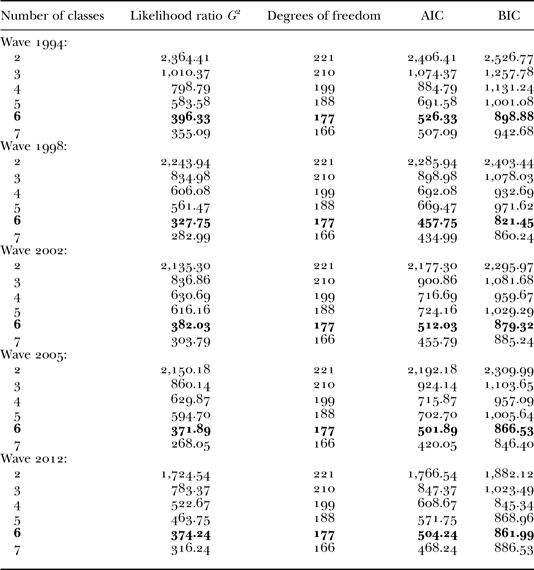
We present the goodness-of-fit statistics in Table 2. It shows the likelihood ratio statistics as well as AIC and BIC, from a two-class to seven-class model for each wave. From 1994 to 2012, the statistics clearly suggest that a six-class structure is the best latent class structure overall across the survey years except for the last two waves (bold values in the table). Using the 1994 wave as an example, the BIC decreases from 2,526.77 in a two-class model to 898.88 in a six-class model, and then increases to 942.68 in a seven-class model. All these point to a six-class model as the best. For the years 2005 and 2012, however, the patterns of BIC are less consistent. For 2005, BIC decreases steadily from the two-class to four-class model but increases for the five-class model and then decreases again. For 2012, BIC decreases consistently from the two-class to four-class model and then changes very little after that. A later examination of the item-response probabilities suggests that one class that was identified in the earlier waves has disappeared completely in 2005 and 2012 but a new class has emerged, although the new class actually resembles one of the existing classes. This suggests that time-use patterns change with increasing age and life circumstances shift accordingly. In order to keep the meaning of each class consistent across the years, we adopt a six-class structure from 1994 to 2002 and use a five-class structure for 2005 and 2012 (see the later elaboration).
Comparison of goodness-of-fit of basic latent class models, 1994–2012

Notes: Boldface type indicates the selected model. AIC: Akaike Information Criterion. BIC: Bayesian Information Criterion.
Source: Cebu Longitudinal Health and Nutrition Survey.
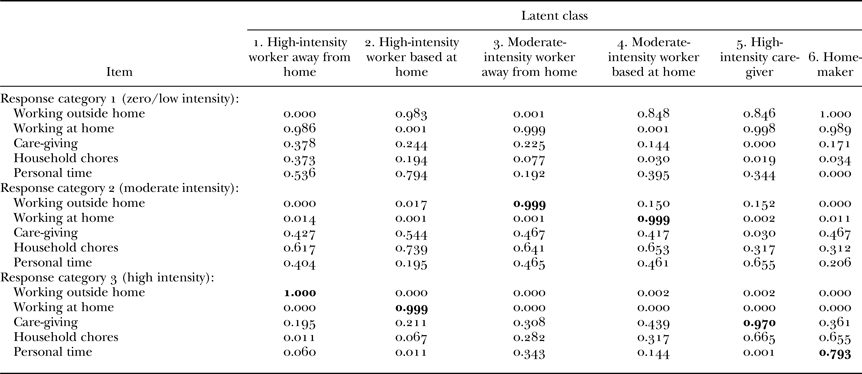
Table 3 shows the item-response probabilities associated with each class in a six-class model in 1994. Each class is distinguishable from another based on the distribution of these probabilities and thus allows us to come up with a clear substantive label for each class. In Table 3, we highlight the ρ that centrally defines the class in bold which is also what informs creation of the labels. In the summary below, we describe each class in detail and make note of the commonality and differences across these different classes.
Item-response probabilities for six-class model, 1994

Note: Boldface type indicates the ρ that centrally defines the class.
Source: Cebu Longitudinal Health and Nutrition Survey.
The first class we identify is labelled as ‘high-intensity worker away from home’. They have a 1.0 probability of being high intensity (response 3) in working outside home. Meanwhile, women belonging to this group are likely to engage in moderate household chores (a probability of 0.617 in response 2, much larger than that in the other two response categories), low to moderate care-giving activities (probability of 0.427 in response 2 and 0.378 in response 1) and a low level of personal time (probability of 0.536 in response 1). The second class is labelled as ‘high-intensity worker based at home’. They have a 0.999 probability of being high intensity (response 3) for working at home. They are also likely to engage in moderate household chores (probability of 0.739 in response 2), moderate care-giving activities (probability of 0.544 in response 2) and a low level of personal time (0.794 in response 1). Both high-intensity workers away from and based at home are obviously characterised by their high level of involvement in work (more than eight hours a day). What is also striking is that they maintain a moderate level of family responsibilities, both in terms of housework and care-giving. Clearly these two classes of women are shouldering a heavy ‘double burden’.
We identify the third class as ‘moderate-intensity worker away from home’. They have a 0.999 probability of being in response category 2 for working outside home. They are likely to engage in moderate household chores (probability of 0.641 in response 2), moderate care-giving activities (probability of 0.467 in response 2) and moderate level of personal time (probability 0.465 in response 2). The fourth class is identified as ‘moderate-intensity worker based at home’. They have a 0.999 probability of being in response category 2 for working at home. They are likely to engage in moderate household chores (probability of 0.653 in response 2), moderate to high care-giving activities (probability of 0.417 in response 2 and 0.439 in response 3) and a low to moderate level of personal time (probability of 0.461 in response 2 and 0.395 in response 1).
Classes 3 and 4 are distinguished from 1 and 2 primarily by the intensity of their workload. Women in Classes 3 and 4 engage in a moderate level of work activities while those in 1 and 2 engage in a high level of work activities. There is some difference with respect to intensity of family responsibilities of care-giving and household chores. Those in Classes 1 and 2 are unlikely to be in the high-intensity group when it comes to care-giving and household chores. Those in Classes 3 and 4 are more likely to be in the high-intensity group for care-giving and household chores, and equally likely to be in the moderate-intensity group. All of this means that women in all these four classes are subject to a heavy double burden, but the high-intensity workers are more likely to shoulder a heavier burden in the work arena while the moderate-intensity workers have a heavier demand from family responsibilities. In terms of personal time, women in Classes 1 and 2, who are high-intensity workers, suffer from the highest deficit, reflected by a very low probability of having high-intensity personal time. In comparison, the moderate workers in Classes 3 and 4 are somewhat more likely to be spending a moderate or high level of their time with personal pursuits.
The next two classes (Classes 5 and 6) are labelled ‘high-intensity care-giver’ and ‘home-maker’. What distinguishes these women from the above four classes is the high load of family responsibilities and the lack of work responsibilities. Those identified as ‘high-intensity care-giver’ have very high probabilities of being in the zero/low-intensity category for working for pay outside the home or at home (0.846 and 0.998, respectively). For Class 6, labelled ‘home-maker’, the probabilities are 1.000 and 0.989, respectively. These two classes are strikingly similar in their probabilities of having a high housework load. Women in both groups are very likely to be in the high-intensity category for household chores (item probability of 0.665 and 0.655, respectively). But, the two classes are also distinct in two important ways. ‘High-intensity care-givers’ have a 0.970 probability of being in the category of high intensity (response 3) for care-giving. For ‘home-makers’, the same item probability is only 0.361. Women in the ‘home-maker’ group are the only ones that are likely to enjoy a high level of personal time (item probability of 0.793 in response 3). ‘High-intensity care-givers’ are likely to enjoy a moderate amount of personal time (item probability of 0.655 in response 2).
The patterns of item-response responsibilities are quite similar in 1994, 1998 and 2002 (results not shown). The amount of care-giving decreases for women in every class except for Class 5 (‘high-intensity care-giver’). Given that the sample is getting older at later waves of data collection, this may be reflecting a decrease in mothering activities with increasing age. We ran the six-class latent class model for years 2005 and 2012, the same as we did for the earlier three waves. Based on the results of item-response probabilities, we find an exact match between five of the classes identified in earlier waves. However, we did not find a class that matches with the description of ‘moderate-intensity worker based at home’ (Class 4), in terms of item-response probabilities. Instead, in 2005, the sixth class has the item-response probability distribution resembling the class of ‘high-intensity worker away from home’. For 2012, the sixth class has item-response probabilities similar to the class of ‘home-maker’. In order to be consistent with analyses in earlier waves, we did not create a new class for 2005 and 2012, rather we collapsed the sixth class with the already-identified class in the previous waves which its item-response probabilities resemble. We believe that a five-class latent class structure is sufficient to describe time-use patterns in 2005 and 2012.
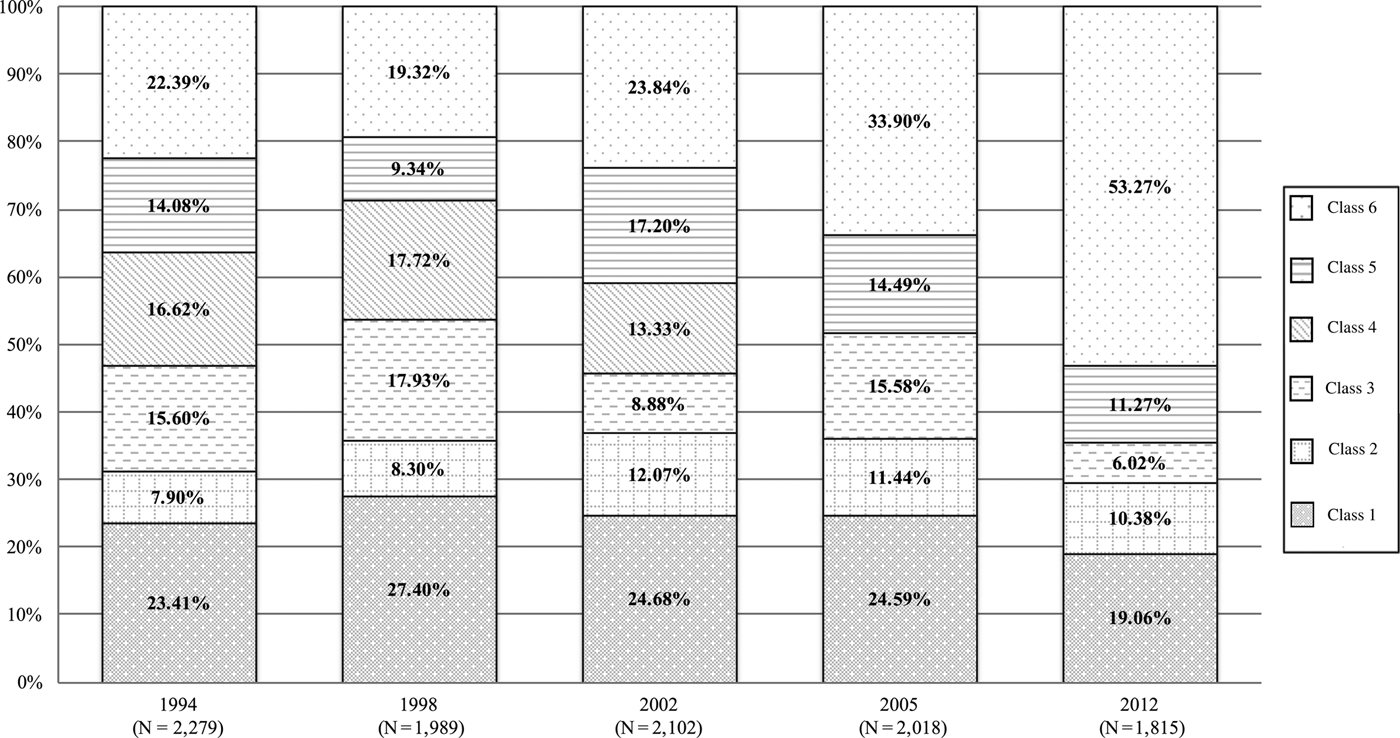
The above estimates on item-response probabilities (ρ) help us to distinguish six classes of women apart from each other (five classes in 2005 and 2012), with the first four classes subject to heavy ‘double burden’ from the combinations of work and family responsibilities, while the last two are mostly responsible for household duties only. The second estimate from the basic LCA model, class membership probabilities (γ), identifies the probability distribution of class membership in the six classes (adding up to 100%). This measure is extremely useful in helping us to document how prevalent ‘double burden’ is among the CLHNS women and whether there exists any trend over time (see Figure 1).
Distribution of time-use class membership, 1994–2012 .

About a quarter of women were identified as ‘high-intensity workers away from home’ in 1994 (modal category) and the proportion remained steady over time but dropped to 19.1 per cent in 2012. There is a slight increase in ‘high-intensity worker based at home’ over time. This suggests not much ‘scaling back’ for women in the high-intensity worker categories over time. At the same time, we observe a steady decline in the moderate-intensity worker categories. For those who are considered ‘moderate-intensity workers away from home’, the proportion dropped more than half over 18 years. As for ‘moderate-intensity workers based at home’, this category completely disappeared in 2005 and 2012. Accompanying the decline in moderate-intensity workers, we see a dramatic rise in the ‘home-maker’ class, from 22.4 per cent in 1994 to 53.3 per cent in 2012. The ‘high-intensity care-giver’ class fluctuates over time, with decreases early on and then with increases. Because care-giving is broadly defined, this could reflect a declining responsibility for caring for one's children and parents and increasing responsibilities for grandchildren care.
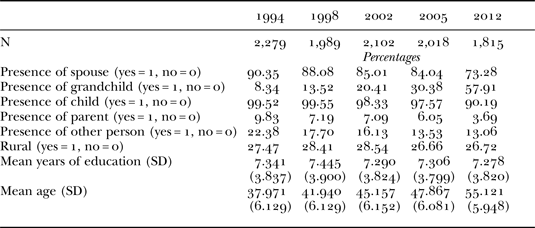
What could drive the fluctuation in time-use class membership? We hypothesise that they correspond to lifecourse transitions. In the next step of the analysis, we explore household composition as a key predictor of time-use class membership, and also include other covariates such as age, education and rural/urban residence. We measure household composition by (a) presence of a spouse, (b) presence of a grandchild, (c) presence of a child, (d) presence of a parent and (e) presence of another person. Table 4 shows the descriptive characteristics for these variables. What stands out in the changes in household composition over time is the dramatic increase in the presence of grandchildren. While only 8.3 per cent of the women had co-resident grandchildren in the household in 1994, by 2012 the majority of these women were living with grandchildren.
Mean/proportion and standard deviation (SD) for selected independent variables, 1994–2012

Source: Cebu Longitudinal Health and Nutrition Survey.
LCA with covariates
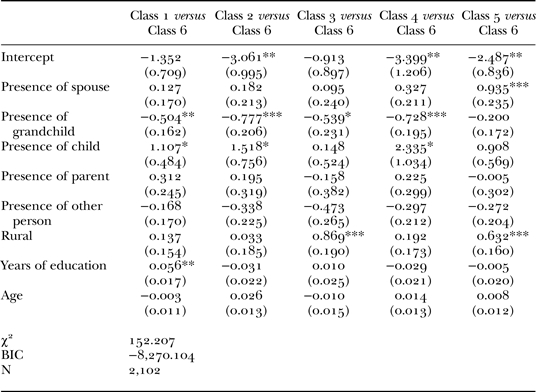
The results of the multinomial logistic regressions predicting class membership are voluminous, because we have five models for each wave of the data, with each model containing a contrast between a class and the base category (‘home-maker’). In order to facilitate our interpretation, and because the presence of grandchildren is of key interest, we calculate predicted probabilities of class membership as a function of the presence of grandchildren based on the estimated models, with all other variables held at their means (for continuous variables) and modes (for categorical variables), and present them in Figure 2 (results for the 1994 wave are not presented because only a few households had grandchildren and the effect of the presence of grandchildren was not statistically significant). We present the full results of the multinomial logit models in 2002 as an example in Table 5. We illustrate this year since it is the wave when the presence of grandchildren in the household became more prevalent (full results for other years are available upon request).
Class membership probability as a function of presence of grandchild in (a) 1998, (b) 2002, (c) 2005, (d) 2012.

Multinomial logistic regression on time-use class membership, 2002

Notes: Class 1: high-intensity worker away from home. Class 2: high-intensity worker based at home. Class 3: moderate-intensity worker away from home. Class 4: moderate-intensity worker based at home. Class 5: high-intensity care-giver. Class 6: home-maker. BIC: Bayesian Information Criterion. Standard errors in parentheses.
Source: Cebu Longitudinal Health and Nutrition Survey.
Significance levels: * p < 0.05, ** p < 0.01, *** p < 0.001.
Figure 2 clearly illustrates a difference in the high-intensity work type (Classes 1 and 2, both high-intensity workers based at and away from home), that is, women with co-resident grandchildren are less likely to engage in long hours of work, although the difference is significant in some years but not the others. For example, in 2002, the probability of being a ‘high-intensity worker based at home’ is 0.131 for those without grandchildren present in the household, as compared with 0.088 for those with grandchildren present in the household. The effect of grandchild presence is less consistent for the moderate-intensity work type (Classes 3 and 4). Having co-resident grandchildren in the household slightly reduces the probability of being a ‘moderate-intensity worker away from home’ (Class 3) in 2002, but the difference is only 0.013 (see Figure 2b). Women with co-resident grandchildren are also less likely to be ‘moderate-intensity workers based at home’ (Class 4). In 2012, those with grandchildren present in the household were much more likely to be ‘high-intensity care-givers’ than those without them (a probability of 0.134 versus 0.084).
The effect of other household composition variables is less consistent across years but there exists some commonality. As shown in Table 5, for example, the presence of children in the household increases the likelihood of being in Classes 1, 2 and 4 (‘high- and moderate-intensity workers’) relative to Class 6 (‘home-makers’). This could indicate the economic pressure faced by multigenerational households, as well as more opportunities for family members to co-operate with each other. As expected, age has little effect on time-use patterns when household composition variables effectively take into account life transitions. Having more years of education is associated with an increasing probability of being a ‘high-intensity worker away from home’, while living in rural areas decreases one's likelihood of being a home-maker relative to the others, with significant effects in some contrasts.
Results from LTA
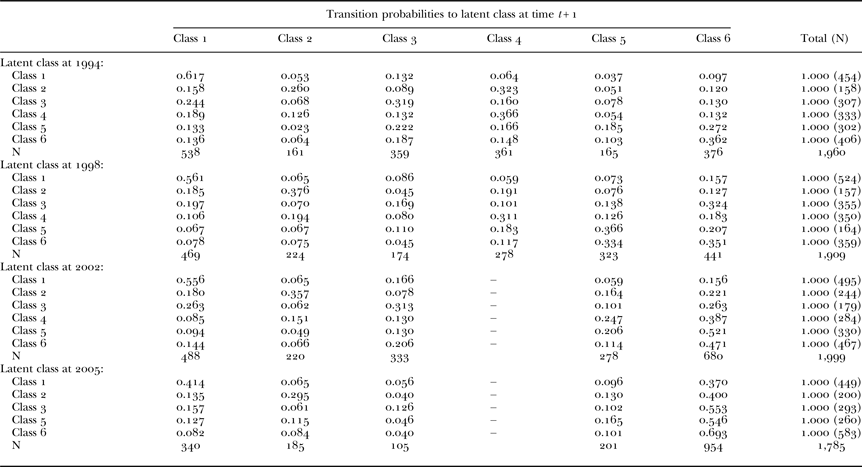
Table 6 shows the transition probabilities in time-use latent classes across the five waves of measurement. Overall, about 60 per cent of the sample experienced transition in time-use class membership in between survey intervals. Some of the classes are more stable than others. For example, 61.7 per cent of those ‘high-intensity workers away from home’ stayed in the same class from 1994 to 1998. The stability decreases slightly over time, but still 41.4 per cent of the women remained in the same group from 2005 to 2012. This pattern is consistent with our cross-sectional analysis, in that the proportion of ‘high-intensity workers away from home’ remains steady. The stability of ‘home-maker’ class increases over the years, with 63.8 per cent of those transitioned out of the class from 1994 to 1998, but the turnover rate was cut down by half in 2005–2012, with only 30.7 per cent of those transitioned out of the class. Other classes are more volatile. For instance, in the ‘high-intensity care-giver’ class (Class 5), only 16.5 per cent of those stayed in the same class from 2005 to 2012, while the majority (54.6%) transitioned into ‘home-maker’ by 2012.
Transition probabilities for time-use class membership, 1994–2012

Notes: Class 1: high-intensity worker away from home. Class 2: high-intensity worker based at home. Class 3: moderate-intensity worker away from home. Class 4: moderate-intensity worker based at home. Class 5: high-intensity care-giver. Class 6: home-maker.
Source: Cebu Longitudinal Health and Nutrition Survey.
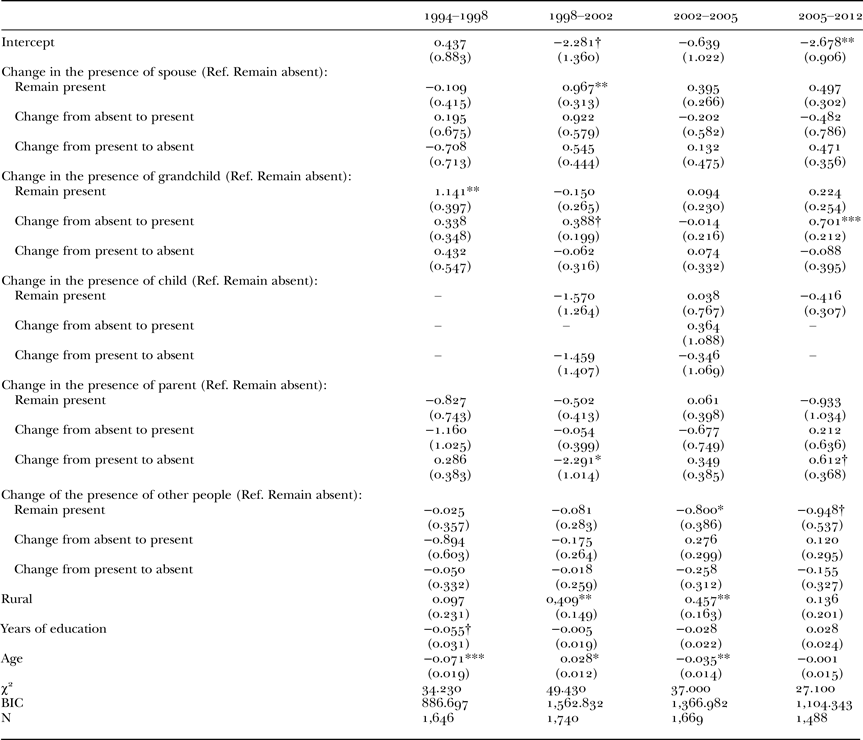
What could have prompted these transitions in time-use membership over all? Our cross-sectional LCA shows that household composition matters, particularly the presence of grandchildren in the household. As Table 4 shows, the presence of grandchildren has increased from 8.3 to 57.9 per cent of the households. Do we observe any dynamic change in latent classes of time-use membership? We now turn to our results from LTA. With five or six classes, potentially we could examine 30–36 types of transition/non-transitions in-between adjacent waves of data. With four survey intervals, the results could be overwhelming. Instead of taking an exhaustive approach, our LTA thus uses results from cross-sectional analysis as well as our substantive interests as a guide. First, we model the transition into the ‘high-intensity care-giver’ (Class 5) in logistic regression models for four survey intervals, given our interest in grandparental care-giving. The results are presented in Table 7. The key covariates for the analysis are dynamic changes in the household composition. The most notable effect in the table comes from the changes in the presence/absence of grandchildren. For example, compared with those households with no grandchildren in either 2005 or 2012, those women who experienced a transition from no grandchild to having grandchildren living in the household were twice as likely to become ‘high-intensity care-givers’ (translating the log odds of 0.701 into an odds ratio). The effect is marginally significant in 1998–2002. Interestingly, in 1994–1998, while the majority of the women did not have grandchildren in the household yet, those who already had grandchildren in the household in both survey years were 3.13 times more likely to become ‘high-intensity care-givers’ than those without grandchild in the household (translating the log odds of 1.141 into an odds ratio).
Logistic regression models of transition into high-intensity care-giver

Notes: Transition = 1; no transition = 0. Ref.: reference category. BIC: Bayesian Information Criterion.
Source: Cebu Longitudinal Health and Nutrition Survey. Standard errors in parentheses.
Significance levels: † p < 0.10, * p < 0.05, ** p < 0.01, *** p < 0.001.
We also note a couple of other interesting findings. For those with a spouse present in 1998 and 2002, women were more likely to become ‘high-intensity care-givers’ than those with no spouse in the household in both years. For those who lost parents in the household from 1998 to 2002, they were less likely to transition into ‘high-intensity care-givers’. Because we do not distinguish among spousal care, elderly care and child care in the measurement of care-giving, these transitions capture the diversity in the women's care-giving experience as they age over the lifecourse. We note that, because the presence of children in the household is very steady across waves and without much change (e.g. almost all households have children in 1994 and 1998), some dynamic effects could not be estimated and are therefore absent from Table 7.
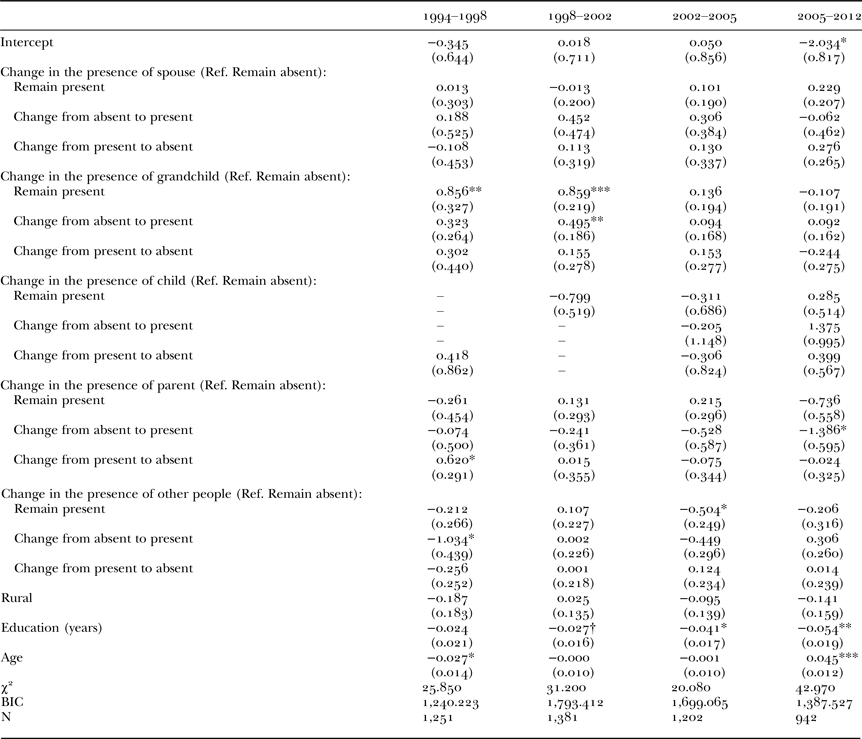
We also ran a series of logistic regression models of transition out of Classes 1–4 but did not find much effect in the dynamic change of the presence of grandchildren (results not shown). We interpret the non-findings in two possible ways. First, women do not scale back work activities even when care-giving duties potentially increase. The moderate- and high-intensity workers actually are engaged in a significant amount of care-giving and household work, and are subject to a great deal of double burden. The other possible reason for non-findings is due to the lack of power as sample sizes are quite small in each category. We estimated another logistic regression model that combined Classes 1–4 together (the ‘double-burdened categories’) and therefore modelled the transition out of work category (See Table 8). We find that the change from absent to present in grandchildren had a significant positive effect in 1998–2002, that is, women are more likely to transition out of the worker category if they experienced the addition of grandchildren to the household. We also find that from 1994 to 1998 and from 1998 to 2002 having grandchildren consistently present in the household was associated with a higher likelihood of women transitioning out of both the moderate- and high-intensity work categories, suggesting that the continued demands from care-giving for grandchildren may make a woman completely leave the workforce and become a devoted care-giver or home-maker in the family.
Logistic regression models of transition out of work, Classes 1–4 combined

Notes: Transition = 1; no transition = 0. Ref.: reference category. BIC: Bayesian Information Criterion.
Source: Cebu Longitudinal Health and Nutrition Survey. Standard errors in parentheses.
Significance levels: † p < 0.10, * p < 0.05, ** p < 0.01, *** p < 0.001.
Discussion and conclusion
Women are overwhelmingly responsible for housework and care-giving responsibilities around the world in spite of their increased entry into the labour market. Although the term ‘double burden’ is often invoked in the discussion of women's work and family roles, our understanding of these competing demands remains inadequate, particularly in the context of developing countries and transitional economies, where the informal work sector is large and the distinction between work and home environment is often blurred (Desai and Jain Reference Desai and Jain1994; Donahoe 1999; Lloyd 1991; Short et al. Reference Short, Chen, Entwisle and Zhai2002). Time-use data are an excellent source of information to help us to understand work activities that standard surveys often fail to capture, and to document the associated patterns between work and other unpaid household work and care-giving work (Floro and Komatsu Reference Floro and Komatsu2011; Hirway and Jose Reference Hirway and Jose2011).
While the gendered pattern of time use is no news, we also know little of the process during which women's time-use patterns change over the lifecourse (see the review by Sayer, Freedman and Bianchi Reference Sayer, Freedman, Bianchi, George and Ferraro2016). Time re-allocation is inevitable when one moves from younger to older age, and transitions from one role to the other. The results from our LCA and LTA of time-use allocation data for the Cebu women in CLHNS data reveal diverse patterns of configuration in work and family responsibilities over time. Close to a third of the sample are steadily engaged in high-intensity work for pay either away from home or at home. It is important to note that although we label them as ‘high-intensity workers’, the labels do not readily convey the sense that these women's involvement in household chores is still extensive (two to six daily hours). At the same time, those who are moderate-intensity workers often carry a heavy load of household responsibilities. Thus, for those groups of women, the double burden of work and home responsibilities is tilted in a different way. Without such detailed time-use information, we would not have been able to capture the nuance in the alignment in work and family responsibilities for these women.
The above results are not surprising by any means. Just like women in other parts of the world, women in the Philippines are disproportionately heavily involved in family responsibility despite their increasing contribution to the family economy. What is striking is how incredibly consistent are the classes of ‘high-intensity workers’ during an 18-year timespan from 1994 to 2012. This means that these Filipino women have been shouldering the double burden of work and household responsibilities for a long lifespan from mid-life to early old age. Although the proportion of the sample that is classed as ‘home-maker’ is growing over time, those classed as high-intensity workers decrease very little over time in their proportions. Indeed, our LTA shows that the ‘high-intensity worker away from home’ is relatively stable over time.
In addition, as many women become grandmothers and live with grandchildren, the life transition undoubtedly affects their time-use patterns. Both our LCA and LTA results clearly suggest that being a co-resident grandmother significantly increases the likelihood of being a ‘high-intensity care-giver’ and becoming a co-resident grandmother increases the transition probability into a ‘high-intensity care-giver’ across survey intervals. At the end of the 18-year span, the majority of the women in the sample still do not have the luxury of enjoying a substantial amount of personal time. For these women, the increase in care-giving responsibilities often crowds out the time for self-care, which can be critical as individuals transition into old age (Arora and Wolf Reference Arora and Wolf2014; Offer and Schneider Reference Offer and Schneider2011). This stands in sharp contrast with the experiences of older adults in developed countries, who often experience a much more noted increase in leisure time (Gauthier and Smeeding Reference Gauthier and Smeeding2003). Interestingly, we also observe that for a large proportion of the women in the sample, during the transition from mid-life to old age or into grandmotherhood, work responsibilities remain an important defining characteristic for their time-use patterns. Addition of grandchildren into the household leads to transition out of the worker role for some women but not all. Therefore, these women who remained in Classes 1–4 are still heavily double burdened, without enjoying a surge in leisure time.
While the current paper is a fruitful use of the time-use data in CLHNS, it is not without limitations. For example, changes in time-use patterns could also be attributed to period effects, apart from lifecourse effects. The economy of the Philippines is gradually becoming more industrialised, given its Gross Domestic Product of US $272.1 billion being the 15th largest in Asia (World Bank 2013). Therefore women's participation in market work during the 18-year span could be potentially affected by the economic development. In terms of generalisability of the analysis, we caution that the survey covers the second-largest metropolitan area in the Philippines and is not a nationally representative survey. Further, our analysis starts in 1994, but close to one-third of the sample has been lost to follow-up since 1983/84, with out-migration being the most common reason. As a result, women in our sample are less educated, have a higher number of children and are more likely to live in rural areas, compared with the baseline sample. Another limitation is that we characterise work by work place and work hours but do not take into account other work characteristics such as occupations, types of job or work sectors. The latent classes do not directly capture work and family conflicts, but the differentiation between work place (away from home versus home-based) is a proxy to highlight the compatibility of work and family responsibilities. Finally, our definition of role transition, specifically the transition into grandmotherhood, is limited by the household structure. For those women who become grandmothers but do not co-reside with grandchildren, we are unable to capture whether such role transition entails any shifts of their time use. Despite these limitations, we believe our study takes an important step in understanding women's time-use patterns and the changes over time in a developing country setting and in illuminating the reconfiguration of work and family responsibilities in transitioning from mid-life to old age.
Acknowledgements
This paper was presented at the 2015 annual meeting of the Population Association of America. Funding for the study comes from the National Institute of Aging (R01 AG039443; principal investigator: Linda Adair; co-investigator: Feinian Chen).