Introduction
This article analyses two Jawi manuscripts of traditions that were transmitted by Muslim miracle-workers, ritual specialists and spirit mediums, known as pawangs. Pawangs, who remain neglected by historians of Malaya, penetrated forests of the Malay Peninsula in the course of the eighteenth and nineteenth centuries, negotiated with spirits, and extracted natural resources.Footnote 1 These miracle-working men and women were venerated for their esoteric science (ilmu) and employed by Malay peasants, as well as Chinese, Malay, and European miners. Miners were in awe of the pawangs’ ‘wonderful nose’ for prospecting for tin and depended upon pawangs’ esoteric knowledge of the terrain in western Malaya.Footnote 2 A traveller ploughing through the interior of nineteenth-century Malaya would have encountered a variety of pawangs. This traveller would have met pawangs in mines, pawangs who trapped elephants for their Asian and European clients, pawangs who crafted guns and bullets, and the rice pawangs this article focuses on.
The following sections investigate an epistle of an agrarian pawang from the Malay state of Negri Sembilan, and examine a Kitab Perintah Pawang (Book of the Pawang's Command) that was transcribed in the state of Perak (see Map 1). These documents of pawangs have been selected from a broader corpus of Malay manuscripts pertaining to religious economies and pawangs. A number of post-colonial scholars have dismissed these manuscripts as texts replete with legends, fantasies, magic, folklore, and entertainment, rather than the ‘stuff of historians’.Footnote 3 According to these scholars, these texts lacked the scientific data required for writing histories of social, economic, and cultural worlds in early modern and modern Malaya. Through examining these compendia of frontier patois, I aim to recount a history of rice worlds in the interior of modern Malaya, wherein projects of forest clearing and cultivation were spearheaded by pawangs. Indeed, these two manuscripts contain rich data of economies in which agrarian change, extraction, and production were directly associated with the esoteric science of pawangs and their rituals of communicating with spirits. Spirits of the Malayan interior who were drawn into conversations by pawangs and were mobilized for agrarian work included prophets, divinities, demons and jinns of Asian descent and Zanggi (an appellation indiscriminately given to Black African and ‘African’-looking peoples in general) origins. Moreover, the popular historical traditions of peasants in nineteenth- and early twentieth-century western Malaya have been recorded in these texts, and they are invaluable historical documents of the religious and economic sensibilities of cultivators. These manuscripts are truly products of settings wherein Muslim peasants associated the success of rice agriculture with pawangs and implemented the instructions of pawangs in forests and ricefields.
Malaya. Source: Indien: Handbuch Für Reisende, published by Verlag von Karl Baedeker, Leipzig, 1914. Courtesy of the University of Texas Libraries, The University of Texas at Austin.

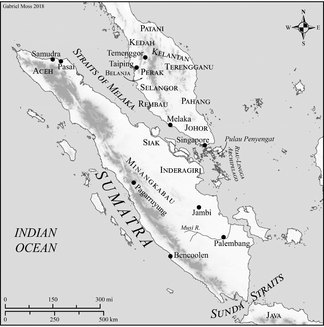
This article begins by analysing the 1922 epistle of a Tamil pawang, Abdullah bin Pilleh, before investigating the 144-page-long Kitab Perintah Pawang that was transcribed in 1879. This has been done to acquaint readers with rice worlds in modern Malaya in which agriculture was associated with the intercession and fertility rituals of actual pawangs like Abdullah Pilleh. Indeed, Abdullah Pilleh belonged to a prestigious lineage of pawangs from Negri Sembilan and was venerated as a successor of the first human pawang. By 1913, he commanded a cult of devotees from the villages of Sepri, Chembong, and Batu Hampar in the district of Rembau in Negri Sembilan.Footnote 4 Abdullah Pilleh's 1922 epistle recorded a historical tradition that was popular amongst members of this agrarian cult. This tradition traced dry and wet rice production in the Malay state to the prophet Muhammad and Muslims who migrated from the Minangkabau uplands of central Sumatra to Malaya. In fact, in between the medieval and modern periods, parts of the Peninsula such as Rembau had expanded as key areas of settlement for migrants from Minangkabau, who were moving for religious and economic purposes (see Map 2).Footnote 5 The 1922 epistle, however, remembered events from the agrarian lives of the first batch of Minangkabau migrants to Negri Sembilan, and their prophetic ancestor Muhammad, to emphasize that they were all dependent upon the powers of the pawang. It was highlighted here that prophets, historical colonizers, and contemporary Muslim peasants alike had to depend upon the pawang for successful rice production.
The Malay Peninsula and Sumatra. Source: Gabriel Moss. Courtesy of the author.

The Kitab Perintah Pawang was transcribed in the sub-district of Belanja in the upstream interior of Perak by the headman, pawang, and noble, Hajji Raja Yahya.Footnote 6 The 1879 Kitab compiled traditions related to the role of the pawang in leading Muslim colonization of the frontier and in establishing the ladang (dry ricefield and product of cultivation upon high, dry ground). These were traditions of an economy in the north-western Malayan interior wherein a form of transhumant agriculture upon unlimited forest lands, as well as a doubling of the population of Muslim peasants since the 1830s, had produced ladangs.Footnote 7 The Kitab meticulously described how the archetypal pawang led labourers to clear forests, helped Muslim peasants establish ladangs, and negotiated with spirits of the forest to ensure agrarian change. The modern pawang and heir of a chain of historical pawangs gave religious sanction to a type of subsistence cultivation that was subsequently prohibited by the British Residency in Perak.
These traditions of pawangs on the frontier were recorded in the Kitab Perintah Pawang by Hajji Raja Yahya, who thence gifted his manuscript to the Assistant Resident of Perak, William E. Maxwell. Such scholarly collaborations between pawangs and representatives of the British Residencies in western Malaya were common by the late nineteenth century. Pawangs and Malay scribes were regularly employed to transcribe traditions that had been orally transmitted by pawangs and members of their cult and to copy manuscripts housed in libraries of Malay royals. A year before the Kitab was written, Maxwell had stressed that it was urgent to document the popular religious traditions of Malay Muslims and gain ‘explanations about various customs and ceremonies’ that were prone to ‘diminish as civilisation extends’.Footnote 8 Following Maxwell, a list of European scholars and administrators in late nineteenth- and early twentieth-century Malaya looked upon pawangs as mines of information on Malay religion, and as prime agents of extracting natural resources. In fact, these scholar-administrators employed pawangs to penetrate the Malayan interior, hunt elephants, and conduct scientific experiments.Footnote 9 They also hired pawangs to transmit their esoteric knowledge of the environment and resources to scribes. All these scholarly collaborations produced a plethora of Jawi and romanized Malay documents, including the Kitab Perintah Pawang, manuals for tin and gold mining, and botanical treatises.
The employee of the Straits Settlements Civil Service, Charles O. Blagden, referred to the pawang as the ‘indispensable functioning’ in western Malayan forests and ricefields. In his 1892 ethnographic notes, Blagden highlighted that the pawang was essential for ‘sowing, reaping, irrigation works, clearing jungle for planting and other agricultural operations’.Footnote 10 In 1897, the ethnographer William W. Skeat advised English scholars against dismissing the faith Malay Muslim peasants placed in the magic of rice pawangs as ‘childish folly’.Footnote 11 According to Skeat, Malay Magic was intelligible in terms of its ‘real significance’ in forests and ricefields. Moreover, in a 1926 pamphlet, the Director of Education, Straits Settlements and Federated Malay States, Richard O. Winstedt, argued that pawangs were ‘not mere charlatans even to the eye of the materialist’.Footnote 12 In Winstedt's words, pawangs possessed weapons in their ‘spiritual “gun-room”, for rice agriculture, trapping, hunting and mining’. Even as little post-colonial scholarly attention has been paid to manuscripts of pawangs’ traditions, Farouk Yahya’s more recent book on Magic and Divination examined the ways in which manuscripts like the Kitab Perintah Pawang were illustrated.Footnote 13 While Yahya adopted a strict art historical focus, this article complements his work by exploring these magical manuscripts as rich sources of historical data on socioeconomic worlds that remain inaccessible to the academy. In the Malayan interior, the ‘magic’ of Islam encouraged peasants, miners, and hunters to extract natural resources.
Amidst this conspicuous academic silence on pawangs and religious economies, a number of scholars of the agricultural economy in modern Malaya have acknowledged that rice cultivation was esteemed for cultural reasons and associated with pawangs. In the words of John M. Gullick, it was an ‘occupation hallowed by tradition and esteemed for more than purely economic reasons’.Footnote 14 Following Gullick, Paul H. Kratoska, Cheng Siok Hwa, Lim Teck Ghee, and Patrick J. Sullivan have mentioned that rice production was the most important facet of the economic life of Malays due to the high religious value of rice.Footnote 15 This was in spite of the fact that rice cultivation was prone to vermin, tropical diseases, and vagaries of water supply, and that it provided a lower income than market gardening and wage labour. In brief sentences and footnotes, the aforementioned scholars recognized that Malay Muslim peasants in general conceived of the crop as a supernatural bounty and actively practised a religion that encouraged agrarian life. These scholars also mentioned that pawangs were indispensable experts of rice cultivation, and possessors of esoteric environmental science and magic. They orchestrated rituals in ricefields and fixed times for a variety of agricultural operations. Moreover, Ronald D. Hill's comprehensive historical geography of Rice in Malaya noted that ‘magico-religious observances pertaining to rice’ persisted within late nineteenth-century Malacca, Negri Sembilan, and Perak.Footnote 16 Hill acknowledged that Malay Muslim peasants refused to substitute rice with ‘more remunerative crops’ due to religious sanction. He also mentioned that, in states like Perak, a system of Muslim law compelled cultivators to employ pawangs, to vivify their ricefields once every three months.
The following sections propose that Abdullah Pilleh's epistle and the Kitab Perintah Pawang are key historical documents for writing new economic, labour, religious, and connected histories of Malaya. In doing so, this article is inspired by Carlo Ginzburg's The Cheese and the Worms and his notes on microhistory. Herein, Ginzburg focused upon magical individuals who were regularly ignored by mainstream historians, and undertook a historical investigation of documents replete with ‘fairy-tale and absolutely exceptional’ traditions.Footnote 17 Ginzburg argued that a microscopic examination of these magical individuals and traditions would provide valuable information on the ‘characteristics of an entire social stratum in a specific historical period’.Footnote 18 In focusing upon these manuscripts, I am also inspired by the more recent writings of a number of scholars working on historical discourse in pre-colonial and colonial India and Africa. Historians such as Daud Ali, Steven Feierman, Nile Green, Azfar Moin, Scott S. Reese, and Luise White have argued that texts full of magic, wonder, divination, spirits, and chronological anachronisms were exceptionally reliable historical documents.Footnote 19 These scholars proposed that such magical materials were imperative for writing histories of social worlds that were otherwise inaccessible to the academy. These documents promised rich information on historical agents who are ignored in academic literature, and data of the magical terms these actors had used to understand their terrain, activities, transitions, and dangers.
In writing a history of religious economies and pawangs, I am also indebted to Michael Adas's work on the rice frontier of Lower Burma, and Richard M. Eaton's writings on the Islamic colonization of the Bengal delta.Footnote 20 Adas's project to write a broad socio-economic history of the late nineteenth- and early twentieth-century Burma delta endeavoured to ‘fully integrate the much neglected history of the “peasant masses”’.Footnote 21 Adas's ‘insider's history’ of the frontier, however, was based upon European settlement reports. In particular, he explored reports pertaining to how rice production exponentially increased after the British annexation of Lower Burma in 1852. This article attempts to write an insider's history of the Malayan interior through analysing Jawi texts that were produced very close to the action in forests and ricefields. It aims to write a history of agrarian change through a perspective that was much closer to that of Muslim peasants, and pays attention to the religious terms these subalterns and their pawangs used to describe their dangerous, nutritional, and spiritual frontiers.Footnote 22
Eaton's works on the early modern rice frontier of Bengal examined Bengali literary texts and traditions relating to the miracles of colonizing pirs (elders; holymen). According to Eaton, these early modern and modern Bengali literary texts were produced by Muslim communities and scribes associated with the colonization of the Sundarbans forests. These communities and scribes ‘mytho-historically’ argued that Islamic prophets and saints were the first colonizers of the Bengal delta, and their traditions showed that charismatic pirs led forest clearing in the early modern Sundarbans. Nevertheless, Eaton conceded that these early modern colonizer-pirs were in all probability ‘industrious and capable forest pioneers’ who were reconstructed into Islamic colonizers by the modern period.Footnote 23 In the popular memory of modern Bengali peasants, these forest pioneers had ‘swelled into vivid mythico-historical figures, saints’.Footnote 24 The manuscripts explored in the following sections, however, described rice worlds wherein pawangs were, in the course of their lifetimes, pivots of a ‘socioeconomic system geared to the production of rice’ and an Islam that ‘conferred special meaning on agrarian life’.Footnote 25
The planter prophet and the messianic pawang in Negri Sembilan
Spoke God the Sacred and Mighty to the prophet Muhammad [—] endeavour to establish a ladang [dry ricefield] so as to materialise nutritional sustenance . . . Muhammad established a garden and a ladang . . . upon the appearance of a padi disease manifest as rats, caterpillar-like rice pests [ulat]. . . the pawang who was named ya Muhammad Saleh was called . . . . He was the Pawang of Provenance!
Abdullah bin Pilleh, Rembau (1922)
In a Jawi epistle dated 16 February 1922, the pawang Abdullah Pilleh transmitted the genealogical tradition, Darihal Pawang (Of that Concerning the Pawang), to the District Officer of Rembau.Footnote 26 The transmission of the Darihal Pawang commenced with tracing a historical period wherein ‘God’, ‘Muhammad’, the ‘Earth’, and ‘sky’ were not yet known as such, and wherefrom God created the nur Muhammad (light of Muhammad) as an object of divination. This light, in turn, created the aligned solar system and a plethora of supernatural beings. These beings included keramats (miracle-workers and miracle-working shrines), jinns, hantus (demons), shetan (armies of Iblis, not to be confused with Satan, Iblis), and, most pertinently, the Pawang of Provenance. This pawang was introduced by the Prophet Muhammad to God as Muhammad Saleh.Footnote 27
Abdullah Pilleh proceeded to introduce a slightly later historical period in which the Prophet Muhammad became paranoid about the food scarcity of his emerging community. Seeking urgent solutions, the prophet approached God and the archangel Jibrail, who had earlier transmitted the Qur'an to Muhammad. Upon the advice of God and Jibrail, Muhammad established a ladang and a garden for the production of rice, wheat, and millet.Footnote 28 The resolutely Malay (rather than Arab) prophet selected Negri Sembilan as the chosen land for food production and thereby established an Islamic work ethic of subsistence cultivation for his contemporary and future community.Footnote 29 Nevertheless, the pioneer planter was struck by calamity when a rice epidemic ravaged his ricefields upon their maturity. The prophet was compelled then to plead for the miracle-worker and intermediary of agrarian frontiers, the Pawang of Provenance, Muhammad Saleh.
Abdullah Pilleh's epistle was preoccupied with narrating historical events that demonstrated the miraculous expertise of Muhammad Saleh. Indeed, the pawang restored Prophet Muhammad's ricefields in seven days and won believers throughout prophetic Negri Sembilan. The epistle emphasized that dry rice-pushing prophets, historical cultivators of permanent wet rice in marshes, and contemporary Muslim cultivators alike were dependent upon the intercession of the pawang. Beyond the aforementioned episode of the prophet Muhammad's impotence vis-à-vis Muhammad Saleh, it elaborated upon a historical event from the medieval period that was memorialized by generations of pawangs and peasants in Negri Sembilan. This event was that of establishing a pioneer permanent wet rice colony at a ‘broad and extensive marsh’ in the Malay state.Footnote 30 According to Abdullah Pilleh, this historic colony was a product of collaboration between the community and heirs of Prophet Muhammad, ‘human assemblies’ (an allusion to non-Muslims), hantus (demons), jinns, and shetan (armies of Iblis). This appeared to be a reference, to which nineteenth-century oral traditions recorded in Rembau attest, to the establishment of permanent wet rice colonies in the lowland valleys of Negri Sembilan, by circa 773/1388.Footnote 31 These colonies were established by Minangkabau settlers and sheikhs who were simultaneously experts of agricultural techniques and Islam, as well as the aboriginal horticulturalists of Jakun (or related) stock.
Abdullah Pilleh's didactic epistle placed little emphasis upon orthodox historical chronology. It was instead preoccupied with listing historical episodes that were remembered in Negri Sembilan rice worlds, wherein Muhammad Saleh miraculously intervened on the behalf of colonizers. Indeed, the early twentieth-century pawang accentuated that the aforementioned pioneer Minangkabau wet rice colonizers were forced to beg for the intercession of Muhammad Saleh. In the fashion of their prophetic forefather Muhammad, they were compelled to do so upon persistent outbreaks of rice epidemics and vermin.
Following the fourth month of the second annual crop, the pioneer wet ricefields of Negri Sembilan were ravaged by these epidemics. A mere beckon away from the believing cultivator, the time- and space-travelling Muhammad Saleh popped up in the Malay state. He mobilized the peasantry for a seven-day-long fertility rite, berpuar, to expel the real cause of rice epidemics and vermin: malignant supernatural beings. The berpuar was a spiritual combat with the stems of puar, amomum cardamomum, that were described by a witness in early twentieth-century Negri Sembilan as ‘3½ feet long darts’.Footnote 32 Spearing the four directions with puar stems, a war-cry-screaming Muhammad Saleh led a march of cultivators, armed with items such as gongs, elongated weapons, multi-coloured flags, and banners. They marched into the wet ricefields (sawah) from the upper waters of the principle river watering the parish area's valley(s) to the lower reaches. The pawang terrified malevolent hantus and rice pests in the sawah, in the course of reminding colonizers to befriend beneficial jinns and armies of Iblis in the upstream interior through buffalo sacrifice.
Abdullah Pilleh's direct associations of dry, hill, and wet rice cultivation in Negri Sembilan with Islamic forefathers and the archetypal pawang serve to address lacunae in historiography on peasants’ Islam in Malaya. In the words of Leonard Y. Andaya and Barbara W. Andaya, Malayan historiography yet suffers from ‘glaring gaps’ in knowledge of the practice of Islam and the ‘life of the Malay peasant’ and ‘common people’.Footnote 33 The contributions in Greg Bankoff and Peter Boomgaard's History of Natural Resources in Asia and Boomgaard and David Henley's Histories of Foodcrop and Livestock Farming further highlight that historians have paid ‘literally no attention’ to certain key subjects.Footnote 34 These subjects include the belief systems and popular historical traditions of Southeast Asian agriculturalists and the ‘conventions, schemata and stereotypes’ employed by them to define environments and resources.
The 1922 Jawi epistle is thus an invaluable document of the religio-historical sensibilities of Minangkabau peasants in modern Negri Sembilan who associated the expansion of the rice frontier and crop with the ilmu and miracles of Muhammad Saleh. In fact, according to Abdullah Pilleh, this Pawang of Provenance, who was employed by the Prophet Muhammad and fourteenth-century Muslim colonizers, lived to conduct fertility rites in the ricefields of nineteenth-century Negri Sembilan. Whilst Abdullah Pilleh's hagiography of the Pawang of Provenance was silent about Muhammad Saleh's genealogy, the scribe was careful to attach a section entitled ‘The Descent of the Pawang of Provenance’. This section chronologically charted a list of pawangs who succeeded Muhammad Saleh as heirs of his chain of authority, up to Abdullah Pilleh. It revealed that the ancient, albeit time-travelling, Muhammad Saleh was only replaced by a successor-pawang in 1867.
Abdullah Pilleh's account of the messianic pawang’s encounters with the Prophet Muhammad and his Minangkabau heirs in Negri Sembilan was not simply a record of an imagined Islamic past. It served as a document of the socio-economic sensibilities and agricultural techniques of communities of Minangkabau colonizers and peasants in nineteenth- and early twentieth-century Negri Sembilan. A range of European documents suggested that Abdullah Pilleh's portrayals of rice agriculture as an occupation transmitted from pious ancestors to modern Muslim peasants were far from being self-fulfilling exaggerations of a profiteering pawang. These documents consisted of the writings of representatives of the British Residencies in western Malaya, compiled in the 1893 compendium Reports Furnished by Order of His Excellency the Governor upon the Best Means of Encouraging the Cultivation of Rice (Rice Reports). Multiple Rice Reports emphasized that the Minangkabaus of Negri Sembilan were an ‘ideal peasantry’ that preserved ‘ancient habits and traditions’.Footnote 35 Herein, it was accentuated that, amongst the Malays of Negri Sembilan, the cultivators of Rembau were peculiarly prone to conceive of rice as an ancestral factor of production rather than an ‘ordinary article of commerce’ for sale and exchange.Footnote 36
Rice cultivation in Rembau was further described as being driven by customs and religio-historical precedent in the early nineteenth-century writings of an officer in the 23rd Regiment Madras Light Infantry, as well as an 1884 article of the Resident-Councillor of Malacca, Dudley F. A. Hervey.Footnote 37 On the one hand, according to these English records, the peasants of Rembau religiously opposed the extraction of alluvial tin deposits, fearing that the discharge would ‘poison the “sawah” and impede rice cultivation. On the other hand, these cultivators abided by agricultural techniques inherited from pious ancestors, including the method of preparing the soil before harrowing by means of a large wooden “changkul” or hoe’. In spite of buffaloes being more available in Negri Sembilan vis-à-vis Malacca wherein buffaloes were employed for ploughing and puddling, the quintessential cultivator of Rembau followed the footsteps of the hoe-bearing Prophet Muhammad. Furthermore, instead of harking back to a prophetic past, Abdullah Pilleh depicted the prophet Muhammad in the fashion of archetypal nineteenth-century Minangkabau ladang-pushers. These ladang-pushers were cultivators of tracts of secondary forest upslope from a garden that provided a variety of vegetables upon the piedmont. They enjoyed an ‘innate love of liberty, and freedom from all shackles’ of state monopolies over river systems that snaked into the interior.Footnote 38 These peasants were connoisseurs, like the first planter Muhammad, conscious of ladang rice being ‘sweeter and whiter, and to keep better’ than the ‘watery’ rice of wet fields.
In the manner of Malay epistles, demonologies, and manuals pertaining to pawangs who eradicated pests, Abdullah Pilleh's epistle contained rich information on how Muhammad Saleh's heirs were venerated as messianic, fertility-bestowing pawangs.Footnote 39 This is apparent in both the discussion of Muhammad Saleh's expertise in prophetic and historical Negri Sembilan and the aforementioned section on the Descent of the Pawang of Provenance. Herein, through a chain of succession, Abdullah Pilleh associated himself with the esoteric science and miraculous expertise of Muhammad Saleh and his pre-1867 ‘agency as pawang’ (jawatan pawang).Footnote 40 This was an agency even the prophet Muhammad lacked. In this section, the pawang legitimized his succession of his Minangkabau guru ‘Pawang Dris’ (Idris of Sepri) in 1913 and command over parish areas and miracle-working shrines (keramats) in the district of Rembau. Abdullah Pilleh highlighted that his agency was premised on its faculties to assure Negri Sembilan the ‘extensive comprehensive healthy padi . . . and bountiful pleasures’ it enjoyed under the supervision of Muhammad Saleh in the nineteenth century.Footnote 41 Abdullah Pilleh also elaborated upon how two of his predecessors and aspirants of the ‘agency as pawang’ and Muhammad Saleh's expertise had been fired in 1895 and 1904, respectively. These wannabe pawangs had been fired due to the emergence of ‘poor padi’ and civil strife within the peasantry of Negri Sembilan, during their period in office.
It is difficult to ascertain whether Abdullah Pilleh's epistle sought to legitimize his ‘agency as pawang’ through the aforementioned Descent of the Pawang of Provenance. Indeed, he had ascended from being a Tamil orphan from the village of Chembong and from being a mere ‘child disciple’ of the Minangkabau pawang Dris, to the rank of Pawang commanding Minangkabau parishes.Footnote 42 Nevertheless, in addition to the 1922 epistle, a variety of materials provided snippets of information on projects of colonization in the western Malayan interior that were spearheaded by multifarious pawangs such as Abdullah Pilleh. Malay manuscripts, newspaper articles, and the writings of European scholar-administrators and missionaries were all equally telling of projects that involved Malay and creole (Arab-Malay) husbandmen, as well as Tamil and southern Chinese cultivators in the case of the district of Krian in Perak.Footnote 43 These late nineteenth- and early twentieth-century enterprises were driven by Malay, Tamil, and Arab Muslim pawangs and their less significant European Roman Catholic and American Methodist competitors. Herein, the success of agrarian change was directly associated with the esoteric science and miracles of these ‘pawangs’.
Abdullah Pilleh's discussion of the prototypical rice pawangs’ ‘agency’ neither provided specific examples of extensions in the Nerasau valley of Rembau in the 1890s nor mentioned outbreaks of epidemics such as rinderpest from 1882 to 1884.Footnote 44 Nonetheless, it furnished valuable data on subaltern socio-economic worlds that yet remain in obscurity for most Malayan historians. Herein, agricultural progress, the rice crop, and Islam were associated with a chain of pawangs who, to paraphrase Eaton, were ‘saints whose lives served as metaphors for the expansion of both religion and agriculture’.Footnote 45 This lineage of pawangs comprised Muhammad Saleh and his successor, Abdullah Pilleh, who mediated epidemic-causing spirits and determined ‘extensive comprehensive healthy padi’ in Negri Sembilan.Footnote 46
The Tamil pawangs’ epistolary claims that the esoteric science of Muhammad Saleh was indispensable in Negri Sembilian rice worlds were substantiated by the diatribes of a reformist Muslim courtier. This was the Undang or Supreme Law Giver of Rembau, Dato Sedia Raja Abdullah bin Haji Dahan (in office 1922–38) whose successor, Dato Hajji Ipap (in office 1938–62) fined Minangkabau clan chiefs for facilitating rice pawangs.Footnote 47 The writings of Abdullah bin Haji Dahan berated pawangs who held unparalleled authority over Muslim peasants in modern Negri Sembilan, and were venerated as saints and godlike intermediaries of wet ricefields. In the words of the courtier, these pawangs were, in reality, ‘lamentable obstacles’ to the economic progress of Muslim commoners and relics of the ‘pre-Islamic “Days of Ignorance”’.Footnote 48 The fact that rice production in nineteenth- and early twentieth-century Negri Sembilan was directly associated with pawangs such as Muhammad Saleh was particularly apparent in a 1925 article of Abdullah bin Haji Dahan. This was written to rubbish the aforementioned berpuar ceremony that had been initiated by the zealously venerated Muhammad Saleh and was a fertility rite perpetuated by his heirs in contemporary Negri Sembilan. The courtier's article, however, reproduced a concise hagiography of Muhammad Saleh that was circulated in rice worlds of the Malay state. Herein, the pioneer pawang and his successors were attributed esoteric knowledge of a ‘Book’ of miracles and remedies transmitted by God to Muhammad Saleh via the prophet Muhammad.Footnote 49 This relegation of the Prophet Muhammad into the role of Jibrail, transmitting the Qur'an to Muhammad Saleh, was similar to Abdullah Pilleh's portrayal of the prophet as being dependent upon the pawang. These representations were testaments of Malayan frontiers whereupon cultivators called upon messianic pawangs and their successors rather than the historically distant and less efficacious Prophet Muhammad.
The Pawang's Command: traditions of Islamic colonization from the spiritual frontier
Requesting the clump of practise in this [forested] territorial space . . . my anak chuchu [descendants], raiat [peasants, freemen], tentera [armies] cut down brushwood [—] fell large trees [—] plant directly through dibbling holes in the clump of practise of this territorial space . . . in this earth of beasts for the ladang [—] it is not I who fells timber by cutting fine notches [—] it is the primordial Being, Pawang Sadia [—] the Vice-regent Pawang [—] Batara Guru [Siva] . . . . Retreat, withdraw demons and armies of Iblis! The children of Adam intend to make passage.
Kitab Perintah Pawang, 1879Footnote 50
The preceding section explored Abdullah Pilleh's 1922 epistle that associated rice agriculture with religio-historical tradition and with the intercession and rituals of pawangs who straddled the ephemeral boundaries between human and spiritual agency on the Malay frontier. This section focuses upon select traditions recorded in the 1879 Book of the Pawang's Command—a compendium of chapters, sections, and clauses of recitations, charms, and talismans that were orally transmitted. These portions of the Kitab Perintah Pawang were related to the prototypical pawang’s command over operations in forests and ricefields, and the religio-historical basis of the pawang’s command. Moreover, these parts of the text pertained to rituals of communication undertaken by the pawang with eclectic spiritual beings upon the terrestrial frontier. As a concluding note specified, the manuscript was completed by Hajji Raja Yahya upon 21 Shaaban 1296 (10 August 1879) in the village of Belanja Kanan, in the interior of Perak.
My exploration of the Kitab Perintah Pawang aims to address the lacuna in academic literature on Islamic texts on environments and natural resources. Alan Mikhail's and Arash Khazeni's works on Middle Eastern and Central Asian environments, for instance, have argued that historians have so far neglected ‘Islamicate systems of knowledge about nature’.Footnote 51 According to these historians, the academy has ignored Islamic literature informative about how ‘Muslims have put into real world effect’ religious knowledge on reclaiming environments.Footnote 52 The scribe of the 1879 Kitab unfortunately provided no data regarding the connections between recorded agricultural traditions and specific peasant communities or rice pawangs. He also provided no information about the original transmitters of parts of the Kitab, beyond certain names. Nonetheless, the transmitters of the text appear to have been particularly familiar with actual trends in forests wherein pawangs selected precise plots (or clumps of practice) for prospective ricefields. Upon selected terrain, these pawangs spearheaded forest clearing and planting in the ‘earth of beasts’, which was in turn converted by the pawang’s rites, into the Muslim peasant's ladang.Footnote 53
These transcriptions in the Kitab are cogent representations of types of subsistence cultivation as well as agricultural techniques that were subsequently prohibited by the British Residency in Perak from 1888. This was done through Orders in the Perak Council such as the Order in Council No. 6 of 1890 that was passed ‘with the object of discouraging the cultivation of ladang’ or the ‘temporary and destructive use of land by transients’.Footnote 54 This Order was designed to encourage permanent agriculture upon potentially productive land in western Malaya so as to address the Peninsula's ‘massive annual food deficit’ and reduce the amount of rice being imported from Burma and Siam, to feed a burgeoning population of foreign labourers.Footnote 55 The Order was enforced under the auspices of District Offices by 1893 and through schemes such as an 1891 project to colonize blocks of land near Belanja for permanent wet rice production. As a matter of fact, it struggled to terminate ladang agriculture, since the ‘objective of the Perak Malay was self-subsistence’.Footnote 56
According to Maxwell's 1884 survey of customary Malay land tenure and contributions to the 1893 Rice Reports, ladang was encouraged by the ‘availability of land’ and dire ‘want of population’ in late nineteenth-century Perak. In Maxwell's words, it was ‘no doubt, the national Malay mode of agriculture’.Footnote 57 Significant portions of the Kitab Perintah Pawang described agrarian settings in which this ‘national Malay mode of agriculture’ had attained deep religious connotations. Herein, ladang cultivation was associated with establishing an Islamic presence or clump of practice in Malay forests, emulating historical pawangs and channelling God's powers to Malaya. According to the transmitters of the Kitab, this was a process of supernaturally converting the forested ‘earth of beasts’ into a Muslim ladang.
Chapters of the 1879 Kitab that captured the procedures of establishing a dry ricefield were coherent with the erstwhile Principal Secretary, Bencoolen, William Marsden's 1783 notes on ‘shifting cultivation’.Footnote 58 These chapters of the Kitab included, on the one hand, the chapter recited to incense whilst towards commencing upon felling establishing the ladang. This chapter was in all probability recited before the husbandman selected and appropriated a plot (that was, in Marsden's words, an ‘acre or two in extent’). On the other hand, these chapters consisted of the chapter recited to the timber-knife that reported on how the descendants, peasants, and troops cleared brushwood and dislocated and deviated roots and sprouted to the sky large trees through lopping their branches off. Forest clearing herein was depicted as an activity of emulating historical pawangs and conducted under the auspices of their contemporary heir, a physically present pawang. These transmissions further included, first, the chapter recited to incense towards conducting burning that described forest clearers being led by the pawang to violently conquer the ‘earth of beasts’ and set fire to cleared timber and underwood that was adequately arid; second, the recitation whilst burning that elaborated on how the pawang channelled the ‘permission of God the All Powerful’ into Malay forests for burning the last logs in the clearing; and, third, the chapter recited whilst directed towards planting the seed directly that portrayed how the pawang facilitated sowing in shallow holes across the ricefield. Typically, according to Marsden, bluntly pointed five-feet-long sticks were used to make shallow holes into which approximately five seed grains were dropped.Footnote 59 This operation that followed a month- or two-month-long period of comprehensive burning marked the miraculous conversion of the ‘earth of beasts’ to the Muslim's ladang.
The transmissions recorded in the Kitab Perintah Pawang moreover serve as windows into forests in nineteenth-century Malaya, wherein agrarian change was directly associated with the labours of historical pawangs and prophets. These pawangs included the primordial Being, Pawang Sadia (Skr. sadhya, accomplishment or perfection), and Pawang Asal (Ar. asl, provenance or extraction), who served as the first Vice-regent Pawang, of Sadia. Other such pawangs of the Kitab, which often confused pawangs with prophets and divinities, were the prophets Noah and Adam, and rice divinities such as the Batara Guru (Siva), who was also the grandson of Noah.Footnote 60 The image of historical pawangs as pushers of agricultural labour emerges in the Kitab’s preface, Origin and Genealogy of the Pawang, that was transmitted by a pawang, Puan Jambi (the Madam of Jambi, Sumatra). She was, in turn, credited with preserving the transmissions of a list of pawangs including a prominent agrarian pawang, To’ (Elder) Sheikh Idrus.Footnote 61
The Origin and Genealogy traced a historical setting wherein ‘God was not yet referred to as Allah, and the Prophet not yet referred to as Muhammad’. This was an era when the light of Muhammad, the sky, Earth, solar system, heaven, hell, jinns, humanity, Iblis, and angels had not been created.Footnote 62 In this atmosphere, the lonesome Pawang Sadia was the only existing Being. Longing for a consort, Sadia created the bird-like bidadari (houri), the Pawang Asal. Serving as the vice-regent of Sadia, Asal created the whole solid Earth in seven days, and generated further pawangs, elements, humanity, jinns, shetan, Iblis, raw husked rice, and parched rice. For its creative labours, the bird-like pawang was gifted the mantle of the ‘elder, sheikh and expert of the forest’ (to’ sheikh belantrawan) by the elder Sadia. This mantle was, in turn, to be passed on by Asal to successive human pawangs, who were to penetrate the newly created forests. Even over the course of recounting spectacular genealogies of Iblis, jinns, divinities, and divinities, Puan Jambi's Origin and Genealogy prevented its audience from forgetting the socio-economic relevance of the chronicle of the pre-human pawangs, Sadia and Asal. It emphasized that contemporary human pawangs were in reality vice-regents of the pioneer pawangs in Malay forests and heirs of their Creative ilmu. Pawangs in modern Malaya were heirs of the cloak of ‘elder, sheikh and expert of the forest’.Footnote 63
The Origin and Genealogy also introduced the prophet Noah as the first human pawang, as well as pioneer of ladang production and husbandry with iron tools. Beyond this preface, multiple sections of the Kitab Perintah Pawang referred to Noah as the prophet of timber. Forest clearing in modern Malayan forests as such required the intercession of the historical pawang Noah, who still presided over timber and was exclusively invoked by contemporary pawangs.Footnote 64 Furthermore, the Kitab is replete with chapters that refer to forest pioneers as ‘the children of Adam’, ‘the human descent of Adam [—] the people of Islam’, and ‘the party [—] children of Adam’. These vividly connected agrarian projects with the pawang and prophet Adam, who was venerated by select peasant communities in nineteenth-century Perak as the father of the semangat padi (vital force or soul of rice).Footnote 65 According to a popular religio-historical tradition documented by the Acting Assistant District Officer of Krian (Perak), G. E. Shaw, in 1911, the prophet had migrated to western Malaya upon his expulsion from Eden. Anxious about food scarcity in his emerging community, Adam sacrificed a son and daughter ‘into the plains . . . chopping them into small fragments . . . scattering these over the ground’.Footnote 66 In the course of six months, and miraculously, these chops gave birth to ‘wide plains waving with golden harvest’. The chopped children of Adam collectively became the rice-soul and survived to impregnate modern Malay ricefields and assure bountiful harvests, annually.
In an 1881 pamphlet on Malay Myths, Maxwell referred to traditions of the Kitab Perintah Pawang like the Origin and Genealogy as traditions of ‘Perak pawangs, or Shamans’. In his words, these were ‘firmly believed in by the Malays’ despite inconsistency with the ‘teachings of orthodox Muhammadanism’.Footnote 67 As a scholar of Malay religious evolution, the Assistant Resident was primarily interested in the Kitab as a ‘jumble of aboriginal superstition . . . Hindu mysticism . . . [and] Muhammadan nomenclature’. He remained oblivious to how Myths compiled in the 1879 manuscript were elaborate Islamic genealogies of agrarian pawangs and prophets, whose heirs physically penetrated forests in modern Malaya and negotiated with genii loci of the frontier. Maxwell also paid little attention to how the esoteric science of pawangs was meticulously described as essential for agrarian change throughout Muslim history, from the prophetic era of the first ladang cultivator Noah, to the modern period. However, in an undated memo attached to the 1879 Kitab, he mentioned that the grandson of Noah and rice divinity, Siva, was regularly invoked by Muslims ‘in remote hamlets . . . at clearing jungle for a ricefield’.Footnote 68 Similarly, in the 1881 pamphlet, the Assistant Resident noted that pawangs had established lucrative careers in Perak rice worlds, by showing the ‘antiquity of the pawang’s profession’ through the Origin and Genealogy.Footnote 69
Although the Kitab Perintah Pawang commenced with a genealogy of forest pioneering prophets and pawangs, like Abdullah Pilleh's later epistle, it was not simply a record of an imagined Islamic past. It was a document of the agricultural sensibilities, conventions, and techniques of colonizers in contemporary Malaya, and possibly Sumatra. For instance, the Kitab represented rice or ladang rice as a prestigious supernatural product for nutritional sustenance that was passed down from historical pawangs and prophets to modern peasants. It made no reference to rice as a monetized commodity for exchange or sale. This representation of subsistence rice production in fact reflected the character of an agricultural economy in the upstream interior of north-western Malaya, wherein land was a factor of production instead of a commercial article. This economy was mentioned in Hill's Rice in Malaya, notes in the 1893 Rice Reports, and late nineteenth-century European journals of expeditions to Perak. These writings made multiple mentions of ladangs that were widespread upon tracts of secondary forest upslope from gardens cultivating vegetables such as Indian corn. These dry ricefields had been produced by a form of transhumant cultivation in between the 1830s and late 1870s, and an approximate doubling of the population of ‘agriculturalists and their dependants’ in this period.Footnote 70 Cultivators of these ladangs were in turn described by their European observers as ‘superstitious’ Malay Muslims who bore a ‘fertile imagination’.Footnote 71 These peasants were convinced that the frontier was populated by supernatural forces and spirits, and they organized cultivation around rituals of mediating these spirits.
Within a broader corpus of Jawi manuscripts collected from Perak, the Kitab Perintah Pawang was the most detailed record of the intercessionary rites of the pawang and the pawang’s physical authority in ricefields. Manuscripts that contain data on the subject include the Undang Undang ke-99 (99 Laws, of Perak) that has been traced to a ‘family of sayyid courtiers’ in the reign of the Sultan of Perak, Iskandar Zulkarnain Shah (1752–65). Another such manuscript is an untitled Jawi record of the Peraturan Resam Pawang Melayu (Arrangement and Customary Usage of Malay Pawangs) that was gifted to Winstedt by two Perak headmen in 1913.Footnote 72 The 12th, 29th, 59th, and 80th chapters of the Undang Undang ke-99, for instance, were related to questions posed by the Sassanid emperor, Anushirwan (d. 579) to his minister. Nevertheless, these chapters were telling of a resolutely Malay (rather than Persian) setting wherein the pawang was the ruler of the ricefield, was ‘entitled to maintenance from the faithful’, and was free from state taxation and forced labour. These chapters described a world wherein pawangs were venerated for their powers to correct ‘matters that were improper’ in the ricefield through incantations. Furthermore, they were employed by peasants to conduct a tri-yearly ritual of vivifying rice that was strikingly similar to the berpuar.Footnote 73
The Peraturan Resam alternatively was a compelling portrayal of the agrarian science and practices of pawangs who penetrated the forests of modern Perak. Remarkably, the Peraturan Resam was a first-person narrative told from the viewpoint of the western Malayan husbandman who looked upon the pawang as being the ‘second in line for obeisance’ after God and the Prophet Muhammad.Footnote 74 The document explained how the pawang gifted tools to the colonizer, taught techniques of forest clearing, and planted seeds directly through dibbling within seed plots. These were in fact seed plots that the pawang had earlier tasted, selected, and partitioned. When sowing was complete, the pawang called for the gating of the ricefield. Upon harvest, the pawang reaped the delicate rice-soul to preserve it for the following cycle of cultivation, and advised peasants to appropriate reaping tools and techniques that did not upset the rice-soul. Thereafter, the pawang organized the pounding, airing, cleansing, and storing of reaped rice.
In the fashion of the aforementioned traditions and Abdullah Pilleh's later epistle, significant parts of the Kitab Perintah Pawang served as windows into forests and ricefields wherein pawangs were physically engaged in spearheading agriculture. According to a series of chapters, the quintessential pawang was indispensable throughout agrarian operations in modern Malaya due to the fact that he had inherited tools and items that had originated from the body of the pre-human pawang, Asal. These items and tools, passed down from the Creator Asal to the contemporary pawang, consisted of the inner heart of the divinity Indra (Indra rasa). The Indra rasa was transferred from the body of Asal to Malayan clearings via the pawang’s teeth, and it miraculously transformed into raw husked rice that was sown in forest clearings, to repel dangers of the frontier.Footnote 75 Another item—the ‘freer from dirt and danger and disastrous arthropods’—emanated from the finger and toenail of the pawang into the ricefield.Footnote 76 Other similar items consisted of incense for mediating spirits, and the protector of crops, the ‘freer from dirt and danger, disaster, and antidote to the venomous and gnomes’.Footnote 77 Incense materialized in forests and ricefields through the snot of the pawang and the protector of crops was described as having fallen from heaven, only to be sprinkled upon the ricefield off the beard of the pawang.
The bodily presence of the pawang, however, is most apparent in two chapters concerning forest clearing. These were, on the one hand, a chapter recited to the timber-knife wherein the iron of blades was claimed to be a metallic form of the pawang’s semen and, on the other, a chapter recited towards swinging the light hatchet.Footnote 78 According to these parts of the Kitab, frontier-traversing pawangs regularly inspected the tools and notches of forest clearers, and they selected plots and organized colonization through petua (Islamic jurisprudential opinion, fatwa). After the preliminary clearing of brushwood upon a prospected plot, pawangs inspected the first notch made by the labourer with the timber-knife and subsequently checked on the forest clearer's ‘fine notching of three punches’ with the light hatchet.Footnote 79 If these inspections were favourable, these ‘elders, sheikhs and experts of the forest’ appropriated the plot for a ladang field, marked it with talismans, and issued a petua of colonization for their clients.
Upon selecting the plot, according to three sections of the Kitab, the archetypal pawang began rice agriculture through erecting a genggulang (an altar or platform for propitiating spirits). By the late nineteenth century, pawangs were employed to erect genggulangs to invite spirits to cooperate with both peasants and miners, for planting and excavating tin ore.Footnote 80 According to the 1879 Kitab, modern pawangs and heirs of the Creator Sadia used these altars to propitiate prophets and divinities who visited the western Malayan interior such as Noah and Muhammad. The pawang, for example, called upon Muhammad to assist in planting and to protect the cultivator throughout forthcoming agricultural operations by harnessing communities of jinns and angels.Footnote 81 The pawang did so through erecting the altar, burning incense, and through Islamic rituals of remembering the name and life of the prophet. In addition, the pawang invited a list of divinities and historical pawangs to the plot, to fill the altar with unseeable items that appeased the Prophet Muhammad. These historical pawangs included the son-in-law of Muhammad, Ali; the Pandava divinity, Bhima; and Pawang Chulan, who was regularly invoked across the pages of the Kitab. Elsewhere in the Sejarah Melayu (Malay Annals), Chulan was portrayed as a south Indian descendant of Iskandar Zulkarnain (Alexander the Great), who crossed the Indian Ocean and impregnated the Ocean's princess. Chulan's offspring, in turn, made their way to Palembang (Sumatra) to promise Malays bountiful harvests. They miraculously converted dry hill rice clearings into fields of ‘luminous golden rice’.Footnote 82
Pawangs’ rituals of communication and the work of spirits in Malay forests
The essays in Ruy Blanes and Diana E. Santo's recent volume, Social Life of Spirits, proposed that academic writing on Asian and American frontiers focus upon the corporeality of spirits and the thin line between human and spiritual agency. These writings also suggested that scholars should systematically explore the ways in which mediums communicated with spirits and analyse how spirits possess an ‘intentionality capable of directing and exerting actions’.Footnote 83 Indeed, in their History of Malaysia, Andaya and Andaya mentioned that Malayan forests from early history were perceived to be ‘haunts of demons and spirits’.Footnote 84 The work of extracting aromatic woods, resins, and rattans, as such, was tied to the ‘mastery of the secret and esoteric knowledge’, supernatural powers, and a ‘special language’. Entering the Perak interior in the 1870s, explorers such as Maxwell and the deputy commissioner of the Perak Expedition complained that the never-ending forests of north-western Malaya were yet replete with ‘homes of ghosts’.Footnote 85 To travel upon this ‘horrid ghostly’ frontier, these explorers were forced to rely upon the occult sciences and ‘curious customs’ of spirit mediums, and beg for the ‘dispensation of Providence’.Footnote 86
This section argues that the Kitab Perintah Pawang is the most detailed Jawi collection of rituals of communication undertaken by pawangs with multifarious spirits in the modern Malayan interior. These conversations with the spirits of prophets, divinities, pawangs, fire beings, gnomes, and Zanggi jinns and demons allowed clients of the pawang to penetrate forests in western Malaya and extract natural resources successfully. To a lesser extent, shorter Jawi documents such as Abdullah Pilleh's epistle and the aforementioned Peraturan Resam noted that pawangs actively negotiated with spirits to spearhead rice agriculture in western Malaya. The Tamil pawang’s 1922 epistle, for example, highlighted that select hantus, jinns, and shetan who lived in the upstream interior of prophetic, medieval, and modern Negri Sembilan had triggered rice epidemics and were expelled by pawangs. Nonetheless, Abdullah Pilleh emphasized that amoral jinns, demons, and armies of Iblis had regularly cooperated with Muslims in forest clearing, and that these spirits could be befriended through the propitiatory rituals of pawangs.Footnote 87
The 1913 Peraturan Resam was a first-hand narrative of how the Perak husbandman directly associated the success of a broad spectrum of agricultural activities with the pawangs’ propitiation of spirits. Herein, the selection of a lucrative plot was connected to the pawangs’ rituals of communicating with the spirit ‘elders who held the clump of practise’ or plot.Footnote 88 Efficient forest clearing was associated with the pawangs’ negotiations with ancestors who continued to live in the Malayan interior to supervise deforestation. Planting and harvesting proceeded, otherwise, through the pawangs’ rituals of befriending the prophet Muhammad and ancient pawangs. The friendly prophet managed seeds that were directly planted in dry hill clearings of the Perak interior. To ensure bountiful harvests, the ancient pawangs collaborated with peasants to reap the crop. Furthermore, the 1913 Peraturan Resam reported on how the pawangs simultaneously expelled a list of spirits who were detrimental for agriculture from the ricefield. These included Earth jinns, gigantic fire beings, Earth gnomes (jembalang bumi), and female banshees.Footnote 89
Alternatively, multiple transmissions that were recorded in the 1879 Kitab connected the success of intricate agrarian activities to the powers of God and supernatural beings who were invoked by pawangs. Through sophisticated negotiations in the modern Malayan interior, pawangs acquired the transferrable blessings (berkat), talismans, and exorcist powers of God, prophets, historical pawangs, and bataras. These bataras were characterized in the missionary Rev. J. Perham's 1881 study of Dyak divinities as ‘saving powers’ and as divinities who possessed a ‘superior knowledge’ of agriculture and protected the rice crop against evil spirits. According to Perham, pawangs enjoyed a ‘special acquaintance’ with these divinities and called upon bataras to collaborate with peasants in the annual cycle of cultivation.Footnote 90
Such an image of bataras was evident in multiple sections of the Kitab, including a Genealogy transmitted by a pawang, Ngah Johor Andong.Footnote 91 This Genealogy that was compiled in the middle of the Kitab reintroduced the pioneer pawangs, Sadia and Asal. It elaborated upon how their creation of the Earth had a side effect. It inadvertently allowed demons and armies of Iblis (collectively, the hantu shetan) to start roaming the Earth.Footnote 92 From this early moment onwards, agrarian operations such as forest clearing were condemned to draw the ire of demons and the armies of Iblis and, as such, could only proceed with the support of bataras. A charm transmitted by Ngah Johor Andong with this Genealogy clarified that agrarian change upon this demonic frontier depended upon the pawangs’ faculties to employ armies of bataras. The pawang penetrated the interior, befriended divinities such as Batara Guru (Siva) and Batara Kala (Siva the Destroyer) through incantations and charms, and requested their armies for a series of tasks.Footnote 93 On the one hand, upon the selection of a plot, these batara armies were employed to convince spirits who ruled the plot to share it with the client of the pawang. These spirits of the plot consisted of keramats (miracle-workers), jinns, fairies, lesser divinities, and a list of divinities such as Indra. On the other hand, prior to becoming protectors of seeds that were planted in holes across the plot, these batara armies ‘disciplined and punished’ belligerent demons and armies of Iblis who had been roaming Malayan forests since the era of Creation.Footnote 94
In general, the Kitab Perintah Pawang was a compendium of conversations undertaken by pawangs with an array of spirits, to initiate functional relationships. Significant portions of the 1879 Kitab document the recitations of pawangs who guaranteed fruitful deforestation, planting, and reaping, through their functional friendships with divinities, spiritual elders, and cosmic pawangs. The aforementioned chapter recited to the timber-knife, for example, showed that efficient forest clearing depended upon the pawangs’ invocations of bataras and a cosmic pawang, Si Raja Pawang (the sayyid pawang of the Sun and Moon).Footnote 95 Herein, Si Raja Pawang was befriended by the contemporary pawang, called upon to ‘stand positioned’ with the forest clearer, and appointed as the actual agent to clear brushwood, dislocate roots, and chop timber. With the support of Batara Guru, Batara Kisna (Krsna), and Batara Bisnu (Visnu), the cosmic sayyid pawang notched the timber-knife and ‘lifted the traps of fronds’ that engulfed Malayan forests.
Further recitations transmitted by pawangs such as an Itam Dembut described how agricultural activities from sowing down to reaping in contemporary Malaya required the intercession of eclectic friendly spirits.Footnote 96 These portions of the Kitab reported on how the incanting pawang began cultivation by gathering a congregation of friendly spirits to shield the bodies of peasants engaged in dibbling and direct seed planting.Footnote 97 This congregation was formed by a list of prophets, spirit elders, keramats, ancient pawangs, and the yet-living ‘graves of instructors of Islam’. When sowing was complete, the pawang invited a deity to the modern Malayan ricefield, to serve as the playmate, foster mother, nurse, and ‘enchantress’ of the hearts of seeds that had recently been planted, for a period of six months.Footnote 98 This deity was referred to, in Itam Dembut's transmission, as the ‘crosser of 190 afflictions and illnesses’ and as the Gandum Suri Sulong (the Eldest Queen of Wheat).Footnote 99
Having employed this maternal deity, the pawang proceeded to communicate with seeds sown within holes dibbled across the ricefield and requested these seeds to reside under ‘foster care for a period of five months’. Speaking directly to these seeds, the pawang informed them that, upon the sixth month of reaping, they would return from Earth to the palace of God.Footnote 100 The final recitation of Itam Dembut compiled in the Kitab elaborated upon the pawangs’ harvesting of the delicate rice-soul upon the sixth month of ladang cultivation. This act of clipping the freak ear, however, was performed by friends of the modern pawang who were invited to the Malayan ricefield. These friends consisted of a list of historical pawangs such as Chulan and the Pandava divinities, Bhima and Ranjuna (Arjuna).Footnote 101
The trope of negotiating with spirits to pursue agrarian transformation was not one peculiar to Malay materials like the Kitab Perintah Pawang. The earlier Sejarah Melayu, for instance, narrated anecdotes from the life of the historical superhuman from Perak, Badang. Herein, Badang's powers to ‘shiver huge trees into pieces’, ‘extract the all-embracing forest from its roots’, and ‘reconstruct the deep forest into a somewhat wide plain’ were described as powers gained through his negotiations with a hantu (demon).Footnote 102 The 1879 Kitab nonetheless is the most detailed Jawi collection of conversations and negotiations undertaken with ‘African’ (Zanggi) jinns and hantus in Malayan forests to transform forested tracts into ricefields. This was apparent in chapters of the Kitab that recorded pawangs’ rituals of communicating with Afrasian spirits to colonize a plot selected by the pawang and peasant. For example, in a ritual of communication pertaining to colonizing the plot (or establishing the clump of practice), the pawang spoke to jinns, demons, and armies of Iblis in the forest, and bargained with these potentially hazardous spirits. These spirits comprised hantus who lived in ravine valleys and within timber and jinns such as the jinn ghai Zanggi perkasa tuha (old gallant Zanggi forest banshee).Footnote 103
Amidst this conversation, the pawang befriended these spirits, converted them into agents of agriculture, and bound them into an unseeable (ghaib) letter of agreement. According to the terms of this contract, these hantus and jinns were to collaborate with a list of Muslim colonizers who had been readied by the pawang, upon the frontier. These Muslim agents of rice agriculture in turn, consisted of clients of the pawang, prophets, elders, jinns, fairies, lesser divinities, and divinities.Footnote 104 This ghaib contract legally bound the aforementioned demons and Zanggi jinn to perform a series of agrarian tasks. To promote cultivation, these spirits were obligated to awaken and revitalize a community of sleepy spirits who lived on the head, foot, and navel of individual rice plants. These spirits were also required to discipline a group of spirits who regularly bullied the delicate ‘rice child’ (crop) and inflicted fevers, anxiety, and delirium upon peasants. These belligerent spirits were in turn depicted in the Kitab as anak rajas (the royal offspring) of the historical pawangs, Ranjuna and Bhima.Footnote 105 Moreover, upon being drawn into the aforementioned contract, spirits like the jinn ghai Zanggi perkasa tuha were employed by the pawang to control the spread of 190 varieties of pests, crawlers, reptiles, and arthropods in the ricefield. These rice pests were described in the Kitab as the raiat (freemen) of the prophet, King Solomon, who had spread over the Earth in the course of history.Footnote 106
Rituals of communication related to forest clearing and dibbling in the Kitab further elaborated upon how the pawang transformed the ‘earth of beasts’ into a ladang field, through another unseeable contract. This was a contract the pawang made with the aforementioned Zanggi jinn and another ‘Sumatran and Zanggi’ spirit, the jinn bumi jembalang tanah (the androgyny of the Earth jinn and gnome).Footnote 107 Numerous sections of the Kitab portrayed this androgynous spirit as the cause of tremors, obstacles, and severe physical and psychological infirmity in the Malayan interior. The pawang, however, fearlessly communicated with both these belligerent jinns, converted them into companions and lovers, and, thereafter, tied them down by a contract. According to the terms of this letter of agreement, these spirits were legally bound to banish their ‘descendants, freemen, armies’, and idols from ricefields, to allow the complete autonomy of Muslim peasants who employed the pawang. Moreover, upon being drawn into this contract, these jinns were obligated to protect the child (crop) of the dry ricefield throughout the six months of cultivation from 190 types of disease.Footnote 108
Other Zanggi spirits named in the Kitab included a convulsive hantu identified as Zanggi Ilyas and a Stiff Haired Courtier of the Zanggi Mountain, who haunted the forests of Johor, Perak, and Sumatra. Rituals of communication transmitted by two pawangs, such as Naam and Imam Ungu Hajji Abdul Kadir, showed how these potentially hazardous Zanggi spirits were reformed by pawangs. In the course of conversations in the Malayan interior, the pawang transformed these spirits who molested, sickened, and injured the bodies of Malay Muslim peasants into being guardians of these clients of the pawang. These Zanggi spirits were, in turn, warned by the pawang that, if they refused to reform and protect peasants, they would suffer petrifying punishments that would be administered by a list of prophets, pawangs, and divinities.Footnote 109 All the aforementioned portrayals of Zanggi spirits were in line with how popular Islamic traditions in northern Malaya referred to East Africans as ‘residents of the hulu’ (upstream interior) by the late nineteenth century.Footnote 110 In a similar vein, these references to Zanggis in the 1879 Kitab were consistent with how courtiers and commoners in contemporary Perak conceived of Zanggi spirits as prominent ‘genies’ of the interior.Footnote 111 Indubitably, to cite from Helene Basu's work on the migration of East African spirits, manuscripts such as the Kitab were sophisticated historical records of the ‘high mobility of [Zanggi] spirit pantheons’ across the Indian Ocean.Footnote 112
On the whole, pawangs befriended prophets, bataras, jinns, and hantus through rituals of communication that were reproduced in the Kitab and employed these spirits for agrarian transformation. The economic advantages of these associations between pawangs and their clientele of peasants on the one hand and spirits on the other were ensured through penal threats. This was evident in the aforementioned friendships, contracts, and bargains initiated by pawangs with spirits. Herein, spirits’ refusals or failures to collaborate with the agrarian pawang and peasant were declared as being tantamount to treason (derhaka) against God. Andaya and Andaya have highlighted that Islamic control was maintained in Malay societies through associating derhaka against representatives of God on Earth, Sultans and rajas, with the ‘odious culturally abhorred’ crime of treason against God.Footnote 113 The 1879 Kitab was a compelling portrayal of frontiers, whereupon a form of Islamic hegemony was being implemented through converting potentially hazardous spirits into workers who laboured to establish the Muslim peasant's ladang. Through rituals of communication, the pawang warned spirits that their refusals to collaborate with the pawang were tantamount to derhaka against God and that treasonous spirits would be violently punished. According to the Kitab, treasonous spirits would be slaughtered by the pawang, would find their ears, eyes, tongues, and hearts being crushed, or would die excreting under a stone from Khorasan (Iran). Other rebellious spirits would be trapped by the pawang and hurled from Malayan forests to an East African (Zanggi) whirlpool that swallowed exorcized spirits.Footnote 114
Conclusion
This article has unearthed and investigated two manuscripts of traditions that were transmitted by pawangs who served as key intermediaries of agrarian transformation in western Malaya. These magical individuals and their anti-scientific methods have been neglected by post-colonial historians of Malaya, and these pawangs have been condemned by Muslim reformists as relics of the pre-Islamic ‘Days of Ignorance’ and as obstacles to Malay economic progress. This article has endeavoured to cast a microhistorian's lens upon the Islamic esoteric science of these actors who were pivotal to a broad range of socio-economic activities in the modern Peninsula. In focusing upon religious economies and pawangs, the preceding sections have extrapolated data from manuscripts that were in essence most explicit about local spheres of extracting natural resources, producing rice, and appropriating technologies. Nevertheless, I have suggested that a study of pawangs, religious economies, and magical texts bears the potential of leading historians into environments wherein pawangs, peasants, labourers, and spirits were not simply fixed or immobilized in their spheres of operation. On the contrary, they appear to have been plugged into broader Indian Ocean networks. Moreover, it has been argued that such materials portrayed environments that were composite socio-economic worlds. These were indeed worlds shared by Malay, Tamil, and Arab pawangs; Malay, creole, Tamil, and Chinese husbandmen; European Orientalists and missionaries; and a list of Afrasian spirits and supernatural forces. As such, this article presents rudimentary explorations into the social, spiritual, literary, and geographical cosmopolitanism of ‘subaltern’ pawangs and peasants, whose labour and connected histories have yet to be systematically written.Footnote 115