Introduction
Successful weed management relies on limiting weed seed germination, growth and seed production. Blackshaw et al.Reference Blackshaw, Anderson, Lemerle, Upadhyaya and Blackshaw 1 suggested a change from reactive weed control measures to a systems approach focused on cropping system optimization aimed at reducing weed establishment through crop competition. This result can be achieved by creating an unfavorable environment for weeds while ensuring a greater level of biodiversity and soil protection. Considered as an important link between soil, crop, insect pest and weed managementReference Bàrberi 2 , cover crops may aid in creating this environment. The weed suppressive potential of a cover crop is dependent on which species or mixtures are planted. For example, BàrberiReference Bàrberi 2 indicated that grass cover crops generally have a stronger competitive and allelopathic effect than legumes. Cover crop termination methods (i.e., incorporating as a green manure (GM) or mechanical flattening to create a mulch) may also play a role in effective weed managementReference Wortman, Francis, Bernards, Blankenship and Lindquist 3 . The incorporation of a GM cover crop may inhibit weed germination and growth through the release of allelopathic compoundsReference Weston 4 , Reference Kruidhof, Gallandt, Haramoto and Bastiaans 5 . On the other hand, cover crop flattening cools the soil and reduces light levels, thus creating a physical barrier to seedling emergence while inhibiting seed germination and weed growthReference Teasdale, Brandæter, Calegari, Skora Neto, Upadhyaya and Blackshaw 6 – Reference Mirsky, Curran, Mortensen, Ryan and Shumway 8 . Many studies have reported effective weed suppression with roller-crimpers (RCs) Reference Altieri, Lana, Bittencourt, Kieling, Comin and Lovato 7 – Reference Davis 10 , as successful strategies based on RC adoption aim to reduce weed growth and help create an environment favorable to robust crop growth. The bulk of the current scientific literature on RC studies has been carried out on organic rotational no-till grain production systems located in central PennsylvaniaReference Mirsky, Curran, Mortensen, Ryan and Shumway 8 , eastern North CarolinaReference Smith, Reberg-Horton, Place, Mejer, Arellano and Mueller 11 , central IowaReference Delate, Cwach and Chase 12 , south central Saskatchewan, CanadaReference Shirtliffe and Johnson 13 and southeastern BrazilReference Lana 14 . Results from central and Mediterranean Europe on the use of mechanically flattened cover crops for weed suppression are limitedReference Peigné, Ball, Roger-Estrade and David 15 – Reference Canali, Campanelli, Ciaccia, Leteo, Testani and Montemurro 17 . Moreover, research results from organic vegetable cropping systems, utilizing RC technology, have demonstrated both increases and decreases in yields and weed populations, based on the different sites and crops studiedReference Altieri, Lana, Bittencourt, Kieling, Comin and Lovato 7 , Reference Delate, Cwach and Chase 12 , Reference Leavitt, Sheaffer and Wyse 18 , Reference Luna, Mitchell and Shrestha 19 . Because vegetable crops are generally not competitive with weeds, due to their short stature and rapid growth cycle, a rolled-crimped cover crop mulch should be considered to improve weed control in vegetable cropping systemsReference Mortensen, Bastiaans and Sattini 20 . Cultivar selection, or planting crop genotypes that possess traits conferring a greater ability to compete with weeds, also should be considered, in addition to environmental conditions and managementReference Bàrberi 2 . The competitive balance (C b), which quantifies the ability of a crop to compete with weed populations, can be a useful tool in comparing different treatments and cultivars for their ability to compete in weedy field situationsReference Paolini, Faustini, Saccardo and Crinò 21 .
In order to investigate the relative effectiveness of cover crop termination methods on weed development and control in organic vegetable crops in a Mediterranean climate, a 2-year field experiment with transplanted zucchini was carried out at the Vegetable Research Unit (ORA) of the agriculture ministry's research branch, Consiglio per la Ricerca in Agricoltura e l' analisi dell'economia agraria (CRA), in Monsampolo del Tronto in the Marche region of central Italy (42° 53′N, 13° 48′E). The hypothesis of the experiment was that cover crop termination by the RC compared to cover crop incorporation or fallow (FA, control) would result in: (i) reduced weed biomass; (ii) modification of the crop–weed competitive relationship in favor of the crop; and (iii) increased zucchini crop yield. The objectives pursued in order to test the hypothesis were: (i) determine weed biomass among treatments; (ii) apply weed indices of competition to determine the effect of weed management on competitive relationships, and measure crop and weed abundance and dominance; and (iii) examine a potential genotype effect on the crop–weed competitive relationship by comparing the aforementioned indices and yields between two widely grown zucchini cultivars under the different cover crop treatments.
Materials and Methods
Site description and experimental design
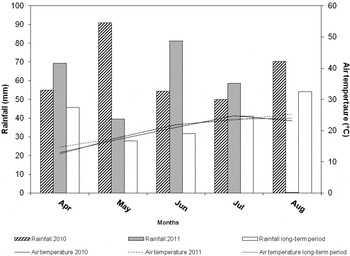
A 2-year field experiment was carried out in 2010 and 2011 at the MOVE (MOnsampolo VEgetables) long-term organic experimental site in central Italy. The site is characterized by a ‘thermomediterranean’ climate 22 , with an average total annual precipitation of 564 mm and temperatures averaging 9 and 20°C in the October–March and April–September growing periods, respectively (Fig. 1). Soil types at the field trial site were fine-loamy, mixed thermic Typic Calcixerepts 23 . The experimental design was a split-plot with two factors and three replications. The main factor was the type of cover crop management: (i) no cover crop or control (FA), (ii) barley (Hordeum distichum L., cv. ‘Trasimeno’) chopped and incorporated with a rotary disk as a GM and (iii) barley terminated with a RC. Barley is a commonly used cover crop in Italy because of its quick establishment in cool weather and extensive biomass production. Split-plots were used to compare two zucchini (Cucurbita pepo L.), cultivars, ‘Dietary’ and ‘Every’, which were randomized within each cover crop treatment.
Mean monthly temperature and rainfall at the MOVE long-term experiment during April–August 2010 and 2011 compared with long-term (30-year) mean values. The zucchini-growing period was May–June in both experimental years.

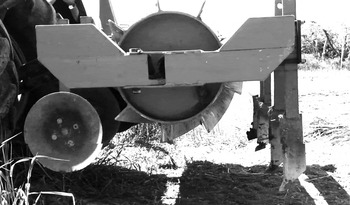
The machinery utilized to kill and flatten the cover crop and simultaneously prepare the zucchini transplanting area in the RC treatment consisted of a steel RC cylinder (45-cm diameter, weighing 0.8 Mg when filled with water), equipped with two sharp vertical coulters, followed by two 30-cm-deep straight shanks with 4-cm-wide cutting sweeps, installed in-line at the front and rear of the RC, set to match the width of the crop rows, which created the transplanting furrows (Fig. 2). Additional information about the machinery utilized is reported in Canali et al.Reference Canali, Campanelli, Ciaccia, Leteo, Testani and Montemurro 17 . All FA and GM plots (5 × 20 m) were tilled with a rotary tiller (DL 2500; Maschio SPA, Padua, Italy) to a depth of 15-cm and disked (15-cm deep) according to standard agronomic practices used by organic farmers in the area, thus ensuring full cover crop incorporation into the soil in the GM treatment and a properly prepared field in the FA treatment. Drilling of barley in cover crop plots occurred on 4 and 29 November in 2009 and 2010, respectively, at a rate of 200 kg ha−1, 35% higher than the rate commonly used in the area, with the goal of high biomass amounts at termination. Termination of the cover crop in the GM and RC treatments occurred on 6 and 9 May in 2010 and 2011, respectively, when the barley was in anthesis (Zadoks scale of 61–65Reference Mirsky, Curran, Mortensen, Ryan and Shumway 24 ). Zucchini transplants were 2 weeks old and were hand-transplanted at an inter-row × row distance spacing of 1.5 m × 1.0 m on 10 May in 2010 and 2011. In 2010, the harvest began on 14 June and was completed on 2 August, with a cropping cycle of 84 days. In 2011, the harvests occurred from 13 June to 29 July, with a cropping cycle of 80 days. The zucchini crop was irrigated by a drip system with 830 m3 ha−1and 701 m3 ha−1 of water applied in 2010 and 2011, respectively. Zucchini plants were fertilized with off-farm animal-manure-based organic fertilizers (Superstallatico—Nuova Concimer, S.Severino Marche, MC; Goldust – Ico-hydro srl, Mutignano, BA; Prodigy 4 and Prokton – Intrachem Bio Italia, Grassobbio, BG), compliant with EU organic regulations. Half of the total fertilizer rate of 116, 47 and 32 kg ha−1of N, P2O5 and K2O, respectively, was applied at transplanting and the other half 2 weeks after planting. In order to test the effect of cover management on weed germination and growth, weeding was not performed in any of the main plots during the entire zucchini cropping cycle.
A similar modified RC for transplanting vegetables (4-row model). Note the modification of the shanks with sweeps to form the transplanting row furrows.

In order to examine in detail crop–weed competition, additional strips (2 × 18 m) were included on the sides of main plots in the experimental layout as: (i) weed stands without crops (‘pure weed stands’) and (ii) crop stands without weeds (‘pure crop stands’ managed by manual weeding) for each cover × cultivar combination. Zucchini plant spacing in the strips was identical to the main experiment. Overall plant density in weed/crop mixtures was estimated in the weed seedling stage and was similar to the sum of the density of crop and weeds in their pure stands, following as close as possible an additive design for determining competition indicesReference Paolini, Faustini, Saccardo and Crinò 21 , Reference Snaydon 25 .
Plant sampling
At barley termination, aboveground cover crop biomass was measured by clipping all plant material at ground level within a half-meter-square area and drying at 70°C for 48 h to obtain dry weights. Three plants were randomly selected from each plot and from the pure crop stands at each of the zucchini harvest periods. Fresh weights of all mature zucchini fruits at preferred market size were determined from these plants. At the final harvest period, aboveground zucchini crop residue biomass (whole plants and fruits) and weed biomass were collected within a randomly selected 1.5 m × 1.0 m area in each plot, and dried at 70°C for 48 h to obtain dry weights. Zucchini fruit and plant biomass were summed to obtain total zucchini aboveground biomass. At the final zucchini harvest, weed biomass was also collected within a half-meter-square quadrat, randomly selected from the pure-weed-stand area, in the associated study strips of each plot. The effect of treatment on crop–weed competitive relationships was examined according to two complementary approaches: calculation of ecological indices (competitive indices) and coverage assessment.
Ecological index measurement
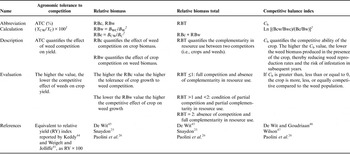
In order to measure zucchini yield losses as affected by weed competition and quantify the relative ratio of weed and crop biomass in each plotReference Paolini, Principi, Froud-Williams, Del Puglia and Biancardi 26 , ecological indices comparing data from experimental plots and pure stands were calculated for each treatment. For ease of comparison, the indices of competition assumed the weed community as a single species, per previous studiesReference Paolini, Faustini, Saccardo and Crinò 21 . The following indices were calculated (Table 1): relative biomass of crop (RBc), relative biomass of weeds (RBw), relative biomass total (RBT) of crops and weeds and competitive balance index (C b). The RBc provided a comparison of the effect of weed competition on crop biomass production, while the RBw quantified the effect of crop competition on weed biomass. A high C b value signified low weed biomass produced in the presence of the crop, thereby reducing weed reproduction rates and risk of infestation in subsequent years. Using yield data from the weed-free strips and the main plots, an agronomic tolerance to competition (ATC) value was calculated where a high value symbolized a low competitive effect of weeds on crop yield.
Crop–weed indices of competition utilized in the MOVE long-term organic vegetable experiment, Monsampolo, Italy, 2010–2011.

1 Y CW: yield of mixed plots (crops + weeds); Y C: yield of pure crop stand (hand-weeded).
2 B CW: aboveground biomass of crops in mixed plots (crops + weeds); B C: aboveground biomass of crops in pure crop stand; B WC: aboveground biomass of weeds in mixed plots (weeds + crops); B W: aboveground biomass of weeds in pure weed stand
Coverage assessment
In order to evaluate crop–weed competition during different phases of zucchini plant growth, a coverage assessment was estimated in each cover management treatment in four phases: transplanting (T), flowering (F), start of harvest (SH) and last harvest (LH). A crop and weed cover abundance/dominance index was estimated according to the Braun–Blanquet scaleReference Braun-Blanquet, Fuller and Conard 27 , as modified by PignattiReference Bàrberi 2 Reference Mirsky, Curran, Mortensen, Ryan and Shumway 8 . Photographs were taken to determine crop–weed abundance/dominance by placing the zucchini plant in the middle of the frame within three randomly selected 1.5 × 1.0 m quadrats within each plot, and then placing a digital grid over the photographs to determine six classes as follows: 5 for coverage ranging from 75 to 100% of the photographed area; 4 for 50 to 74%; 3 for 25 to 49%; 2 for 5 to 24%; 1 for 1 to 5% and +for coverage <1%. Coverage estimation was performed for both zucchini and weeds. Each Braun–Blanquet class was converted to its midpoint coverage value and graphed as coverage over time according to Wikum and ShanholtzerReference Wikum and Shanholtzer 29 . At LH, the main weed species were recorded based on visual evaluation, according to the Braun–Blanquet scaleReference Braun-Blanquet, Fuller and Conard 27 .
Statistical analysis
Biomass parameters and indices of competition were analyzed by ANOVA using year, cover crop management and cultivar as factors. The Duncan Multiple Range Test (DMRT) was performed for treatment mean comparisons (P ≤ 0.05 probability level). Before analysis, data for ATC (range 30–80%) required angular transformationReference Gomez and Gomez 30 . The Kruskal–Wallis H-test, based on rank transformation, was applied for the analysis of cover abundance/dominanceReference Hahn and Scheuring 31 . The pairwise comparisons per cover management factor were processed by the Mann–Whitney post-hoc testReference Lehmann and D'Abrera 32 . All analyses were performed with the SPSS 16.0 package.
Results and Discussion
Climatic variation was high over the 2 years of the experiment (Fig. 1). Air temperature was near the long-term (30-year) mean in both years, but greater and more consistent rainfall during the cropping cycle in 2010 (195 and 179 mm from May to July in 2010 and 2011, respectively) may have led to weed and crop biomass differences between years, despite drip irrigation in each plot.
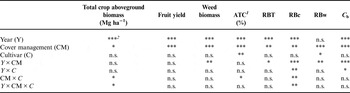
There was a significant effect of year in 7 out of 8 parameters, with the exception of RBw (Table 2). Cover management affected all parameters, while cultivar differences were significant only for the plant competition index, ATC and RBw. Significant differences were also observed in the following year × cover management interactions: weed aboveground biomass, RBT, RBc, RBw and C b. Year × cultivar interactions were significant for RBc and C b, while the three-factor interaction (year × cover management × cultivar) was significant for total crop aboveground dry biomass and RBc.
Results of ANOVA for tested parameters in the MOVE long-term organic vegetable experiment, Monsampolo, Italy, 2010–2011.

1 ATC, agronomic tolerance to competition; RBc/RBw, relative biomass for crop/weeds; RBT, relative biomass total; C b, competitive balance.
2 n.s., not significant; ***, P ≤ 0.001; **, P ≤ 0.01; *, P ≤ 0.05.
Effects on plant growth and yields
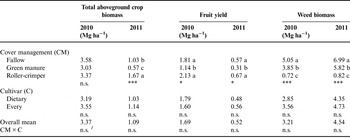
Barley cover crop aboveground biomass across all cover crop treatments averaged 16.1 ± 0.6 Mg ha−1 and 13.9 ± 0.6 Mg ha−1 in 2010 and 2011, respectively (data not shown). Total zucchini crop aboveground biomass did not differ between cover management systems in 2010 (Table 3). Conversely, in 2011, the RC treatment had 62% greater zucchini biomass than the FA treatment, and 193% greater crop biomass than the GM treatment. On the other hand, 81% greater crop biomass was produced in the FA treatment compared to the GM treatment. No significant differences in crop biomass were observed between the ‘Dietary’ and ‘Every’ cultivars, averaging 3.4 and 1.1 Mg ha−1 in 2010 and 2011, respectively.
Zucchini and weed dry biomass in the MOVE long-term organic vegetable experiment, Monsampolo, Italy, 2010–2011.

1 Mean values in each column followed by a different letter are significantly different according to DMRT; n.s., not significant; ***, P ≤ 0.001; **, P ≤ 0.01; *, P ≤ 0.05.
Zucchini fruit yield differed among the three cover management treatments in both years: the RC treatment produced 2.13 and 0.67 Mg ha−1 in 2010 and 2011, respectively, which was equivalent to the FA treatment, at 1.81 and 0.57 Mg ha−1. The GM treatment, which produced 1.14 and 0.31 Mg ha−1 of fruit yield in 2010 and 2011, respectively, was lower than the other two treatments both years. No fruit yield differences between ‘Dietary’ and ‘Every’ cultivars were found, which averaged 1.70 ± 0.1 and 0.52 ± 0.04 Mg ha−1 in 2010 and 2011, respectively, and there were no significant interactions between cultivar and cover management related to fruit yield. Yields in pure crop stands in 2010 averaged 3.14 ± 0.3, 2.63 ± 0.5 and 2.69 ± 0.4 Mg ha−1 in the FA, RC and GM treatments, respectively, and, in 2011, 2.60 ± 0.4, 1.33 ± 0.2 and 1.22 ± 0.2 Mg ha−1 in the FA, RC and GM treatments, respectively. Nitrogen immobilization following the incorporation of the large amount of barley cover crop residue may explain crop growth reduction in the GM treatment in both weedy and non-weedy plotsReference Korsaeth, Henriksen and Bakken 33 , Reference Dahlin and Marstorph 34 . Moreover, a strong pre-emptive competition effect has been reported for barley cover crops, reducing nitrogen availability to the succeeding crop in the rotationReference Thorup-Kristensen 35 . In order to mitigate these effects, legume cover crops or mixtures of different families (e.g., legumes, grasses and brassicas) could be alternatives to the sole barley cover crop. Moreover, the reduction of crop yield in the RC treatment compared to the pure stand yield was potentially due to a 2–3°C reduction in soil temperature due to the mulch, as reported at the same site by Canali et al.Reference Canali, Campanelli, Ciaccia, Leteo, Testani and Montemurro 17 .
Cover management also affected weed biomass in both years (Table 3). Plots where cover crops were terminated with the RC developed the lowest weed biomass (0.72 Mg ha−1) in 2010 and in 2011 (0.82 Mg ha−1), while plots where cover crops were incorporated as GM had 5 and 7 times greater weed biomass than rolled-crimped plots in 2010 and 2011, respectively. Plots that were fallowed with no cover crop had 7 and 8 times greater weed biomass in 2010 and 2011, respectively, compared to rolled-crimped plots. There were no significant interactions between cultivar and cover management related to weed biomass. As previously reported, cover crop residue incorporation and/or mulching were found to have negative effects on weed seedling emergence and growthReference Wortman, Francis, Bernards, Blankenship and Lindquist 3 , Reference Kruidhof, Gallandt, Haramoto and Bastiaans 5 , Reference Cousens and Mahktari 36 , Reference Campiglia, Mancinelli, Radicetti and Caporali 37 . Bernstein et al. Reference Wortman, Francis, Bernards, Blankenship and Lindquist 3 Reference Mirsky, Curran, Mortensen, Ryan and Shumway 8 , for example, reported a weed biomass reduction of 75% in organic soybeans (Glycine max L.) in a rolled-crimped rye mulch compared to a tilled system, similar to results obtained here. Differences among treatments were particularly important during the 2011 season when weed pressure overall was 30% higher than in 2010. The GM system was associated with a reduction of weed biomass compared to the FA treatment, but total zucchini crop biomass and yield were less than that obtained in fallowed and rolled-crimped plots. Weed reduction may be explained by the release of allelopathic compounds from the large amount of barley biomass incorporated into the soil, which may have interfered with weed seed germination and growthReference Bernstein, Posner, Stoltenberg and Hedtcke 38 – Reference De Albuquerque, Dos Santos, Lima, Péricles de Albuquerque, Nogueira, da Câmara and de Rezende Ramos 40 .
Effects on crop–weed competition
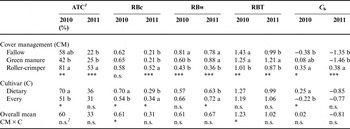
The three cover management treatments differed in all weed–crop indices of competition, except for RBc in 2010 (Table 4). In 2010, low ATC values in the GM treatment (42%), along with the FA (58%), demonstrated a competitive effect of weeds on crop yield, compared to the RC treatment (81%), although the RC ATC was not statistically different than the FA treatment. The low C b values for GM (–0.38) and FA (0.08) treatments also demonstrated a less competitive zucchini crop in these treatments compared to the weed populations. While the RC treatment's ATC and C b values (0.35) were equivalent to the FA and GM treatments, respectively, in 2010, the RC treatment showed the lowest values for RBT in 2010, representing lower weed biomass values. Along with the GM treatment, the RC treatment had lower RBw values compared to the FA treatment. All RBT values were between 1 and 2 in 2010, representing a condition of partial competition and partial complementarity in resource use between crops and weeds. Complementarity in resource use occurs when competitors (e.g., zucchini plants and weeds) utilize limited resources (e.g., soil nutrients and moisture) to produce similar biomass in the presence of each other or when grown in pure standsReference Snaydon 25 , Reference Paolini, Principi, Froud-Williams, Del Puglia and Biancardi 26 , Reference Weigelt and Jolliffe 41 . In 2011, the RC treatment had the highest values for ATC (53%), RBc (0.52) and C b (0.38), and the lowest value for RBw (0.36). Both the RC and FA treatments had RBT values of <1 in 2011, suggesting full competition by the crop and absence of complementarity in resource use. The FA and GM treatments did not differ in competition indices, except for RBT, where the GM treatment showed the highest value (1.21 compared to 0.99 and 0.87 for the FA and RC treatments, respectively), suggesting a less competitive crop in 2011.
Zucchini crop and weed indices of competition in the MOVE long-term organic vegetable experiment, Monsampolo, Italy, 2010–2011.

1 ATC, agronomic tolerance to competition; RBc/RBw, relative biomass for crop/weeds; RBT, relative biomass total; C b, competitive balance.
2 Mean values in each column followed by a different letter are significantly different according to DMRT; n.s., not significant; ***, P ≤ 0.001; **, P ≤ 0.01; *, P ≤ 0.05.
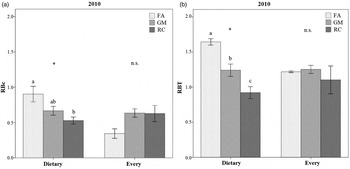
Competitive ability against weeds also differed between zucchini cultivars in 2010, with ‘Dietary’ exhibiting greater tolerance to weed competition (ATC value of 70% compared to 51% for ‘Every’) and a higher C b value (+0.25 compared to −0.22). In 2011, however, differences in these parameters were not significant. The ‘Every’ cultivar, however, showed higher RBc and RBw than ‘Dietary’ in 2011. Significant cover management × cultivar interactions were found for RBc and RBT in 2010 (Fig. 3a,b), where ‘Dietary’ plots had lower RBc and RBT values in the RC and GM treatments compared to ‘Every’ plots, where there were no differences in these indices of competition across the different cover management treatments. These conflicting results could be due to climatic conditions having an impact on cultivar performance, particularly crop competitiveness against weedsReference Weston 4 Reference Bàrberi 2 .
Effects of cover management on RBc (a) and RBT (b) by cultivar in 2010 in the MOVE long-term organic vegetable experiment, Monsampolo, Italy. FA, fallow treatment; GM, green manure; RC, roller-crimper; RBC, relative biomass of crop; RBT, relative biomass total. Bars represent mean values, with different letters as significantly different according to the DMRT test. Cultivar comparisons within each cover management treatment are signified as n.s., not significant; *, P ≤ 0.05.

Effects on weed–crop coverage and weed species abundance
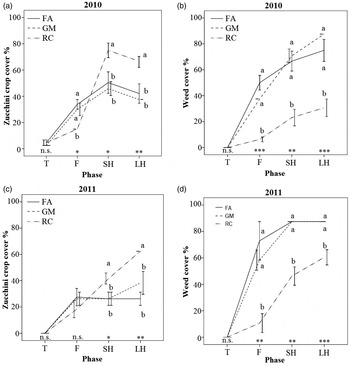
Percentage weed coverage, determined through photographic analysis, was lowest in the RC treatment compared to the GM and the FA treatments over the entire cropping cycle (Fig. 4b,d), while weed coverage in green manured plots was equivalent to fallowed plots. Zucchini crop coverage was also highest in the RC treatment from SH (start of harvest) to LH (last harvest) both years (Fig. 4a,c), while crop coverage was equivalent in the GM and FA treatments. In 2010, zucchini plants in the RC treatment experienced a 60% increase in crop coverage from the F (flowering) to the SH phase, while in 2011, growth rates were more uniform between phases.
Crop and weed coverage results by year (2010 = a, b; 2011 = c, d) and species (crop = a, c; weed = b, d). FA, fallow treatment; GM, green manure; RC, roller-crimper. T, transplanting phase; F, flowering; SH, start of harvest; LH, last harvest. Mean values at each phase with a different letter are significantly different according to the Mann–Whitney post-hoc test. Cultivar comparisons within each cover management treatment showing a significance are denoted according to: n.s., not significant; ***, P ≤ 0.001; **, P ≤ 0.01; *, P ≤ 0.05.

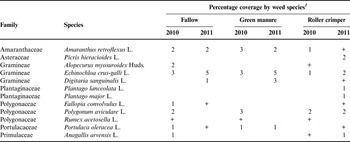
Twelve main weed species were present at different levels in this experiment (Table 5). Identified species were representative of common weeds in vegetable crop production areas in central ItalyReference Pignatti 43 . Main species included Amaranthus retroflexus L. (redroot pigweed), Digitaria sanguinalis L. (large crabgrass), Echinochloa crus-galli L. (barnyardgrass), Polygonum aviculare L. (prostrate knotweed) and Portulaca oleracea L. (common purslane). Weed species abundance differed among cover management treatments, especially during the second year, when the FA and GM treatments contained a substantial infestation of E. crus-galli, which became the dominant weed species in these systems (Table 5). In comparison, a larger number of species of weeds developed in the RC treatment, but without a dominant species. The daisy, Picris hieracioides, was present only in the RC treatment. Based on these results, we speculated that RC use over time could influence the weed community structure in organically managed vegetable cropping systems.
Main weed species and coverage estimates by species in the MOVE long-term organic vegetable experiment, Monsampolo, Italy, 2010–2011.

1 Coverage index: 5, 75–100%; 4, 50–74%; 3, 25–49%; 2, 5–24%; 1, 1–5%; +, <1%.
Conclusions
Effective weed management techniques are considered one of the main constraints for increased diffusion of organic farming worldwide. Our study demonstrated the potential for combining different agronomic strategies to reduce weed emergence and development, thus limiting the need for mechanical cultivation to control weeds in organic vegetable systems. Our results also highlighted the role of cover crop management strategies in affecting crop–weed competitive relationships, demonstrating the potential for both incorporated and rolled-crimped cover crop termination to create an unfavorable environment for weed development and growth. Among the experimental strategies, the locally designed RC technology, with a modification to assist in vegetable planting and transplant viability, was associated with the greatest reduction of weed population impacts on crop yield and weed coverage within plots compared to the GM and FA treatments. This effect, also determined through competitive indices based on weed-free areas and natural weed infestations within plots, could be attributed to altering the zucchini–weed competitive relationship in favor of the crop, and potentially, reducing weed seed germination and emergence. Additionally, weed reproduction rates and the risk of infestation in subsequent years will be reduced when weeds are effectively managed. The barley mulch in the RC treatment was particularly effective in managing weeds under unfavorable climatic conditions, demonstrating that yields may still be high even if weeds are present. On the other hand, the incorporated barley cover crop treatment resulted in a reduction in zucchini fruit yield. Because GM treatments continue to be a popular method of soil- and weed–management enhancement on organic farms in Italy, particularly when weather conditions limit RC use, additional studies will include evaluating the effectiveness of different cover crops and cash crops in specific environments. Future experiments also will compare RC treatments to weeded treatments and seek to identify mechanisms underlying enhancement of allelopathic effects from cover crop residues on weed germination and growth.
Acknowledgements
The authors wish to thank Alberto Alianello, Piergiorgio Angelini and Andrea Pepe for their contributions in field operations, soil and plant sampling, and analysis. This paper is a result of the ORWEEDS research project (Agronomic Strategies for Weed Control in Organically Managed Vegetable Cropping Systems) funded by the Organic Farming Office of the Italian Ministry of Agriculture in the frame of the National Action Plan for Organic Food and Farming.