Pasta-filata cheeses include soft and semi-soft varieties consumed fresh or after only a brief period of ageing (e.g. Mozzarella), and semi-hard or hard varieties that are subjected to ripening prior to consumption (e.g. Provolone and Caciocavallo). Caciocavallo cheese is produced using either raw or pasteurized cows' milk, which coagulates at 36–38°C; a natural whey culture may be used as starter. After cutting and whey removal, the curd is placed on tables and ripened for 4–10 h (or more if necessary) until pH reaches a value suitable for stretching in hot water (75–95°C). Caciocavallo cheese is oval shaped (weight 1·5–2·5 kg) and is salted by immersion in brine for more than 6 h. It must be ripened for at least 1 month or for 3–4 months, although cheese ripened for 6 months to 1 year can also be found on the market. PDO Caciocavallo Silano (EC No. 1263/96) is produced in selected areas of Puglia, Calabria, Basilicata, Campania, and Molise regions of Southern Italy under a specific standard (Piraino et al. Reference Piraino, Zotta, Ricciardi and Parente2005). The Caciocavallo cheese produced in the area of Monti Dauni Meridionali is considered to be a popular cheese, although today it does not yet have the legal recognition which other pasta filata cheeses produced in other areas of Southern Italy have, such as Caciocavallo Podolico (Quinto et al. Reference Quinto, Sevi, Di Caterina, Albenzio, Muscio and Rotunno2003) and Caciocavallo Pugliese (Gobbetti et al. Reference Gobbetti, Morea, Baruzzi, Corbo, Matarante, Considine, Di Cagno, Guinee and Fox2002; Morea et al. Reference Morea, Matarante, Di Cagno, Baruzzi and Minervini2007). The area designated as Monti Dauni Meridionali (latitude 41°22′0″ and longitude 15°9′0″) is of about 1300 km2 in south-west of Foggia (Puglia region, Southern Italy); the uplands are particularly utilized for cow, small ruminant, and swine breeding using extensive or semi-extensive system. Milk produced in this area is totally destined to typical cheese production i.e. Cacioricotta and Pecorino, which are very appreciated by local and national markets. Together with Caciocavallo these are representative of the dairy products made using traditional protocol for cheese manufacture.
The aim of this study was to assess the effect of milk source and of cheese production protocol on proteolytic and lipolytic pattern of Caciocavallo cheese produced by six dairy farms located in the Monti Dauni Meridionali area.
Materials and methods
Experimental design and milk analyses
The study involved six dairy factories located in the rural area of Monti Dauni Meridionali. Factories investigated varied in their source of raw milk. Indeed, three dairy factories (A, C, and E) processed milk collected from farms located in the neighbouring area, whereas the other three dairy factories (B, D, and F) processed their own milk.
A total of 24 milk samples were analysed: milk samples were collected from each farm on the day of the cheesemaking (two cheesemaking trials were performed for each farm) and analysed in duplicate for pH, total protein, fat, lactose content, and somatic cell count (SCC) (Albenzio et al. Reference Albenzio, Caroprese, Marino, Muscio, Santillo and Sevi2006). Mesophilic bacteria (Plate Count agar, Oxoid, Milano, Italy) and total coliform (Violet Red Bile agar) at 37°C for 24 h were enumerated in the milk and cheese samples using standard procedures.
Cheese production and cheese composition
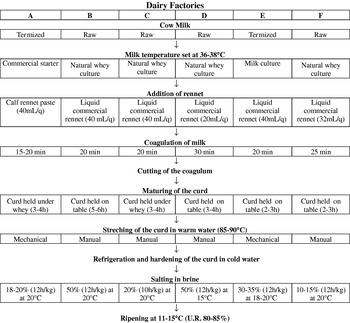
The protocol for production of Caciocavallo cheese for each factory is reported in Fig. 1. Two cheesemaking were performed in each dairy and cheese samples were collected at 1, 30, 90, and 180 d of ripening and analysed in duplicate.
Production protocols of Caciocavallo cheese of the six factories located in Monti Dauni Meridionali area.

Moisture and NaCl of cheeses were determined according to the International Dairy Federation standards (1986, 1988). Total nitrogen (TN), water soluble nitrogen (WSN), non casein nitrogen (NCN), and pH 4·6 soluble-N were determined as described in Albenzio et al. (Reference Albenzio, Marino, Caroprese, Santillo, Annicchiarico and Sevi2004); fat content was measured using a Soxhlet method by using petroleum-ether. Plasmin (PL) activity in cheese was determined according to Baldi et al. (Reference Baldi, Savoini, Cheli, Fantuz, Senatore, Bertocchi and Politis1996). Samples of cheese were treated using a modification of the method of Richardson & Pearce (Reference Richardson and Pearce1981), as described in Santillo & Albenzio (Reference Santillo and Albenzio2008).
Assessment of proteolysis
Water-insoluble and -soluble fractions of the cheeses were analysed by urea-polyacrylamide gel electrophoresis (PAGE) using a Protean II xi vertical slab gel unit (Bio-Rad, Watford, UK). Samples diluted with sample buffer were heated to 50°C for 20 min and then loaded on the gels. Gels were stained with Coomassie Brillant Blue G250 by the method of Blakesley & Boezi (Reference Blakesley and Boezi1977). The destained gels were acquired by the Gel Doc EQ system (BioRad) using a white light conversion screen and analyzed with the Quantity One software (BioRad) to determine the signal intensity (optical density) of the defined bands. Identification of bands was done by comparison with the NaCN standard. Given 100% to the sum of the intensities of the defined bands in a lane, the relative quantity of each band was determined as the percentage of the signal intensity of the defined band in a lane.
Assessment of lipolysis
Volatile free fatty acids in cheese were extracted with diethyl ether: hexane (1:1, vol/vol), after grinding with sodium sulphate and addition of 2·5 m-sulphuric acid (Ha & Lindsay, Reference Ha and Lindsay1990). Free Fatty Acids (FFAs) were isolated using an aminopropyl column as adsorbent; the desorption of the FFA was carried out with 2% formic acid in diethyl ether (de Jong & Badings, Reference de Jong and Badings1990). Analysis and identification of FFA were performed according to Santillo et al. (Reference Santillo, Albenzio, Quinto, Caroprese, Marino and Sevi2009).
Total lipids from cheeses were extracted according to de Jong & Badings (Reference de Jong and Badings1990). FFA derivatization was performed, according to Morrison & Smith (Reference Morrison and Smith1964). FFA and CLA were separated on a capillary column (HP88; 100 m×0·25 mm i.d, 0·20 μm film thickness, Agilent Technologies Santa Clara, USA). The injector and flame ionization detector temperatures were 260°C. The programmed temperature was 100°C for 1 min, increased to 240°C at a rate of 3·5 deg C/min, maintained at 240°C for 15 min. The split ratio was 1:50 and helium was carrier gas with a pressure of 33 psi. Pure CLA isomers were purchased as FAMEs (Fatty Acids Methyl Esters) from Matreya Inc. (Pleasant Gap, PA, USA). All solvents were analytical grade from J.T. Baker (Phillisburg, USA).
Statistical Analysis
All the variables were tested for normal distribution using the Shapiro-Wilk test (Shapiro & Wilk, Reference Shapiro and Wilk1965), and milk SCC was transformed into logarithm to normalize its frequency distributions before performing statistical analysis. Data were analysed by ANOVA using the GLM procedure of SAS (1999): the variation due to dairy factory was tested for milk parameters and for FFA and CLA at 180 d of ripening of Caciocavallo cheese; the variations due to dairy factory, time of ripening, and their interactions were tested for biochemical parameters of Caciocavallo cheese.
When significant effects were found (at P<0·05), the Student t-test was used to locate significant differences between means. Linear simple correlations between milk parameters and PL were also investigated.
Results and Discussion
Milk composition and quality
The gross composition of bulk milk from the six dairy factories (Table 1) involved in the study ranged between 3·59 and 6·08% fat, 3·28 and 3·83% protein, 2·46 and 2·98% casein, 4·54 and 4·79% lactose; the levels of fat and protein evidenced good nutritional and cheese making quality of milk. Moreover, SCC was always lower than 3 log10 cells/ml; SCC is widely used as an indicator of milk hygienic quality and for pricing raw milk. SCC level evidenced that the farms investigated followed good management and milking practices so that milk could be processed to cheese without any heat treatment according to EEC directive 92/46. Mesophilic bacteria were higher in B and D milk than in the other milk samples; however the mesophilic cell load did not exceed the threshold of 5 log10 cfu/ml whereas total coliform were always lower than 1 log10 cfu/ml.
Bulk milk composition, SCC, and mesophilic cell load from six dairy factories located in Monti Dauni Meridionali area
Values are means±SEM n=24

† NS, not significant; * P<0·05; ** P<0·01, n.d. not detected. a, b, c indicative level of significance in rows
The best quality found in A milk compared with C and E milk may be partly ascribed to a more accurate choice of well-managed farms for collecting milk for cheesemaking. As well, more careful herd management might be claimed for better nutritional quality observed in F milk compared with B and D milk. The highest SCC and microbial cell load were found in B and D milk. Although somatic cell count is related to physiological, sanitary, and climatic factors, it enhances during the pasture grazing period (Pomiés et al. Reference Pomiés, Gasqui, Bonny, Coulon and Barnouin2000) so the result for B and D milk was attributed to the rearing and feeding system adopted by the farms which provided pasture to cows during daytime and a concentrate supplementation in the cowshed.
Chemical composition and cheese quality
Milk quality in terms of both nutritional properties and hygienic features is important in milk processing and maturing profile of cheese. In particular a wide range of hydrolytic enzymes are associated with SCC and microorganisms. These enzymes are able to impair milk coagulation properties during storage prior to cheesemaking (Albenzio et al. Reference Albenzio, Caroprese, Santillo, Marino, Muscio and Sevi2005). However, the cooking and stretching treatment of acid-ripened curd in hot water (85–90°C) for Caciocavallo cheese production may be regarded as important steps involved in the microbiological control.
Fat, protein, and casein content ranged between 29·7–49·49, 27·2–32·2, and 42·94–48·1% on dry matter, respectively at 180 d ripening. Moisture content of Caciocavallo decreased during ripening thus contributing to an adequate development of cheese characteristics, and ranged between 30·83 and 38·82% at 6 months of ripening, in line with previous reports on the same cheese (Vernile et al. Reference Vernile, Spano, Lecce, Tarantino, Beneduce and Massa2006) This parameter is an indicator of cheese quality, given that cheese with poor quality—often accompanied by off-flavours—is associated with higher moisture level. The concentration of salt in moisture (S/M) ranged between 8·57 and 15·29% at 180 d ripening; the wide variability could be attributed to differences in brine concentration and time of dipping among factories. In a previous study on Monti Dauni Meridionali Caciocavallo cheese, Vernile et al. (Reference Vernile, Spano, Lecce, Tarantino, Beneduce and Massa2006) found that dairy microflora reached a maximum after 30 d ripening and decreased until 180 d; while the mesophilic lactobacilli increased rapidly and reached a maximum level (9·3 log cfu/g) after 90 d and then decreased throughout ripening.
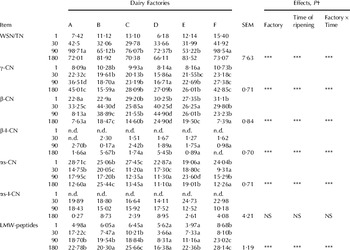
Nitrogen fractions accumulate in the cheese matrix as an outcome of casein matrix disruption ruled by the proteolytic process. It is worth noting that farms A and F displayed the best ripening performance—in terms of higher WSN/TN (Table 2)—probably as an outcome of the greater content of fat, protein, and casein in the processed milk or due to higher proteolytic activity of enzymes from microbial origin. Especially, factory A has used commercial starter which may have had higher proteolytic activity. It can be inferred that milk nutritional properties as well as type of rennet and of starter bacteria played an important role in the subsequent proteolytic process occurring in cheese during ripening. WSN contains numerous small- and medium-sized peptides, free amino acids and their degradation products, organic acids and their salts (McSweeney & Fox, Reference McSweeney and Fox1997). It is worth noting that the evolution of this parameter is not univocal among factories. A and F cheeses evidenced the maximum values at 90 d ripening and a further decrease in the subsequent time of ripening; C and D cheeses followed a similar trend displaying lower levels of this parameter; finally B and E cheeses showed a linear increase of the WSN/TN with the advanced ripening. This result suggests that A, C, D and F cheeses accumulated the highest levels of WSN within the first three months of ripening with the small- and medium- sized peptides and free amino acids being further catabolized in the subsequent ageing. Aminoacids, in fact, are important precursors for a range of catabolic reactions which produce volatile compounds essential for cheese flavour (McSweeney & Sousa, Reference McSweeney and Sousa2000).
WSN/TN and composition of pH 4·6—insoluble nitrogen fraction during ripening of Caciocavallo Monti Dauni Meridionali cheeses produced by six factories
Values are means±semn=96

† NS, not significant; *** P<0·001, n.d. not detected. a, b, c indicative level of significance in rows
WSN/TN=Water Soluble Nitrogen on Total Nitrogen
LMW-peptides=Lower Molecular Weight
The quantitative analysis of Urea-PAGE of insoluble nitrogen fraction of Caciocavallo cheeses at 1, 30, 90, and 180 d at pH 4·6 is reported in Table 2. Detection of hydrolysis of casein fractions and identification of newly formed peptides allowed monitoring of the intensity of proteolysis in cheese. In general, an effect of time of ripening was reported for the principal CN fractions: α-CNs disappeared greatly within the first 30 d ripening whereas β-CN underwent a greater hydrolysis passing from 30 to 90 d. The residual coagulant may have acted in the first stages of cheese ripening in Caciocavallo cheeses, α-CNs being the principal target of chymosin and most other commercial rennet (Feeney et al. Reference Feeney, Guinee and Fox2002). This trend was confirmed by the accumulation of the corresponding casein degradation products with αs-I-CN reaching the higher percentage at 30 d whereas γ-CN displaying a major increase starting from 30 d.
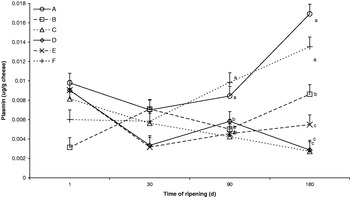
As concerns the effect of the factories involved in the study, β-CN turned out to be hydrolyzed at higher rate in A and F cheeses being the residual intact β-CN the lowest in these cheeses at 180 d whereas αs-CN was hydrolysed at comparable levels among factories, except for B and E cheeses. These results could be partly attributed to the contribution of plasmin activity to cheese proteolysis (Fig. 2); PL activity increased in A and F cheeses starting from 30 d, being the highest at 90 and 180 d. It is well known that β-CN is the preferred substrate for PL activity with the liberation of γ-CN fraction in the cheese matrix. Gobbetti et al. (Reference Gobbetti, Morea, Baruzzi, Corbo, Matarante, Considine, Di Cagno, Guinee and Fox2002) reported that stretching may lead to elevated plasmin levels in Caciocavallo pugliese cheese as evidenced by the degradation of β-CN with the concomitant formation of γ-CN during ripening. The contribution of plasmin activity in pasta filata cheese could be relevant owing to high-cooking temperature, removal of whey containing inhibitors of plasminogen activators, and to denaturation of the coagulant. PL was positively correlated (r=0·89; P<0·05) with pH (data not shown). Values of pH remained almost unchanged during the first 30 d ripening and increased from 30 d on in A and F cheeses. The evolution of PL evidenced that the acidification of the curd in Caciocavallo cheese production exerts an inhibitory effect on the enzyme activity. In fact deacidification starting from 30 d, could have led to more favourable cheese environment for PL activity, this enzyme being less active at low pH values. Accordingly, Gobbetti et al. (Reference Gobbetti, Morea, Baruzzi, Corbo, Matarante, Considine, Di Cagno, Guinee and Fox2002) found that in Caciocavallo pugliese cheese pH value increased slightly during ripening.
Evolution of plasmin in Caciocavallo cheese produced from six dairy factories located in Monti Dauni Meridionali area during ripening. Farm A, ○; Farm B, □; Farm C, ▵; Farm D, ⋄; Farm E, ×; Farm F, +.
a,b,c Different letter means statistically significant differences at P<0.05.
Values are means, bars show SEM for n=96

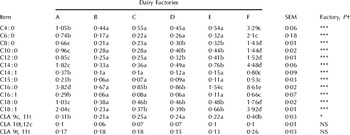
In Table 3 is reported the FFA and free CLA content of Caciocavallo cheese from the six factories representative of Monti Dauni Meridionali area at 180 d ripening. In general, the most abundant FFAs were C4:0, C6:0, C14:0 C16:0 C18:1 according with studies on Caciocavallo pugliese cheese (Gobbetti et al. Reference Gobbetti, Morea, Baruzzi, Corbo, Matarante, Considine, Di Cagno, Guinee and Fox2002). An effect of the factory was found for FFAs, C18:1, and CLAs in Caciocavallo cheese: F cheese displayed the highest levels of FFAs and 9c, 11t – CLA, A cheese had intermediate levels, and B, C, D, and E cheeses the lowest levels. Similar to proteolysis, the greater lipolysis found in A and F cheeses could be ascribed partly to the better nutritional quality of processed milk. The use of raw milk in F cheese may be responsible for a more complex endogenous milk microflora, which yields proteolytic and lipolytic enzymes, in agreement with the findings of Albenzio et al. (Reference Albenzio, Corbo, Shakell-Ur-Rehaman Fox, De Angelis, Corsetti, Sevi and Gobbetti2001) in semi-hard Canestrato pugliese cheese. Natural whey cultures are readily available from the whey of the previous cheesemaking day, being produced daily at the cheese plant, and the desired microflora is obtained as a result of a number of selected conditions (heat treatment, temperature of incubation, pH, competition and/or antagonism) (Parente et al. Reference Parente, Rota, Riccriardi and Clementi1997). Liquid commercial rennet provides coagulant and proteolytic enzymes (i.e. chymosin and pepsin) whereas rennet paste—used in A cheese production—is characterized also by the presence of lipolytic enzymes (esterase and PGE), which play a role in the lipolytic process of cheese during ripening.
Free fatty acids (FFAs) and conjugated linoleic acid (CLA) (μmol/g of cheese) in Caciocavallo Monti Dauni Meridionali cheeses produced by six factories at 180 d of ripening
Values are means±semn=24

† NS, not significant; * P<0·05; *** P<0·001. a, b, c, d indicative level of significance in rows
In conclusion, the study of the Monti Dauni Meridionali Caciocavallo cheese evidenced the important role of milk quality and manufacturing techniques in ripening features of the cheese. In particular, the use of raw milk, of natural whey cultures, of rennet paste is able to influence markedly the proteolytic and lipolytic pattern of cheese.
The authors would like to thank Dr. Concetta Perilli and Dr. Daniela Ruggieri (Dipatimento PrIME, Università di Foggia, Italy) for expert technical assistance.