Introduction
In the last decades, parties have developed new ways of connecting with citizens, diversifying their affiliation options (Scarrow, Reference Scarrow2015; Barberà et al., Reference Barberà, Sandri, Correa and Rodriguez-Teruel2021). Some have argued that these new types of affiliation are the functional equivalent of traditional, dues-paying membership (Hooghe and Kölln, Reference Hooghe and Kölln2020). Parties can rely on supporters to build trust (Hooghe and Kern, Reference Hooghe and Kern2015), a better image, or to get new ideas (Scarrow, Reference Scarrow1994; Reference Scarrow2015). However, studies also show that members provide unique benefits to parties that other affiliates do not, especially when it comes to elections. Webb et al. (Reference Webb, Poletti and Bale2017) show that parties rely heavily on members to perform intensive campaign tasks. Fisher et al. (Reference Fisher, Fieldhouse, Johnston, Pattie and Cutts2016) emphasize that a large number of members in a district is a pre-condition for higher supporter activity, members acting as recruiters via their contacts in the community. Members also bring benefits to parties outside election time. Kölln (Reference Kölln2014) shows that membership decline brings parties to employ more staff, to spend more, to be more reliant on state subsidies. Ultimately, Bolleyer (Reference Bolleyer2013) or Beyens et al. (Reference Beyens, Lucardie and Deschouwer2016) show how parties that build grassroots organizations have a higher chance of survival. In this light, members still constitute a distinct and unique asset for parties. It is therefore crucial to better understand the conditions under which parties are able to maintain that specific linkage and can recruit or retain members.
However, despite a few recent exceptions (Kölln, Reference Kölln2016) most studies on party membership focus on aggregate data at the country level (Bartolini, Reference Bartolini, Daalder and Mair1983; Beyme, Reference Beyme1985; Sundberg, Reference Sundberg1987; Katz and Mair, Reference Katz and Mair1992a, b; Mair and van Biezen, Reference Mair and van Biezen2001; Whiteley, Reference Whiteley2011; van Biezen et al., Reference van Biezen, Mair and Poguntke2012). Theoretically, these studies focus on membership variations across countries or over time. In doing so, they ignore variations across parties. They fail to explain, for instance, why the Labour party in the UK gained members in the 2010s while the Parti Socialiste (PS – Socialist Party) in Belgium lost half of its membership over the same time period. This calls for an approach that would put parties back at the center of the focus when investigating membership levels. Empirically, these studies are heavily centered on western democracies due to data availability at the time. We lack a more global picture that tests existing explanations of membership variation in more diverse settings.
This paper innovates by putting parties back at the center of the focus. It allows to disentangle external (country-level) and internal (party-level) drivers of membership variations across parties. In doing so, we address the following questions: Is there a specific set of factors that make it easier for a party to recruit members? And do certain party incentives or barriers influence membership recruitment? Ultimately, can parties do anything about their membership levels, or are they powerless victims of contextual factors? We argue that, while context matters, the way parties organize has an effect in the construction of party membership. We rely on cross-sectional data that includes 223 parties in 38 countries, innovatively covering third-wave democracies, post-communist countries, and advanced democracies. Our analysis covers parties from all continents, far beyond the European context that has been the focus of previous studies, which allows for a unique analysis of recruitment patterns under quite different circumstances and traditions.
Our results show that party-level variables are much more powerful than country-level factors in explaining variations in party membership. Parties that offer more opportunities for representation for their internal sub-groups (e.g. youth and women), that place lower barriers for the enrolment of new members, and that have more public support (partisan attachment), present higher levels of membership, regardless of country-level constraints. Our results confirm that contemporary parties can master their fate. Their organizational choices in terms of affiliation rules and intra-party representation are crucial for partisan mobilization. This does not mean that the context has no influence on parties’ ability to recruit. Our findings suggest that younger democracies, more decentralized states and presidential or mixed systems of government, and countries in which citizens have higher levels of general trust in parties, tend to have parties with higher membership ratios. Finally, we also show how party origins, and the foundational environment in which they emerged, are important to understand how membership varies across parties today.
Explaining membership variations
Most existing studies explain party membership fluctuations over time using supply-side explanations rooted in the literature on political participation. Modernization theories have pointed to the development of post-industrial societies, shifts in participation repertoires (Norris, Reference Norris2002) and the emergence of alternative modes of political participation (Lawson and Merkl, Reference Lawson and Merkl1988). These shifts are linked to higher levels of education and changes in values generating atomized participation to the detriment of group-based memberships (Marien and Quintelier, Reference Marien, Quintelier and van Haute2011). Yet this view is partly challenged at the micro-level, as the resource model (Brady et al., Reference Brady, Verba and Schlozman1995) stresses the positive impact of the level of education on party membership. Furthermore, these studies tend to ignore variations across parties. Besides, they are mainly focusing on western democracies.
Departing from these longitudinal explanations of membership fluctuation over time, this paper is the first attempt to disentangle external (country-level) and internal (party-level) drivers of membership variation across parties. We investigate whether there is a specific set of factors that make it easier for a party to recruit members. Our central argument is that while context is expected to matter, parties are not powerless victims of external forces. We expect their organizational choices to have an effect in the construction of party membership. Testing this framework puts Harmel and Janda’s (Reference Harmel and Janda1994) classic theory of party change, which distinguishes between external and internal factors, to the empirical test with a specific focus on one dimension of party organizations: membership.
Among country-level variables, authors have stressed the role of state structure. Weldon (Reference Weldon2006) showed how federalism divides power and reduces the size of the polity, thereby positively affecting membership levels. He links it to the fact that parties in decentralized states adopt a multilevel organization (Deschouwer, Reference Deschouwer, Katz and Crotty2006; Detterbeck and Hepburn, Reference Detterbeck, Hepburn, Erk and Swenden2010; Detterbeck, Reference Detterbeck2012). As a group becomes smaller the propensity for collective action becomes larger, following Olson’s paradox of collective action. More resources, policies and powers at the sub-state level means that multilevel parties are able to offer more selective incentives and opportunities for citizens to participate (Whiteley and Seyd, Reference Whiteley and Seyd1996). Following these arguments, we expect that the higher the level of state decentralization, the higher the parties’ membership ratios (H1).
A second country-level factor is the system of government. For Samuels and Shugart (Reference Samuels and Shugart2010), presidential systems have a strong negative impact on party organizations and membership. Presidentialized parties would suffer from a lack of internal cohesion due to the separation of goals and incentives between presidential candidates and the internal elite dedicated to legislative elections. As a consequence, there would be less interest and less capacity in developing grassroots organization. Conversely, Bartolini (Reference Bartolini, Daalder and Mair1983) and Tan (Reference Tan2000) point to the positive effect of presidential systems presenting on membership levels, mainly due to the mobilization provided by nationally centralized presidential elections. We expect, therefore, that countries with directly elected presidents (i.e. presidential and hybrid systems) will display higher membership ratios compared to parliamentary systems (H2).
Third, party laws at the national level also provide parties with distinct incentive structures to recruit, or not, members (van Biezen, Reference van Biezen2009). The cartel party thesis insists on the idea that state funding would decrease incentives for parties to recruit members by making them less dependent on membership contributions (Katz and Mair, Reference Katz and Mair1995), albeit the empirical evidence of this association is limited (van Biezen and Kopecky, Reference van Biezen, Kopecky, Scarrow, Webb and Poguntke2017).Footnote 1 Conversely, some states link the authorization to establish a party, its eligibility to state funding, or the criteria to subsidy allocation to the number of members that they can claim, which can incentivize parties to build a party on the ground. Regulation of party revenues can also influence their incentives to recruit. When direct donations from private (non-members) individuals, companies, or associations (e.g. unions or churches) are strictly prohibited or capped, parties have more incentives to recruit members, as they constitute an alternative source of funds. Following these arguments, we expect that the greater the membership incentives in the state party laws, the higher the parties’ membership ratios (H3).
Looking at European democracies, Mair and van Biezen (Reference Mair and van Biezen2001) investigated the impact of age of democracy on the levels of party membership. Their expectation was that in newer democracies, parties have fewer members because they have to build their organization from scratch and focus on electoral goals rather than organizational development. They found only partial confirmation of this link: while it was confirmed for post-communist countries, it was not for newer democracies in Southern Europe. This might be due to the fact that parties within the same country might have a different relation to democracy. Some parties were born in an autocratic regime and survived the democratization process while in other instances the entire party system was renewed after democratization. As several studies on post-communist and third-wave democracies have pointed out, parties that were born under authoritarian regimes (as dominant ruling party or anti-regime party) acquire certain competitive advantages that persist during and after the democratization process. These parties inherit organizational resources, party brand, and an electoral base that they can consolidate before the electoral competition opens up (Randall and Svasand, Reference Randall and Svasand2002; van Biezen, Reference van Biezen2003; Loxton, Reference Loxton2015: 17–19). Therefore, the political context under which the party was founded and has developed in its early years might matter. This expectation applies to all parties in the analysis, not just the group of late democratizing countries. Following that argument, we expect that parties that emerged in a fully democratic regime have lower membership ratios than parties that emerged under more authoritarian rule (H4).
Finally, our last country-level factor relates to public opinion towards parties. Diffuse support for, or trust in parties as institutions is thought to have a positive impact on institutionalized participation, such as party membership (Hooghe and Marien, Reference Hooghe and Marien2013; Bäck and Serup Christensen, Reference Bäck and Serup Christensen2016). Therefore, we expect that the higher the level of general trust in parties, the higher the parties’ membership ratios (H5).
Next to country-level factors, a handful of recent studies have investigated the role of party-related factors to explain membership variations across parties (Kölln, Reference Kölln2016). These studies show that how parties organize matters for their recruitment capacity. Parties can offer benefits to their members, set up rules of affiliation, and develop structural links to sub-groups, which can affect their membership levels.
In terms of benefits, parties differ in how many incentives for joining are provided to members in the form of rights granted in internal decision-making processes, for instance in terms of party leader selection, candidate nomination and policy decisions (Cross and Blais, Reference Cross and Blais2012; Cross and Pilet, Reference Cross and Pilet2015; Gauja, Reference Gauja2015). Kosiara-Pedersen et al. (Reference Kosiara-Pedersen, Scarrow, van Haute, Scarrow, Webb and Poguntke2017) found partial support for the idea that higher levels of benefits lead to higher membership ratios. Following these arguments, we expect that the higher the level of benefits granted to members regarding key intra-party processes, the higher the parties’ membership ratios (H6).
Parties also differ in terms of affiliation rules, that is, the financial costs and procedural barriers they set for joining. Some parties make it easy to join; others have set additional barriers, such as requiring sponsorship by an existing member, requiring prospective members to sign a statement of support for party principles, or setting a probationary period (Scarrow, Reference Scarrow1996; Detterbeck, Reference Detterbeck2005; Sandri and Pauwels, Reference Sandri, Pauwels and van Haute2011). The required fees or minimum dues to join also vary widely across parties, as well as the easiness of joining online from parties’ web pages. Moreover, some party statutes recognize a different level of formal affiliation with reduced rights and obligations (e.g. party friend or sympathizer), which increases the relative costs of the traditional membership for those who want to get closer to the party. Kosiara-Pedersen et al. (Reference Kosiara-Pedersen, Scarrow, van Haute, Scarrow, Webb and Poguntke2017) found partial support for the idea that higher costs of affiliation lead to lower membership ratios. Following this argument, we expect that the higher the costs of joining, the lower the parties’ membership ratios (H7).
Besides, how parties integrate various sub-groups such as senior, youth, women, unions, etc. in their organizational structure and decision-making processes, is thought to affect the level and nature of membership recruitment (Poguntke, Reference Poguntke2002; Achury et al., Reference Achury, Scarrow, Kosiara-Pedersen and van Haute2018). While some parties simply recognize and mention sub-groups in their statutes, others offer representation in their decision-making bodies (e.g. delegates at party congresses, ex officio seats on the party’s highest executive body). Achury et al. (Reference Achury, Scarrow, Kosiara-Pedersen and van Haute2018) show that inclusive parties have a more representative pool of members, because their recruitment is much wider. Parties that integrate sub-groups in their structure to ensure their representation might attract more members, since better representation provides an indirect incentive to join. Therefore, we expect that the more parties are representative in their organizational structure, the higher the parties’ membership ratios (H8).
Lastly, general public opinion towards parties (H5) might blur the fact that citizens hold distinct opinions towards distinct parties. We therefore also include specific partisan attachment as an explanatory factor. Classic electoral studies frequently use party attachment to predict party vote. We adopt the same logic here, although we replace party vote by party membership as behavioral measure. Multiple studies point to the fact that party attachment and party membership are not identical. At the aggregate level, the two trends over time do not overlap. Party attachment tends to be on the decline (see e.g. Dalton and Wattenberg, Reference Dalton and Wattenberg2002; Dalton, Reference Dalton2013), whereas there are parties that are facing membership growth (van Haute et al., Reference Van Haute, Paulis and Sierens2018). At the individual level, studies have shown that members have various incentives to join, including material incentives that are not related to party attachment (Whiteley and Seyd, Reference Whiteley and Seyd1996). Studies have also shown that members are not necessarily loyal voters (Kölln and Polk, Reference Kölln and Polk2017). Yet studies have shown that party attachment, as an attitudinal measure of party size, matters for membership levels (Tan, Reference Tan2000; Weldon, Reference Weldon2006). Therefore, we expect that the higher the level of a party’s partisan attachment, the higher the party’s membership ratios (H9).
Table 1 summarizes our hypotheses. Overall, this set of hypotheses puts parties back at the center of the focus. They allow identifying which set of factors make it easier for a party to recruit members. They disentangle external (country-level) and internal (party-level) drivers of membership variations across parties, which have never been tested together.
Overview of the hypotheses

Data and methods
Our data was primarily retrieved from the Political Party Database project (PPDB – Poguntke et al., Reference Poguntke, Scarrow, Webb, Allen, Allot, van Biezen, Calossi, Costa Lobo, Cross, Deschouwer, Enyedi, Fabre, Farrell, Gauja, Pizzimenti, Kopecky, Koole, Müller, Kosiara-Pedersen, Rahat, Szczerbiak, van Haute and Verge2016; Poguntke et al., Reference Poguntke, Scarrow and Webb2020),Footnote 2 which includes data on parties represented in their national legislature. We use the round 2 dataset released in 2020, with data gathered between 2016 and 2019.Footnote 3 In some instances of missing data in the round 2 dataset, we used the round 1 dataset released in 2017 instead. Ultimately, our final dataset includes 223 parties in 38 countries, including third-wave democracies, post-communist countries, and advanced democracies. Innovatively, our cases include parties outside the European context. We break away from western-centric studies and offer the largest test of explanations of membership variation to date, in very diverse settings.
Overall, the analyses mobilize around 40 PPDB variables (see online Appendix). Given the short interval between the two PPDB rounds, variations over time on our selected variables are not significant enough to run a longitudinal analysis with solid inferences. Therefore, the analyses presented here offer a cross-sectional perspective and emphasize country-level and party-level based differences between parties’ membership ratios across our cases, pointing towards an association between variables and avoiding strong causal language.
Our dependent variable, membership ratios, corresponds to the number of registered members divided by the electorate (M/E). It is mainly retrieved from the PPDB dataset. To compensate for missing cases in the PPDB dataset, we combined it with data from the MAPP dataset (van Haute and Paulis, Reference van Haute and Paulis2017). It contains 6,307 data points of membership figures for 397 parties in 31 countries between 1945 and 2014 (van Haute et al., Reference Van Haute, Paulis and Sierens2018). Another relative measure of membership is the members/voters ratio, that is, the number of registered members divided by the number of voters of the party at a given election (M/V). We use the M/E ratio rather than the M/V ratio as we are interested in variations of parties’ membership ratios across parties in different countries at one point in time, and not in the capacity of parties to mobilize their own voters. Besides, the M/V ratio is more unstable as it is sensitive to the parties’ electoral results, which can be highly volatile in some countries and less in others (Katz and Mair, Reference Katz and Mair1992a: 331). Furthermore, it does not take into account differences in population sizes between countries. Therefore, we opted for the M/E ratio that is a more stable indicator and that offers membership figures relative to population size, to allow for comparisons across countries.
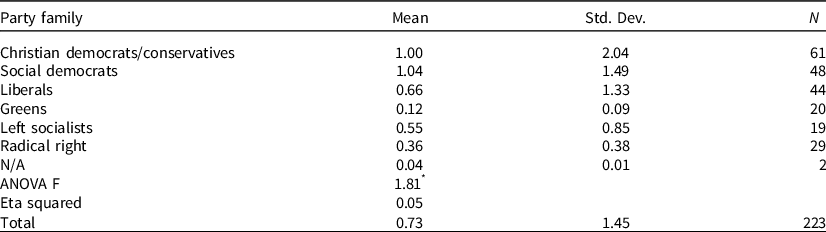
Table 2 presents descriptive data regarding our dependent variable (M/E ratios), aggregated by party family. Social Democrats and Christian Democratic parties display higher membership ratios, followed by the Liberals; the Greens and the Radical Right present lower ratios. These patterns are similar to previous studies that focussed on a narrower set of cases (e.g. Webb and Keith, Reference Webb, Keith, Scarrow, Webb and Poguntke2017). It is interesting to see that the patterns hold in a broader, more diverse set of cases. Overall, there are no clear outliers to isolate or exclude from the analyses.
M/E ratio by party family

Source: Computed by the authors.*P < 0.10.
Our independent variables are retrieved from a variety of datasets (see online Appendix 2 for full information). As regard the country-level variables, we use the country’s score on the Regional Authority Index (Hooghe et al., Reference Hooghe, Marks, Schakel, Chapman-Osterkatz, Niedzwiecki and Shair-Rosenfield2016) as a measure of state decentralization (H1). The type of government (H2), coded as dummy parliamentary vs. non-parliamentary systems, was retrieved from Cheibub et al. (Reference Cheibub, Gandhi and Vreeland2010) and PPDB. Party law incentives (H3) combine four PPDB indicators on subsidy allocation and political contributions in each country (with subsidies linked to membership coded as incentive). These indicators are computed in a simple additive index, recoded on a 0–1 scale, from low to high incentives to recruit. This is a finer measure than state subsidies, often used in the literature (van Biezen and Kopecky, Reference van Biezen, Kopecky, Scarrow, Webb and Poguntke2017). The measure of formative environment (H4) is computed as the average of the Revised Combined Polity Score (polity2 score) in the five initial years after party foundation. This score, retrieved from Polity V database (released in 2020),Footnote 4 classifies each country-year according to a combination of the Democracy Index and the Autocracy Index, and ranges from −10 (strongly autocratic) to +10 (strongly democratic). For the sake of standardization, we recoded the score on a 0–1 scale, from a party born in a strongly autocratic to a strongly democratic environment. Finally, trust in parties (H5) is retrieved from different waves of two international surveys: the World Values Survey (waves 5 to 7, ‘confidence in parties’) and the European Social Survey (ESS rounds 8.0 and 9.0, ‘trust in parties’)Footnote 5 . As a rule of thumb, we used the survey wave that was closest to the date of the reported membership figures in each country. Because the surveys have different scales, we adapted and recoded the indicator on a 1–5 scale, from no trust to complete trust in political parties.
As regards party-level variables, all indicators for the party organization variables (H6 to H8) are retrieved from the PPDB dataset and coded on three 0–1 scales (see online Appendix 3). The benefits scale (H6) evaluates whether party members may vote on leadership and candidate selection processes and on the adoption of the party manifesto. It ranges from no rights to full rights for members. With only three variables (see Appendix 3), this index is more straightforward than the Plebiscitary index of intra-party democracy developed by von dem Berge and Poguntke (Reference von dem Berge, Poguntke, Scarrow, Webb and Poguntke2017), which allows to include a larger number of cases in our analyses. The costs of joining index (H7) aggregates seven PPDB variables in a simple additive index (from low to high costs). These variables include procedural and financial requirements for full membership, the existence of a different level of formal membership with reduced obligations and reduced rights (e.g. party friend or sympathizer), and the easiness to join online. Finally, the representativeness index (H8, low-high representativeness) is computed as the arithmetic mean of three sets of variables (21 PPDB variables). Each set measures the presence and weight of intra-party sub-groups within the party structure: a) the simple mention of the sub-group in party statutes; b) the opportunity to send delegates to party congress; c) the guarantee of ex officio seats on the party’s highest executive body.Footnote 6 The more important the weight (from ‘a’ to ‘c’), the higher the score on the scale (see Appendix). Finally, the level of partisan attachment (H9) was based on different waves of ESS (rounds 8.0–9.0) and the Comparative Study of Electoral Systems (modules 4–5).Footnote 7 Both surveys include a ‘feel closer to a party’ question, which makes them comparable.Footnote 8 This indicator expresses the percentage of total voters in the country who mention that they ‘feel close or closer’ to the specific party.Footnote 9
The models include four control variables. As there is a wide variation in the number of cases per country, the results are controlled by the number of parties in each country in the final dataset (not shown in Tables 3 and 4). Second, the literature on party institutionalization ties party age and membership size, often implicitly considering party age as a proxy for professionalization (Bolleyer, Reference Bolleyer2013; Beyens et al., Reference Beyens, Lucardie and Deschouwer2016). Following this literature, party age is measured as the number of years (logged) since the foundation of the party (retrieved from MAPP and other web sources). The models also control for the age of democracy measured by the age of the current regime in logged years (retrieved from Polity V). Finally, we control the results for the party system fragmentation, measured by the effective number of electoral parties (ENEP) retrieved from Gallagher (Reference Gallagher2019) and PPDB. As our dependent variable expresses the proportion (%) of members to the electorate, it is reasonable to assume that the more parties in a given system, the smaller the pool of recruitment available to each party taken individually. Furthermore, some authors have pointed out that high levels of fragmentation reduce the system’s intelligibility for the voter, which negatively affects partisanship and recruitment (Huber et al., Reference Huber, Kernell and Leoni2005; Lupu, Reference Lupu2015).Footnote 10 Lastly, we do not control for party size as it is already captured by several of our independent and control variables (partisan attachment, ENEP).
Country- and party-level explanations of membership variations

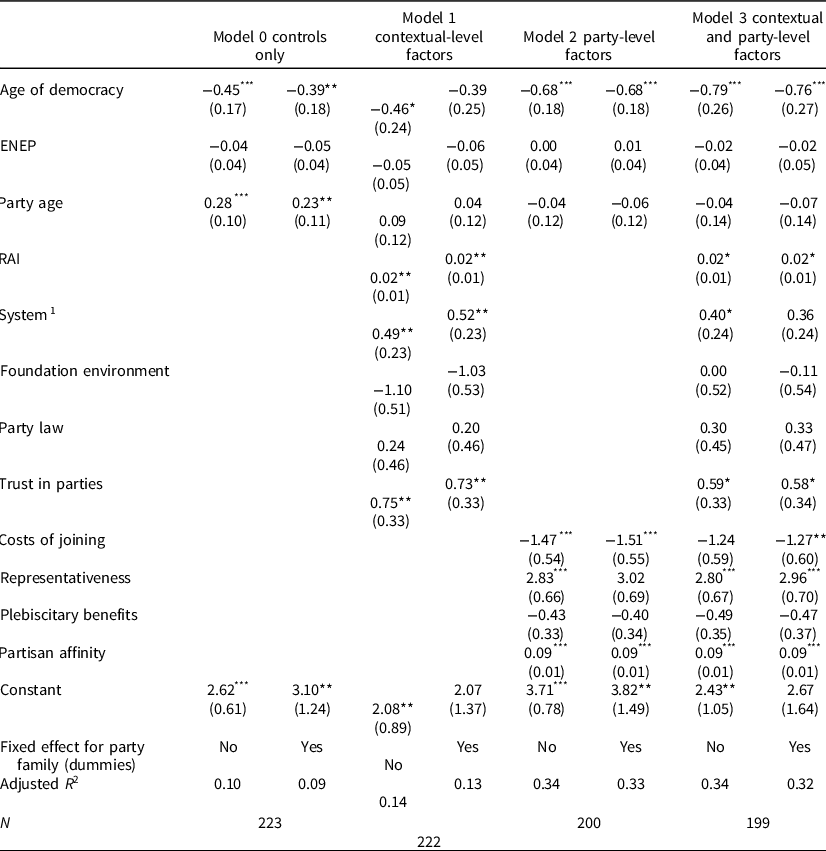
Note: Entries are unstandardized coefficients with standard errors in parentheses.***P < 0.01, **P < 0.05, *P < 0.10.
1 System is a dummy variable (0 = parliamentary system; 1 = presidential and hybrid systems).
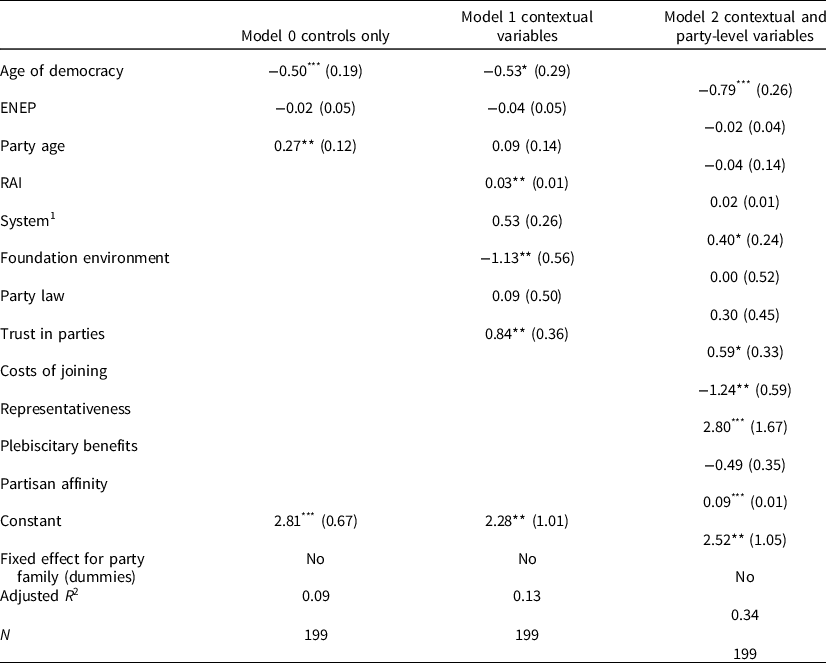
Country- and party-level explanations of membership variations (hierarchical model)

Note: Entries are unstandardized coefficients with standard errors in parentheses.
***P < 0.01, **P < 0.05, *P < 0.10.
1 System is a dummy variable (0 = parliamentary system; 1 = presidential and hybrid systems).
As our dependent variable (M/E) is continuous we use ordinary least squares regression models. Our models proceed stepwise by including country-level variables first, and then party-level variables. All models were tested for multicollinearity. We run both non-hierarchical (separate) and hierarchical (single) regression models. Note that because our cases are not a random sample, but the population of the main parties represented in the lower chamber in each country (with valid data), we focus on the coefficients and the direction of the relationships and not on statistical significance although we chose to display significance levels in the tables for transparency.
Analyses
We start our analysis by presenting the results in non-hierarchical models (Table 3), which allows a comparison between them. Model 0 is a baseline model that includes only the control variables. Model 1 includes country-level variables, while model 2 includes party-level variables. Model 3 comprises all the variables. As ideology can be related to differences in parties’ organizational features, we present two specifications for each model, with and without fixed effects for party family (coded as dummies). This is a simple measure that easily travels across heterogeneous countries (see Scarrow et al., Reference Scarrow, Webb and Poguntke2017).
Contrary to Mair and van Biezen’s (Reference Mair and van Biezen2001) findings, the baseline model (and the subsequent models) shows that parties in older democracies have fewer members. This may be directly related to the expansion of analytical coverage beyond traditional parliamentary democracies, as a lot of presidential systems are found in newer democracies. The average age of democracy for presidential and semi-presidential countries covered by our analysis is 41 years, against 68.5 years for the parliamentary democracies. At the party level, older parties have higher membership ratios, which points to the competitive advantage of traditional parties within their national party systems.
The inclusion of country-level contextual variables (model 1) only slightly increases the power of our analysis, as measured by the R-squared. The country-level variable with the largest association with membership ratios is the general trust in parties, followed by the system of government and the formative environment; coefficients are lower for party law incentives and level of centralization especially (according to the standardized coefficients not presented in the table). Our results confirm that all country-level variables play in the expected direction. We find that parties in decentralized systems display higher membership ratios as expected (H1 supported), which suggests that parties in smaller polities are associated with more partisan recruitment, albeit the effect is limited. Second, our results show that parties under presidential or mixed systems present membership ratios that are, on average, 0.5 percentage points higher than the numbers shown by their counterparts in parliamentary democracies (H2 supported). Third, we find that party law incentives at the national level boost membership ratios (H3 supported). The formative environment in which parties emerged also matters (H4 supported). The mean difference in membership levels between a party created in a fully autocratic environment and a party founded under a strongly democratic regime is around 1.1 p.p. in favor of the former (the actual interval of formative environment in the dataset runs from 0.17 to 1.0; see descriptive statistics in the Appendix). Finally, trust in parties has a strong positive association with membership ratios, as expected (H5 supported). A one-unit increase in the general trust in parties in a particular country is associated with an increase of 0.7 p.p. in the M/E ratio of each party in that country.
Adding party-level variables (model 2) strongly improves the model: the R-squared more than doubles compared to model 1. Such an increase provides a strong support for our central argument: parties are not powerless victims of external factors, and their organizational arrangements matter for membership recruitment.
Contrary to our expectations, more benefits granted to members are associated with lower, not higher, membership ratios (H6 reversed). This may be due to the fact that it is parties facing decreasing membership ratios that engage in party reform and decide to grant their members more rights. We cannot resolve this causal mechanism with our cross-sectional data and it calls for additional longitudinal studies to disentangle this relationship. Our results strongly support the idea that parties that opt for higher costs of joining have lower membership ratios (H7 supported). The fact that our results confirm patterns that were highlighted in previous studies, but on a broader number of cases, is an important finding. It means that rules of affiliation (costs and benefits of joining) have a similar effect on membership ratios in a wide variety of settings. Another original finding is the strong support for the idea that parties that give more weight to sub-groups in their organizational structure and decision-making processes display higher membership ratios (H8 supported). A party scoring the maximum level on the representativeness scale would have, on average, a M/E ratio around three percentage points higher than a party scoring zero on the scale. The explanation for this strong impact can be three-fold. First, the literature shows that certain party models favor the inclusion of sub-groups in their party structure: mass-based parties and parties of social integration, such as the Social Democrats and Christian Democrats, tend to display these organizational characteristics. They are also parties with higher membership ratios (albeit declining over time). However, as shown in Table 3 the results hold in our models with fixed effects for party family. The findings are not only linked to the presence of Christian Democratic or Social Democratic parties in our dataset. The second explanation relates to a representativeness argument: parties that include more sub-groups in their structure and build stronger collective linkages are more attractive, as organizations, to these various sub-groups and manage to recruit more members, being able to rely on more (diverse) recruitment pools. Third, the relationship can also run in the opposite direction, with more diverse parties facing more pressure to grant more representation to sub-groups in their internal decision-making structures. With cross-sectional data, we are not able to ascertain the direction of causality, but this calls for further research. Finally, coefficients in Table 3 shows that higher levels of party attachment are associated with larger memberships (H9 supported), albeit the coefficients are low.
Interestingly, the party age sign changes direction from positive to negative when we add the party-level variables in model 2 (this change is confirmed in Table 4 below). As the party-level variables are stronger than the country-level factors, this negative association remains in model 3 (full model). In the country-level model, older parties have greater recruiting capacity. However, newer parties can compensate for this disadvantage by adopting more aggressive recruitment strategies, such as lowering membership costs and offering more innovative mechanisms for internal participation. Controlled by age of democracy and type of regime, our data show that older parties place higher costs and barriers for the entry of new members and offer fewer benefits to their members, which might explain the inversion of the sign once the party-level variables are included. This shows how strongly organizational variables are associated to membership levels, vis-à-vis the country-level variables.
Finally, model 3 includes both country-level and party-level variables. The adjusted R-squared values remain roughly the same between models 2 and 3, and the coefficients confirm that party-related factors are more important that country-level variables for membership ratios. Overall, running the four models with fixed effects by party family (as dummies) has a slight detrimental effect on the R-squared values. Across the models, only one variable has the opposite effect than predicted by our hypotheses (benefits, H6), albeit without statistical significance. All the other relations work in the expected direction. The variables with the strongest coefficients are party-related variables, and the strongest macro-level factor is the formative environment under which the party was founded, which stresses that context matters most when looked at from a party-specific angle.
As a robustness check for our findings, we also ran all regressions in a single hierarchical model, which implies the loss of cases due to missing values (Table 4). It does not change the main findings. The baseline model confirms that parties in older democracies have fewer members, and that party age is positively associated with membership ratio. Country-level variables work in the same way in model 1 in the hierarchical design. Parties in decentralized states (H1), with presidential or hybrid systems (H2), and that receive more incentives to recruit from their national party laws (H3) display higher membership ratios. A party’s formative environment in an autocratic regime (H4) and higher levels of trust in parties (H5) are associated with higher membership ratios.
While country-level variables add some explanatory power compared to the baseline model (0.04 p.p.), the R-squared increases to 0.34 in model 2 that includes party-level variables. The previous findings are confirmed. Higher benefits of joining are related to lower membership ratios (H6 reversed), as are costs of joining (H7). A party that imposes more barriers of entry to new members, such as the Peruvians for Change, the Politics Can be Different in Hungary, or the Electoral Action of Poles in Lithuania – Christian Families Alliance (EAPL-CFA) in Lithuania, tends to present an M/E ratio between 1.2 and 1.5 p.p. lower than a party that plans very low costs, such as the Swedish Social Democrats or The Liberals in Switzerland. The results also confirm the strong positive association between representativeness and membership ratios (H8), and the positive yet weak effect of party attachment (H9).
We ran robustness checks for both specifications (hierarchical and non-hierarchical), running models with fixed effects by type of regime coded as a three-fold category, by global region, and by the level of clientelism in the country (using the V-DEM party linkage variable v2psprlnks, version 9.0, coded from more clientelistic to more programmatic linkages),Footnote 11 and the key results remain similar. Table 5 summarizes our findings in the light of our initial hypotheses.
Summary of findings

Note: confirmed hypotheses are in bold; confirmed hypotheses with weak effect are underlined; reversed effects are in italics.
Conclusion
Our main goal was to enhance our understanding of variations in membership levels across parties by means of comparing very heterogeneous polities, covering all regions of the world. We also made the most of the recent advances in large-scale comparative datasets on parties, which allow multilevel approaches focusing on country- and party-level effects. More specifically, the paper investigated whether a specific set of circumstances can make it easier for parties to recruit members, but also whether parties themselves can implement specific incentives for enrolment that favor membership recruitment. In doing so, the paper emphasizes the importance of country-level and party-level factors, using a cross-sectional dataset. Our main results are consistent across our different models and regression specifications. These findings are especially robust, as they survive an unprecedented coverage that includes century-old and very young electoral democracies with very different traditions in terms of party organization and extremely heterogeneous contexts.
Those findings point in three directions. First, we confirm that context matters, also outside western democracies. We found that parties display higher membership ratios in decentralized states, in presidential or hybrid systems, and in countries with higher levels of trust in parties and that have adopted party laws that incentivizes to build a party on the ground. This is not entirely new, but our findings expand our existing knowledge in two ways. First, by broadening the scope of countries that is traditionally covered in this kind of analysis, our results offer more robust tests of country-levels effects across types of democracies. Second, this broader scope challenges existing knowledge and points to a reversed effect of some variables. Particularly, we found that parties in younger democracies display higher membership ratios. Third, we show that context can matter in more subtle ways and can be specific to each party. Especially, we show that the formative environment in which parties emerged matters (party origins) and is important to understand party membership levels today. Parties created in more authoritarian environments inherit resources that remain assets even decades after the democratization process.
More importantly, we show that party-level variables matter more than country-level variables for membership ratios. Parties that place lower barriers and costs for the entry of new members, that offer more opportunities for representation for their internal sub-groups, and that have more public support in terms of partisan attachment, display higher levels of membership. Parties are not powerless when it comes to membership. We argue that they are not mere victims of their environment or societal evolutions. Our cross-sectional data does not allow us to judge whether environmental or societal evolutions would have similar effects within a single party; to test this, we would need longitudinal data. However, in an era where parties are reforming their organizational structures and affiliation rules, these results do suggest that some reforms could work in a favorable direction in terms of membership recruitment. Organizational choices, such as affiliation rules and representation of sub-groups in the organizational structure, matter a lot. Especially, representation of sub-groups is key. This article adds to existing knowledge by stressing that parties that recognize the existence of sub-groups in their statutes, but also grant them specific representation rights at the party Congress and/or seats in the party executive, tend to attract more members. In this sense, openness to and integration of these sub-groups is crucial. The promotion of collective linkages with organized sub-groups may be an efficient strategy for revitalizing partisan mobilization. Diffusion of the decision-making power, deliberation, and pluralism (Ignazi, Reference Ignazi2020), may be the key in future debates on party recruitment and intra-party democracy.
Supplementary material
To view supplementary material for this article, please visit https://doi.org/10.1017/S1755773922000212.
Acknowledgements
The authors thank Thomas Poguntke, Susan Scarrow, Paul Webb, and Goran Čular for their comments on previous versions of the paper.
Funding statement
This manuscript benefited from the funding 34680657 PINT-BILAT-M/SPRINT 3/2018 FAPESP/FNRS (# 18/19925-8) for the research Project EXPOND ‘Explaining Party Membership in Old and New Democracies: Institutional and Demand-Side Variables’.
Conflict of interest
The authors declare that they have no competing interests.