INTRODUCTION
In the early 1980s an unknown pathogen caused a massive mortality in the sea urchin Diadema antillarum that reduced its populations between 93–100% throughout the Caribbean (Bak et al., Reference Bak, Carpay and Ruyter van Steveninck1984; Lessios et al., Reference Lessios, Robertson and Cubit1984). Before the die-off, this echinoid was one of the major macroalgae consumers in coral reefs ecosystems, as Diadema africanum in sub-littoral ecosystems of the Canary Islands (Cabanillas-Terán et al. Reference Cabanillas-Terán, Martín, Rodríguez-Barreras and Luque2014); what supports the importance of the genus Diadema as a keystone species (Edmunds & Carpenter Reference Edmunds and Carpenter2001). The absence of this important herbivore has resulted in fleshy macroalgae out-competing coral for space and limiting coral recruitment (Edmunds & Carpenter, Reference Edmunds and Carpenter2001; Carpenter & Edmunds, Reference Carpenter and Edmunds2006; Myhre & Acevedo-Gutiérrez, Reference Myhre and Acevedo-Gutiérrez2007). Accordingly, the collapse of D. antillarum is considered one of the major causes of the drastic decline in coral cover in the Caribbean (Carpenter & Edmunds, Reference Carpenter and Edmunds2006).
Recent studies suggest that a recovery process is occurring across the Caribbean (Carpenter & Edmunds, Reference Carpenter and Edmunds2006). In Puerto Rico the current state of recovery, however, is uncertain as very few population studies have been conducted after the die-off (i.e. Weil et al., Reference Weil, Torres and Ashton2005; Ruiz-Ramos et al., Reference Ruiz-Ramos, Hernández-Delgado and Schizas2011; Soto-Santiago and Irizarry-Soto, Reference Soto-Santiago and Irizarry-Soto2013; Rodríguez-Barreras et al., Reference Rodríguez-Barreras, Pérez, Mercado-Molina, Williams and Sabat2014). Moreover, no study has assessed changes in population size over time in locations where historical data exist; limiting our understanding of the population dynamics of D. antillarum at the local level. The available information indicates that local population densities are lower than those found at other Caribbean localities (Weil et al., Reference Weil, Torres and Ashton2005; Ruiz-Ramos et al., Reference Ruiz-Ramos, Hernández-Delgado and Schizas2011). For instance, Carpenter & Edmunds (Reference Carpenter and Edmunds2006) reported densities ≥4.00 ind. m−2 for Belize, St. Croix, Grenada and Jamaica; whereas the highest mean density reported for Puerto Rico is 2.65 ind. m−2 at Tamarindo Bay, which is located in Culebra Island (Rodríguez-Barreras et al. Reference Rodríguez-Barreras, Pérez, Mercado-Molina, Williams and Sabat2014). In addition, densities found by Ruiz-Ramos et al. (Reference Ruiz-Ramos, Hernández-Delgado and Schizas2011) for 28 other reefs did not exceed 0.91 ind. m−2. This contrasts with pre-mortality densities that ranged between 13.8 and 18 ind. m−2 (Bauer, Reference Bauer1980; Vicente & Goenaga, Reference Vicente and Goenaga1984).
Due to the link between the presence of D. antillarum and coral-dominated reefs, it is important to make well-informed management and/or conservation decisions that promote population recovery of this sea urchin. Evaluating the status of local populations is a first step towards this end, as the information obtained may provide the basis to (1) determine which populations need to be the focus of conservation initiatives and (2) identify the vital rate(s) (e.g. survival or reproduction) that need management intervention. At the same time, results may serve as a baseline to assess future changes in population size. In this sense, the aim of this study was to assess the current population status of D. antillarum in terms of population density and size structure at various fringing reefs in northern Puerto Rico where previous population data were available. We also explored the relationship between sea urchin density with substrate complexity and algal cover as it has been suggested that these environmental variables play a role in the population dynamics of D. antillarum (Lee, Reference Lee2006; Rogers & Lorenzen, Reference Rogers and Lorenzen2008). Results of this study will contribute towards elucidating the prospect of population recovery around the island of Puerto Rico.
METHODS
Study sites
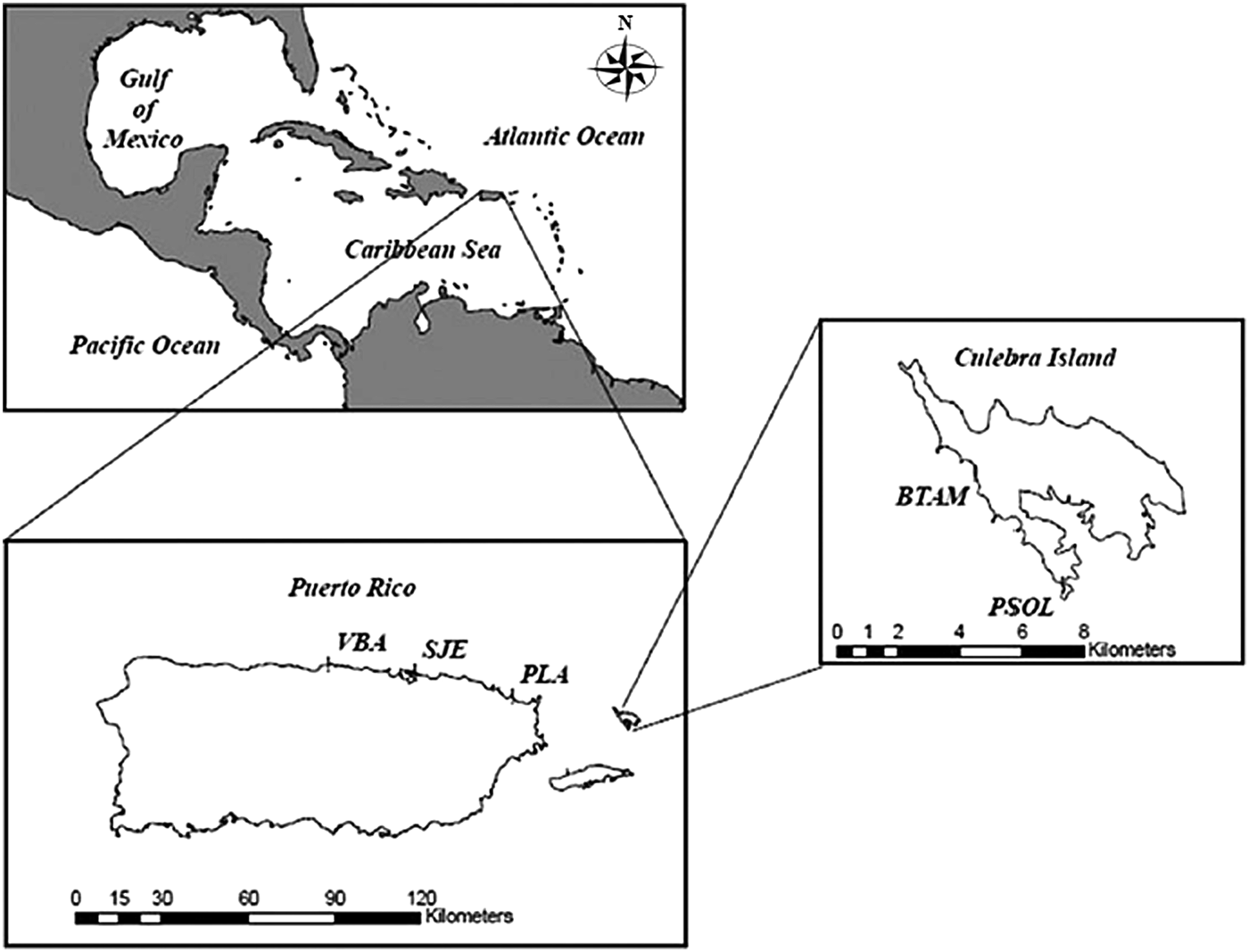
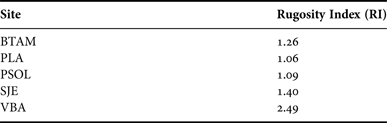
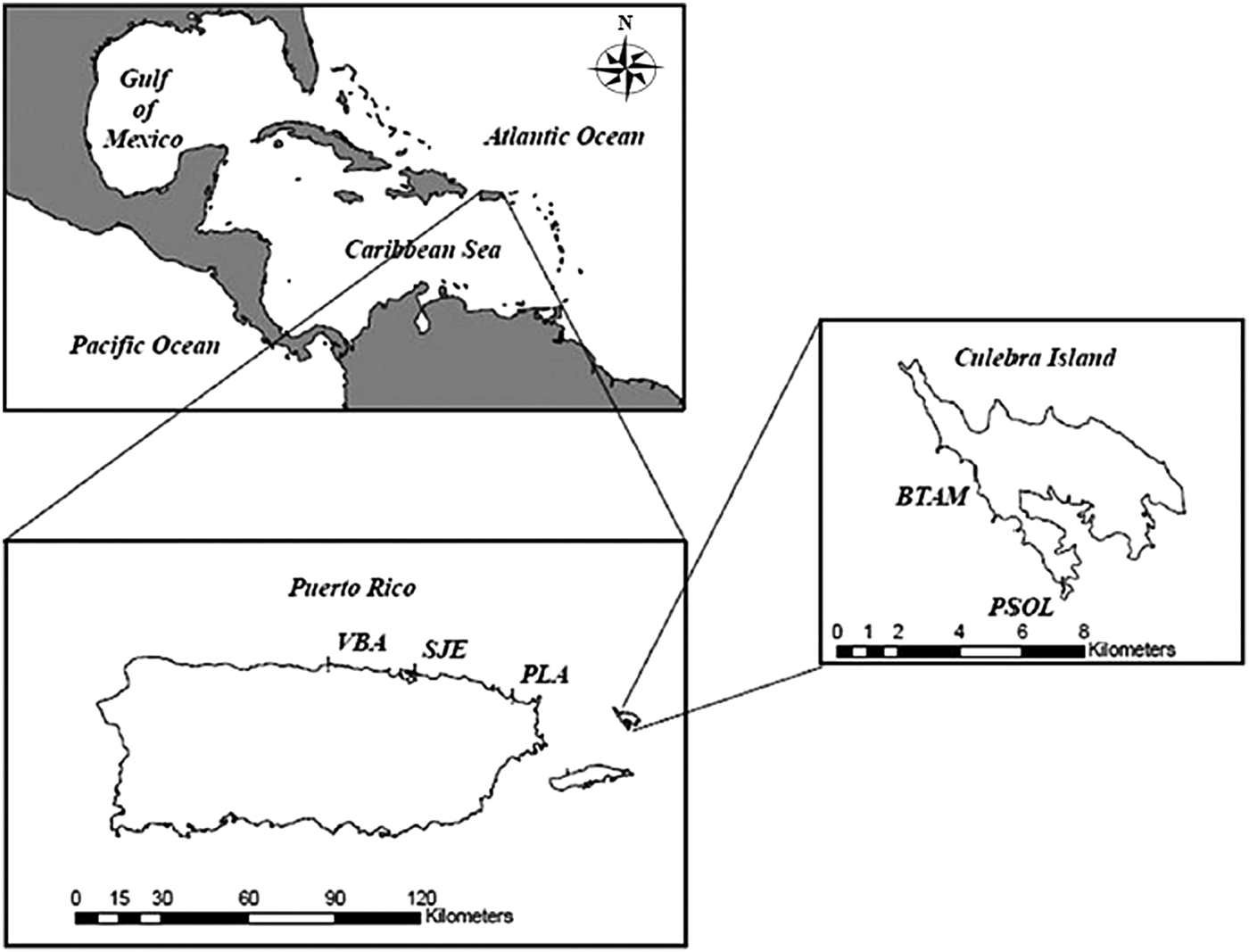
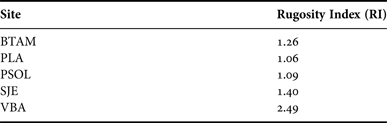
The study was conducted in five fringing reefs of Puerto Rico: three in the north coast and two in the island municipality of Culebra (Figure 1). The structural composition of these reefs differs among sites. Vega Baja (VBA) is a reef dominated by an extensive Acropora palmata zone with relatively high substrate complexity (Table 1). Bahía Tamarindo (BTAM) and Punta Soldado (PSOL) are characterized by a consolidated bottom with relatively low topographic relief (Table 1). At these two sites, benthic macrofauna is visually dominated by Millepora spp., Diploria spp. and Porites spp. Topographic relief at Playa Azul (PLA) is also relatively low, but the bottom is a mixture of consolidated substrate and coral rubble. On the other hand, San Juan Escambrón (SJE) is typified by a moderate topographic relief (compared with the other reefs) with relatively high abundance of crevices and holes. At PLA and SJE coral cover is low (<5%). Fish species richness is much higher at BTAM (compared with the other reefs) given its location within a no-take marine reserve (Hernández-Delgado et al., Reference Hernandez-Delgado, Alicea-Rodriguez, Toledo and Sabat2000). PLA, SJE and VBA are sites directly exposed to high wave action generated by the easterly trade winds and North Atlantic winter storms. BTAM and PSOL are leeward bays characterized by relatively calm water (Ruiz-Ramos et al., Reference Ruiz-Ramos, Hernández-Delgado and Schizas2011). With the exception of PLA all sites were previously surveyed by Ruiz-Ramos et al. (Reference Ruiz-Ramos, Hernández-Delgado and Schizas2011) between 2003 and 2004.
Map illustrating the five study sites. BTAM = Bahía Tamarindo; PLA = Playa AzuL; PSOL = Punta Soldado; SJE = San Juan Escambrón; VBA = Vega Baja.
Rugosity index for each of the five study sites.
Population surveys
Density of D. antillarum was assessed seven times between November 2009 and November 2011 by counting all individuals within five 20 m2 (10 m × 2 m) belt transects. Transects were randomly established parallel to the coast and separated 10 m from each other once the position of the first transect was selected haphazardly from a set of geo-reference points. Depth varied between 1–3 m, considering that at these depths sea urchins tend to be more common (Weil et al., Reference Weil, Torres and Ashton2005; Ruiz-Ramos et al., Reference Ruiz-Ramos, Hernández-Delgado and Schizas2011). Surveys were carried out between 7:00 am and 8:30 am.
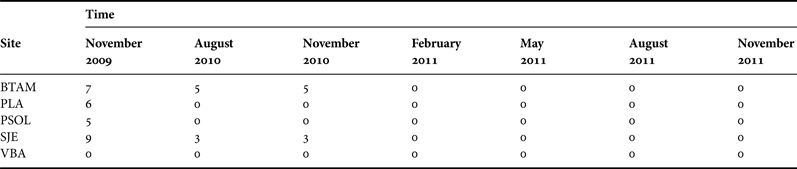
During each survey, population size structure of D. antillarum was estimated by measuring the test diameter of individuals (up to 100 individuals) found within the five 20 m2 transects. All crevices and holes were carefully examined to account for all individuals. Sea urchins were classified in three size classes following Ebert (Reference Ebert, Jangoux and Lawrence1983) and Lessios et al. (Reference Lessios, Robertson and Cubit1984): Class 1 – juveniles: individuals < 2.0 cm TD; Class 2 – early adults: individuals 2.0–4.0 cm TD; and Class 3 – adults: individuals >4.0 cm. Due to the difficulty of measuring larva settlement in-situ we defined recruitment as the number of sea urchins recorded as juveniles.
Algal cover and substrate complexity
To estimate algal cover, five 1 m2 quadrats, subdivided in four 0.25 m−2 sub-units, were placed randomly within each of the five 20 m2 transects (N = 25 quadrats). Photographs of each sub-unit were taken and percentage of algal cover was assessed by superimposing a total of 15 random points (60 per 1 m2 quadrats) on the image using the software Coral Point Count version 4.1 (CPCe®, Kohler & Gill, Reference Kohler and Gill2006).
Substrate complexity was estimated by superimposing a 10 m long chain along the contour of the reef substrate three times (Lee, Reference Lee2006; Alvarez-Filip et al., Reference Alvarez-Filip, Dulvy, Gill, Cote and Watkinson2009). This method allows the determination of a rugosity index (RI) by calculating the ratio between the total length of a chain and the length of the same chain when fitted along the reef surface (Lee, Reference Lee2006; Alvarez-Filip et al., Reference Alvarez-Filip, Dulvy, Gill, Cote and Watkinson2009). A value of 1 indicates a flat surface with RI increasing as levels of substrate complexity increase. RI was calculated during the first survey (November, 2009).
Statistical analyses
Two-way Repeated Measures ANOVA was used to compare densities (ind. m−2) of D. antillarum among sites and sampling periods followed by Student–Neuman–Keuls (SNK) test as a posteriori analysis of all pairwise comparisons. Because size-frequency distribution did not vary significantly through time at any of the study sites, we pooled all site-specific size data and used Kruskal–Wallis One-way ANOVA to determine whether median test diameter differed significantly among sites. Pairwise comparisons were then performed with Dunn's test as a posteriori analysis because sample sizes were unequal. Pearson's correlation analysis was used to explore the relationship between reef complexity and sea urchins abundance. To assess the relationship between sea urchin density and algal cover, Spearman's rank correlation analysis was performed because data did not fulfil the requirements of normal distribution and equal variances.
RESULTS
Population abundance
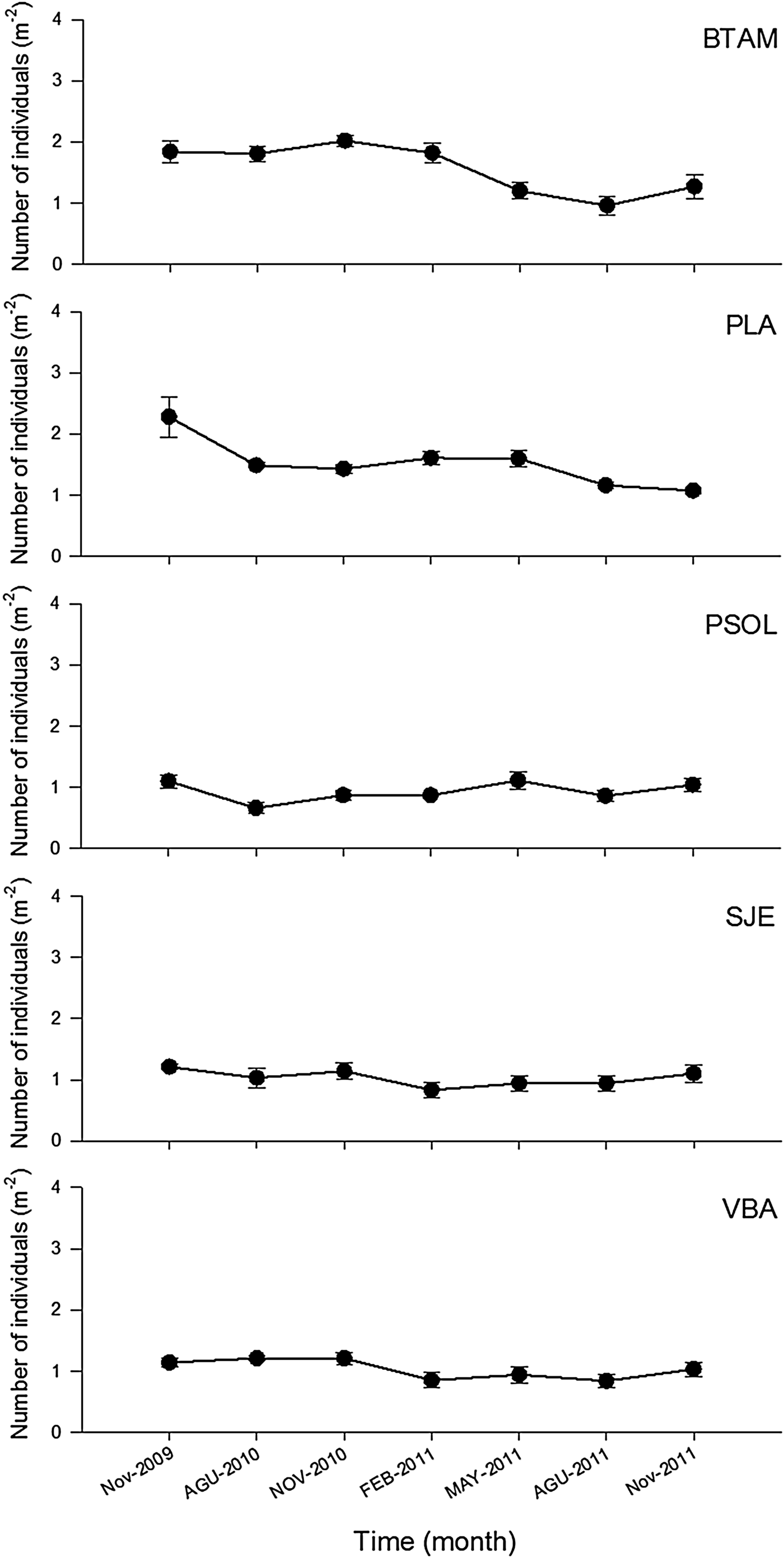
Results of Two-way Repeated Measures ANOVA showed that densities of D. antillarum differed significantly among the study sites (F (4,140) = 8.589, P < 0.05). BTAM and PLA were the sites with the highest densities, with an overall mean value of 1.46 ± 0.274 (SE) ind. m−2 and 1.49 ± 0.276 (SE) ind. m−2, respectively. PSOL was the site with the lowest density with a mean overall value of 0.86 ± (0.444, SE) ind. m−2. Sea urchin densities also varied significantly with time (F (6,140) = 2.207, P = 0.046). Mean overall density tended to be higher early in the study (mean density for the first 3 months = 1.28 ± 0.095 (SE) ind. m−2), slightly decreasing with time (mean density for the last 3 months = 1.06 ± 0.097 (SE) ind. m−2) (Figure 2). The interaction between location and time was not significant (F (24, 140) = 1.150, P > 0.05), indicating that differences in mean density among sites did not vary with sampling period.
Mean densities (±SE) of Diadema antillarum for the five study sites and seven census periods. BTAM = Bahía Tamarindo; PLA = Playa AzuL; PSOL = Punta Soldado; SJE = San Juan Escambrón; VBA = Vega Baja.

Population size structure
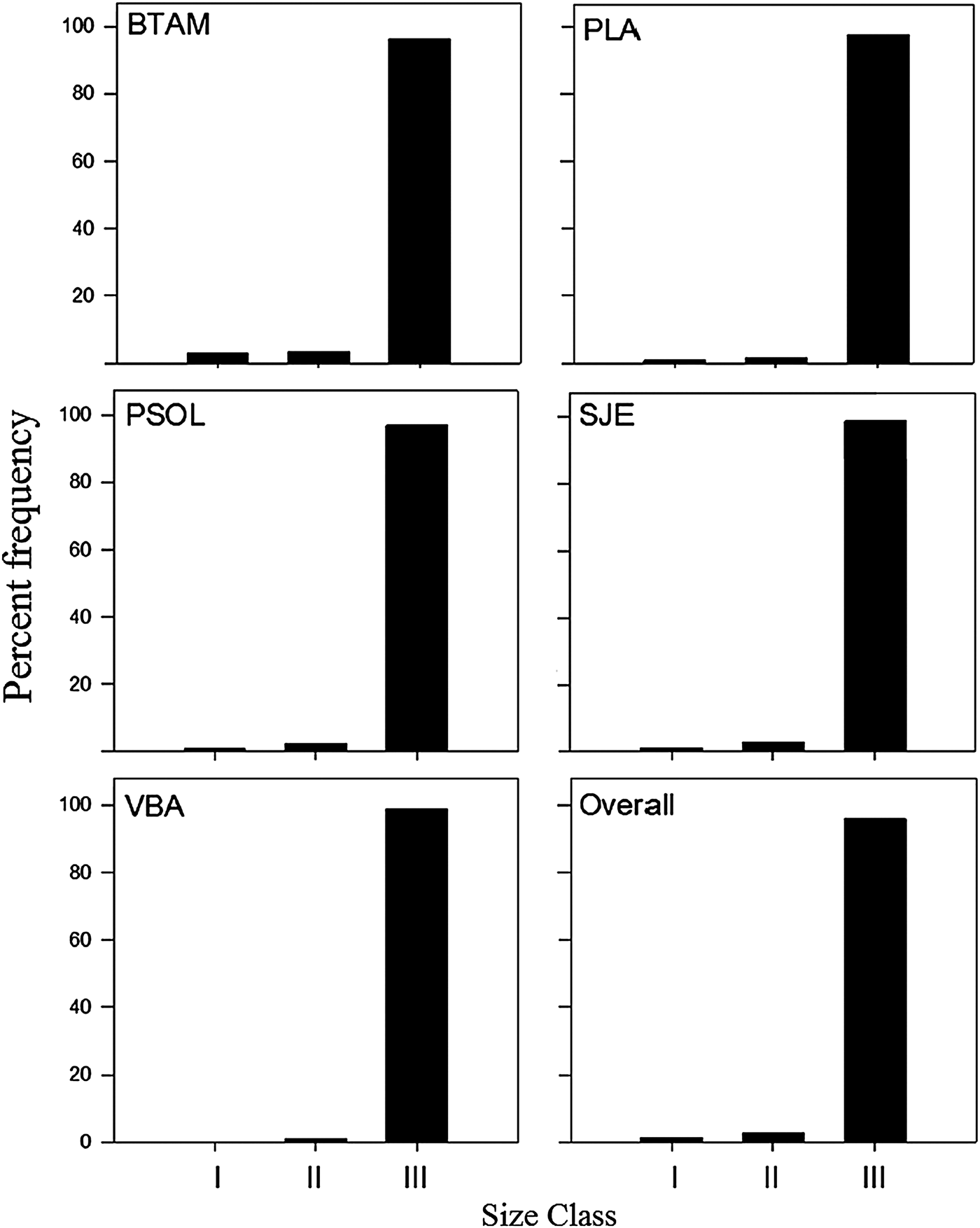
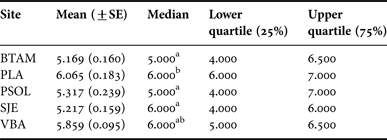
Size-frequency distribution of D. antillarum was dominated by individuals with a test diameter larger than 4 cm at all sites (Figure 3). Juveniles and early adults were rare during the study period (Table 2). Only 0.92% of all the individuals measured were juveniles, and 2.31% of them were classified as early adults. Test diameter of D. antillarum differed significantly among sites (Kruskal–Wallis, P < 0.001) with median size being significantly larger in PLA compared with all other locations with the exception of VBA (Dunn's test, Table 3).
Size-frequency distribution of Diadema antillarum at the five study sites. Data for all time periods were pooled due the scarcity of juveniles and early adults. Overall panel depicts pooled data for all sites and census periods. Class I = juveniles, Class II = early juveniles, Class III = adults. BTAM = Bahía Tamarindo; PLA = Playa AzuL; PSOL = Punta Soldado; SJE = San Juan Escambrón; VBA = Vega Baja.
Total number of juveniles (individuals <2.0 cm in test diameter) of Diadema antillarum found within five 10 × 2 m belt transects for the five study sites and seven census periods.
Descriptive statistics of Diadema antillarum test diameter for the five study sites. Different letters (a, b) indicate significant difference in median test size (in cm) in pairwise comparison (Dunn's test) among sites (P < 0.05). SE = Standard Error. Data based on all individuals measured during the study period.
Substrate complexity and algae cover
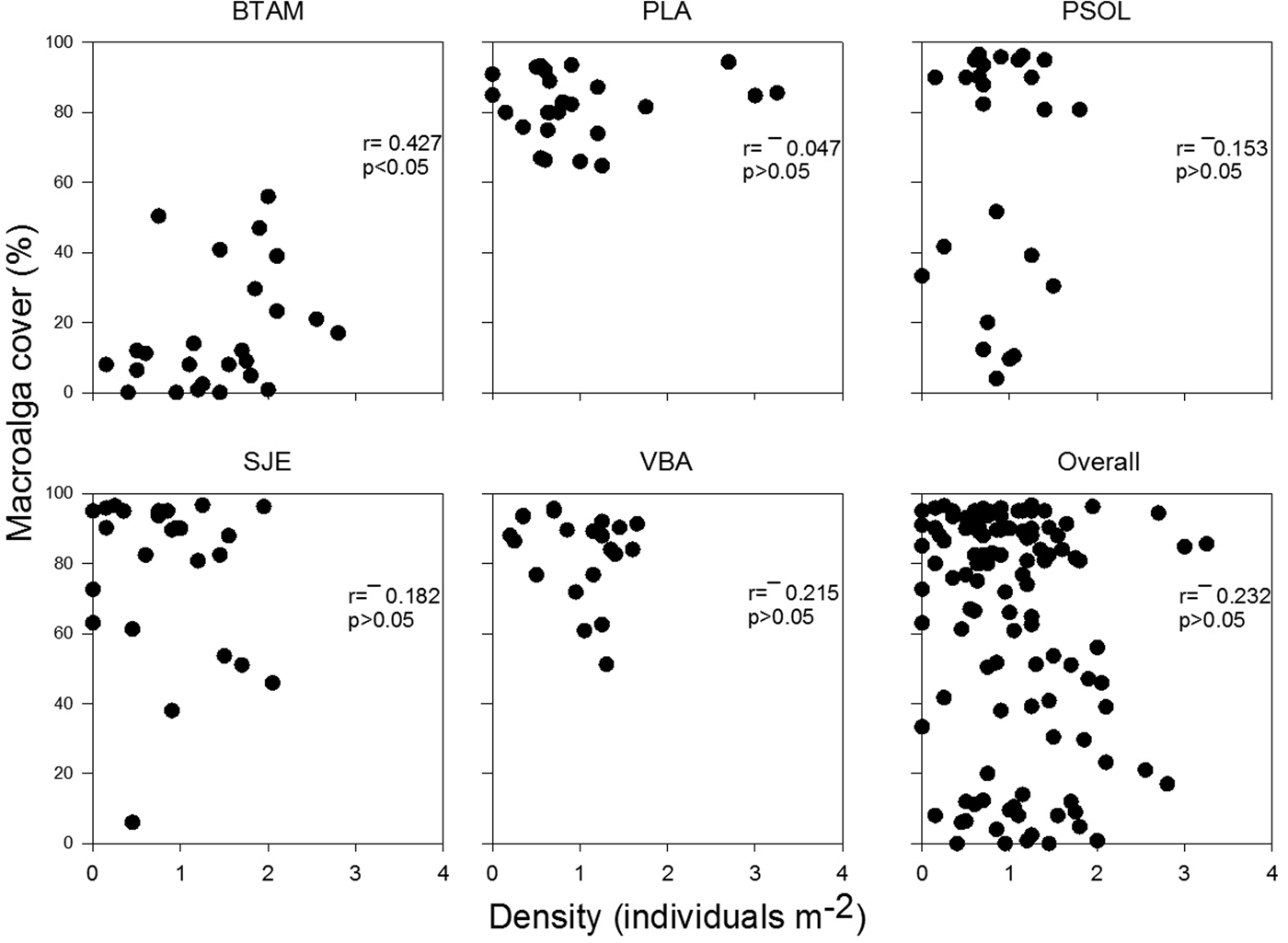
No relationship between the abundances of sea urchins and substrate complexity was found (r = −0.368, P > 0.05). Likewise, there was no significant correlation between densities of D. antillarum and algal cover at four of the five sites; the exception was BTAM where we detected a positive correlation between algal cover and the number of sea urchins (Figure 4). When all data are pooled (sites and time), a negative but non-significant correlation (r = −0.232, P > 0.05) was found.
Spearman correlation analysis between sea urchin density and alga cover at each of the five study sites monitored from 2009 to 2011. Overall panel depicts pooled data for all sites and census periods. BTAM = Bahía Tamarindo; PLA = Playa AzuL; PSOL = Punta Soldado; SJE = San Juan Escambrón; VBA = Vega Baja.
DISCUSSION
A major goal of our study was to provide baseline information on the current population status of D. antillarum in northern Puerto Rico. Population densities recorded during this study were higher than those found for the same sites by Ruiz-Ramos et al. (Reference Ruiz-Ramos, Hernández-Delgado and Schizas2011) between 2003 and 2004. Likewise, population of D. antillarum at Enrique reef, in the south-western coast of Puerto Rico, has increased from 1.19 ind. m−2 in 2001 (Weil et al., Reference Weil, Torres and Ashton2005) to 2.35 ind. m−2 in 2009 (Soto-Santiago & Irizarry-Soto Reference Soto-Santiago and Irizarry-Soto2013). These results merit the inclusion of Puerto Rico to the list of localities where populations of D. antillarum have shown some population growth since the mass mortality event. However, densities are still far from pre-mortality values of 13.8 and 18 individuals m−2 reported for Puerto Rico by Vicente & Goenaga (Reference Vicente and Goenaga1984) and Bauer (Reference Bauer1980), respectively. It can be argued that local populations are increasing, but at a very low rate; especially when compared with other Caribbean locations such as Barbados, Belize, Dominica, Jamaica and Saint Croix (Carpenter & Edmunds, Reference Carpenter and Edmunds2006; Steiner & Williams, Reference Steiner and Williams2006). This raises the question of why are the D. antillarum populations around Puerto Rico recovering at rates different from other Caribbean localities?
There is some debate with respect to the influence of predation in the population dynamics of D. antillarum. Harborne et al. (Reference Harborne, Renaud, Tyler and Mumby2009) attributed the absence of sea urchins within the Exuma Cays Land and Sea Park Marine Reserve in the Bahamas to a higher predation pressure inside the reserve compared with unprotected sites. Other studies, on the other hand, conclude that fish predation does not significantly affect sea urchin population densities (Lessios, Reference Lessios1988a, Reference Lessiosb). Unfortunately, the descriptive nature of this study does not allow us to determine whether or not fish predation may be limiting local population growth. It is worth noticing, however, that sea urchins tended to be more abundant at BTAM, which is located within a Non-Take Marine Zone where the abundance of fish predators is expected to be higher (Brown-Saracino et al., Reference Brown-Saracino, Peckol, Allen Curran and Robbart2007; Harborne et al., Reference Harborne, Renaud, Tyler and Mumby2009). Martín-Blanco et al. (Reference Martín-Blanco, Clero-Alonso, González-Sansón and Pina-Amargós2011) and Ruiz-Ramos et al. (Reference Ruiz-Ramos, Hernández-Delgado and Schizas2011) also found the highest densities of D. antillarum within marine protected areas, but we cannot rule out fish predation as a potential factor limiting local population dynamics without further experimental studies (e.g. cage exclusion). An alternative explanation for higher densities at BTAM is that this site is sheltered from direct wave action. Recently, Alcolado et al. (Reference Alcolado, Caballero, Lara, Rey-Villiers, Arriaza, Lugioyo, Alcolado-Prieto, Castellanos, Perera and Rodríguez-García2013) as well as Rodríguez-Barreras et al. (Reference Rodríguez-Barreras, Pérez, Mercado-Molina, Williams and Sabat2014) have associated higher abundance of D. antillarum with a lower wave exposure.
Some authors argue that habitat heterogeneity can play a role in the population dynamics of D. antillarum by providing both adults and juveniles with shelter from predators (Forcucci, Reference Forcucci1994; Lee, Reference Lee2006). Nevertheless, we did not find a clear association between sea urchin abundances (juveniles and/or adults) and reef heterogeneity. For instance, no juveniles or early adults were sighted at VBA despite this site being characterized by a well-developed Acropora palmata zone which is known to provide suitable refuge for D. antillarum (Weil et al., Reference Weil, Torres and Ashton2005; Sellers et al., Reference Sellers, Casey, Burge and Koepfler2009). Conversely, the number of adults and juveniles were higher at BTAM which is a site with a consolidated substratum, low topographic relief, small boulders and relative few crevices. Martín-Blanco et al. (Reference Martín-Blanco, González-Sansón, Pina-Amargós and Clero-Alonso2010) and Rodríguez-Barreras et al. (Reference Rodríguez-Barreras, Pérez, Mercado-Molina, Williams and Sabat2014) also found little evidence to assert that more topographically complex reefs sustain greater numbers of sea urchins (juveniles or adults).
Karlson & Levitan (Reference Karlson and Levitan1990) argue that populations of D. antillarum are recruitment-limited. Our results are consistent with this claim since the lack of population growth observed during this study coincides with a period of time where very few juveniles were observed. Similarly, Lacey et al. (Reference Lacey, Fourqurean and Collado-Vides2013) and Rodríguez-Barreras et al. (Reference Rodríguez-Barreras, Pérez, Mercado-Molina, Williams and Sabat2014) noticed that juveniles were very rare or absent from populations that have not increased significantly in recent years. Hence, the low rates of recovery at our studied sites could be attributed, in part, to low recruitment rates. The fact that densities remained relatively stable (PSOL, SJE, VBA) or showed only a slight decrease (BTAM and PLA) during the study period can be attributed to low recruitment and high adult survival.
Rogers & Lorenzen (Reference Rogers and Lorenzen2008) refers to the cultivation effect as the preference of larvae to settle in areas already grazed by sea urchins. Based on this effect, higher numbers of sea urchins recruits should be expected in areas with low algal cover. This, however, is not consistent with our results. Other studies have also failed to show a relationship between sea urchin abundances (juveniles and/or adults) and the percentage of algal cover (Steiner & Williams, Reference Steiner and Williams2006; Ruiz-Ramos et al., Reference Ruiz-Ramos, Hernández-Delgado and Schizas2011). A possible explanation is that sea urchin abundances are still too low to significantly reduce algal cover below a certain threshold to allow significant larval settlement. Densities greater than 2 ind. m−2 appear to be a critical population size to effectively limit algal growth (Steiner & Williams, Reference Steiner and Williams2006; Myhre & Acevedo-Gutiérrez, Reference Myhre and Acevedo-Gutiérrez2007; Hernández et al., Reference Hernández, Clemente, Sangil and Brito2008), and local overall mean densities in this study did not surpass 1.49 ind. m−2.
Larva supply has been considered another important factor limiting recruitment (Karlson & Levitan, Reference Karlson and Levitan1990; Lessios, Reference Lessios1988a, Reference Lessiosb; Chiappone et al., Reference Chiappone, Swanson, Miller and Smith2002; Miller et al., Reference Miller, Kramer, Williams, Johnston and Szmant2009). Because populations of D. antillarum are considered open (Karlson & Levitan, Reference Karlson and Levitan1990) the pool of larvae may be independent of the local abundance of adults, relying, instead, on the influx of larvae from neighbouring populations (Karlson & Levitan, Reference Karlson and Levitan1990; Caley et al., Reference Caley, Carr, Hixon, Hughes, Jones and Menge1996). From this perspective, it is possible that the amount of larvae arriving to the studied localities is not enough to sustain an adequate recruitment rate (i.e. larva filtering effect, Gaines et al., Reference Gaines, Brown and Roughgarden1985; Lessios, Reference Lessios1988a, Reference Lessiosb; Chiappone et al., Reference Chiappone, Swanson, Miller and Smith2002), even when D. antillarum is reproductively active throughout the year (Williams et al., Reference Williams, García-Sais and Capella2009). Nevertheless, some authors argue that larval post-settlement survival rather than larval availability plays a major role in the recruitment dynamics of this sea urchin (Chiappone et al., Reference Chiappone, Swanson, Miller and Smith2002; Miller et al., Reference Miller, Kramer, Williams, Johnston and Szmant2009; Vermeij et al., Reference Vermeij, Debrot, Van der Hal, Bakker and Bak2010; Williams et al., Reference Williams, Yoshioka and García-Sais2010).
Since recruitment failure, in terms of the number of individuals reaching the juveniles stage, appears to be the limiting factor for local population growth it is difficult to envisage whether D. antillarum will be able to reach pre-mass mortality abundances. The very few juveniles (recruits) observed during the studied period might be due to natural variation in the potential reproductive output (i.e. low rates of fertilization, Lessios, Reference Lessios, Fernández-Palacios, de Nascimento, Hernández, Clemente, González and Díaz-González2013), or to unfavourable environmental conditions precluding recruitment success. In the latter case, site-specific studies focusing on the dynamics of larval settlement, sea urchin reproductive biology, as well as studies directed to assess the genetic structure of populations around Puerto Rico may shed light on the relative importance of larval availability, larval dispersal, and pre/post larvae settlement dynamics in the recovery process of this key species. At the same time, factors that can influence settlement rates of larvae not considered in this study such as benthic biofilms, hydrodynamics, surface chemistry and water temperature (Roberts et al., Reference Roberts, Rittschof, Holm and Schmidt1991; Hunt & Scheibling, Reference Hunt and Scheibling1997; Miller & Emlet, Reference Miller and Emlet1997; Hernández et al., Reference Hernández, Clemente, Girard, Perez-Ruzafa and Brito2010) certainly deserve more attention.
To conclude, the vital functional role that D. antillarum plays on Caribbean coral reefs calls for initiatives directed to accelerate population recovery. An important finding of this study is that despite the very low number of juveniles entering the population, overall population density (considering all sites and time periods) decreased only slightly during the study period (2009–2011). Thus, in the absence of recruitment, relatively high and constant survival of adults helps in keeping urchin abundance relatively stable. The relevance of this finding, from a management perspective, is that head-starting programmes that would rear D. antillarum in culturing facilities until attaining a ‘refuge’ size would be a very effective strategy.
ACKNOWLEDGEMENTS
The local NGO Sociedad Ambiente Marino (SAM) provided logistical support. Invaluable field assistance was provided by volunteers of SAM and Capítulo Estudiantil Sociedad Ambiente Marino. Special thanks to Jaime Fonseca, Pedro Alejandro, Yasiel Figueroa, Frances Candela, Elizabetha Ortiz, Christian Resto, Rafael Guerrero, Javier S. Tellechea, Carmen González, and Abimarie Otaño for field assistance. To Sofia Burgos-Caraballo for map illustration. Comments by Damien Bontemps, Sean Kelly and Fabiola Rivera-Irizarry improved earlier versions of this manuscript.
FINANCIAL SUPPORT
This research was funded by the Center for Applied Tropical Ecology and Conservation (NSF grant HRD #0734826) at the University of Puerto Rico, Río Piedras Campus.