Implications
Changes in consumer preferences have influenced the market for all types of meat. Product development and innovation are necessary. As a result of these changes, interest in new meat products is required, especially related to shelf life. Freeze-drying is not a new technique; it is expensive, but an excellent option for processing meat for instant meals. Different types of bovine muscles, especially economic ones, are necessary to be studied so that they can be accepted by costumers. As an approach to product quality, physicochemical and senescence parameters were evaluated in order to determine which muscle can be used in instant meals.
Introduction
It is well known that processing may affect the quality of a food product. Indeed, various changes in physical, chemical and/or biological characteristics in food may occur during processing, preservation and distribution. These changes alter the physical aspects such as colour and structure. They can also develop undesirable biochemical reactions such as deterioration of aroma compounds or degradation of nutritional substances. All the aforementioned physical and biochemical changes certainly cause a reduction in product quality and in process efficiency as well. Many authors have reported the application of freeze-drying as an important preservation method for food (Georgieva and Tsveltkov, Reference Georgieva and Tsvetkov2008; Ciurzyńska and Lenart, Reference Ciurzyńska and Lenart2011). The popularity of this method is based on some well-known advantages compared with competitive processes: sample stability at room temperature, the easy reconstruction by the addition of water, the defined porous product structure, the reduction in weight and the possibility of easy sterile handling (Ciurzyńska and Lenart, Reference Ciurzyńska and Lenart2011).
In meat, several physicochemical changes appear when different treatments are applied. During heating, the different proteins in meat denature and they cause structural changes, such as the destruction of cell membranes, shrinkage of fibres, the aggregation and gel formation of myofibrillar and sarcoplasmic proteins and solubilisation of the connective tissue (Garcia-Segovia et al., Reference García-Segovia, Andres Bello and Martínez Monzo2007). When frozen storage is required, as in freeze-drying, quality deterioration cannot be avoided during freezing because of the formation of ice crystals, which leads to distortion of tissue structure and mechanical damage and denaturation of protein (Jeong et al., Reference Jeong, Don-Kim, Sul Yang and Tea Joo2011). Because of these stated points, it is important to understand the physical changes in the product when they are subjected to different processes.
On the other hand, freeze-drying is an expensive method because it requires deep freezing at low pressures, and the process can take over 1 to 3 days. However, it is still an excellent option for instant meal due to its longer shelf life. In order to minimise costs of freeze-drying, economic muscles such as Semimembranous (SM) and Spinal is dorsi (SD) were evaluated to consider which of them was suitable for an instant meal. Physicochemical and senescence parameters were studied as an approach to eating quality attributes.
Material and methods
The experimental part was divided into two steps. In the first step, the Semitendinosus (ST) muscle was evaluated to establish methodology and experimental conditions. ST was selected because it is considered a homogeneous muscle and it exhibits a regular intra-muscular pattern of muscle fibre trials along the length (Brandstetter et al., Reference Brandstetter, Picard and Geay1997). Once we established the experimental conditions and methodology to be applied in the first step, experimental conditions were applied in the second step with SM and SD muscles in order to compare them and to establish which one was suitable for an instant meal.
First step
Raw matter, cooking process and sample preparation
Bovine muscles were provided by an abattoir centre in Argentina. Whole ST muscles (sp: Aberdeen angus) were cut into about 4×2×2 cm steaks with the fibre parallel to the longest axis, and were individually labelled and weighed. Steaks were grilled in aluminium-folded strips and cooked to an end-point temperature of 71.5±0.5°C (American Meat Science Association, 1995) using an electric grill (Philips, CABA, Argentina). Internal temperature was monitored with a T-type thermocouple inserted to the geometric centre of each steak. ST muscles were weighed in order to determine cooking loss by dividing the weight loss during cooking by the pre-cooked weight and was reported as a percentage. Samples were cooled at room temperature (30 min), and then chilled in a refrigerator at 4±1°C for 24 h. Each cooked steak was cut with a cork-bore to a cylindrical form with 13 mm diameter and 3 cm height. Each cylindrical sample was sliced into units of 1 mm thickness and stored at 3°C until the freeze-drying process.
Freeze-drying treatment, samples storage and preparation for analyses
An experimental non-continuous freeze-drying equipment supplied with four trays designed by an industrial constructor (Rificor, Buenos Aires, Argentina) was used. ST samples were classified and placed in each tray. The following parameters were applied: freezing temperature: −50±1°C; time to reach in the fluid: 24 h; drying process: 40±1°C at maximum vacuum (pressure: 0.346 Pa) during 48 h. Samples were vacuum packaged, individually identified and stored in a dark place at room temperature. In order to analyse physicochemical and senescence parameters in freeze-dried samples, rehydration was performed with tap water at room temperature. The duration of the rehydration process was fixed for 30 min, because after that time period there was no more absorption of water by the samples.
Senescence and physicochemical parameters
Colour parameters were analysed using a spectrocolorimeter B-K Gardner spectro guide 45/0 gloss (Geretsried, Germany). Colour parameters (L*, a* and b*) were measured four times and the average value was used for statistical analysis. Chroma (C* ab ) was calculated as C* ab =(a*2+b*2)½. Hue angle (h* ab ) was calculated as h* ab =arch tan (b*/a*), where h* ab =0° for red hue and h* ab =90° for yellowish hue, and reflectance ratio (R630/580) was calculated as an estimate of cooked colour change from red to brown. Water activity (a w ) was analysed using a water activity meter (AquaLab 4TE®, Washington, USA). Linear offset was checked using a calibration standard (Decagon®, Washington, USA) and distilled water. The calibration standards used were as follows: LiCl 13.41 molal in H2O (a w : 0.250±0.003)/NaCl 6.0 molal in H2O (a w =0.760±0.003). Samples were analysed three times. Humidity (H%) was determined by the ISO R-1442 method (AOAC, 1975), using the gravimetric method.
For scanning electron microscopy (SEM), ST samples were analysed according to Palka and Daun (Reference Palka and Daun1999). Samples were mounted on holders and coated with gold. Microscopic evaluation was performed using an SEM conventional high-vacuum model Philips 515 (Philips, USA). Micrograph pictures were built-in image scanning device dials, Model Genesis Version 5.21.
Statistical analyses
A mixed model was applied for senescence and physicochemical parameters. The Tamhane and the Bonferroni test were applied. The random effect was analysed using variance component. Statistical analyses were performed with SPSS-Advanced Statistics 17 software (SPSS Inc., Chicago, IL, USA).
Second step
Sample preparation
Bovine muscles SM and SD (sp: A. angus) were prepared and analysed as described in step one.
Statistic analyses
A non-balanced factorial experiment was applied to analyse senescence parameters among the two factors (SM and SD) and four levels (raw, cooked, freeze-dried and rehydrated samples). Mean values were compared by LSD, the Student’s t and the Bonferroni tests. The Tamhane test was also applied for L* values. a w and H% were analysed as mean values. SPSS-Advanced Statistics 17 software (SPSS Inc.) was used.
Results
First step
Senescence and physicochemical parameters in ST muscle
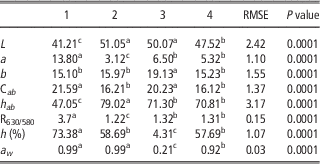
Table 1 shows results obtained for senescence and physicochemical parameters. The results showed that senescence parameters (P<0.05), humidity and water activity were statistically significant (P<0.0001). L* values decreased for the different levels as follows: cooked, freeze-dried and rehydrated. Lower a* values were observed in cooked condition. Lower a* values indicate less myoglobin degradation. b* values were similar for cooked and rehydrated samples. Liu et al. (Reference Liu, Lyon, Windham, Realini, Pringle and Duckett2003) reported that when meat was cooked, several changes in the appearance and physical properties of meat occurred. Changes included discolouration due to the oxidation of pigmented haeme groups. The stated author also reported than an increase in the cooking temperature causes a reduction in DeoxyMB and OxyMb (reddish loss) contents and an increase in MetMb (brownish-red) and SulfMb (greenish) contents. Changes in ST samples can be attributed to the cooking process, velocity/time of freezing applied in the process, etc. Data for C* ab for cooked and rehydrated samples were similar (a higher number indicated a more vivid colour); h* ab for cooked and rehydrated samples were between 79.02 and 70.81, respectively (a higher number indicated a greater shift from red to yellow); R630/580 indicated changes in colour from red to brown, data obtained were between 1.22 (cooked) and 1.31 (rehydrated samples).
Senescence and physicochemical parameters in Semitendinosus (sp: Aberdeen angus) samples

1=raw; 2=cooked; 3=freeze-dried; 4=rehydrated; RMSE=root mean square error; C ab =chroma; h ab =hue angle; R630/580=reflectance ratio; L=lightness; a=red to green; b=yellow to blue; H (%)=humidity; a w =water activity.
* Small letters within each row indicate that means are significantly different (P<0.05) related to condition effects (Tamhane and Bonferroni test).
No significant differences were observed for cooking loss (cooking loss: 39.8±0.7%). Water activity for cooked samples was higher than the rehydrated ones. Among homogeneity of freeze-drying process, results showed that there were no differences (P>0.05) among the trays when processing was carried out. Serra et al. (Reference Serra, Ramìrez, Arnau and Gou2005) reported that when the Biceps femoris muscle were subjected to drying (15±2°C) until constant weight, water activity decreased from 0.90 to 0.70. The stated authors also reported that lower values of water activity and water content increased hardness in Biceps femoris.
SEM
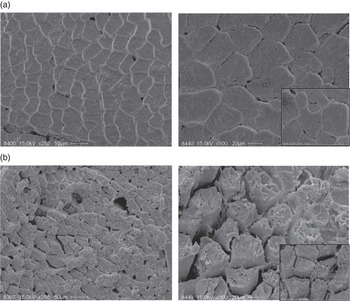
Micrographs taken of cooked ST are shown in Figure 1a. Cooked samples showed an organised structure with compacted fibres and without gaps among fibres. Figure 1b shows micrographs of freeze-dried samples. The structures appeared disorganised compared with cooked samples, showing gaps among fibre bundles and between fibres. Myofibrils were dehydrated, separated and partially fragmented. Rehydrated samples of ST presented gaps among fibres (figure not shown). Palka and Daun (Reference Palka and Daun1999) reported in cooked ST at different temperatures (70°C to 100°C) that granulation between muscle fibres were visible. When the cooking temperature was increased (over 70°C), the meat structure became more and more compact. A general view of all micrographs showed that microstructure of the cell was mainly modified.
(a and b) Scanning electron micrographs performed at 250, 500 and 1000× magnification of Semitendinosus cooked sample at 71°C and Semitendinosus freeze-dried samples.

Second step
Senescence and physicochemical parameters in SM and SD muscle
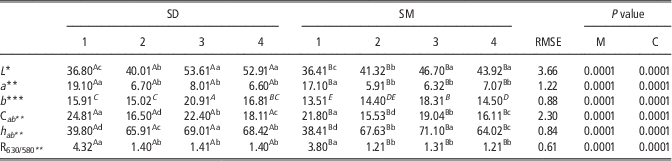
Table 2 shows data obtained for SM and SD. Differences in condition effects and in the muscles were observed for L* and a* values. SM and SD samples had higher L* values when rehydrated compared with cooked samples. Cooked, freeze-dried and rehydrated samples of SM and SD had similar a* values. Statistical difference was observed between interaction of condition effects by muscle for b* values. During freeze-drying process, SD samples were slightly separated and fragmented. Garcia-Segovia et al. (Reference García-Segovia, Andres Bello and Martínez Monzo2007) reported that Deep pectoral muscle samples tended to be generally lighter (high L* values) and more yellow (high b* values) when they were cooked. They also reported that a higher a* value is due to more myoglobin degradation. Differences among SM and SD can be due to protein denaturation as the stated authors reported. Jones et al. (Reference Jones, Carroll and Cavanaugh2006) reported that when ST muscles were cooked at different temperatures (50°C, 60°C and 90°C) for 45 min, fragmentation occurred. Myofibrils of the meat appeared dehydrated, separated and partially fragmented. Separation and fragmentation of SD samples could be due to muscle characteristics and cooking process, and in this case it could have increased because freeze-drying was applied. h* ab and C ab showed statistical differences in condition effects and muscle.
Senescence and physicochemical parameters in Semimembranous (SM) and Spinalis dorsi (SD) muscle (sp: Aberdeen angus) samples

1=raw; 2=cooked; 3=freeze-dried; 4=rehydrated; RMSE=root mean square error; M=muscle; C=condition; L=lightness; a=red to green; b=yellow to blue; C ab =chroma; h ab =hue angle; R630/580=reflectance ratio.
* Lowercase and capital letters indicate statistical differences for condition effects and muscle (Tamhane test, P<0.001).
** Lowercase and capital letters indicate statistical differences for condition effects (Bonferroni test and LSD, P<0.05) and muscle (T-tests, P<0.05).
*** Italic capital letters indicate statistical differences in interaction for condition effects by muscle (Bonferroni test and LSD, P<0.05).
Cooking loss for SD (30.55±4.12%) showed higher variability when compared with SM (33.47±1.34%). Water activity and humidity for SM (raw (a w =0.99; H%=70.3), cooked (a w =0.99; H%=54.5) and rehydrated (a w =0.99; H%=53.6)) showed similar results when compared with SD (raw (a w =0.99; H%=72.3), cooked (a w =0.99; H%=60.4) and rehydrated (a w =0.99; H%=57.6)). On the other hand, for freeze-dried samples, humidity and water activity for SD could not be analysed because samples were separated and fragmented; therefore, measurements could not be performed correctly. Freeze-dried SM samples showed good values of a w =0.39 and H%=4.7, and no fragmentation occurred as in SD samples. Results showed that among the muscles analysed that cooked and rehydrated samples did not exhibit differences.
Selection of bovine muscle for instant meal
According to the results obtained between SM and SD muscles, data showed that the SM muscle was suitable for freeze-drying according to the following observations: samples were not separated and fragmented as in SD; water activity was reduced satisfactorily in order to preserve the food; when cooked and rehydrated samples of SM were compared, humidity and water activity did not exhibit differences, although differences were observed in colour. In the future, other quality parameters must be evaluated, such as biochemical and sensory profiles, in order to complete the study.
Acknowledgements
Authors express their gratitude to Karina Moreno and Norma Ortiz for their technical support and to Dante Giménez to collaborate with SEM analyses.