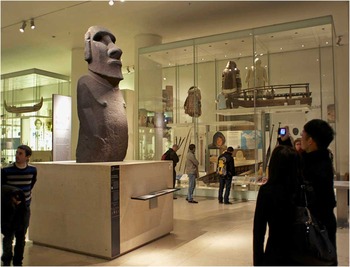
Hoa Hakananai'a is one of the best known and most viewed of all the Easter Island statues. Taken from the remote Pacific island in 1868 and delivered to the British Museum the following year, it has been on public display in central London almost without a break for more than 140 years (fig 1). Annual visitors to the museum first passed a million in 1850,Footnote 1 and today, with around six million visitors a year, it is the UK's most popular cultural attraction at which figures are counted. By contrast, annual visitors to Rapa Nui, the native name for the island, which has a population of some 4,000, are said to have risen in recent years to around 70,000.
Hoa Hakananai'a in the Wellcome Gallery at the British Museum. The original nineteenth-century plinth is now encased in a marble-tiled box. Photograph: M Pitts

Alfred Métraux, a Swiss anthropologist who co-directed a Franco-Belgian expedition to Easter Island in 1934–5, described Hoa Hakananai'a as ‘without a doubt, the finest example of Easter Island sculpture’, ‘the masterpiece’.Footnote 2 It has inspired great artists, among them Henri Gaudier-Brzeska and Henry Moore.Footnote 3 Robert Frost wrote a poem about it.Footnote 4 Ronald Lampitt used it as a model for an illustration of Easter Island for Look and Learn magazine.Footnote 5 It featured on a Royal Mail postage stamp in 2003. It was selected by British Museum director Neil MacGregor as one of the 100 objects with which he told the history of the worldFootnote 6 – and in the same year, it was the target of a protest against BP's handling of an oil spill in the Gulf of Mexico.Footnote 7
Despite this, Hoa Hakananai'a was little studied until recently, though a British expedition to Easter Island conducted important research there in 1914–15.Footnote 8 Only in the past twenty years have scholars begun to ask how it reached the British Museum and to analyse its form and unusual petroglyphs.Footnote 9
The site from which Hoa Hakananai'a was taken has not been the subject of special study. When found in 1868 by men from HMS Topaze, the statue was part-buried, but upright, within a roofed stone structure, one of around fifty low, cave-like ‘houses’ between the lip of Rano Kao, a volcanic crater on the south-western tip of the island, and a vertiginous cliff falling 300m to the sea. This spectacular site, known as ‘Orongo village, was a key location in an island birdman cult, traditionally seen as a successor to an older cult linked to the island's famous statues. As well as the houses and Hoa Hakananai'a, the compact plateau was the focus for an exceptional number of petroglyphs and rock paintings.Footnote 10 There has been no scientific excavation at the statue house (named Taura Renga), the best description being by Routledge.Footnote 11
It seemed that a comprehensive digital imaging survey of the statue would therefore be of value to an interested public, not least on Rapa Nui itself, and might reveal details hitherto obscure or unremarked. The hard flow lava (an unusual material for Easter Island statues) has preserved the worked surface better than is typical with the commoner soft tuff. Study of the carvings could be expected to throw light on both the statue and the wider field of Easter Island rock art and ritual.Footnote 12
THE NEW SURVEY AND CONTEMPORARY PHOTOGRAPHS
The project began as a result of Mike Pitts's long-standing interests in Stonehenge and Easter Island. As it became clear that overlooked carvings on megaliths at the former site would finally become available to study through the application of digital survey technologies,Footnote 13 it seemed appropriate to apply the same techniques to Hoa Hakananai'a. A proposal was presented to the Department of Africa, Oceania and the Americas at the British Museum in January 2011, and the survey was conducted after public opening hours in the museum's Room 24 (‘Living and Dying’) on 15 and 16 February 2012.Footnote 14
The only previous systematic study of the statue of which we were aware was a three-dimensional (3D) laser scan conducted by Z + F UK in 2006.Footnote 15 Details of this remain unpublished, but we did not wish to duplicate it. Instead we decided to use two different techniques: photogrammetry and reflectance transformation imaging (RTI). Using photographic images captured by James Miles and Hembo Pagi, Miles produced a high-resolution 3D photogrammetric model of the whole statue, and five RTI images – still pictures in which the observer can move a light digitally across the view to highlight specific surface details. One of the RTI images features an area at the front of the statue, while four are images of the back. The survey, which should be seen as partial rather than definitive, focused particularly on the petroglyphs.Footnote 16
Although attracting relatively little attention since it reached the British Museum, Hoa Hakananai'a featured in a surprisingly large number of lectures, reports, logs and albums made by members of the HMS Topaze crew.Footnote 17 Several unpublished records are known and others may well exist.Footnote 18 These have yet to be fully documented, but it emerged in the course of this project that sketches were made of Hoa Hakananai'a on Easter Island and photographs taken shortly after its removal which reveal features relevant to the new digital survey.
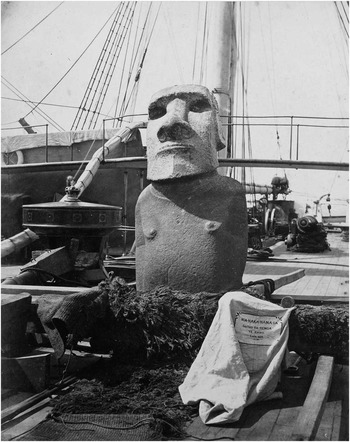
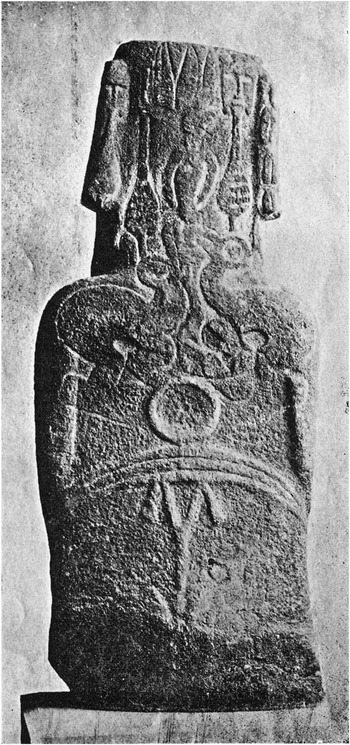
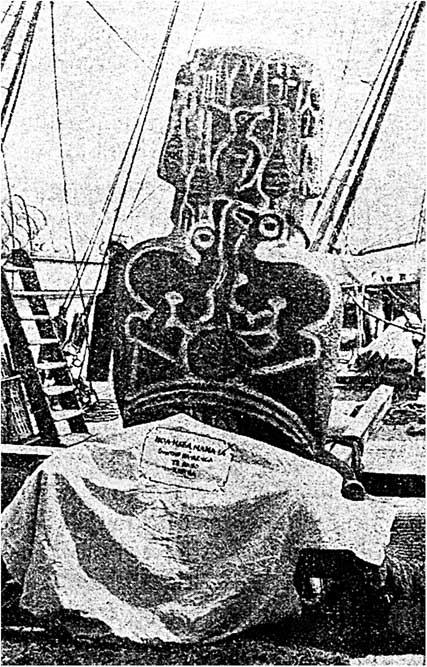
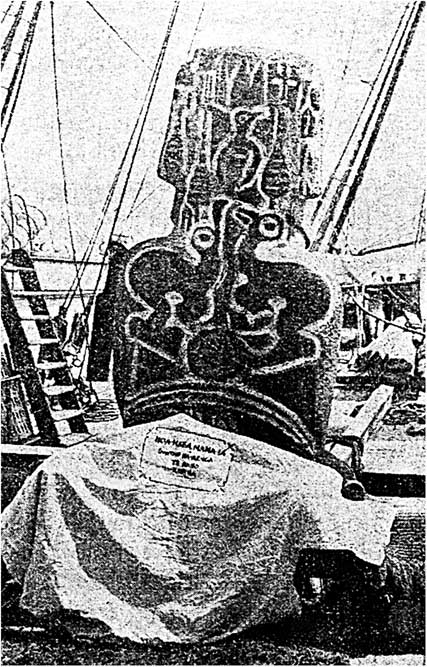
Of particular significance are two photographs of the statue on board HMS Topaze. One of these is reproduced in part on the cover of Van Tilburg's monograph, where it is described as having been taken in Portsmouth in 1869 (fig 2).Footnote 19 It seems more likely that this image of the front, and another that shows the statue's back, were taken the year before, in Valparaiso, Chile, shortly after HMS Topaze had left Easter Island.Footnote 20 During the Pacific voyage the statue was protected by a canvas sheet, so that the paint that can be seen clearly in both photographs can safely be regarded as reflecting how the statue looked before it was uprooted by Europeans.Footnote 21
Hoa Hakananai'a, probably in Valparaiso, Chile, in 1868, on board HMS Topaze. Photograph: from Beaussant Lefèvre, Paris

Unfortunately, no original print has so far been found of the rear of the statue. All we have is a poor reproduction published in France nearly ninety years ago.Footnote 22 It is clear, however, that two drawings of the statue by Dundas were based directly on these 1868 photographs, and can thus be used as corroborative evidence.Footnote 23
HOA HAKANANAI'A: THE STATUE
Easter Island's large stone statues (moai) are mostly found in one of three locations.Footnote 24 First, in and around Rano Raraku, a volcanic crater near the eastern end of the island where most of them were quarried, and where today the only standing statues that have not been re-erected are to be found; second, scattered in isolation inland, where they seem to be associated with stone ‘roads’ that have been interpreted variously as tracks for moving statues along or territorial boundaries;Footnote 25 and third, arranged together in groups on long stone platforms known as ahu, mostly close to the shore with the statues’ backs to the sea. Only in the latter case do statues typically have carved eye sockets, and stone ‘hats’ (pukau), circular drums of a red-coloured stone formerly placed on top of some moai, but all now lying close by on the ground.
Hoa Hakananai'a is unusual in almost every respect. It was found at none of the above locations, but on its own, high above a sea cliff, half-buried inside a stone-roofed house and – unlike any other recorded, identifiable large statue beyond the Rano Raraku quarries – still erect.Footnote 26
The statue itself is also unusual. Out of as many as 1,000 moai on Easter Island, it is one of only fifteen or so known to have been carved from flow lava;Footnote 27 most are of yellow-brown Rano Raraku tuff. At around 2.5m high it is relatively small for a statue of its type. No full inventory of the island's statues has been published,Footnote 28 but observers agree that typical examples found away from the quarries (where some specimens are significantly larger still) are 3.5m to 6m high.Footnote 29
Despite all this, however, Hoa Hakananai'a is considered to be typical of the statue form.Footnote 30 Its features – heavy brow, blocky face and jutting chin, prominent nipples, arms lightly bent down the sides with hands reaching towards the stomach, long, rectangular, stylised ears and a ‘belt’ or ‘girdle’ across the lower back with attached circle above and angular lines below – all fall within the range of details seen across the island.Footnote 31
The eyes (which our survey did not record well; the face was not a target in the project) have been hollowed out in a way that is characteristic of statues that had been erected on ceremonial ahu platforms. That Hoa Hakananai'a once stood on an ahu in this way may also be supported by the conformation of the top of the head. As presently seen in the British Museum, where the statue is raised above its likely height on Easter Island (see fig 1), the top appears rounded. However, our images show it to be smooth and completely flat, with nothing to suggest this is anything other than an original feature, as if it had been prepared to balance a pukau, again like statues on coastal ahu.
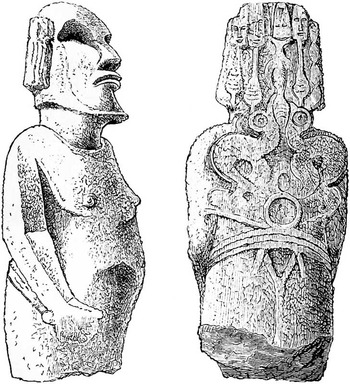
Hoa Hakananai'a's base is now hidden in a block of stone or concrete. However, the figure was drawn for The Builder before it was thus positioned in 1870.Footnote 32 The artist was clear that the statue base was undressed, showing, from the back, an irregular jagged end and rough surface contrasting with the smooth stone above (fig 3); an early British Museum photograph (see fig 7) conveys a similar impression. This unusual base, noted by Routledge,Footnote 33 differs from the typical ahu statue, which is carved all the way down to the bottom, which is flat for standing. Van Tilburg suggests that Hoa Hakananai'a was ‘either never perfectly or completely finished’, or, having been thus finished, was later modified and reduced for standing in the ground.Footnote 34
The only known depiction of the complete statue, published in The Builder three months after it arrived in London. Drawing: from Anon 1870

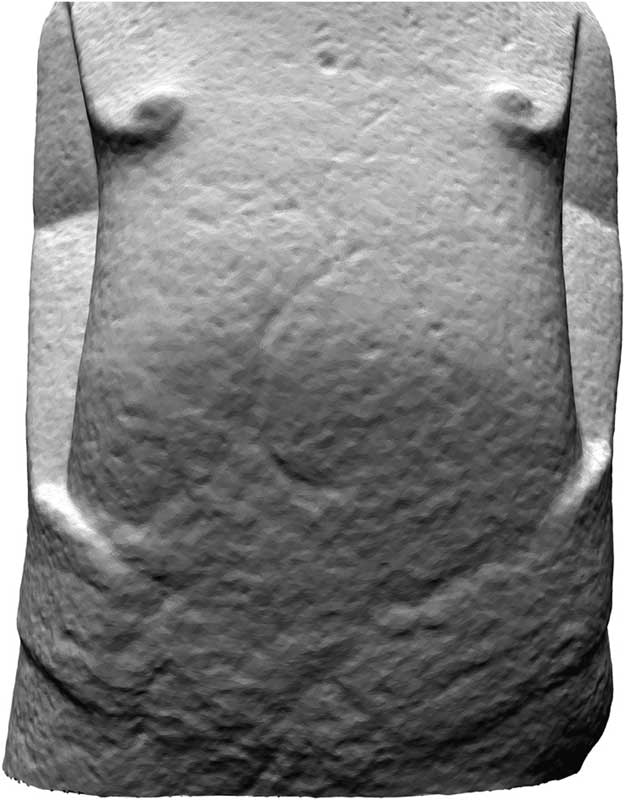
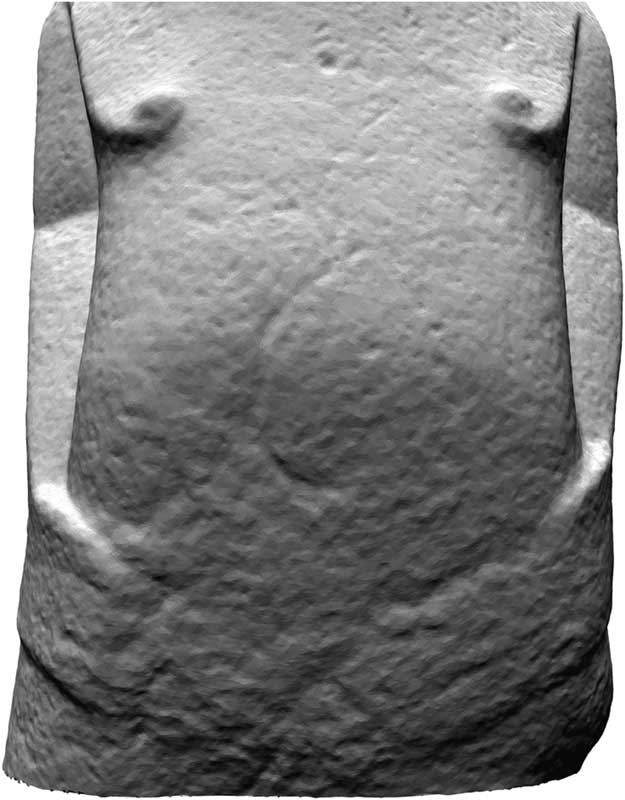
Our survey supports the observation that Hoa Hakananai'a's base is atypical. There is an uncharacteristic angle on the back near the bottom where the surface plunges inwards; the carvings on the back all stop above the angle (fig 4) and below the angle the stone is less regular. Among the carvings are two lines that rise and curve away from the central, spine-like ridge, suggesting buttocks. If the original statue had been thinned, these might once have been more prominent, both below the change in surface angle, where they would have been entirely removed, and perhaps also above, where they might have been diminished. Evidence for alteration on the front is less obvious, but where extended fingers might have been expected, both hands largely stop abruptly and prematurely close to the side of the body (fig 5); there is a very light suggestion of a hand reaching from the right to near centre, but the fingers drawn by Pakarati could partly be signs of tooling left by their removal.Footnote 35 Where the fingers might once have met from either side, there is no typical pubic swelling or hami;Footnote 36 though Van Tilburg illustrates a raised navel,Footnote 37 we can see no evidence for this. Again, all this points to the possibility that the original statue may have been thinned, presumably to aid its insertion into a hole in the ground immediately prior to its erection at the spot where it was found in 1868.
RTI image with specular enhancement, lit to illustrate fissures on the back at bottom right where, it is suggested, the statue retains the surface of the rock from which it was carved (cf fig 3). The circular plug seems to be of painted wood or plaster filling a hole that was perhaps bored for an undocumented study of the stone; it is not visible in the earliest photographs of the statue in the British Museum (cf fig 7). RTI image: authors

Photogrammetric detail of the front, showing how the hands appear incomplete or partially removed; two curving grooves across the stomach area look like damage. Photograph: authors
Arguably, Hoa Hakananai'a once had a flat base, for standing on a stone support. The British Museum describes its present height as 2.42m.Footnote 38 Before it was displayed in the museum, it was variously described as ‘about 8 feet’ high, ‘8 ft 6 ins’ and ‘8 feet 9 inches’.Footnote 39 At 2.59m to 2.67m, these earlier figures are 170mm to 250mm taller than the British Museum figure, but are similar to the 2.64m given by Wilson.Footnote 40 It seems likely that the latter (c 2.65m) is the full height, and the former (2.42m) the height from the modern support block (we did not measure this). To this might be added a further hypothetical missing 100mm, to give a height of 2.75m.
Routledge describes a flat, circular stone of ‘hard basalt’ built into the wall of a house close to the one in which Hoa Hakananai'a was hidden. This ‘precisely resembles the bed plates of the images on the ahu’, and measured 1.04m by 860mm.Footnote 41 She thought it highly probable that the statue once stood in the open on this stone, though ‘the contracted form of the base of the image’ appeared to make this difficult. However, it is perfectly possible if the statue originally had a flat base, and one that was closer to the dimensions that Routledge gives (910mm by 460mm). We are not told the thickness of the circular slab, but if we guess 250mm, and further speculate that the statue originally had a typically proportioned pukau, 750mm high, then Hoa Hakananai'a's complete standing height above the surface of an ahu would have been around 3.75m, or over 12ft.
However, this interpretation presents a problem: an extended base to the original statue would raise the bottom of the hands, which typically are very close to the ground, some 300mm above the hypothetical platform – proportionally a significant gap in a relatively small statue.
An alternative and more likely explanation is possible. This is that the contracting base is an original feature. Close examination of the visible topography of the base and the nature of the stone suggests that the plunging surface noted above is in fact not tooled, but a naturally weathered face of the original boulder or outcrop from which the statue was carved (see fig 4). On the one hand, this surface is smoother than one might expect if it had been dressed merely to reduce stone that would have been hidden by burial; no tool marks can be seen. On the other, the texture and colour of the stone differ from the rest of the statue, giving a more weathered appearance. The carved stone immediately above has a fresher, firmer look. Conservation records at the museum would seem to corroborate this. On three documented occasions the stone surface has been stabilised, always near the base: ‘Lower quarter of figure – small areas of spalling’ (1987), ‘Consolidate lower portion’ (1995) and ‘Random areas of fragile surface and small spots of fresh abrasion around the figure, close to the plinth’ (2003).Footnote 42
The ‘spine’ (the ridge extending down from the girdle) and the curving buttock lines meet immediately above the change in stone, and in places (especially on the right side as viewed from the back) the carved surface seems to rise as it approaches its termination. No comparable natural surface can be seen on the front, and the finely tooled, smoothly curving face there might suggest either that a navel, extended fingers and a hami were never carved, or, if originally present, had been carefully removed but without the principal intention of thinning the statue.
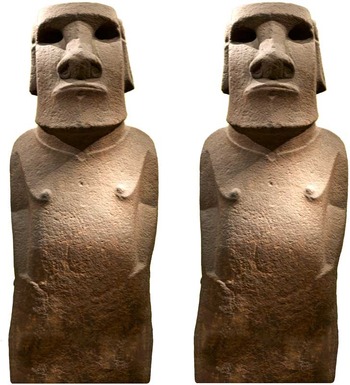
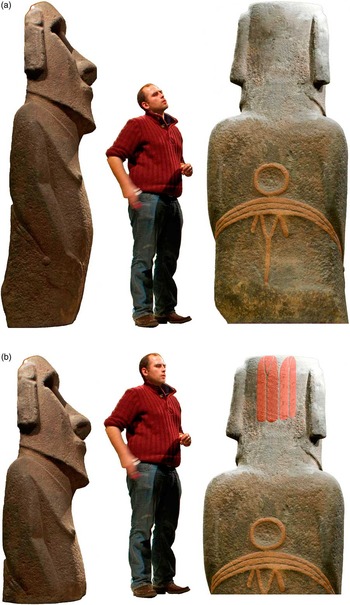
This would seem to make it unlikely that Hoa Hakananai'a ever stood on a platform, especially given the yet narrower bottom indicated by the engraving in The Builder. In the 1868 photographs and in the present arrangement of Hoa Hakananai'a (which may reflect the way it was fixed into a base in 1870), the statue appears to lean a little to the left when seen from the front. To set the flat top at a horizontal level would mean rotating the statue slightly clockwise. If this is done (fig 6), it is notable that several otherwise asymmetric features become less so or fully symmetric: the eyes, mouth and chin are more even, the nipples are nearly on a level and the angles between the hands and arms at the sides are closer to each other. This might suggest that the statue is not precisely standing as it had been designed; our proposal that it never stood on its base, but was placed in a pit from the start, could explain a bottom that was not correctly levelled for the rest of the statue.
Left: Hoa Hakananai'a as currently standing; right: adjusted so that the flat top is level; the face, chest and elbows are more symmetrical in the adjusted figure. Photograph: M Pitts

THE CARVINGS ON HOA HAKANANAI'A
The statue has a unique group of carvings on the back, including some of the classic island petroglyph designs.Footnote 43 Published descriptions of the details vary, and in some areas – particularly at the top and near the centre of the group – clarity has been elusive. It therefore seemed likely that our survey could prove useful here.
To begin, however, on the front, in an article that reached us the day after we had completed our work in the British Museum, Davletshin described a large and previously unseen petroglyph below the nipples.Footnote 44 This takes the form of an atypical ‘birdman’ (see below) and a number of isolated symbols, recorded after ‘several hours of work in the museum and many photos’. They may be there,Footnote 45 but we can see nothing in our survey to support the presence of a birdman. A curved line around the stomach area of the statue, visible since the first photographs were taken in 1868, is the clearest of a number of shallow grooves and hollows that have the air of damage rather than intentional carving.
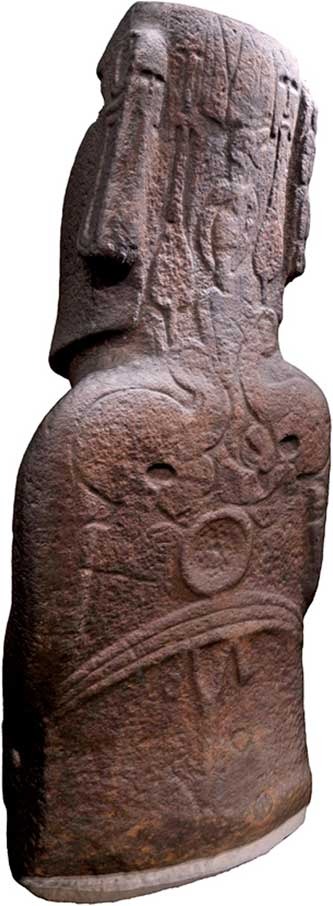
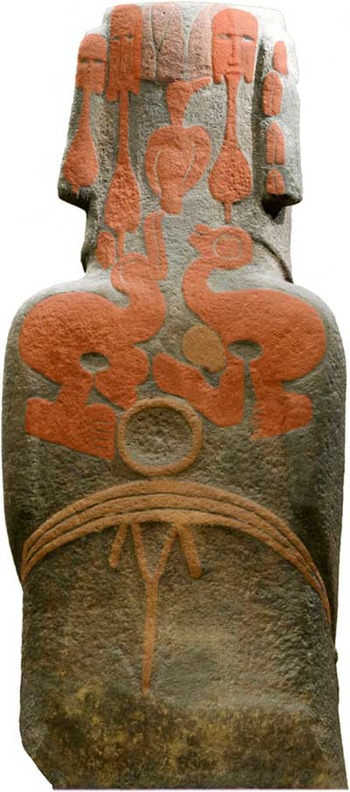
No such doubt surrounds the carvings on the back (fig 7). Ranged between the girdle and the top of the head, these consist of two facing ‘birdmen’, or tangata manu (an arrangement known as manupiri), and, above their beaks, a bird, usually identified as a sooty tern (manutara), flanked on either side by ceremonial wooden paddles (‘ao or rapa) and vulva symbols (komari, typically represented by two parallel pointed ovals that connect with a diamond shape at one end). We see nothing to contradict the widespread assumption that all of these were added to the statue some time after its original carving – that is, they were created either by cutting into its surface (for engraved linear shapes) or by lowering its surface (to isolate low bas-relief forms).
Photograph of the back published in 1899 to accompany a paper read at the British Museum in April 1898, showing white paint, including clear stripes across the right paddle and suggestions of a rounded beak on the right birdman. This must have been taken before the statue was cleaned in 1900, and probably also before earlier cleaning in 1898 (Van Tilburg Reference Van Tilburg2006, 3–4). The same photograph, in poorer quality, features in an undated lantern slide at the British Museum: Routledge Collection, reg. no. Oc,G.T.1736; British Museum Collection Online, 〈http://www.britishmuseum.org/research/collection_online/collection_object_details.aspx?objectId=3144210&partId=1〉 (26 Jan 2014). Photograph: Royal Geographical Society of South Australia Inc, from Barclay Reference Barclay1899

Horley and Lee have suggested a complex reading of these petroglyphs, with at least two phases of birdman carving, including as many as four possible birdmen preceding the two that now dominate the statue's back.Footnote 46 While admitting that there is a significant area we are insufficiently confident to resolve (between the left birdman and the main body of the right birdman), we see little to support such complexity. For example, contrary to Horley and Lee, we see no signs of carving inside the ring above the girdle, and neither do we see a sequence of overlapping komari symbols along the top of the head.Footnote 47
However, in an important respect, we agree with these authors, not least in their conviction that lines at the top do represent komari. Van Tilburg is more equivocal, describing them as symbols comparable to the ‘Y-shaped designs on the statue's chin’ and below the belt on the back, and as ‘abstracted representations of birds, fish or … komari’. We also agree with Horley and Lee that these komari pre-date the faces of the ‘ao paddles.Footnote 48
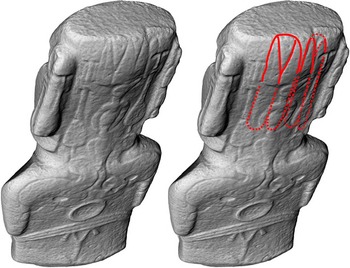
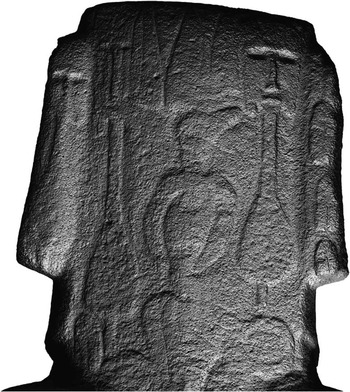
In our images, clarification of these variously interpreted designs at the top comes particularly in photogrammetric views that show how the lines run on to the flat surface of the head (fig 8). In a way not reported before, these make it very clear that part of a large komari symbol is delineated slightly across and to the right of the head of the left-hand paddle, its upper end very slightly running on to the flat end of the statue's head. Moving further to the right, the beginnings of a second komari can be seen. However, this largely disappears into the right-hand paddle face. It can be seen how the top of this paddle has been defined by pecking away the lip of the head platform, which would also have removed any part of the komari that might have been there. This one, at least, probably pre-dates the paddle, and it seems likely that a pair of komari was succeeded by a pair of paddles, as Horley and Lee suggest. This is consistent with a general typology that places incised petroglyphs at ‘Orongo as being earlier than relief carvings.Footnote 49
Photogrammetric model viewed from above, showing two engraved komari (the solid red lines on the right) that run on to the head's flat top. The dotted lines are hypothetical, but represent the typical proportions of complete komari. At the top the right-hand komari was partially removed when a paddle head was carved; another paddle cuts across the left-hand komari. Below, the entire surface could have been lowered to remove the old engravings before recarving. Photograph: authors

The first suggested stage of carving on the back of Hoa Hakananai'a, then, consists of no more than two large incised komari at the top. It is difficult to know how big these were, as the lower parts of both seem to have been removed by – or perhaps intentionally during – later carving. We suggest they ran down much of the head to a length of about 500mm. Future study of images such as ours may throw more light on this. Across the island, Lee says these common motifs range from 40mm to 1.3m in length.Footnote 50
There seem no compelling reasons to separate the remaining petroglyphs into more than one stage. Unlike the komari, they were made by carefully lowering the surface of the stone around the desired shapes, beginning with the removal of most of the komari (fig 9). From the top, the first of these is a small bird, with raised beak and wings curving down by its sides (the manutara). Van Tilburg interprets the beak as open,Footnote 51 but our survey shows the lower ‘beak’ to be part of relatively recent scored damage (fig 10); Horley and Lee also show a closed beak.Footnote 52 So too, very clearly, do the 1868 photograph of the back of the statue (fig 11) and Dundas's redrawing of the same (fig 12).
Full colour photogrammetric view showing how the left-hand komari is cut away above and to the left of the later bird head; also visible is a hollow curve to the back of the statue's head, which could be the result of removing the complete komari lower down. Photograph: authors

RTI image with specular enhancement showing damage scored across the head of the bird in the centre, sometimes interpreted as the lower bill of an open beak. RTI image: authors

A photograph of Hoa Hakananai'a taken on board HMS Topaze in 1868, showing the same bird with a closed beak as in fig 10 and the same rounded beak on the birdman as in fig 17. Photograph: detail from Roussel Reference Roussel1926
The same two beaks as in figs 10 and 17 shown in Dundas's sketch apparently based on the 1868 photo. Drawing: from Dundas Reference Dundas1870, pl xvii

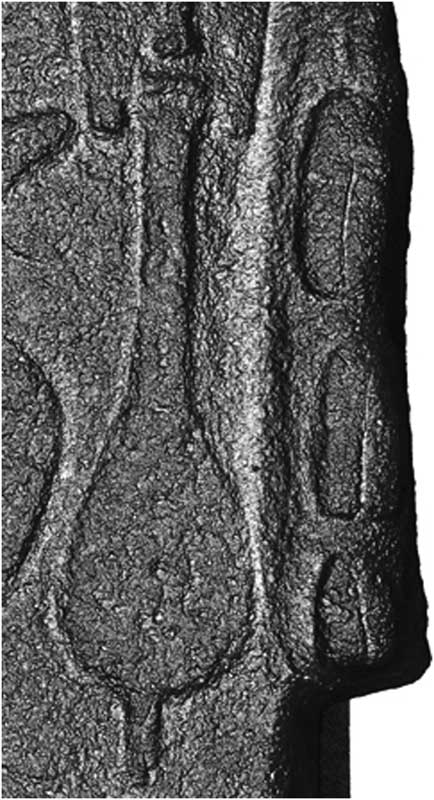
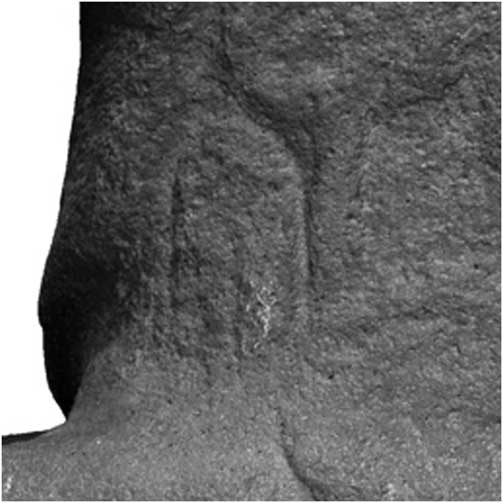
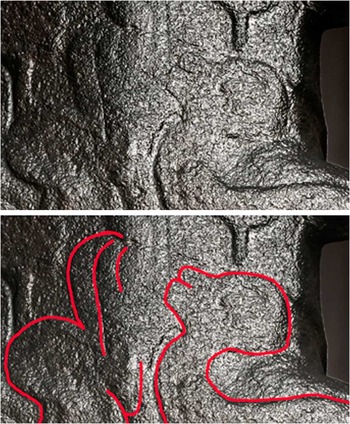
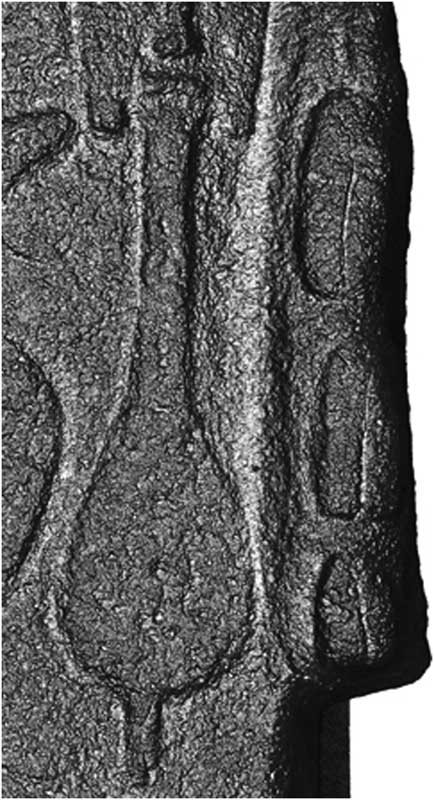
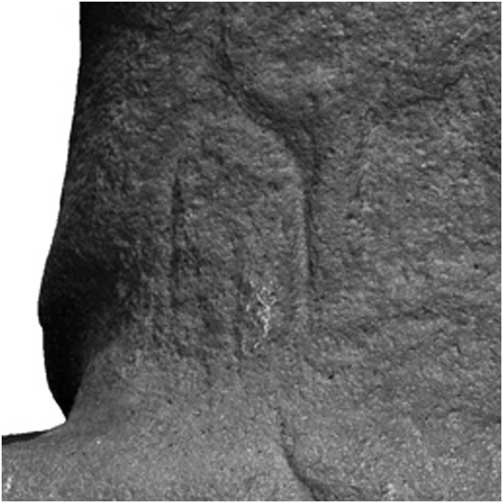
Flanking this are the previously noted paddles, one on each side and a third on the statue's left ear, and a column of four komari, the uppermost of which seems to have been partly removed by damage, on the right ear (fig 13). Immediately below and to the left of the large paddle on the left, in the space between the bottom of the statue ear, the paddle and the back of the birdman's head (see below), is a low carving difficult to interpret (fig 14). It appears in the 1868 photo and Dundas's drawing, and Horley and Lee note it, reading it as a komari.Footnote 53 It is also possible to see it as an attempt at a head from a paddle or ‘ao.
RTI image with specular enhancement showing three komari on the right ear (as seen from the back), shaped in relief and finished with lightly engraved lines. RTI image: authors
An unclear feature near the base of the left ear that could be a komari or the head of a paddle. RTI image: authors
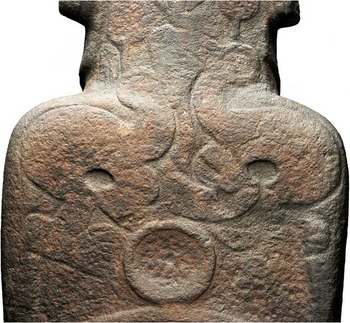
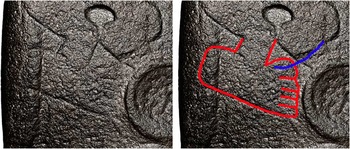
Below these are the two prominent birdmen (fig 15). The one on the left is easier to read. A long, hooked beak rises almost vertically from a head with a large round eye, and a neck curves into a rounded body from which an arm and a leg, the latter with a prominent foot, reach towards the ring of the original statue. Toes are delineated on the large foot with simple engraved lines; there seem to be six, and this is how they are usually represented.Footnote 54 However, a rough groove that is almost certainly damage cuts across the arm in a slight curve and appears to continue to the left across the top of the foot towards the heel; this line is the one separating the top ‘toe’, and it may be that the foot was drawn with five (fig 16). Where the arm might have had fingers, it in effect disappears beneath the ring.
The two birdmen, carved above the ring and belt that were part of the original statue. RTI image: authors

RTI image with specular enhancement, lit to illustrate the scored damage (blue line) giving the false impression of six toes on the left-hand birdman's foot. RTI image: authors

The facing birdman has a similar form. The beak reaches towards the opposite beak rather than straight up, and lower down, the area of the arm and leg is confused. This is almost certainly partly the result of damage, which seems to have removed much of a hand above the ring and possibly most of a foot. There are further details, however, that are difficult to dismiss in this way, including an oval shape below the neck (scored by damage) and a rounded triangular hollow immediately below this. Horley and Lee make much of the latter, describing it as a ‘keyhole’ indicative of the space between elbow and knee of an otherwise hard-to-see earlier birdman.Footnote 55
We are not convinced by this: the rest of the supposed figure is elusive, and the hollow might equally be the crook of the right birdman's elbow as the arm reaches up over the ring.Footnote 56 The prominent curving line immediately below this ‘keyhole’ might be the edge of a significant patch of damage that has separated the inner from the outer elbow below. The paint on the 1868 photograph does not offer definitive support for any particular interpretation, but can be read to be consistent with our suggestion of a crooked arm. Into this arrangement, the aforementioned oval shape makes an unconvincing neck swelling,Footnote 57 and remains unexplained.
It is with this birdman's beak that we see an important difference from traditional readings (fig 17). These all show a long pointed beak that touches the beak of the opposite figure. Our images, however, reveal a distinct, shallow groove that defines the beak with a short, rounded end, leaving a clear space between the two bills. Irregular lines that appear to continue the shape of a longer beak seem more convincingly to be read as later damage. This interpretation is strongly supported by the 1868 photograph (fig 11) and Dundas's rendition (fig 12), and can also be seen, though less clearly, in what seems to be white paint in a photograph taken at the British Museum before around 1917 (fig 7).Footnote 58
RTI image with specular enhancement showing a short rounded tip to the right-hand birdman's beak. RTI image: authors

DISCUSSION: HOA HAKANANAI'A AS MAKEMAKE
The new imaging has clarified several aspects of Hoa Hakananai'a's form and ornamentation, such that a consideration of the statue's history and meaning is warranted. To begin at the end of the story, there are damage-like marks to back and front, some of which have in the past been read in error as part of the statue's petroglyphs.
On the front, there is small sporadic chiselling below the chin running from upper right to lower left, a pair of curved grooves reaching down across the stomach and short vertical grooves that cut into the hands. The first two, at least, were present when Hoa Hakananai'a was photographed in 1868. The first could be remnants of original dressing marks or from chiselling at a later time (for instance, associated with the removal of paint or plaster); the second may be fissures naturally present in the rock. The rough vertical grooves, two of which are particularly clear immediately beyond the termination of the hand on the left, could be associated with cutting away the hands, though again they have more the air of inadvertent damage.
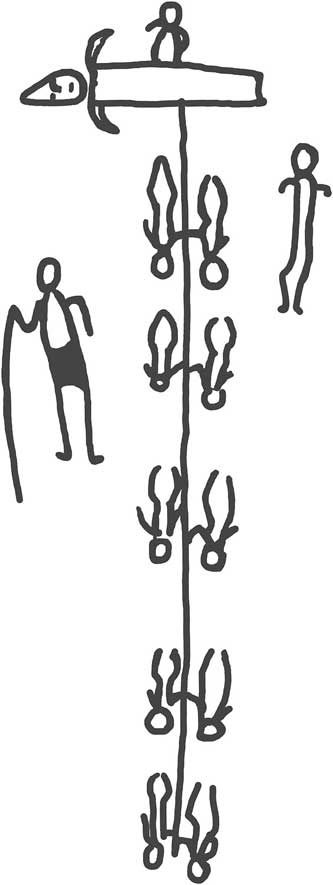
Such grooves on the back are different, crossing from side to side, rising to the left (for example, cutting across the head of the bird) or falling (cutting across the body of the right birdman, and the arm and foot of the left birdman). A tattoo recorded in 1884 purports to show Hoa Hakananai'a lying on its back being dragged over the ground, with the length of its body perpendicular to the rope (fig 18).Footnote 59 Dundas witnessed and recorded this procedure. ‘We sent a party of 40 men to disinter this image’, he wrote in his log, ‘and having got him out a large party were sent to drag him to the ship, a distance of more than three miles wc. [which] they accomplished by making a sledge of capstan bars & dragging him broadside on over the softer ground & end on up the steep places.’Footnote 60 The grooves on the back would be parallel to the broadside direction of movement, and may well be damage inflicted when the statue was taken to HMS Topaze; there are no comparable grooves on the front.
A tattoo recorded in 1884 showing Hoa Hakananai'a being dragged overland to HMS Topaze before being shipped to England. Grooves on the statue's back are consistent with damage inflicted at this time. Drawing: after Hjalmar Stolpe/Van Tilburg

Aside from such relatively trivial markings, the analysis reveals at least four stages in the statue's history. It is important to remember that until Hoa Hakananai'a was dug out by the crew of HMS Topaze, it could never have been seen on Rapa Nui as we see it today (fig 19).
The three stages of ornamental carving now visible. Photograph: M Pitts

1. The original statue ( fig 20a): the freshly carved statue is erected in the ground, and fitted with eyes and a hat.
Three stages in Hoa Hakananai'a's history: (a) as a classic Easter Island moai, with a missing stone ‘hat’ of unknown height; (b) partial burial and the carving and painting of two komari on the back; (c) full transformation into a representation of Makemake bearing a narrative of the birdman myth. James Miles is 6ft 2in. (1.88m) tall. Photographs: M Pitts


An important revision to the common view that Hoa Hakananai'a was carved for an ahu platform, like other statues around the island's coast, is that this was never the case. Rather, it was designed from the start to stand in the ground, perhaps for the simple reason that the chosen material did not offer blocks of sufficient size to allow for the bulk and base width required for the statue to balance on its base. This means there is no need to imagine that it was made for a different, unidentified location from the one where it was found in 1868.Footnote 61 With no evidence to the contrary, we must assume that the crew of HMS Topaze removed it from the pit in which it had always stood.
This may not have been the only statue carved without a flat base and erected directly into the ground. Routledge comments that such a base ‘is not associated with the ahu, but with the buried statues’.Footnote 62 By this, she means statues standing around the main quarry at Rano Raraku, numbering some forty outside the crater and twenty inside.Footnote 63 Here the bodies (often covered with slope debris sufficient to conceal part of the head) disappear straight into the soil. Routledge dug out ‘some 20 or 30’. Her descriptions are incomplete, and some at least do appear to have had flat bases, but one had a base ‘contracted in such a manner as to give a peg-shaped appearance’ and another stood in a hole carved out of the rock.Footnote 64
Unlike any of the Rano Raraku statues (nearly 400 in all),Footnote 65 Hoa Hakananai'a has carved eye sockets. It could also have supported a stone ‘hat’, in the fashion of ahu statues. Palmer notes the ‘top of the head was cut flat, so as to allow the crown to be put on’.Footnote 66 No pukau of the characteristic red stone has been found at ‘Orongo, but, as noted above, an unusual round stone with at least one flat face has been recorded close to Hoa Hakananai'a's site: Routledge's ‘circular stone … of hard basalt’.Footnote 67 We are not told how thick this stone is, but its width (1.04m by 0.86m) would be entirely appropriate for a pukau, a unique flow lava hat for a flow lava statue. Perhaps part of Hoa Hakananai'a remains on Rapa Nui.
2. Alteration phase 1: features on the face and the front of the body are removed.
Given the very fine style and finish of the carving in the classic form of Easter Island statues, we would expect the front of Hoa Hakananai'a to have had a raised navel and hands that reached towards the centre where there would be a pubic swelling (hami), suggesting masculinity. There is no navel, no such swelling and there are almost no fingers. The very slight indications of missing hands support the likelihood that such features were originally present, but subsequently were removed with tooling of the type applied to create the statue, to leave little trace and a smooth body profile. As hands are typically at the very base of statues, this would probably have occurred when the ground was at a level similar to that at the time of erection.
By analogy with other statues with carved eye sockets, it seems reasonable to imagine that Hoa Hakananai'a had eyes of white coral and red scoria or black obsidian. There were none when the statue was found in 1868. If, as we suggest, the statue remained where first erected, there would be no necessary reason for the eyes to have fallen out. These may have been removed when details of navel, hands and hami were chipped away. The ‘hat’ may also have been taken away at this time.
An alternative hypothesis would be that the statue looks now as it always has, and the absent fingers and hami, like the restricted base at the back, are a function of the limited size of the original stone. Our study concentrated more on the back of the statue than the front, and further imagery may help to resolve this.
3. Alteration phase 2 ( fig 20b): two komari, vulva symbols, are engraved into the top of the head at the back. Midden deposits rise to cover the lower part of the statue.
When found in 1868, Hoa Hakananai'a was described as being ‘buried waist deep in the ground’,Footnote 68 ‘buried up to the shoulders’,Footnote 69 and ‘buried to its shoulders in the ground’.Footnote 70 James Harrison sketched the statue while still in situ, illustrating the top of the stone head apparently positioned at shoulder height measured against two nearby observers.Footnote 71 For this to be the case, the feet of a 6ft (1.83m)-high person would be at the level of the statue's girdle, suggesting that a little over a third of the statue as seen when first erected had by then become buried.Footnote 72
How, when and how extensively this deposit accumulated are questions that cannot presently be answered. Describing partly buried statues at Rano Raraku, Routledge notes ‘debris, which had descended from the quarry above in the form of rubble’, below which ‘was the substance in which a hole had been dug to erect the image’. ‘Not infrequently’, she adds, ‘the successive descents of earth could be traced by the thin lines of charcoal which marked the old surfaces, obviously the result of grass or brushwood fires.’Footnote 73 Once erected, facing upslope, Hoa Hakananai'a could have become further buried over time as slopewash accumulated around it, though the narrow terrace would have offered very limited opportunity for this compared to Rano Raraku.
Artificial burial was undoubtedly more significant. Palmer notes the presence in ‘many’ houses of ‘enormous quantities of a univalve – a maritime Neritina – which had been used for food’.Footnote 74 Van Tilburg notes that an 1868 observer described specifically how the statue was buried ‘in the earth, and debris: no bones, but plenty of sea shells … and other univalves’.Footnote 75 Routledge excavated floors inside ‘Orongo houses. This work is barely described, but it is notable that bird and chicken bones and marine shells seem to have been common on or within floor deposits; she also notes bones of rabbit and sheep, suggesting that midden accumulation continued into historical times.Footnote 76 During the lengthy birdman festival, men lived in the stone houses on food brought up from below the ridge, which could account for such debris.Footnote 77
Although the house that stood around Hoa Hakananai'a was damaged and then restored, and the statue's removal would have disturbed the ground,Footnote 78 deposits may remain on the site that could elucidate its history; for this reason any future excavation, conservation or restoration there should be approached with the greatest care and precision of recording, preceded by non-invasive survey. While the chronology of accumulation can only be guessed at, however, the petroglyphs suggest a possible relative sequence.
The komari run slightly on to the flat surface on the statue's head as noted above, something that seems most likely to have occurred if the engraving was done while the statue was upright, and also while the carver was raised to be able to see the top, but not so much as to think of the top as part of the canvas. This suggests the work was done after the statue had been erected,Footnote 79 and after the ground level had risen sufficiently to position the artist at an appropriate height. If the ground was a little below the girdle on the back, with an accumulation of some 600mm exposing a statue about 1.8m high, a tall person would have faced the site of the petroglyphs directly.
4. Alteration phase 3 ( fig 20c): a bas-relief scene depicting aspects of the birdman ceremony is carved on the back. The statue is enclosed within a stone house.
A further deposit of about 300mm brought the ground to the level seen in 1868. With the statue finally reduced to a height of about 1.5m, the new carvings, which succeeded the komari as described above, would still all have been visible, so could have been worked at any point during this accumulation.
It was probably at this time that the stone house was raised around and over Hoa Hakananai'a, protecting it, perhaps, but also preventing it from ‘seeing’ the outside world. In two trenches excavated near the outside front of the house, Ferdon found charcoal-rich layers of earth that seem to have continued beneath the adjacent, attached house;Footnote 80 this implies that most of the deposit around the statue had accumulated before the house was built.
The main differences we have seen in the final carvings as compared to previous readings are in the features along the top (no komari were carved there at this stage), the closed beak of the bird (as opposed to open) and the shorter, rounded beak of the right birdman. The latter suggests a new interpretation for the entire canvas. To understand this, we need to see the carvings in their local context.
All the design elements of Hoa Hakananai'a's petroglyphs occur at ‘Orongo, but proportions differ. Komari are the second commonest design at ‘Orongo (564 examples)Footnote 81 and the commonest on Hoa Hakananai'a (six or seven). There are three paddles (‘ao) and possibly the head of a fourth on Hoa Hakananai'a, but only two elsewhere at ‘Orongo.Footnote 82 Thirteen of the fifteen carved birds identified as frigates on Easter Island are at ‘Orongo,Footnote 83 but the bird on Hoa Hakananai'a is a sooty tern; including paintings, only six such birds have been identified at ‘Orongo, but eighteen elsewhere.Footnote 84 At ‘Orongo simple cup marks or cupules dominate; there are none on Hoa Hakananai'a (unless the small depression on the front above the line of the nipples is so identified, but an explanation as damage seems as likely). Neither is there a face petroglyph on Hoa Hakananai'a, though there are 160 – often little more than a pair of eyes – at ‘Orongo.Footnote 85
Arranged compositions are not a feature of ‘Orongo. Especially at the south-eastern tip, known as Mata Ngarau, individual carvings fight for space on irregular surfaces, the scale, orientation and elements of their design being apparently determined at least partly by the availability of blank rock. The exception to this is the manupiri, paired facing birdmen, of which there are ten examples,Footnote 86 to match the single case on Hoa Hakananai'a.
In contrast, the back of Hoa Hakananai'a seems to present a deliberate composition. Symmetric about the rising bird and the space between the two birdmen, and balanced on the ring and girdle of the original statue, the arrangement is fitted to the shape of the statue's back, with a regimented line of komari – more typically at ‘Orongo clustering like swarms of butterflies – on one ear, paralleled by a paddle on the opposite ear and two further paddles between.
Thus not only is Hoa Hakananai'a unique among one thousand statues on Easter Island for the petroglyphs on its back, but these carvings, while also found individually at ‘Orongo, are atypical both in their selection and in their arrangement. We suggest the key to unlocking the meaning of this lies in the differing beaks of the two birdmen.
Horley and Lee analysed a boulder, now in the Peabody Museum of Archaeology and Ethnology, Harvard University, which features a pair of facing birdmen, carved and painted in similar style to those on Hoa Hakananai'a.Footnote 87 The same beak pattern occurs in both manupiri, pointed on the left and rounded on the right. They compare the rounded beak to komari, noting a birdman petroglyph at ‘Orongo and a carved wooden figure originally from Easter Island that have komari in place of beaks.Footnote 88
Horley and Lee's article appeared after we had noted the rounded beak on Hoa Hakananai'a, offering a gendered explanation that would be appropriate in an artistic landscape strikingly rich in sexual imagery. Describing the many komari at ‘Orongo, Lee finds their close association with birdmen carvings ‘somewhat of a curiosity’: females, she writes, were traditionally seen as inferior, and women were excluded from sacred places throughout Polynesia – so ‘one would not expect vulva signs … near the symbol of the sacred birdman’.Footnote 89
Recorded in the nineteenth and early twentieth centuries, notably by Routledge, the birdman ceremony was an annual event in which men vied to seize the first egg laid by sooty terns nesting on rocky islets just out to sea from ‘Orongo.Footnote 90 Victory went to he who could swim back and scale the cliff with the egg. His patron then became birdman (tangata manu) for the year, the founder god Makemake made incarnate. Bringing power and prestige to his clan, the tangata manu carried the winning egg from Rano Kau around the coast to Rano Raraku, where, among standing statues on the crater's outer slope, he entered a house, which he would not leave for the remainder of the year.
According to Routledge, four ‘gods’ (atua) engaged with the birdman ceremony: Hawa-tuu-take-take (‘chief of the eggs’) and Makemake, who were male, and Vie Hoa (Hawa's ‘wife’) and Vie Kenatea, females. The birdman was always male. Routledge considered that the many birdman carvings at ‘Orongo might have ‘represented one of the egg gods’, but felt it more probable that each was a memorial to a birdman.Footnote 91
That the birdmen on the back of Hoa Hakananai'a might be ‘egg gods’, however, seems entirely reasonable, and in view of our suggestion that the beaks are gendered, the paired manupiri could represent the male and female partners Hawa-tuu-take-take (‘chief of the eggs’) on the left, and Vie Hoa on the right. Other motifs echo the pairing. On the statue's right ear is a row of four female komari; on the left ear is a dance paddle or ‘ao, a symbol of male authority (participants in the birdman ceremony were also known as ‘ao).Footnote 92 Between these male and female groupings rises a bird, flanked by male paddles – a male fledgling, destined to lead, the new tangata manu.
The lower part of the right birdman, in an area that remains difficult to read in our images, is rounded in shape and could be interpreted as an egg; another possibility is that the ring clutched in the birdmen's arms (part of the statue's original form) has itself been re-imagined as an egg. The design portrays the flight from the nest of a male chick, watched by its half-bird, half-human parents. It narrates the birdman ceremony, in other words. Meanwhile the entire statue has become Makemake, its face painted white (as we can see in the 1868 photograph of the front)Footnote 93 in the manner of the human birdman, each hidden from the living inside their houses on the edge of one of the island's two large, water-filled craters.Footnote 94
It is tempting to propose a tentative chronology for these developments, as Hoa Hakananai'a passed from free-standing statue with eyes and hat to enclosed head in which the focus of attention shifted from front to back. The conventional chronology for Rapa Nui was laid down by Thor Heyerdahl in the 1950s, building on a combination of island myths and a few radiocarbon dates. Yet the reality is harsh.Footnote 95 Despite widespread adoptions of variants of the Heyerdahl model, there are no acceptable absolute dates for the carving of statues (neither for the start nor the finish – the assumption that all statues were made as part of a single extended event has never been tested), the construction of houses at ‘Orongo or the origin of the birdman cult. Estimates for when Easter Island was first settled range from ad 300 to 1200.Footnote 96
The one thing we can say about Hoa Hakananai'a with confidence is that it was participating in the birdman cult in the nineteenth century, possibly as late as a year before it was taken from the island. Perhaps the cult was recent, inspired by European visits.Footnote 97 The first documented such arrival was in 1722, when the Dutch Jacob Roggeveen brought three ships. Having noted that the last full birdman ceremony described by locals appeared to have occurred in 1866 or 1867, Routledge says she was told the names of eighty-six birdmen, or eighty-six ‘bird-years’.Footnote 98 Taken literally, this would suggest the ceremony had begun by at least 1780. Somewhere between three and six generations – 75 to 150 years – is enough for the ceremony to have reached its frenetic complexity, and for the bas-relief petroglyphs to have covered the rocks of ‘Orongo and the back of Hoa Hakananai'a.Footnote 99
Ideas behind the cult need not have appeared from nowhere. There are simple birdman petroglyphs, defined by engraved lines in the manner of the two komari at the top of the statue, that Lee has convincingly argued are older than the bas-relief carvings.Footnote 100 These earlier engravings suggest a history that may have gone back centuries. But the ceremony as described to European visitors could have been a response to those great white sails appearing from nowhere across the endless expanse of ocean, piloted by people who might have been gods, and bringing strange, prized foods and materials. Every year, like the Pacific cargo cults that anticipated the return of Japanese and American soldiers after the Second World War, men re-enacted the arrival of a ship and its crew, appropriating its power and hoping for the next one. At the centre of this was Hoa Hakananai'a, once, perhaps, a figure celebrating ancestral and inherited authority, transformed into a bird with powers gifted to whoever might win the prize.
Acknowledgements
We are grateful to the British Museum (in particular Polly Bence and Natasha McKinney, of the Department of Africa, Oceania and the Americas) for allowing us to study the statue outside public opening hours and for assisting us in this work. The photogrammetric model was created with Agisoft PhotoScan software and analysed in MeshLab; the RTI images were made and viewed with open-source software produced by Universidade do Minho and Cultural Heritage Imaging using equipment funded by the Arts and Humanities Research Council. Thanks are also due to staff at the British Museum and the British Library for help with archives, and to the two anonymous reviewers who read and commented on the draft version of this paper for the Antiquaries Journal.