With an average count of over 1000 tornado touchdowns a year, the United States has a higher annual number of tornado events than any other country in the world. Tornado warnings play a critical role in saving lives. However, a national average of 13 minutes’ lead time in tornado warnings from the National Weather Service (NWS) has greatly challenged warning dissemination.Reference Hoekstra, Klockow and Riley 1
People receive warnings through different information sources including television, cellphones, commercial radio, computer instant messaging, and interpersonal communication, etc.Reference Coleman, Knupp and Spann 2 Recent growth in social media websites such as Facebook and Twitter has also increased their potential as important warning information sources.Reference Durage, Wirasinghe and Ruwanpura 3 For example, a study on warning communication during 2 wildfires found that over 75% of respondents used more than 1 source of information (mainly television, phone, newspaper, and the Internet) for warnings, 50% used 3 or more sources, 35% used 4 or more sources, and 15% used 5 or more sources.Reference Benight, Gruntfest and Sparks 4
It was found that receiving warnings from multiple information sources motivated protective action during tornadoes, such as in the 2011 Joplin EF5 tornado.Reference Luo, Cong and Liang 5 , 6 Receiving warning from multiple sources could help confirm the warnings, reduce the threat denial, increase the perception and personalization of the risk, and, as a result, encourage compliance to warnings.Reference Drabek 7 Compliance to warnings could make a difference between life and death, a decision residents have to make during the short lead time provided by tornado warnings. Thus, it is important for residents to have access to warnings through multiple information sources.
However, most studies on warning dissemination focus on whether respondents received any warnings or not.Reference Rodríguez, Quarantelli and Dynes 8 Few studies have empirically examined factors that affect the number of WISs, despite its unique practical and theoretical significance in the warning-response process. It is noteworthy that previous research has shown the importance of the number of WISs in promoting protective action.Reference Luo, Cong and Liang 5 , 6 In addition, the number of WISs contains richer information than a dichotomous variable does and thus, theoretically speaking, could serve as a more accurate measure of access to warnings.
In this study, we examined the research question of which factors affect the number of WISs that people received warnings from during tornadoes. The research question was investigated with the 2 costliest tornadoes in the US history. The second costliest is the EF4 tornado that struck Tuscaloosa, Alabama, in April 2011 and caused over 60 fatalities and 1500 injuries. Approximately 1 month later, an EF5 tornado, the costliest, destroyed Joplin, Missouri, and caused over 160 fatalities and 1000 injuries. 9 These 2 events were selected because of the high number of casualties and significant social and health impacts. Both storms were properly forecasted and warned by the National Weather Service, which has thus raised concerns about the effectiveness of warning information dissemination and compliances to warnings.Reference Simmons and Daniel 10 In addition, the differences between these 2 cities provide opportunities to examine factors affecting the number of WISs under different social and historical contexts.
METHODS
Subjects and Survey Instrument
A telephone survey was conducted in October, 2012 with respondents aged 18 and older in the 2 cities. The data collection was approved by the Institutional Review Board of Texas Tech University. The sample included 2383 telephone numbers randomly selected from 2 zip codes in Tuscaloosa (35401 and 35406) and 2557 telephone numbers randomly selected from 1 zip code in Joplin (64804). These zip codes were selected because they overlapped with the paths of tornadoes. Only respondents who were present in these 2 cities when the tornadoes happened were interviewed. Altogether, 1006 interviews were completed with a response rate of 22.77% in Tuscaloosa and 22.87% in Joplin. Based on the research question, the sample was constrained to the 962 respondents who gave valid answers concerning whether they received warnings before the tornadoes and if so, the number of WISs. Listwise deletion of the missing values in other variables further reduced the sample size to 903 respondents.
Measures
The dependent variable is the number of WISs. Respondents were asked whether they received any warning before the tornado. If the answer was yes, a follow-up question was asked: How did you receive a tornado warning? Ten choices were offered, including TV, Radio, Phone, In-Person Communication, E-mail, News, Website, Social network (eg, Facebook, Twitter, and Message Board), Tornado sighting, and Tornado siren. Respondents chose all the information sources from which they received the warnings, and the number of WISs was then counted, with “0” meaning that the respondents did not receive any warnings.
Predictors included respondents’ sociodemographic factors and their functional limitations. Age was categorized into 4 groups: 19–39 years, 40–49 (reference) years, 50–64 years, and 65 years and above. Other sociodemographic factors included gender (0=male, 1=female), level of education (high school or less [reference], some college, and college graduate), marital status (married [reference], divorced, and unmarried and others), and race (1=white, 0=others). Four indicators of functional limitations were included by asking: how much difficulty have you had with (1) walking, (2) running, (3) vision, and (4) hearing. The choices were: 1=no difficulty, 2=mild, 3=moderate, 4=severe, 5 =could not walk/run/see/hear. Because of the skewed distribution of these variables, these 4 variables were dichotomized respectively, with “0” meaning no difficulty and “1” meaning having difficulties.
Statistical Analysis
The outcome, ie, the number of WISs, is a count variable, which is usually modeled with Poisson regression. When there are excess zeroes, zero-inflated Poisson regression (ZIP) is preferred. Two sets of parameters are estimated with ZIP. One is for a zero-inflation model that uses a logit model to estimate predictors for membership in a latent class where respondents received 0 warnings with a probability of 1 versus not in that class. The other is for a count model that estimates factors influencing the number of warning sources among those who did not always receive 0 warnings, which is assumed to be from a Poisson distribution. Both Poisson and ZIP regression were used and compared in respect to how well they fit the data. The analysis was conducted for Tuscaloosa and Joplin residents separately.
RESULTS
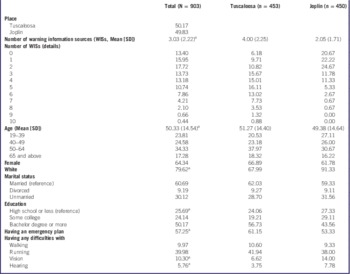
Table 1 shows the characteristics of the working sample. T-test and χ2 test were used to examine whether Tuscaloosa and Joplin residents were significantly different from each other. It showed that over 20% Joplin residents did not receive any warnings at all, whereas this percentage was only about 6% for Tuscaloosa residents. On average, Tuscaloosa residents received warnings from more information sources (M=4.00, SD=2.25) than Joplin residents did (M=2.05, SD=1.71). Table 1 also shows other differences between the samples from these 2 cities.
Characteristics of the Working Samples (% Unless Otherwise Noted)

a p<.05 with χ2 test/t-test concerning the difference in distribution/mean between Tuscaloosa and Joplin.
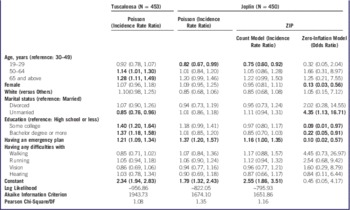
Table 2 shows how various factors affected the number of WISs in the 2 cities. ZIP regression for Tuscaloosa was not reported. This was because there did not seem to be excess zeroes in the outcome. In addition, with only around 6% of residents reporting no WISs, ZIP did not provide reliable estimates for the zero-inflation model. In Tuscaloosa, age, marital status, education, and whether having an emergency preparation plan were significantly associated with the number of WISs. Those respondents aged 50–64 years (IRR=1.14, CI=1.01, 1.30) and aged 65 years and above (IRR=1.28, CI=1.11, 1.49) reported more WISs than the 40–49 age group did. Being unmarried reduced the number of WISs (IRR=0.85, CI=0.76, 0.96). Those who had higher levels of education (IRR=1.40, CI=1.20, 1.64; IRR=1.37, CI=1.18, 1.58) and those who had an emergency preparation plan (IRR=1.21, CI=1.09, 1.34) also reported more WISs.
Poisson and Zero-Inflated Poisson regression (ZIP) Regression Predicting the Number of Warning Information Sources

In Joplin, ZIP was preferred over Poisson regression. Over 20% of Joplin residents reported no WISs, a sign of excess zeroes, which was further supported by ZIP’s better model fit. According to the ZIP model, the number of WISs was significantly affected by age (IRR=0.75, CI=0.60, 0.92 for those who were aged 19–39 years) and whether there was an emergency preparation plan (IRR=1.16, CI=1.00, 1.35). The ZIP model showed that those who were unmarried were more likely to always have zero WISs (OR=4.35, CI=1.13, 16.71), whereas being female (OR=0.13, CI=0.03, 0.56), having an emergency preparation plan (OR=0.10, CI=0.02, 0.57), and having higher levels of education reduced the likelihood (OR=0.09, CI=0.01, 0.97; OR= 0.22, CI=0.05, 0.91).
DISCUSSION
This study examined factors that affected the number of WISs with the 2 costliest tornadoes in US history. It is interesting to note that different factors came into play for residents in these 2 cities. In Tuscaloosa, very few respondents were left unwarned possibly because of the good preparation of the community; thus social disparity is more reflected in how many WISs residents received warnings from rather than whether they could receive any warnings. In contrast, in Joplin, gender, marital status, education, and having an emergency plan affected the likelihood of receiving any warnings. This is generally consistent with previous studies showing that disadvantages in socioeconomic status and social connections are major reasons for not receiving any warnings.Reference Rodríguez, Quarantelli and Dynes 8
At the macro level, we suspect that a reason for fewer WISs and higher percentage of no warning in Joplin than in Tuscaloosa is that Tuscaloosa had more exposure to tornadoes and was more prepared than Joplin. It is recorded that 35 events of tornadoes including 8 EF2 or above events were reported in Tuscaloosa County since 1995 and before the 2011 tornado. In contrast, only 10 tornado events including 1 EF2 or above tornado were reported in Joplin area (ie, Jasper County) during the same period. 9 In addition, an EF3 tornado happened in Tuscaloosa just 1 week before the violent EF4 tornado. As a result, Tuscaloosa residents and communities were more alert and prepared for it. Other factors such as forewarning, siren systems, and TV coverage might have also provided Tuscaloosa some advantages over Joplin. 6 , 11 In addition, the Joplin tornado happened in a weekend, a factor associated with higher casualties partly because people were more likely to receive warnings in workplaces or schools on weekdays than on weekends.Reference Simmons and Sutter 12
Concerning the number of WISs, having an emergency preparation plan increased the number of WISs in both cities. The importance of having emergency preparation plans is usually investigated regarding its effects on promoting taking protective action; this study further suggests that having an emergency preparation plan may make people more attentive and alert to potential hazards and thus raise the possibility of receiving warnings from more information sources. It is important for emergency management agencies and policy makers to understand why having emergency plans is important and encourage individuals and families to make emergency preparation plans.
In addition, older age increased the number of WISs in both cities. Previous studies have shown that although older adults may be less likely to use newly developed media, they are more likely to use traditional communication channels.Reference Hayden, Drobot and Radil 13 Our study suggests that younger adults were not necessarily advantaged in their access to warnings with respect to the number of WISs. It is possible that the overreliance on newly developed media such as social media reduced exposure to traditional media among younger adults,Reference Papathanassopoulos, Coen and Curran 14 but the consequences of which are beyond the scope of this study. Future studies should examine how older and younger adults are different from each other in the overall patterns of receiving warnings and how different patterns are associated with different responses.
Besides that, education is a predictor for the number of WISs in Tuscaloosa but not in Joplin, though it did affect the likelihood of receiving no warnings in Joplin. Thus, the findings might suggest an underlying mechanism in which education makes a difference in whether and how people receive warnings instead of the number of warnings they receive, which deserves further examination.
CONCLUSIONS
In conclusion, people have more access to tornado warnings than before. Nevertheless, still a considerable proportion of residents were left without receiving any warnings. This study shows that social disparity affects access to warnings not only in the likelihood of receiving any warnings but also in the number of WISs. Even among those who received warnings, substantial disparity exists concerning the number of WISs, which affects residents’ compliance to warnings. Thus, we recommend that the number of WISs should be regarded as an important measure to evaluate access to warnings in addition to the likelihood of receiving warnings. We also recommend that emergency management agencies and public health officials should focus on raising public awareness regarding the importance of making emergency preparedness plans, allocating additional sources to disseminate warnings in places where preparation may not be sufficient, adopting different strategies for different age groups, and targeting individuals who are identified as disadvantaged by relevant research during disaster preparation and warning dissemination.
Acknowledgments
This work is based upon work supported in part by the National Science Foundation under grant no. CMMI-1000251. We would also like to thank Dr. Sara T. Norman, Director of the Earl Survey Research Lab at Texas Tech University, for providing valuable assistance in survey design and data collection.