Mango is an important global fruit crop. The demand for fresh mango fruits is growing. From India alone, 36 329 million tonnes of the fruit is exported (Agricultural and Processed Food Products Export Development Authority 2015). Considering that the demand for organically produced mango is increasing, orchardists are transitioning to organic mango orchards. In our preliminary surveys, it was found that one of the main emerging problems of organic mango orchards is the infestation and rapid multiplication of mealybugs (Rastrococcus Ferris; Hemiptera: Pseudococcidae). The infestation starts at the fruit set, and by harvest, the fruits become unfit for consumption or marketing. Surveys have shown that the infestation is spreading. However, in insecticide-sprayed orchards, the infestation is limited to a few trees only. A model to predict the population build up is useful for biocontrol preparedness.
To manage the mealybug, the best organic approach is by using the predator Cryptolaemus montrouzieri Mulsant (Coleoptera: Coccinellidae) (Singh Reference Singh1995). However, the main drawback, especially in south Asian and African countries, is getting adequate predators when needed. Commercial insectaries, which maintain a nucleus culture of C. montrouzieri, will scale-up based on market demand. This would require at least three to four weeks of advanced prediction. In India, about 20 species of mealybugs are known to attack mango, of which the mealybug Rastrococcus iceryoides (Green) (Hemiptera: Pseudococcidae) causes significant damage (Tandon and Verghese Reference Tandon and Verghese1985). The objective of this study was to develop a prediction tool that could alert farmers of an impending attack of R. iceryoides, using a measurable independent weather parameter.
The study was carried out in an organically maintained mango orchard at the Indian Council of Agricultural Research – Indian Institute of Horticultural Research, Hesaraghatta (12°8'N, 77°35'E), Bengaluru, Karnataka, India during June 2012–June 2015. For this study, the data during fruiting was considered. Data collected during June–August 2012, February–August 2013, February–August 2014, and February–June 2015, coinciding with fruiting period, were used for statistical analysis. The mealybugs collected were identified as R. iceryoides using keys by Williams (Reference Williams2004) and further confirmed by experts. Of the 28 trees aged 14 years, 10 trees were randomly selected. From each tree, a total of 20 fruits, from marble size to mature fruits, till harvest were randomly selected and mealybugs were visually counted each week. Thus, 200 fruits/week were sampled. This sampling procedure was followed for three consecutive years. The data collected during the fruiting season by counting the number of settlers were tabulated and means calculated for each week and subjected to statistical analyses.
In order to study the influence of abiotic factors (meteorological parameters) on mealybug population, the meteorological data, i.e., maximum and minimum temperature (°C), relative humidity (morning and afternoon %), rainfall (mm), and wind speed (km/hour) were collected from the meteorology section of Indian Institute of Horticultural Research, Bengaluru. These abiotic variables were calculated one, two, three, and four weeks before the observation date. The calculated abiotic variables and mealybug population were first subjected to correlation analyses and the co-efficient (r) were determined. Significance was tested at P=0.05.
Significant variables were further regressed to explain the variability in the mealybug population by the abiotic factors. From the regression models, the predicted values of mealybug population were calculated using maximum temperature. The predicted and observed mealybug counts were subjected to a t-test (P=0.05) to see if there was a significant difference between the two (Little and Hills Reference Little and Hills1978).
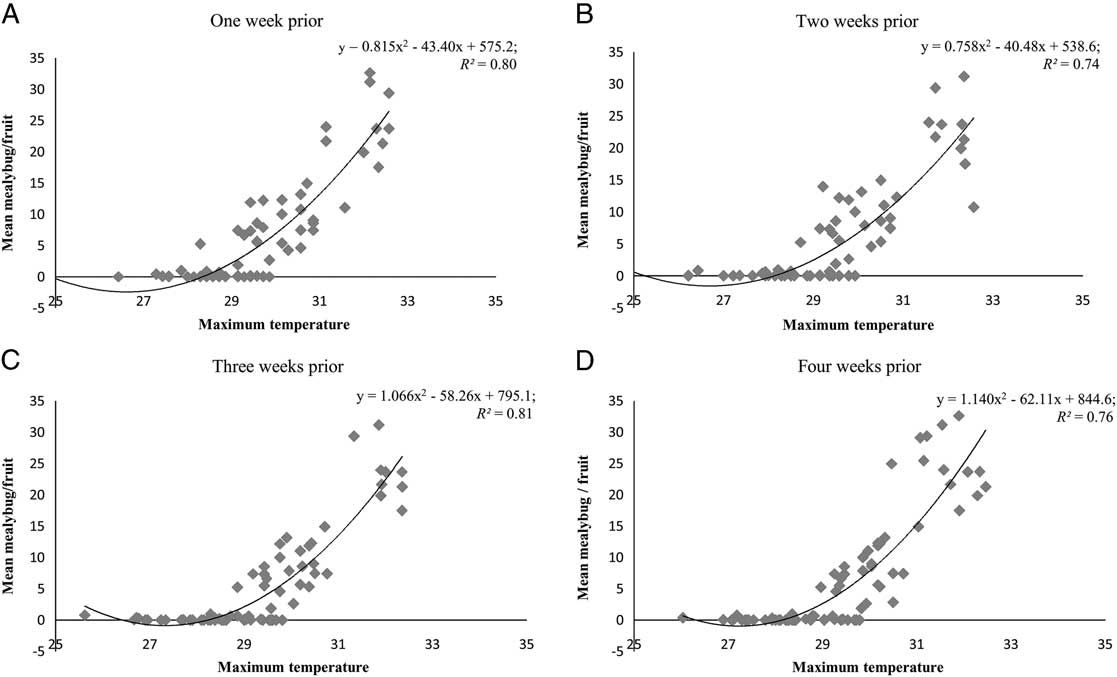
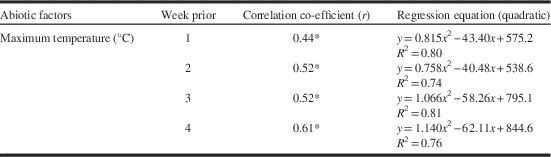
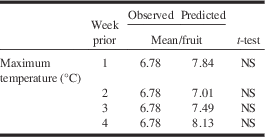
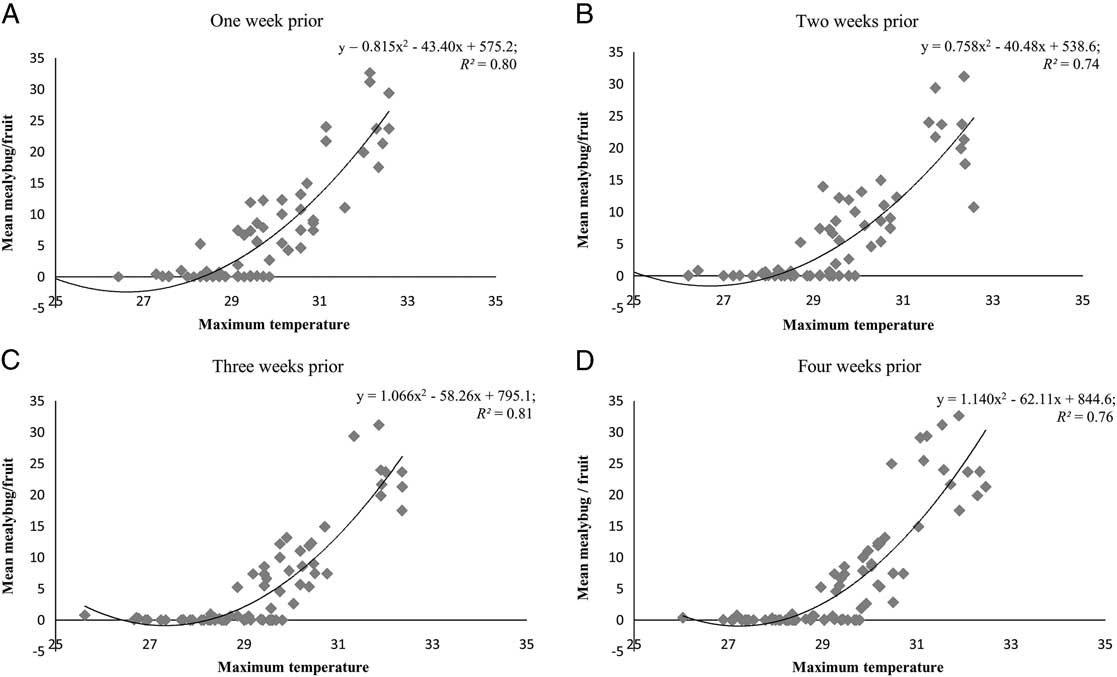
In this study, only maximum and minimum temperatures showed significant positive relationship with mealybug population. Correlation coefficients of one, two, three, and four weeks prior data of mealybug population with maximum temperature showed a significant positive correlation (r=0.44, r=0.52, r=0.52, and r=0.61), as shown in Table 1. Hence, maximum temperature was considered to develop the prediction model for mealybug population. These significant variables were further regressed, and the best-fit model obtained for maximum temperature was quadratic (Fig. 1A– D), which could explain the variability in the mealybug population up to 80%, 74%, 81%, and 76%, respectively (Table 1). Since the maximum variation in the population of mealybug was explained by maximum temperature, the quadratic model was used to predict the mealybug population for three consecutive years. There was no significant difference between the observed and predicted mealybug populations (Table 2). Therefore, maximum temperature seemed fairly robust for predicting the population one, two, three, and four weeks before mealybug onset.
Quadratic models showing the relationship between maximum temperature and mean number of mealybugs observed per fruit.
Relationship between mealybug population and maximum temperature from 2012 to 2015.

* Significant at P=0.05.
Results from the t-test for predicted and observed mealybug population using the quadratic model with maximum temperature as the independent variable.
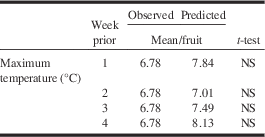
NS, not significant.
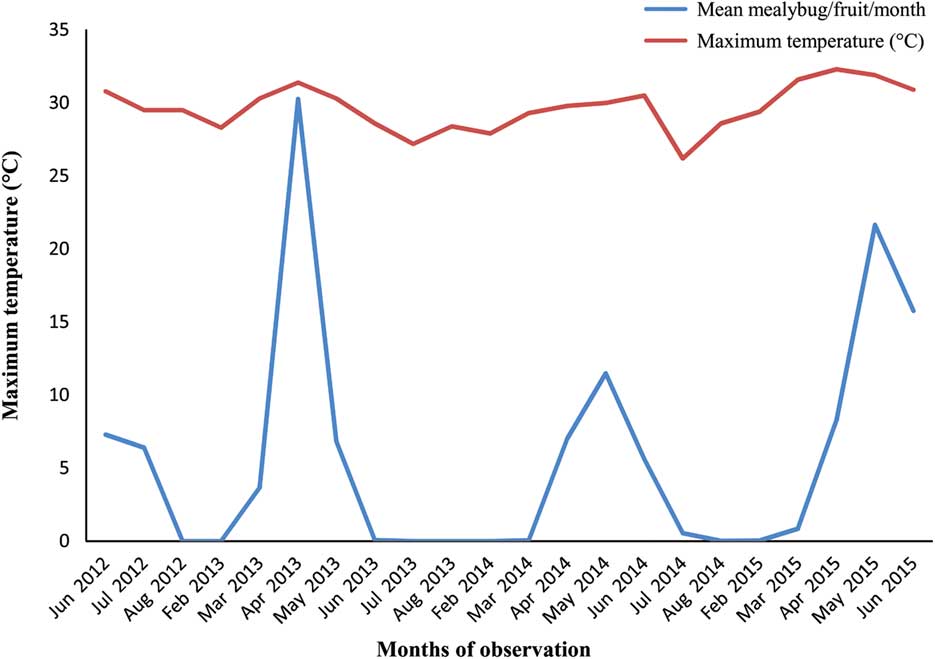
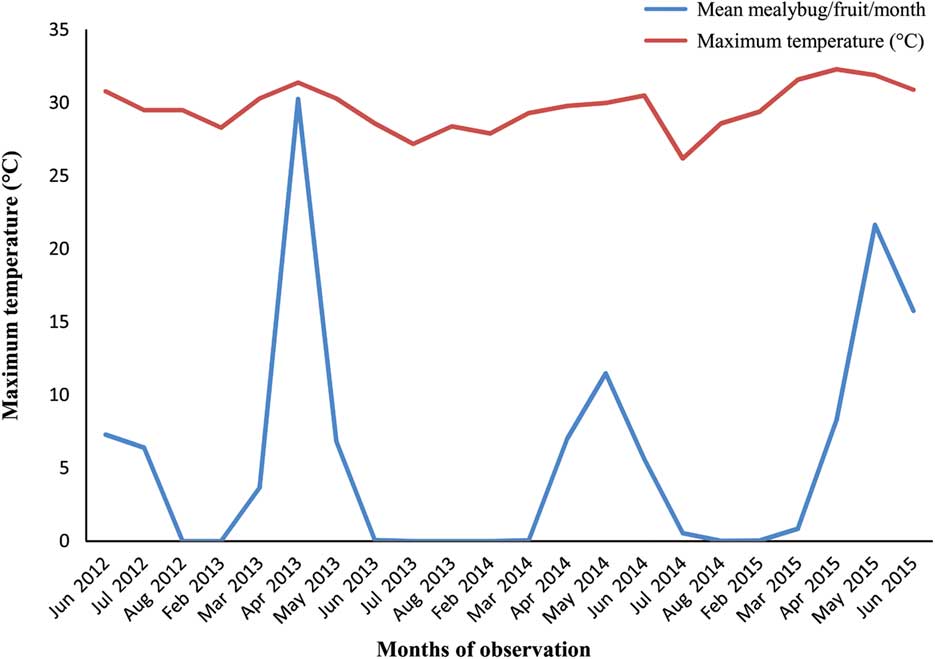
Suresh and Kavitha (Reference Suresh and Kavitha2008) reported associations between the weather parameters and population of the mealybug R. iceryoides. They found that high temperature and lack of rainfall were associated with an increase in mealybug populations. The population of R. iceryoides was found to be very low at the beginning of the mango fruiting season. Subsequently, the population reached its peak during mango harvesting, which coincided with summer (Fig. 2 and Supplementary Material Table 1).
Seasonal incidence of mealybugs, Rastrococcus iceryoides, from 2012 to 2015 during the fruiting season.
Biological control using C. montrouzieri has been recommended (Mani et al. Reference Mani, Krishnamoorthy and Pattar1995) at early establishment of populations. The prediction model, which predicts three to four weeks in advance of a pending infestation, arrived at in this study can be used by even non-specialist extension personnel and farmers to implement biological control. Early decision making is imperative, as obtaining sufficient numbers of C. montrouzieri requires three to four weeks. The life cycle of predator C. montrouzieri from egg to adult stage under laboratory conditions requires 27–30 days (Kairo et al. Reference Kairo, Paraiso, Gautam and Peterkin2013). Such models also help extension personnel to convince the commercial insectaries to produce adequate predators, as they are apprehensive of future market. Models also serve to inform organic farmers of an impending mealybug explosion warranting that they order adequate predators sufficiently in advance.
Models that can predict R. iceryoides population with a single independent variable have the advantage of being used early by progressive farmers and extension personnel for sourcing predator population from commercial insectaries. This study is designed to help in managing R. iceryoides at early incidence through biocontrol intervention in organic mango orchards.
Acknowledgements
The authors thank the Director of Indian Institute of Horticultural Research and National Bureau of Agricultural Insect Resources, Bengaluru for constant support and encouragement. The authors are also thankful to Jain University, Bengaluru. Thanks are also due to Indian Council of Agricultural Research for financial support through the Out Reach Programme on Management of Sucking Pests on Horticultural Crops. Suggestions from Dr. Kevin Floate, Editor-in-Chief, and two anonymous referees were helpful in recasting the manuscript from an original version. This work is a part of the Ph.D. thesis of the first author.
Supplementary material
To view supplementary material for this article, please visit https://doi.org/10.4039/tce.2017.42