Introduction
The volutes (family Volutidae Rafinesque, Reference Rafinesque1815) are a very diverse group of gastropods. Their shell form and most other morphologies are strongly variable. In the definition of the family and in differentiating between members of it, however, columellar plaits have traditionally played an important role. This character is also quite variable in terms of number and strength (Pilsbry and Olsson, Reference Pilsbry and Olsson1954). Columellar plaits are, however, not exclusive to this family. The feature is common in the superfamily Turbinelliodea Rafinesque, Reference Rafinesque1815 and the family Mitridae Swainson, Reference Swainson1831. It also independently evolved in the gastropod subclasses Opisthobranchia Milne Edwards, Reference Milne Edwards1848 and Pulmonata Milne Edwards, Reference Milne Edwards1848 (Price, Reference Price2001). Nevertheless, columellar plaits are most elaborately developed in some volutes including the type genus Voluta Linnaeus, Reference Linnaeus1758. Volutes are further distinguished from other prosobranch gastropods with columellar plaits in having stronger plaits toward the anterior part whereas in others they occur posteriorly.
Early researchers who pioneered the study of Cenozoic mollusks from the western part of the Indian subcontinent reported many typical volutids and some peculiar species that resemble members of different families except in having prominent columellar plaits (d'Archiac and Haime, Reference d'Archiac and Haime1854; Cossmann and Pissarro, Reference Cossmann and Pissarro1909; Vredenburg, Reference Vredenburg1923, Reference Vredenburg1925; Douvillé, Reference Douvillé1929; Cox, Reference Cox1930, Reference Cox1931; Eames, Reference Eames1952). Most of these authors’ monographs were based primarily on mollusks from Sindh and Balochistan of Pakistan with minor contributions from Kutch and Subathu in India (d'Archiac and Haime, Reference d'Archiac and Haime1854; Eames, Reference Eames1952).
The Cenozoic marine sedimentary deposits of Kutch, Gujarat on the western coast of India include an almost continuous succession from the lower Eocene to the Holocene (Fig. 1). The first attempt to record mollusks from this succession was by Sowerby (Reference Sowerby1840), who briefly described and figured some species. Vredenburg (Reference Vredenburg1925, Reference Vredenburg1928a) described the post-Eocene mollusks from western India, which at the time of publication included basins from Pakistan and western India. The majority of species that he described came from Pakistan. In recent times, the Oligocene and the Miocene gastropods from Kutch were reviewed by Harzhauser et al. (Reference Harzhauser, Markus, Piller, Berning, Kroh and Mandic2009) and Kulkarni et al. (Reference Kulkarni, Bhattacharjee Kapoor and Borkar2010). The Eocene mollusks from Kutch, however, remained much less attended until recently except in some sporadic reports (Sastry and Mathur, Reference Sastry and Mathur1968; Tandon, Reference Tandon1971; Tandon and Srivastava, Reference Tandon and Srivastava1980). More recently, they have started getting some attention from paleontologists (Kachhara et al., Reference Kachhara, Devi and Jodhawat2011a, Reference Kachhara, Jodhawat and Devib; Halder, Reference Halder2012; Halder and Sinha, Reference Halder and Sinha2014; Halder and Bano, Reference Halder and Bano2015).
(1) Map of the area with collection localities demarcated. (2) Geological map showing fossil localities discussed in the text (modified after Biswas, Reference Biswas1992).

The present authors intended to make a comprehensive systematic study of the gastropods from the Eocene of Kutch. Halder and Sinha (Reference Halder and Sinha2014) recently reported the Eocene cerithioids (superfamily Cerithioidea Fleming, Reference Fleming1822) from Kutch. The present paper deals with volutids. Some species, which resemble members of other families in some diagnostic features but have elaborately developed volutid-like columellar plaits on their inner lips, are included. Paleobiogeographic implications of finding these animals in Kutch and other basins of the western part of the Indian subcontinent are also explored.
Geologic setting
The Kutch basin received a widespread, thick pile of sediments during much of the Mesozoic, followed by eruption of the Deccan Trap volcanics (Biswas, Reference Biswas1992). The resurgent sea started to deposit fresh sediments during the lower Eocene (Ypresian) over the basement of the Deccan Trap or the Mesozoic sedimentary rocks (Biswas, Reference Biswas1992; Saraswati et al., Reference Saraswati, Khanolkar, Raju and Banerjee2016). There are, however, suggestions that Paleocene sediments are also present in Kutch (Tandon, Reference Tandon1971; Kachhara et al., Reference Kachhara, Devi and Jodhawat2011a).
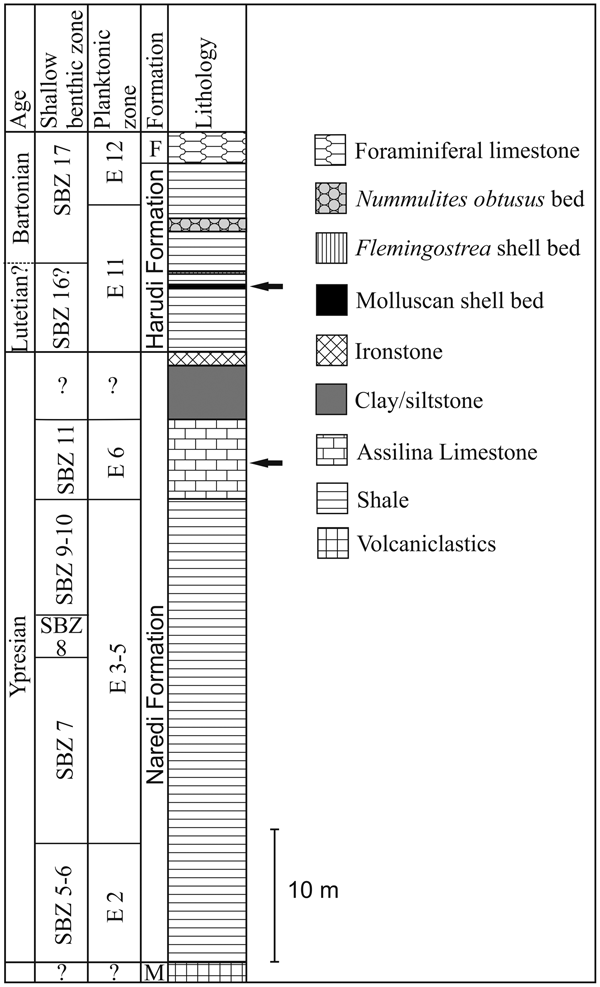
Sedimentation initiated in the Kutch basin in a restricted environment under quiet conditions. Plane laminated shale is the motif of the basal unit, the Naredi Formation (Biswas, Reference Biswas1992), which was punctuated only once by a limestone bed studded with species of the larger benthic foraminifer Assilina d'Orbigny, Reference d'Orbigny and Sagra1839 (Fig. 2). Molluscan shells are found in the shales and the Assilina Limestone Member (Biswas, Reference Biswas1992). Because of poor induration of shales, the fossil shells are fragile and often difficult to retrieve. Fossils are preserved mostly as internal molds in the Assilina Limestone. They are also sometimes distorted.
Composite lithostratigraphic section with collection levels marked by arrows. F = Fulra Limestone; M = Matanomadh Formation.

The overlying Harudi Formation (Biswas, Reference Biswas1992) is also primarily argillaceous (Fig. 2). However, marine signatures are clearer here than in the Naredi Formation with several beds yielding abundant marine mollusks. A molluscan shell bed in the basal part of this formation is the most productive unit as far as well-preserved molluscan shells are concerned. The majority of species reported herein come from this bed. A persistent oyster bank occurs ~ 1 m above this shell bed. Near the top of this formation, another species of oyster is found in plenty. Megainvertebrate fossils are rare in the intervening portion of the formation. However, there is a thin, persistent foraminiferal limestone comprised of the larger benthic foram Nummulites spp. in this part. Oyster spats are found attached to them (Sengupta et al., Reference Sengupta, Syed, Sarkar and Halder2011). Foraminiferal limestones, mainly characterized by the larger foram Discocyclina Gümbel, Reference Gümbel1868, are also found below and above this bed. Deposition in this transgressive systems tract culminated in a thick foraminiferal limestone formation called the Fulra Limestone (Biswas, Reference Biswas1992; Catuneanu and Dave, Reference Catuneanu and Dave2017) (Fig. 2). The Harudi Formation and the Fulra Limestone are mainly deposits of the Bartonian age (Saraswati et al., Reference Saraswati, Khanolkar, Raju and Banerjee2016).
The Cenozoic formations outcrop in an arc surrounding the Deccan volcanics and the Mesozoic sedimentary rocks. They are roughly parallel to the present-day coastline (Fig. 1).
New subfamily Indovolutinae
Cox (Reference Cox1931) first noticed the uniqueness of a group of species with volute-like columellar plaits from the western part of the Indian subcontinent. These species resemble members of different families. He referred to their endemism but did not suggest an evolutionary relationship. Instead, Cox (Reference Cox1931) incorporated Indovoluta Eames, Reference Eames1956 in the family Conidae Fleming, Reference Fleming1822 and Involuta Cox, Reference Cox1931 in none, and retained Prestrombus Douvillé, Reference Douvillé1929 in the family Strombidae Rafinesque, Reference Rafinesque1815. Douvillé’s (Reference Douvillé1929) records of Eovasum Douvillé, Reference Douvillé1920 and Lyrischapa Aldrich, Reference Aldrich1911 (= Diploconus Douvillé, Reference Douvillé1929; = Diconomorpha Wenz, Reference Wenz and Schindewolf1943) were also included in the group by Cox (Reference Cox1931).
Givens (Reference Givens1991) suggested the necessity of a separate volutid subfamily to include the distinctive group of genera comprising Indovoluta, Gosavia Stoliczka, Reference Stoliczka1865, and Lyrischapa. The group flourished mainly in the western part of the Indian subcontinent during the Upper Cretaceous and the Paleogene. He re-assigned some volutid species from Pakistan to Lyrischapa. This genus is based on the type species Lyrischapa harrisi Aldrich, Reference Aldrich1911 from the middle Eocene of America. Later, Merle et al. (Reference Merle, Pacaud, Métais, Bartolini, Lashari, Brohi, Solangi, Marivaux and Welcomme2014) elaborated on Lyrischapa spp. from Pakistan. The genus Eovasum is regarded as belonging to the family Turbinellidae Swainson, Reference Swainson1835. However, E. soudanense Douvillé, Reference Douvillé1920 was considered by Givens (Reference Givens1991) to belong to Lyrischapa.
Here we report volutid species from the Eocene of Kutch. None of these were previously known from Kutch. Many of these volutids resemble members of other families in some features. These unusual volutids belong to three genera—Indovoluta, Involuta, and Prestrombus. We have reviewed type specimens of many volutid species from Pakistan, e.g., the syntypes of Prestrombus vredenburgi Douvillé, Reference Douvillé1929 (Fig. 3.1–3.4), the type species of the genus, the syntypes of Lyrischapa elegans (Douvillé, Reference Douvillé1929), and the plesiotypes of Lyrischapa haimei (d'Archiac and Haime, Reference d'Archiac and Haime1854) (Fig. 3.5–3.9). Our observations and understanding of these genera and their allied forms, which led to the erection of Indovolutinae n. subfam., are discussed below.
(1–4) Prestrombus vredenburgi Douvillé, Reference Douvillé1929 from the lower Paleocene “Cardita beaumonti” beds of Sindh, Pakistan: (1, 2) syntype, GSI 15047, abapertural (1) and apertural (2) views; (3, 4) syntype, GSI 15048, abapertural (3) and apertural (4) views. (5–9) Lyrischapa haimei (d'Archiac and Haime, Reference d'Archiac and Haime1854) from the lower Eocene Hangu Shale of North West Frontier Province, Pakistan: (5) plesiotype, GSI 14685, apertural view; (6) plesiotype, GSI 14686, apical view; (7) plesiotype, GSI 14687, abapertural view; (8, 9) plesiotype, GSI 14688, apertural (8) and apical (9) views. Scale bars = 10 mm.

Indovoluta Eames, Reference Eames1956
Eames (Reference Eames1956) erected the genus Indovoluta based on two Eocene species—Indovoluta humberti (d'Archiac and Haime, Reference d'Archiac and Haime1854) and Indovoluta multidentata (d'Archiac and Haime, Reference d'Archiac and Haime1854). These are reported here for the first time from Kutch and redescribed based on several specimens. The species were earlier placed in Gosavia (Cox, Reference Cox1931; Eames, Reference Eames1952), a distinct genus restricted to the Upper Cretaceous (Eames, Reference Eames1956; Givens, Reference Givens1991). Gosavia has a Conus-like low biconic shell. Its shell surface is characterized by reticulate ornamentation and its inner lip bears multiple columellar plaits in a volute-like arrangement. Indovoluta, resembling Gosavia in most respects except having a smooth shell and more numerous columellar plaits, appeared in the lower Eocene. Cox (Reference Cox1931) regarded Gosavia to belong to the family Conidae because of its extreme similarity in coiling pattern, shape, and subsutural anal sinus. These features commonly characterize the members of Conidae (Bouchet et al., Reference Bouchet, Kantor, Sysoev and Puillandre2011) but are not restricted to that family. Biconic to obconic shapes and subsutural sinuses are known from familiar volutid genera, e.g., Athleta Conrad, Reference Conrad1853 (Maxwell, Reference Maxwell2003; Pilsbry and Olsson, Reference Pilsbry and Olsson1954).
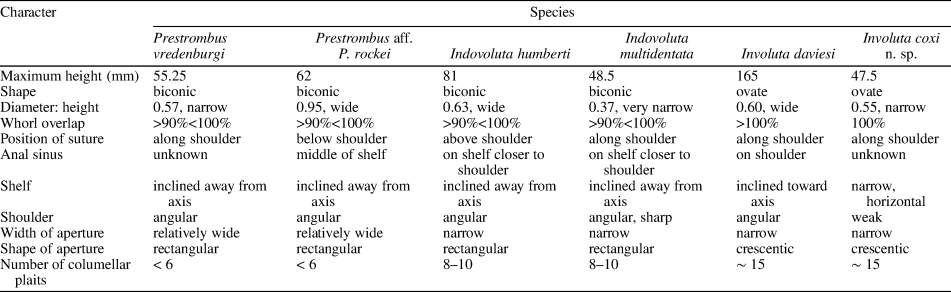
The contemporaneous genus closest in appearance to Indovoluta is Lyrischapa, which comes mainly from the Paleocene to the middle Eocene of America and Pakistan. Indovoluta lacks the shoulder tubercles and axial ornamentation of Lyrischapa. Spiral ornamentation on the shelf of Lyrischapa spp. also distinguishes them from Indovoluta spp. All other features of these two genera, including number and arrangement of columellar plaits, are similar. Some Lyrischapa spp. from Pakistan, however, differ from the middle Eocene type species from America in having distinct shell overlapping on the shelf. The posterior end of the whorl in some Pakistani species partially overrides the preceding shelf, thereby draping the shoulder and approximately half of the shelf of the previous whorl. Shoulder tubercles are commonly visible only on the last whorl (Givens, Reference Givens1991, fig. 3.8, 3.10; Merle et al., Reference Merle, Pacaud, Métais, Bartolini, Lashari, Brohi, Solangi, Marivaux and Welcomme2014, figs. 5e, 6c, i). Indovoluta humberti from Kutch also clearly exhibits this overriding thick shell revealing only half of the shelf of the previous whorl and covering the trace of the anal sinus to a large extent (Fig. 4.7). Lyrischapa is known from 11 species that differ in ornamentation, degree of subsutural flexure, protoconch size, and coiling (Givens, Reference Givens1979, Reference Givens1991; Merle et al., Reference Merle, Pacaud, Métais, Bartolini, Lashari, Brohi, Solangi, Marivaux and Welcomme2014). Recently, Merle et al. (Reference Merle, Pacaud, Métais, Bartolini, Lashari, Brohi, Solangi, Marivaux and Welcomme2014) reviewed Lyrischapa spp. from the lower Eocene of Pakistan. The genus Lyrischapa has been assigned to the family Volutidae although authors have been uncertain about its subfamilial affinities (Givens, Reference Givens1991; Merle et al., Reference Merle, Pacaud, Métais, Bartolini, Lashari, Brohi, Solangi, Marivaux and Welcomme2014). Indovoluta, although close to Conus in shell shape, is closer to Gosavia and Lyrischapa in all features except ornamentation. Following Givens (Reference Givens1991), we assign this genus to Volutidae. The combination of low biconic shell shape, a distinct subsutural anal sinus on the shelf, and the elaborate arrangement of columellar plaits makes these genera unique among volutids (Table 1).
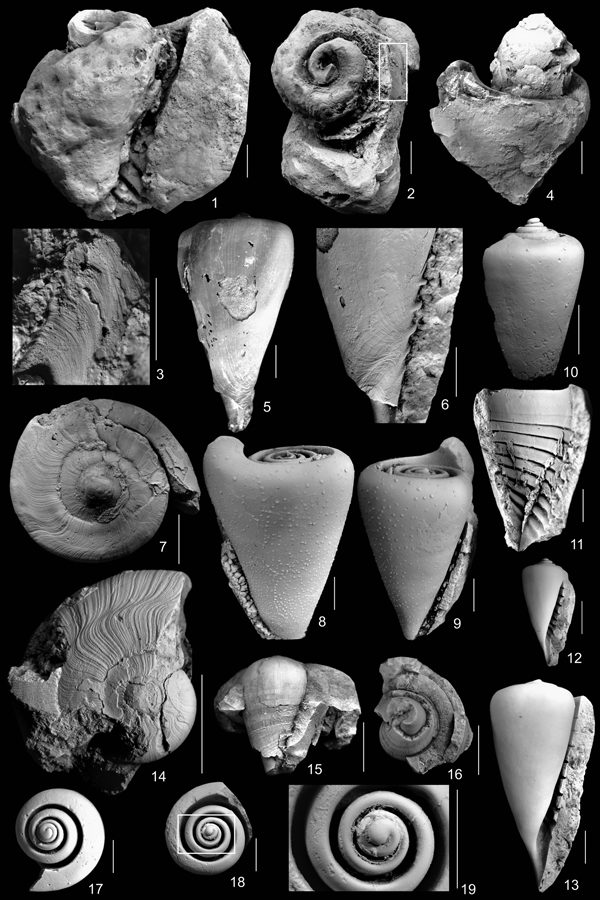
(1–4) Prestrombus aff. Prestrombus rockei Cox, Reference Cox1931: (1, 2) PG/KG/Vl 64 from Loc. 1, Naredi Formation, apertural (1) and apical (2) views; (3) close-up of inset in Figure 4.2, preserved shell showing growth lines; (4) PG/KG/Vl 62 from Loc. 1, Naredi Formation abapertural view. (5–19) Indovoluta humberti (d'Archiac and Haime, Reference d'Archiac and Haime1854): (5–7) PG/KG/Vl 7 from Loc. 2, Harudi Formation, abapertural view (5), apertural view (in part) (6) showing columellar plaits, and apical view (7) showing shell overlapping on shelf; (8, 9) PG/KG/Vl 16 from Loc. 2, Harudi Formation, abapertural (8) and apertural (9) views; (10) PG/KG/Vl 6 from Loc. 4, Harudi Formation, abapertural view; (11) PG/KG/Vl 123 from Loc. 2, Harudi Formation, interior of the fragment of a whorl revealing columellar plaits; (12) PG/KG/Vl 23 from Loc. 2, Harudi Formation, apertural view; (13) PG/KG/Vl 17 from Loc. 2, Harudi Formation, apertural view; (14–16) PG/KG/Vl 3 from Loc. 4, Harudi Formation, apical view (14) showing trajectory of growth lines on shelf, apertural view (15), and basal view (16) revealing thick shell; (17) PG/KG/Vl 6 from Loc. 4, Harudi Formation, apical view showing large protoconch; (18, 19) PG/KG/Vl 19 from Loc. 2, Harudi Formation, apical view (18), and close-up (19) of inset in Figure 4.18 showing bulbous protoconch. Scale bars = 10 mm.

Characters of the species belonging to the three genera of Indovolutinae n. subfam. discussed in the text.

Involuta Cox, Reference Cox1931
It is difficult to assign the monospecific genus Involuta to any existing family because of its unusual characteristics, e.g., its long ovate shape, thin involute shell, parallel-sided crescentic aperture, and a series of sharp columellar plaits. Here we ascribe a new species to this genus, Involuta coxi new species, which has a convolute shell with no umbilicus on the apical side. Cox (Reference Cox1931) refrained from assigning the genus to any family pending discovery of specimens with preserved shells. We have several specimens of the type and only known species Involuta daviesi Cox, Reference Cox1931. Most of the specimens are internal molds. However, the shell is visible in some places. On well-preserved internal molds, the thin shell left its impression, which we were able to reconstruct. Growth lines are essentially straight on the whorl side (Fig. 5.14). In early ontogeny, the shell bears reticulation (Fig. 5.21).
(1–8) Indovoluta multidentata (d'Archiac and Haime, Reference d'Archiac and Haime1854): (1–3) PG/KG/Vl 89 from Loc. 3, Harudi Formation, abapertural view (1), close-up (2) showing elevated spire, angular shoulder, and straight growth lines on lateral side, and apical view (3) showing sinus on concave shelf; (4, 5) PG/KG/Vl 90 from Loc. 3, Harudi Formation, apertural view (4) exhibiting columellar plaits, and apical view (5); (6) PG/KG/Vl 97 from Loc. 3, Harudi Formation, apical view showing bulbous protoconch; (7) PG/KG/Vl 102 from Loc. 3, Harudi Formation, apertural view; (8) PG/KG/Vl 110 from Loc. 3, Harudi Formation, apertural view revealing columellar plaits. (9–21) Involuta daviesi Cox, Reference Cox1931: (9–11) PG/KG/Vl 29 from Loc. 3, Harudi Formation, apertural (9), abapertural (10), and apical (11) views; (12, 13) PG/KG/Vl 30 from Loc. 3, Harudi Formation, abapertural view (12), and close-up (13) of inset in Figure 5.12 showing growth lines on whorl side; (14–16) PG/KG/Vl 121 from Loc. 2, Harudi Formation, apertural (14), abapertural (15), and apical (16) views; (17–19) PG/KG/Vl 26 from Loc. 2, Harudi Formation, interior of a separated part of the last whorl (17) revealing columellar plaits and straight growth lines, apertural view (18), and apical view (19); (20, 21) PG/KG/Vl 120 from Loc. 2, Harudi Formation, abapertural (20) and apertural (21) views showing details of ornamentation. Scale bars = 10 mm.

Cymbium Röding, Reference Röding1798 (family Volutidae) superficially resembles Involuta in shape. It has wide ramp sloping toward the axis like that in Involuta daviesi (Smith, Reference Smith1942; Landau and Marquet, Reference Landau and Marquet2000). However, its shell is not as involute as the latter, which has a deep apical umbilicus. Cymbium differs from Involuta mainly in the shape of the aperture and in having a strong siphonal fasciole (Landau and Marquet, Reference Landau and Marquet2000). The aperture in the former is wide with the outer lip roughly parallel to the axis. The aperture of Involuta is crescentic with almost parallel-sided lips (Fig. 5.14). Columellar plaits are also much more numerous in Involuta.
In internal molds of Involuta coxi n. sp., the suture is slightly upturned along with a weakly constricted aperture and there is the suggestion of a faint plication on the interior of the outer lip. A slightly flared outer lip with a thickened interior produces an upturned suture in the internal mold. The flared, internally thickened, plicated outer lip is reminiscent of strombid gastropods (family Strombidae) (Savazzi, Reference Savazzi1991). However, this similarity of apertural features appears to be superficial because Involuta does not resemble strombids in any other morphology, and such features are observed in other groups of gastropods including volutids (see e.g., Pilsbry and Olsson Reference Pilsbry and Olsson1954; Maxwell, Reference Maxwell2003). Involuta resembles unusual western Indian volutids much more closely in having a large, bulbous protoconch; a narrow, parallel-sided aperture; and an elaborate pattern of columellar plaits. Among these unusual gastropods from western India, development of columellar plaits is at its maximum in this genus. It has ~ 15 sharp plaits. Its ovate shape with a convolute to involute shell is also most distinctive among the members of this group (Table 1).
Prestrombus Douvillé, Reference Douvillé1929
The genus Prestrombus was erected based on Prestrombus vredenburgi, a lower Paleocene species from Sindh, Pakistan. The name suggests kinship with the family Strombidae. Douvillé (Reference Douvillé1929) considered this the oldest representative of the family Strombidae, but also noticed similarity with representatives of Muricoidea Rafinesque, Reference Rafinesque1815. The type species, represented by two internal molds (GSI 15047, 15048), shows a moderately upturned adult suture and strong columellar plaits (Fig. 3.1–3.4). The species is depressed having a wider aperture relative to those of Indovoluta, Lyrischapa, and Involuta (Table 1). However, its aperture resembles that of these genera in having nearly parallel-sided lips. It appears from the disposition of the suture and the preserved shell at places on the specimens that the shell was relatively thin. The only other species of the genus, Prestrombus rockei Cox, Reference Cox1931, was also relatively poorly known and represented only by internal molds. Here we report the species from Kutch. Although the Kutch specimens are also poorly preserved, one of them exhibits a clearly defined shelf that is slightly inclined. Growth lines on the shelf flex back into the sinus (Fig. 4.3). The shell is very thick. The aperture of the species is wide but adapical extension of the suture is not prominent. Cox (Reference Cox1931) observed that its columellar plaits increase in strength from anterior to posterior, in contrast to the opposite trend found in volutes. In Indovoluta, Involuta, and Lyrischapa, we found that the most anterior plait is always quite weak followed by two relatively closely spaced strong plaits. Posterior to these, two or three plaits are more widely spaced and have almost equal strength. Strength decreases drastically thereafter. We observed, contrary to Cox (Reference Cox1931), that the pattern is similar in Prestrombus. Whereas several weaker plaits characterize the posterior part of the inner lip in the former genera, the total number of plaits in Prestrombus appears to be restricted to four to six (Douvillé, Reference Douvillé1929; Cox, Reference Cox1931).
Prestrombus, having similarity to other Paleogene Indian volutids in shape, patterns of growth lines, and columellar plaits, perhaps belongs to the same lineage. Adapical extension of the suture, which appears to be the primary reason for its inclusion in Strombidae, has also been observed in Indovoluta (Fig. 4.9), Involuta (Fig. 6.2), and other volutids (Pilsbry and Olsson, Reference Pilsbry and Olsson1954; Maxwell, Reference Maxwell2003, figs. 12, 28).
(1–7) Involuta coxi n. sp.: (1) paratype, PG/KG/Vl 117 from Loc. 3, Harudi Formation, lateral view; (2–5) holotype, PG/KG/Vl 42 from Loc. 3, Harudi Formation, abapertural view (2), apertural view (3), oblique apertural view (4) revealing columellar plaits, and apical view (5); (6) paratype, PG/KG/Vl 37 from Loc. 2, Harudi Formation, apical view; (7) paratype, PG/KG/Vl 119 from Loc. 3, Harudi Formation, apical view. (8–15) Athleta (Volutocorbis) harnaiensis Cox, Reference Cox1931: (8–10) PG/KG/Vl 47 from Loc. 4, Harudi Formation, apical (8), abapertural (9), and apertural (10) views; (11) PG/KG/Vl 55 from Loc. 3, Harudi Formation, apertural view showing columellar plaits; (12, 13) PG/KG/Vl 59 from Loc. 3, Harudi Formation, internal mold showing prominent spiral ornamentation, apertural (12) and abapertural (13) views; (14, 15) PG/KG/Vl 122 from Loc. 2, Harudi Formation, abapertural (14) and apertural (15) views. (16–18) Lyria? cf. Lyria punjabensis Eames, Reference Eames1952: abapertural (16), apertural (17), and apical (18) views. Scale bars = 10 mm.

Discussion
It appears that Prestrombus, Indovoluta, Lyrischapa, and Involuta are unified by a prominent shelf and shoulder, an anal sinus on the shelf, a parallel-sided aperture, and several strong columellar plaits. They vary in degree of whorl overlapping, the position of the suture, depth and position of the deepest part of the subsutural sinus, width of the aperture, number of columellar plaits, and ornamentation. This Cenozoic group flourished mainly in the western part of the Indian subcontinent. The Cretaceous genus Gosavia, with similar characteristics, probably formed the rootstock. The purported descendants diverged in different directions. For instance in Prestrombus, the suture lies below the shoulder of previous whorl. The suture overrides the previous whorl in Indovoluta and Lyrischapa, and entirely drapes the previous whorl in Involuta. The anal sinus is at the shoulder in Gosavia. This state is retained in Involuta. In other Paleogene representatives, the sinus is on the shelf. Ornamentation varies from reticulate in Gosavia to almost smooth in Prestrombus, Indovoluta, and Involuta, and is characterized by shoulder tubercles and axial ribs in Lyrischapa. Reticulation in early ontogeny in the posterior part of Involuta daviesi demonstrates a possible evolutionary link (Fig. 5.21). Columellar plaits were seen to increase in number from four to six in early forms like Gosavia and Prestrombus, to 10–15 in later forms such as Indovoluta, Lyrischapa, and Involuta. We erect Indovolutinae n. subfam. for this unique and primarily Indian strain of volutid gastropods, with the genus Indovoluta as its type.
Key to the genera of Indovolutinae n. subfam
1. Biconic with rectangular aperture ----------- 2
1′. Ovate, involute to convolute, crescentic aperture with ~15 columellar plaits---------------Involuta
2. Columellar plaits < 6-----------------3
2′. Columellar plait > 6-----------------4
3. Ornamented (reticulate)----------------Gosavia
3′. Smooth-----------------Prestrombus
4. Ornamented (shoulder tubercles, axial ribs)-------- Lyrischapa
4′. Smooth------------------Indovoluta
Materials and methods
Specimens were collected from two stratigraphic levels and four localities. The Assilina Limestone Member of the Naredi Formation, exposed at the type section of this formation near the village of Nareda (Loc. 1, 23°34′32″N, 68°38′55″E) (Figs. 1, 2), yielded a few specimens. The shell bed in the basal part of the Harudi Formation (Fig. 2) yielded the rest of the specimens from three localities, one of which is the type section of the formation near the village of Harudi (Loc. 2, 23°32′N, 68°40′52″E) (Fig. 1). The other two localities of collection from this level are – Loc. 3, 3 km NW of Nareda, 23°35′03″N, 68°36′40″E and Loc. 4, 3 km WSW of the village of Godhatad, 23°38′37″N, 68°38′21″E (Fig. 1). Specimens were coated with MgO before photography.
Repositories and institutional abbreviations
All of the specimens from Kutch used here for systematic study are deposited in the Department of Geology, Presidency University (PG), Kolkata, India. Specimens are numbered with this institutional abbreviation, plus locality (K = Kutch) and taxonomic (G = Gastropoda, Vl = Volutidae) abbreviations. Other type specimens examined for this study are available in the Repository of Fossils of the Curatorial Division of Geological Survey of India (GSI), Kolkata. Type specimens of most of the existing species redescribed here are either in The Natural History Museum, London (NHM) or in the Geological Society of London (GSL).
Systematic paleontology
Class Gastropoda Cuvier, Reference Cuvier1797
Subclass Caenogastropoda Cox, Reference Cox and Moore1960
Cohort Sorbeoconcha Ponder and Lindberg, Reference Ponder and Lindberg1997
Subcohort Hypsogastropoda Ponder and Lindberg, Reference Ponder and Lindberg1997
Superorder Latrogastropoda Riedel, Reference Riedel2000
Order Neogastropoda Wenz, Reference Wenz and Schindewolf1938
Superfamily Volutoidea Rafinesque, Reference Rafinesque1815
Family Volutidae Rafinesque, Reference Rafinesque1815
Subfamily Indovolutinae new subfamily
Type genus
Indovoluta Eames, Reference Eames1956
Diagnosis
Large bulbous protoconch; teleoconch with 3–5 whorls; shape biconic to ovate, large whorl overlapping from > 90% to involute with development of apical umbilicus; generally with prominent shoulder; growth lines straight on whorl side, with sinus on shelf or shoulder; narrow parallel-sided aperture, rectangular to crescentic in shape; 4–15 elaborately developed columellar plaits; surface smooth to ornamented with spiral and axial ribs and shoulder tubercles.
Genus Prestrombus Douvillé, Reference Douvillé1929
Type species
Prestrombus vredenburgi Douvillé, Reference Douvillé1929, lower Paleocene, Pakistan, by original designation.
Prestrombus aff. Prestrombus rockei Cox, Reference Cox1931
Figure 4.1–4.4
- Reference Cox1931
Prestrombus rockei Cox, p. 52, pl. 2, fig. 6.
Holotype
NHM G.50252, lower Eocene, Sindh, Pakistan.
Occurrence
Lower Eocene, Sindh and Punjab, Pakistan; lower Eocene, Khuiala Formation, Rajasthan; lower Eocene, Naredi Formation, Kutch, western India.
Description
Large (largest specimen ~ 62 mm height, 59 mm diameter); wide, somewhat biconic with elevated step-like spire; protoconch unknown; teleoconch of ~ 4 whorls; last whorl large with convex side in posterior part and conical toward anterior; shell very thick; sutures prominently marked by wide gap in internal mold, running much below shoulder of previous whorl; shoulder angular; shelf wide, inclined, slightly concave in preserved shell; strong columellar plaits toward anterior part; posterior part of inner lip unknown; aperture wide, subelliptical, with nearly parallel-sided lips; growth lines with asymmetric subsutural flexure on shelf, unknown for remaining shell surface; suture showing vague tendency to rise posteriorly in latest part of whorl; basal constriction moderate.
Materials
Three specimens (PG/KG/Vl 62–64) from the Naredi Formation exposed at Loc. 1; mostly internal molds with shell partially preserved.
Remarks
The species is represented by a few ill-preserved specimens in our collection. It has its closest affinity to Prestrombus rockei from Sindh (Cox, Reference Cox1931) in general shape and apertural features. However, the Sindh form is narrower than the Kutch form. Specimens of the latter are also much abraded. Hence, we place the Kutch form in open nomenclature. Prestrombus aff. Prestrombus rockei differs from Prestrombus vredenburgi, the type species from Pakistan, in having a thicker shell and less prominent posterior extension of the adult suture. The latter also comes from an older stratigraphic level of the lower Paleocene.
Genus Indovoluta Eames, Reference Eames1956
Type species
Voluta humberti d'Archiac and Haime, Reference d'Archiac and Haime1854, lower Eocene, Pakistan, by original designation.
Indovoluta humberti (d'Archiac and Haime, Reference d'Archiac and Haime1854)
Figure 4.5–4.19
- Reference d'Archiac and Haime1854
Voluta humberti d'Archiac and Haime, p. 327, pl. 34, fig. 9.
- Reference d'Archiac and Haime1854
Voluta salsensis d'Archiac and Haime, p. 328, pl. 34, figs. 10–11.
- Reference Dalton1908
Voluta birmanica Dalton, p. 632, pl. 57, fig. 10.
- Reference Cox1931
Gosavia humberti; Cox, p. 57, pl. 1, fig. 18.
- Reference Vokes1937
Gosavia humberti; Vokes, p. 5, fig. 7.
- Reference Eames1952
Gosavia humberti; Eames, p. 113.
- Reference Eames1956
Indovoluta humberti; Eames, p. 109, pl. 22, figs. 1–3.
- Reference Iqbal1969b
Gosavia humberti; Iqbal, p. 55, pl. 5, fig. 77.
- Reference Iqbal1972
Gosavia humberti; Iqbal, p. 65, pl. 16, fig. 5.
- Reference Bhatia and Khosla1978
Indovoluta humberti; Bhatia and Khosla, p. 246, pl. 4, fig. 11.
Lectotype
GSL 9886, lower Eocene, Sindh, Pakistan.
Occurrence
Paleocene to middle Eocene, several areas of Pakistan; upper Eocene, Myanmar; middle Eocene, Subathu Formation, Himachal Pradesh, India; lower Eocene, Khuiala Formation, Rajasthan, India; lower Eocene, Naredi Formation and middle Eocene, Harudi Formation, Kutch, India.
Description
Biconic, large (largest specimen 81 mm height, 51.5 mm diameter), moderately wide; spire barely elevated only near apex; protoconch bulbous, approximately one whorl; teleoconch ~ 5 whorls; whorl side only slightly convex at posterior part, flat conical anteriorly. Anterior end of columella slightly bent; suture on internal mold marked by prominent gap between whorls, flushed with surface where shell preserved; shoulder rounded on internal mold, nearly angular with shell. Shelf very slightly inclined, slightly depressed near shoulder; aperture narrow, elongated, parallel-sided, almost rectangular with distinct siphonal notch; latest ontogeny marked by slight flaring of aperture and upturned suture in internal mold; inner lip characterized by distinct thin parietal callus and prominent columellar plaits, plaits stronger and closer in anterior part, relatively more distantly spaced posteriorly, generally eight or nine columellar plaits, sometimes with fainter intermediary plaits at different ontogenetic stages; surface smooth; growth lines with prominent asymmetric flexure on shelf, straight on whorl side, sharply flexed in anterior part in connection with siphonal notch; siphonal fasciole not demarcated by any border. Shell moderately thick, thicker on shelf, characteristically draping approximately half of shelf of previous whorl; basal constriction weak; faint basal grooves posterior to anterior siphonal flexure.
Materials
Twenty-four specimens: one (PG/KG/Vl 2) from the Naredi Formation at Loc. 1; others from the Harudi Formation, 11 (PG/KG/Vl 7, 16–24, 123) from Loc. 2, seven (PG/KG/Vl 8, 9, 11–15) from Loc. 3, and five (PG/KG/Vl 1, 3–6) from Loc. 4. Majority of specimens adult to subadult.
Remarks
Indovoluta humberti was known so far mainly from different areas of Pakistan. It was also recorded from Himachal Pradesh and Rajasthan of India. It ranges in age from the Paleocene to the middle Eocene (d'Archiac and Haime, Reference d'Archiac and Haime1854; Cox, Reference Cox1931; Vokes, Reference Vokes1937; Eames, Reference Eames1952; Iqbal, Reference Iqbal1969b, Reference Iqbal1972; Bhatia and Khosla, Reference Bhatia and Khosla1978). However, the only formal description of the species was by d'Archiac and Haime (Reference d'Archiac and Haime1854). The present report extends the distribution of the species further south to Kutch. We redescribe the species, adding new information regarding shell morphologies, e.g., partial draping of the shelf by succeeding whorls (Fig. 4.7). D'Archiac and Haime (Reference d'Archiac and Haime1854) mentioned the presence of 15 or 16 columellar plaits in the inner lip. On the other hand, Cox (Reference Cox1931) and Eames (Reference Eames1956) found 5–7 plaits. The number of columellar plaits in Kutch specimens is generally 8 or 9, sometimes with several associated intercalatories.
Indovoluta multidentata (d'Archiac and Haime, Reference d'Archiac and Haime1854)
Figure 5.1–5.8
- Reference d'Archiac and Haime1854
Voluta multidentata d'Archiac and Haime, p. 326, pl. 32, fig. 1.
- Reference Cox1931
Gosavia multidentata; Cox, p. 58.
- Reference Vokes1937
Gosavia multidentata; Vokes, p. 7.
- Reference Eames1952
Gosavia multidentata; Eames, p. 114.
- Reference Eames1956
Indovoluta multidentata; Eames, p. 109.
Lectotype
GSL 9885, lower Eocene, Sindh, Pakistan.
Occurrence
Paleocene to middle Eocene, several areas of Pakistan; middle Eocene, Subathu Formation, Himachal Pradesh and Harudi Formation, Kutch, India.
Description
Biconic, small (largest specimen 48.5 mm height, 18 mm diameter), narrow, thick-shelled; spire moderately raised; protoconch bulbous, of approximately one whorl; teleoconch ~ 4 whorls; whorl side slightly convex toward posterior, flat conical toward anterior; shelf narrow, slightly sloping, depressed, bordered by sharp, angular, slightly elevated shoulder; suture prominent, lying just below shoulder; in internal mold shoulder not demarcated and suture prominently impressed; columella slightly bent at anterior part; eight or nine prominent columellar plaits characterizing inner lip, with anterior plaits relatively stronger than posterior plaits; sometimes weaker plaits, five or six in number, alternate with stronger ones in later ontogeny; parietal callus prominent, relatively thick in posterior part; aperture narrow subrectangular, high narrow in posterior end, relatively wider in anterior end; siphonal notch shallow; growth lines with slightly asymmetric distinct subsutural flexure on shelf, convex forward at posterior end of whorl, becoming straight later, unknown at anterior part; adult aperture flared or thickened internally, with suture slightly upturned in internal mold; base only slightly constricted.
Materials
Forty-seven specimens, all from the Harudi Formation: 14 (PG/KG/Vl 65–75, 107–109) from Loc. 2, 29 (PG/KG/Vl 76–102, 110, 111) from Loc. 3, and four (PG/KG/Vl 103–106) from Loc. 4; mostly internal molds, shell preserved in some parts.
Remarks
Indovoluta multidentata has been reported from the Paleocene and the middle Eocene of different parts of Pakistan, and Himachal Pradesh, India (d'Archiac and Haime, Reference d'Archiac and Haime1854; Vredenburg, Reference Vredenburg1923; Douvillé, Reference Douvillé1929; Vokes, Reference Vokes1937; Eames, Reference Eames1952, Reference Eames1956). This is the first report of the species from the middle Eocene of Kutch. The species was primarily distinguished from contemporaneous Indovoluta humberti in having a smaller, narrower shell, with less conical whorls, more convex sides, and a higher number of columellar plaits (Cox, Reference Cox1931; Eames, Reference Eames1956). We found similarity in number of columellar plaits between these two species. However, its smaller size, narrower shell outline, more elevated spire, and sharper raised shoulder easily distinguish Indovoluta multidentata from other congeneric species. In Indovoluta multidentata, the suture lies just below the shoulder, whereas in Indovoluta humberti, it overrides the preceding shelf.
Genus Involuta Cox, Reference Cox1931
Type species
Involuta daviesi Cox, Reference Cox1931, middle Eocene, Pakistan, by monotypy.
Involuta daviesi Cox, Reference Cox1931
Figure 5.9–5.21
- Reference Cox1931
Involuta daviesi Cox, p. 58, pl. 2, figs. 2, 4.
- Reference Vokes1937
cf. Involuta daviesi; Vokes, p. 7.
- Reference Eames1952
Involuta daviesi; Eames, p. 115.
Holotype
NHM G.50161, middle Eocene, Balochistan, Pakistan.
Occurrence
Middle Eocene, different areas of Pakistan; middle Eocene, Subathu Formation in Himachal Pradesh, and Harudi Formation in Kutch, India.
Description
Large (largest measures ~ 165 mm height, 100 mm diameter), prominently involute with deep umbilicus on apical side, ovate-conical; protoconch paucispiral, slightly greater than one whorl, bulbous, smooth; teleoconch of ~ 4 whorls; whorl side convex on posterior part, conical in anterior part; shoulder angular; shelf wide, convex, adaxially inclined; sutures deeply impressed; aperture narrow, crescentic, parallel-sided; ~ 15 more or less regularly arranged columellar plaits, strength of plaits decreasing whereas spacing slightly increasing posteriorly; basal constriction weak; columella only slightly curved; shell thin, relatively thickened toward posterior; growth lines with shallow subsutural flexure close to shoulder, straight on whorl side, with flexure on anterior part for siphonal notch; siphonal fasciole not observed except for faint groove demarcating posterior end of anterior flexure in some specimens; shell surface essentially smooth, except more or less regularly arranged, well-spaced, collabral, sharp striae and faint spiral undulations, in early ontogeny weak reticulation on posterior part.
Materials
Nine specimens, all from the Harudi Formation: four (PG/KG/Vl 25, 26, 120, 121) from Loc. 2, five (PG/KG/Vl 27-31) from Loc. 3; all internal molds, with shell preserved at some parts.
Remarks
This is only the second report of the genus from India. The species was so far known from Pakistan (Cox, Reference Cox1931; Eames, Reference Eames1952), and the Subathu Formation from Himachal Pradesh, India (Vokes, Reference Vokes1937). The specimens reported here from Kutch resemble the species closely and are considered conspecific. Their size and shape, involute nature with a deep apical umbilicus, their narrow, parallel-sided, crescentic apertures, and the number and pattern of columellar plaits match very closely. The only other species referred here to this genus is much smaller and is discussed below.
Involuta coxi new species
Figure 6.1–6.7
Holotype
PG/KG/Vl 42, from the Harudi Formation exposed at Loc. 3; internal mold.
Diagnosis
Small, convolute; shelf narrow, flat, horizontal; shoulder weak.
Occurrence
Middle Eocene Harudi Formation, Kutch, Gujarat, India.
Description
Small (largest 47.5 mm height, 26 mm diameter), convolute, ovate-conical; protoconch paucispiral, slightly greater than one whorl, bulbous, smooth; teleoconch < 3 whorls; whorl side rounded toward posterior, conical anteriorly; suture impressed; aperture narrow, slightly wide anteriorly, posteriorly curved and almost straight in anterior part; shelf narrow, horizontal; shoulder rounded, not prominent; ~ 15 more or less regularly arranged columellar plaits, stronger and more closely spaced toward anterior; basal constriction weak; columella only slightly curved; shell thin; growth lines straight on whorl side, unknown on shelf and anterior end; suture at latest ontogeny slightly upturned along with slightly constricted labrum in internal mold.
Etymology
In honor of L.R. Cox, who did pioneering studies on mollusks from the Indian subcontinent.
Materials
Sixteen specimens, all from the Harudi Formation: seven (PG/KG/Vl 32–38) from Loc. 2, six (PG/KG/Vl 42, 43, 116–119) from Loc. 3, and three (PG/KG/Vl 39–41) from Loc. 4; seven designated paratypes PG/KG/Vl 32, 34, 37, 43, 117–119; PG/KG/Vl 32 with partially preserved shell, others internal molds.
Remarks
The species is easily distinguishable from Involuta daviesi in two respects—size and coiling pattern. It is much smaller than the latter species. Adult size in a volutid gastropod, which is characterized by indeterminate growth, can only be surmised from the large individuals of a population. In case of Involuta coxi n. sp., however, the upturned suture along with the constricted aperture perhaps indicate that it was approaching adulthood. However, this dwarf species is easily distinguished from its larger sister by its coiling pattern—Involuta coxi n. sp. is convolute whereas Involuta daviesi is strongly involute with apical umbilicus. The apical umbilicus is already evident in the very first teleoconch whorl of the latter (Fig. 5.16). Shoulder and shelf, which are very well developed in Involuta daviesi, are not prominent in Involuta coxi n. sp. The aperture with a slight widening toward the anterior end in Involuta coxi n. sp. also differs from that in Involuta daviesi. However, the overall ovate-conical shape and the number and nature of the columellar plaits are similar in the two species.
Subfamily Athletinae Pilsbry and Olsson, Reference Pilsbry and Olsson1954
Genus Athleta Conrad, Reference Conrad1853
Subgenus Volutocorbis Dall, Reference Dall1890
Type species
Volutilithes limopsis Conrad, Reference Conrad1860, Paleocene, USA, by original designation.
Remarks
Volutocorbis was synonymized with Athleta by Darragh (Reference Darragh1971). Merle et al. (Reference Merle, Pacaud, Métais, Bartolini, Lashari, Brohi, Solangi, Marivaux and Welcomme2014), however, rightly pointed out that this and some other morphotypes of Athleta are still recognizable primarily because of their characteristic ornamentation. Volutocorbis with spiral rows of tubercles arranged on collabral ribs on the whorl side is easily distinguishable from other members of the genus Athleta. We uphold the view of Merle et al. (Reference Merle, Pacaud, Métais, Bartolini, Lashari, Brohi, Solangi, Marivaux and Welcomme2014) and use Volutocorbis as a subgenus.
Several similar looking species of Volutocorbis have been recorded from the Paleocene-Eocene strata of Pakistan. They resemble one another in an ornamental pattern in which tubercles are arranged in a reticulate fashion. The tubercles are roughly equidimensional and spaced equidistantly. They are slightly upturned to produce a rasp-like appearance. Species are differentiated based mainly on shell size and morphometric proportions, and the relative spacing of the spiral and axial components of the ornaments. For instance, Volutocorbis eugeniae Vredenburg, Reference Vredenburg1923, with which Volutospina sykesi (d'Archiac and Haime, Reference d'Archiac and Haime1854) (sensu Cossmann and Pissarro, Reference Cossmann and Pissarro1909) was synonymized by Merle et al. (Reference Merle, Pacaud, Métais, Bartolini, Lashari, Brohi, Solangi, Marivaux and Welcomme2014), is large and slender and has four spiral rows of tubercles on the spire whorls. Volutocorbis burtoni Vredenburg, Reference Vredenburg1923, which subsumes Volutocorbis victoriae Vredenburg, Reference Vredenburg1923 and Volutocorbis soriensis Eames, Reference Eames1952 (Merle et al., Reference Merle, Pacaud, Métais, Bartolini, Lashari, Brohi, Solangi, Marivaux and Welcomme2014), is slightly stouter and has two or three spiral rows of tubercles on the spire whorls. These characters, however, appear to vary intraspecifically and also ontogenetically. For example, in Volutocorbis daviesi Cox, Reference Cox1930, spiral rows of tubercles are reduced from four on early whorls to three on the penultimate whorl (Cox, Reference Cox1930). These varieties, however, are often found to be geographically and stratigraphically restricted and mutually exclusive. Hence, their specific identity is justified.
In other recorded species of Volutocorbis from Pakistan, either the axial or the spiral component is dominant. They are also distinguished based on similar minor morphological differences. These morphological variants, again, have restricted and often nonoverlapping geographic and temporal ranges.
Athleta (Volutocorbis) harnaiensis Cox, Reference Cox1931
Figure 6.8–6.15
- Reference Cox1931
Volutocorbis harnaiensis Cox, p. 56, pl. 2, fig. 7.
- Reference Iqbal1969a
Volutocorbis harnaiensis; Iqbal, p. 23, pl. 10, figs. 3–4.
Holotype
NHM G.50111, lower Eocene, Balochistan, Pakistan.
Occurrence
Lower Eocene, Balochistan, Pakistan; middle Eocene, Harudi Formation, Kutch, India.
Description
Small (largest 21.5 mm height, 10.5 mm diameter), biconic-fusiform; spire low; last whorl much larger; protoconch not fully preserved, small; four spire whorls, ~ 20% of each exposed; whorls convex; suture impressed where shell preserved, marked by distinct gap in internal mold; basal constriction very prominent; aperture narrow, elliptical, slightly widening anteriorly; inner lip with parietal callus and four prominent columellar plaits; surface of internal mold marked by series of spiral grooves on entire whorl side posterior to basal constriction; grooves closer anteriorly; preserved shell surface ornamented with closely spaced tubercles in reticulate arrangement; posteriormost row of tubercles somewhat separated from remaining, forming shoulder-like angulation; collabral growth lines essentially straight on whorl side, tending to bend back at basal extremity for shallow siphonal notch.
Materials
Twenty-one specimens, all from the Harudi Formation: five (PG/KG/Vl 52-54, 113, 122) from Loc. 2, nine (PG/KG/Vl 55-61, 114, 115) from Loc. 3, and seven (PG/KG/Vl 45-51) from Loc. 4; mostly internal molds, a few with well-preserved shells.
Remarks
The specimens from Kutch resemble Volutocorbis harnaiensis very closely except in having a slightly smaller shell. On the spire whorls, four rows of spiral tubercles are visible, whereas 18 or 19 are found on the last whorl. On the last whorl, 27 axial costae are observed. This count falls within the wide range recorded by Cox (Reference Cox1931) for the species from Pakistan. Volutocorbis eugeniae has a similar number of visible spiral rows on the spire whorls and axial costae on the last whorl but is larger and relatively slender. Volutocorbis daviesi also differs from Volutocorbis harnaiensis in minor ornamental details and is slenderer. This is the first report of this species from Kutch.
Subfamily Volutinae Rafinesque, Reference Rafinesque1815
Tribe Lyriini Pilsbry and Olsson, Reference Pilsbry and Olsson1954
Genus Lyria Gray, Reference Gray1847
Type species
Voluta nucleus Lamarck, Reference Lamarck1811, Recent, eastern Australia, by original designation.
Lyria? cf. Lyria punjabensis Eames, Reference Eames1952
Figure 6.16–6.18
- Reference Eames1952
Lyria punjabensis Eames, p. 107, pl. 4, fig. 92.
- Reference Iqbal1969b
Lyria cf. Lyria punjabensis (?); Iqbal, p. 56, pl. 6, fig. 78.
Holotype
NHM G.68306, middle Eocene, western Punjab, Pakistan.
Occurrence
Middle Eocene, Pakistan; doubtfully also from Paleocene, Pakistan; middle Eocene, Harudi Formation, Kutch, India.
Description
Small (26 mm height, 14 mm diameter), lyriform; protoconch paucispiral, small, bulbous, ~1–1.5 whorl, ~2.5 mm diameter, protoconch boundary not well-marked; teleoconch ~3.5 whorls; spire moderately raised; suture moderately impressed; spire whorls slightly convex; last whorl rounded posteriorly, becoming straight from middle to base; aperture subelliptical with shallow siphonal notch; prominent callus on inner lip; prominent axial costae throughout shell surface, with 14 costae on each whorl; costae becoming finer and closely spaced on latest part of last whorl; growth lines only slightly convex at posterior end, straight on whorl side, curving backward at base, paralleling siphonal notch; siphonal fasciole absent.
Material
One specimen (PG/KG/Vl 44) from the Harudi Formation exposed at Loc. 4, with preserved shell.
Remarks
The only specimen in our collection is comparable to Lyria punjabensis in most respects. Costae are prominent and widely spaced in both. However, the Kutch form differs from Lyria punjabensis in having finer and more closely spaced costae in the latest part of the last whorl. The generic status of the form is also doubtful because in a typical Lyria, the spire is higher and there are two or three strong columellar plaits on the basal part of the inner lip. The present species does not have an elevated spire. Columellar plaits cannot be studied due to the presence of matrix on the inner lip. Eames (Reference Eames1952) also could not observe collumellar plaits, however, he assigned it to the genus Lyria. It resembles the genus Lyriopsis Merle et al., Reference Merle, Pacaud, Métais, Bartolini, Lashari, Brohi, Solangi, Marivaux and Welcomme2014 due to the presence of a shorter spire. However, the absence of a shoulder and the curvature of the costae at the posterior end distinguish it from Lyriopsis.
Discussion
Paleobiogeography
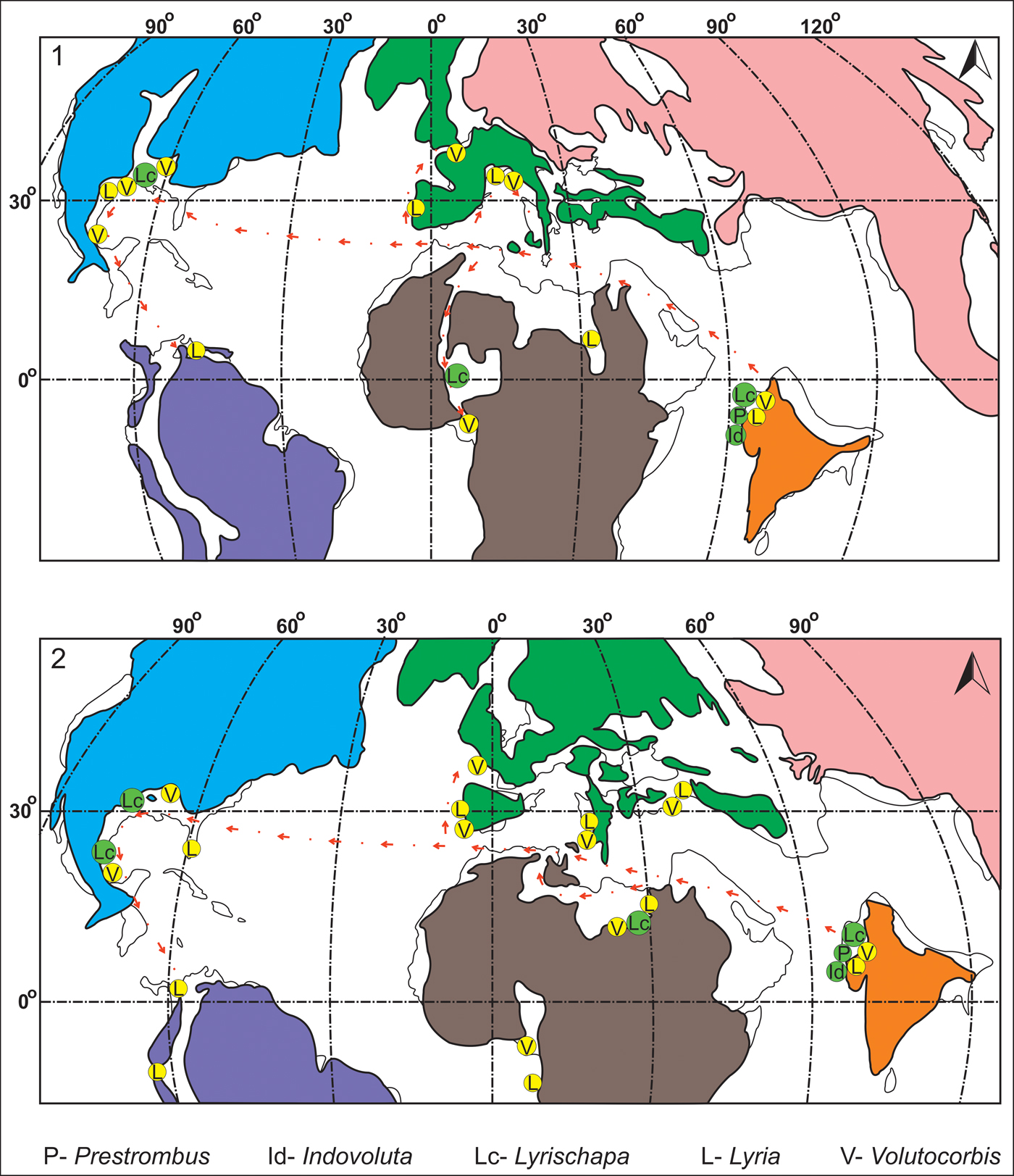
The subfamily Indovolutinae n. subfam. apparently evolved and flourished in the western part of the Indian subcontinent. Indovoluta was known from Sindh Province of Pakistan, and Himachal Pradesh and Rajasthan in India (d'Archiac and Haime, Reference d'Archiac and Haime1854; Cox, Reference Cox1931; Vokes, Reference Vokes1937; Eames, Reference Eames1952; Iqbal, Reference Iqbal1969b, Reference Iqbal1972; Bhatia and Khosla, Reference Bhatia and Khosla1978). Involuta was restricted to the western part of the Indian subcontinent and known from Pakistan and Himachal Pradesh (Cox, Reference Cox1931; Vokes, Reference Vokes1937; Eames, Reference Eames1952). Prestrombus was known only from Pakistan and Rajasthan (Cox, Reference Cox1931; Eames, Reference Eames1952; Bhatia and Khosla, Reference Bhatia and Khosla1978). Whereas these genera of this subfamily were largely restricted to this Tethyan province, Lyrischapa appears to have migrated to America. The latter speciated there during the lower and middle Eocene. This genus is also known from the Eocene of Egypt (Abbass, Reference Abbass1967) and Mexico (Perrilliat et al., Reference Perrilliat, Avendano, Vega and Solé2006) and the Paleocene of Niger (Givens, Reference Givens1991). Givens (Reference Givens1991) thought that some kind of sweepstake mechanism was involved in the migration of Lyrischapa from the Tethyan part to the USA because it lacked planktotrophic larval ontogeny. The presence of the westward-flowing Tethys Paleocurrent (Haq, Reference Haq1981) and perhaps also volcanic islands on the way from east to west facilitated this transatlantic dispersal (Givens, Reference Givens1991). However, the absence of Lyrischapa in most of the Mediterranean basins, especially those in the southern part of Europe, is noteworthy. Southern European basins are known to yield the most diverse gastropod fauna of the Paleogene (Das and Halder, Reference Das and Halder2016, Reference Das and Halder2018). It appears that the genus evolved in the western Indian province during the Paleocene and migrated along the southern border of the relict Tethys Sea before crossing over to the western shores of the Atlantic (Fig. 7). Harzhauser et al. (Reference Harzhauser, Piller and Steininger2002), following Popov (Reference Popov1993), demonstrated an eastward current along northern shores of the relict Tethys and a westward current along its southern shores during the upper Eocene (Harzhauser et al., Reference Harzhauser, Piller and Steininger2002, fig. 3). The above scenario of dispersal of Lyrischapa appears to be plausible if there were similar currents operative during earlier parts of the Paleogene.
Paleobiogeographic distribution of indovolutine and other volutid genera discussed herein during the Paleocene (1) and the lower Eocene (2). Suggested routes of larval dispersal marked by arrows. Paleocoastline maps modified after Smith et al. (Reference Smith, Smith and Funnel1994).

Givens (Reference Givens1989) reported the presence of several more Tethyan faunal components in the Gulf Coastal Plain. He recorded 32 gastropod and 14 bivalve genera that migrated from the Tethys Realm to the USA. A recent analysis involving all Paleocene and Eocene gastropod genera recorded in the “Compendium” (Sepkoski, Reference Sepkoski2002) and their geographic distribution data as obtained from the Paleobiology Database (http://fossilworks.org/) reveals very high generic similarity across the Atlantic between the Mediterranean and the eastern American basins (Das and Halder, Reference Das and Halder2016, Reference Das and Halder2018). Out of 252 Eocene gastropod genera from the Gulf Coastal Plain, 119 are also known from the Mediterranean basins. In the Paleocene, this ratio was 51 out of 136. Both of these provinces also exhibit high generic similarity with Central American and Caribbean basins (Das and Halder, Reference Das and Halder2016, Reference Das and Halder2018).
A distribution pattern somewhat similar to that shown by Lyrischapa, conspicuous by its absence or poor representation in the middle of its distribution, has also been exhibited by some other groups of mollusks. They are abundant and diverse in the eastern part of the Tethys Realm represented by the western Indian basins (Western Indian Province, sensu Harzhauser, Reference Harzhauser2007) and in the western Atlantic provinces of the Gulf Coastal Plain, and Central American and Caribbean basins. Kapalmerella Allmon, Reference Allmon2005 (= Palmerella Allmon, Reference Allmon1996), which belongs to the gastropod family Turritellidae Lovén, Reference Lovén1847, is known extensively from the USA. It has recently been reported from Kutch (Halder and Sinha, Reference Halder and Sinha2014). Turritella ranikoti Vredenburg, Reference Vredenburg1928b, known from Pakistan and now also from Kutch, has been reassigned to this genus (Halder and Sinha, Reference Halder and Sinha2014). Except in Egypt, this genus has not been reported from the western part of the Tethys Realm, i.e., the Mediterranean basins (Mediterranean Iranian Province, sensu Harzhauser et al., Reference Harzhauser, Piller and Steininger2002). Glyptoactis Stewart, Reference Stewart1930, a bivalve belonging to the family Carditidae Férussac, Reference Férussac1822, was also quite diverse in the USA and western India (d'Archiac and Haime, Reference d'Archiac and Haime1854; Vokes, Reference Vokes1937; Tandon, Reference Tandon1971; Mathur, Reference Mathur1975; Bhatia and Khosla, Reference Bhatia and Khosla1978; Halder, unpublished data) but much less so in the Mediterranean Iranian Province. Haas and Miller (Reference Haas and Miller1952) also found maximum similarity of the Eocene nautiloid (Nautiloidea Agassiz, Reference Agassiz1847, Cephalopoda Cuvier, Reference Cuvier1797) fauna from America with that of Pakistan.
Emaciated presence of certain genera in the middle of their distribution in the Mediterranean and Middle East countries is, however, an exception rather than the rule. The Western Indian Province shares much with these areas. Out of 87 Eocene gastropod genera that were reported in the “Compendium” (Sepkoski, Reference Sepkoski2002) and known from the western Indian basins (http://fossilworks.org/), 67 are also known from the Mediterranean Iranian Province. The Western Indian Province fauna displays relatively less similarity with the Gulf Coastal Plain fauna. They have 53 gastropod genera in common during the Eocene whereas the Western Indian Province had a total of 87 and the Gulf Coastal Plain 252 known genera (Sepkoski, Reference Sepkoski2002).
Das and Halder (Reference Das and Halder2016, Reference Das and Halder2018) demonstrated that in the Paleogene a broadly similar gastropod fauna lived in the circumtropical and subtropical zones including those mentioned above and western American basins such as California, Oregon, and Washington, and Southeast Asia (viz. mainly Indonesia). A strongly different fauna existed in the contemporaneous basins of Australia and New Zealand. This distribution pattern indicates strong influence of temperature and wide dispersibility of many gastropods, and also the presence of dispersal routes and favorable currents. Indovolutinae n. subfam. was an atypical representative of this widespread fauna having abundance only in the western part of the Indian subcontinent and America.
In contrast to Indovolutinae n. subfam., the two other volutid genera reported here have a wide geographic distribution in different Tethyan basins and North America during the lower Paleogene. The oldest representatives of Athleta come from the Upper Cretaceous of Egypt (Kassab et al., Reference Kassab, Kenawy and Zakhira1995) and Poland (Abdel-Gawad, Reference Abdel-Gawad1986). The oldest representative of the morphotype Volutocorbis Dall, Reference Dall1890 also comes from the Upper Cretaceous of Egypt (Kassab et al., Reference Kassab, Kenawy and Zakhira1995). It appears, therefore, that this volutid is also essentially a Tethyan form that crossed the Atlantic in the lower Paleogene (Fig. 7). In the Paleogene, Athleta was most widespread and present in Southeast Asia as far south as Australia and New Zealand (Maxwell, Reference Maxwell2003). The genus survives today in a relatively restricted geographic occurrence in Africa, Australia, and New Zealand (Maxwell, Reference Maxwell2003 and references therein). The earliest Lyria spp. were also recorded from the Upper Cretaceous Tethyan basins of Central Asia (Pojarkova, Reference Pojarkova1984) and the United Arab Emirates (Gameil, Reference Gameil2005). Later, it flourished through a large part of the Tethys Realm in the Paleogene and crossed over to America in the Paleocene (Darragh, Reference Darragh1989; http://fossilworks.org/) (Fig. 7). Its distribution widened in the Neogene to several of the western Pacific and Australian basins. It is survived today by several species distributed in western Atlantic and western Pacific countries, and Australia (Maxwell, Reference Maxwell2003 and references therein).
Remarks
The Paleogene members of the subfamily Indovolutinae n. subfam. had nonplanktotrophic development; all of them are characterized by paucispiral, bulbous protoconchs. All but Lyrischapa were geographically very restricted and had low specific diversity. Lyrischapa appears to have speciated rapidly by allopatry after fortuitous dispersals by sweepstake routes despite having nonplanktotrophic larvae (Hansen, Reference Hansen1982). The subfamily did not live long and was restricted to the Paleocene and the Eocene after its origin in the Cretaceous with Gosavia. Evolution of this subfamily demonstrates the close link of nonplanktotrophic development and restricted geographic distribution with low specific diversity and extinction.
Modern volutids have lecithotrophic development (Bouchet and Poppe, Reference Bouchet and Poppe1988), which is reflected in their narrow geographic ranges. Athleta and Lyria are two exceptions that managed to disperse widely in the past, especially in the Paleogene. The wide geographic distribution of Athleta in the Paleogene has been attributed to larval planktotrophy (Fischer et al., Reference Fischer, Rodda and Dietrich1964; Darragh, Reference Darragh1971, Reference Darragh1989; Hansen, Reference Hansen1978, Reference Hansen1982). Later, by the Neogene, planktotrophy was suppressed in all volutes (Bouchet and Poppe, Reference Bouchet and Poppe1988) including members of Athletinae. Volutocorbis spp., with conical multispiral protoconchs in the Paleogene (Merle et al., Reference Merle, Pacaud, Métais, Bartolini, Lashari, Brohi, Solangi, Marivaux and Welcomme2014), had planktotrophic development (Hansen, Reference Hansen1982) and expectedly achieved wide geographic distribution. This morphotype of Athleta survives today.
The Lyria species reported here had lecithotrophic development. However, the genus was known also by planktotrophic development (Maxwell, Reference Maxwell2003). Modern species of the genus are known by large, bulbous protoconchs reflecting nonplanktotrophic development, but some show disjunct populations separated by deep ocean basins. This observation led to different explanations, e.g., the presence of a demersal swimming larval stage (Bouchet and Poppe, Reference Bouchet and Poppe1988; Bouchet and Bail, Reference Bouchet and Bail1991) and polyphyletic origin from species with planktotrophic larval ontogeny (Maxwell, Reference Maxwell2003). The wide geographic and temporal distributions and large specific diversity of the genus is perhaps due to its diverse developmental strategy.
Acknowledgments
We are thankful to an anonymous reviewer and D. Friend for providing valuable suggestions. We thank the Director and staff of the Curatorial Division, Repository of Fossils, Geological Survey of India, Kolkata for providing permission and logistic support to study type specimens. The study was financially supported by Science and Engineering Research Board, Department of Science and Technology, India (Project nos. SR/S4/ES/653-2012 and EMR/2016/002583), and the FRPDF scheme of Presidency University.