In Boston, in the spring of 1890, Vida Dutton Scudder (1861–1954) and Ralph Adams Cram (1863–1942) helped to launch a new experiment in Christian community: the Episcopal Church of the Carpenter. Boston's Puritan founder John Winthrop dreamed of a City on a Hill in which the affective and material ties of charity connected rich and poor. But that imagined city lay in ruins amid a Gilded Age culture that worshiped wealth and individual ambition. Scudder, a literary critic and professor at Wellesley, and Cram, an architect and bohemian littérateur, joined with other religious radicals at the Church of the Carpenter to preach the good news of Christian socialism as the antidote to the gospel of greed. Their congregation embraced “all sorts and conditions of men,” from wealthy philanthropists to hardscrabble labor leaders.Footnote 1 It embodied the possibility of a new religious–social order – one that went beyond Winthrop's vision by aiming to ameliorate social inequality through moral suasion.
At the Church of the Carpenter, ancient liturgy fueled anticapitalist dissent. Scudder soon joined the “Brotherhood of the Carpenter” attached to the congregation, which proselytized on behalf of Christian socialism, investigated the labor practices of local businesses, and helped the unemployed find work. Of their meetings, she recalled, “Not only did we worship together, singing with special zeal the Magnificat, but we had wonderful suppers, true agape, when the altar at the back of the little room was curtained off and we feasted on ham and pickles and the hope of an imminent revolution.”Footnote 2 The Magnificat – a song attributed to the Virgin Mary in the Gospel of Luke and a staple of the Anglican Order for Evening Prayer – evokes a revolutionary God, dedicated to the overthrow of the rich and powerful and to the welfare of the poor and needy:
Though it attracted over three hundred people to its inaugural service and enlisted over a hundred members in the Brotherhood, the Church of the Carpenter sustained fewer than twenty regular communicants. After six years, it folded. But the spirit of the congregation – the idea of a worshiping community bound in and through ritual to seek the good society – lived on for the next five decades in Scudder's and Cram's writings on medieval monasticism.
Medieval monasticism furnished Cram and Scudder with icons that enabled them to read the social future in the sacred past. Jackson Lears has noted that for Anglo-Catholic intellectuals at the turn of the century, “monasticism as a disciplined, ascetic way of life offered an eloquent witness against the emerging culture of comfort and convenience.”Footnote 4 Instead of the bourgeois values of wealth, personal fulfillment, and family, Cram and Scudder modeled their vocations on the monastic vows of poverty, obedience, and celibacy. In their social thought, these vows became less counsels of perfection than principles of social reconstruction. Cram and Scudder took the vow of poverty as an injunction to oppose the exploitative system of industrial capitalism. They took the vow of obedience as a mandate to affirm what Cram called “definite, dogmatic, and sacramental religion.”Footnote 5 And they took the vow of celibacy as an invitation to imagine, and to practice, communal forms of love bent toward social renewal that challenged and often exceeded the norms of reproductive heterosexuality.
At the end of the nineteenth and into the first decades of the twentieth century, as same-sex desires were increasingly medicalized and pathologized, Christian religious practices held open an important cultural space for queer writers. Because of historical Christianity's ethical prohibitions on same-sex practices, however, this space was strictly qualified. It was located primarily in traditions of celibacy that gave religious sanction to life-aims not comprehended by successful reproduction and child rearing in a heterosexual family. Yet queer Christian writers such as Cram and Scudder exploited what they could of these celibate traditions, conceiving for themselves forms of life in which, by their own testimony, they experienced celibacy as the socialization, rather than the repression, of sexual desire. On the evidence of her autobiographical novel A Listener in Babel (1903), Scudder indeed felt this socialized desire as something like her true orientation: “Not … the presence of one exclusively beloved, but the presence of all men, had ever been, so she believed, the substance of her unconscious desires,” as “[t]he craving for joy of a whole race sorrowing and dispossessed throbbed … in her heart.”Footnote 6 Just as their devotion to sacred history fueled Cram and Scudder's opposition to capitalism, it also nourished their queer existence.
By tracing the imbrication of sexuality, religion, and politics in Cram and Scudder's writings on monasticism, I seek to expand a burgeoning conversation between religion-and-literature and queer studies to compass self-consciously traditional forms of Christianity, American Anglo-Catholicism in particular. Recent efforts to join “a history of sexuality to a history of religion” in the study of American culture have illuminated the “nonsecular sexualities” lived out in post-Protestant religious formations such as spiritualism and Mormonism.Footnote 7 The present essay draws nearer to Elizabeth Freeman's discovery of approaches to “bodies, desires, fantasies, and affinities … that contest the regime of modern sexuality” in “Catholic liturgical practice.”Footnote 8 Freeman's analysis carefully separates Catholic liturgy from the Catholic theological tradition, finding in the work of maverick modernist Djuna Barnes “remainders” of a liturgical understanding of the body and of desire.Footnote 9 I argue that Scudder and Cram reveal a different, and deeply counterintuitive, configuration of religion and sexuality in late nineteenth- and early twentieth-century US literature. These two writers strove to hold liturgy and doctrine together, and they committed themselves to lay intellectual leadership of a Christian community premised on recovering deep continuities of practice and belief with the ancient and medieval church – namely the Anglo-Catholic movement within the Protestant Episcopal Church in the United States. Paradoxically, Scudder and Cram aimed to unite deviance from sexual norms with loyalty to normative religious tradition. In short, they sought a queer orthodoxy, and they found precedent for it in monasticism.
Conceiving of monasticism as a religious community structured by passionate same-sex attachment, common worship, and common ownership, Cram and Scudder melded nonnormative sexuality, religious practice, and anticapitalist radicalism. Cram emphasized the need for a radical break from mainstream US culture, drawing on Benedictine monastic tradition to propose “walled towns” – beautifully built, self-contained alternative societies. These Benedictine convictions took shape among the monks of the Caldey Island monastery where he visited and worked. Scudder took her cues from St. Francis of Assisi and stressed presence with the poor and suffering, rather than retreat; she opposed monastic withdrawal almost as vigorously as she rejected capitalism. Scudder imitated Francis alongside her companion, the writer Florence Converse (1871–1967) and their sisters in the Society of the Companions of the Holy Cross, an Anglican women's order devoted to social justice and intercessory prayer. However salient their differences, Cram and Scudder each pursued a radical ressourcement of Christian tradition made possible, in part, by the extra-normative forms of love they cultivated. As Scudder put it in 1931, “a really conservative view of Christianity carries with it a critical, not to say revolutionary, attitude toward society. Those who cling most ardently to tradition are likely to shock and alienate the surface orthodoxies of their day.”Footnote 10
MEDIEVALISM, SOCIALISM, AND SEXUALITY IN AMERICAN ANGLO-CATHOLICISM
When they each converted to the Anglo-Catholic tendency within Anglican Christianity after encountering European Catholic art on Continental tours in the 1880s, Cram and Scudder traded their familial connections to New England Protestantism for a spiritual kinship with the Middle Ages.Footnote 11 But as Anglo-Catholics, rather than Roman Catholics, Cram and Scudder laid claim to pre-Reformation Christian tradition without the social penalty of membership in what most New England Protestant elites still considered an immigrant church. Their preference for Anglo-Catholicism over Roman Catholicism was not merely a matter of prejudice or convenience. By their Anglicanism, Cram and Scudder declared their loyalty to the English Christian socialist tradition of churchman F. D. Maurice (1805–72) and art critic John Ruskin (1819–1900), among others. A conversion to Rome, by contrast, was more likely to seem a conservative move before Pope Leo XIII's encyclical Rerum Novarum (1891) spoke up for workers' rights.Footnote 12 If Anglo-Catholicism offered Cram and Scudder a partial exit from Protestantism and a portal into the Middle Ages, it also gave them the opportunity to identify with the radical heritage evident at the Church of the Carpenter.
Anglo-Catholicism does not map neatly onto the liberal–fundamentalist divide that cleaves Protestant-focussed accounts of late nineteenth- and early twentieth-century US religious history. Neither wholeheartedly embracing progress with pluralistic religious liberals nor implicitly endorsing the status quo with Protestant fundamentalists, Cram and Scudder turned to Christian sacred history for spiritual nourishment and political guidance. Turn-of-the-century religious liberals like William James (1842–1910) affirmed a multiform sacred outside all dogma. His Varieties of Religious Experience (1902) was a key text for religious liberals, a compendium that testified to the common mystical root of all religions and to religion's essentially solitary character.Footnote 13 His famous definition of religion there is both individualistic and pluralistic: “the feelings, acts, and experiences of individual men in their solitude, so far as they apprehend themselves to stand in relation to whatever they may consider the divine.”Footnote 14 Like James, Scudder also investigated the varieties of religion. Daughter of a missionary to India, Scudder affirmed that “every definition of ‘God’ that I have ever met is helpful to me,” and she closed her autobiography with a quotation from the Gita rather than the Gospels.Footnote 15 But Scudder explicitly rejected James's individualist and pluralistic definition of religion as she encountered it in the writings of Alfred North Whitehead. She defined her own religion in organic, communal terms:
I remained an orthodox Christian because I knew that faith was an adventure; and also that it was a growth springing straight from life … I am called a revolutionist, but I am also very much of an authoritarian – that is, I am humble enough to find tremendous force in testimony. Religion, says Whitehead, is what one does with his solitariness. I think this only partially true; my own approach is social, and the witness of other minds has great weight with me.Footnote 16
Both James and Scudder sought a more catholic sense of the sacred. But while James moved beyond the strictures of any faith tradition in particular, Scudder's explorations drew her more deeply into Christian liturgy, history, and dogma.
Cram and Scudder gave fresh articulations to basic Christian tenets such as the Trinity and the Incarnation, recalling in some ways the project of Protestant fundamentalists. But in their hands, these Christian doctrines rebuked the dogmas of industrial capitalism. Cram argued that the enfleshment of God in the Incarnation ennobled matter and invalidated the crass materialism enabling the exploitation of both natural resources and human bodies.Footnote 17 Scudder reasoned that the doctrine of vicarious atonement demanded a “class-sacrifice” of the haves on behalf of the have-nots.Footnote 18 The evangelical Protestant apologists of The Fundamentals (1910–15), on the other hand, considered socialism tantamount to heresy.Footnote 19 Like their liberal opponents, fundamentalists labored to show how smoothly religion could fit with modern ways of being and knowing – and, implicitly, of making a living. But Cram and Scudder each recovered Christian tradition to point up, in different ways, the incompatibility of modern capitalist life and Christian faith.
Anglo-Catholicism also set Cram and Scudder apart from their contemporaries who sought to ground radical social thought in Christian belief. Progressive Christians at the turn of the century – such as the Baptist theologian Walter Rauschenbusch, whose writings, including Christianity and the Social Crisis (1907), were the leading intellectual documents of the Social Gospel movement – followed a Jamesian trajectory away from liturgy and dogma, reading a slimmed-down Scriptural canon composed of the Gospels and the Prophets and urging social service as Christian moral duty.Footnote 20 Although Scudder shared many of Rauschenbusch's aims, she pushed him and her other left Christian colleagues to develop a more elaborated theology and a more radical politics.Footnote 21 She further believed that a more radical politics followed from a more full-orbed theology. For Scudder, Jesus' injunctions on behalf of the poor in the Sermon on the Mount might be interpreted as a call for private charity, but the doctrine of the Trinity calls for outright socialism.Footnote 22 For his part, Cram decried revolution, although he did so in the name of the “spirit of real communism” – less egalitarian in reality than he makes it sound – that he glimpsed in medieval Christianity.Footnote 23
Scudder and Cram kept faith with the social idealism of their New England Protestant heritage even as they embraced Catholic forms of worship and belief. In 1884, Scudder was one of the first two American women to study at Oxford. There, Scudder, daughter of a Congregationalist missionary, picked up Anglo-Catholic theology from the second-generation disciples of the Oxford Movement and anticapitalist dissidence from Ruskin's final public lectures. She subsequently volunteered with the Salvation Army and, on her return to the United States, pioneered New York's Rivington Street settlement house weeks before Jane Addams's storied Hull House opened in Chicago.Footnote 24 But it was at the Church of the Carpenter that Scudder first integrated her Anglican with her socialist convictions, and she remained attached to the congregation throughout its tenure.Footnote 25 At the time of its demise, however, she was already moving leftward – and backward. By 1912, she strove to reconcile “conservative Christian and revolutionary socialist” as an Anglo-Catholic churchwoman and a member of the Socialist Party.Footnote 26
In between were years of personal crisis. Scudder's labors in women's education, settlement work, and Christian socialism made not so much as a dent in the hide of the industrial capitalist behemoth. When Wellesley accepted Rockefeller money over her protests in 1900, she felt betrayed. Under these pressures, Scudder suffered a neuraesthenic breakdown in 1901.Footnote 27 When she had partially recovered, she made pilgrimage to Italy and found a guide for her writing and life in St. Francis of Assisi. Scudder drew “prophetic hints for socialists” from the Povorello's radicalized monasticism.Footnote 28 Francis also helped her to resolve her personal crisis. Before her breakdown, Scudder had lamented the ineffectual and “purely inward torture, which only in rare moments can they believe to hold in itself some expiatory grace,” suffered by the “sensitive souls” of privileged reformers “helplessly aware” of the great gulf fixed between them and the working masses.Footnote 29 In Francis's stigmata, Scudder glimpsed a suffering no longer merely inward but palpable and salvific. Scudder shared, as Francis had shared, in the “sacrificial passion” of Christ's sufferings by publicly uniting with workers in the Socialist Party.Footnote 30
It was before the tomb of St. Francis in Assisi that, in 1886, Ralph Adams Cram first felt compelled to pray. A year later, the lapsed Unitarian was converted during a midnight Mass in Rome.Footnote 31 While Scudder studied at Oxford, Cram was touring the Continent to learn about architecture. Seeking an aesthetic education in Italy's churches, he was beguiled by the lure of the holy. Cram returned to the United States an Anglo-Catholic like Scudder and soon joined with her in Christian socialist agitation at the Church of the Carpenter. But Cram marked his departure from the community with The Decadent (1893), a novella of intellectual debate pitting his apocalyptic vision of social renewal against Christian socialist gradualism. Protagonist Aurelian Blake explains his loss of confidence to his socialist mentor: “You taught me that we lived in another Renaissance; I know it now to be another decadence.”Footnote 32 At the country estate he calls his “monastery,” surrounded by male companions, opium, and art, Blake awaits capitalism's collapse and guards “the seeds of the new life” to come.Footnote 33 Even in this explicitly antisocialist text, the idea that animated the Church of the Carpenter – that a religious community could serve as the womb of a new world to come after capitalism – persists in transfigured form as a decadent monastery.
Cram had rejected by 1893 what Vida Scudder abandoned only after her breakdown: the optimistic philosophy of social progress. Reflecting back on the “assumption of progress” drawn from “evolutionary thought” that was endemic to “the later nineteenth century,” Scudder admitted in 1923 that “change is one thing, progress quite another,” and that “we can no longer lay the flattering unction to our souls that change inevitably or even naturally means advance; it is just as likely to mean decay.”Footnote 34 As an alternative to the historiography of linear progress, Cram offers a wave model of history that he would go on to elaborate in later works:
Ah, that “law of evolution” – I knew you would quote it to me sooner or later. You hug the pleasant and cheerful theory to your hearts, and twist history to fit its fancied laws. You cannot see that the law of evolution works by a system of waves advancing and retreating; yet as you say the tide goes forward always. Civilisations have risen and fallen in the past as ours has risen and is falling now. Does not history repeat itself?Footnote 35
The assumption of linear progress leads ironically to “a vain repetition of history,” while the sober recognition of history's repetitive structure can secure true progress, since evolution comes in waves.Footnote 36 Industrial capitalism's new decadence is but vain repetition, despite its veneer of productivity; Aurelian Blake's new monasticism is productive, despite its appearance of dissipation. This distinction between vain and productive repetition is grounded in Cram's Anglo-Catholic understanding of the sacramental nature of time. The productive daily repetition of the liturgy connects worshipers to the past and anticipates the eschatological future of the kingdom of God. Cram and Scudder, feeling abandoned by the historiography of religious progressives, turned instead to this liturgical temporality. They found wisdom in sacred history about a future whose outcome was, to them, no longer assured. This shared, deeply felt, existential dislocation in time drove them to medieval monasticism in their quest to find new imagery for their social visions.
Cram and Scudder shared their “anticipatory” relation to history with other “queer figures” of the period who “looked to the past in the present to imagine the future.”Footnote 37 Through teaching, writing, and personal devotion to medieval literature and religious figures, Scudder found her “real home” either in the “Middle Ages or in the Utopian future”: “I know that in both the nineteenth and the twentieth century, I have often felt homesick enough.”Footnote 38 Her temporal homesickness is inextricable from her sexual subjectivity. Scudder's conviction that material progress in the industrial capitalist West had failed to provide a home for social idealists like herself was predicated upon the felt discrepancy of her vocation as celibate reformer with the heterosexual marriage plot. “Until I was thirty, I wanted desperately to fall in love [with a man] … I was eager for the experience without which, all literature assured me, life missed its consummation. Once or twice I tried to compass it, but I couldn't.”Footnote 39 Feeling askew of the dominant life-narrative consummated by heterosexual marriage, she also grew skeptical of narratives of social development that made her present moment the cutting edge of progress. Her desire found a home in the medieval celibate religious communities she researched, imagined, and imitated.Footnote 40 But when Scudder moved toward the Middle Ages, she was also moving dialectically toward “the Utopian future.” Though Cram married in 1900, same-sex, celibate monastic communities that would bring nearer “the far prospect of another thirteenth century in the times that are to come” remained the center of his social imagination.Footnote 41 Both writers believed that the road to modern social renewal ran through an imaginative engagement with the medieval past. For Cram, however, Utopia could only be approached through a disaster worthy of the Dark Ages.
RALPH ADAMS CRAM: THE WALLED TOWN AND THE DECADENT ABBEY
In Cram's monastic writings, an ineluctable sense of doom jars with a dogged intuition of hope. Monasticism signifies both negativity and Utopia for Cram: the refusal of the social project of civilization and the creation of an alternative society (significantly, an alternative society of same-sex religious community). This doubled affect comes through clearly in Cram's mid-career essay “The Great Thousand Years” (1908), in which he explicitly prophesies a crisis for modern Western civilization that will catalyze the redemption of community in a new form of Benedictine monasticism:
When the abandoned insolence of man, mad in his pride of life, has dashed itself to the stars and, falling again, crumbles away in impotent deliquescence, then perhaps will come the new prophet, son of S. Benedict (though perhaps in a new habit and with an amended rule), who as in 500 and 1000 and 1500, will release the souls of men from their captivity, and strive again to make all things new in Christ.Footnote 42
Cram relishes decay. His paradoxically energetic description of civilizational entropy culminates in the purple phrase “impotent deliquescence,” which conjures the grotesque image of a liquefying phallus. Despite the reproductive failure this implies, Cram's hope for a new “son of S. Benedict” persists. This conjunction of images – the failure of civilizational reproduction figured as sexual impotence, on the one hand, and the “son” arising from the chaste reproduction of monastic tradition, on the other – suggests that the architect and social visionary's language of building is inextricable from the languages of sex, of desire, and of reproduction. For Cram, the monastic way of making “all things new” runs athwart the presumptions of progress. His break with normative conceptions of social development also implies a break with normative conceptions of sexual development issuing in heterosexual marriage and child rearing – a link that becomes clearer in light of the essay's publishing context.
Cram published “The Great Thousand Years” through queer monastic connections. The essay, composed in 1908, first appeared in Pax, the quarterly magazine of the Anglican Benedictine monks of Caldey Island, Wales, in 1910.Footnote 43 Founded in 1906, Caldey was perhaps the most colorful experiment in monastic community among later nineteenth- and early twentieth-century devotees of the Anglo-Catholic movement within the Church of England. Cram spent time at the lavishly furnished and architecturally splendid monastery during his British travels, and he carved a figure of St. Benedict, as well as the Cram coat-of-arms, for an altar at Caldey.Footnote 44 Benjamin Aelred Carlyle, a charismatic and alluring figure “of dynamic personality, hypnotic eyes, and extraordinary imagination,” led the Caldey monks.Footnote 45 Carlyle encouraged physical displays of affection and recreational activities such as nude swimming and reading Baron Corvo's homoerotic stories. Such features led Cram's biographer Douglass Shand-Tucci to describe Caldey as an “all but explicitly homosexual monastery.”Footnote 46 Carlyle's religious name, Aelred, refers to Aelred of Rievaulx, a twelfth-century Cistercian abbot (the Cistercians are an offshoot of the Benedictines) whose writings, especially the treatise Of Spiritual Friendship (c.1164), sanctified passionate love between men even as they preached celibacy for monks.Footnote 47 When the Great War led Cram to republish “The Great Thousand Years” as a small book in 1918 with a new afterword, he dedicated the work to Carlyle, styled “Lord Abbot of Caldey.”
The Caldey community helps us, in particular, to understand how monasticism functions in Cram's writings as a social organism that runs on desire. At the same time, monastic life redirects desire through embodied practices of ritual and recreation into religio-social renewal (“making all things new in Christ”) without merely sublimating that desire into religion or politics.Footnote 48 It is tempting to read through the sensual celibacy of Carlyle's monks to see their activities either as a religious practice screening homosexual sex or as inauthentically sublimating sexual energies into religious practice. Benjmamin Kahan rightly warns against the perils of such paranoid readings of celibacy and argues instead for a “depthless hermeneutic” that “leaves the knottedness of coding and difficulty intact, reading the blockage not as an impediment obstructing a flow elsewhere but an elegant formation in and of itself.”Footnote 49 Under such a hermeneutic, Caldey emerges as a community in which monasticism sustained an atmosphere of Aelredian “spiritual friendship,” intensely, often playfully, sensualized through embodied practices. This incarnate friendship accepts the restraint of chastity, even as it also creates a communal love extending beyond the nuclear family and with the potential to transform social life. At the same time, the monastery also depends on sexual reproduction for its continued existence: new monks must come from somewhere. The communal love of Caldey was neither entirely sexually normative nor entirely nonnormative. A married man and father when he visited Caldey, Cram moonlighted as a monk, putting on for a time the abbey's celibate communal ethos of incarnate friendship and appropriating it for his social criticism.
Cram's visits to Caldey thus afforded him intervals of heightened medievalism within his modern life. There, Cram could sustain his “allegiance … to the medieval church … that Aelred Carlyle was clearly dreaming about.”Footnote 50 But in his writings, Cram sought a more lasting synthesis of same-sex communal love with family life. Walled Towns (1919) imaginatively integrates his public life as prominent architect and paterfamilias with his semiprivate life as aspiring queer monastic by portraying a Benedictinism for “the human family.”Footnote 51 The medieval walled town exemplified a quasi-monastic separatist community that embraces “groups of natural families, father, mother and children,” alongside single-sex monastic communities. The logic of this model, Cram emphasizes, is one of addition, not supersession: “for the monks, canons-regular and friars, of the old tradition and the old line, will be as necessary then as ever; instead it will be an amplification of the indestructible idea [of monasticism], fitted to, and developing from, the new conditions that confront society.”Footnote 52 This logic of addition speaks both to the structure of Cram's concept of history and to his personal life insofar as marriage and children were, for him, an addition to, not a replacement for, same-sex relationships.
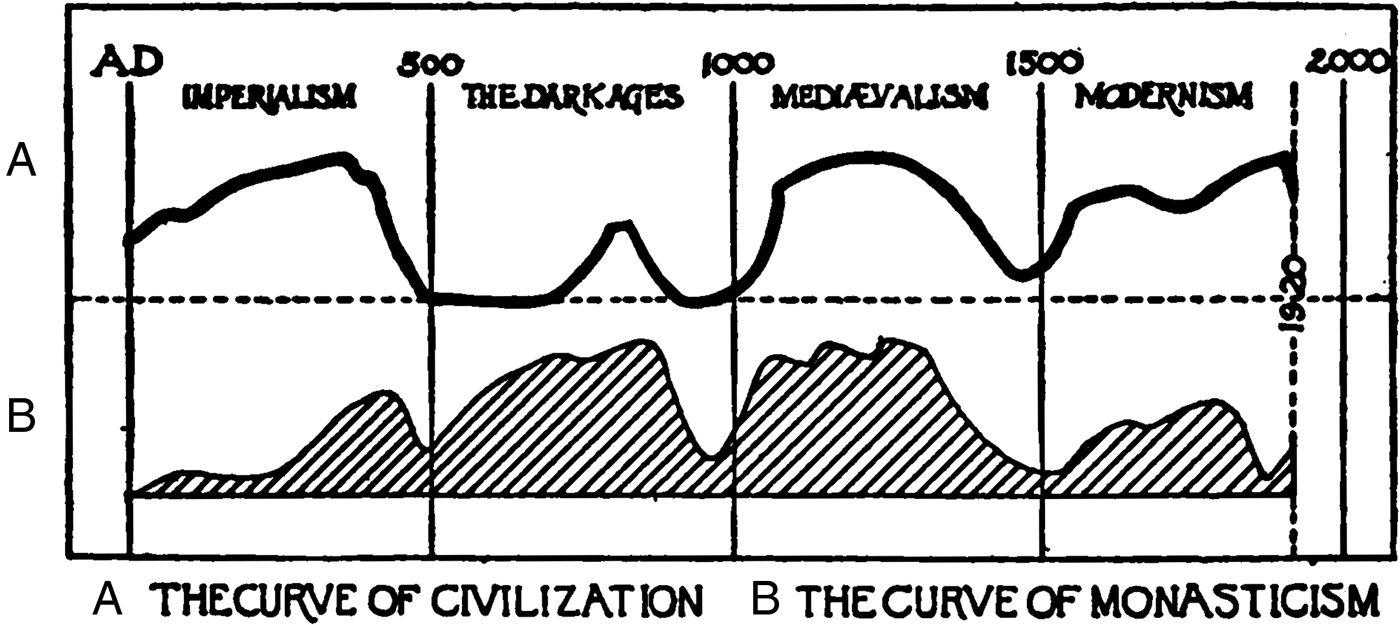
Walled Towns’s middle chapters constitute a fierce polemic against a progressive ideology of history, “the nineteenth-century superstition that life proceeds after an inevitable system of progressive evolution, so defiant of history,” in favor of a history structured by intervals.Footnote 53 Here, he systematically elaborates his theory of historical change in terms of five-hundred-year waves of civilizational rise and fall, as in Figure 1. These waves, similar but not precisely symmetrical, describe a temporality of simultaneous forward motion and backward resonance. Although time moves ever onward and historical circumstances always change, the similarities between different intervals allow the student of the past to gain historical wisdom. For Cram, that wisdom finds expression through creative imitation of heroic figures, especially saints like Benedict of Nursia. Rather than stranding monastic forms on the forgotten shores of the past, then, Cram's waves reactivate and add to those forms but do not altogether replace them. Monasticism endures to “transmute itself into new forms”; the type calls forth new antitypes in new historical intervals.Footnote 54 Refreshing the sixth-century vision of St. Benedict just as he understood the tenth-century Cluniacs and the sixteenth-century Jesuits to have done, Cram proposes a twentieth-century monasticism.
Graph plotting the development of civilization against the development of monasticism, from Ralph Adams Cram, Walled Towns (Boston: Marshall Jones, 1919), 33.

Walled Towns figures that monasticism at its most utopian. The book ends with a sketch of a new walled town called “Beaulieu” and a rousing call to imitate its scheme of social redemption. It opens with a pair of tableaux in which Cram juxtaposes an ideal medieval walled town against a grimy modern industrial suburb, taking the latter scene verbatim from his novella The Decadent (1893). A scandalous work that betrayed the influence of European decadent writers – especially Joris-Karl Huysmans and Oscar Wilde – notorious for depicting and/or practicing sex between men, Cram's book was originally published anonymously. Compared with Walled Towns, The Decadent, written while Cram was a single man and a central figure in Boston's fin de siècle cultural bohemia, is almost unremitting in its negativity.
A crucial text for a full understanding of Cram's monastic vision, the novella, subtitled “The Gospel of Inaction,” depicts same-sex communal desire on monastic lines bent toward social catastrophe rather than social transformation. Malcolm McCann, a socialist, finds his former protegé Aurelian Blake gone luxuriantly to seed at Blake's New England estate, called, in a reference to Dante, “Vita Nuova” – literally, “new life.”Footnote 55 Inside Vita Nuova, dissolute young white men, attended by black men and a Japanese woman, lie about on couches in an opium haze, surrounded by books, paintings, and sculptures representative of both Eastern and Western cultural splendor. While the men in the story focus their overt sexual attentions on Shiratsuyu, the Japanese woman, the novella erotically charges the relationships between Blake and his “brothers” through phallic imagery like this quivering, spurting snake:
[A] dark figure with closed eyes, swaying softly as it leaned forward … while the curtains closed, fell with a long sweep gently toward the brazier, – not as men fall, but as a snake with its head lifted high might advance slidingly, and as it came, droop lower and lower until it rested prone on the uncrushed flowers. So Enderby, heavy with the suave sleep of haschish, came among the smokers and dropped motionless in the midst of the cushions. The movement set a tall glass quivering until it fell to one side, and the yellow wine sank slowly into the silky fur of a leopard skin.Footnote 56
The scene at Vita Nuova seems calculated for maximum outrage to the socialist McCann: exploitation along the lines of class, race, and sex, compounded by the accumulation of wealth and, worst of all, an atmosphere of amoral languor. But in its unproductiveness, inefficiency, and anachronism, Vita Nuova affronts the capitalist work ethic as much as the socialist sense of justice. Blake explains to McCann that he no longer considers socialist reform to “the system of the nineteenth century” radical enough.Footnote 57 Rather than work to improve liberal capitalism, Blake preaches its passive destruction while preserving the beauties of the past against the present order's demise. So he takes the monastics for his model:
Even as in the monasteries of the sixth century the wise monks treasured the priceless records of a dead life until the night had passed and the white day of mediævalism dawned on the world, so suffer me to dream in my cloister through evil days; for the night has come when man may no longer work.Footnote 58
In its luxury and sensuality, though not in its languor (no vigorous nude swimming here), Vita Nuova prefigures the Caldey monastery that Cram would later frequent.
The quasi-monastic community of The Decadent incarnates a sort of being toward destruction dialectically opposed to the “being toward reform” evident in Cram's later Caldey-inspired monastic writings such as The Great Thousand Years and Walled Towns.Footnote 59 Rather than the exemplary community of Walled Towns’s Beaulieu, Vita Nuova recapitulates – in heightened, grotesque form – the social ills of the nineteenth-century order it condemns. Instead of by faith, the members of Vita Nuova's community are bound together by despair. To the extent that Aurelian Blake's decadent abbey symbolically concentrates the exploitative forces that threaten the idea of the social, The Decadent refuses the futurity of civilization – at least, in its industrial capitalist form. Even in The Decadent, however, Cram leavens his pessimism with hope. “Within my walls, which are the century-living pines,” Blake declares, “is the world of the past and of the future, of the fifteenth century and of the twentieth century.”Footnote 60 Out of the death of the capitalist order – and out of the premodern past – will come the new life promised in the name of Blake's estate. But in The Decadent, that new life will come only through wholesale spiritual revolution, not piecemeal political improvement – messianic rupture, not steady progress.
The Decadent’s negativity highlights what is at stake in the queerness of Cram's Benedictinism, even when he articulates it in a utopian register: the refusal to reproduce the sociopolitical status quo. For Cram, this status quo was defined by ever-increasing aspiration toward greater size and control; his most stinging epithet for modern Euro-American civilization was “imperial.” “For five hundred years there has been unbroken, cumulative progress toward the imperial scale in all things, and the perfection of this system was achieved during the first decade of the twentieth century,” he wrote in 1918, parodying St. Paul's famous paean to Faith, Hope, and Charity. “Imperial States, Imperial Finance, Imperial Industry rose triumphant over society, and the greatest of these was Imperial Finance.” Benedictine monasticism modeled “communal life conceived in the human scale” rather than the imperial.Footnote 61
Cram's appropriation of Christian monastic tradition enables him to imagine human-scale communities of incarnate friendship where desire, directed but not destroyed by the discipline of chastity, participates in the renewal of all things. Although his walled towns integrate nuclear families and same-sex monastic communities side by side in a larger whole, they also police the boundary between them. In Beaulieu, “each family must maintain a separate house,” and “no multiple houses of any sort are permitted,” though the town includes “several conventual establishments.”Footnote 62 As in Cram's life, his writings leave the tension between normative and nonnormative forms of communal love unresolved. His thought is riven through by such paradoxes or contradictions. A handicraft renaissance and a guild system power the walled towns' industry – though citizens also own small factories in common. Under the leadership of prophet heroes, each walled town is religiously unanimous – though they are also voluntarily constituted. In a lecture on workers' housing delivered in 1918, Cram maintained that “to live decently and in an environment that has some elements of attractiveness if not actual beauty” was a “natural right” of every person, whether proletarian or bourgeois.Footnote 63 That Cram considered beauty, but not the franchise, a universal right is typical of his political outlook. Though his criticism of modern life may be powerful, ultimately Cram's vision holds its strongest appeal for those more appalled by the ugliness than the injustice of the industrial world.
VIDA DUTTON SCUDDER AND FLORENCE CONVERSE: WEDDED SISTERS OF ST. FRANCIS
In the new conclusion to the 1923 edition of her book Social Ideals in English Letters, Scudder criticized Cram for seeing the Middle Ages “in rose-color, as the one epoch of true freedom.”Footnote 64 At the time, she was a quarter-century into her own medieval quest, and she had begun work on the two Fransciscan books in which that quest would culminate. As her assessment of Cram reveals, Scudder was more discriminating in her approach to the Middle Ages and more ready to find aspects of “true freedom” in modernity than was the architect. This qualified medievalism explains her devotion to St. Francis, a figure whose elective poverty sums up so much that is beguilingly strange about medieval Christianity and whose rootlessness uncannily prefigures the modern condition.
Scudder's Franciscan writings implicitly criticize Cram's neo-monasticism within the shared framework of medievalism. In her major statement of social theory, Socialism and Character (1912), Scudder allows that “monasticism held distinct prophetic hints for socialists,” especially its architectural and agricultural practices that fostered vital common life and labor.Footnote 65 But monasticism serves as a faulty signpost for socialists in its reliance on “corporate segregation of elect individuals,” while “[t]he Franciscan movement, on the other hand, carries us out into the open” and away from the cloister; its “unworldliness and devotion [are] carried on spontaneously among normal men.”Footnote 66 The early Franciscans abjured cloisters in favor of “the cloister of the whole wide world” because of their ethics of property, which Scudder considered the mendicant movement's greatest prophetic hint to modern radicals.Footnote 67 While monastics disclaimed private possessions, they sometimes held great wealth in common with their orders. However, St. Francis – and his more extreme followers, known as the Spiritual Franciscans – repudiated all property whatsoever. Scudder insisted on the value of the Spiritual Franciscan ethic not because she believed common ownership of property to be wrong; she was, after all, a socialist. Rather, Scudder challenged the complacency of a modern monastic imagination content to pursue true community for a select few but indifferent to injustice beyond the boundaries of the cloister, or the walled town.Footnote 68
Scudder dramatized her quarrel with monasticism in her novel Brother John: A Tale of the First Franciscans (1927), in which a young English lord abandons his wealth and privilege to become a friar and later dies in prison, a victim of the persecution of the Spiritual Franciscans. Soon after joining the friars, John visits his uncle, the subprior of a Benedictine monastery, who is appalled that his nephew has “joined a company of lazy vagabonds.”Footnote 69 When John examines his surroundings, “the contrast between the noble Benedictine monastery and the mean little [Franciscan] house he had left at Exeter flashe[s] through his mind. To be frank, the monastery smelled clean.” His defiance flaring, John asks his uncle to consider which of their vocations is more Christ-like:
Your community is rich and strong. You are sheltered; I would follow One who was shelterless. You are fed; I would be one with all the hungry. You live secure in this fat and pleasant priory; my new brothers wander over the world, ignorant of security, sharing the common lot, begging their way or earning it by their labor.Footnote 70
Here we are equally distant from either pole of Cram's Benedictine dialectic – the decadent abbey Vita Nuova or the walled town Beaulieu. Brother John would condemn the former for its pleasant riches and the latter for its isolated strength.
Nevertheless, as with Cram's monasticism, Scudder's Franciscan mendicancy signifies both negativity and Utopia. In Brother John, negativity takes the mystical name of “naughting,” releasing the soul from all attachments to achieve union with God in Nothingness.Footnote 71 The elective poverty of John and his fellow friars is part and parcel of this spiritual practice of detachment. But in the narrative, “naughting” also looks like an attachment, a practice that anticipates Utopia: when John and his brothers chant the litany of naughting, they cavort in fields, pick flowers, and dance hand in hand. Unlike Cram's built-to-last walled towns, Scudder's Utopia is fleeting, carried in human relationships and constituted by gestures, as when John kisses the cord of a habit that once belonged to Francis and declares, “I am henceforth of your fellowship, my brothers.”Footnote 72 Such gestures open onto “the not-yet-here,” always promised eschatological social possibilities that never fully arrive.Footnote 73 Nor does Utopia ever fully arrive in Brother John. Told in flashbacks from John's prison cell, the novel's form foregrounds defeat and refuses narrative progress.Footnote 74 For Scudder, however, a Utopia deferred ensures the perpetual pilgrimage of the radical conscience. Indeed, she rejected cloistered partial Utopias like Cram's walled towns because she hoped for the total transformation of the social order rather than enclaves of religious community.
Scudder forged her Franciscan vision in the women's communities she helped to build throughout her life. At Wellesley, she taught courses in medieval literature to the newly independent middle-class young women of New England and pioneered American socialist criticism. At the Denison House settlement, she honed her Italian with new immigrants to Boston's South End. And in the Society of the Companions of the Holy Cross, the Anglican women's order she joined in 1888, she devoted herself to prayer for social justice and wrote about the social implications of the liturgy. When Scudder's developing radicalism threatened her job and got her dismissed from settlement work, the support of the Companions remained steadfast. In all of these contexts, Scudder was accompanied by Florence Converse, a poet, novelist, and assistant editor at the Atlantic Monthly. From 1919, the two women shared a house in Wellesley together with their mothers and, occasionally, other housemates.Footnote 75 Converse had been Scudder's student at Wellesley. She joined her former teacher in the work at Denison House and the prayer of the Society of the Companions of the Holy Cross, and she went on to become, if anything, a more ardent socialist than Scudder herself.
In the summer of 1911, Scudder and Converse made pilgrimage to La Verna in Tuscany where, in 1224, St. Francis received the stigmata. While staying in the village, Scudder composed the preface to Socialism and Character, the book that announced her “alliance with the international socialist party.”Footnote 76 Framed as an epistle dedicatory to Converse, her “Comrade and Companion,” Scudder's preface amounts to a public declaration of the love, socialist conviction, and Christian faith that she shared with Converse – indeed a vow witnessed by her readers and sanctified by the presence of St. Francis. This document is the central token in a lifelong exchange of book dedications between the two women.Footnote 77 It cements their love to their socialist radicalism and Franciscan devotion.
Yet this intense love was by Scudder's account chaste. And that chastity was not incidental but crucial to the sociability of their love, rendering their particular bond the nucleus of a wider structure of socially transformative desire. By Scudder's admission, Converse “entered the inmost region in my power to open.”Footnote 78 But for her, the way to that “inmost region” was not through sex acts. Addressing her celibacy head-on, Scudder teases the reader of her autobiography with the “empty secret” of her sexuality.Footnote 79 “At this point the reader – if I have any – will immediately become less languid. He knows what to expect. He is now going – yes, you anticipate – he is going to hear about my Sex Life.”Footnote 80 By delaying gratification through interruption, Scudder's syntax builds up her reader's arousal. That very delay seems to promise erotic fulfillment, but Scudder ends in perpetual deferral: “I am sorry to disappoint.”Footnote 81 She insists, humorously, that her own reticence on the matter of sex stems from lack of interest rather than prudery: “I am not squeamish and I don't think I am a prig … My imagination is immune from shock; but I do not see why one should pay so much attention to one type of experience in this marvelous, this varied, this exciting world.”Footnote 82 Scudder's rhetoric of celibacy refuses to sublimate either her desire or her readers'. Instead, she recruits desire through her style before channeling it into the various and profound romance of activist friendship centered on, but not exclusive to, her relationship with Converse.
This poem is inscribed next to the preface on the flyleaf of Converse's personal copy of Socialism and Character:
The poem places the love of these two women in the wider context of Christian worship – particularly, of those worship practices that function as rituals of union, a theme the poem drums home by repeating the word “one” seven times. The poem references two methods for receiving the blood of Christ in the Eucharist: “to syppe” the “loving-cuppe” or “to dippe / In one dish,” via the intinction of the Host. The Eucharist is the quintessential rite of Christian union, forming worshipers into a body as they partake of the body of Christ. Congregational singing “in swete accord” likewise performs congregational unity by actively joining voices; singing appeals to the sense of hearing alongside the senses of sight and taste activated in the Eucharist. A determination to fight the injustice that prevents unity (“one wrong to wreke,” with “wreke” in the sense of avenge or make right) and a willingness to suffer for the good of others flow naturally from these embodied practices of unification.
These practices fold the love of the couple into the worshiping community. The “here” where “felowschipe” is found is at once the space of intimate friendship (“two lambkins”) and the space of church community (“one folde”) – particularly the women's community of the Society of the Companions of the Holy Cross. “Felowschipe,” then, refers to a ritualized, sacramental love shared by the poem's “thou and I” as well as by other worshipers. It is a love at once exclusive and inclusive, private and social. Articulated through the imagery of embodied liturgical practices – especially the Eucharist – “Lo, here is felowschipe” expresses a communal love of incarnate friendship which admits varying degrees of closeness or intensity, but places the friends on the same level of authority.
If in many ways this “felowschipe” sounds like a marriage, it most directly resembles the medieval Christian institution of liturgically consecrated same-sex “wedded brotherhood” that historians such as John Boswell and Alan Bray have brought to scholarly attention over the past thirty years.Footnote 84 Boswell pioneered research into medieval Christian liturgies consecrating same-sex unions: “Passionate friendships, especially among paired saints and holy virgins, continued to exercise a fascination over the early Christians … and in time were transformed into official relationships of union, performed in churches and blessed by priests.”Footnote 85 While Boswell emphasizes the sexual potential of such relationships, Scudder's defense of chaste friendship leads me to align her with Bray, for whom friendship “has a facticity all its own, [and] is a direct challenge to the foundations of much work on the history of sexuality.”Footnote 86 Scudder likewise argues that friendship plays no second fiddle to sex, and contemporary readers should take her claim to celibacy seriously even while recognizing the radical challenge to heteronormative scripts for womanhood that her vowed “felowschipe” with Converse poses. While it is unlikely that Scudder and Converse knew about the particular ceremonies for “wedded brotherhood” discovered by Boswell and others beginning in the 1980s, “Lo, here is felowschipe” intuits just such a historical possibility.
I read the poem's adoption of morphological and orthographic conventions of Middle English as a stylistic form of “temporal drag”: at once “a crossing of time” akin to the transgression of gender boundaries and “a productive obstacle to progress, a usefully distorting pull backwards … a necessary pressure upon the present tense.”Footnote 87 This temporal drag registers a longing for the intimate and social possibilities of sacred history – like the institution of wedded brotherhood – and the desire to make the future in accordance with those possibilities. Explicit ecclesiastical recognition of their attachment was not available to Scudder and Converse in the Episcopal Church in the early twentieth century. Instead, they solemnized their bond through the sacrament of publishing.
Though this shift from medieval spoken liturgy to modern printed literature seems to betoken a process of cultural secularization, in this case literature actually becomes a vehicle for returning repressed aspects of religious tradition – that is, the Christian tradition of liturgically consecrated same-sex unions – to cultural consciousness. Scudder and Converse reimagine the medieval tradition of wedded brotherhood, first of all by claiming the tradition for women, otherwise unprecedented in the male-dominated archive of medieval liturgy. By writing in the vernacular rather than in ecclesiastical language, they add a further ahistorical twist. “Lo, here is felowschipe” enacts the historical fantasy of a socially conscious medieval vernacular Christian worship service that consecrates the love of two women for one another. In this wedded sisterhood, the vision of the Church of the Carpenter returns in queer medieval form.
SACRED HISTORY AND UTOPIA
Early in her career, Scudder believed that total social transformation would come through gradual evolution, but later she came to accept the necessity of revolution. For a brief period, she countenanced revolutionary violence as a regrettable political necessity, but her Franciscan studies helped her to imagine a nonviolent “Christian Revolution” to which she committed her labors from the late 1920s forward.Footnote 88 Cram could only conceive of rebuilding the social order after catastrophe, not of transforming it. Scudder's Franciscanism reflects her – presumptuous, perhaps – desire to identify with the working poor as well as her radical demand for total social transformation. Cram had no interest in identifying with the poor, and he believed that liberal capitalism could only be transformed through withdrawal into voluntary separatist communities that would school the rest of the world in human flourishing. His Benedictinism was an elitist aesthetic project: craft a beautiful image of community to oppose the “Iron City” of industrial America.Footnote 89 Scudder's Franciscanism was a populist ethical project: live simply in the secular world as a present sign of contradiction against that world's principalities and powers. Despite these differences, medieval sacred history provided both authors with a grammar of dissent from normative progress narratives of political-economic and sexual development.
Through literature, Cram and Scudder blur the traditional Christian distinction between secular and religious vocations – between the calling to live and work in the world of temporal concerns and the calling to live and work in communities devoted to prayer. This renegotiation of boundaries both resists and accommodates a process of secularization. By modeling worldly life on the religious, Cram and Scudder reclaim, at the level of social imagination, some of religion's lost turf. In another sense, their secular monasticisms testify to the loss, in modern Western culture, of a theological rationale for life peculiar to the world of temporal affairs. Still, their religious response to secularization differs crucially from recent critical accounts of the postsecular that envision religion as persistent but fragmented, hollowed out, or marginalized by secularization.Footnote 90 As such, these writers offer a starting point for a new genealogy of the postsecular in modern American literature. Postsecular narratives of splintered faith need to be supplemented by accounts of faith as the desire and pursuit of the whole. Such treatments will necessarily attend to traditional forms of religious belief. Full-orbed faith, like Cram's or Scudder's, may have political perils, but it also possesses extraordinary resources for radical social imagination.
A literary history that takes account of those resources and of the twentieth-century American writers and social movements nourished by them could proceed with the emergence of the Catholic Worker movement in the 1930s, the same decade in which Cram and Scudder published their final major works. Though the movement's Roman Catholic cofounders Dorothy Day (1897–1980) and Peter Maurin (1877–1949) were inspired more often by European thinkers than by their American Anglo-Catholic predecessors, Maurin quotes Cram in one of his long manifesto-like poems, “Back to Christ! – Back to the Land!,” first published in the November 1935 Catholic Worker newspaper.Footnote 91 The Workers lived a common life in urban houses of hospitality and rural farm communes; some, including Day and Maurin, embraced celibacy. Much like Scudder, they looked especially to Francis of Assisi as a medieval monastic exemplar to guide their literary, religious, and political opposition to industrial capitalism. Many Catholic Worker communities and publications continue to thrive today. Scudder and Cram's queer orthodoxy finds further echoes in the American and Anglo-Catholic later career of the gay English emigrant poet (and friend and fellow-traveler of Day and the Catholic Workers) W. H. Auden (1907–73) – especially in his postwar writings that recover the idea of monasticism as a form of communal religious protest against a corrupt but putatively Christian empire.Footnote 92
Cram and Scudder paved the way for these later writers when they crystallized their social criticisms and social hopes in medieval-inspired images of same-sex communal love sustained by Christian belief and practice. The normative pressure of reproductive heterosexuality on the loves that each nurtured pushed them toward times and social forms in which they could imagine their affections would be welcome. They turned to the monastics in the hope of inaugurating new forms of life imbued with the virtues, eclipsed in capitalist modernity, that they glimpse in their contemplations of the past. And they realized, in partial yet profound ways, these new-old forms of life for themselves. If in some sense Cram wanted to turn back the clock on modernity, Scudder reminds us that hours marked by prayer are permeable to the future as well as the past – to Utopia as well as sacred history. Both in their literary works and their lives, the histories of sexuality, social thought, and religion that they discern come together in the unique formation of a queer, socialist, orthodox Christianity. In our current moment – a time of legal milestones marking increased mainstream acceptance of the rights of queer people, of renewed public debate on socialism, and of heightened attention to religion across academic and intellectual discourses – that formation deserves this closer look.