INTRODUCTION
Iron (Fe) is an essential element for plants because it is required for many biological functions, including haeme and chlorophyll synthesis, and chloroplast development (Alcaraz et al. Reference Alcaraz, Hellín, Sevilla and Martínez-Sánchez1985; Miller et al. Reference Miller, Huang, Welkie, Pushnik and Abadia1995). Iron is a co-factor for a number of metalloenzymes, cytochromes, hydroxyperoxidases, catalases and peroxidases and a constituent of ribonucleotide reductase (Hellín et al. Reference Hellín, Llorente, Piquer and Sevilla1984, Reference Hellín, Ureña, Sevilla and Alacaraz1987; Almansa et al. Reference Almansa, Palma, Yáñez, Del Río and Sevilla1991). Although Fe is the fourth most abundant element in the soil, it is often unavailable to plants because it forms insoluble ferric hydroxide complexes in aerobic environments at neutral or basic pH, increasing its solubility at low pH values (Guerinot & Yi 1994). Thus, plants have developed efficient mechanisms for Fe acquisition that are directed towards increasing Fe solubility. Strategy I plants (dicots and non-grass monocots) obtain Fe from the rhizosphere through the action of membrane-bound ferric chelate reductase (FCR) and the Fe(II) is then transported into root cells by metal ion transport. Strategy II plants (all grasses) respond to Fe deficiency by releasing siderophores (small, high-affinity Fe-chelating compounds) (Römheld Reference Römheld1991) and inducing a specific plasma membrane Fe(III)-phytosiderophore transporter in root systems (Hell & Stephan Reference Hell and Stephan2003). Also, it has been reported that the microbial community, including plant growth-promoting rhizobacteria (PGPR) present in the rhizosphere, play an important role in Fe acquisition (Masalha et al. Reference Masalha, Kosegarten, Elmaci and Mengel2000) as well as plant Fe status, affecting the composition of siderophore-secreting microbes in the rhizosphere (Jin et al. Reference Jin, Li, Yu and Zheng2010). In this plant-microbial interaction, vegetation plays an important role in the remediation of contaminated or deficient soils because plant roots secrete a wide spectrum of compounds, which act as growth promoters and energy substrates for microbial development in the rhizosphere and promote the proliferation of an active microbial population (Espinosa-Urgel et al. Reference Espinosa-Urgel, Kolter and Ramos2002; Houlden et al. Reference Houlden, Timms-Wilson, Day and Bailey2008). In turn, organisms present in the rhizosphere have a positive impact on plants by producing growth-promoting compounds, increasing the availability of insoluble nutrients or suppressing the activity of pathogens (Podile & Kishore Reference Podile, Krishna Kishore and Gnanamanickam2006). This last effect is thought to be mediated by the competitive scavenging of limiting Fe through the production of high-affinity siderophores by the growth-promoting bacteria (Ji et al. Reference Ji, Juarez-Hernández and Miler2012); predominant among these are the Bacilli and Pseudomonads (Podile & Kishore Reference Podile, Krishna Kishore and Gnanamanickam2006). Pseudomonas spp., an efficient root colonizer in a number of agricultural plants, responds to Fe limitation by secreting siderophores, which are synthesized by a non-ribosomal peptide synthetase coded by the ppsD gene in Pseudomonas putida (Meyer Reference Meyer2000; Devescovi et al. Reference Devescovi, Aguilar, Majolini, Marugg, Weisbeek and Venturi2001).
Alfalfa (Medicago sativa L.) has been reported to grow in nutrient-deficient and contaminated soils and is able to stimulate a number of micro-organisms in the rhizosphere, principally petroleum hydrocarbons degraders (Kirk et al. Reference Kirk, Klironomos, Lee and Trevors2005; Martí et al. Reference Martí, Camejo, Fernández-García, Rellán-Álvarez, Marques, Sevilla and Jiménez2009). Studies have shown that Pseudomonas appears to have a growth-promoting effect on alfalfa, and also mungbean (Vigna radiata L.) (Carrillo-Castañeda et al. Reference Carrillo-Castañeda, Juarez Muñoz, Ramon Peralta-Videa, Gómez and Gardea-Torresdey2002; Sharma et al. Reference Sharma, Johri, Sharma and Glick2003), but the effect of the presence of Pseudomonas on the mobility of Fe through the activity of the FCR is unknown. Thus, the present work analysed the effect of different Fe concentrations in the nutrient solution on growth and Fe status, and some possible mechanisms involved in the response to this situation including changes in extracellular pH and in the activity of FCR in alfalfa plants. Changes induced by seed inoculation with P. putida (KT2442), segregating siderophores and its mutant unable to segregate them (ppsD), on growth and FCR activity in alfalfa plants grown in the presence and absence of Fe were also studied.
MATERIALS AND METHODS
Plant material and iron treatments
Alfalfa seeds were purchased from a local market (Ramiro Arnedo S.A.) and sterilized with 100 ml/l bleach for 10 min, placed on trays (35×50×7 cm) filled with silica sand and irrigated daily until their germination. Once germinated, seedlings were grown in control conditions of light (250 μmol/m2/s, Philips SON-T, 400 w), 16/8 h light/dark photoperiod, 70–80% relative humidity and irrigated with distilled water for 5 days. After that, plants were irrigated with Hoagland's nutrient solution containing 5 ppm Fe (Hoagland & Arnon Reference Hoagland and Arnon1950) for 7 days prior to starting the Fe deficiency treatments (12-day old plants). Plants were then randomly divided into four groups and exposed to different Fe concentrations, i.e. 0, 0·25, 0·5 and 1·0 with the last group being used as the control treatment.
Bacterial cultures and seed inoculation
Pseudomonas strains were obtained from the Pseudomonas Reference Culture Collection (PRCC, Estación Experimental del Zaidín, CSIC, Spain). The rifampicin-resistant strain P. putida KT2442, able to produce siderophores (Franklin et al. Reference Franklin, Bagdasarian, Bagdasarian and Timmis1981) was used for seed inoculation. The strain was grown at 30 °C in minimal medium (basal M9 medium supplemented with Fe-citrate, magnesium sulphate (MgSO4) and trace metals) (Abril et al. Reference Abril, Michan, Timmis and Ramos1989) and with benzoate (15 mm) as a carbon source. Alfalfa seeds were surface sterilized with 700 ml/l ethanol for 10 min and washed at least three times with distilled water. Seeds were inoculated by immersion for 30 min, with slow shaking, in a cell suspension of P. putida KT2442 or its ppsD mutant, which is unable to produce siderophores. One group was immersed in a sterile culture medium as the control. The seeds were placed on trays filled with silica sand to germinate and irrigated daily. After germination the seedlings were irrigated with distilled water for 5 days, then with Hoagland's solution for 7 days. The conditions of light, photoperiod and relative humidity were as described above. The control (1·0Fe) and 0Fe treatments were imposed upon plants grown from inoculated and non-inoculated seeds and morphological and biochemical measurements were performed 3 and 10 days after treatments.
Experiment 1: Growth analysis, iron status, chlorophyll content and ferric chelate reductase activity under decreasing iron content
In order to evaluate the response of alfalfa plants to decreasing Fe content, root and stem length were measured on 20 plants for each Fe level. The fresh weight of roots and aboveground biomass was measured immediately after harvesting and the dry weight was recorded after drying at 80 °C to constant weight.
Iron content was measured using oven-dried tissue, which was digested in a microwave Ethos 1 (Milestone, Italy) with nitric acid (HNO3):hydrogen peroxide (H2O2) (4 : 1). The mineral concentration was determined by inductively coupled plasma spectrometry (ICP) (Iris Intrepid II; Thermo Electron Corporation, Franklin, MA, USA). Iron determination was carried out on three replicates per treatment. Under these conditions, the leaf chlorophyll content was tested with a chlorophyll meter based on measurement of leaf transmittance, a portable Konica MINOLTA soil plant analysis developer (SPAD) (Hoel & Solhaug Reference Hoel and Solhaug1998) and expressed as SPAD units. Chlorophyll measurements were carried out on ten fully expanded leaves per treatment.
The FCR activity was measured in alfalfa roots of plants after growing under the different Fe treatments (Chaney et al. Reference Chaney, Brown and Tiffin1972). Three plants were incubated in 50 ml Falcon tubes containing 25 ml of a solution of 0·2 mm CaSO4, 5 mm 4-Morpholineethanesulfonic acid (MES), pH 5·5, 500 μ m Fe+3-EDTA and 0·3 mm bathophenanthrolinedisulphonate (BPDS) for 20 min. The absorbance change at 535 nm and the amount of reduced Fe were calculated by the concentration of the Fe(II)–(BPDS)3 complex formed (Molar Extinction Coefficient of BPDS is 22·1/mM/cm). Results were expressed in nmol/g FW/min. Three replicates per treatment were carried out.
Experiment 2: Change of external pH under decreasing iron content
In order to examine the changes in extracellular pH, 12-day old alfalfa plants were transferred to 50 ml-Falcon tubes containing 30 ml of nutritive solution with the different Fe treatments. The pH change in the nutritive solution produced by ten plants per tube was measured with a pH electrode after 3 and 10 days of treatment. Five replicates per treatment were analysed.
Experiment 3: Growth analysis and ferric chelate reductase activity in presence of Pseudomonas
The aim of Expt 3 was to analyse whether the presence of P. putida KT2442 and its ppsD mutant produced any change in the plant physiology and in the FCR activity in alfalfa plants grown at 0Fe content compared with control plants. The lengths of roots and stems, as well as fresh and dry weights of roots and aboveground biomass, were measured as described above. The FCR activity was measured in control plants and inoculated plants with both Pseudomonas as described above (three replicates per treatment).
Statistical analysis
The experiment was conducted in a completely randomized design. The results are the mean of at least three replicates from each experiment and all experiments were repeated three times. The significance of any differences between mean values was determined by one-way analysis of variance (P<0·05); Duncan's multiple range tests were used to compare the means when necessary, and each different treatment was compared with the control (1·0Fe) treatment.
RESULTS
Growth parameters, Fe status, chlorophyll content and FCR activity under decreasing Fe content.
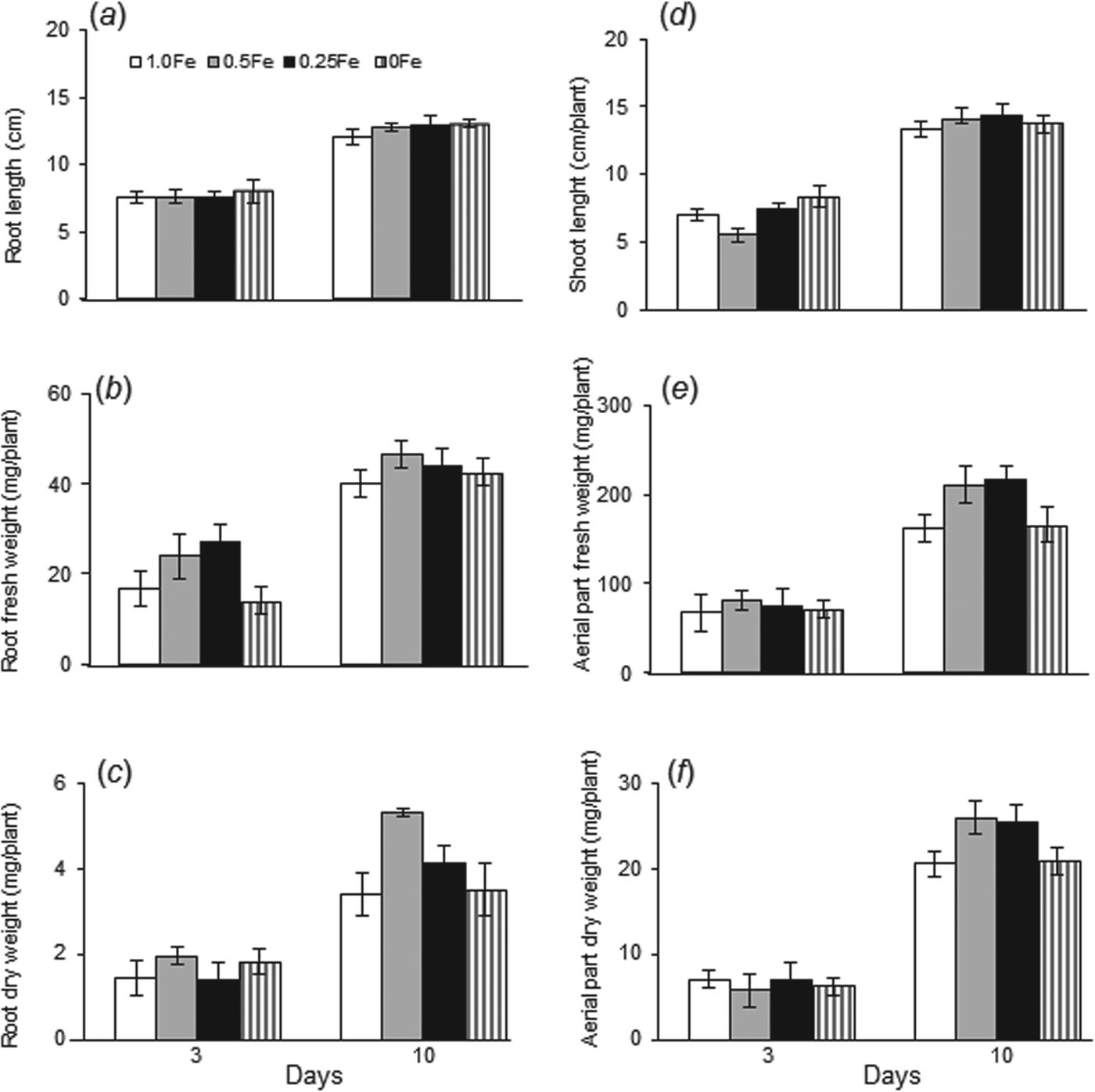
In order to explore the response of alfalfa to different Fe levels in the growing media (0·5Fe, 0·25Fe and 0Fe), the lengths of roots and stems as well as fresh and dry weights of roots and aboveground biomass were measured after 3 and 10 days, and compared with the 1·0Fe treatment. After 3 days of treatment, no significant changes were observed in any parameter (Fig. 1); however, after 10 days the root dry weight had increased significantly (P<0·05) from 3·4 to 5·3 mg/plant (an increase of 55·8%) in plants treated with 0·5Fe. The other Fe treatments did not affect this parameter (Fig. 1c). The fresh weight of aboveground biomass increased significantly (P<0·05) from 161·4 to 210·8 mg/plant in 0·5Fe-treated plants (an increase of 30·6%), and to 217·4 mg/plant in 0·25Fe-treated plants (an increase of 34·7%). The dry weight also increased significantly (P<0·05) from 20·5 to 26·0 mg/plant in 0·5Fe-treated plants (an increase of 26·8%) and to 25·3 mg/plant in 0·25Fe-treated plants (an increase of 23·4%) (Figs 1e and f).
Growth parameters of alfalfa plants grown for 3 and 10 days under decreasing Fe content. Values are means of three experiments±s.e.

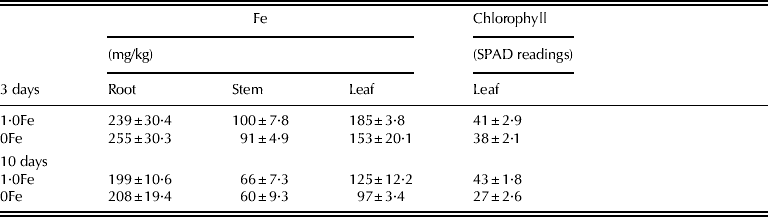
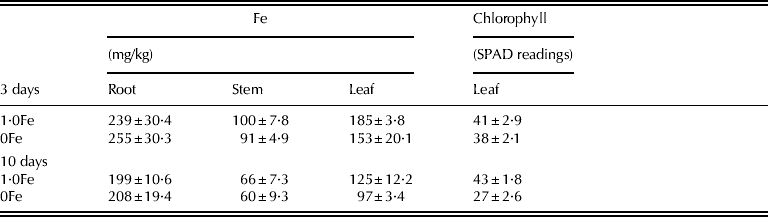
Iron content in roots, stems and leaves showed no significant changes at 0·5 and 0·25Fe (data not shown), whereas in the 0Fe-treated plants, a significant (P<0·05) decrease of 9·1% was found in stems at 10 days and decreases of 17·3 and 22·4% were observed in leaves at 3 and 10 days, respectively (Table 1). Leaf chlorophyll content was not altered by 0·5 and 0·25Fe treatments at 3 or 10 days (data not shown), but decreased by 37·2% in alfalfa plants grown in total absence of Fe (0Fe) at 10 days (Table 1).
Fe content in root, leaf and stem and changes in leaf chlorophyll content of alfalfa plants grown in 1·0Fe (control) and 0Fe in the nutrient solution for 3 and 10 days. Values are means of three experiments±s.e.
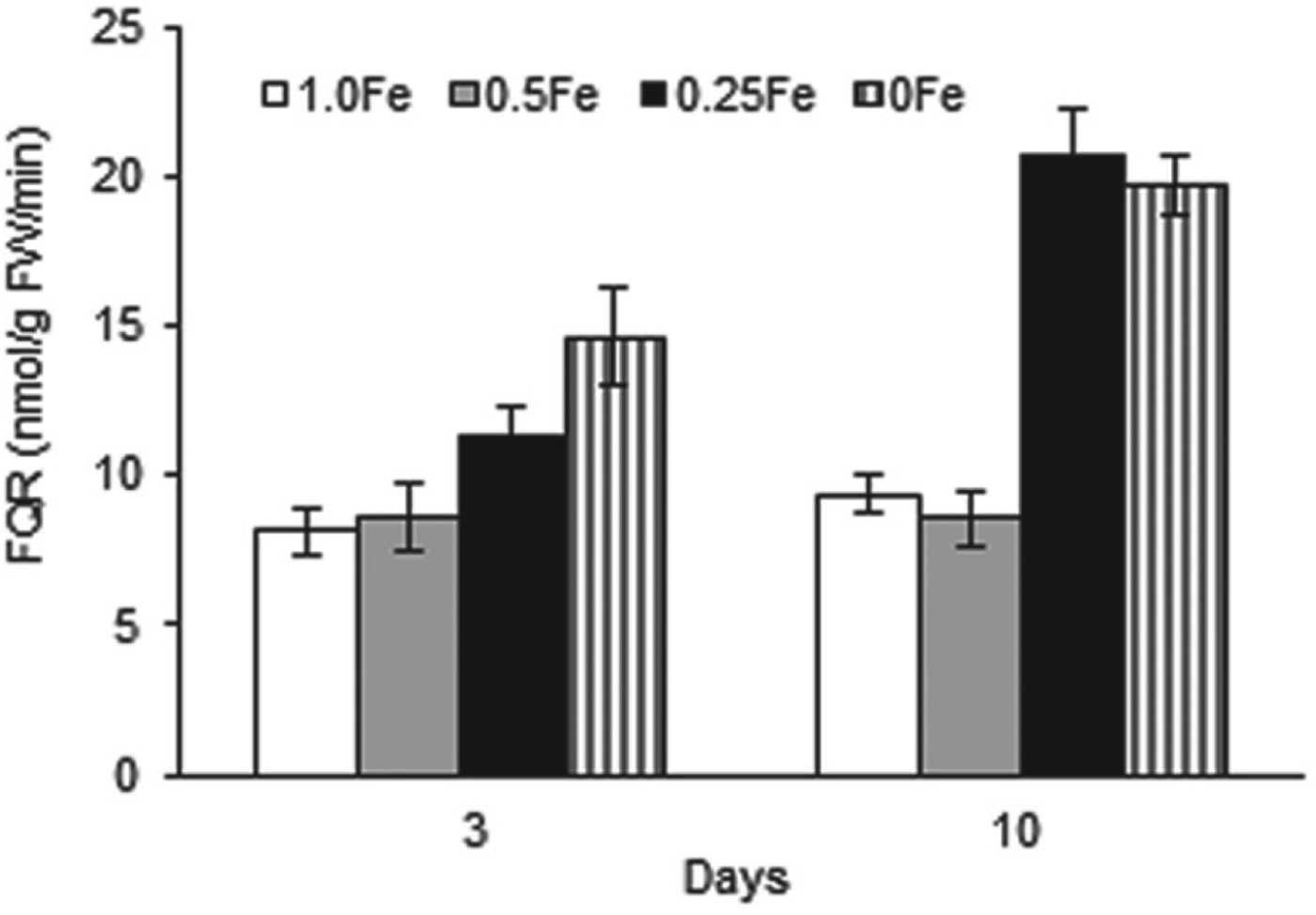
Ferric chelate reductase activity was measured at 3 and 10 days after the Fe treatments and an increase of 80% was observed in plants treated with 0Fe in the nutrient solution at 3 days (Fig. 2) when compared with the control treatment. This activity increased two-fold in the 0·25 and 0Fe treatments at 10 days.
Ferric chelate reductase activity of alfalfa plants grown under decreasing Fe content. Values are means of three experiments±s.e.
Changes in pH under decreasing iron content
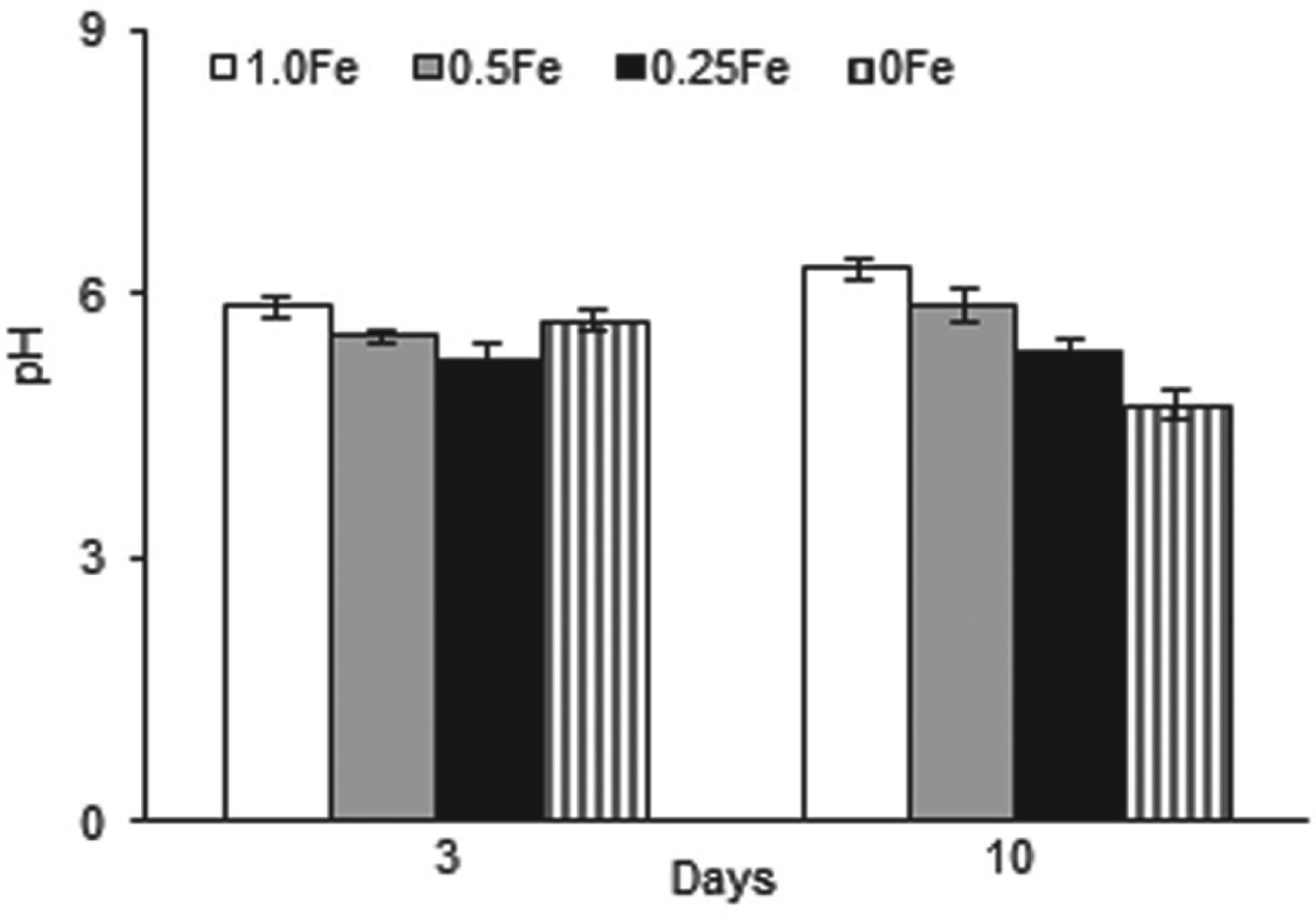
In order to verify whether the different Fe treatments provoked acidification in the root environment, the pH of the growth solution was measured in alfalfa plants grown under hydroponic conditions after 3 and 10 days at 0·5Fe, 0·25Fe and 0Fe and compared with plants grown with 1·0Fe. No significant changes in the pH were observed in any of the treatments at 3 days (Fig. 3), but a longer exposure (10 days) to the absence of Fe provoked an acidification of the media, which was only significant (P<0·05) in the plants grown with 0Fe.
Changes in pH values of the growth solution in alfalfa plants grown under decreasing Fe content. Values are means of three experiments±s.e.
Effect of Pseudomonas inoculation on alfalfa growth and ferric chelate reductase activity
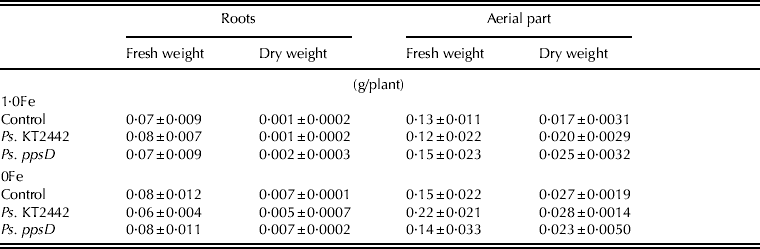
Following observation of the induction of FCR activity in plants treated with 0Fe in the nutrient solution at 3 and 10 days, an investigation was conducted into whether inoculation of seeds with P. putida KT2442 and its ppsD mutant would have any effect not only on the plant physiology but on the FCR activity induced by this condition. The effect of bacterial inoculation on the growth of alfalfa plants was analysed first and no effect was observed on any of the growth parameters measured at 3 days (data not shown). After 10 days of 1·0Fe treatment, the dry weights of roots and aboveground biomass increased by 91·7 and 47%, respectively, in the plants inoculated with ppsD mutant compared with the control non-inoculated plants (Table 2). At this time in the 0Fe treatment, the fresh weight of aboveground biomass increased by 46·6% in plants inoculated with the KT2442 strain compared with control non-inoculated plants.
Growth parameters of alfalfa plants grown for 10 days under 1·0Fe and 0Fe content in the nutrient solution in non-inoculated (control) and inoculated alfalfa seeds with Pseudomonas putida KT2442 and its ppsD mutant. Values are means of three experiments±s.e.
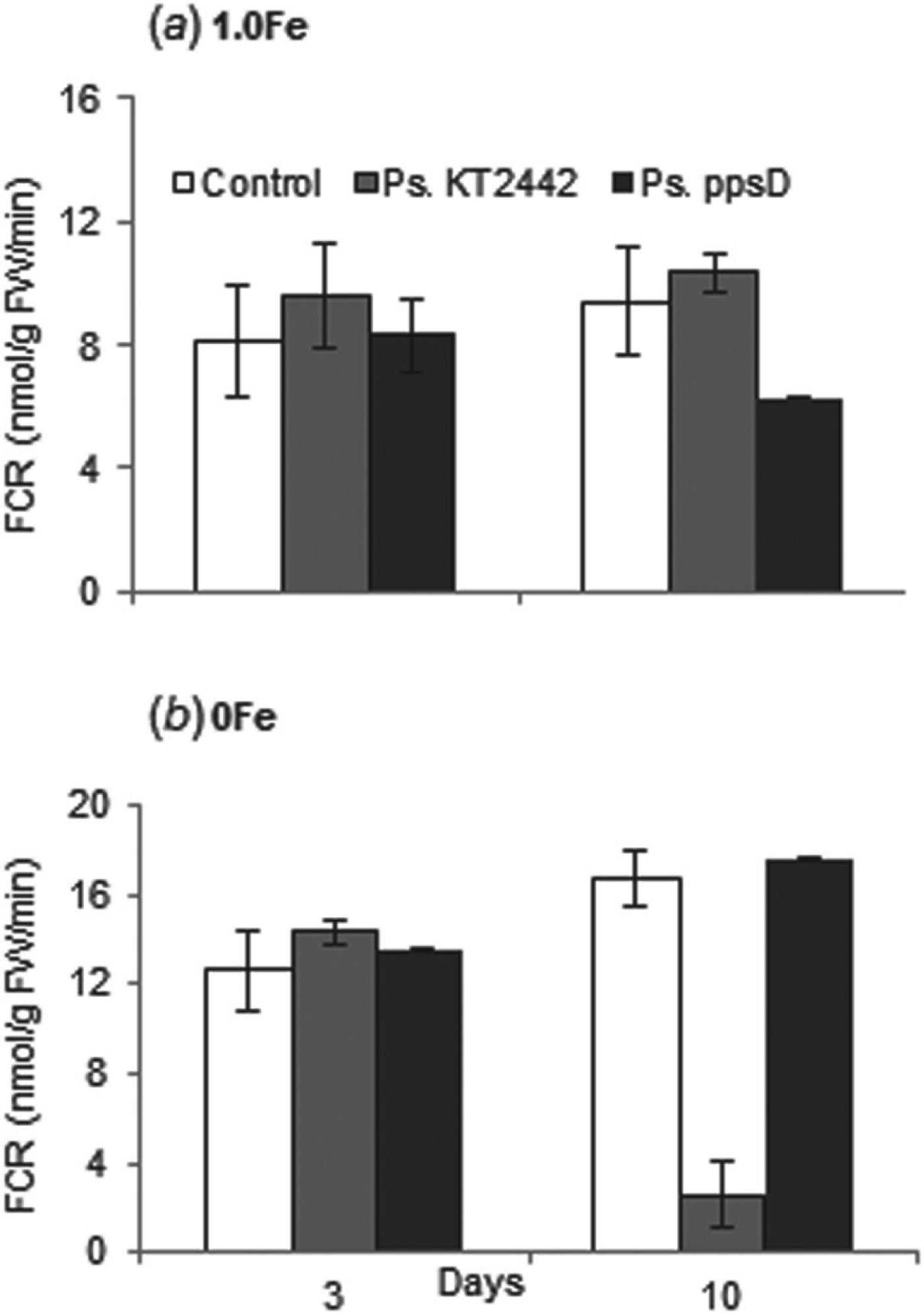
When alfalfa plants were grown under the 1·0Fe treatment, seed inoculation with P. putida KT2442 or its ppsD mutant did not produce any change in the FCR activity at 3 or 10 days (Fig. 4a). However, under the 0Fe treatment a reduction in the FCR by 84·6% was produced only in the plants inoculated with the Ps KT2442 strain (able to produce siderophores), and not with the mutant ppsD (unable to produce siderophores), compared with non-inoculated plants (Fig. 4b).
Ferric chelate reductase activity of of alfalfa plants grown in 1·0Fe (a) and 0Fe (b) in the nutrient solution for 3 and 10 days in non-inoculated (control) and inoculated alfalfa seeds with P. putida KT2442 (Ps. KT2442) and its mutant P. putida ppsD (Pseudomonas ppsD). Values are means of three experiments±s.e.
DISCUSSION
Iron bioavailability is one of the main problems for plant growth in terrestrial ecosystems. Iron deficiency is a common agricultural problem in calcareous soils with high pH (above 6·5), affecting Fe availability. In these conditions, the crop yield is reduced due to impairments in chlorophyll biosynthesis and chloroplast development, affecting photosynthesis and many other processes where Fe enzymes or cellular Fe-dependent components are involved (Sevilla et al. Reference Sevilla, Del Río and Hellín1984; Del Río et al. Reference Del Río, Sevilla, Sandalio and Palma1991; Hellín et al. Reference Hellín, Hernández-Cortes, Piqueras, Olmos, Sevilla and Abadia1995). Alfalfa is a model plant in phytoremediation (Peralta-Videa et al. Reference Peralta-Videa, De La Rosa, González and Gardea-Torresdey2004; Martí et al. Reference Martí, Camejo, Fernández-García, Rellán-Álvarez, Marques, Sevilla and Jiménez2009), and together with wheat, it is defined as less sensitive than others to metal deficiencies and specifically to Fe deficiency. The present work corroborated that alfalfa is tolerant to moderate Fe-stress conditions (0·5Fe and 0·25Fe treatments), which promoted accumulation of root and aboveground biomass without affecting Fe status or chlorophyll content (essential factors for photosynthesis and related to tolerance). However, more severe conditions (0Fe) affected the Fe content of leaves as well as the chlorophyll content. The total content of chlorophyll a and b and their ratios, which are fundamental indexes of photosynthesis activity, serves as stress indicator for plants and pollution detectors of the environment (Iturbe-Ormaetxe et al. Reference Iturbe-Ormaetxe, Morán, Arrese-Igor, Gogorcena, Klucas and Becana1995; Vanacker et al. Reference Vanacker, Sandalio, Jiménez, Palma, Corpas, Meseguer, Gómez, Sevilla, Leterrier, Foyer and Del Río2006; Camejo et al. Reference Camejo, Martí, Nicolás, Alarcón, Jiménez and Sevilla2007).
In addition to the results observed in the growth parameters of the plants, at the root level alfalfa plants responded to Fe stress by decreasing the external pH to increase the efficiency of Fe uptake to tolerate the stress situation. A decrease in rhizospheric pH is a response widely described in plants grown under conditions of Fe deficiency; it increases proton extrusion by the activation of a specific plasma membrane H+-ATPase of root epidermal cells (Zocchi & Cocucci Reference Zocchi and Cocucci1990; Rabotti & Zocchi Reference Rabotti and Zocchi1994; Dell'Orto et al. Reference Dell'Orto, Santi, De Nisi, Cesco, Varanini, Zocchi and Pinton2000). In other phytoremediation species such as Lupinus albus, a decrease in rhizosphere pH under acid soil conditions has been described, which could be due to cation–anion balance, organic anion release, root exudation and respiration and redox-coupled processes (Hinsinger et al. Reference Hinsinger, Plassard, Tang and Jaillard2003; Martínez-Alcalá et al. Reference Martínez-Alcalá, Walker and Bernal2010).
Another strategy under Fe deficiency conditions is the observed induction of the membrane-bound ferric FCR activity of roots, which was higher at 10 days than at 3 days, indicating that absence of Fe in the nutrient solution induced this mechanism to obtain Fe from the rhizosphere, together with the acidification of extracellular media in the alfalfa plants. Previous studies found that morphological changes were induced by Fe deficiency, and an increase in lateral root branching with good correlation between total lateral root number and the Fe-deficiency-induced FCR activity has been described in red clover (Trifolium pratense L.) and tomato (Solanum lycopersicum L.) genotypes (Jin et al. Reference Jin, Chen, Meng and Zheng2008; Dasgan et al. Reference Dasgan, Römheld, Cakmak and Abak2002). In Arabidopsis thaliana L., genes encoding the FCR (FRO1 and FRO2) and the ferrous Fe transporter (IRT1) have been identified and it is known that they are activated as part of the strategy I response (Robinson et al. Reference Robinson, Procter, Connolly and Guerinot1999; Vert et al. Reference Vert, Grotz, Dedaldechamp, Gaymard, Guerinot, Briat and Curie2002; Connolly et al. Reference Connolly, Campbell, Grotz, Prichard and Guerinot2003). These plants released more protons to decrease the rhizosphere pH and increase Fe solubility (Morrissey & Guerinot Reference Morrissey and Guerinot2009). The involvement of H+-ATPase activity in the release of organic acids by cluster roots of white lupin (Lupinus albus L.), causing an acidification of the surrounding environment, has been demonstrated by Tomasi et al. (Reference Tomasi, Kretzschmar, Espen, Weisskopf, Fuglsang, Palmgren, Neumann, Varanini, Pinton, Martinoia and Cesco2009). The determination of FCR, which has been shown to increase under Fe deficiency stress in grass and non-graminaceous species (Robinson et al. Reference Robinson, Procter, Connolly and Guerinot1999), has been widely used for selecting Fe-chlorosis-tolerant genotypes (Gogorcena et al. Reference Gogorcena, Abadía and Abadía2000). In contrast, phytosiderophores are used for Fe (III) chelation by graminaceous species and by bacteria and fungi (Guerinot & Yi Reference Guerinot and Yi1994). An interesting combined strategy has been described by Cesco et al. (Reference Cesco, Rombola, Tagliavini, Varanini and Pinton2006) in chlorosis-susceptible citrus trees (citrumelo ‘Swingle’ and Citrus aurantium L.) growing on calcareous soil, which recovered in the presence of grass species since they were able to use the Fe solubilized by the phytosiderophores released from the graminaceous species and enhancing Fe-availability. A similar strategy using the arbuscular mycorrhizal fungi Glomus versiforme was said to be effective by Wang et al. (Reference Wang, Xia, Hu, Dong and Wu2007); the presence of this fungi-affected citrus (Poncirus trifoliata L. Raf) plants' Fe uptake leading to increases in plant growth, chlorophyll content, Fe and root FCR activity. Among these mechanisms, the possibility that proliferation of bacteria, specifically Pseudomonads in the alfalfa rhizosphere, could be involved in plant responses to Fe deficiency was explored in the present work. The observed increase in the fresh weight of aboveground biomass after 10 days of Fe deficiency in plants inoculated with P. putida KT2442, capable of producing siderophores, is in agreement with Sharma et al. (Reference Sharma, Johri, Sharma and Glick2003), who observed a two-fold increase in stem fresh weight in mungbean plants inoculated with Pseudomonas sp. strain GRP3. It is unlikely that the bacteria had an indirect effect through increasing the substrate pH, since carbon source concentrations in root exudates are generally below those required by the strain to produce significant pH changes through their metabolism (Romano & Kolter Reference Romano and Kolter2005). Furthermore, these changes would also be observed in the mutant strain and while the P. putida ppsD mutant strain, unable to produce siderophores, had a positive effect on the dry weight of roots and aboveground biomass of the alfalfa plants, this was only seen under control conditions of 1·0Fe. Pseudomonas has been reported to promote plant growth under a variety of environmental stresses, such as Fe-limiting conditions, increasing the mineral uptake by alfalfa plants and Fe availability by secreting siderophores, as described by Carrillo-Castañeda et al. (Reference Carrillo-Castañeda, Juarez Muñoz, Ramon Peralta-Videa, Gómez and Gardea-Torresdey2002). The presence of Pseudomonas in the rhizosphere of the plant could promote the secretion of phytohormones and vitamins essential for growth (Mordukhava et al. Reference Mordukhava, Skvortsova, Kochetkov, Dubeikovskii and Boronin1991). The observed increase in FCR activity after 3 days of Fe deficiency, independently of the presence of Pseudomonas KT2442, indicated that the plant activated the FCR enzyme as a short-term response to Fe deficiency. However, at 10 days, inoculation with these bacteria overrode the signal induced by the deficiency, thus eliminating the FCR-mediated plant response at this time and suggesting that only conditions of prolonged absence of Fe will activate this mechanism. P. putida KT2440 is known to produce only one siderophore, a high Fe affinity pyoverdin with a molecular mass of 1073, the synthesis of which is controlled by several genes distributed across the genome (Matthijs et al. Reference Matthijs, Laus, Meyer, Abbaspour-Tehrani, Schäfer, Budzikiewicz and Cornelis2009). It is known that bacterial siderophores and membrane receptors are only synthesized under Fe stress conditions and the tolerance to Fe deficiency is controlled by the affinity of the siderophores for Fe, the kind and quantity of siderophores secreted, kinetics of exchange, and availability of Fe-complexes to bacteria and the plant (Negishi et al. Reference Negishi, Nakanishi, Yazaki, Kishimoto, Fujii, Shimbo, Yamamoto, Sakata, Sasaki, Kikuchi, Mori and Nishizawa2002; Richens Reference Richens2005; Dertz et al. Reference Dertz, Stintzi and Raymond2006). Plant roots have receptors or channels that recognize the Fe3+–siderophore complex; Fe3+ is incorporated into plants and converted to the ferrous form within the root cell (Schmidt Reference Schmidt2003). Also, it has been reported that Fe can be removed from Fe3+–siderophore complex by nicotinamine in the presence of ascorbic acid (Weber et al. Reference Weber, Von Wiren and Hayen2008).
In order to test whether the effect of P. putida on FCR activity was actually due to its ability to secrete siderophores under severe Fe limiting conditions, a ppsD mutant derivative of P. putida KT2442 that is unable to produce siderophores was used. In this case, an interesting result was obtained after 10 days of Fe deficiency, when the presence of these bacteria did not produce the marked decrease in FCR activity that the wild-type Pseudomonas did. These results implied that bacterial influence on FCR activity and Fe uptake is due to the production of siderophores.
In conclusion, alfalfa is a crop tolerant to moderate Fe stress conditions that promote the accumulation of roots and aboveground biomass without affecting Fe status and leaf chlorophyll content. Response mechanisms focused on Fe acquisition, i.e. acidification of the external medium and activation of the FCR enzyme were induced when Fe was absent from the growth solution. The presence of P. putida KT2442 in the rhizosphere eliminated FCR activation under severe Fe deficiency and this effect was through the excretion of siderophores, as demonstrated using a ppsD mutant strain that did not produce them. The presence of micro-organisms able to release siderophores into the media could be one of the main benefits of the micro-organism-plant interaction in Fe deficiency conditions. Therefore, taken together with the mechanisms demonstrated to increase Fe availability, alfalfa can be recommended as a useful crop in the recovery programmes of soils where available Fe is low as consequence of soil pollution or soil degradation.
This work was supported by the SÉNECA Foundation (project no. 04553/GERM/06), DGI-FEDER (project no. BFU BFU2011-28716), EU Consolider Ingenio 2010 (no. CSD2007-0005) and Spanish Environmental Ministry (no. 116/2004/3).