Case presentation
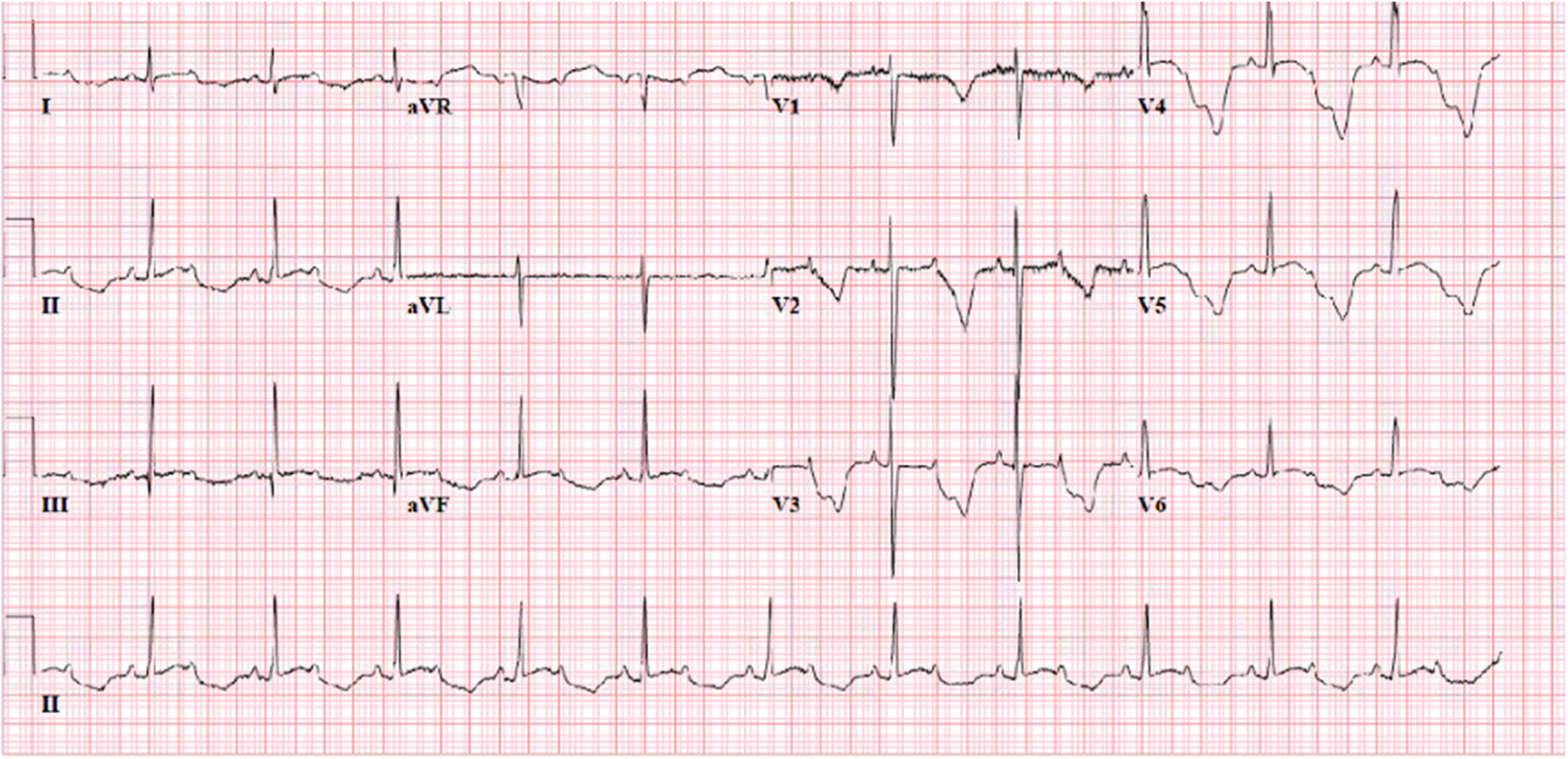
A female neonate was born by induced labour due to maternal overstrain at 39 6/7 weeks’ gestation after an uncomplicated gravidity. During labour, an irregular heartbeat was observed. Shortly after birth, bradycardia (80/minute) was noted and electrocardiogram showed severely prolonged QT interval with continuous second degree atrioventricular block (Fig 1). Echo showed a structurally and functionally normal heart. Family history noted maternal paroxetine usage during the whole pregnancy (30 mg/day). With suspected long QT syndrome, propranolol was immediately started and the dosage gradually increased to 3.23 mg/kg/day under close surveillance. Breastfeeding was withheld because of the possible link between maternal selective serotonin reuptake inhibitors usage and neonatal long QT syndrome.
Electrocardiography at day 1. Sinus rhythm with 2:1 atrioventricular-block and severe QT prolongation (QTc = 693 ms) (aVL: augmented Vector Left; aVR: augmented Vector Right; aVF: augmented Vector Foot; QTc: Corrected QT).
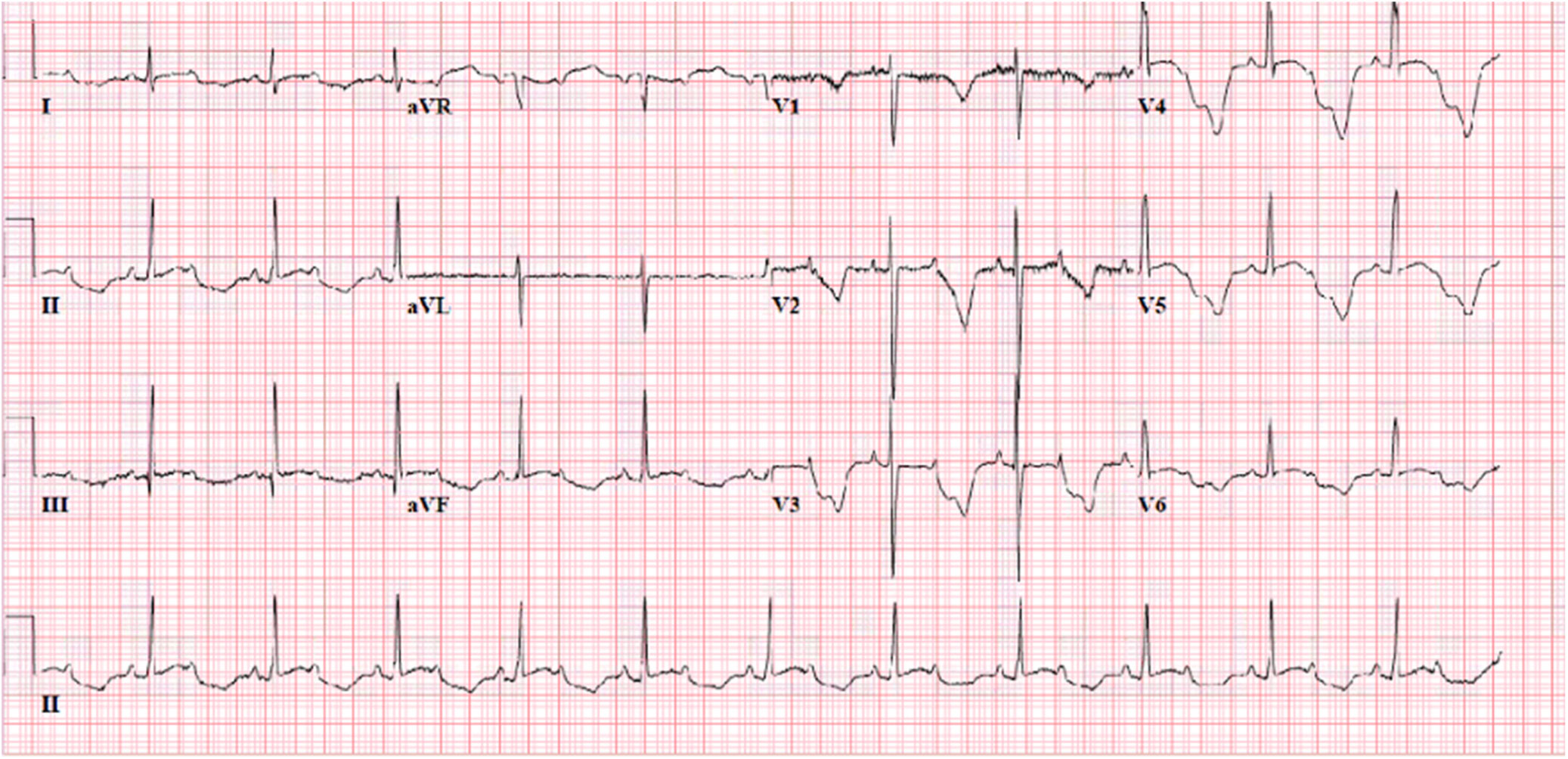
Electrocardiography of both parents and sisters showed no abnormalities. After 2 days, the atrioventricular block had spontaneously resolved despite persisting severe QT prolongation.
Clinical lidocaine (sodium channel blocker) and potassium challenges were done to see if congenital long QT syndrome type 2 (potassium channel related) or 3 (sodium channel related) was likely causative. Corrected QT did not shorten after lidocaine administration but significantly shortened after potassium supplementation. With a suspected long QT syndrome type 2, potassium suppletion (0.81 mmol/kg/day) as well as spironolactone (1.68 mg/kg/day) was initiated. Electrocardiography’s and potassium levels were obtained every other day until stable plasma levels were reached (potassium > 5 mmol/L). No side effects were observed.
Despite these results, urgent genetic tests were negative for long QT syndromes type 1–3 (no mutations in KCNQ1, KCNH2, and SCN5A genes). During the course of several months, the patient remained symptom free and the corrected QT spontaneously normalised and remained normal after cessation of propranolol. Currently, the patient is 5 years old, symptom free, and doing well without any medication.
Discussion
Long QT syndrome can be acquired, congenital, or a combination of both. Congenital long QT syndrome is based on well-known mutations in genes that encode cardiac ion channel sub-units or proteins involved in modulating ionic currents. Defects can be found both in outward potassium currents and in sodium currents and therefore lead to a prolonged action potential and prolonged repolarisation both resulting in a prolonged QT interval.Reference Crotti, Celano, Dagradi and Schwartz1, Reference Vincent, Timothy and Zhang2 Since ion channel defects and hence an increased or decreased ion flux over the cardiac cell membrane is causative of the prolonged repolarisation, blocking the sodium channel in case of gain of function of the sodium channel (long QT syndrome 3) or increasing serum potassium levels in case of loss of function of the potassium channel (long QT syndrome 2) may normalise repolarisation and can so demask the dysfunctioning ion channel leading to both the correct diagnosis and possible treatment options. Acquired long QT is most often due to use of certain pharmacological drugs but can also be caused by non-drug-related causes such as metabolic abnormalities like hypokalaemia, hypocalcaemia, and hypomagnesaemia.Reference Camm, Malik and Yap3, Reference Marzuillo, Benettoni, Germani, Ferrara, D′Agata and Barbi4
Depressive symptoms and major depressive disorders are common in pregnant women and preferably treated with selective serotonin reuptake inhibitors. Selective serotonin reuptake inhibitors can cause congenital (heart) anomalies and a neonatal withdrawal syndrome. However, little is known about the effects of selective serotonin reuptake inhibitors on neonatal cardiac repolarisation. In adults, selective serotonin reuptake inhibitors may cause long QT syndrome because of altered repolarisation by inhibition of one of the cardiac potassium channels.Reference Dubnov-Raz, Juurlink and Fogelman5
One study in 2008 researched the possible link between in utero selective serotonin reuptake inhibitor exposure and prolongation of the QT interval in neonates. At least 10% of the drug-exposed neonates showed a clinically significant prolongation of the QT interval (range: 462–543 ms). Various observations contribute to a possible relationship between in utero selective serotonin reuptake inhibitor exposure and a neonatal long corrected QT. Firstly, selective serotonin reuptake inhibitors and their active metabolites can be absorbed in the foetal respiratory and gastro-intestinal tracts by crossing the placenta and appearing in the amniotic fluid. Secondly, in neonates who are not exposed to selective serotonin reuptake inhibitors, only 1% have prolonged corrected QT in contrast to 10% of the exposed neonates. Thirdly, three antidepressant-exposed neonates with prolonged repolarisation showed normalisation shortly post-partum, simultaneous with the cessation of drug exposure. Therefore, it seems likely that foetal selective serotonin reuptake inhibitor exposure predisposes to QT prolongation.Reference Dubnov-Raz, Juurlink and Fogelman5
Alteration in the expression of metabolic enzymes and transporter proteins can affect the concentration of selective serotonin reuptake inhibitors in the maternal circulation and therefore lead to a variation in foetal selective serotonin reuptake inhibitor exposure and may explain the observed variation in corrected QTs in neonates affected by maternal selective serotonin reuptake inhibitor usage.
Conclusion
In utero exposure to selective serotonin reuptake inhibitors may cause severe transient neonatal long QT syndrome.
Acknowledgements
None.
Financial Support
This research received no specific grant from any funding agency, commercial or not-for-profit sectors.
Conflicts of Interest
None.
Ethical Standards
The research does not involve human and/or animal experimentation.