The publication of Dismantling the Welfare State in 1994 emerged at a moment when the future of the welfare state was very much in doubt. The language of welfare cutbacks had forcefully entered public debates as both scholars and policymakers came to the realization that the postwar economic boom had passed. Throughout the 1980s, anti-welfare parties, espousing a vision of a leaner state, scored major electoral successes on both sides of the Atlantic. Simultaneously, in other sectors of the economy, policymakers began to engage in drastic deregulation and economic privatization.
For welfare state scholars, growth slowdown initially prompted attention to the political origins of the welfare state, its expansion no longer seeming like an inevitable product of advanced capitalism (Quadagno Reference Quadagno1987). This search for origins led many to emphasize the role of political constellations on the Left—particularly mobilized unions and social democratic parties—in promoting extensive welfare state development (Esping-Andersen Reference Esping-Andersen1990; Stephens Reference Stephens1979). This work on left “power resources,” however, implied an equally gloomy future for the welfare state. Rates of union density were declining through the 1980s, falling from 46% across OECD countries in 1980 to 38% by 1994 (Visser Reference Visser2013). Footnote 1 At the same time, the working class as an electoral force was shrinking with workers constituting an increasingly smaller part of the electorate with more volatile voting patterns. By 1994, across the European Union, only one out of every four employed voters of Social Democratic, Communist, and Green parties was a traditional manual worker, a number that now stands below one-fifth (Gingrich and Hausermann forthcoming). While scholars of left-wing “power resources,” such as Esping-Andersen (Reference Esping-Andersen1990), suggested that welfare states might create their own support bases as they developed, as Pierson argues in Dismantling, a straightforward application of these arguments in an era of declining labor power suggested cutbacks.
DISMANTLING THE WELFARE STATE
Against this background, Pierson asks a provocative question. Why, when the world around the welfare state has so dramatically changed—and the political actors thought to support it have weakened—does it persevere? This question re-problematized welfare state research, making its continuity, not its impending decline, a subject worthy of empirical and theoretical scrutiny. Pierson’s answer to this question was equally groundbreaking, with Dismantling making three (or more) profoundly influential claims.
First, Pierson argues that radical retrenchment of the welfare state has not happened and is not likely to happen. Massive cutbacks or changes in entitlement are unlikely, even where the conditions appear favorable for them.
Second, the reason for the broad stability of the welfare state lies not in its overarching institutional structure, but in the particular structure of welfare programs. Dismantling makes a key analytic shift in the study of social programs, emphasizing policy itself as a source of stability. Pierson argues that as programs mature, they create constituents in both the electorate and organized groups who are willing and able to mobilize to protect them. These groups are powerful because they represent concentrated beneficiaries who have more to lose through change than reform proponents have to gain.
The intellectual foundations for these claims rest on work in the study of American social policy (e.g., Weir, Orloff, and Skocpol Reference Weir, Orloff and Skocpol1998), with Pierson extending this research. Drawing on new institutional economics and a nuanced analysis of varying programmatic structures in the institutionally distinct political systems of the United States and the United Kingdom, Pierson draws out how policies themselves temporally and structurally shape politics. In Dismantling he focuses primarily on how programs nurture their own political costs to change, but in the other work, he develops these arguments into a broader theorization of how institutions and policies become vested on multiple fronts—including through technical aspects of their structure, such as expertise, staffing, and complementary institutions (Pierson Reference Pierson1996; Reference Pierson2000).
Third, Pierson argues that the politics of the welfare state vary over time. On the one hand, as welfare states mature, they bring into being new actors to defend them, such as client groups and mobilized voters in the middle classes. These groups provide fundamental ballast for the welfare state in an era of declining labor power and fiscal austerity. On the other hand, much of the focus in Dismantling is on how conservative actors wanting to cut back the welfare state navigate these political constraints. Pierson argues that while the political terrain around advanced welfare states limits overt cuts, it offers conservative actors other strategies. Crucially, building on work by R. Kent Weaver (Reference Weaver1986) and others, Pierson points to “blame avoidance” strategies as a key feature of modern welfare politics. These strategies can take a number of forms, which also follow from the particular programmatic constraints actors face, but they tend to be more incremental and less visible. The new politics of the welfare state are different, not only in the identity of the core actors, but also in the type policymaking it encourages.
MASS RETRENCHMENT?
From the perspective of two decades after its publication, there is no doubt that Dismantling has been tremendously influential. The book, alongside Pierson’s subsequent articles developing its logic (1996; 2000), inspired a voluminous research agenda examining the scope of welfare state retrenchment and the politics of change (or lack thereof). How have Pierson’s claims held up in this broader inquiry? Was Dismantling right? To evaluate these questions, it is worth returning to Pierson’s core arguments.
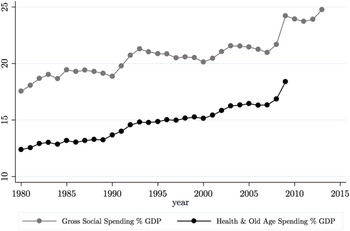
First, has there been radical retrenchment across welfare states? In most countries, the answer is clearly “no.” Figure 1 shows total social spending and spending on health and old age across advanced democracies—demonstrating an ongoing high level of spending (OECD 2014). Footnote 2 While individual countries vary, and when we look at nonspending measures, such as Lyle Scruggs and his collaborators’ (2014) work on generosity, we see that some places have experienced decline; however, on the whole, these indicators confirm that the state continues to play a clear role in providing social welfare to citizens.
Social Spending in Wealthy Democracies

When we revisit Pierson’s original puzzle in Dismantling these data are even more striking. For other nonwelfare public services (rail, electricity, post, telecoms) the world has dramatically changed since the 1980s; with a substantial divestment of state ownership across Europe and beyond. Equally, when we look at finance, trade, and other areas of economic regulation, there has been extensive deregulation in many countries (with some re-regulation). In contrast, the stability in social spending is remarkable, and speaks to the ongoing relevance of Dismantling.
As the language of marketization, workfare, and personal responsibility have entered advanced welfare states, and many countries have reformed individual programs, including two of the cases at the heart of Dismantling there appears to be real programmatic change.
PROGRAMMATIC STABILITY?
Second, does this general continuity come from the type of programmatic stability that Pierson theorized? The evidence here is more mixed. As the language of marketization, workfare, and personal responsibility have entered advanced welfare states, and many countries have reformed individual programs, including two of the cases at the heart of Dismantling, there appears to be real programmatic change.
For instance, in Dismantling, Pierson argues that despite the seeming vulnerability of means-tested income-support programs, in both the US and UK, these programs showed surprising resilience. These claims have fared less well two decades on. The 1996 welfare reforms in the United States dramatically recast cash-welfare (AFDC), introducing time limits and devolving responsibility to the states. Equally, policymakers in the United Kingdom have moved away from a contributory principle for unemployment benefits, and towards a more residual and work-focused system (Clasen Reference Clasen, Clasen and Clegg2011). These shifts have cumulatively cut unemployment replacement rates from over 50% in the early 1970s to under 18% by 2011 (Scruggs et al. Reference Scruggs, Detlef and Kati2014). Footnote 3
Outside of these two cases, we also see shifts in unexpected areas, with some countries introducing substantial change in pay-as-you-go pensions. Pension programs are crucial, as they often entail the structures outlined in Dismantling that are most likely to exhibit continuity. While many pension reforms have followed the incremental and delayed approaches hypothesized in Dismantling, some policymakers have introduced more substantial change, including moving away from defined benefit structures, changing funding streams, or expanding private pillars. These shifts have introduced substantial long run reductions in the level of public benefits and a change in the public-private mix (Huber and Stephens forthcoming).
The puzzle then, is why some programs have been more vulnerable than others, including, in some cases, those with both concentrated interests protecting them and entrenched structures. This problem is itself one that flows from the basic expectations in Dismantling, and indeed, work examining which actors, under which conditions, have been able to change welfare program, often confirms, rather than supplants, its core analytic focus. Understanding reform requires embedding the interests and resources of reformers and other actors within the existing programmatic context.
For instance, work on pension reform suggests that pro-reform groups and diffuse electoral interests can be more powerful than the headline claims in Dismantling would suggest (although, perhaps not its more nuanced analysis of conservative strategies). Silja Häusermann’s (Reference Häusermann2010) work on pension reform in continental Europe shows that in many cases policymakers have both substantially altered pension systems and that these shifts are not purely characterized by low-visibility incremental reforms that aim at “blame avoidance.” Instead, she argues that these reforms are possible because organized groups of pro-reform actors worked around opponents by creating broad coalitions of winners—including by expanding benefits to those excluded from the existing pension system to smooth the costs of transition. Put differently, savvy political entrepreneurs were able to engineer concentrated benefits from reform, mobilizing groups in their favor. This process was possible because the particular of the opportunities continental European pensions systems created (see also Andersen Reference Anderson2001 on Swedish pensions).
Equally, the technical constraints around changing programs are often less severe than Pierson suggested. Pierson argues in Dismantling that small changes can add up over time. Incremental changes though, do not just alter the size of benefits, but also future costs to change. For instance, elsewhere I argue (Gingrich Reference Gingrich2015) that in the case of AFDC reform in the United States, early waivers to the states and changes in Medicare helped to reduce some of the structural barriers to reforming AFDC—making it relatively “cheaper,” rather than more costly, to introduce more reform as time passed.
Put differently, this literature suggests that both the programmatic constraints and the actors mobilized around them are hardly “straight jackets.” These points, while sometimes cast critically, are nonetheless clearly friendly amendments. In Dismantling, Pierson both suggests many programs are vulnerable to cuts and that reformers have strategies to work around constraints. The challenge that subsequent work has taken up has been to systematically articulate how programmatic features shape the resources of actors, the options at hand, and the types of politics that emerge.
Indeed, these questions take on a particular urgency in current debates about not only cutbacks but expansion. In many countries, the economic structure and associated risks have changed quite substantially in recent decades, creating new risks for young people. Yet as Julia Lynch (Reference Lynch2006) shows, the countries that have traditionally spent a great deal on the elderly often continue to do so over long periods of time. Programmatic continuity affects not only the resilience of a given program, but in a more negative sense, the ability of policymakers to restructure the state. Indeed, one of the questions animating political and scholarly debate in Europe today is why so-called insiders, those who have stable or protected employment or benefits, have been able to maintain these benefits in the face of changing economic conditions (Rueda Reference Rueda2007). The whole concept of welfare state or labor market “insiders,” and the political resources at their disposal, follows from a programmatic structure that divides citizens. Understanding the varying programmatic resources that insiders have to protect particular benefit structures is at the heart of much research on contemporary European political economy, taking the analytic tools developed in Dismantling in new directions.
NEW POLITICS?
Finally, are we really in an era of new politics? Given the above analysis, the answer would appear to be “yes.” Work by Huber and Stephens (Reference Huber and Stephens2001) shows a muting of partisan differences over welfare policy after 1990. Moreover, this muting often occurs in part for the reasons Pierson suggests—because conservative parties are loathe to risk voter backlash and moderate when it comes to large welfare programs (Jensen Reference Jensen2014). While the old politics of Left versus Right, labor versus capital, are themselves contested (e.g., Mares Reference Mares2003), it would appear that they are even less relevant in mature welfare states. Pierson’s own recent work, however, raises questions about this interpretation.
One of the most important recent economic phenomena in many developed democracies is growing income inequality. In Dismantling, Pierson separates the question of inequality from programmatic stability. The changes in the broader structure of the economy following from financial deregulation, privatization, and changing tax regimes, are an analytic foil for his analysis of the programmatic continuity in the welfare state. While offering a nuanced analysis of the potential for systemic retrenchment, Dismantling itself does not emphasize the interconnection between the structure of welfare politics and broader changes in labor markets, financial markets, or other sectors.
Put differently, the dramatic economic reforms that are the foil to the relative calm of the welfare state in Dismantling are also, in part, responsible for the strength of its foes in this more current rendering.
Yet, as early critics such as Clayton and Pontusson (Reference Clayton and Pontusson1998) point out, the distributive role of social policy exists in an economic context. Whether a pension system protects against income insecurity among the old will depend in part on both how entitlements are constructed and how the labor market operates. One part of this interdependence comes from the value of the benefit itself vis-à-vis economic needs. Policies that stay constant in the face of changing needs, or broader economic developments, may work in substantially different ways. However, the interdependence between benefits and the broader economic context matters not only for the way programs work, but also welfare politics themselves. Jacob Hacker (Reference Hacker2004) argues that much of what Pierson calls “decremental” changes (or what Hackers labels “drift”) emerges from purposive political action by actors who have been partly empowered by the broader changes occurring outside the welfare state. Indeed, it is Pierson’s more recent work with Jacob Hacker (Reference Hacker and Pierson2010) that powerfully articulates these claims in the American context. This work characterizes politics in the United States as “off-center,” pointing to a deep imbalance between both the preferences and power of organized interests pushing for economic changes and those of many voters. Even as core welfare programs, such as Social Security, remain relatively insulated from radical cuts, the terrain around them has changed. It is hard to analyze the recent partisan brinksmanship over the debt ceiling, conflict over food stamps, and the decision of some states to reject federal funds for Medicaid expansion under the Affordable Care Act, without looking at the growing polarization in party politics. The causes of polarization, and its relationship to income inequality, are hotly debated, but it is likely that some of the policy changes outside of the welfare state that empowered economic elites have played a role (Hacker and Pierson Reference Hacker and Pierson2010). Put differently, the dramatic economic reforms that are the foil to the relative calm of the welfare state in Dismantling, are also, in part, responsible for the strength of its foes in this more current rendering.
The American case, while not unique, is also not universal. Kathleen Thelen’s (Reference Thelen2014) recent work on labor market liberalization shows that the character of recent economic changes has varied across advanced democracies. Thelen’s interest is in wage bargaining institutions—not welfare programs per se—but the implications are clearly germane to this debate. Thelen argues that even as wage bargaining institutions reproduce themselves in particular ways that appear resistant to change, these modes of reproduction can have different distributive and political implications depending on what role they play in the broader economy. In some cases, wage bargaining institutions have narrowed, reducing equity among workers, while in others, they have maintained more equitable structures. These differences partly follow from the broader behaviors of unions and employers, and the way they combine liberalization in one sphere with that in another.
Neither how these programs work in practice nor their politics, then, are entirely independent of the larger economy or economic actors. This point brings us back to the debate about the “old politics” of the welfare state (Korpi and Palme Reference Korpi and Palme2003). Even though it clearly is true that partisan differences are more muted in current welfare politics, and that social programs can survive without strong labor movements, it does not necessarily follow that these traditional actors no longer matter. What made broad based economic actors like unions or business groups so crucial to shaping the original character of the welfare state is that they operated in multiple economic spheres, advocating policies in the labor market and the state simultaneously (e.g., Esping-Andersen Reference Esping-Andersen1990)—something that, by and large, groups that emerge around particular programs do not do. As such, while unions and mobilized left parties may not have been necessary in a narrow sense to preserve particular programs, as Thelen (Reference Thelen2014) shows, they very likely have played a crucial role in reproducing a broader economic structure that shapes how these programs actually operate. Indeed, for the most part, the countries that are more equal today, or where inequality has increased less, are those with relatively stronger labor movements.
These claims do not imply that the politics of the welfare state have not changed over time, or that “old” politics fully explain current trajectories, but rather that the interaction between old and new interests, broader economic and political institutions, and program structures is crucial. In this research enterprise, the claims in Dismantling continue to offer crucial insights about social policy—a remarkable achievement two decades on.