

INTRODUCTION
During the second half of the 20th century, some scholars produced several studies surveying a scientific school of astronomy in Islamic lands which flourished around the 13th century and aimed at producing “non-Ptolemaic planetary models”.Footnote 1 Since the leading figures of this movement, Muʾayyad al-Dīn al-ʿUrḍī (1200–1266), Naṣīr al-Dīn al-Ṭūsī (1201–1274) and Quṭb al-Dīn al-Shīrāzī (1236–1311) passed a period of their life in the Marāgha observatory which was built in the court of the Ilkhanid dynasty in the northwest of today Iran, in modern literature it is referred to as the “Marāgha School”. Although some of ʿUrḍīFootnote 2 and Ṭūsī’sFootnote 3 works containing non-Ptolemaic models have been edited and studied, none of Shīrāzī’s astronomical works has been edited and his contribution to non-Ptolemaic astronomy had been only partially studied. Nevertheless his role in the 13th century astronomy is best shown by the frequency of mentioning his name by later astronomers and his influence on their scientific approach. All of these show why a deep study of Shīrāzī’s achievements has attracted the interest of a new generation of scholars in recent years.Footnote 4
Shīrāzī’s works, apart from the non-Ptolemaic models, show several interesting aspects, the most important among which are his reconstruction of Ptolemaic planetary modeling process,Footnote 5 new considerations in centricity and immobility of the Earth,Footnote 6 Venus transits and the location of its sphere in relation to the SunFootnote 7 etc. Nevertheless, in this article I focus on his critical considerations concerning his predecessors’ non-Ptolemaic planetary models and the gradual development of his own models in his three comprehensive hayʾa books: Nihāyat al-idrāk fī dirāyat al-aflāk (completed in mid-Shaʿbān 680 A.H./November1281),Footnote 8 Ikhtiyārāt muẓaffarī (completed in 9th of Dhū al-Ḥijja 680/March 21th 1282)Footnote 9 and al-Tuḥfa al-shāhiyya (completed in 684 A.H./1285).Footnote 10 In the first two books, Shīrāzī presents the difficulties of Ptolemaic models of the Moon and the five planets, his predecessors’ solutions for them, his criticisms of these solutions and his own “better” models. In the years following the redaction of Nihāya and Ikhtiyārāt, he realizes that his own models for superior and inferior planets are not without difficulties.Footnote 11 Accordingly, he writes his al-Tuḥfa, including a revision of the previous models and a series of new ones.
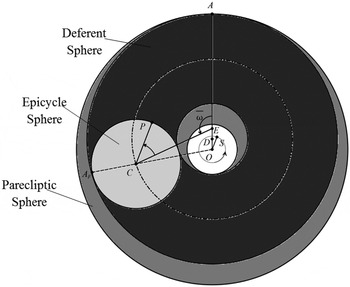
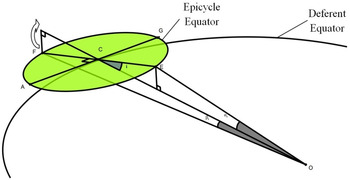
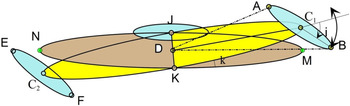
One may classify the difficulties of the Ptolemaic planetary models under two titles:Footnote 12 (1) the equant problem, i.e., the non-uniform motion of the deferents in longitude due to the uniform circular motion of the epicycle center C relative to the equant point E rather than the deferent center D (Fig. 1); and (2) the oscillation problem, i.e., the back and forth spinning of the epicycles and the deferents in latitude or longitude (Fig. 2 and Fig. 3). As Ibn al-Haytham (965–1040) emphasized in his al-Shukūk ʿalā Baṭlamiyūs,Footnote 13 these difficulties do not emerge from the observational or numerical aspects of the models, but from their physical interpretation. Since, as Ibn al-Haytham and his followers believe, these models represent the real configuration of the physical celestial spheres, they have to obey the natural principles governing the movement of celestial bodies. Inspired by the peripatetic natural philosophy, Ṭūsī and Shīrāzī put forward a list of these principles:Footnote 14 (1) the celestial spheres naturally rotate with uniform circular motion (which is in contradiction with non-uniform motion of deferent);Footnote 15 (2) any motion of an object, other than natural motion, is caused by another object whose motion is natural; (3) any object has only one natural motion; (4) any natural motion is in one direction or path only (which is in contradiction with oscillation of the spheres).
A cross-section of physical configuration of the spheres in Ptolemaic model for superior planets; Deferent sphere moves the epicycle center C, uniformly relative to E rather than to the deferent center D.

According to Ptolemy, the equators of the epicycles of the five planets oscillate around the line AG. In addition to this, there is another oscillation for the inferior planets around the line FE as well. αi and βi are extracted from observed values.

According to Ptolemy, the equator of the deferents of the five planets oscillates around the line JK.

SHĪRĀZĪ’S CONSIDERATIONS ON ṬŪSĪ AND ʿURḌĪ’S SIMPLE MODELS
To solve the above-mentioned difficulties, Ṭūsī and ʿUrḍī put forward a series of new models involving some simple models. A “Ptolemaic simple model” is a model which produces only one of the anomalies of planetary motions by combining uniform circular motions; epicycle model and eccenter model are examples of a Ptolemaic simple model. Similarly, a “non-Ptolemaic simple model” produces the non-uniform motions or oscillations of the spheres in the same manner, namely by combining uniform circular motions. A non-Ptolemaic planetary model may be a combination of Ptolemaic and non-Ptolemaic simple models.
Following Ptolemy's Almagest Footnote 16 and Ṭūsī’s Tadhkira,Footnote 17 Shīrāzī presents Ptolemaic simple models (al-Uṣūl),Footnote 18 in separate chapters in Nihāya and al-Tuḥfa, followed by chapters including the recent non-Ptolemaic simple models and his critical considerations.Footnote 19
Ṭūsī’s Simple Model
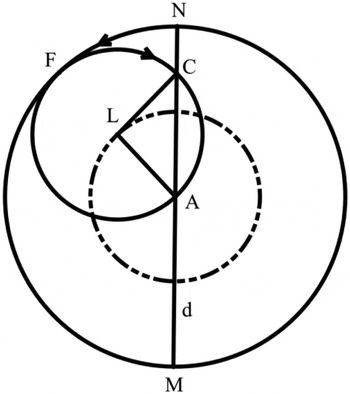
To solve the first difficulty, namely the problem of equant point, Ṭūsī’s models for the moon, Venus and the superior planets involve a simple model made up of three spheres.Footnote 20 Two of these spheres constitute a sub-model which is called the “Ṭūsī couple”, a modern name for a combination of two circles, one carrying the other (Fig. 4).Footnote 21 Ṭūsī proves that any point (e.g. C) on the circumference of circle ACF oscillates back and forth along a diameter (e.g. MN) of the circle MNF. In the curvilinear version of this sub-model, Ṭūsī supposes two physical spheres whose equators coincide with the circles of the Ṭūsī couple; one carrying the other, with proper speed and in proper direction.
Ṭūsī Couple.

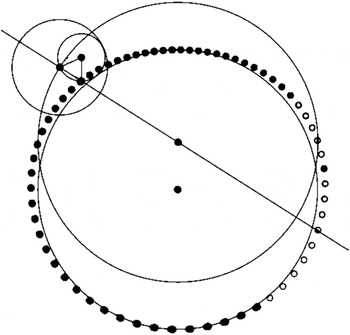
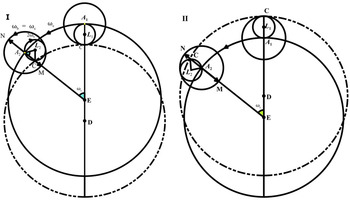
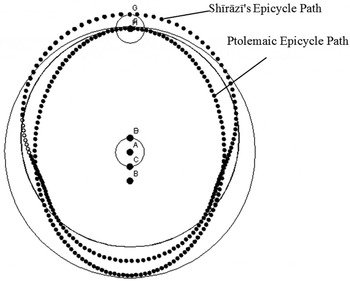
Ṭūsī also proves that if a deferent sphere is supposed with the center E, carrying a Ṭūsī couple on its circumference with the angular velocity ωc = ωb, the point C would move uniformly with respect to the point E, and its path is close to the circumference of a circle with center D (DE = d) whose diameter is equal to the diameter of the deferent (Fig. 6.I). This is what we call “Ṭūsī simple model”, it moves the epicycle center C uniformly with respect to the equant point E, on a path close to the circumference of Ptolemaic deferent with center D. Ṭūsī shows that the path of the point C is not a true circle, as it is shown by a simulation (Fig. 5).Footnote 22 Although Ṭūsī claims that this deviation from Ptolemaic model is not more than 10 minutes in the case of the planetary models and not observationally noticeable,Footnote 23 Shīrāzī considers it as a negative point for Ṭūsī’s planetary models.
A simulation shows that the path of the epicycle center (the dotted line) in Ṭūsī simple model is not a true circle.

Two versions of Ṭūsī Simple Model.

Shīrāzī presents two versions of this model in Ikhtiyārāt and Tuḥfa.Footnote 24 The first version: if at the moment when the center of the big sphere, A1, is at the apogee, the point C is below the apogee, the approximate center D will be beneath the equant point E (Fig. 6.I).The second version: if at the moment when the center of the big sphere, A1, is at the apogee, the point C is above the apogee, the approximate center D will be above the equant point E (Fig. 6.II).
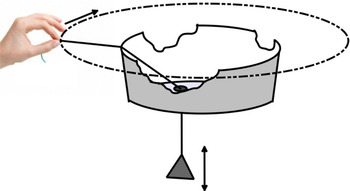
Shīrāzī realizes that the physical interpretation of Ṭūsī couple would lead to a difficulty from the point of view of natural philosophy. The difficulty is as follows: there is an inevitable rest between the back and forth motions in Ṭūsī couple, while rest, according to Aristotelian natural philosophy, is not allowed for heavenly bodies.Footnote 25 So, it would not be possible to employ this model to explain the heavenly motions. Nevertheless, Shīrāzī, in both Nihāya and Ikhtiyārāt, believes that the Ṭūsī couple does not imply such a rest.Footnote 26 In Tuḥfa he offers a solution to this problem in the form of a thought experiment:
[…] if we bore at the bottom (kaʿb) of a round bowl whose edge has an unequal altitude from the surface of its bottom, and then pass a string (khayṭ) through the bore and suspend a weight from the side of the string extending from the bore and move its other side on the edge [of the bowl], then the weight falls and rises due to the variation of the altitude of the edge. Nevertheless, it is not still at any time because its mover never abates by assumption.Footnote 27
Figure 7 is drawn on the basis of Shīrāzī’s descriptions. Although this thought experiment may not satisfy a modern understanding of back and forth motion, it may illustrate the type of thinking of the ancient scholars. Although Shīrāzī responds to the criticisms upon Ṭūsī’s modeling, he believes that the number of spheres in Ṭūsī’s model is more than what is acceptable and a model with fewer spheres, like ʿUrḍī’s, is better.
Shīrāzī’s Thought Experiment.

ʿUrḍī Simple Model (ʿUrḍī Lemma)
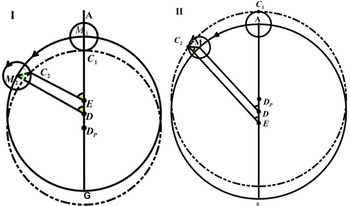
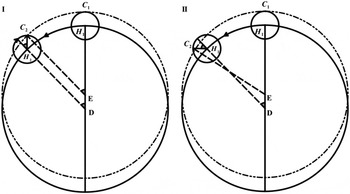
To produce the uniform motion of the epicycle center with respect to the equant point, ʿUrḍī’s model for the superior planets involves a simple model.Footnote 28 Saliba calls the abstract geometrical form of this simple model “ʿUrḍī Lemma”.Footnote 29 While ʿUrḍī did not present this simple model separated from his model for superior planets, Shīrāzī delivers this simple model, attributing it to “one of the recent scholars”.Footnote 30 In this model the deferent center D is at halfway between points Dp (Ptolemaic deferent center) and equant point E (ED = DDp). Deferent carries the center of circle M on its circumference, whose radius is M1C1 = ED (Fig. 8.I). ʿUrḍī proves that if the circle M carries point C on its circumference with the same angular speed as the deferent, the point C would move with uniform speed relative to point E on a path close to a circle with approximate center Dp.
Two versions of ʿUrḍī Simple Model.

Shīrāzī presents two versions of this model in Ikhtiyārāt:Footnote 31 (1) if at the moment when the center of the small sphere, M1, is at the apogee, the point C1 is below the apogee, the approximate center Dp will be beneath the deferent center D and the center of uniform motion E will be above it (Fig. 8.I); (2) if at the moment when the center of the small sphere, A, is at the apogee, the point C1 is above the apogee, the approximate center Dp will be above the deferent center D and the center of uniform motion, E, will be beneath it (Fig. 8.II).
Curvilinear Version of Ṭūsī Couple
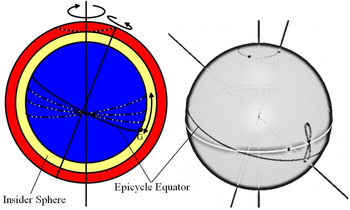
In his treatise Fī ḥall shukūk ḥarakat al-iltifāf, Ibn al-Haytham puts forward a new model producing the oscillation of the spheres without violating natural principles. This model is nothing more than Eudoxus’ concentric model.Footnote 32 To make oscillate the epicycle, he adds two spheres encompassing it and rotating its poles around an inclined axis. According to Eudoxus, if the two spheres rotate with similar speed and in opposite direction, any point of the equator of the epicycle will move on an elongated 8, which Ibn al-Haytham supposes to be an arc of a circle. Ṭūsī and Shīrāzī criticize this model for its side effects,Footnote 33 because the epicycles of the superior planets do not oscillate like a spinning top (Fig. 2).
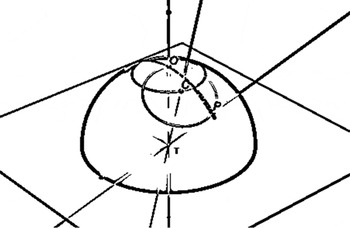
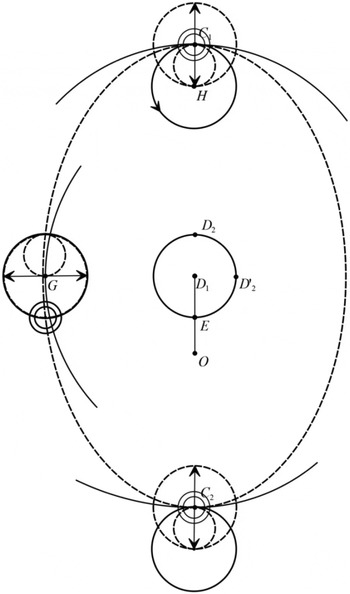
To solve this problem, Ṭūsī presents a new model now called “curvilinear version of Ṭūsī Couple”Footnote 34 or “spherical case of Ṭūsī Couple”Footnote 35 which causes a sphere to oscillate using two concentric spheres without any noticeable side effect.Footnote 36 As it is shown in Figure 9, the poles of the oscillating sphere move in a path which is not a simple arc but an elongated 8.Footnote 37 Due to the highly elongated shape of this figure, its deviation from an arc was only noticed by Niẓām al-Dīn Nīsābūrī in his Tawḍīḥ al-Tadhkira,Footnote 38 and repeated by the other commentators of Ṭūsī’s Tadhkira.Footnote 39
Curvilinear Version of Ṭūsī Couple, epicycle pole P oscillates on an approximate arc by the motion of the two spheres with poles C and O.

Shīrāzī criticizes this model for failing to produce the appropriate time duration of Ptolemy's models. Since the deferent spheres in planetary models are eccentric and the oscillations of the deferents and epicycles in latitude are adjusted with deferents motions, their oscillations are not in a uniform manner;Footnote 40 rather the time of the motion in the first half of the arc is not equal to the time of the motion in the second half. Shīrāzī believes that what is needed is a model oscillating faster in one half and slower in the other.
Shīrāzī’s Criticism of Ṭūsī and ʿUrḍī’s Planetary Models
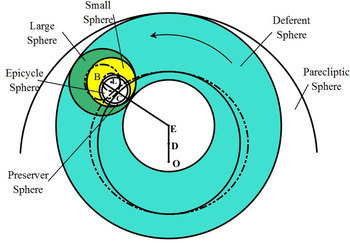
The aim of non-Ptolemaic models is to solve the difficulties of Ptolemaic models using simple models. Ṭūsī, in his al-Tadhkira fī ‘ilm al-hayʾa, applies the second version of his simple model to the lunar model (Fig. 10)Footnote 41 and the first version to the models of the superior planets and Venus (Fig. 11).Footnote 42 He explicitly states his inability to put forward a model involving his simple model to solve the difficulties of Mercury.Footnote 43
A Physical Configuration of Ṭūsī’s Lunar Model.

A Physical Configuration of Ṭūsī’s Model for Superior Planets and Venus.

In course of a response to a criticism concerning the physical configuration of Ṭūsī’s planetary models, Shīrāzī takes up the problem of the difference between the diameter of the physical spheres and the diameter of the abstract circles as it is shown in the figures. Without mentioning their names, Shīrāzī characterizes the critics as persons with sick imagination who claim there is no enough space in Ṭūsī couple for the epicycle:
[…] Then, once [the critic] put it before someone [else] mentally weaker than him, he accepted and could propose no answer. Then, since he thought it a powerful criticism, and as an excuse for his failing to provide an answer, he said: “this criticism was brought against the author of this model [i.e. Ṭūsī], he accepted it and ordered it to be removed. But both he [i.e., Ṭūsī] and his critic forgot it or feigned so”.Footnote 44
Nevertheless, to accommodate the epicycle sphere, the spheres of Ṭūsī couple may be much larger than the abstract circles of Ṭūsī couple.Footnote 45
According to Shīrāzī, since each one of Ṭūsī’s planetary models, in addition to a Ṭūsī couple, involves one or two curvilinear versions of Ṭūsī couple to produce the oscillations of the epicycles (Fig. 12), the number of the additional spheres is too many. Moreover, he adds other criticisms:
-
1. The epicycles oscillate in a non-uniform manner; so the time of the motion in the first half of the arc is not equal to the time of the motion in the second half, as mentioned above; but the curvilinear version of Ṭūsī couple model is incapable to produce such a motion.
-
2. The path of the epicycle center in Ṭūsī's models is not exactly a circle. Although, as Shīrāzī knows, this deviation is not perceptible, he believes that such a motion contradicts the general rule of heavenly bodies whose motions should be circular.
-
3. Although Shīrāzī thinks there is no rest between back and forth motions, Ṭūsī couple may not be acceptable to the scholars who do not agree.
The Moon epicycle is surrounded by a curvilinear version of Ṭūsī couple to produce oscillation of the epicycle in longitude.

Shīrāzī, in Nihāya and Ikhtiyārāt, puts forward his criticisms of ʿUrḍī’s planetary models, as well. ʿUrḍī, in his Kitāb al-Hayʾa, applies the first version of his model to the superior planets and Venus. In this model the deferent center D is at halfway between the Ptolemaic deferent center DP and equant point E (Fig. 13).Footnote 46
ʿUrḍī’s Model for Superior Planets.

Shīrāzī, in both Nihāya and Ikhtiyārāt, believes that, in the case of the superior planets, it is not allowed to displace the deferent center from its original position in Ptolemaic model. Since Ptolemy did not present any proof for the position of the deferent center, Shīrāzī produces an argument in Nihāya.Footnote 47 Nevertheless this criticism is not plausible, because in ʿUrḍī’s model the epicycle center produces a circle-like path whose center is at the same position as the original position of deferent center in Ptolemaic model and this is all that is needed in the Ptolemaic model. Later on, Shīrāzī realizes his mistake in criticizing ʿUrḍī’s model, and so he does not hesitate to use it in Tuḥfa in his own planetary models.
Although ʿUrḍī applies his simple model to superior planets, his models for Mercury and Moon are not in line with his other non-Ptolemaic models. In the case of these two planets, he solves the problem of non-uniform motion by changing the velocities and directions of the spheres. For the lunar model he denies the necessity of the uniform motion of the epicycle center with respect to the universe center O, since, as ʿUrḍī says, and Shīrāzī reports:
[…] what is known by the observation is that when the [epicycle] center is at quadrature with the Sun, the Sun is at half way between them [ = lunar apogee and epicycle center] and it happens in our [ʿUrḍī’s] theory as well. But to tell that [the Sun] should be at half way [between them] in other positions is based on mere conjecture. And Ptolemy's conjectures are not necessarily better than those of the others.Footnote 48
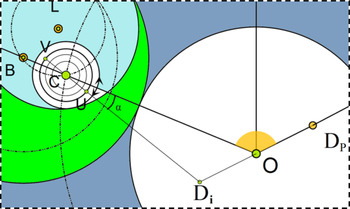
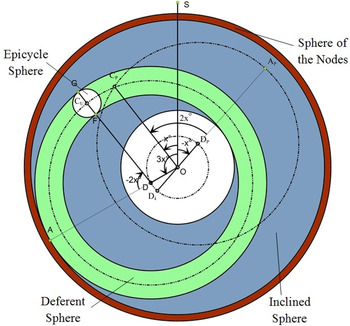
Therefore there is no need for the motion of the epicycle center with respect to the universe center to be uniform and the difficulty of the lunar model is solved automatically. Thereafter, ʿUrḍī solves the problem of oscillation of lunar epicycle, by changing the velocities of the lunar spheres, since the prosneusis point Di is always approximately along the epicycle radius GF (Fig. 14).
ʿUrḍī’s Lunar Model.

Nevertheless Shīrāzī does not agree with this model, since he believes that the position of the epicycle center Cu in ʿUrḍī’s model is not everywhere identical with the Ptolemaic epicycle center CP.Footnote 49 Although this criticism is not acceptable because of the lack of observation in the points other than the quadratures, Shīrāzī prefers to follow Ptolemy's footsteps.
For Mercury,ʿUrḍī increases the velocity of the director sphere to three times its Ptolemaic value and redoubles the velocity of the deferent.Footnote 50 Consequently, although the Ptolemaic deferent of Mercury moves the epicycle center uniformly with respect to the equant point, the deferent of ʿUrḍī model rotates uniformly around its own center. Since, as ʿUrḍī states, (1) the extension of line CD2 passes close to the equant point E (Fig. 15); and (2) the deferent center D2 coincides three times, in each rotation, with the equant point E, one may say that the epicycle center C, would move, most of the time, almost uniformly with respect to equant point E.Footnote 51 Shīrāzī does not accept ʿUrḍī’s reasoning, because:
If [this sort of argumentation] is allowed, it would be possible to say that the uniform motion [of the epicycle center] and the alignment maybe with respect to another point near to the point which is proved by argument. And if it be so, certainty would leave the geometrical arguments and this science [i.e. astronomy] would enter among other conjectural sciences. Heaven forbid!Footnote 52
ʿUrḍī’s Model for Mercury.

This plausible criticism, as well as other criticisms, encourages Shīrāzī to develop his own models. This is especially the case for Mercury, for which Ṭūsī presents no model and ʿUrḍī fails to present an appropriate one.
DEVELOPMENT OF NEW PLANETARY MODELS IN SHĪRĀZĪ’S ASTRONOMICAL WORKS
Shīrāzī presents his planetary models in several stages. Nihāya is his first effort to develop his new models alongside with his criticism of the previous models. Unfortunately he did not present his new models in the chapters on planetary models, rather in a separate part, at the end the chapter of planetary motions in latitude.Footnote 53 Ikhtiyārāt, which is written in Persian only 4 month after Nihāya, includes exactly the same models as Nihāya, presented in appropriate chapters, in addition to a new model for Mercury which Nihāya lacks.Footnote 54 Shīrāzī, in Nihāya and Ikhtiyārāt, introduces his new simple models as follows:
Shīrāzī’s First Simple Model
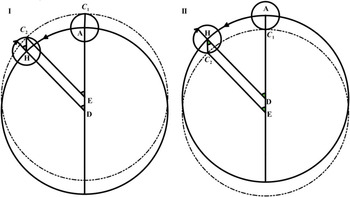
In Nihāya and Ikhtiyārāt Shīrāzī presents a new simple model, to solve the problem of the non-uniform motion.Footnote 55 This model involves two spheres: a deferent sphere with center D, carrying another sphere with center H on its circumference (Fig. 16). Shīrāzī proves that if the second sphere rotates with the same speed as the deferent, but in the opposite direction, the point C1, on the circumference of the second sphere, would move on a circle whose center E is the center of the uniform motion (ED = HC1). Since the angles D and H are always equal and ED = HC1, the quadrangle C2HDE would always be an equilateral, and consequently angles D and E are equal and therefore they change uniformly.
Shīrāzī’s Simple Model.

In Ikhtiyārāt, Shīrāzī presents two versions of this model:Footnote 56 (1) if at the moment when the center of the small sphere, A, is at the apogee, the point C1 is above the apogee, the center of the uniform motion E will be above the deferent center D (Fig. 16.I); (2) if at the moment when the center of the small sphere, A, is at the apogee, the point C1 is below the apogee, the center of uniform motion E will be beneath the deferent center D (Fig. 16.II).
The first version of Shīrāzī’s simple model reminds us of the model Abū ʿUbayd al-Jūzjānī puts forward in his Tarkīb al-aflāk Footnote 57 to solve the problem of the non-uniform motion of the superior planets.Footnote 58 Realizing this similarity, Shīrāzī mentions the difference between them: the small sphere of Jūzjānī’s model rotates in the same direction as the deferent does (Fig. 17.II),Footnote 59 while, in Shīrāzī’s own model, this sphere rotates in the opposite direction (Fig. 17.I).Footnote 60 Shīrāzī criticizes this model, because the angular speed of the point C on the circumference of the small sphere of Jūzjānī’s model is not uniform relative to E and this model cannot solve the problem. Many years later, Shīrāzī, in his Fa‘altu fa-lā talum,Footnote 61 states that Jūzjānī disgraced himself by producing a false model which is an obvious mistake and a grave error.Footnote 62 Contrary to Shīrāzī’s account of Jūzjānī’s model, Saliba interprets Jūzjānī’s text as representing a model exactly similar to Shīrāzī’s simple model. This misinterpretation may be due to the difficulty of the text.
I. The First Version of Shīrāzī Simple Model; II. Jūzjānī’s Model.

Although in his Nihāya and Ikhtiyārāt, Shīrāzī incorporates this simple model into his models of superior planets and Mercury, he criticizes it in Tuḥfa. The problem with this model, as Shīrāzī realizes, is that although the motion of the point C is uniform with respect to equant point E, the point C moves on the circumference of a circle whose center is E too, rather than the deferent center D. But in Ptolemaic planetary models the center of the uniform motion is different from the center of equal distance (i.e. deferent center). Excusing himself for his previous incorporation of this model, he writes:
Knowing how this hypothesis necessitates these matters, we have used it in our books without referring to them as a test of intellects of the intelligent, [to recognize] if they pay attention to it or to some of it.Footnote 63
One may not be sure of Shīrāzī’s sincerity, especially when, after presentation this model in Nihāya and Ikhtiyārāt, he does not hesitate to show his satisfaction by praising his model or quoting some verses of Quran to thank God.Footnote 64 In addition to that, he modifies some of Nihāya manuscripts, as we shall see, to eliminate his mistake.
Shīrāzī’s Second Simple Model (the Oscillating Model)
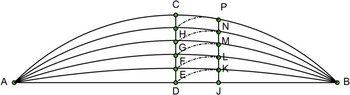
Shīrāzī’s model for solution of the oscillation problem is a modified version of the model already presented by Ibn al-Haytham in his treatise Fī ḥall shukūk ḥarakat al-iltifāf:Footnote 65 In place of joining the poles of the inner sphere to those of the epicycle sphere, a point on the equator of the epicycle is jointed to a point on the equator of the inner sphere. As the latter moves on an arc (which is approximately an elongated 8), the equator of the epicycle oscillates (Fig. 18) and consequently the epicycle itself oscillates, without having any noticeable side effect in other directions.
Shīrāzī Oscillating Model.

To justify this model, Shīrāzī argues in the following way: suppose that the semicircle ADJB is half of the equator of the outer sphere and ACPB is half of the equator of the inner sphere (Fig. 19). Because of the rotation of the outer sphere, point C goes to P, while the rotation of the inner sphere brings it back to H. Similarly point H goes to N following the movement of the outer sphere while at the same time it goes back to G following the movement of the inner sphere. Accordingly the point C traces the arc CD and the equators coincide with each other. If the perigee of the epicycle (which is a point on its equator) is jointed to the point C, the epicycle equator would oscillate while C traces the arc CD.
Shīrāzī’s Planetary Modeling Process

Without presenting any proof, Shīrāzī seems to believe that if the inner sphere is eccenter with the outer sphere, the epicycle would not oscillate in a uniform manner. This, he thinks, is a requisite of any satisfactory planetary model, while the curvilinear version of Ṭūsī Couple fails to do so. He calls this simple model “Aṣl al-Mumīla” and involves it in all of his models.
Shīrāzī’s Planetary Modeling Process
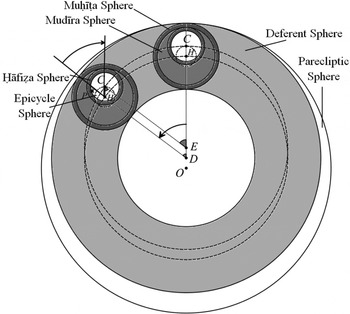
In Nihāya and Ikhtiyārāt, Shīrāzī, not realizing yet the difficulties with his first simple model, applies its second version along with his second simple (oscillating) model for the superior planets;Footnote 66 the former to solve the equant problem and the latter to cause the epicycles to oscillate. As it is shown in Figure 20, the outer sphere with center H (called Muḥīṭa) plays two roles: to carry the epicycle according to Shīrāzī’s first simple model and to cause the equator plane of the epicycle to oscillate in latitude together with another sphere (called Mudīra) according to Shīrāzī’s second simple (oscillating) model. Moreover, Shīrāzī brings in another sphere with center C (called Ḥāfiẓa) to undo the additional motion of epicycle due to the added spheres.
Shīrāzī’s Model for the Superior Planets in Nihāya and Ikhtiyārāt.

After presenting this model in Nihāya, he adds:
This is the figure of the solid spheres of each one of these three [planets …] which does not correspond to what we have chosen, because the way we conceive it is something else. It is as follows: we suppose … Footnote 67
The phrases in bold face do not exist in Tabriz manuscript (copied in Shiraz, Ramaḍān 683 A.H./November 1284)Footnote 68 and are added in the margin of Köprülü manuscripts (681 and 683 A.H.), they are included in the body of the text in other manuscripts, except the Malik manuscript which lacks “not”.Footnote 69 According to the end phrase of the Köprülü manuscript (MS 957), it is copied from the original manuscript and is read aloud to the author (probably in Sīwās). It seems that the author, after finishing his Nihāya, realizing the problems of this model, changed his mind and provided a revised version promptly. This conjecture agrees very well with what one finds in Tuḥfa.Footnote 70 Nevertheless there is no sign of revision in the manuscripts of Ikhtiyārāt.
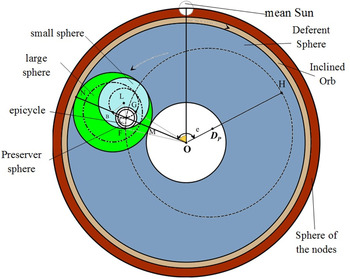
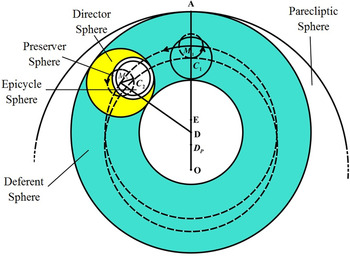
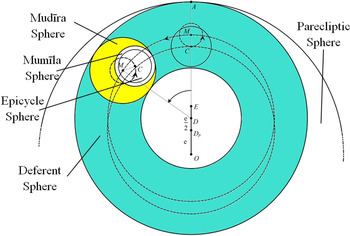
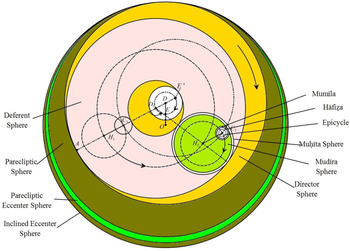
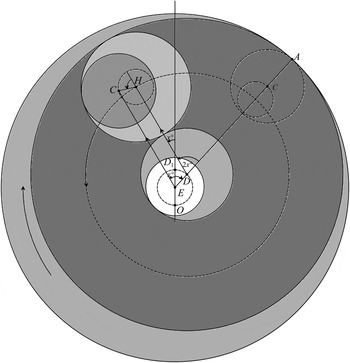
In the years following the redaction of Nihāya and Ikhtiyārāt, Shīrāzī realizes the difficulties of his first simple model and presents a different model for the superiors in Tuḥfa. This model is nothing more than the ʿUrḍī’s model for the superiors (Fig. 21);Footnote 71 except that Shīrāzī adds a sphere (called Mumīla) with center C which, together with the sphere Mudīra (to the center M) causes the equator plane of the epicycle to oscillate in latitude, according to his oscillating model.Footnote 72
Shīrāzī’s Model for the Superior Planets in Tuḥfa.

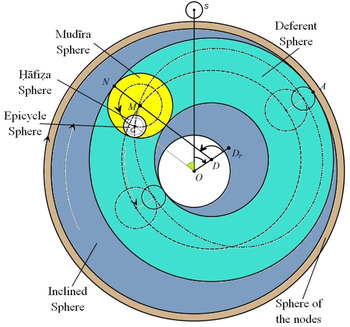
To solve the equant problem for the lunar model, Shīrāzī, in Nihāya and Ikhtiyārāt, employs the second version of ʿUrḍī simple model and displaces the deferent center D to a point halfway between O and DP (ODP is the distance between the center of the universe and the Ptolemaic deferent center).Footnote 73
In this model, the sphere with center M (called Mudīra) carries the epicycle, according to ʿUrḍī simple model, in a uniform speed relative to O. Since the epicycle rotates around itself by the motion of Mudīra, Shīrāzī adds another sphere (called Ḥāfiẓa), to the center C, containing the epicycle, whose role is to undo the extra motion of epicycle in opposite direction of Mudīra. After presenting his lunar model in Nihāya, he adds:
And this is the figure of its spheres not according to what is chosen, since there is no need for Ḥāfiẓa.Footnote 74
The phrases in bold face do not exist in Tabriz (fol. 121a) and Malik (fol. 107b) manuscripts and are added in the margin of Köprülü manuscripts (fol. 77b), they are included in the body of the text in other manuscripts. These facts support our conjecture that, after realizing his mistakes in Nihāya, Shīrāzī prepared a second version of his Nihāya. Although Shīrāzī presents in his Tuḥfa the same model for Moon we find in Nihāya and Ikhtiyārāt; he eliminates the Ḥāfiẓa and changes the epicycle velocity to undo the extra motion of epicycle produced by Mudīra.
Shīrāzī claims that the difficulty of the lunar epicycle oscillation in longitude, which is due to prosneusis, needs no solution. The argument he proposes in support of this claim does not seem sound.Footnote 75 Ṣadr al-Sharīʿa (d. 1346/1347), a scholar from the next generation, solves this problem by adding another sphere to Shīrāzī's lunar model.Footnote 76
Because of the problems which beset, in his view the models already put forward, for Mercury, Shīrāzī presents a series of models for this planet. As mentioned above, Ṭūsī in his Tadhkira could not develop a model for Mercury involving Ṭūsī couple. The reason is that the distance between the deferent center of Mercury and the equant point is variable, while this does not happen in other Ptolemaic models. He writes:
As for Mercury, it has not yet been possible for me to conceive how it should be done. For it is difficult to conceive what could cause the motion to be uniform about a point whereby the moved object in its motion toward and away from it is composed of multiple motions.Footnote 77
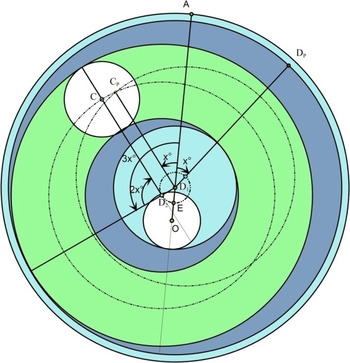
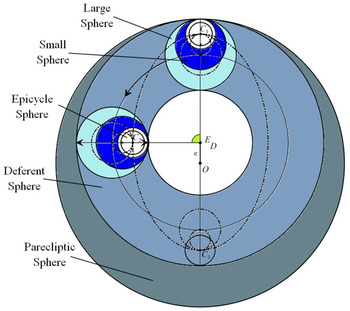
After quoting this phrase in Nihāya, Shīrāzī presents a model for Mercury involving Ṭūsī couple. He supposes a deferent to the center E and a Ṭūsī couple embedded in it (Fig. 22).Footnote 78 The size of the large circle of Ṭūsī couple is GC1 = 3 (= Mercury eccentricity) and its speed is twice the deferent speed. The deferent moves the Ṭūsī couple which in its turn causes the epicycle center to oscillate on a line. Consequently the epicycle center moves uniformly with respect to point E. (The resultant path is an oval-shaped figure to the center E).
Shīrāzī’s Lunar Model.

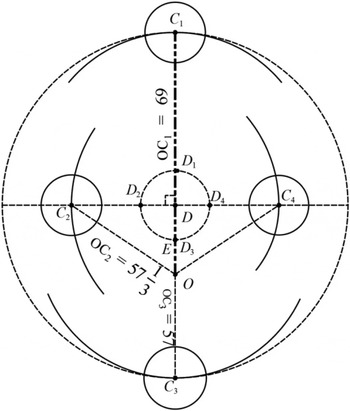
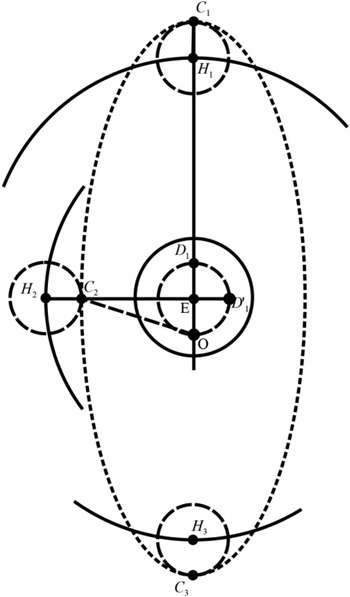
Although the epicycle center is moved toward and away from the equant point E, as it does in Ptolemaic model, its path does not conform to the Ptolemaic path of epicycle center. Shīrāzī considers four key points of this path (Fig. 23): apogee C1, perigee C3 and the quadrants C2 and C4, whose distances to the Earth in Ptolemaic model are C1O = 69, C3O = 57 and C2O = C4O = 57 1/3; where OE = 3 and C1D1 = 60. Since these distances in Shīrāzī's first model are C1O = 66, C3O = 60 and C2O ≈ 57(where DG = 60), they do not accord with Ptolemaic values. Shīrāzī presents this model only in Nihāya to show, contrary to Ṭūsī’s view, the possibility of developing a model involving the Ṭūsī couple.
Shīrāzī’s First Model for Mercury involving a Ṭūsī Couple (Nihāya).

Shīrāzī’s Second Model for Mercury
In Nihāya and Ikhtiyārāt, Shīrāzī develops his second model for Mercury involving the first version of his first simple model to solve the equant problem and his second model for the oscillations of the deferent and epicycle.Footnote 79 Consequently, two spheres are needed to cause the director sphere to oscillate in latitude and four spheres are needed to cause the epicycle equator to oscillate in two directions, as it is necessary in Ptolemaic model.
In Figure 25, the deferent carries another sphere with center H (H1C1 = 2e) embedding an epicycle. According to Shīrāzī’s first simple model, the epicycle center C would rotate uniformly relative to the point E′. In Ptolemaic Mercury model, the deferent center rotates by an additional sphere (with center D1) called “the director”. Consequently, in Shīrāzī’s model the deferent sphere is carried by the director and accordingly the point E′ rotates as well, while the center of uniform motion has to be fixed at the equant point E. After presenting this model in Nihāya he adds:
And these are two figures of solid spheres of Venus and Mercury as it is imagined on planes not according to what we have chosen.Footnote 80
Distances of Mercury Epicycle Center in Four Key Points to the Earth O in Ptolemaic Model.

Shīrāzī's Second Model for Mercury Involving his Simple Model (Nihāya and Ikhtiyārāt).

The word “not” (lā) does not exist in Tabriz (fol. 126a) and Malik (fol. 112a) manuscripts, but appears in the body of the text in Köprülü 956 and the remaining manuscripts. This revision is in line with the previous ones mentioned above. In Ikhtiyārāt, Shīrāzī tries to develop another model, which Nihāya lacks, without confessing the difficulty of this model due to involvement of his first simple model.
Shīrāzī’s Third Model for Mercury
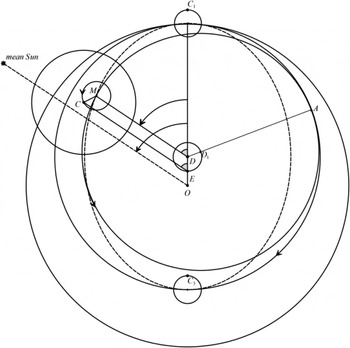
In Ptolemaic model of Mercury, the epicycle center rotates, with a speed equal to the Sun's mean motion, by the motions of the deferent and the director. In his third model, Shīrāzī supposes that these two spheres play together the role of one deferent sphere in the second version of ʿUrḍī’s simple model and move the circle M (MC = e = 3) uniformly with a speed equal to the Sun's mean motion (Fig. 26).Footnote 81
Shīrāzī’s Third Model for Mercury (Ikhtiyārāt).

Shīrāzī concludes that, according to the second version of ʿUrḍī simple model, the epicycle center moves uniformly with respect to the equant point E. Nevertheless the path of the epicycle center C of this model is not identical with Ptolemaic path of epicycle center (Fig. 27), because the distances between the epicycle centers and the Earth in Shīrāzī’s model, in the key points, do not accord with the same distances in Ptolemaic model.
 $$\eqalign{& {\rm C}_1 {\rm O}{\rm} = {\rm} {\rm OE}{\rm} + {\rm} {\rm ED}{\rm} + {\rm} {\rm DD}_1 + {\rm} {\rm D}_1 {\rm A}{\rm} + {\rm} {\rm MC}{\rm} = {\rm} 72, \cr & {\rm C}_3 {\rm O}{\rm} = {\rm} {\rm D}_1 {\rm A}{\rm} -{\rm} {\rm OE}{\rm} -{\rm} {\rm MC}{\rm} = {\rm} 54,} $$
while Ptolemaic values are C1O = 69 and C3O = 57.
Shīrāzī’s Third Model for Mercury vs. Ptolemaic Model.

Although Shīrāzī, while writing Ikhtiyārāt, was aware that the path of epicycle center is not a true circle, he did not see it as a difficulty. He states:
And all the difficulties is solved such that no excuse is needed, and this is due to the subtle mind and the strange imagination which is proper to us; “Praise be to God, who preferred us above many of His servants!”Footnote 82 […] The orbit of Muḥīṭa center (M), in this case, is not a true circle concenter with the director, since it goes toward and away from it; but this is not a difficulty, since the desired uniform motion of the Muḥīṭ a center with respect to director center is obtained […].Footnote 83
These words show, as mentioned earlier, that during writing Ikhtiyārāt, Shīrāzī did not realize yet this difficulty. Nevertheless he notes that he has a half-made model in mind and he would present it somewhere else.Footnote 84 After 4 years a modified version of this model appears in Tuḥfa.Footnote 85
Shīrāzī’s Fourth Model for Mercury
To solve the problem of the distance between epicycle center and the Earth, Shīrāzī has to find a procedure to add 3 units, at perigee, to and subtract 3 units, at apogee, from this distance. He employs a Ṭūsī Couple with radius 3 units which includes the Muḥīta and moves it up and down. When the center of Ṭūsī couple is at the apogee, it brings the Muḥīta center 3 units closer to the Earth and when it is at the perigee, it brings the Muḥīta center 3 units farther. Consequently the distances C1O = 69 and C3O = 57 are in agreement with Ptolemaic values (Fig. 28).
Shīrāzī’s Fourth Model for Mercury (Tuḥfa).

Shīrāzī’s Fifth Model for Mercury
Realizing the difficulties of his simple model, Shīrāzī abandons his second model for Mercury and develops, through a modification of Ptolemaic model, a new model in Tuḥfa, not involving his simple model.Footnote 86 Shīrāzī applies the first version of ʿUrḍī’s simple model and replaces the position of the director center to the equant point E. Consequently the deferent center (D) rotates by the rotation of the director on a circle around E and the epicycle center would move uniformly relative to E (Fig. 29).
Shīrāzī’s Fifth Model for Mercury (Tuḥfa).

The distance between the Earth and the epicycle center at apogee accords with the same distance in Ptolemaic model C1O = 69, while this distance at the perigee (C2O ≈ 55 1/2) and quadrants (C3O = 63) does not accord with Ptolemaic values (C3O = 57 and C2O = 57 1/3) (Fig. 30). This difficulty leads Shīrāzī to abandon the modification of this model and develop a totally different one.
Path of the Epicycle Center in the Fifth Model of Mercury.

Shīrāzī’s Sixth Model for Mercury
E. S. Kennedy presented, for the first time, Shīrāzī’s last model for Mercury,Footnote 87 without paying attention to his previous models as a gradual process, which may explain why so many spheres are employed in this model. Although Kennedy's illustration using rotating vectors shows the various motions, it does not illuminate the physical nature of planetary models.
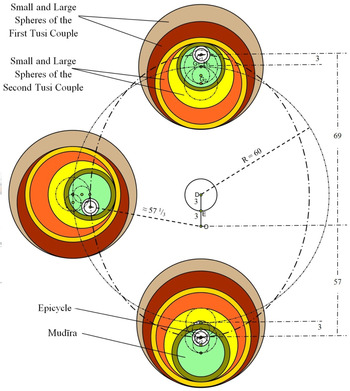
To illustrate Shīrāzī’s path to this model, one may put his previous models together. He has two criteria for his modeling for Mercury: (1) distances between epicycle center and the Earth in four key points; (2) uniform motion of the epicycle center with respect to equant point. Of these criteria, he could achieve the former only by his fourth model and the latter by his first and fifth model. Consequently he combines these three models in one model. He eliminates the director sphere from the fifth model and replaces it by one deferent sphere.Footnote 88 A Ṭūsī couple plays the role of the director to move the epicycle center toward and away from the Earth. Another Ṭūsī couple, according to the fourth model, combined with a second version of ʿUrḍī’s simple model, rotating the epicycle center uniformly with respect to the equant point E, adjusts the distances between the epicycle center and the Earth (Fig. 31). The result is a model including seven spheres as following: two Ṭūsī couples, a Mudīra, a deferent and an epicycle. Adding these spheres to six spheres for the deferent and epicycle oscillations in latitude, two Ḥāfiẓas for each Ṭūsī couple, a deferent and an epicycle, the number of the spheres amounts to seventeen!
The Sixth and the Last Shīrāzī’s Model for Mercury.

Shīrāzī’s Second Model for Oscillations in Latitude
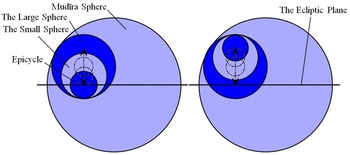
Shīrāzī, not only puts forward new models for Mercury, but also presents a new model for the oscillations in Tuḥfa.Footnote 89 Although this model does not reduce the number of the spheres, it eliminates any probable side effect of the previous models for oscillation in longitude. Shīrāzī supposes a Ṭūsī couple in the Mudīra sphere whose back and forth motion is perpendicular to the plane of ecliptic (Fig. 32). It can simulate the oscillation of the deferents of Mercury and Venus in latitude by forcing the epicycle to oscillate up and down; however it does not produce the non-uniformity of these oscillations.
Shīrāzī’s Second Oscillation Model (Tuḥfa).

So far we presented the role of Shīrāzī’s consideration on the previous models and his own models based on what we said of the model building process in 13th century. Although Ṭūsī and ʿUrḍī’s models were almost valid, they could put forward no satisfying model for Mercury; Ṭūsī admitted not to be able do so and ʿUrḍī’s model for Mercury was not without observational difficulties. The latter never even tried to present a model for oscillations. Although some of Shīrāzī’s models in his Nihāya were not acceptable, he could present some valid models for all the planets in his Tuḥfa. Nevertheless his models were inspired from Ṭūsī and ʿUrḍī’s simple models. Although his last model for Mercury in Tuḥfa solves the problems and is in harmony with the Ptolemaic observations and natural principles, it is not satisfactory, due to numerous spheres it involves. Consequently there were some motivations yet for the next generation to continue the work in this field.
The number of the extant manuscripts of Tuḥfa, compared to Nihāya and Ikhtiyārāt, shows that this book was considered by the later generations as a more satisfying and comprehensive work. Nevertheless they continue the non-Ptolemaic model building tradition of Tuḥfa and Ṭūsī’s Tadhkira by revising Shīrāzī’s models or presenting new models inspired from them.Footnote 90 Even astronomers, like Ghiyāth al-Dīn al-Kāshī (d. 1429), who did not participate in the non-Ptolemaic modeling tradition, were attracted to this scientific tradition. In his letter to his father, he writes:
After a while of my entrance [to Samarqand], there were some problems which were shared in Tuḥfa, Nihāyat al-idrāk, Mawlānā Niẓām al-Dīn Nīsābūrī’s Commentary of Tadhkira and gloried Sayyid Sharīf [Jurjānī]’s Commentary of Tadhkira, but all wrong. This servant [ = I] presented this issue in a meeting of His Majesty [Ulugh Beg]. It was received by all the scientists viva voce. Some people at the back [of the meeting] protested saying that how someone criticizes what the great scholars admitted, it has to be proved.Footnote 91
This quotation shows that the Ṭūsī and Shīrāzī’s scientific tradition continued through commentaries of Ṭūsī’s Tadhkira. There are many extant manuscripts of Tadhkira and Tuḥfa from 15th century Shiraz, Herat, Samarqand, Isfahan and Mashhad.Footnote 92 Nevertheless this tradition never converged to a series of standard non-Ptolemaic models. Contrary to Shīrāzī’s purpose to put forward the ultimate true models, the divergence of the later generation models disappointed the scientists. The non-Ptolemaic models never appeared in the standard abridged Hayʾa books and never were accepted widely. Abū Ṭālib Ḥusaynī, a Persian scholar of eighteenth century living in India, summarizes and criticizes the non-Ptolemaic modeling to defend the new western astronomy as follows:
The first person who decided to solve the problems was Abū ‘Ubayd Jūzjānī […] and he proved a hundred and twenty spheres, but by deep consideration it is clear that his solution is erroneous. Afterward Ibn al-Haytham Miṣrī [sic] decided to solve some of these problems, but [his solution] also is not without difficulty. Later on Khwāja Naṣīr al-Dīn Ṭūsī and Muḥyī al-Dīn MaghribīFootnote 93 did so with difficulty and much toil, but their error is obvious to the intelligent people. And ‘Allāma Shīrāzī proposed nine solutions to solve [the problem of] the equant point and then he confessed to invalidity in eight cases, describing seven of them and with holding the eighth to test the intellects of the intelligent people, as he says. And he supposed the ninth one to be satisfying, while it is not without failure as well. […] It is worth noting that these problems are due to the existence of the spheres.Footnote 94
He concludes that to solve the problems of the Ptolemaic models, it is necessary to omit the physical spheres as did by the new western astronomers such as Brahe and Kepler. That is the way non-Ptolemaic model building tradition undesirably showed the inability of Ptolemaic models and opened a way to acceptance of new astronomy in the East. Nevertheless the proposing of a solution to the equant point was one of the motivations which led Copernicus to develop new astronomy, because his models involved physical spheres and inevitably had the same problems as the non-Ptolemaic models of Islamic astronomers.
Acknowledgement
I would like to acknowledge the guidance and support of my supervisor Dr. Hossein Masoumi Hamedani. I would also like to thank Dr. Jamil Ragep for his kind support of me as a visiting scholar at McGill University, Dr. Asghar Ghaedan, the ex-director of the Institute for the History of Science, my dear friends Dr. Kaveh Niazi, Dr. Mehdi Nasrin, Dr. Hassan Amini and Mr. Hadi Tabatabaee for their helps. Thanks also to the Staff of Majlis Library, Malik Library, Astan Quds Library, British Library, University of Tehran Library and Tabriz Library. To my wife, Dr. Fatemeh Arbabifar, who edited the draft of this paper, I can only offer my humble gratitude for her love and joy that she provided me.