DEFINING THE SAY SLATE CERAMIC GROUP IN NORTHERN YUCATAN
The ceramic ware most characteristic and easily identifiable of the three complexes that span from the Late Classic to the early Postclassic period in northern Yucatan is known as Slate Ware. Characterized by a frequent use of volcanic ash as temper, the ceramic's innate strength and quality ensured its continuing importance in the region for six centuries.
While the Cehpech ceramic complex of the Terminal Classic period (associated with Muna Slate group-Puuc Slate Ware) and the Sotuta Ceramic complex (associated with Dzitas Slate group-Chichen Slate Ware) have been defined and separated since the earliest ceramic studies in the area, a clear identification and definition of Motul Ceramic complex slate ware eluded northern Yucatan ceramic studies for many years. The earliest of the region's slate wares, the Slate Ware of the Motul Ceramic complex (Late Classic period)—sometimes referred to as early Slate Ware—has been recently defined (Boucher Reference Boucher1992; Carrasco and Boucher Reference Carrasco, Boucher and Miranda1990; Chung Seu Reference Chung Seu2000; Chung Seu et al. Reference Chung Seu, Morales and Arenas1998; Pérez de Heredia Puente Reference Pérez de Heredia Puente1998, Reference Pérez de Heredia Puente2004a; Varela Torrecilla Reference Varela Torrecilla1998).
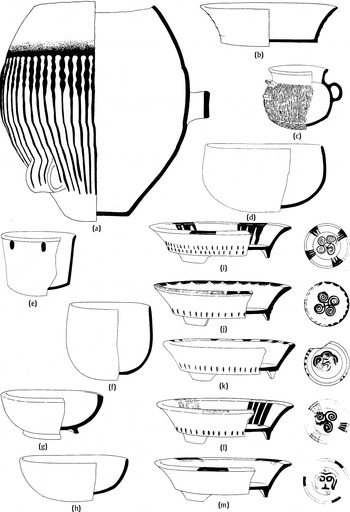
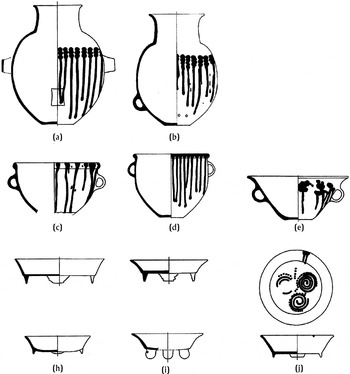
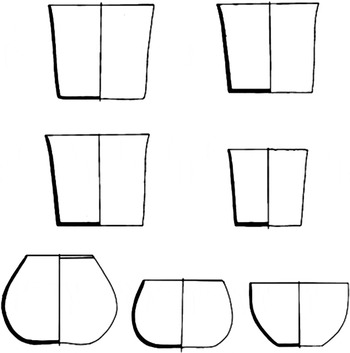
The existence of a Slate Ware preceding Puuc Slate Ware was first noted by George Brainerd (Reference Brainerd, Hatt, Fisher, Langebartel and Brainerd1953) in the Xkyc Cave, and later in the Dzebtun collection (Brainerd Reference Brainerd1958). Commenting on the Dzebtun collection (see Figure 1) Brainerd (Reference Brainerd1958:180, see also legend to Figure 35) stated that:
Dzebtun collection (Brainerd Reference Brainerd1958:Figure 35).

although most of the vessels are easily classifiable as Florescent, there are various reasons why it should be placed very early in the stage … comparable sherds come from Regional or Regional-Florescent transition deposits. The basal break bowls i-l with slab legs and thumbed decoration are closest to those from Yaxuna, fig. 10, d-f, which occur in collections judged early Florescent or Regional-Florescent, also close to those from Dzibilchaltun (fig. 15, a). Thus there are several independent reasons to believe this collection comes from a relatively short time span in the early Florescent stage. This allows us to use it for reference in placement of other vessels, and for criteria of form, ware, and decoration.Footnote 1
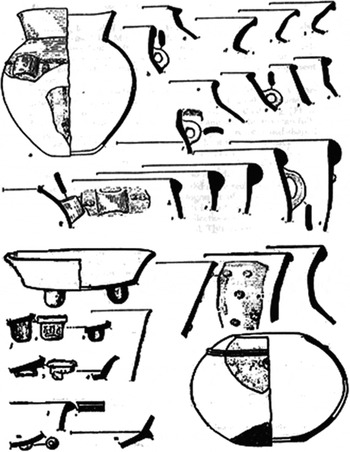
The collection from Actun Xkyic, of comparable date to the Dzebtun sample, is illustrated in Brainerd's 1953 publication (see Figure 2).
Aktun Xkyc collection (Brainerd Reference Brainerd, Hatt, Fisher, Langebartel and Brainerd1953:Figure 1).

Most of the slipped pottery in the Xkyc collection (Lot 71) is of the slateware group which dominates the Florescent culture stage in Yucatan, but there are many indications which suggest that it fits into the early history of slateware and is related, in both form and finish, to the Regional stage monochromes which were made during the period dating from 350 to 750 a.d. in Yucatan (Brainerd Reference Brainerd, Hatt, Fisher, Langebartel and Brainerd1953:117).
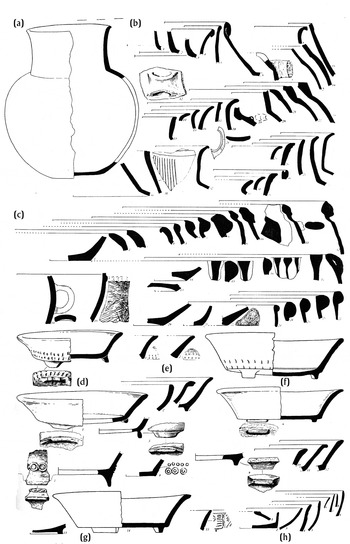
Finally, a collection of sherds and vessels from Yaxuna (Figure 3) also suggested to Brainerd an early development of Slate Wares: “[t]he forms of slateware found here differ in several respects from those of the Puuc sites. The jar forms, concave interior basin lips, and slab bowl legs all argue for an early Florescent dating for most of this assemblage” (Brainerd Reference Brainerd1958:128).
Yaxuna Florescent Slate Ware collection (Brainerd Reference Brainerd1958:Figure 10).

Other examples of the early Slate Ware were later found at different archaeological sites in northern Yucatan. Simmons (Reference Simmons1979:13–15) characterized the early Slate Ware of Dzibilchaltun (mainly from Structure 612) by showing a slip with more variation in color than his corresponding Puuc Slate Ware, noting variations from yellow to brownish red in the same vessel. He noted that no Slate ceramics appear during the Piim complex, which ends by a.d. 600. He, therefore, places the early Slate Ware of Dzibilchaltun in the Copo 1 complex (that is, during the Late Classic period).
At Coba, Robles Castellanos (Reference Robles Castellanos1990) defined the early variety Chemax of the Muna Slate type, placing it in the Blanco complex (a.d. 300/350–500/600), noting that its stratigraphic position seems to indicate an early variety of Slate Ware pertaining to the early Classic period. But to make things more difficult, he notes that it is also associated with materials of the Palmas complex, which corresponds to the Late Classic period.
Robles Castellanos stated that Chemax represents a manifestation that precedes the appearance and standardization of the types of Muna group, and he characterized the slip of bright brown color of the Chemax variety as not being as homogeneous and waxy as that of the Muna variety. According to Robles Castellanos (Reference Robles Castellanos1990:108–109), the Chemax variety appears also at Dzibilchaltun and Yaxuna.
Muna Slate group is reported for the Palmas complex dated a.d. 550/600–700/730 (Robles Castellanos Reference Robles Castellanos1990:136, 182–186). Robles considered that at Coba, the Muna Slate group “starts in the Palmas complex, though in sporadic fashion and with different forms to those of the Oro complex” (Robles Castellanos Reference Robles Castellanos1990:184; Author's translation). Only three forms of the early Muna Slate group are listed by Robles Castellanos (Reference Robles Castellanos1990:184–185), but no explanation for this scarcity of forms is given.
The early Slate Ware of the Late Classic period was first named Say Slate by Sylviane Boucher (Reference Boucher1992). At Sayil, Boucher found examples of early Slate Ware associated with materials characteristic of the Copo I phase of Dzibilchaltun, such as polychromes, Fine Gray Ware, Fine Black Ware, etc. These were collected under sealed floors in an early Puuc-style building at Sayil (Carrasco and Boucher Reference Carrasco, Boucher and Miranda1990:34).
Based on her work with ceramic materials from the Puuc site of Sayil, Boucher presented a review of the possible antecedents of Say Slate, stating that:
at least since 600 a.d …at the end of early Classic and beginnings of Late Classic, in the Puuc region, Dzibilchaltun, Oxkintok, the Chenes area, Edzna and Coba, certain forms of early Slate Ware are present, which can coexist or evolve from the local monochrome traditions of red, brown or buff colors…. Compared with the Florescent Slate Ware, generally the paste of the early Slate ceramics is less hard. It presents spots or variations in color ranging from buff to brown, and has a less translucent slip (Boucher Reference Boucher1992:473; Author's translation).
For Boucher, an indicator of early Slate Ware is the vitrified aspect of the surface, with iridescent areas. Boucher showed how early Slate Ware consistently falls within a Late Classic timeframe at several sites from northern Yucatan (a.d. 600–800). Boucher identifies the characteristic forms of this complex as the following:
Basins with bolster rim and concave interior profile; “Chenes style” Basins; Basins with bolster rims, Basins with striated exteriors without slip, or without slip; Bowls with ring-stand bases and with beveled-out lips; Chultun jars with interior handles or exterior striations below brown slip and Jars with interior concave profile neck and/or hooked rims, among others (Boucher Reference Boucher1992:473).
The work of Carmen Varela Torrecilla (Reference Varela Torrecilla1998) with the ceramics of Oxkintok enhanced our understanding of early Slate Ware. She defined other groups associated with it, such as the Katil Unslipped and the Red Cassasus. In Oxkintok, the early Slate Ware is associated with constructions of the Proto-Puuc B architectural style, pertaining to the Noheb Phase, dated a.d. 600–630 to 713–714 (Varela Torrecilla Reference Varela Torrecilla1998:38). Varela stated that Early Slate Ware:
Presents many traits of Slate Ware, but has not yet acquired the uniformity in surface treatment, keeping some brightness, a greenish hue and many firing spots indicating a period of experimentation with new techniques of production. On the other hand, it retains forms clearly reminiscent of earlier periods (such as basal-break silhouettes, annular supports, etc. (Varela Torrecilla Reference Varela Torrecilla1998:41; Author's translation).
Varela offered another name for the early Slate Ware: Sat Slate Ware. Since I follow Say as the name for the early Slate group, I will use Sat as the name for the early Slate Ware. I also use Say as the name for the early Slate Ware undecorated type, and I reserve the name Chemax (proposed by Robles Castellanos as a variety) as the name for the type Black-on-Slate of the early Slate Ware (see the list of Yabnal-Motul ceramics at the end of the text).
In summary, the early Slate Ware of northern Yucatan is easily recognizable by form, slip, and other modal traits, and is generally dated for the Late Classic period (a.d. 600–800) except in the case of Coba, where it is not clear.
THE SAY SLATE GROUP AT CHICHEN ITZA
The Motul Ceramic complex of the Late Classic period was not recognized at Chichen Itza until 1997. In that year I carried out an analysis of the collection of ceramic fragments recovered from the Sacred Well during the 1960 explorations by the Instituto Nacional Anthropología e Historia (Pérez de Heredia Puente Reference Pérez de Heredia Puente1998). The identification of this early complex confirmed for the first time a Late Classic period occupation of the site. Later excavations by the Chichen Itza Project have increased our knowledge of this complex.
The Say (early) Slate group at Chichen Itza includes the types and varieties shown below. The incised, gouged, applied, and unslipped types remain unnamed; that task will be completed in a future work on the typology of Chichen Itza's ceramics.Footnote 2
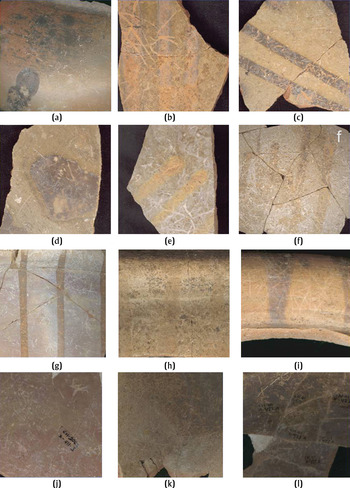
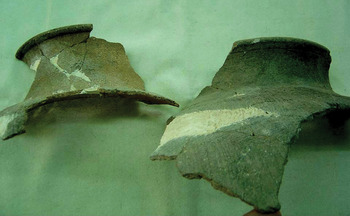
The Say Slate group of Chichen Itza is characterized by a translucent slip, which highlights the contrasts of the different colors provoked by the usual appearance of spots known as “fire clouds” (see Figure 4a). Fire clouds occur as a result of the vessel's contact with fuel or hot gases during the firing cycle and is strongly associated with open or pit firings (Shepard Reference Shepard1956:92). The relatively poor control of the firing process of the Say Slate group of Chichen Itza results in a wide range of colors grouped around Dull Orange, Dull Brown, and Light Gray, with a great variability in the hues (see Figure 4).Footnote 3 This variability of colors even occurs in the same vessel, particularly in vessels with a greater exposed surface area such as big jars and basins, rather than in smaller forms such as bowls and plates. The stacking system employed during the firing process of smaller vessels may have further reduced discoloration and contributed to a greater tonal homogeneity for these forms (see Figure 4j–l).

Variation in Say Slate group slips and appearance: (a–f) jars; (g–i) basins; (j–l) plates. Photographs by the author.

In the case of Chemax Black on Slate type, the trickled paint makes a distinctive effect because of the frequent loss of the original black color of the design, which ends up in a lighter hue than the slip (see Figure 4). This effect suggests that the painting was applied before the firing. According to Chung Seu (personal communication 2003) this effect is also possibly achieved by a double firing of the vessels: the first firing after coating of the slip, followed by painting, and then the second firing. The second firing would be responsible for the burning of the color of the painted designs, and would render them in a characteristic “negative” effect.
The texture of the Say Slate group at Chichen Itza is compact, even, and smooth, but not waxy. Occasionally, Say Slate vessels from the site may exhibit a metallic sheen visible in the slip of some areas of the vessels (see Figure 4a and 4g). Other times, if the firing temperatures were especially intense, the slip coat may be entirely burned away lending a texture similar to vessels of the Unslipped type (see Figure 4b). This happens more frequently on large forms, such as jars and basins.
The characteristic forms of Say Slate, as based on the collection of complete and restorable vessels recovered by the Chichen Itza Project, are shown in Figures 7 and 15. Other forms, such as grater bowls, small vessels with very restricted mouths, modeled vessels, and miniature forms can be identified from fragments in the sherd collection.
Unslipped vessels of Slate Ware paste are particularly common in this Motul complex, especially in some small forms. It is also frequent to leave the lower parts of big jars and bowls without coating. Shards of the lower parts of those vessels show the Unslipped Slate group texture mentioned above.
So-called “root marks” or “dendritic markings” of light color are frequent in Say Slate Ware. These marks are also evident on the examples of the Unslipped Slate group type. Its causes are as yet uncertain, but according to potter Peter Acadia of Latrobe University (personal communication 2005) they could be the result of an imperfect kneading of the clay.
The paste of Say Slate ceramics is of high strength and permits the creation of forms of large size with very thin walls. Petrography analysis done by Heajoo Chung Seu on Chichen Itza sherds (Chung Seu Reference Chung Seu2000) show that the early Slateware from Chichen contains volcanic glass and volcanic tuff, which is also present in later Slate Wares at the site.
ARCHAEOLOGICAL CONTEXTS OF THE YABNAL-MOTUL COMPLEX AT CHICHEN ITZA
Once the early Say Slate group was distinguished from other Slate groups, it became evident that Motul ceramics are abundant at the site. Additionally, it became clear that many of the slate fragments had been misclassified previously by many ceramics analysts, including myself. For example, body sherds of Slate Ware were frequently misidentified as belonging to the Sotuta Dzitas group or as examples of Cehpech Muna group while diagnostic parts such as rims or slab-legs had been confused with Muna's counterparts. I made the same mistakes at the beginning of my work at the site, but since all collections are still available, I have been able to reclassify the collections and correct most errors.
I present here the ceramic collections that can be considered as Yabnal deposition contexts in order to illustrate the ceramics produced and used at the site during the Late Classic period. Most of the examples date to the late facet of the Yabnal complex. We have not yet found contexts dating to the early facet of the Yabnal complex, nor have we been able to date the beginning of Yabnal complex with any certainty. I provisionally follow the traditional dating for the beginning of Yabnal complex set at approximately a.d. 600 by Robert Smith (Reference Smith1971). Our knowledge of the Late Classic period at the site begins in the middle of the Yabnal-Motul complex. At least three large terraces can be dated to the Middle to Middle/late facet of this complex, with a conservative dating around a.d. 650–750: the terrace under the Initial Series group, the terrace under the Three Lintels Building, and a terrace under the Plaza del Castillo.
The earliest context datable for the Motul complex in our collections comes from a group of six cist burials I excavated beneath the Yabnal-Motul terrace of the Three Lintels group during the 2004 season. These burials can be securely dated to the Middle facet.
Burials in Cists under the Three Lintels Platform
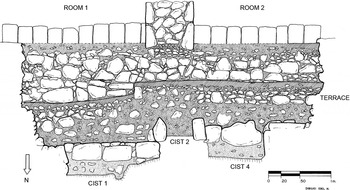
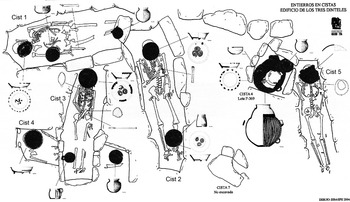
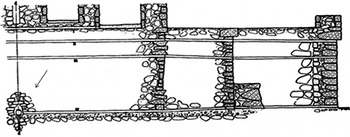
A total of six burials were excavated in 2004 under the terrace on which rests the Temple of the Three Lintels (Pérez de Heredia Puente Reference Pérez de Heredia Puente2004b) (Figure 8). The bodies were disposed of in extended fashion, lying on their backs and arranged in two different directions (see Figures 5 and 6). The oldest burials contain an elderly male and an elderly female (Cists 1 and 6, respectively), were interred with the head facing east, but the bodies themselves were found in a poor state of conservation. The more recent burials are in an upper level, with Cists 2 and 3 partially overlapping the former Cists 1 and 6. This group has the head oriented to the south and consists, from east to west, of a young female (Cist 3), an adult male (Cist 2), an infant inside a big jar (Cist 4), and another young female (Cist 5; identification of sex and age estimate by M. Arias, personal communication 2004).
Cists under the Terrace of the Three Lintels Building. Only three cists are shown in this profile (1, 2, and 4). Note that Cist 2 overlies Cist 1. Drawing by Ildefonso Hoil.

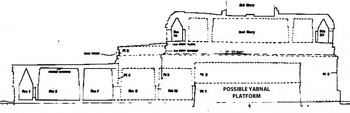
Cists under the Terrace of the Three Lintels Building. Drawing by the author.

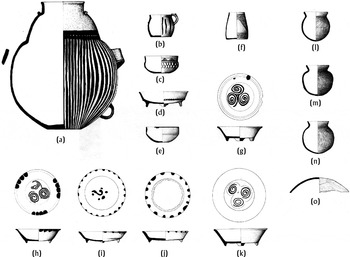
Of utmost interest to the research are the 15 ceramic items found in the cists (see Figure 7). Each male cist contained three vessels, while the women were interred with only two, with the exception of the woman in Cist 5, who only had a big sherd from a jar covering her face. The burial of the infant is formed by three vessels: a big jar lying on its side, with a squared hole in the body made to introduce two bowls, rim to rim, which contained the bones of the child. All of the burials show a bowl (and in the case of Cist 5, a large striated sherd) facedown covering the faces of the deceased; many of the other vessels are situated at the feet (Figure 6).
Vessels found in cists. Located in the terrace under the Three Lintels Building. Drawing by the author.

All of the vessels pertain to the Yabnal-Motul ceramic complex and constitute the best complete collection of the period found at Chichen Itza. Seven different ceramic types are represented: Chemax Black on Slate (Figure 7a, g, h, i, j and k), Cidra Composite (Figure 7b and 7c), Junquillo Impressed (Figure 7d), and Itzimna Red-Orange type (Figure 7e), as well as the Incised type from the Tohopku group (Figure 7f) and the Katil Striated type (Figure 7l, m, n, and o).
It is difficult to date precisely this collection by itself. It evidently represents a fully developed Motul complex and, therefore, should be placed in the middle or middle/late facet.
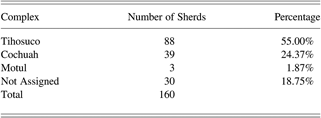
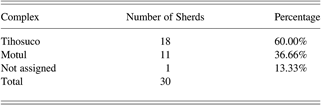
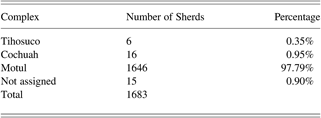
The soil matrix covering the cists contained an important number of sherds and offers an alternative means of checking the dates associated with these burials. As we can see in Table 1, the percentage of Yabnal-Motul ceramics is extremely low. This information can be used to support an earlier, rather than a later, position. A general date in the early/Middle or Middle facet of the Yabnal-Motul complex (ca. a.d. 630–700) seems most likely.
Matrix of Dark Soil Covering the Cists
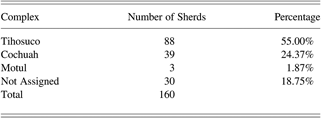
Lots: F-306, F-307
The structural context of the burials, if any, could not be determined. No floor was found directly over them; however, a distinct stratigraphy is apparent in the profiles of the excavation allowing for the differentiation of the burial's covering matrix of soil from the fill of the posterior Yabnal-Motul terrace (see Figure 5). An alignment of stones in the southwest corner of our excavations could indicate the limit of a household platform, but it is too small a section to be certain (see Figure 6).
The Terrace under the Three Lintels Building
The layer of dark soil that covers the cists was in turn covered by an extensive terrace, whose limits have not been fully mapped. Referred to here as the Yabnal-Motul Terrace, it rises 50 to 80 cm over the top of the cists in the area we excavated (Figure 5). The fill is made of a layer of medium size and small size stones and was covered by a stucco floor, which was found intact, strongly supporting the placement of the cists as a pre-Terrace phenomenon.
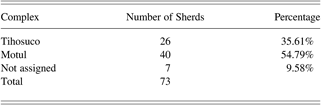
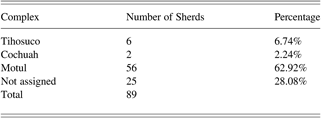
Table 2 shows the ceramic contents of the fill of this terrace as found in Test Pit 1, made in Room 1, while Table 3 shows the ceramic contents of this platform in Test Pit 2, made in Room 2. The contents are similar in both test-pits, dating to the Yabnal-Motul Ceramic complex, but the percentages are different, with Tihosuco more frequent in Test Pit 1 and Yabnal-Motul more abundant in Test Pit 2.
Construction of the Yabnal-Motul Terrace under the Three Lintels Building Test Pit 1, Room 1
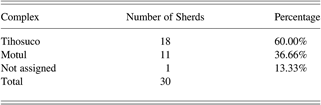
Lots: F-304, F-305
Construction of the Yabnal-Motul Terrace under the Three Lintels Building Test Pit 2, Room 2
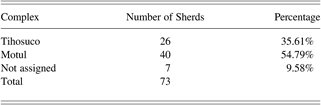
Lots: F-356, F-359
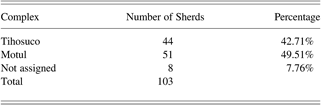
The sum of the contents of both test-pits is shown in Table 4. Here, Tihosuco complex amounts to 42%, while Yabnal-Motul complex is represented by 49%; therefore, I have concluded that the best timeframe for the construction of the Motul Terrace under the Three Lintels Building would be in the Middle, or Middle/late facet of the Yabnal-Motul complex, between a.d. 650 and 700. If correct, this dating will make this terrace the oldest Yabnal-Motul architectural construction dated so far at Chichen Itza.
Construction of the Yabnal-Motul Terrace under the Three Lintels Building Test Pits 1 and 2
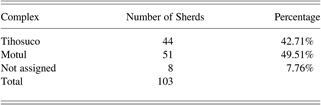
Lots: F-304, F-305, F-356, F-359
The Construction of the Terrace under the Initial Series group
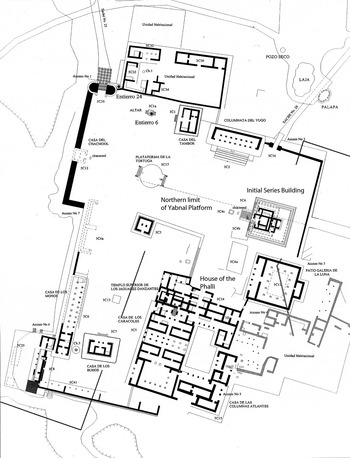
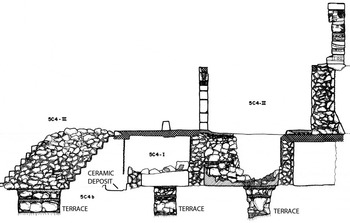
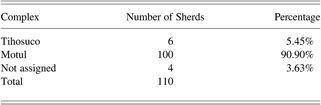
Another terrace at Chichen Itza, this one located underneath the Initial Series group, can be dated to the Yabnal-Motul complex (see Figures 9 and 10). The dimensions of this terrace are not yet well known, but excavations by José Osorio León (2000–2003) under the building of the Initial Series discovered the northern limit of the terrace (Osorio León Reference Osorio León2004a), later tested and confirmed with other test-pits along the northern limit. The ceramic contents of the fill of this terrace, as shown by the sum of the materials of three different test pits excavated under the Initial Series Building (Structure 5C4), is presented in Table 5. The total collection shows a high predominance (90.9%) of the Yabnal-Motul complex.
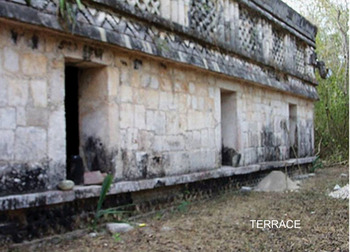
The Three Lintels Building. Photograph by the author.

The Initial Series Building location in the Initial Series group, the northern limit of the Yabnal–Motul Terrace and location of Room 10, House of the Phalli. Drawing by the author.

Location of test-pits in the Initial Series Building (Structure 5C4). The lower level corresponds to the Yabnal-Motul Terrace. Drawing by the author.

Construction of the Yabnal-Motul Terrace under the Initial Series Building (Structure 5C4).
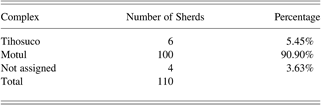
Lots: X415C, X420A, X420B, X421A
We have not been able to determine yet the other limits of this terrace. We do know that it extends to the south below the House of the Phalli (Structure 5C14), based on a test-pit excavated by Luis García (Reference García2003). Although García's excavation produced a smaller collection than that from under Structure 5C4, it shows a very similar frequency for the Motul complex.
Terrace Levels under the Plaza del Castillo (Great Terrace)
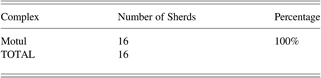
During the excavation of trenches for the boxes of the Light and Sound Show Installation at the Plaza del Castillo (or Great Terrace) in the late 1970s, ceramic materials were collected by Schmidt (Collections CHI-79). These have been analyzed only recently. Many of these test-pits show terrace levels sealed by floors with construction fills of pure Yabnal-Motul complex deposits. In Table 6 only the ceramics of Trench 19 has been considered (see Figure 11). The results of the analysis of these collections were presented recently (Schmidt and Pérez de Heredia Puente Reference Schmidt and de Heredia Puente2006).
Location of Trench 19 of the Light and Sound Show installation. Image edited by the author.

Test-pit 19 at the Terrace of El Castillo, between Floors 3 and 4
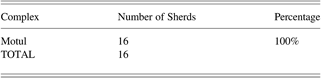
Lots: CHI-79-40
Construction Fill of the House of the Stuccoes (Structure 5C4-I)
On top of the Yabnal-Motul Terrace of the Initial Series group, a masonry building known as the House of the Stuccoes (Structure 5C4-I) was erected (Osorio León Reference Osorio León2004a) (Figure 13). This is the first formal building to be firmly dated to the Late Classic Period found at Chichen so far (Osorio and Pérez de Heredia Puente Reference Osorio León and Puente2001). Other elaborate constructions such as the substructures under the Monjas complex most likely pertain to the same phase. However, the ceramic collections from these Monjas contexts are unavailable.
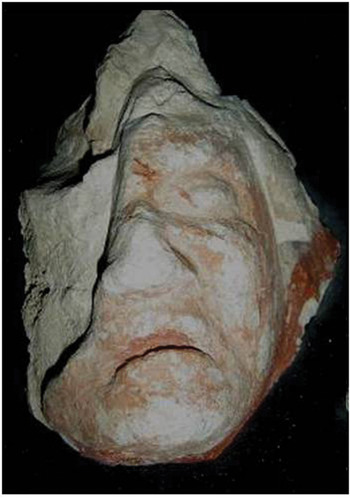
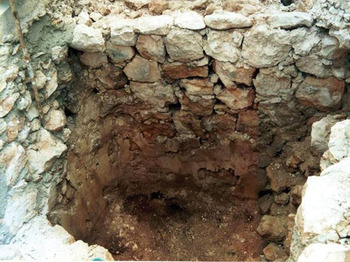
The House of the Stuccoes consists of a small building of three rooms of masonry, with walls constructed of stone and mud, and covered by stucco plaster, as are the floors (see Figure 13). The roof was possibly made of perishable materials (Osorio León Reference Osorio León2004a). The abundant fragments of modeled stucco found in the fill of the building's next phase of construction suggest that a portion of the frieze, or upper wall, was originally adorned with modeled stucco sculpture of anthropomorphic figures (see Figure 12).
Stucco head from the Temple of the Stuccoes. Photograph by the author.

The House of the Stuccoes, Structure 5C4-I; south wall of Room 2. Photograph by the author.

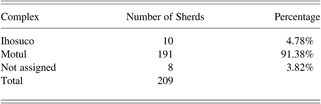
The ceramic materials from the interior of the construction of Structure 5C4-I, shown on Table 7, illustrate a high amount of Yabnal-Motul complex fragments (91.3% of a collection of 209 sherds). We do not know if it was constructed immediately after, shortly after, or much later than the Motul platform. Based on the high frequency of Yabnal-Motul sherds, a date in the very late facet of the complex is reasonable; therefore, I suggest a date between a.d. 750 and 800 for this construction.
Construction of the House of the Stuccoes (Structure 5C4-I), Initial Series group
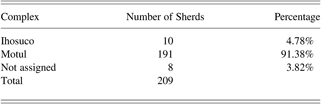
Lots: X415, X415A, X415B, X420, X421
The Destruction of the House of the Stuccoes (Structure 5C4-I), Initial Series group
Our excavation suggests that the House of the Stuccoes was deliberately destroyed in antiquity as much of the structure was razed and its thatch roof burned. Its polychrome stucco decoration was most likely smashed into pieces. On top of the remains, a new building, Structure 5C4-II, was constructed with a more elaborate masonry technique (Osorio León Reference Osorio León2004a; Osorio León and Pérez de Heredia Puente Reference Osorio León and Puente2001).
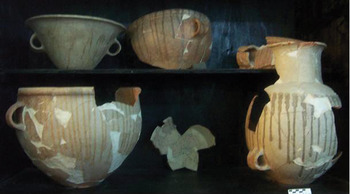
An excellent collection of materials was found lying directly on top of the floor with the largest concentration outside the west façade of the building (see Figures 14 and 15). Given the fact that the next construction phase (Structure 5C4-II) pertains to the following Cehpech complex, it can be reasonably argued that these materials mark the Terminal facet of the Yabnal-Motul complex (see Table 7). I propose a date around a.d. 800–830.
Some Yabnal-Motul vessels from the ceramic deposit on 5C4-I. Photograph by the author.

Complete forms of the Say Slate group from the ceramic deposit on 5C4-I. Drawing by the author.

This deposit consists mainly of ceramic sherds and several restorable vessels with traces of burning shown in Figures 14 and 15. It possibly represents the ceramic inventory of the last occupants of the building before its destruction. The Yabnal-Motul ceramics are mostly of Say Slate Ware, but they also contain an excellent sample of sherds of the Yabnal-Motul Unslipped Ware. The complete vessels are an important collection of forms, which could be considered, for modal seriation purposes, as the end of the evolution of Yabnal-Motul vessel forms. No specialized ritual ceramics were found in this context. The ceramics are mostly utilitarian forms including large jars (Figure 15a and 15b), large basins (Figure 15c, d, and e), and slab-footed plates (Figure 15f, g, h, and j). An example with hollow legs (Figure 15i) is also present. The basin with inverted bell-shape profile in Figure 15e is a very unusual form in the repertory of forms of this period; it will be copied during the early facet of the Cehpech complex.
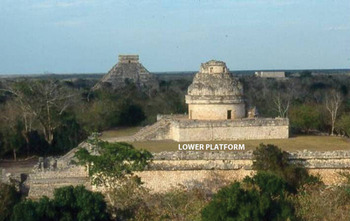
The Construction of the Lower Platform of the Caracol (Structure 3C15)
The Carnegie Institution of Washington excavated the Observatory (Figure 16), also called the Caracol (Structure 3C15), between 1925 and 1931 (Ruppert Reference Ruppert1935; see also the next section of this article). According to the latest analysis of the inscriptions on the Caracol, there are at least three different calendar dates. Only one of these dates, the Hieroglyphic Serpents, can be definitively attached to the Caracol construction with some certainty (Graña-Behrens Reference Graña-Behrens2002; Grube et al. Reference Grube, Lacadena and Martin2003). Of the other two dates mentioned, the earlier appears in Block 9 and dates between July of a.d. 876 and July a.d. 877. The second date appears in Block 17 and falls between May a.d. 884 to May a.d. 885; this date also appears in Panel 1 of El Caracol (Voss Reference Voss2001).
The Caracol Lower Platform. Photograph by the author.

Alexander Voss (Reference Voss2001:157) proposed a possible reading of a.d. 911 for the date pictured in Block 18. If correct, it would place the Caracol as the latest dated monument of Maya-Puuc architecture at the site, but since the date remains in question, I accept here only the two earlier dates. From a stratigraphic point of view, we can say with fair certainty that the First Circular Platform, which antedates the Caracol itself, and the Lower Platform, which antedates the First Circular Platform, must be dated before a.d. 885.
Some of the ceramics excavated at the Caracol were analyzed by Brainerd (Reference Brainerd1958). The ceramics, he states:
[c]onsist almost entirely of fragments accumulated during occupation of the building and in debris left by later visitors. Fortunately for ceramic dating of the main structure of the Caracol, several vessels were found cached during its construction. In the absence of sherds which definitely antedates parts of the construction, these pieces are of prime dating value. (Brainerd Reference Brainerd1958:36)
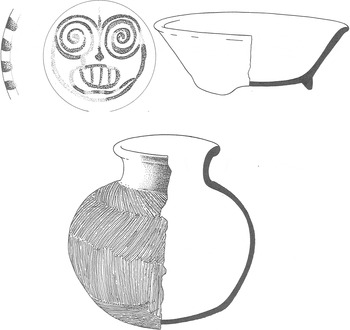
Of the caches found at the Caracol, the most important one is possibly that found “25 cm below the lower platform floor on north side of upper platform, a striated jar and a Medium Slateware bowl” (Brainerd Reference Brainerd1958:36–37) (see Figure 17). According to Brainerd (Reference Brainerd1958:37), “the slab-legged, Medium slateware basal break bowl is very close to the material from Yaxuna, Dzebtun, and Mani, and dates either early Florescent or is a regional variant contemporaneous with, though typologically earlier, than the Puuc pottery.”
Cache found below the lower platform floor on north side of upper platform (Brainerd 1968:Figures 67a, 68a).

I agree with Brainerd's assessment of the bowl, but without a first-hand examination of the vessel, I cannot definitively identify it as either Yabnal-Motul or as Cehpech Slate Ware. The striated jar resembles vessels from the Three Lintels burials and can clearly be identified as a Motul vessel. I can, therefore, refine Brainerd's earlier description of the Caracol cache and state that this cache includes two Yabnal-Motul vessels or a Yabnal-Motul jar and a Cehpech bowl. If both vessels are definitively Yabnal-Motul, then the lower platform of the Caracol will show a construction fill of pure Yabnal-Motul ceramics. However, if the vessels are identified with the second scenario as a Motul jar and a Cehpech bowl, then the lower platform will yield an early Cehpech context. A date around a.d. 830 seems to be somewhere in the middle of both scenarios.
Construction of the First Circular Platform of the Caracol (Structure 3C15)
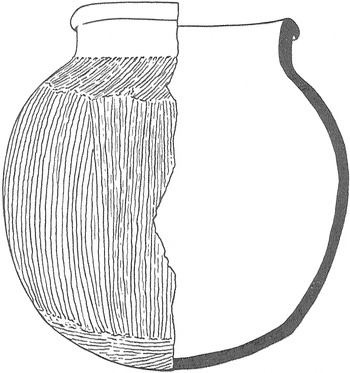
Another cache located on the Caracol was placed “in a cyst in the lower platform at the center of the first circular platform, sealed in place by construction of this platform, an unslipped, striated jar” (Brainerd Reference Brainerd1958:37) (see Figure 18). This jar is almost identical to those found in the cists of the Three Lintels' terrace. The cache's position in the construction sequence of the Caracol (see Figure 19) supports a placement in the late facet of the Yabnal-Motul complex or the beginning of the Cehpech complex; a date close to that in the previous context of the lower platform is therefore recommended (ca. a.d. 830–850).
Cache inside a cist in lower circular platform (Brainerd Reference Brainerd1958:Figure 68e).

Vessel inside a cist inside lower circular platform (Ruppert Reference Ruppert1935:Figure 99).

Construction of the First Platform of the Monjas Building
Some sherds of the Monjas complex were classified by Brainerd (Reference Brainerd1958):
A collection of five sherds which may antedate platform 1 and certainly is not later than platform 2, shows sherds of waxy orange slipped ware similar to certain sherds of the Coba group B period (late Regional). This is faint evidence, but suggests that construction at the Monjas group may have been started at this period, which is strongly represented at Yaxuna (Yaxuna III), not far from Chichen Itza to the south.” (Brainerd Reference Brainerd1958:42, 43)
Although the construction phases of the complex have not yet been securely tied to ceramic dates, because of the loss of collections it is clear that, working backward from the calendric inscriptions of the second story Monjas lintels dated a.d. 880 through to the earliest constructive sequence of the building, the lower substructures enter into the Late Classic period (see Figure 20). It is very possible then, that by the late facet of the Yabnal-Motul complex around a.d. 750–830, this area constituted one of the settlement's focal points. It should not be very surprising that Motul substructures were also to be found under the neighboring platforms of the Red House and House of the Deer.
The Monjas building construction sequence (after Bolles Reference Bolles1977:44).

OTHER YABNAL-MOTUL COMPLEX CERAMIC COLLECTIONS
A collection of ceramics from the Sacred Well was recovered during the 1960s excavations. In 1998 I analyzed the recovered material and identified the presence of early Slate Ware of the Yabnal-Motul complex at Chichen Itza (Pérez de Heredia Puente Reference Pérez de Heredia Puente1998). A total of 2,368 sherds (representing 3.7% of the collection) were classified as pertaining to the Yabnal-Motul complex. The Yabnal-Motul ceramic collection from the Sacred Well is not only important for its quantity, but also for the diversity of ceramic types represented, the most varied found so far in a single context at the site, at 18 different types. Several of these types are not locally produced and can be used to trace possible political and/or trade connections. Other Yabnal contexts are also noteworthy:
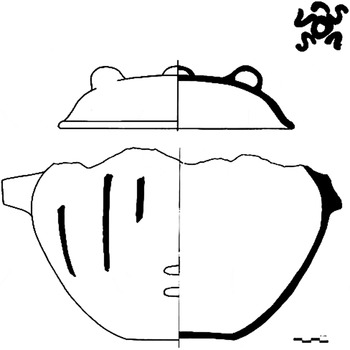
• At the Mayaland Hotel, two vessels were found during the installation of an electric line. They formed part of an infant burial (Pérez Ruiz Reference Pérez Ruiz1996), a basin and a tripod plate. Both vessels show extensive wear, and both form part of the Say Slate group (Chemax Black on Slate type) (see Figure 21). A small frog decorates the interior of the plate in its center.
• The collection of the Three Lintels Building's chultun, reanalyzed in 2004, yielded a total of 4,958 sherds, of which 19% pertain to the Yabnal-Motul complex.
• Chultun Xnaba (Lot G-72) presents an even heavier concentration of Yabnal-Motul ceramics: 635 sherds, which represent 37.9% of the contents of that context. Another chultun with a considerable, but smaller representation of the Yabnal-Motul Ceramic complex is the Chultun del Basurero (Lot G-68), with 294 sherds representing 6.4% of that collection.
• A layer of black soil was found under the East Stairway of the Osario Pyramid that may be a result of a refuse accumulation from an occupation of the area predating the construction of the pyramid. The percentage of Yabnal-Motul ceramics in this layer is high (62.9%) and dates the formation of the deposit to the Middle to Middle/late facet of the Late Classic period (see Table 09).
• Ceramics from Rejollada Poxil demonstrate 74.2% of the Yabnal-Motul complex, at a totel of 72 sherds. On the group of the Cornisas Esculpidas, a surface collection by Perez Ruiz (Reference Pérez Ruiz1993, Lot C50) in the Structures 3F42 to 3F54, yielded a total of 162 Yabnal-Motul complex fragments, representing 19.5% of the sample.
• Several surface collections on the East group or Bóvedas group, also by Pérez Ruiz (Reference Pérez Ruiz1993–1994; Lots C45, C46, C47, C48, C49), taken together, amount to a total of 296 sherds of the Yabnal-Motul complex, representing a 27.5% of the materials of that architectural group.
• Another important collection comes from the group of Structures 3F46, 3F47, and 3F48. Ceramic material of these structures, taken together, amount a total of 178 sherds of the Yabnal-Motul complex, representing a 26.4% of those materials (Pérez Ruiz Reference Pérez Ruiz1993–1994; Lot C51, C52, C53). The group of Structure I of Ikil (Lots M1 to M494), east of Chichen Itza, yielded a collection of 350 Yabnal-Motul sherds (14.4%) (Osorio León and Pérez Ruiz Reference Osorio León and Ruiz2002).
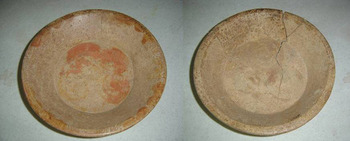
• Finally, mention must be made of two complete plates of Say Slate Ware of the Yabnal-Motul complex excavated by Peter Schmidt in 1985 during the construction of the Tourist Entrance west of the Great Terrace (Figure 22). Both plates are housed at the “Palacio Cantón” Museum in Mérida.
Infant burial from the Mayaland Hotel. Drawing by the author.

Say Slate Ware, tourist entrance area, Chichen Itza. Photograph by the author.

Materials from the abandonment of the House of the Stuccoes, Initial Series Group, lying on top of the floors
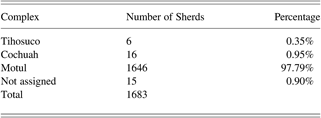
Lots included: X411F, X411H, X411I, X411J, X411K, X411L, X411M, X412C, X413C, X143D, X413E, X425.
Materials from a layer of black soil under East Stairway of the Osario Pyramid
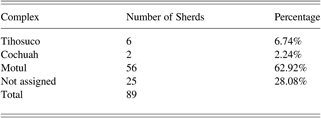
Lot: H-150
OTHER CERAMIC GROUPS OF THE YABNAL-MOTUL COMPLEX AT CHICHEN ITZA
The most varied deposit for the Yabnal-Motul complex is the Sacred Well presented in Context M10. Outside the Say Slate group few complete vessels have been found, so our knowledge comes basically from sherds. A revision of the different wares represented at our collections follows below.
Several small size jars of striated unslipped surface of the Late Classic period are present in the cists under the Three Lintels Terrace (Context M1). In the Substructure of Initial Series Building (Structure 5C4-I), a good collection of sherds of Katil Unslipped type jars of medium and large size was recovered (Figure 23).
Katil Unslipped type. Temple of the Stuccoes, Initial Series Building (Structure 5C4-I). Photograph by the author.

Also in this substructure small sherds were found of an unidentified type of Fine Orange Ware, of Chablekal Fine Gray type, and a Fine Black type whose provenance most likely lies in the region of Tabasco (Sylviane Boucher, personal communication 2003).
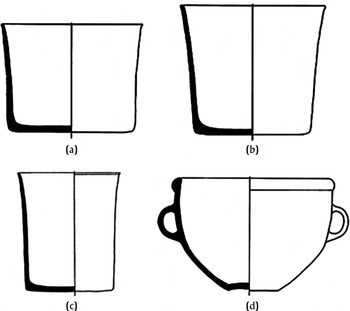
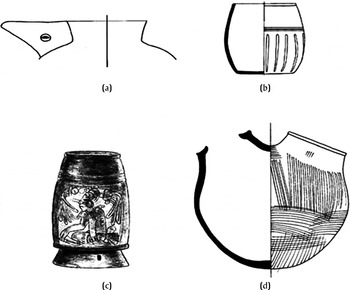
The Casassus Red group is scarcely represented at Chichen Itza so far, and our collection of sherds is still very small. Several vessels have been classified in this group: three vases from the Sacred Well (see Figure 24a, b, and c) and the basin from Burial 6 (Figure 24d).
Vessels of the Casassus Red group. Drawing by the author.

Vases of the Casassus Red group are very similar in form to some examples of Tohopku Thin Slate group also found in the Sacred Well (Figure 25).
Vessels of the Tohopku Thin Slate group. Drawing by the author.

Finally, some imported wares of the Yabnal-Motul complex are shown in Figure 28. In the Sacred Well, imported wares from this period were found, such as the Tres Marías Striated type (Figure 26d) showing connections with south of Quintana Roo and northern Belize, where it is called Aventura type; and also the Tinaja group (Figure 26a and 26b) which shows relations with the Peten area. The vase shown in Figure 26c is an example of a carved Fine Orange vase with an image of characteristic Late Classic style, from the Chultun of Three Lintels. Finally, some Becanchen Brown type sherds, not shown here, are related with the Rio Bec area).
Imported vessels of the Yabnal-Motul complex. Drawing by the author.

CONCLUSIONS
The distribution of Late Classic ceramic traits at Chichen Itza is very wide. The sample includes collections from the Ikil group, the Sacred Well, the Castillo Terrace (also known as the Great Terrace or “Gran Nivelación”), the Terrace of the Osario Pyramid, the group of the Initial Series, the group of the Three Lintels, the group of the Chultun, the Akabdzib Building, the Plazas group, the group of the Alux, the group of the East or the “Bóvedas group,” the group of Sacbe 61, the “Rejollada de la Abuelita,” Structures 3E19 and 4D6, the Red House Building, the Halakal group, the Area of the Tourist Entrance, the group of Sacbe 19, and the Holtun group.Footnote 4
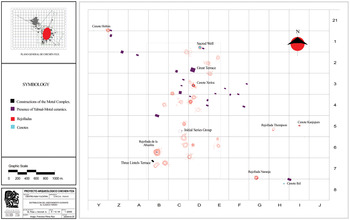
Ceramic materials from the Yabnal-Motul complex are concentrated south of the Sacred Well and around Cenote Xtolok, but this concentration may only reflect the fact that excavations have been more intense in this area. Admitting that the development of the administrative center of the city during the following Terminal Classic period took place in precisely this same area, it is very possible that it was already favored during the Late Classic period. Another residential area is indicated between the Great Terrace and the Bóvedas group.
The significant quantities of Yabnal-Motul ceramics at Chichen Itza point to a long and moderately dense occupation of the site. Despite the construction of large terraces along a north-south axis during the Yabnal-Motul period, the concentration of architecture is not as impressive as at other contemporary sites such as Coba and Ek Balam. Chichen Itza may have been subordinate to one of these larger sites during this period. Collections of the Yabnal-Motul ceramics have also been recovered along the outskirts of the settlement in cenotes, sinkholes, and platforms.
Pure deposits of Yabnal-Motul complex ceramics have been securely identified in the construction fill of several terraces and in the foundation of at least one building. Seven burials and several refuse deposits have provided additional Yabnal/Motul contexts.
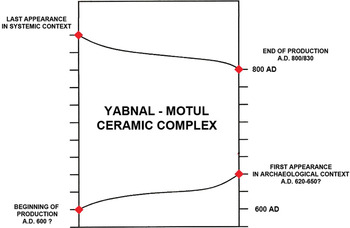
The beginning of production of the local ceramics of the Yabnal-Motul complex is difficult to determine with exactitude (see Figure 27). The first appearance in the archaeological context for the Motul complex, according to our data, is the layer of dirt covering the cists in the Terrace of Three Lintels. This estimate is based on the frequency of Motul sherds, but we lack an absolute dating for this context. Provisionally, I will use the traditional date (ca. a.d. 600) for the beginning of production of Motul ceramics, as proposed by Smith (Reference Smith1971) and corroborated by Simmons (Reference Simmons1979).
Dates of the Yabnal-Motul ceramic complex. Illustration by the author.

Distribution Map of the Yabnal-Motul ceramic complex at Chichen Itza. Map by the author.

The end of production of Motul ceramics is dated here by the beginning of production of Cehpech complex ceramics, which happened at Chichen Itza around a.d. 800/830. As shown in many contexts, residuality of Motul ceramics during the Terminal Classic period is very high.
The Yabnal-Motul complex is characterized by the creation of a ceramic tradition of high-quality pottery: the Slate Ware. The origins of this ceramic tradition are still not very clear. Some antecedents for the Say Slate group have been proposed by Boucher (Reference Boucher1992), but a clear link (transition or substitution) with previous wares has not been demonstrated. Motul sphere ceramics are present throughout the northern plains, suggesting a homogeneous ceramic tradition with many production centers. The cultural continuity or disruption with the previous period is a matter for further research and debate. The most developed architecture during the Late Classic period occurs in the Puuc region, and it is clearly there that this question will be better answered.
The Yabnal-Motul ceramic complex is so far associated at Chichen Itza with the construction of massive terraces and at least one building of crude architecture with modeled and painted stucco decoration (Terrace of the Three Lintels Building, early Terrace of the Initial Series group, levels of terraces at the Plaza del Castillo, Building of the Stuccoes 5C4-1). The beginning of urbanization at Chichen Itza can possibly be traced to this period, but no monumental structures have yet been dated to this complex. Chichen Itza was possibly a very secondary site during this time, and no local hieroglyphic inscriptions can be firmly associated with the Late Classic period. Some carved jades from the Sacred Well bear inscriptions with dates or styles that fall into the Late Classic period (Proskouriakoff Reference Proskouriakoff1974), but they are imported items and their arrival at Chichen Itza, and deposition at the Sacred Well, cannot be dated with certainty.
RESUMEN
Entre los avances en el entendimiento de la historia de la antigua ciudad de Chichen Itza realizados en los últimos años por el Proyecto Arqueológico Chichen Itza-Instituto Nacional de Antropología e Historia destaca la definición de un nuevo complejo cerámico, que se ubica en el periodo clásico tardío, y que ha sido denominado Complejo Cerámico Yabnal-Motul.Footnote 5 Este complejo es correspondiente temporalmente al complejo cerámico Motul de Mayapan.
Las colecciones utilizadas para definir el complejo Yabnal proceden mayoritariamente de excavaciones recientes, y las más importantes incluyen formas completas y restaurables obtenidas de contextos sellados. En general provienen de terrazas y plataformas, y se distribuyen por toda el área que ocupó Chichen Itza en su apogeo, pero también se han encontrado asociadas a la construcción y uso de edificios con cuartos (como por ejemplo la subestructura del Templo de Serie Inicial).
El Complejo cerámico Yabnal muestra una variedad de vajillas locales y de importación semejante a la hallada en otros sitios de la Planicies del Norte, siendo el grupo cerámico más importante el Grupo Pizarra. La cerámica Pizarra es una tradición de larga duración en el norte de Yucatan, con una duración aproximada de 600 años, de cerámica de una gran calidad y resistencia, caracterizada por el uso frecuente de ceniza volcánica como desgrasante.
La Vajilla Pizarra Say del periodo clásico tardío, que se conoce también como Vajilla Pizarra Temprana, permaneció por mucho tiempo sin una definición apropiada, y ha sido más estudiada recientemente, gracias al esfuerzo de varios investigadores. La Vajilla Pizarra Say en Chichen Itza incluye varios tipos y variedades, y se caracteriza por un engobe translúcido y por un amplio rango de colores agrupados alrededor del Naranja Opaco, Café Opaco y Gris Claro, con una gran variabilidad en tonos.
Aunque la discusión sobre la cerámica de Chichen Itza en los últimos años se ha enfocado en los periodos clásico terminal y posclásico temprano, el complejo cerámico Yabnal del clásico tardío enriquece nuestra visión del sitio y de su cronología y tiene importantes implicaciones para la historia de las Planicies del Norte.
TYPES OF THE YABNAL-MOTUL CERAMIC COMPLEX AT CHICHEN ITZA
KATIL UNSLIPPED GROUP
Another Type of Katil group: Unslipped
Katil Striated Type: Katil Variety
Another Type of Katil group: Modeled
Another Type of Katil group: Painted
Another Type of Katil group: Appliqué
SLATE SAY GROUP
Say Slate Type: Say Variety
Chemax Black on Slate Type: Chemax Variety
Another Type of Say group: Appliqué
Another Type of Say group: Incised
Another Type of Say group: Gouged
Junquillo Impressed: Junquillo Variety
Another Type of Say group: Modeled
Cidra Composite: Cidra Variety
Another Type of Say group: Unslipped
TOHOPKU THIN SLATE GROUP
Tohopku Thin Slate Type: Tohopku Variety
Another Type of Tohopku group: Appliqué
Another Type of Tohopku group: Black on Slate
CASASSUS RED GROUP
Casassus Red Type: Casassus Variety
Another Type of Casassus group: Thin Variety
GRAY CHABLEKAL GROUP
Chablekal Gray Type: Chablekal Variety
Chicxulub Incised Type: Variedad Chicxulub Variety
BLACK YALCOX GROUP
Yalcox Black Type: Yalcox Variety
TINAJA RED GROUP
Tinaja Red Type: Tinaja Variety
Pantano Impreso Type: Pantano Variety
Corozal Incised Type: Corozal Variety
Another Type of Tinaja group: Modeled Variety
Another Type of Tinaja group: Gadrooned Variety
RED CONKAL GROUP
Conkal Red Type: Conkal Variety
BLACK DZITYA GROUP
Algarrobo Modeled Type: Algarrobo Variety
BROWN BECANCHEN GROUP
Becanchen Brown Type: Becanchen Variety
HUNABCHEN GROUP
Hunabchen Orange Type: Hunabchen Variety
GRUPO KINICH
Tipo Itzimna Rojo sobre Naranja; Itzimna Vatiety
GROUP
Tres Marías Striated Type: Tres Marías Variety
GROUP
Cizin Striated Type: Cizin Variety