Effortful control (EC), the self-regulatory aspect of temperament, has been defined as “the efficiency of executive attention, including the ability to inhibit a dominant response and/or to activate a subdominant response, to plan, and to detect errors” (Rothbart & Bates, Reference Rothbart, Bates, Damon, Lerner, Damon and Lerner2006, p. 129). EC includes both effortful inhibitory (effortfully suppressing prepotent behaviors or emotional response) and excitatory aspects (initiating and thus maintaining a subdominant option), as well as the effortful modulation of attention. EC is associated with voluntary and, therefore, relatively flexible control-related behaviors (Eisenberg, Spinrad, & Eggum, Reference Eisenberg, Spinrad and Eggum2010).
EC is of central importance to the study of developmental psychopathology because of its fairly consistent relation to psychopathology in childhood, especially externalizing and internalizing symptoms (for reviews, see Eisenberg et al., Reference Eisenberg, Spinrad and Eggum2010; Muris & Ollendick, Reference Muris and Ollendick2005). EC is believed to influence child maladaptation by affecting information processing and the modulation of emotion, cognition, and behavior (Eisenberg et al., Reference Eisenberg, Spinrad and Eggum2010). Because of EC's fundamental role in psychopathological development, we examined the prediction of EC from the quality of early parenting and the potential moderating role of the dopamine transporter gene (dopamine transporter 1 or SLC6A3) in this relation.
Maternal Socialization of EC
Through parental support for emerging developmental capacities, children's behaviors are believed to become more internally regulated (Eisenberg, Cumberland, & Spinrad, Reference Eisenberg, Cumberland and Spinrad1998). Maternal warmth and sensitivity, which refer to mother's accepting, supportive, and responsive or contingent behaviors toward the child, have been found to predict higher levels of children's self-regulation (see Eisenberg et al., Reference Eisenberg, Cumberland and Spinrad1998, Reference Eisenberg, Spinrad and Eggum2010; Kopp & Newfeld, Reference Kopp, Neufeld, Davidson, Scherer and Goldsmith2003), likely through several potential mechanisms. Warm, supportive mothers tend to express more positive emotion within the family context and, thus, model effective methods of emotion and behavior regulation and stress coping (Power, Reference Power2004). These mothers also are likely to help children modulate their arousal by discussing emotions so children can better respond to and learn from parental socialization efforts (Morris, Silk, Steinberg, Myers, & Robinson, Reference Morris, Silk, Steinberg, Myers and Robinson2007). In addition, children with responsive, accepting mothers, in comparison to children with less supportive mothers, are believed to be more attentive and receptive to maternal socialization goals, including those related to self-regulation. The positive mood evoked by maternal warmth may also foster active attempts by children to regulate emotions and behavior, especially in problem-solving situations. Moreover, maternal positive emotion and especially sensitivity may relate to children's EC through promoting a secure mother–child attachment (see Eisenberg et al., Reference Eisenberg, Cumberland and Spinrad1998; Morris et al., Reference Morris, Silk, Steinberg, Myers and Robinson2007). Mother–child attachment security has been emphasized as a key mechanism for the development of early EC partially because it contributes to children's willing acceptance (internalization) of mothers' expectations and socialization goals (Karreman, van Tuijl, van Aken, & Deković, Reference Karreman, van Tuijl, van Aken and Deković2008). In contrast, maternal negative control or intrusiveness, such as love withdrawal, harshness, and criticism, may undermine children's internalization of socializers' demands (Kochanska & Knaack, Reference Kochanska and Knaack2003) and the development of EC.
Models of Plasticity to Environmental Influences
Although it has been shown that EC has a genetic basis (see Eisenberg et al., Reference Eisenberg, Spinrad and Eggum2010) that can interact with the quality of the environment in predicting EC (e.g., Kochanska, Philibert, & Barry, Reference Kochanska, Philibert and Barry2009), the nature of such interactions is unclear. Several alternative models of plasticity to environmental influence have been proposed to account for interactions between environmental influences and person variables (e.g., temperament or heredity).
According to the diathesis–stress model, some individuals, due to a biologically based vulnerability, are disproportionately or even exclusively likely to be affected adversely by environmental stressors such as insensitive parenting or negative life events (Monroe & Simons, Reference Monroe and Simons1991). This vulnerability is realized only in the presence of an adverse rearing environment. Kochanska et al. (Reference Kochanska, Philibert and Barry2009) found support for the diathesis–stress model when predicting EC from attachment and the serotonin transporter gene. The vantage sensitivity model (Pluess & Belsky, Reference Pluess and Belsky2012) is similar to the diathesis–stress model except that individual differences are expected exclusively in supportive environments. Each of these models posits that susceptible and unsusceptible individuals differ only at one end of a continuum of environmental quality. In contrast, the differential susceptibility model posits that individuals who are susceptible to environmental influences differ from less susceptible individuals in a “for better and for worse” pattern (Belsky, Bakermans-Kranenburg, & van IJzendoorn, Reference Belsky, Bakermans-Kranenburg and van IJzendoorn2007). According to this perspective, in Gene × Environment (G × E) interactions, it is the children with putative plasticity genes, rather than vulnerability genes (per the diathesis–stress model), who are more likely to develop poor functioning in unsupportive environments and better functioning in supportive environments. In the current study, we sought to determine which model best explains the moderating effect of genetics in the association between early parenting and preschoolers' EC.
The Dopaminergic System and EC
Genes influencing the dopaminergic system have been identified as some of the most important candidate genes for control-related behaviors and disorders. Broadly, the dopaminergic system refers to the neurotransmitter dopamine, the category to which certain proteins such as the dopamine transporter and dopamine receptors (encoded by genes such as DRD2 and DRD4) belong. The dopaminergic system has been shown to be involved in a variety of functions, including the control of movement, memory, emotion, attention, learning, and pleasurable reward (Missale, Nash, Robinson, Jaber, & Caron, Reference Missale, Nash, Robinson, Jaber and Caron1998). SLC6A3 encodes the membrane-spanning dopamine transporter protein that pumps dopamine out of the synapse back into cytosol, thus terminating the signal of the neurotransmitter. SLC6A3 may be unique in its ability to regulate dopamine because although there are several dopamine receptor proteins, there is only one dopamine transporter (Rowe et al., Reference Rowe, Stever, Gard, Sanders and Abramowitz1998). Specifically, increased dopamine transporter protein density (i.e., higher SLC6A3 gene expression) has been shown in many studies to be directly tied to dopamine availability and stability, and recycling and turnover in the brain, with reduced dopamine transporter densities resulting in higher inattention and impulsivity, as well as disorders such as attention-deficit/hyperactivity disorder (ADHD; for a review, see del Campo, Chamberlain, Sahakian, & Robbins, Reference del Campo, Chamberlain, Sahakian and Robbins2011). Animal studies have demonstrated that dopamine modulates activity in the prefrontal cortex areas that underlie self-regulation (Roddriguiz, Chu, Caron, & Wetsel, Reference Roddriguiz, Chu, Caron and Wetsel2004), and in humans, experimental depletion of dopamine has resulted in deficits in sustained attention, a major component in EC and executive function (Matrenza et al., Reference Matrenza, Hughes, Kemp, Wesnes, Harrison and Nathan2004). SLC6A3 is hypothesized to be a major candidate gene in the etiology of conduct disorder or externalizing problems in childhood due to the high comorbidity and polygenically inherited nature of ADHD and conduct disorder (both reflecting deficits in control-related behaviors). One of the more explored SLC6A3 polymorphisms is a 40 base pair variable number tandem repeat (VNTR) in the 3′-untranslated region (3′UTR) of the gene, with common 9- and 10-repeat alleles (Mitchell et al., Reference Mitchell, Howlett, Earl, White, Mccomb and Schanfield2000). For example, Cook et al. (Reference Cook, Stein, Krasowski, Cox, Olkon and Kieffer1995) first reported an association between ADHD and the 10-repeat allele (also see Cornish et al., Reference Cornish, Manly, Savage, Swanson, Morisano and Hollis2005), and Guo, Roettger, and Shih (Reference Guo, Roettger and Shih2007) found that delinquency was higher in adolescents homozygous for the 3′UTR VNTR 10-repeat allele compared to those homozygous for the 9-repeat allele.
Although the 3′UTR VNTR has been implicated in association studies, inconsistencies have emerged in studies of G × E interactions. For example, Li and Lee (Reference Li and Lee2012) reported more ADHD symptoms among maltreated females homozygous for the 10-repeat allele than those with at least one 9-repeat allele. Sonuga-Barke et al. (Reference Sonuga-Barke, Oades, Psychogiou, Chen, Franke and Buitelaar2009) found that maternal expressed positive emotion was predictive of a reduced level of children's externalizing, but only for 9-repeat homozygotes or 9/10-repeat heterozygotes (also see van den Hoofdakker et al., Reference van den Hoofdakker, Nauta, Dijck-Brouwer, van der Veen-Mulders, Sytema and Emmelkamp2012). Lahey et al. (Reference Lahey, Rathouz, Lee, Chronis-Tuscano, Pelham and Waldman2011) found that constructive/supportive parenting was protective with regard to a decline in the conduct problems only for 9-repeat homozygotes. These inconsistencies implicating one allele may stem from different operationalizations and measures of outcomes, as well as the heterogeneity across samples (Franke et al., Reference Franke, Vasquez, Johansson, Hoogman, Romanos and Boreatti-Hümmer2010). They may also indicate that the function of alleles of 3′UTR VNTR depend on the other SLC6A3 variants that are in linkage disequilibrium (LD). LD, where certain alleles are more often found inherited together as haplotypes, can result in these alleles acting interactively with respect to their function. If these polymorphisms are not functionally independent, then examining them combined as inherited haplotypes could be a more precise discriminator of adaptation and maladaptation than examining single variants.
Several functional SLC6A3 variants in LD with the commonly studied 3′UTR VNTR have been identified, and these variants may better explain variation in dopamine functioning among individuals. Greenwood, Schork, Eskin, and Kelsoe (Reference Greenwood, Schork, Eskin and Kelsoe2006) conducted association analyses on inattention and impulsivity in children and identified single nucleotide polymorphisms (SNPs) in intron 8 (rs27048, “A” allele) and intron13 (rs11133767, “G” allele). Several functional analyses of SLC6A3 variants found no (or even inconsistent) gene expression differences between the 9- and 10-repeat alleles for the 3′UTR VNTR, but instead found other variants exhibited significantly reduced gene expression, predicting lower dopamine functioning (Guindalini et al., Reference Guindalini, Howard, Haddley, Laranjeira, Collier and Ammar2006; Hill, Anney, Gill, & Hawi, Reference Hill, Anney, Gill and Hawi2010; Shumay, Chen, Fowler, & Volkow, Reference Shumay, Chen, Fowler and Volkow2011). Of note, they identified a VNTR 6-repeat allele in intron 8, which is in very high LD (D′ > 0.85) with the intron 8-A allele studied by Greenwood et al. (Reference Greenwood, Schork, Eskin and Kelsoe2006), as well as with other gene expression variants in introns 13–15. Given that the intron 8 VNTR 6-repeat allele alone results in reduced SLC6A3 expression, this allele likely explains the significant associations noted above regarding the intron 8 SNP (e.g., Greenwood et al., Reference Greenwood, Schork, Eskin and Kelsoe2006).
Because variants in both introns 8 and 13 reflect reduced SLC6A3 expression and dopamine availability and they have been strongly associated with children's inattention and impulsivity, it was predicted that combinations of these variants with the 3′UTR VNTR as haplotypes would best explain behavioral variation among individuals. Bender et al. (Reference Bender, Rellum, Freitag, Resch, Rietschel and Treutlein2012) found that individuals with the 3′UTR 10-repeat and intron 8 6-repeat (10/6) VNTR haplotype had higher levels of dopamine circulating in the prefrontal cortex and presented differences in motor response compared to other haplotypes. In addition, only when these two alleles were examined as the 10/6 VNTR haplotype was a significant association found with increased risk for ADHD (Asherson et al., Reference Asherson, Brookes, Franke, Chen, Gill and Ebstein2007). Others have found the 9/6 VNTR haplotype to confer ADHD and impulsivity risk in adults, but with the 10/6 VNTR haplotype conferring ADHD risk in children (Franke et al., Reference Franke, Vasquez, Johansson, Hoogman, Romanos and Boreatti-Hümmer2010), suggesting that phenotype–haplotype associations differ depending on the environmental context and age group.
The Current Study
Although the role of SLC6A3 has been widely documented in the etiology of developmental psychopathology, there is little research investigating the prediction of EC from SLC6A3 × Parenting interactions. Given the associations of SLC6A3 with ADHD and externalizing behaviors, it makes sense for SLC6A3 to be designated as a candidate gene predicting EC. Wright, Schnupp, Beaver, Delisi, and Vaughn (Reference Wright, Schnupp, Beaver, Delisi and Vaughn2012) found an interaction of maternal negativity with SLC6A3 (3′UTR VNTR 10-repeat allele) when predicting children's low self-control; the effect appeared to be only for high maternal negativity. Moreover, Belsky and Beaver (Reference Belsky and Beaver2011) found that the relation of parenting to adolescent self-regulation was moderated by the cumulative effect of multiple plasticity alleles, including the 3′UTR 10-repeat allele. In the present study, we examined the role of the two SLC6A3 SNPs previously noted in introns 8 and 13, in addition to the SLC6A3 3′UTR VNTR, as moderators of the relation between early maternal parenting and children's EC. Unlike the other two variants, the intron 8 SNP has not yet been shown to have direct functional effects; however, because of the very high LD (D′ > 0.85) between it and the intron 8 VNTR (with reduced dopamine function), its ease in genotyping, and its previous use in association studies, we studied the intron 8 SNP as an appropriate proxy of the intron 8 VNTR. We examined these three variants independently and in combinations as haplotypes to test different models of plasticity to the environment. The use of haplotypes, latent variable models, and repeated measures in the current study may substantially increase power for genetic associations (McArdle & Prescott, Reference McArdle and Prescott2010), which has historically been low with single genetic variants predicting single-occasion binary outcomes (e.g., diagnoses) and reliance on retrospective report of environments and psychopathology.
Methods
Participants
Participants were part of a longitudinal study of young children's socioemotional development (Spinrad et al., Reference Spinrad, Eisenberg, Gaertner, Popp, Smith and Kupfer2007). Families were recruited at birth through three hospitals in a large city. All infants were healthy, full-term, and from adult parents able to read in English.
Children and their mothers participated in laboratory visits at 18 (N = 247), 30 (N = 216), 42 (N = 192), and 54 (N = 168) months of age; each lasted about 1.5–2 hr and included a series of tasks. Because EC is quite immature at 18 months, we used behavioral data from 30-, 42-, and 54-month visits in which EC was measured using the same tasks; mother–child interactions were observed at 30 months. At 72 months, cell samples for genetic analyses were collected for participants with parental consent. Child sex (dummy code; 0 = boys and 1 = girls) and race/ethnicity (dummy code; 0 = Caucasian/non-Hispanic and 1 = others) were examined as covariates.
In the present study, children were excluded only if they were missing the 72-month genetic data; those with missing data on either EC or parenting were included. In this subsample (N = 145; 79 males), at the 30-month visit, children's age ranged from 27.20 to 31.70 months (M = 29.72, SD = 0.64). Racial composition was 84.8% Caucasian, 6.2% African American, 2.1% Asian, 5.5% Native American, 0.7% mix of two minority races, and 0.7% other races; ethnicity was 23.4% Hispanic/Latino. The average annual family income was $45,000 to $60,000; 4.1% mothers did not finish high school, 10.1% completed high school, 39.2% attended but did not finish college, 34.4% graduated from college, and 12.2% had an advanced degree.
We conducted attrition analyses to determine whether there were differences in maternal parenting and EC between children included and those not included due to missing genetic data; no significant differences were found. Among the demographic variables, however, compared to families that provided data at both 30 and 54 months (Ms = 29.73 and 31.63 years, respectively), those participating only at 30 months included younger mothers and fathers (Ms = 27.69 and 29.86 years), ts (252, 245) = 2.63 and 2.20, ps < .01 and < .05, respectively. The racial composition, family income, and maternal education level were also different for the participant and nonparticipant groups (with less nonreported race, higher education, and higher income among the participating families), χ2 (6) = 12.73, 14.30, and 11.16, ps < .05, respectively.
Procedure
Quality of maternal parenting was observed during mother–child interactions in both free-play and teaching tasks at 30 months, and children's EC was assessed using three behavioral tasks available at all three assessments (Kochanska, Murray, & Harlan, Reference Kochanska, Murray and Harlan2000). Families were paid a modest amount for participation, and children were given toys.
Measures
EC
Children completed three behavioral measures of EC at 30, 42, and 54 months.
Rabbit and turtle
Children were instructed by a female experimenter to complete the rabbit/turtle task (Kochanska et al., Reference Kochanska, Murray and Harlan2000) in which the child maneuvered a plastic figurine (a child, rabbit, or turtle) on a curved path from the beginning of a mat to a toy barn at the end. Children were expected to move the rabbit quickly (labeled the “fastest rabbit in the world”) and the turtle slowly (the “slowest turtle in the world”) while keeping the figurines on the path. They completed six trials: two baseline trials with a gender-matched child figurine and four timed trials (two each with the rabbit and the turtle). For each trial, children received points depending on their performance on maneuvering the six curves (2 = figurine kept on the mat and within the path-line, 1 = figurine moved above the mat but followed the general path-curvature, 0 = curve ignored). A mean score was calculated by averaging the total points earned across all six trials and adding 1 (intraclass correlations [ICCs] = 0.96, 0.96, and 0.93 at 30, 42, and 54 months, respectively).
Gift bag/box tasks
Near the end of the lab visits, children were shown an attractive gift bag containing rewards for good performance on the prior tasks. After placing the bag within reach, the experimenter pretended that she had forgotten the gift bow. Children were asked to stay in their seats without touching or opening the gift bag while the experimenter went to fetch the bow (Kochanska et al., Reference Kochanska, Murray and Harlan2000). Latency to open the box (in seconds) was coded by a main coder who scored 100% of the data and a reliability coder (who rated at least 25% of the children for all variables). At 30 months, children received 180 s for the latency measure if they refrained from any manipulation of the gift bag (ICC = 1.0). At 42 and 54 months, the task was slightly different: the gift box was placed right on the table without a gift bag and children were left alone in the room waiting for the experimenter for 2 min. Latency to open the box was coded again; children received a score of 120 s if they refrained from any manipulation of the gift box (ICCs at 42 and 54 months = 0.99). Due to the differences in the coding intervals at 30 (180 s) versus 42 and 54 months (120 s), we set a 120-s limit to the 30-month scores by recoding scores between the range of 120 and 180 to 120. The scores of gift bag/box tasks were divided by 60 in order to keep all EC measures in a similar numeric scale.
Dinky toys
At 30, 42, and 54 months, after the gift bag/box task, the children were directed by the experimenter to sit with their hands in their laps and verbally choose or point out their favorite toy from various small toys (e.g., stickers, bracelets, and sunglasses) contained in a plastic box (Kochanska et al., Reference Kochanska, Murray and Harlan2000). They were given 2 min to decide which one they wanted most. During this period, the experimenter would mildly block children's hands if they attempted to touch the toys. Children were allowed to choose two times. A global restraint measure was coded for each of the two trails (1 = exhibits no attempt at self-restraint, 4 = exhibits extreme attempt at self-restraint; ICCs = 0.71, 0.92, and 0.72 at 30, 42, and 54 months, respectively). Final scores were obtained by averaging the scores of the two gift-choosing trials.
Parenting quality
A free-play situation and a challenging teaching task were videotaped and coded to assess maternal parenting behaviors at 30 months. In the free-play situation, mother and child were instructed to play together as they would at home for 3 min. In the teaching task, they were given 3 min to finish a clown puzzle whose pieces were placed in front of the child. The mother was told to teach her child to do the puzzle using strategies that she would use at home. It should be noted that we used the 30-month maternal parenting in the current study because toddlers are relatively unregulated at 30 months and, thus, they may depend more on their parents to provide a warm, sensitive, and structured environment to promote their regulatory or control ability (Eisenberg et al., Reference Eisenberg, Spinrad and Eggum2010). In addition, maternal parenting at 30 months appears to be a relatively stable construct. The 30-month maternal supportive parenting has been found to positively predict parenting at later time points using the same sample (Eisenberg et al., Reference Eisenberg, Spinrad, Eggum, Silva, Reiser and Hofer2010; Taylor, Eisenberg, Spinrad, & Widaman, Reference Taylor, Eisenberg, Spinrad and Widaman2013); therefore, had we used earlier or later parenting measures in the models, it is quite possible that the findings would hold.
Maternal sensitivity and intrusiveness/overcontrolling behavior were rated at 15-s intervals during free-play and 30-s intervals during the teaching task (1 = no evidence of sensitivity displayed, 4 = high, very aware of the toddler and contingently responsive to his or her interests and affect, good timing is evident; Fish, Stifer, & Belsky, Reference Fish, Stifter and Belsky1991; e.g., providing age-appropriate stimulation, acknowledging, and responding to child's affect, and pacing behavior/verbalizations according to the child's arousal level; ICCs = 0.86 and 0.71, respectively). Ratings of intrusiveness or overcontrolling behavior ranged from 1 = no overcontrolling behavior observed to 4 = mother demonstrates extreme intrusive or overcontrolling behaviors (e.g., offering too many toys and overstimulating the child; ICCs = 0.81 and 0.71 for free-play and the teaching task). Finally, maternal warmth was rated at 30-s intervals during the teaching task (1 = ignoring the child most of the time or displayed primarily negative affect, 5 = engaging physically affectionate with child and exhibiting smiles and laughter with high frequency; e.g., displaying closeness, friendliness, encouragement, positive quality of conversation, ICC = 0.66).
Maternal parenting measures were distributed normally except for maternal intrusiveness/overcontrolling behaviors during the teaching task (i.e., skewness = 3.03, kurtosis = 11.01). Therefore, we transformed the intrusiveness variable by taking the inverse of the original scores (i.e., best transformation of variable with distribution not including values ≤ zero and with severe positive skewness). After transformation, the skewness was 1.91 and kurtosis was 3.02; thus, the transformed scores were used in later analyses. Moreover, all maternal parenting measures were correlated in the expected direction with absolute values of rs ranging from .28 to .81 (ps < .01; Table 1). A 30-month maternal parenting quality composite was created by standardizing and averaging the scores of maternal sensitivity, warmth, and reversed intrusiveness (Cronbach α = 0.75).
Descriptive statistics and zero-order correlations among the 30-month observed maternal parenting tasks

Note: The bold values are significant at p < .001 or less. The italic values are significant at p < .01.
Genotyping
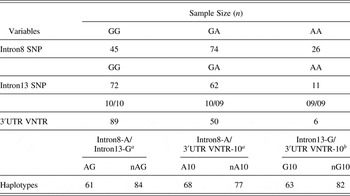
Buccal oral cheek samples were collected from each individual, and DNA extractions were conducted using a standard isolation protocol (Sambrook & Russell, Reference Sambrook and Russell2001). The SLC6A3 3′UTR VNTR was amplified via the pair of polymerase chain reaction (PCR) primers TGT GGT GTA GGG AAC GGC CTG AG (forward) and CTT CCT GGA GGT CAC GGC TCA AGG (reverse) as in Rueda, Rothbart, McCandliss, Saccomanno, and Posner (Reference Rueda, Rothbart, McCandliss, Saccomanno and Posner2005). These PCR fragments were scored for their genotypes via direct gel electrophoresis visualization of 2% agarose gels in 1 × sodium borate buffer with ethidium bromide staining. Two additional primer pairs were designed based on the GenBank human genome sequence draft to amplify two DNA fragments for each individual for the two SLC6A3 SNPs. Primers included the intron8 G/A SNP (rs27048) as CAA TTG CCT ATG GGA CTG G (forward) and ACC TGC TAC CTT GCT ATC CC (reverse), for a 236-base pair fragment, and the intron13 G/A SNP (rs11133767) as GAT CCA GAT ACA GGC ATC CAG (forward) and TGA CAT ATT CCG GGA GCA C (reverse), for a 184-base pair fragment. These two fragments were cleaned and full DNA sequences were generated and genotyped, following our general DNA sequencing protocol (Claw, Tito, Stone, & Verrelli, Reference Claw, Tito, Stone and Verrelli2010). Genotype frequencies for each of the three variants are shown in Table 2. Chi-squared tests of independence confirmed that genotype frequencies for each of the three variants were consistent with Hardy–Weinberg equilibrium (3′UTR VNTR: χ2 = 0.16, p = .92; intron 8 SNP: χ2 = 0.11, p = .94; intron 13 SNP: χ2 = 0.16, p = .92), which is an important assumption of genotype–phenotype association analyses in confirming that certain allele combinations as genotypes are not biasing the sample. In addition to association tests with each of the independent variants, analyses were conducted with combinations of the variants as haplotypes. We used the PHASE v. 2.1.1 program (Stephens, Smith, & Donnelly, Reference Stephens, Smith and Donnelly2001) to statistically infer and construct haplotypes that included the three variants, and the haplotypes for each individual were ultimately based on those with the highest likelihood scores from these program runs. Finally, this sample of individuals was previously genotyped for 10 unlinked VNTRs randomly distributed across the human genome to test for significant population stratification. The VNTRs were D1S1612, D2S1356, D4S1280, D5S1471, D6S1006, D7S2847, D17S1308, D18S535, D19S714, and D20S604 (as in Egan et al., Reference Egan, Goldberg, Kolachana, Callicott, Mazzanti and Straub2001). In an analysis of these VNTR markers with the STRUCTURE program (Pritchard, Stephens, & Donnelly, Reference Pritchard, Stephens and Donnelly2000), no significant admixture in our sample with respect to these variants was detected. This result implies that there is not significant population genetic stratification in our sample.
Sample sizes of genotypes and main haplotypes

Note: SNP, Single nucleotide polymorphism; UTR VNTR, untranslated region variable number tandem repeat.
a Inton8/intron13 AG or intron8/3′UTR VNTR A10 haplotype groups included children with at least one AG or A10 haplotypes, whereas nAG or nA10 groups included children without the corresponding haplotypes.
b Intron13/3′UTR VNTR G10 group included children with two G10 haplotypes, whereas nG10 included children with one or without G10.
As noted above, previous studies have shown inconsistent results with variants at SLC6A3 in both their functional and phenotypic associations, which may be a result of differential LD among variants across the gene in general. Our LD analyses among the three genotyped SLC6A3 variants showed significant pairwise correlations that are similar to previous population studies both in magnitude and in direction (int8/int13: D′ = 0.27, r = .20; int8/3′UTR VNTR: D′ = 0.41, r = .25; int13/3′UTR VNTR: D′ = 0.80, r = .65; all ps < .001 after standard Bonferroni correction). Specifically, the haplotype combinations of intron8-A/intron13-G, intron8-A/3′UTR VNTR-10, and intron13-G/3′UTR VNTR-10 that have been noted previously in LD and haplotype analyses reflect the significant pairwise correlations among variants in this study. In addition, as also previously noted, these specific variant combinations as haplotypes are associated with reduced SLC6A3 gene expression and thus less dopamine transporter. Due to the high LD, we expected that significant interactions between genetic and parenting variables, if any, would be consistent across these haplotype groups (note that the haplotypes all have overlap of the same alleles reflecting the high LD, e.g., intron8-A allele in the first two haplotypes, and 3′UTR VNTR-10 allele in the last two haplotypes). Nonetheless, it is worth noting that the single variants are statistically associated, but they are not completely “linked,” and thus, certain variant pairwise combinations as haplotypes may explain more of the overall EC variance than other haplotypes. Moreover, although specific genetic variants are more likely to be inherited together on a chromosome (as our LD analyses indicated), haplotypes (one of which comes from the mother and one from the father) were not statistically correlated within our sample (i.e., individuals did not have certain paired haplotype combinations more than expected). Our primary hypotheses focused on the individual variants as predictor variables as well as each of these three haplotypes in group contrasts below. Using Gpower, our model has a power of 80% to detect genetic effects that explain >3.4% of the variance for main and interactive effects.
Gene–environment correlation
The nonrandom assignment of environment among different genotypes, which is referred to as gene–environment correlation (rGE), violates the assumption underlying G × E research that genetic and environmental factors are independent (Tal, Reference Tal2012). There are three forms of rGE: evocative rGE, where, for example, the parenting strategy is elicited by children's specific behaviors or characteristics; active rGE, where children “niche pick” and select certain environments based on their heritable traits; and passive rGE, where environmental factors correlate with the parental genotypes that are passed down to the offspring. Therefore, the possibility of rGE was first tested statistically to rule out its influence on G × E findings.
Results
We present descriptive statistics and correlations among observed maternal parenting tasks and the EC measures, followed by the results of the modeling procedures. Because some data were missing, full information maximum likelihood (efficient for analysis with data missing at random; Arbuckle, Reference Arbuckle, Marcoulides and Schumacker1996) estimation was used.
Descriptive statistics and correlations of measures across time
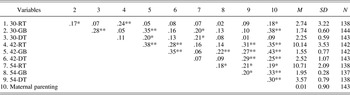
Means, standard deviations, and correlations among the key variables of interest are presented in Table 3. In zero-order correlations, the rabbit and turtle and gift bag/box tasks were each correlated from 30 to 42 months; the gift bag/box and dinky toys tasks were each correlated from 42 to 54 months. There are also several significant correlations between different tasks across time (see Table 3). Within time, gift bag/box was significantly correlated with the dinky toys and rabbit/turtle tasks at 30 months. All three tasks were significantly correlated with one another at both 42 and 54 months.
Descriptive statistics and correlations among key variables in the models

Note: 30-RT, 42-RT, 54-RT: rabbit turtle task at 30, 42, and 54 months, respectively; 30-GB, 42-GB, 54-GB: gift bag/box task at 30, 42, and 54 months, respectively; 30-DT, 42-DT, 54-DT: dinky toys task at 30, 42, and 54 months, respectively.
*p < .05. **p < .01.
To examine the possibility of rGE, we tested the correlations of genetic variables (SLC6A3 intron8, intron13, 3′UTR VNTR, and haplotypes) with observed parenting and the three EC indices at 30, 42, and 54 months. All the correlations were nonsignificant except the one for intron8 with 54-month dinky toys, r (138) = –.20, p < .05. Based on a one-way analysis of variance to examine whether different genetic groups scored differently on EC, children with the SLC6A3 intron8 GA genotype displayed higher EC on dinky toys at 54 months relative to children with the AG genotype, F (135, 2) = 7.21, p < .01. These few relations provide little support for rGE.
Model specification attempts
Using Mplus 6.1, we attempted to specify a growth curve model to predict the trajectory of EC from 30 to 54 months. Because we had three time points, only the linear slope was tested. However, we could not establish the measurement invariance (i.e., whether the measures related to the latent constructs in the same manner at the three ages) of EC for the growth curve model. Failure to establish measurement invariance implied that the relations between the observed measures and latent variables varied across time, which would jeopardize interpretation of longitudinal changes based on analyzing the measured variables (Millsap & Cham, Reference Millsap, Cham, Laursen, Little and Card2012). Therefore, the longitudinal latent growth curve model did not work for our current study.
Eliminating the possibility of a growth curve model, our next attempt was a second-order factor model where a latent higher order EC was estimated from the three first-order factors (i.e., 30-month EC, 42-month EC, and 54-month EC) indicated by the corresponding tasks at each time point. With the correlated error variances suggested by the modification indices, this model provided a good fit to our data, χ2 (23) = 22.01, p = .52; comparative fit index = 1.00, root mean square error of approximation = 0.00, standardized root mean residual = 0.05. After predictors (i.e., genetic variants, parenting, and their interactions) were added to this model, however, an unreasonably high r 2 was generated (e.g., r 2 = .71 for comparisons including the intron 8 SNP). This high r 2 might suggest an overfitted model in which too many terms were included to fit a relatively small number of observations, and thus the errors (such as measurement unreliability) were modeled as well (Colton & Bower, Reference Colton and Bower2002).
Consequently, in order to reduce the model complexity, we estimated a single-indicator measurement model to extract one underlying latent construct of EC during childhood directly from the nine observed EC tasks, and this model (described as following) was the basis for the major analyses examining prediction from parenting, genetic variables, and covariates (child sex and race/ethnicity).
Measurement model
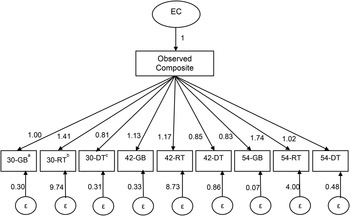
In order to estimate a single-indicator model, we conducted a preliminary confirmatory factor analysis (CFA) to provide explicit verification of the acceptability of the EC measurements, and the CFA model fits statistics were as follows: χ2 (27) = 38.36, p = .07; comparative fit index = 0.95, root mean square error of approximation = 0.07, standardized root mean residual = 0.06. One of the assumptions for estimating a single-indicator model is that there is no error in the measurement of variables, which is not a tenable assumption in most cases. However, this could be avoided by fixing the measurement error variance to a nonzero number calculated from the measurement error estimation. Following the procedures articulated by Werts, Rock, Linn, and Jöreskog (Reference Werts, Rock, Linn and Jöreskog1978), we established the final baseline model for EC by fixing and correcting the measurement error (see Figure 1). This process started with the CFA model forming the composite (i.e., observed composite labeled in Figure 1) from the linear combinations of the nine EC measurements and their loadings (λs). Then, we calculated the measurement error variance of the composite from the residual variance matrix estimated in the CFA model. Finally, the measurement error variance of the observed EC composite was fixed at the scalar computed above, and a pseudo-latent variable (i.e., EC in Figure 1) was formed by fixing the factor loading of the observed composite at 1. The pseudo-latent EC construct was used as the dependent variable in analyses.
Measurement model for the effortful control construct. Factor loadings were unstandardized. After fixing the residual variance, any correlated error variances between the indicators were no longer taken into account. a30-GB, 42-GB, 54-GB: gift bag task at 30, 42, and 54 months, respectively. b30-RT, 42-RT, 54-RT: rabbit/turtle task at 30, 42, and 54 months, respectively. c30-DT, 42-DT, 54-DT: dinky toys task at 30, 42, and 54 months, respectively.

Structural models predicting EC
The next phase of the study was to test the moderating effect of genetic factors (SLC6A3 genotypes and haplotypes) on the relation between quality of maternal parenting and observed EC (using Mplus 6.1). In the structural equation modeling framework, predictors (30-month observed maternal parenting, SLC6A3 genotypes/haplotypes, and, in the interaction effect models, their interactions) and covariates (child sex and race/ethnicity) were included to test the structural models predicting the latent EC formed from the final measurement model discussed above. The main effect models of maternal parenting and genetic variants partialing out the covariates were examined. Then, models including the interaction terms between (centered) maternal parenting variable and genetic predictors (i.e., interaction models) were specified. We calculated the r 2 values for the main effect models and the interaction models, as well as the increase in r 2 value associated with the addition of interaction terms. Separate analyses were conducted for each of the three SLC6A3 variants and the three haplotypes. Significant interactions were examined by calculating the simple effect of maternal parenting for each genetic group. Then, we further analyzed the regions of significance for each of the significant interactions to identify the numerical boundaries of maternal parenting quality beyond which significant genetic influences could be detected (Kochanska, Kim, Barry, & Philibert, Reference Kochanska, Kim, Barry and Philibert2011). We used a range of 2 SD above and below the mean to test for the patterns of effects (i.e., diathesis–stress, vantage sensitivity, or differential susceptibility pattern; Roisman et al., Reference Roisman, Newman, Fraley, Haltigan, Groh and Haydon2012).
SLC6A3 single variants
No significant main effects or interactions were found for the three individual SLC6A3 variants except for the main effects of maternal parenting (bs = 5.81, 5.71, and 5.75, ts = 3.84, 3.74, and 3.78, ps < .001 for intron 8, intron 13, and 3′UTR VNTR, respectively). The total variance of EC accounted for by the predictors including maternal parenting and intron 8, intron 13, or 3′UTR VNTR variants and their interactions individually was 25.9%, 28.2%, and 24.1%, respectively. However, as discussed below, the haplotypes were found to interact with maternal parenting in predicting EC.
SLC6A3 haplotypes
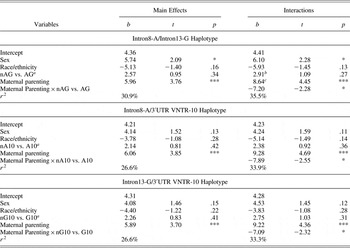
The data and analyses for the three haplotype groups (intron8-A/intron13-G, intron8-A/3′UTR VNTR-10, intron13-G/3′UTR VNTR-10) in predicting the latent ECFootnote 1 are presented in Table 4. When appropriate, haplotype groups were combined (as described below) for contrasts.
SLC6A3 haplotypes interacting with parenting in predicting children's effortful control

Note: UTR VNTR, untranslated region variable number tandem repeat.
a Haplotypes were dummy coded (0 = nAG, nA10 or nG10; 1 = AG, A10 or G10); nAG, nA10 or nG10 was the reference group for each comparison presented.
b The results presented for genes are at the sample mean of maternal parenting.
c Simple effects of maternal parenting presented are for intron8-A/intron13-G haplotype nAG, intron8-A/3′UTR VNTR-10 haplotype nA10, and intron13-G/3′UTR VNTR-10 haplotype nG10, respectively.
*p < .05. **p < .01. ***p < .001.
Intron8/intron13 haplotype
The AG haplotype group included individuals with at least one (and possibly two) intron8-A/intron13-G haplotypes (which treats this haplotype as dominant because patterns for individuals with one or two AG haplotypes were similar in this sample), whereas the nAG haplotype group included individuals without this haplotype (i.e., all other combinations of these two SNPs). The main effects of maternal parenting and sex on EC were significant (bs = 5.96 and 5.74, ts = 3.76 and 2.09, ps < .001 and .05, respectively); no main effect of race/ethnicity or genetic main effect was detected. Total variance accounted for by this main effects model was 30.9%. An interaction between maternal parenting and haplotype was detected for the contrast of nAG versus AG haplotype groups (b = –7.20, t = –2.28, p < .05; see Table 4). This model explained 35.5% of the total variance, an increase of 4.6%, 9.6%, and 7.3% over the main effect model, the model with the intron 8 SNP, and the model with the intron 13 SNP, respectively.
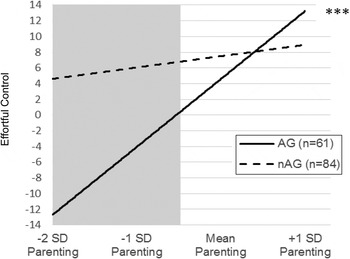
In tests of simple effects, maternal parenting was significantly associated with EC for nAG haplotype children (b = 8.64, t = 4.45, p < .001), but not for AG haplotype children (b = 1.44, t = 0.57, ns; see Figure 2). Region of significance analyses indicated that, consistent with the diathesis–stress model, significant genetic differences could only be detected when the value of maternal parenting was less than or equal to –0.43 (0.48 SD below the sample mean); no significant difference was found when the values of maternal parenting were at or one standard deviation above the sample mean (bs = 2.91 and –3.59, ts = 1.09 and –0.95, ns).
SLC6A3 intron8-A/intron13-G haplotype and maternal parenting quality in predicting childhood effortful control. Simple slopes of maternal parenting quality were 8.64 and 1.44 for nAG and AG groups, respectively. The asterisks indicate a significant simple slope of maternal parenting quality. ***p < .001.

Intron8/3′UTR VNTR haplotype
The measurement model for the observed EC construct for this haplotype comparison was identical to the previous one used for the intron8/intron13 haplotype. Again, the main effect of maternal parenting was significant (b = 6.06, t = 3.85, p < .001), but no genetic main effect or main effects of covariates was detected. The main effect model explained 26.6% of the total variance. Furthermore, a significant interaction was found between maternal parenting and genetics for the haplotype contrast of nA10 versus A10 groups (b = –7.89, t = –2.55, p < .05; see Table 4); the A10 group included individuals with one or two A10 haplotypes (treating the A10 haplotype as dominant based on preliminary analyses) and nA10 included no A10 haplotypes. Total variance accounted for in the model including the interaction term was 33.9%, an increase of 7.3%, 8.0%, and 9.8% over the main effect model, the model with the intron 8 SNP, and the model with the 3′UTR VNTR, respectively.
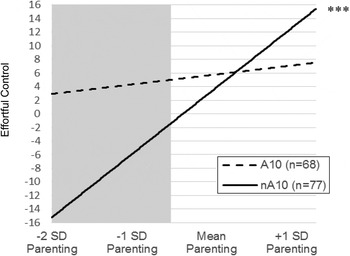
According to simple effects, quality of maternal parenting predicted EC for the nA10 haplotype group (b = 9.28, t = 4.69, p < .001), but not for the A10 haplotype group (b = 1.39, t = 0.58, ns; see Figure 3). When testing the region of significance, significant differences in EC between the nA10 and A10 haplotype groups could be detected when the value of maternal parenting was less than or equal to –0.46 (0.51 SD below the sample mean); no significant difference was found for values of maternal parenting at or one standard deviation above the sample mean (bs = 2.38 and –4.73, ts = 0.92 and –1.27, ns). Therefore, this interaction shows a diathesis–stress pattern.
SLC6A3 intron8-A/3′UTR VNTR-10 haplotype and maternal parenting quality in predicting childhood effortful control. Simple slopes of maternal parenting quality were 9.28 and 1.39 for nA10 and A10 groups, respectively. The asterisks indicate a significant simple slope of maternal parenting quality. ***p < .001.

Intron13/3′UTR VNTR haplotype
Because the G10 heterozygotes (individuals with only one G10 haplotype) showed a pattern identical to the group without any G10 haplotypes, these individuals were binned together as the nG10 haplotype group and contrasted with G10 homozygotes (two G10 haplotypes) as the G10 haplotype group (thus treating this haplotype as “recessive”). As with the two other haplotype analyses, there was a significant main effect of maternal parenting (b = 5.89, t = 3.70, p < .001), but no genetic main effect or main effects of covariates. Total variance accounted for by the main effect model was 26.6%. The G10 haplotype interacted with maternal parenting quality in predicting EC (b = –7.09, t = –2.32, p < .05; see Table 4). The model with this set of predictors explained 33.3% of the total variance, an increase of 6.7%, 5.1%, and 9.2% over the main effect model, the model with the intron 13 SNP, and the model with the 3′UTR VNTR, respectively.
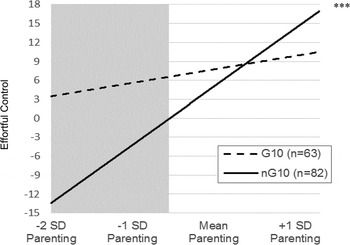
Specifically, maternal parenting was significantly associated with EC in the nG10 haplotype group (b = 9.22, t = 4.36, p < .001), but not in the G10 haplotype group (b = 2.13, t = 0.95, ns; see Figure 4). Region of significance analyses indicated that for values of maternal parenting less than or equal to –0.59 (0.55 SD below the sample mean), there were significant differences between nG10 and G10 haplotype groups in EC. Similar to the results of the previous haplotypes, no significant difference was found when the values of maternal parenting were at or one standard deviation above the sample mean (bs = 2.75 and –3.65, ts = 1.03 and –0.98, ns). The pattern appeared to be consistent with the diathesis–stress model.
SLC6A3 intron13-G/3′UTR VNTR-10 haplotype and maternal parenting quality in predicting childhood effortful control. Simple slopes of maternal parenting quality were 9.22 and 2.13 for nG10 and G10 groups, respectively. The asterisks indicate a significant simple slope of maternal parenting quality. ***p < .001.

Discussion
Rather than focusing exclusively on individual genetic variants of the SLC6A3 gene, our results support the importance of haplotypes as the genetic constructs interacting with environmental influences in predicting children's EC. The total variance in EC accounted for by the models containing haplotypes was higher than that accounted for by the models with single variants. These results underscore the importance of haplotype combinations that incorporate LD and functional interactions among polymorphisms, and thus provide new information that may explain inconsistencies in previous association studies.
It is not surprising that exposure to higher quality parenting characterized by higher maternal warmth and sensitivity with less intrusive control positively predicted children's EC. However, one cannot conclude from this result that genetic effects are swamped by the detrimental environmental impacts. Individual differences clearly exist in children's outcomes even when they experience similar environments. In contrast to maternal parenting, significant genetic main effects were not found in our study, which was in accordance with much of the previous G × E work, indicating that a linear association between a complex behavior and a single gene is often too small to be detected (Durston et al., Reference Durston, Fossella, Casey, Hulshoff Pol, Galvan and Schnack2005), especially in small or moderately sized samples. Prediction from genetic factors to behavioral manifestations is more likely to be detected if environmental influences are also incorporated (Hicks et al., Reference Hicks, South, DiRago, William, Iacono and McGue2009). This argument is supported by the significant interactive effects of maternal parenting and SLC6A3 haplotypes when predicting EC in our study.
Although intron8-A, intron13-G, and 3′UTR VNTR-10 alleles have all been linked to the etiology of EC-related problematic behaviors such as bipolar disorder (Greenwood et al., Reference Greenwood, Schork, Eskin and Kelsoe2006), it was not until haplotypes of these alleles were examined that we found significant interactions with maternal parenting. As noted previously, given the strong LD among the gene variants, documented in previous studies as well as our own, the patterns across haplotypes were also highly similar. This result suggested what few researchers have directly tested: either no single SLC6A3 variant contributes to behavioral phenotypes (e.g., EC), or they are in significant LD with a yet unknown gene variant that is rare in frequency. The latter has been previously suggested (Asherson et al., Reference Asherson, Brookes, Franke, Chen, Gill and Ebstein2007; Greenwood et al., Reference Greenwood, Schork, Eskin and Kelsoe2006), yet if this is the case, it is difficult to reconcile how a rare gene variant in LD with our three variants would generate such a consistent pattern across haplotypes, especially given our moderate sample size.
Given our results, it may be more parsimonious in our sample to implicate the intron8 VNTR-6 allele, which is in high LD with the intron8-A/3′UTR VNTR-10 haplotype. The intron8 VNTR-6 allele has repeatedly been associated with reduced SLC6A3 gene expression when results with other suggested variants such as the 3′UTR VNTR have been inconsistent (Guindalini et al., Reference Guindalini, Howard, Haddley, Laranjeira, Collier and Ammar2006; Hill et al., Reference Hill, Anney, Gill and Hawi2010). Some researchers have suggested that the combination of VNTRs in multiple non-protein-coding gene regions (such as the intron 8 VNTR and the 3′UTR VNTR) alters gene enhancer elements that regulate gene expression, even subtly (e.g., Greenwood et al., Reference Greenwood, Schork, Eskin and Kelsoe2006). Therefore, advanced neuroimaging, genetic imaging, and cognitive studies are needed to determine the extent to which dopamine transporter translational efficiency may be affected by haplotypes in vivo (Vandenbergh et al., Reference Vandenbergh, Thompson, Cook, Bendahhou, Nguyen and Krasowski2000). Our results further support the conclusion that haplotypes, rather than single variants, better reflect a biological and environmental marker for association studies (Claw et al., Reference Claw, Tito, Stone and Verrelli2010).
Our study highlights the underlying G × E framework in which the impact of maternal parenting quality varies depending on children's dopamine regulation. Regions of significance probing of the interactions indicated that the significant differences between genetic groups only existed at the lower level of maternal parenting quality, consistent with the diathesis–stress type of G × E interaction. Specifically, compared to their counterparts, children with haplotypes associated with lower SLC6A3 expression (i.e., AG, A10, G10; lower dopamine functioning) seemed less reactive/sensitive to the varying levels of maternal parenting. Moreover, these children performed significantly better on EC tasks in the presence of less supportive maternal parenting, but they did not benefit more from more supportive maternal behaviors. Thus, our findings did not support the differential susceptibility theory, and might suggest that (a) more stressful environments magnify individuals' genetic vulnerability to environmental impacts on EC; and (b) more supportive maternal parenting was beneficial to all children in terms of their higher EC regardless of the haplotype patterns.
A possible mechanism underlying the Haplotype × Parenting interaction is that environmental exposure changes the individual's genetic vulnerability or risk by influencing the expression of a genetic predisposition, the process of which may intensify over time and channel individuals into stable developmental outcomes (Johnson, Reference Johnson2007). Alternatively, it may be that children's environmental exposure is “blocked” or suppressed by certain genetic factors (e.g., intron8/intron13 AG haplotype), which decreases their reactivity/sensitivity to the different environmental influences per se (Sonuga-Barke et al., Reference Sonuga-Barke, Oades, Psychogiou, Chen, Franke and Buitelaar2009). Our findings clearly support the latter argument such that AG, A10, and G10 haplotypes (associated with lower dopamine functioning) appeared to be the genetic makeup that blocked the influence of environmental stimuli. Hence, children with these haplotypes are more likely to follow the similar behavioral path regardless of different maternal parenting contexts. Due to this low sensitivity, these children might also be able to resist the environmental adversity, demonstrating resilient behaviors (e.g., in our case, higher EC) in the context of less supportive maternal parenting. In contrast, from an evolutionary perspective, individuals with higher SLC6A3 expression (i.e., nAG, nA10, and nG10 haplotypes; more likely to sufficiently regulate circulating dopamine) may be better equipped at identifying and reacting correspondingly to the differences in the rearing contexts. That is, more efficient dopamine regulation can translate to a greater capability in processing environmental stimuli, and thus, these individuals may be more likely to respond with lower EC to the unsupportive caregiving experiences. Perhaps this, to some extent, may signal recognition of discontent with the environment and may present the opportunity to “explore” an alternative adaptive path with more positive influences (Beeler, Reference Beeler2012).
Based on the discussion above, our results do not support the previous notion that a specific genotype or haplotype increases children's risk of poor adjustment when exposed to unsupportive environmental settings (Kochanska et al., Reference Kochanska, Philibert and Barry2009; Rutter & Silberg, Reference Rutter and Silberg2002). Rather, our results imply that certain haplotypes (i.e., AG, A10, and G10) may generally reduce individuals' sensitivity to the different parenting qualities, possibly due to their lower plasticity or lack of ability to regulate dopamine levels in response to the changing environment. These findings and interpretations are consistent with the Sonuga-Barke et al. (Reference Sonuga-Barke, Oades, Psychogiou, Chen, Franke and Buitelaar2009) investigation, where only children who did not carry the 3′UTR VNTR 10/10 genotype showed varied levels of conduct problems when exposed to different levels of positive maternal expressed emotion. A new theoretical perspective in the current G × E literature is to distinguish less sensitive or less plastic genetic markers from those with specific risk properties (Belsky et al., Reference Belsky, Bakermans-Kranenburg and van IJzendoorn2007; Sonuga-Barke et al., Reference Sonuga-Barke, Oades, Psychogiou, Chen, Franke and Buitelaar2009). As noted above, the association between a haplotype and a complex trait disorder may be specific to the environment, and no one genetic background is optimal. This pattern, to some extent, appears to show a trade-off. For example, when exposed to maternal adversity, children with the less sensitive genetic makeup (i.e., AG, A10, or G10, who have deficits in regulating dopamine and efficiently processing and reacting to environmental stimuli) performed better than their peers without this genetic makeup (i.e., nAG, nA10, or nG10). Consistent with Bakermans-Kranenburg, Dobrova-Krol, and van IJzendoorn (Reference Bakermans-Kranenburg, Dobrova-Krol and van IJzendoorn2012), this pattern may provide some preliminary evidence that haplotypes of the dopaminergic system (e.g., AG, A10, and G10) might represent potential genetic resilience against the environmental adversity in some children.
Strengths of the current study include the fact that maternal parenting was assessed through observed mother–child interactions and EC was assessed by coding children's performance on individual EC tasks at three ages. Moreover, it appears that none of the three SLC6A3 variants or the haplotypes is an independent source of genetic influence in EC. Rather, genes may interact with the extrinsic environmental exposure (e.g., maternal parenting) to predict children's outcomes. This idea helps explain the discrepancies among previous findings with regard to the functional variants in SLC6A3 such that there might not be a genetic magic bullet regardless of the different measured variables or different sample characteristics.
However, our study has several limitations. First, a limitation pertains to our relatively small sample size, which may result in the failure to detect significant G × E effects of certain haplotypes due to limited statistical power. However, haplotypes infrequent in our sample are also found to be infrequent in the general population, and thus, extrapolation from our study extends to potentially more common endophenotypes. Second, because the majority of our participants were non-Hispanic Caucasian with relatively high socioeconomic status and the children were not from a clinical sample, our results may lack the ability of generalizing to other populations. Nevertheless, it might also be encouraging that we could detect significant G × E interactions with a relatively homogenous and modest sample. Third, the mother–child interaction tasks were relatively short (i.e., 6 min), which may limit the robustness of the assessment of maternal parenting. Although acknowledging this issue, we also point out that our measures of free-play and the challenging teaching task have been extensively used in the literature and found to be reliable and valid (Eisenberg et al., Reference Eisenberg, Spinrad, Eggum, Silva, Reiser and Hofer2010; Taylor et al., Reference Taylor, Eisenberg, Spinrad and Widaman2013). Fourth, despite the use of longitudinal data, we failed to establish the measurement invariance of the three behavioral EC tasks across time. This result might be due to changes in the speed with which children topped out in their performance on the various EC tasks as they age. The failure to specify a longitudinal model limited our insight into the SLC6A3 × Parenting interaction effects for the developmental trajectory of children's EC. There is still dispute among researchers over the continuity versus change in the patterns of G × E for developmental outcomes (Goldsmith et al., 2008), and we could not address this issue. However, substantial evidence has demonstrated the association between age and dopamine transporter levels in the human brain such that the availability of dopamine transporter protein declines with increasing age (Bannon & Whitty, Reference Bannon and Whitty1997; Shumay et al., Reference Shumay, Chen, Fowler and Volkow2011). If this were the case, altering patterns of G × E would be expected at different ages; this hypothesis could be tested in the future with longitudinal modeling.
In addition, given the importance of SLC6A3 haplotypes in moderating the association between maternal parenting and young children's EC, it would be interesting to further consider the interactions between haplotypes across different genes. For example, would the haplotypes in the dopamine receptor genes (such as the most widely studied DRD2 and DRD4) interacting with SLC6A3 haplotypes identified in our current study function as significant moderators in the relation between the environment and children's behaviors? As previously mentioned, the current results support the possibility that SLC6A3 haplotypes represent different degrees to which children are sensitive/responsive to their rearing environment. Based on these findings, future investigations can also benefit greatly from exploring the plausible mechanisms (perhaps physiological and behavioral endophenotypes; Obradović & Boyce, Reference Obradović and Boyce2009) underlying this genetic (in)sensitivity.