Introduction
Latino/non-Latino ethnic disparities in advance care planning (ACP) are prevalent, heightening the risk among patients with advanced cancer of Latino descent dying without receiving care consistent with their preferences (Carr Reference Carr2012). Specifically, rates of advance directive completion are significantly lower among Latino patients than non-Latino Whites. This includes dramatically lower rates of completing a living will (9% vs. 67%) and naming a health-care proxy (4% vs. 59%) (Carr Reference Carr2011). These disparities are disconcerting because ethnicity is a social construct, which suggests that there may be system-level barriers to engaging Latino patients in ACP and a need for culturally tailored interventions. Understanding what drives disparities in ACP engagement among Latino patients is critical to helping inform culturally relevant and more impactful interventions.
Advance directive completion is critical to improving quality end-of-life care because it is linked to higher quality of life (Garrido et al. Reference Garrido, Balboni and Maciejewski2015) and medical care (Brinkman-Stoppelenburg et al. Reference Brinkman-Stoppelenburg, Rietjens and van der Heide2014) received at the end of life. Due in large part to lower rates of advance directive completion, Latino patients with cancer are more likely than their non-Latino White counterparts to suffer in the quality of medical care they receive at the end of life. Specifically, Latino (compared to non-Latino) patients suffer from higher rates of futile aggressive care (e.g., cardiopulmonary resuscitation (CPR) and intensive care unit (ICU) stays) at the end of life that does not prolong survival (Braun et al. Reference Braun, McCullough and Beyth2008; Hanchate et al. Reference Hanchate, Kronman and Young-Xu2009; Lackan et al. Reference Lackan, Eschbach and Stimpson2009). The aggressive care that Latino patients with cancer often receive at the end of their lives is generally contrary to their preferences and values (Blackhall et al. Reference Blackhall, Frank and Murphy1999; Davis Reference Davis1995; Duffy et al. Reference Duffy, Jackson and Schim2006; Gutheil and Heyman Reference Gutheil and Heyman2006; Mack et al. Reference Mack, Weeks and Wright2010; Volandes et al. Reference Volandes, Ariza and Abbo2008), associated with poorer quality of life (Mack et al. Reference Mack, Weeks and Wright2010; Wright et al. Reference Wright, Zhang and Ray2008; Zhang et al. Reference Zhang, Nilsson and Prigerson2012, Reference Zhang, Wright and Huskamp2009), and very costly (Hanchate et al. Reference Hanchate, Kronman and Young-Xu2009). It should be noted that the type of care received at the end of life is less relevant than ensuring that patients receive care consistent with their beliefs, values, and preferences and that enhances the quality of life at the end of life as it pertains to social, emotional, spiritual, and physical outcomes.
Despite these known disparities, little research has focused on how individual-level factors, such as coping styles, might be differentially related to advance directive completion among Latino and non-Latino patients with cancer. Understanding how coping styles may differentially influence rates of advance directive completion among Latinos and non-Latinos could be critical to understanding how best to engage patients from different ethnic backgrounds in ACP. Prior research indicates that active coping strategies like seeking and receiving emotional support from others, as measured by the widely used Brief COPE (Carver Reference Carver1997), are associated with positive mental and general health outcomes.
While this pattern may hold true for the general population, use of emotional support may have differing effects among patients who are terminally ill and at the end of life (Maciejewski et al. Reference Maciejewski, Phelps and Kacel2012). Patients who are terminally ill, such as patients with advanced cancer, engage in varying coping styles to manage the impact that cancer treatments and poor prognoses have on them (Hagan et al. Reference Hagan, Fishbein and Nipp2017). Limited prior work suggests that coping strategies operate differently among patients with advanced cancer than among the general population. For instance, behavioral disengagement has been associated with higher rates of do-not-resuscitate (DNR) order completion and lower rates of futile intensive care near death (Maciejewski et al. Reference Maciejewski, Phelps and Kacel2012). Although behavioral disengagement is considered a negative coping strategy because it is avoidant in style, outcomes such as reduced futile aggressive care seemingly indicate some level of patient engagement in ACP. Because this type of care is often counter to the “standard” care offered in medical settings at the end of life, patients often have to explicitly express a desire for no futile aggressive care. Similarly, positive coping strategies such as use of emotional support may have different effects on ACP outcomes among those who are terminally ill.
Not only may the use of emotional support as a coping strategy work differently among patients who are terminally ill, but ethnicity may play a moderating role in this relationship between the use of emotional support and ACP outcomes. Prior work indicates that Latino patients with cancer are most likely to utilize coping strategies such as positive reframing (i.e., finding meaning and positive emotions despite having cancer), family support, and religion and spirituality (Carrion et al. Reference Carrion, Nedjat-Haiem and Macip-Billbe2017). Latino patients also often report a more explicit involvement of family members and loved ones into ACP (Kwak and Haley Reference Kwak and Haley2005; Smith et al. Reference Smith, McCarthy and Paulk2008), highlighting the critical role of family members in this process. Thus, the engagement with one’s emotional support network among patients with advanced cancer may look differently among Latino than non-Latino patients.
For instance, Latino patients may engage in or utilize emotional support at higher levels than their non-Latino counterparts due to the critical role that social support plays in their decision-making. Furthermore, because Latino patients report more explicit and direct involvement of their family members in ACP, they may report higher levels of engagement in ACP when engaged in emotional support. In short, the effects of emotional support strategies on advance directive completion outcomes may differ for Latino patients relative to non-Latino Whites. Understanding how ethnicity moderates the relationship between emotional support and advance directive completion could illuminate potential drivers in disparities in ACP outcomes, such as DNR order, living will, and health-care proxy form completion.
The present study sought to determine Latino/non-Latino differences in emotional support’s effect on completion of advance directives among patients with advanced cancers. To do this, we examined the moderating effects of Latino ethnicity (Latino and non-Latino White) on the relationship between the use of emotional support and completion of advance directives (living will, health-care proxy, and DNR order) among patients with advanced cancer. Based on prior research (Carr Reference Carr2011; Carrion et al. Reference Carrion, Nedjat-Haiem and Macip-Billbe2017), we hypothesized that (1) Latino patients would engage in the use of emotional support at higher rates than non-Latino patients; (2) Latino patients would have lower rates of completion of advance directives than non-Latino patients; and (3) emotional support would have a stronger positive effect on advance directive completion among Latino than non-Latino patients.
Methods
Sample
The present study is based on a sample (N = 188) of patient participants in Coping with Cancer III (CwC III), an National Institutes of Health–sponsored (R01 MD007652), multisite, longitudinal, observational cohort study of patients with advanced cancer, their informal (often family) caregivers, and their oncology providers designed to evaluate the influence of medical, religious, and sociocultural beliefs on Latino/non-Latino ethnic disparities in ACP, and end-of-life cancer care. CwC III participants were recruited between November 2015 and May 2019 at the following institutions: Memorial Sloan-Kettering Cancer Center (New York, NY), Columbia University Medical Center (New York, NY), Northwestern University Robert H. Lurie Comprehensive Cancer Center (Chicago, IL), Rush University Medical Center (Chicago, IL), University of Texas-Southwestern (Dallas, TX), University of Texas at El Paso (El Paso, TX), and University of Miami Health System (Miami, FL). Institutional review board (IRB) approval was obtained from all participating sites. Informed consent was provided by all study participants.
Patients were eligible to participate in CwC III if they had been diagnosed with a locally advanced or metastatic gastrointestinal, lung, or gynecological cancer and had experienced disease progression on at least first-line chemotherapy or, for some specific (e.g., colorectal or ovarian) cancers, had experienced disease progression on at least 2 lines of chemotherapy. Thus, in general, eligible patients had incurable cancers and limited (i.e., months, not years) life expectancies. Patients were excluded from participation if they were under 21 years of age, not fluent in either English or Spanish, severely cognitively impaired (i.e., Short Portable Mental Status Questionnaire (Pfeiffer Reference Pfeiffer1975) score <6), or judged by research staff members to be too weak or ill to complete study interviews. Trained research staff interviewers gathered information directly from patient participants longitudinally in up to 3 structured interviews, that is, baseline assessments at study entry, first follow-ups nominally 2 months post-baseline and second follow-ups up to 1-year post-baseline (depending on patients’ statuses). Participants received $25 per interview.
The sample for the present analysis (N = 188) consists of CwC III patient participants who completed the baseline interview, identified as either Latino or non-Latino White, and had complete data for variables included in the present study. Among 242 patients who completed the baseline interview, 194 (80.2%) identified as either Latino or non-Latino White (hereafter “non-Latino”). Among these Latino and non-Latino participants, 6 (3.1%) were excluded from the present analysis due to missing data. Participants excluded due to missing data did not differ significantly from those included in the present analysis with respect to Latino ethnicity, age, gender, education level, health insurance status, or marital status.
Measures
Sociodemographic characteristics
During their baseline interviews, patients provided information regarding Latino ethnic origin, age, gender, education level, health insurance status, and marital status. Sites of patient recruitment were categorized by geographic location (North vs. South) and institution type (cancer center vs. hospital).
Use of emotional support
Use of emotional support as a coping strategy was assessed using the Brief COPE (Carver Reference Carver1997), a well-validated, widely used research instrument that assesses 14 coping methods using 2 items for each method. Use of emotional support was selected for the present study because it has been demonstrated to be a particularly important determinant of psychological adjustment to cancer and QOL (Carver et al. Reference Carver, Pozo and Harris1999; Kershaw et al. Reference Kershaw, Northouse and Kritpracha2004; Lutgendorf et al. Reference Lutgendorf, Anderson and Rothrock2000, Reference Lutgendorf, Anderson and Ullrich2002). Use of emotional support was assessed using 2 Brief COPE items: (1) “I’ve been getting comfort and understanding from someone” and (2) “I’ve been getting emotional support from others.” Both items were coded on a 5-point Likert scale (1 = not at all and 5 = very much) and were significantly correlated in the full sample (N = 188, r = 0.62, p < 0.001), in the Latino subsample (n = 85, r = 0.45, p < 0001), and in the non-Latino subsample (n = 103, r = 0.77, p < 0.001). All analyses were performed using the average score for the pair of items.
Completion of advance directives
During their interviews, patients were asked the following questions: (1) “Have you signed a Living Will?” (2) “Have you signed a Health Care Proxy Form?” and (3) “Have you signed a DNR order?” Response options included “yes,” “no,” “refuse to answer,” and “don’t know.” The present sample included only those who answered “yes” (coded 1) or “no” or “don’t know” (coded 0) to this question.
Statistical analysis
We evaluated bivariate associations between Latino ethnicity and dichotomous study variables, that is, patient sociodemographic characteristics and completion of advance directives, as odds ratios estimated via ordinary logistic regression. We evaluated associations between Latino ethnicity and continuous variables, that is, coping strategies, using Spearman correlations.
To estimate Latino/non-Latino differences in the use of emotional support and completion of advance directives accounting for Latino ethnic differences in sociodemographic variables, we used propensity score weights to minimize sociodemographic differences between Latino and non-Latino patient groups. Propensity score weighting is a common method of matching samples to facilitate inference for between-group effects (Stuart Reference Stuart2010). We constructed stabilized inverse probability propensity weights (Xu et al. Reference Xu, Ross and Raebel2010) for use in analysis to match Latino and non-Latino groups with respect to patient age category, gender, education level, health insurance status, marital status, recruitment site geographic region, and institutional setting. Using the stabilized inverse probability propensity weighted (hereafter “weighted”) sample (N w = 185), we evaluated associations between Latino ethnicity and dichotomous and continuous study variables as odds ratios and Spearman correlations, respectively. We evaluated main and interaction effects of Latino ethnicity and the use of emotional support on completion of advance directives (living will, health-care proxy form, and DNR order) in the weighted sample using multiple logistic models. Statistical analyses were conducted using SAS statistical software, version 9.4 (Cary, NC). Inferences are based on 2-sided tests with p < 0.05 taken to be statistically significant.
Results
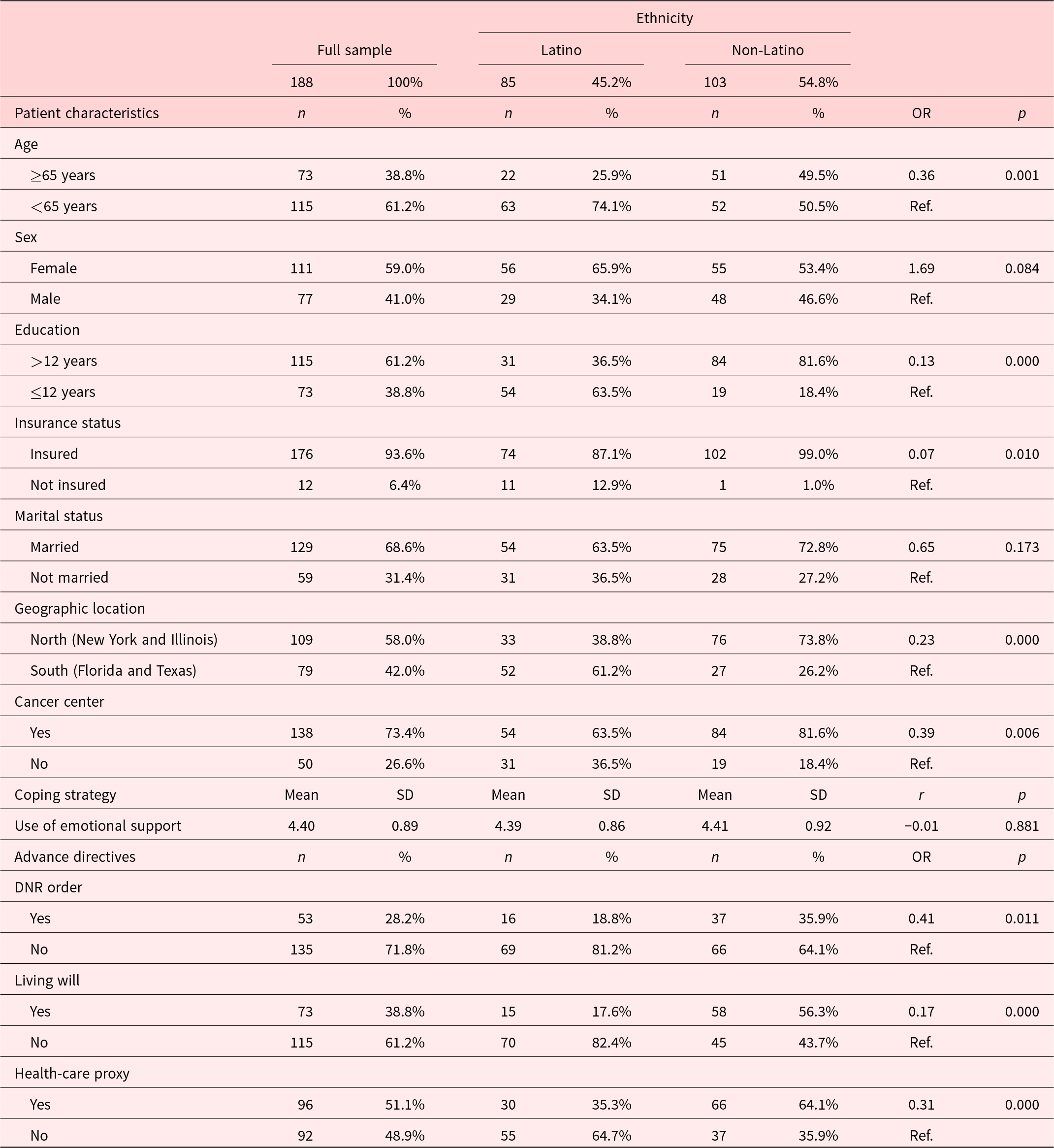
Table 1 compares Latino and non-Latino patients with respect to sociodemographic characteristics, use of emotional support, and completion of advance directives in the unweighted study sample (N = 188; 45.2% Latino and 54.8% non-Latino). Latino patients relative to non-Latino patients had a greater proportion of patients who were younger (<65 years), less educated (≤12 years), not insured, and located in the South (Florida and Texas) (all p < 0.05). Latino patients were also significantly less likely than non-Latino patients to have completed a DNR order (18.8% vs. 35.9%), living will (17.6% vs. 56.3%), or health-care proxy form (35.3% vs. 64.1%).
Patient characteristics, use of emotional support as a coping strategy, and completion of advance directives by Latino ethnicity in the unweighted sample (N = 188)

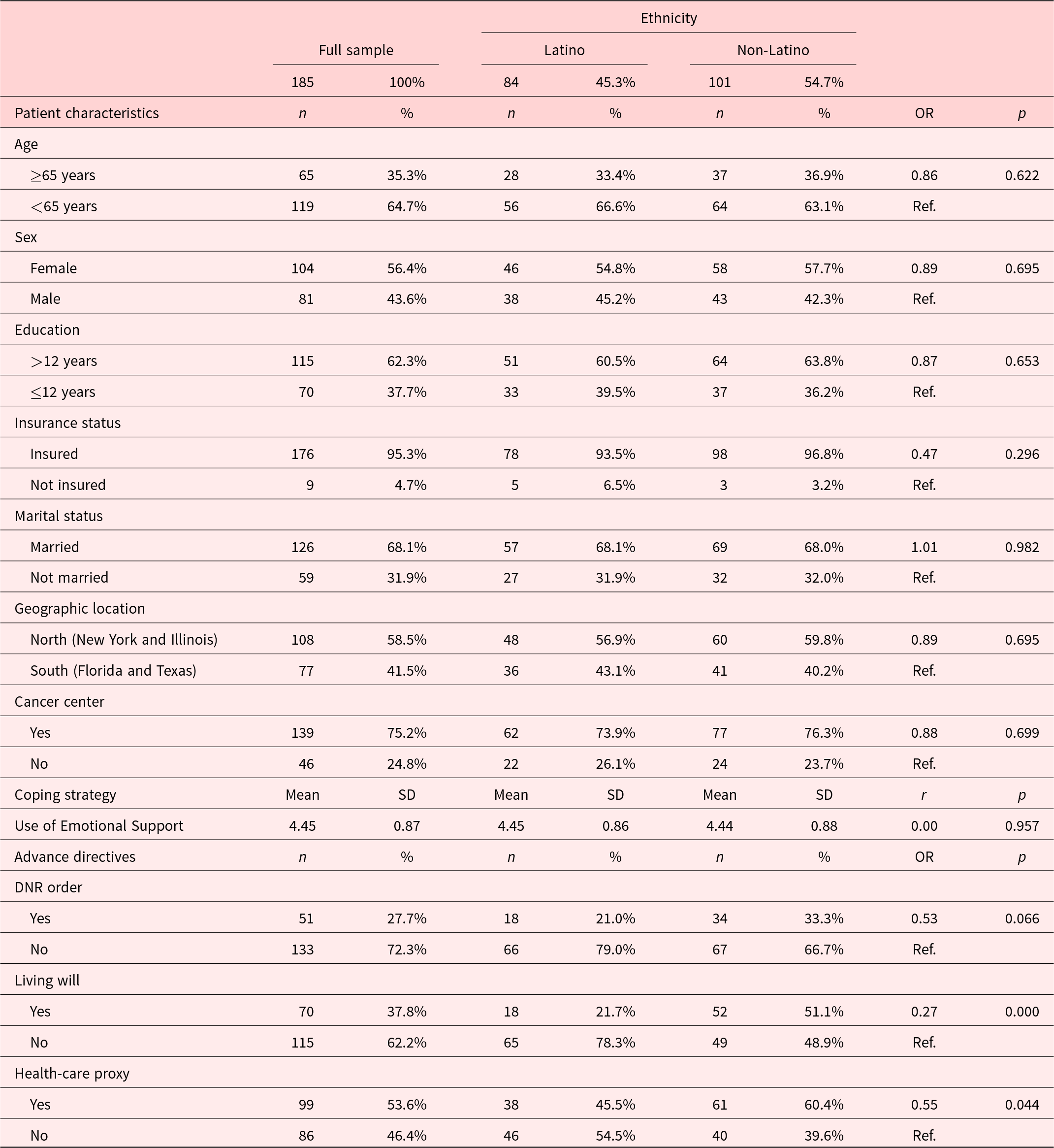
Table 2 compares Latino and non-Latino patients with respect to sociodemographic characteristics, use of emotional support, and completion of advance directives in the weighted study sample (N w = 185; 45.3% Latino and 54.7% non-Latino). In the weighted sample, Latino compared to non-Latino patients did not differ significantly across any of the sociodemographic characteristics. There were no observed Latino/non-Latino differences in use of emotional support. Hypothesis 1, that Latino patients would engage in the use of emotional support at higher rates than non-Latino patients, was not supported. Latino patients were less likely to have completed a living will (21.7% vs. 51.1%; OR = 0.27, p < 0.001) or designated a health-care proxy (45.5% vs. 60.4%; OR = 0.55, p < 0.05). Latino patients also trended toward being less likely to have completed a DNR order (21.0% vs. 33.3%; OR = 0.53, p = 0.066). Hypothesis 2, that Latino patients would have lower rates of completion of advance directives than non-Latino patients, was supported. Among the 85 Latino patients included in the analysis, 26 (30.6%), 17 (20.0%), 13 (15.3%), and 29 (34.1%), were, respectively, of Mexican, Cuban, Puerto Rican, and Other Latino cultural origins.
Patient characteristics, use of emotional support as a coping strategy, and completion of advance directives by Latino ethnicity in the weighted sample (N w = 185)

Analysis conducted with the use of stabilized inverse probability propensity weights.
Table 3 examines multiple logistic regression models for main and interaction effects of Latino ethnicity and use of emotional support on DNR order completion, living will completion, and health-care proxy form completion in the weighted sample (N w = 185). Results indicate that there was an interaction effect between Latino ethnicity and use of emotional support on completion of a DNR order (AOR = 0.33, p = 0.005). Use of emotional support was associated with lower odds of completing DNRs to a greater extent among Latino compared to non-Latino patient. Hypothesis 3, that emotional support would have a stronger positive effect on advance directive completion among Latino than non-Latino patients, was not supported as the opposite directionality was observed.
Models for main and interactive effects of Latino ethnicity and use of emotional support on completion of advance directives in the weighted sample (N w = 185)

Analysis conducted with the use of stabilized inverse probability propensity weights.
Discussion
Consistent with prior studies and confirming our hypothesis, we found evidence that Latino patients with advanced cancer were less likely to complete advance directives than non-Latino patients, including living wills and health-care proxy forms. We also found evidence that Latino ethnicity modifies the effect of use of emotional support on completion of DNR orders. Specifically, use of emotional support was associated with lower odds of completing DNRs to a greater extent among Latino as opposed to non-Latino patients. These differential effects of use of emotional support on DNR order completion, however, did not explain Latino ethnic disparities in ACP. Latino ethnicity remained a significant predictor of lower advance directive completion for DNR, living will, and health-care proxy completion. Thus, it appears that the use of emotional support as a coping strategy may operate differently among Latinos and non-Latinos in the promotion of DNR order completion.
Although underlying mechanisms were not revealed in the present analysis, among Latino patients, receiving emotional support from others appears to inhibit completion of DNR orders. Some possible reasons for this may be the social influence family members play in the patient preferring not to complete a DNR order because they feel the family does not want that. Prior research indicates that among racial and ethnic minorities, including Latino patients, family and community members often actively participate in their medical decision-making (Mead et al. Reference Mead, Doorenbos and Javid2013). As such, understanding how caregivers and family members are influence patients’ medical care decisions is a key area of future research, and highlighting the need include family members in end-of-life decision-making among patients who identify as Latino.
Additionally, patients who feel more emotionally supported and engaged may be more likely to prefer prolonging survival to spend more time with their loved ones or may be receiving support from varying and different sources (e.g., HCP and other family members). Future research should examine why the use of emotional support may serve to demotivate Latino advanced cancer patients from completing DNR orders and to ensure it is due to informed choices about care rather than an oversight in planning for preferred end-of-life care.
The present results do suggest that the use of emotional support may not be the most beneficial in promoting completion of DNR orders among Latino patients. Reasons for this should be explored, including whether it is social or familial pressure to pursue all treatments, desire to be with one’s loved one or prolong life, or other reasons driving these differences. Further, these results suggest that interventions that address the ways patients and family caregivers handle emotional distress (e.g., our EMPOWER intervention (Lichtenthal et al. Reference Lichtenthal, Viola and Rogers2021)) may be effective for promoting DNR order completion among Latino patients. Specifically, if patients and family members can engage in and receive emotional support in a way that still allows them to plan for end-of-life and ultimately decline and death, they may be more willing to engage in difficult end-of-life care planning such as DNR order completion. Additionally, these results suggest the possible need for educational interventions targeting caregivers and family members around the necessity of ACP and completion of advance directives. If family members hold a strong influence on patients’ decision-making, it could be beneficial to target them as well around the importance of engaging in ACP and completing advance directives.
One major strength of the present study is its documentation of specific coping strategies that patients utilize to cope with advanced cancer. Thus, the present study was able to examine the moderating effects of Latino ethnicity on the relationship between the use of emotional support and advance directive completion. Namely, the present study provides compelling evidence that the use of emotional support has differential effects on Latino patients’ and non-Latino patients’ DNR order completion behaviors.
Limitations
The present study contributes novel and relevant findings regarding differential effects of the use of emotional support on Latino patients’ and non-Latino patients’ DNR order completion. Nevertheless, there are limitations that should be considered in interpreting the findings. First, because the timing of advance directive completion was not assessed in the present study, it is unclear at what point in time patients completed their advance directives. Thus, it is unclear if the use of emotional support directly influenced DNR order completion. Second, although the present study found moderating effects of Latino ethnicity on the relationship between use of emotional support and DNR order completion, it did not identify mechanisms by which the use of emotional support might differentially affect these outcomes. Future research should examine potential mechanisms that may underlie the differential effects of coping strategies, such as the use of emotional support, on advance directive completion among non-Latino patients (relative to Latino patients). Third, although use of propensity score weights in the present study allowed us to isolate effects of use of emotional support on completion of advance directives by effectively minimizing sociodemographic differences between the Latino and non-Latino groups, there are almost certainly actual sociodemographic differences between these 2 groups (evident in Table 1) that may influence the studied variables in ways that are not examined in the present analysis. Finally, the present study likely included well-educated Latino patients, given the large number of academic medical centers included in the study. As such, the present results may not generalize to a broader Latino population. Despite these limitations, our findings indicate that a positive coping strategy, that is, use of emotional support, is associated with lower rates of DNR completion among Latino patients as compared to non-Latino patients. This finding is important to consider when promoting certain forms of positive coping strategies among advanced cancer patients ordinarily deemed to be beneficial.
Conclusions
Findings from the present study indicate that coping strategies differentially affect advance directive completion among Latino patients compared to non-Latino patients. Present study findings indicate that use of emotional support as a coping strategy may not support engagement in ACP among Latino patients who are at the end of life. This study highlights the need to understand more clearly how coping strategies may operate differently among advanced cancer patient populations of varying ethnic backgrounds. It is critical for health-care providers to consider how best to improve both non-Latino patients’ and Latino patients’ abilities to use effective coping strategies for their advanced cancer diagnoses and ultimately engage in ACP and plan for end-of-life care through the completion of advance directives. Moreover, it is important to understand the role of caregivers and family members in influencing patients’ medical care decision-making and developing tools to help educate family members as well as patients on the importance of engaging in ACP.
Conflicts of interest
The authors have no conflicts of interest to report.
Ethical approval
All study procedures were approved at each Institution’s IRB. All procedures were conducted in accordance with the required ethical guidelines for protection of human subjects in research. Informed consent was obtained from each participant in the present study.