INTRODUCTION
Hydro-biological parameters in coastal waters are subject to heavy spatio-temporal variability, more than offshore waters. Changes in coastal shallow, water mass movements and landinfluences (e.g. rivers and sewage flow) may affect the dynamics of plankton communities (Walsh, Reference Walsh1988). Ecosystem functioning is dictated mostly by biodiversity and community structure (Raghukumar & Anil, Reference Raghukumar and Anil2003). Due to the ecological importance of zooplankton in marine ecosystems, determining the changes in zooplankton density and community structure and their relationships with environmental conditions are important in understanding how the ecosystems function. Investigations on zooplankton communities are important, not only for understanding the functioning of pelagic environment (Siokou-Frangou, Reference Siokou-Frangou1996), but also in terms of fisheries. In this study, basic information was given on seasonal variations of mesozooplankton communities in relation to environmental factors. Several studies on the seasonal variability of zooplankton have been conducted in different coastal regions of the Mediterranean (Lakkis, Reference Lakkis1990; Mazzocchi & Ribera d'Alcala, Reference Mazzocchi and Ribera d'Alcala1995; Christou, Reference Christou1998; Fernandez de Puelles et al., Reference Fernandez de Puelles, Jansa, Morillas, Amengual and Vicente1998, Reference Fernandez de Puelles, Gras and Hernández de Leon2003, Reference Fernandez de Puelles, Valencia and Vicente2004; Siokou-Frangou et al., Reference Siokou-Frangou, Papathanassiou, Lepretre and Frontier1998; Tarkan, Reference Tarkan2000; Benli et al., Reference Benli, Tarkan and Sever2001; Jamet et al., Reference Jamet, Boge, Richard, Geneys and Jamet2001, Reference Jamet, Jean, Boge, Richard and Jamet2005; Vidjak et al., Reference Vidjak, Bojanic, Kuspilic, Marasovic, Gladan and Brautovic2006, Reference Vidjak, Bojanic, Kuspilic, Gladan and Ticina2007; Zakaria, Reference Zakaria2006; Zenginer-Yılmaz & Besiktepe, Reference Zenginer-Yılmaz and Besiktepe2010; Mazzocchi et al., Reference Mazzocchi, Licandro, Dubroca, Capua and Saggiomo2011). Some of these studies focused on interaction between zooplankton and environmental factors (Siokou-Frangou et al., Reference Siokou-Frangou, Papathanassiou, Lepretre and Frontier1998; Fernandez de Puelles et al., Reference Fernandez de Puelles, Gras and Hernández de Leon2003; Vidjak et al., Reference Vidjak, Bojanic, Kuspilic, Gladan and Ticina2007). However, little information and few data are available regarding species composition and seasonal variations of zooplankton in İskenderun Bay (Toklu & Sarıhan, Reference Toklu and Sarihan2003; Toklu, Reference Toklu2006; Lakkis & Toklu-Alıçlı, Reference Lakkis and Toklu-Alicli2007).
The present study focuses on providing further information and additional data on seasonal variations in abundance and species composition of coastal mesozooplankton communities and their relation with some environmental parameters in İskenderun Bay.
MATERIALS AND METHODS
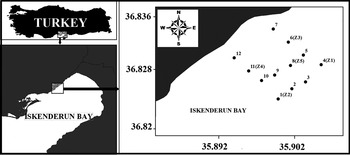
İskenderun Bay is located at the north-eastern corner of the Levantine basin (eastern Mediterranean (36°41′N–36°11.5′E) with a length of approximately 65 km, width of 35 km and surface of 2275 km2 (Figure 1). It is a shallow coastal area of 100 m maximum depth. Ceyhan is the major river discharging an annual average of 180 m3/s water into the sea (Iyiduvar, Reference Iyiduvar1986). The bay is influenced by the winds associated with the passage of storm systems over the Mediterranean, as well as local and regional winds. The general circulation in the bay is affected by the prevailing currents and cyclonic gyres in the open sea (Yılmaz et al., Reference Yılmaz, Basturk, Saydam, Ediger, Yılmaz and Hatipoglu1992).
Sampling stations.

Several small countries, Yumurtalık, Erzin, Dörtyol and İskenderun, are situated around the seaside of İskenderun Bay and human population is around 500,000. A thermal power plant, an oil filling plant, the BTC pipeline and a fertilizer factory are located on the north-northwest coast of the bay. İskenderun harbour an iron and steel factory are located on the south-southeast coast of the bay. There are many coast cottages and camping sites in the seaside of the bay and the population increases exponentially in the summer. For these reasons, it can be said that the bay is under the influence of terrestrial impact.
Sampling was carried out in the coastal shallow waters of İskenderun Bay in April, July, October and December 2008. A total of 20 mesozooplankton samples were collected during daytime (08:00–12:00 am) at 5 of 12 stations whose depth varied from 5 m to 15 m, using standard WP-2 net of 200 µm mesh size and 0.255 m2 mouth area, with vertical hauls. Two different samples were taken from each station, the first of which aimed to measure the biomass of zooplankton and the second to determine the abundance of different groups and species. Soon after collection, the samples were preserved in 4% formaldehyde–seawater solution. In laboratory, biomass samples were filtered on pre-weighted glass-fibre filters (1.2 µm) and dried at 60°C for 24 hours and measured as dry weight. Identification and counting of organisms were carried out on subsamples of 1/4 to 1/25 of an entire fractionated sample with Folsom splitter or stempel pipette, depending on sample density. Copepods, cladocerans and chaetognaths were identified on species level, whereas the remaining groups were determined on higher taxa. Filtered water volume was calculated by length of wire with the net mouth area. Temperature, salinity and dissolved oxygen (DO) were measured using YSI 6600 CTD probe at 5, 10 and 15 m depth at all 12 stations. Chlorophyll-a and phytoplankton density were obtained from water samples taken simultaneously at the same stations. The determination of chlorophyll-a was performed according to Parsons et al. (Reference Parsons, Maita and Lalli1984). Phytoplankton abundance expressed as density of cells/litre was carried out by settlement of the cells in 2 l of seawater. Cell counting was carried out on these concentrated samples under an Olympus phase contrast microscope using Sedgewick–Rafter cell.
For the study of the community structure, the Shannon–Wiener diversity index, the Pielou's evenness index and species richness (species number) were estimated by using PRIMER 6 software. Data concerning adult copepods, cladocerans and chaetognath species were used for these analyses. Some male copepods were considered at the genus level, assuming the species abundance of males randomly to be equal to that of females (Isari et al., Reference Isari, Ramfos, Somarakis, Koutsikopoulos, Kallianiotis and Fragopoulu2006). In order to optimize and facilitate the analysis, the square root transformation was applied to numerical abundance and biomass values prior to applying all statistical tests. Hierarchical agglomerative clustering analysis was carried out using the Bray–Curtis similarity index and multidimensional scaling (MDS) to determine grouping among stations and seasons. Comparison among stations and seasons was carried out by analysis of variance. Relationships between chlorophyll-a, total mesozooplankton abundance and biomass were computed using the Spearman correlation coefficient. Canonical correspondence analysis (CCA) was conducted through the CANOCA package to determine the relationship between mesozooplankton species and temperature, salinity, chlorophyll-a, dissolved oxygen, phytoplankton density. Average values of these in water column were used for this analysis. Monte Carlo software was applied to test the significance of correlations. Counter maps of temperature and salinity as well as distribution maps of chlorophyll-a, mesozooplankton abundance and biomass were carried out using Surfer software. In counter maps, the ordinary point kriging method was used to interpolate temperature and salinity results.
RESULTS
Environmental conditions
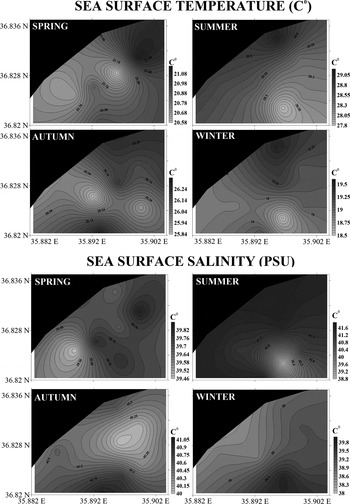
Surface counter maps of temperature and salinity in sampling periods are shown in Figure 2. The highest sea surface temperature and salinity values were observed in summer (29.12°C and 41.7 psu), whereas the lowest ones were measured in winter (18.52°C and 38.06 psu).
Seasonal variations in sea surface temperature and salinity.

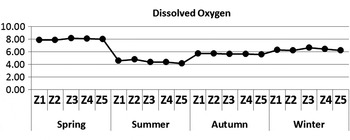
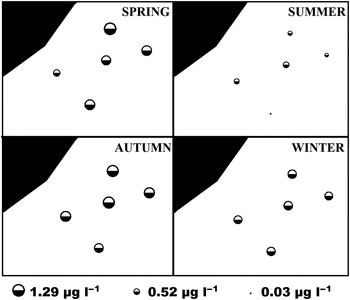
The mean minimum values of DO (Figure 3) and chlorophyll-a (Figure 4) were measured in summer (4.46 ± 0.24 mg l−1, 0.42 ± 0.08 µg l−1, respectively), while maximum mean value of DO was observed in spring (7.96 ± 0.06 mg l−1) (Figure 3). Chlorophyll-a reached higher mean values in autumn (1.08 ± 0.14 µg l−1) and spring (0.95 ± 0.25 µg l−1) and it displayed clear fluctuations depending on stations (Figure 4).
Seasonal variations of dissolved oxygen (mg l−1).

Seasonal variations of chlorophyll-a (Cl a, µg l−1) values.

Zooplankton abundance and biomass
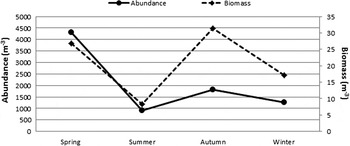
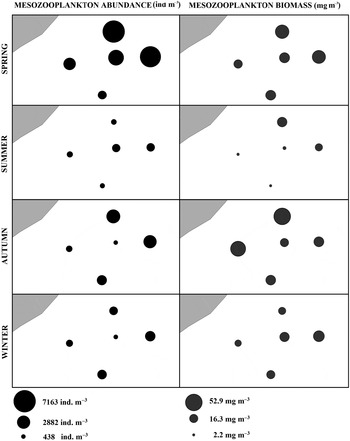
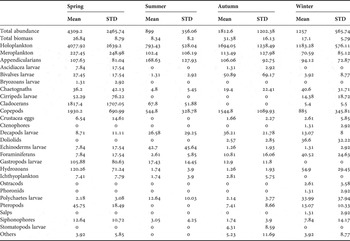
Annual mean zooplankton abundance and biomass were found to be 2069.6 ± 421.3 ind m−3 and 20.9 ± 2 mg m−3, respectively. Mesozooplankton showed two peaks of abundance and biomass: the first one in spring and the second one in autumn in the area (Figure 5). Mean over stations abundance was higher in spring, while biomass was higher in autumn. On the other hand, the lowest mean abundance and biomass was observed in summer (Table 1). Furthermore, mesozooplankton abundance varied from 438 ind m−3 (autumn) to 7163 ind m−3 (spring), while biomass varied between 2.2 mg m−3 (summer) and 52.9 mg m−3 in (autumn) (Figure 6). Differences in abundance and biomass among the seasons were highly significant (P < 0.01), whereas no statistically significant differences were found among the stations. However, mean mesozooplankton abundance and biomass was higher in stations Z1 and Z3 located in the north part of the sampling area and decreased towards the south of the sampling area.
Seasonal mean mesozooplankton abundance and biomass values.

Seasonal distribution of the total mesozooplankton abundance and biomass in sampling stations.

Seasonal variations in mean abundance (ind m−3) of zooplankton groups and species during 2008.

STD, standard deviation.
Mesozooplankton group and species composition
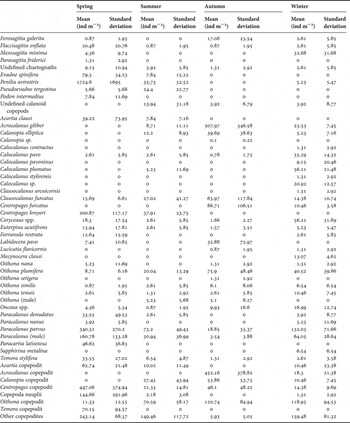
A total of 11 meroplankton and 12 holoplankton groups (Table 1), 30 copepods, 4 cladocerans and 4 chaetognaths species (Table 2), were identified. Holoplankton taxa constituted between 81% and 99% of the total number, with a decrease in summer. Copepods were the dominant group in all seasons, and copepodites were more abundant than adults.
Seasonal variations in mean abundance of copepod + cladocera + chaetognatha species during 2008.

In spring, cladocerans and copepods showed similar abundance. The groups of hydrozoans, gastropods larvae, pteropods, ichthyoplankton, siphonophores and cirripeds larvae were relatively more abundant in spring than in other seasons. Penilia avirostris (Dana, 1849) was the dominant species in this period. Evadne spinifera (P.E. Müller) among cladocerans and Paracalanus parvus (Claus, 1863), Centropages kroyeri (Giesbrecht, 1892), Paracalanus denudatus (Sewell, 1929), Temora stylifera (Dana, 1849), Acartia clausi (Giesbrecht, 1889), Paracartia latisetosa (Krichagin, 1873) among copepods were the most abundant in spring.
In summer, appendicularians and echinoderms larvae were the most abundant following copepods. Among copepods, P. parvus was the dominant species, followed by C. kroyeri, Oithona plumifera (Baird, 1843), Clausocalanus furcatus (Brady, 1883), P. avirostris and Pseudoevadne tergestina (Claus, 1864).
In autumn, the larval abundance of bivalves, decapods and stomatopods displayed their maximum average values. Within copepods, Acrocalanus gibber (Giesbrecht, 1888) was dominant. The other species, Centropages furcatus (Dana, 1849), O. plumifera, Clausocalanus furcatus, Calanopia elliptica (Dana, 1849), Labidocera pavo (Giesbrecht, 1889), P. parvus, Ferosagitta galerita (Dallot, 1971), displayed important contribution to the abundance of zooplankton community during the autumn.
In winter, the most important groups were polychaetes larvae, foraminiferans ctenophores, ostracods, chaetognaths, doliolids and appendicularians. Paracalanus parvus was the dominant copepod in this season, accompanied by the copepods Calocalanus plumatus (Shmeleva, 1965), Calocalanus pavo (Dana, 1852), O. plumifera, Corycaeus spp., A. gibber and the chaetognath Mesosagitta minima (Grassi, 1881).
The distribution of the mesozooplankton groups and species displayed differences among stations. Considering the mean abundance values, among the three groups which made up the majority of the zooplankton abundance, copepods and cladocerans were observed to have higher values of abundance at the north of the sampling area (stations Z1 and Z3). Regarding the abundance of appendicularians, no significant difference was observed between stations. It is significant that some of the other zooplankton groups were observed to be present in some stations throughout the study periods. For example, while ichthyoplankton was not observed in station Z2, specimens of salps and ctenophores were observed only in this station. Ascidaceans larvae were observed at stations Z1 and Z3, specimens of bryozoans larvae only in station Z5, those of phoronoids only in station Z1, those of stomatopods larvae only in station Z3, and those of ostracods only in station Z1 and Z2. Members of siphonophores were not observed only in station Z4. Penilia avirostris, C. elliptica, P. parvus, Clausocalanus furcatus, O. plumifera and T. stylifera which contributed significantly to the abundance of zooplankton were more abundant at the north of the sampling area (stations Z1 and Z3), whereas L. pavo, Acartia clausi and Centropages furcatus were found to be significantly more abundant in station Z1.
Mesozooplankton community structure
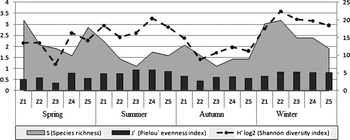
Most of the copepods, cladocerans and chaetognaths were identified at species level and these data were used to measure the species diversity, evenness and richness indices (Figure 7). Species diversity and evenness of these major groups were higher in winter and summer whereas, the species richness index was higher in winter and low in summer. Evenness values were low in spring and autumn due to the abundance of P. parvus and P. avirostris in spring and A. gibber in autumn.
Shannon diversity (H′), Pielou evenness (J′) and species richness (S) indices for each season and station.

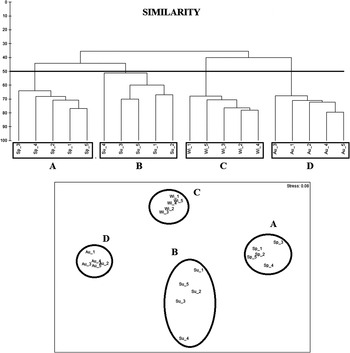
Hierarchical clustering revealed a distinction of four seasonal groups at 50% similarity level (Figure 8). At lower similarity level, the spring samples were grouped with the summer samples whereas the winter samples were clustered with the autumn samples. The differentiation of the four seasonal groups is clear in the MDS plot (Figure 8) and differences among stations were more important in summer than in the other seasons.
Defined groups by the cluster and multidimensional scaling analysis.

Mesozooplankton–environment relationship
Abundance and biomass of zooplankton were correlated with DO at 0.01 and 0.05 significant levels, respectively. Correlation between biomass and abundance was highly significant (P < 0.01). On the other hand, correlation between zooplankton biomass and chlorophyll-a, phytoplankton were positively significant at 0.01 and 0.05, respectively (Table 3).
Correlation results measured among abiotic and biotic parameters.

** correlation is significant at the 0.01 level (2-tailed). * correlation is significant at the 0.05 level (2-tailed); SCC (r), Spearman correlation coefficient; ns, nonsignificant; DO, dissolved oxygen; P. density, Phytoplankton density; abundance, mesozooplankton abundance; biomass, mesozooplankton biomass.
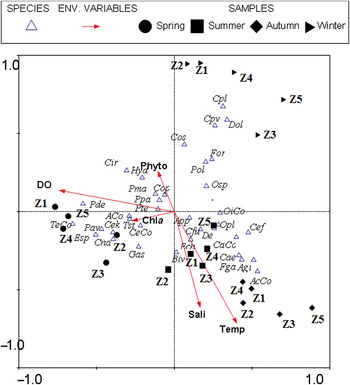
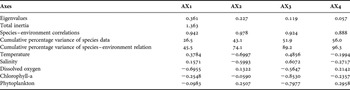
All groups, from higher to lower taxa, were subject to CCAs. Five environmental variables showed statistically significant contributions (P ≤ 0.05). The Monte Carlo permutation test showed that the first two axes were statistically significant (P ≤ 0.01). These axes accounted for 74.1% of the variance between taxa and environmental variables. The correlations between species and environmental parameters for CCA axis 1 (r2 = 0.942) and axis 2 (r2 = 0.978) were very high (Table 4), indicating a strong relationship between environmental variables and mesozooplankton distribution. Axis 1 was negatively correlated with DO as well as chlorophyll-a. Axis 2 was negatively correlated with salinity and temperature, but positively correlated with phytoplankton density (Table 4). DO accounting for 18.34% of the total variance was explained through all the environmental variables and this was followed by temperature (15.40%), salinity (11.01 psu), chlorophyll-a (9.54%) and phytoplankton (8.8%). In spring, mesozooplankton distribution seems to be affected by chlorophyll-a and DO, whereas temperature and salinity should be the main environmental factors affecting zooplankton composition in autumn and summer. The statistical results provide an indication of relationships. Higher positive correlation was found among cirripeds larvae and hydrozoans with phytoplankton density. Similarly, high correlation was computed between chlorophyll-a and the copepods C. kroyeri, T. stylifera, copepodites of Centropages and Acartia, bivalves larvae and salinity, between temperature and F. galerita, A. gibber and Acrocalanus copepodites (Figure 9).
Distribution of the samples, most common mesozooplankton taxa and environmental variables in canonical correspondence analysis plot. AcCo, Acrocalanus copepodit, ACo, Acartia copepodit, Agi, Acrocalanus gibber; App, appendicularians; Biv, bivalves larvae; CaCo, Calanopia copepodit; Cae, Calanopia elliptica; CeCo, Centropages copepodit, Cef, Centropages furcatus; Cek, Centropages kroyeri; Cfu, Clausocalanus furcatus; Cir, cirripeds larvae; Cna, Copepoda nauplii; Cop, copepodit; Cos, Coryceaus spp.; Cpl, Calocalanus plumatus; Cpv, Calocalanus pavoninus; Dec, decapods larvae; Dol, doliolids; Ech, echinoderms larvae; Esp, Evadne spinifera; Fga, Ferrosagitta galerita; For, foraminiferans; Gas, gastropods larvae; Hyd, hydrozoans; OiCo, Oithona copepodit; Opl, Oithona plumifera; Osp, Oncaea spp.; Pav, Penilia avirostris; Pde, Paracalanus denudatus; Pma, Paracalanus male; Pol, polychaetes larvae; Ppa, Paracalanus parvus; Pte, pteropods; TeCo, Temora copepodit; Tst, Temora stylifera; Phyto, phytoplankton density; Chla, chlorophyll-a; Temp, temperature; Sali, salinity; DO, dissolved oxygen.

Summary statistics for four axes of canonical correspondence analysis and weighted correlation matrix showing the relationship between species axes and environmental variables.

DISCUSSION AND CONCLUSION
In this study, seasonal abundance and biomass distribution of mesozooplankton were examined in the coastal area of İskenderun Bay, aiming to give basic information about biodiversity and their relation to environmental parameters.
Mesozooplankton showed two peaks in terms of abundance and biomass in İskenderun Bay, as is the case in most of Mediterranean coastal waters and harbours (Kovalev et al., Reference Kovalev, Mazzocchi, Kideys, Toklu and Skryabin2003). The recorded mesozooplankton abundance values were different from those observed in other Mediterranean coastal areas, such as Toulon Bay (Jamet et al., Reference Jamet, Jean, Boge, Richard and Jamet2005), Gulf of Trieste (Mozetic et al., Reference Mozetic, Fonda-Umani, Cataletto and Malej1998), Bay of Blanes (Calbet et al., Reference Calbet, Garrido, Saiz, Alcaraz and Duarte2001), Vranjic Basin (Vidjak et al., Reference Vidjak, Bojanic, Kuspilic, Marasovic, Gladan and Brautovic2006), Mersin Bay (Zenginer-Yılmaz & Besiktepe, Reference Zenginer-Yılmaz and Besiktepe2010), Lebanese coast (Lakkis, Reference Lakkis and Vanden Berghe2007), coastal area of Balearic Sea (Fernandez de Puelles et al., Reference Fernandez de Puelles, Jansa, Morillas, Amengual and Vicente1998) and North Evoikos Gulf (Christou et al., Reference Christou, Pagou, Christianidis, Papathanassiou, Eleftheriou, Ansell and Smith1995). Significantly similar wide ranges were commonly found in Mediterranean regions (Mazzocchi & Ribera d'Alcala, Reference Mazzocchi and Ribera d'Alcala1995; Siokou-Frangou, Reference Siokou-Frangou1996; Mazzocchi et al., Reference Mazzocchi, Licandro, Dubroca, Capua and Saggiomo2011). In very few of these studies, similar range of biomass values regarding zooplankton are shown (Fernandez de Puelles et al., Reference Fernandez de Puelles, Jansa, Morillas, Amengual and Vicente1998, Reference Fernandez de Puelles, Gras and Hernández de Leon2003; Zenginer-Yılmaz & Beşiktepe, Reference Zenginer-Yılmaz and Besiktepe2010). These differences could be derived from different sampling net and mesh size. Zooplankton sampling was conducted using similar equipment and the same mesh size in this study as in several studies mentioned above (Christou et al., Reference Christou, Pagou, Christianidis, Papathanassiou, Eleftheriou, Ansell and Smith1995; Siokou-Frangou, Reference Siokou-Frangou1996; Mozetic et al., Reference Mozetic, Fonda-Umani, Cataletto and Malej1998). However, different net types and the same mesh size were used in some of these studies (Mazzocchi & Ribera d'Alcala, Reference Mazzocchi and Ribera d'Alcala1995; Lakkis, Reference Lakkis and Vanden Berghe2007; Mazzocchi et al., Reference Mazzocchi, Licandro, Dubroca, Capua and Saggiomo2011). In the related literature, it was realized that sampling had been conducted with different net type and mesh size. Such reasons made it difficult to compare the results of this study with other studies conducted in other parts of Mediterranean Sea.
Another reason for the differences could be explained with the different topographic and hydrographic structure of these areas. Coastal areas are more sensitive and highly changeable systems and variations in water circulation, terrestrial inputs such as sewage and river inputs lead to changes in plankton communities (Calbet et al., Reference Calbet, Garrido, Saiz, Alcaraz and Duarte2001). Regarding this, differences in plankton assemblages according to the impact level from the environmental factors are observed clearly in a study conducted in the Toulon Bay (Jamet et al., Reference Jamet, Boge, Richard, Geneys and Jamet2001). In the coastal area of this mentioned bay where human impact is observed intensively, zooplankton abundance was 7–9 times higher than other areas of this bay less affected by the human impact. The zooplankton abundance in these coastal regions which are relatively away from the human impact was comparatively close to the abundance values found in the present study. In the present study, seasonal grouping of mesozooplankton in each station was very clear and is displayed in MDS and cluster plots. The distribution of abundant mesozooplankton groups and species around these grouped stations are shown in CCA plots, and information is given about seasonal trends of mesozooplankton. Seasonal cycle of species showed differences as well as some similarities compared to previous studies (Toklu & Sarıhan, Reference Toklu and Sarihan2003; Toklu, Reference Toklu2006; Lakkis & Toklu, Reference Lakkis and Toklu-Alicli2007). However, some differences were observed in terms of seasonal cycles of the species besides the similarities. Species and group composition in autumn, in particular, shows significant differences compared to the other seasons due to the contribution of some species such as A. gibber and their denser population in this study. Also, denser population of this species lead to a decrease in species diversity index values in this sampling period as well as observing a similar case due to the increasing density of P. avirostris in spring. Furthermore, more similar results in terms of seasonal variations of zooplankton were found by Toklu (Reference Toklu2006) except for autumn. The seasonal changes of copepod species in the stations located at the coastal region of that study are partly the same with the present study. However, temperature values of the mentioned study during winter and spring were similar to winter values of the present study. It is thought that these variables affect the abundance and dispersion to a great extent; in the studies conducted in the area information on species composition rather than abundance variations (Toklu & Sarıhan, Reference Toklu and Sarihan2003; Toklu, Reference Toklu2006). Due to scarcity of studies conducted on seasonal abundance changes in the bay, it is quite hard to make a comparison. Among the species, found in the present study, A. gibber was not mentioned in any of those studies. This species was reported previously in İskenderun Bay by Gücü et al. (Reference Gücü, Uysal, Mutlu, Kıdeyş, Tuğrul and Bingel2001) and the Alboran Sea and Balearic Islands by Razouls et al. (Reference Razouls, de Bovée, Kouwenberg and Desreumaux2012). Khalil & El-Rahman (Reference Khalil and El-Rahman1997) and El-Serehy et al. (Reference El-Serehy, Aboul-Ezz, Samaan and Saber2001) have reported this species in the Gulf of Aqaba in the Red Sea and Suez Canal, respectively. On the other hand, F. galerita has been reported as the first record by Terbıyık et al. (Reference Terbıyık, Çevik, Alıçlı-Toklu and Sarıhan2007) and reached maximum density in autumn, in conformity with the findings of the present study. İskenderun Bay has the largest number of Erythrean alien species along the Turkish coast (Çevik et al., Reference Çevik, Erkol and Toklu2006). After the opening of the Suez Canal in November 1869, a lot of organisms originally inhabiting the Red Sea or Indo-Pacific region passed to the Mediterranean by way of this canal. Hydrographical conditions in İskenderun Bay support the establishment of these alien species and it is believed that anthropogenic impacts such as thermal discharges and building activities in the marine ecosystems had a further influence (Çevik et al., Reference Çevik, Erkol and Toklu2006). According to Lakkis (personal communication), all lesssepsian species of Indo-Pacific origin are recorded in the eastern Mediterranean during the autumn, when the seawater and salinity are similar to those of the Red Sea (Terbıyık et al., Reference Terbıyık, Çevik, Alıçlı-Toklu and Sarıhan2007).
Most of the species commonly found in the other coastal regions of the Mediterranean were also observed in the sampling area, and both similarities and differences were identified in the seasonal changes of the species composition. Copepods were the most abundant group in this study similar to the other studies conducted in the different coastal area of the Mediterranean (Siokou-Frangou, Reference Siokou-Frangou1996; Fernandez de Puelles et al., Reference Fernandez de Puelles, Jansa, Morillas, Amengual and Vicente1998; Calbet et al., Reference Calbet, Garrido, Saiz, Alcaraz and Duarte2001; Jamet et al., Reference Jamet, Boge, Richard, Geneys and Jamet2001; Vidjak et al., Reference Vidjak, Bojanic, Kuspilic, Gladan and Ticina2007; Zenginer-Yılmaz & Beşiktepe, Reference Zenginer-Yılmaz and Besiktepe2010). Copepods were followed by cladocerans, appendicularians in the study area as in the Gulf of Naples (Mazzochi & Ribera d'Alcala, Reference Mazzocchi and Ribera d'Alcala1995), in Saronikos Gulf (Siokou-Frangou, Reference Siokou-Frangou1996) in the Bay of Blanes (Calbet et al., Reference Calbet, Garrido, Saiz, Alcaraz and Duarte2001). However, appendicularians were found to be the most important group after copepod and crustaceans naupli in Mersin Bay (Zenginer-Yılmaz & Beşiktepe, Reference Zenginer-Yılmaz and Besiktepe2010). Appendicularians did not show clear seasonality, but this group is more abundant in the warm period in the study area. This result conflicted with the data provided by Mazzochi & Ribera d'Alcala (Reference Mazzocchi and Ribera d'Alcala1995). This group was mentioned to have been more abundant in winter in the Gulf of Naples. It could be related to food conditions rather than temperature. Some zooplanktonic organisms such as appendicularians can feed on pico-size foods (Zenginer-Yılmaz & Besiktepe, Reference Zenginer-Yılmaz and Besiktepe2010) and Kahyalar & Polat (Reference Kahyalar (Kaya) and Polat2008) reported picoplanktonic Synechococcus to be the most abundant in warm periods in the study area and confirmed the results of the present study. Cladocerans were reported to be more abundant in summer in some coastal areas of the Mediterranean (Mazzochi & Ribera d'Alcala, Reference Mazzocchi and Ribera d'Alcala1995; Siokou-Frangou, Reference Siokou-Frangou1996; Aker & Özel, Reference Aker and Özel2006). In the present study, cladoceran abundance is higher in spring related to the increase in P. avirostris. Aker & Özel (Reference Aker and Özel2006) reported that P. avirostris was the dominant cladoceran species and more abundant in summer. Temperature seems to be the most important factor relating to the seasonal distribution of this species. The seawater temperature varied between approximately 20.5°C and 23.5°C in summer in their study. However, seawater temperature was measured as 20.58–21.08°C in spring in the study area of the present study. As a consequence, the earlier seawater temperature increased and the earlier abundance of this species increased. Moreover, other environmental conditions such as food condition and salinity could be more favourable in spring in the area. Large and small streams, flowing into the sea in the north of the research area, and rainfalls are the most important freshwater sources affecting the region (Sarıhan et al., Reference Sarıhan, Avşar, Polat, Çevik, Çiçek, Toklu, Ergüden, Olgunoğlu and Çekiç2005). Due to this reason, the salinity values of the research area were measured lower during the winter and spring compared to the other seasons and presumably owing to the affect of the freshwater resources, chlorophyll-a values reached the maximum level in spring. Penilia avirostris was observed in the mouths of rivers and generally in waters with reduced salinity. This species was also considered to be an indicator of low salinity water (Moraitou-Apostolopoulou & Kiortsis, Reference Moraitou-Apostolopoulou and Kiortsis1973).
Seasonal variation of copepod species was partly different from other coastal areas. The most significant difference is that Centropages typicus (Krøyer, 1849) (Mazzocchi et al., Reference Mazzocchi, Christou, Di Capua, Fernández de Puelles, Fonda-Umani, Molinero, Nival and Siokou-Frangou2007) which is found in most of the coastal regions of the Mediterranean was not observed in this study. This species was observed neither in the studies conducted by Lakkis (Reference Lakkis1984) in the coasts of Lebanon, one of the areas closest to the Bay of İskenderun, nor in the other studies conducted in the same region (Gücü et al., Reference Gücü, Uysal, Mutlu, Kıdeyş, Tuğrul and Bingel2001; Toklu, Reference Toklu2006; Lakkis & Toklu, Reference Lakkis and Toklu-Alicli2007). In this study, among copepods P. parvus, A. gibber, C. kroyeri, O. plumifera, Clausocalanus furcatus, Centropages furcatus was the most common species. Mazzocchi & Ribera'd Alcala (Reference Mazzocchi and Ribera d'Alcala1995) stated that P. parvus, A. clausi, C. typicus and T. stylifera are the most abundant in the Gulf of Naples. Siokou-Frangou (Reference Siokou-Frangou1996) reported that Clausocalanus furcatus, P. parvus, T. stylifera, Ctenocalanus vanus (Giesbrecht, 1888), Oithona similis (Claus, 1866), and O plumifera were dominant during most of the year in Saronikos Gulf. Furthermore, Clausocalanus, Oithona and Paracalanus were the most abundant genera and P. parvus, Clausocalanus furcatus, A. clausi, O. plumifera, T. stylifera and C. typicus were the most common species throughout the year in the Balearic Sea (Fernandez de Puelles et al., Reference Fernandez de Puelles, Gras and Hernández de Leon2003).
It is thought that the variability of copepods was due to the different locations of areas which were exposed to different terrestrial inputs and other environmental conditions. As mentioned previously in the present study, the study area is not only affected by human activities and freshwater sources as in most of the coastal areas in the Mediterranean, but also by the Suez Canal and the Red Sea. Similarly, species composition displayed more differences owing to this effect in autumn, as mentioned previously. In spring, temperature is higher in İskenderun Bay than in other coastal Mediterranean areas, that favoured the abundance of the species, P. avirostris and T. stylifera which are dominant in summer in other coastal Mediterranean areas.
Spearman correlation results showed a positive correlation between mesozooplankton biomass and chlorophlly-a as well as phytoplankton abundance. Therefore, food availability most probably affected total zooplankton biomass. Siokou-Frangou (Reference Siokou-Frangou1996) stated that the zooplankton life cycle is related to environmental factors, mainly food availability, and reported a similar relationship in the Gulf of Saronikos. Moreover, food limitation is one of the main factors determining the zooplankton community structure (Fernandez de Puelles et al., Reference Fernandez de Puelles, Jansa, Morillas, Amengual and Vicente1998). However, CCA results showed that seasonal variability of mesozooplankton species was mostly related to the abiotic environmental conditions rather than to trophic factors (chlorophyll-a and phytoplankton abundance) in the present study.
According to CCA results, DO seems to be an important factor affecting the species distribution, followed by the temperature, salinity, chlorophyll-a and phytoplankton abundance. However, since DO values in the present study are higher than minimum oxygen levels required for copepods (Roman et al., Reference Roman, Gauzens, Rhinehart and White1993), the effect of DO on zooplankton community structure could be ignored as was stated by Jamet et al. (Reference Jamet, Boge, Richard, Geneys and Jamet2001). Temperature and salinity are the most important factors accounting for the variability of zooplankton groups and species in the present study. Similar observations were obtained in previous studies conducted in Mediterranean coastal areas (Christou, Reference Christou1998; Calbet et al., Reference Calbet, Garrido, Saiz, Alcaraz and Duarte2001; Jamet et al., Reference Jamet, Boge, Richard, Geneys and Jamet2001; Fernandez de Puelles et al., Reference Fernandez de Puelles, Gras and Hernández de Leon2003). Additionally, Siokou Frangou et al. (Reference Siokou-Frangou, Papathanassiou, Lepretre and Frontier1998) reported that temperature seems to be the main factor for seasonal changes of zooplankton species, but salinity was not a limiting factor for it due to the narrow range of values (37.5–39 psu). On the other hand, salinity values in our study area were in a wider range (38.06–41.78 psu) and their effect on community structure was seen more clearly.
In conclusion, it can be concluded that the seasonal cycling of mesozooplankton abundance and biomass in İskenderun Bay displayed a similar pattern to those observed in other coastal areas of the eastern Mediterranean, while copepod species composition differed partially. Environmental factors affect not only plankton community structure and the functioning organization, but also the composition and abundance. Species distribution in the area was mainly related to abiotic parameters while, on the other hand, zooplankton biomass is strictly related to the trophic conditions prevailing in the area, especially chlorophyll-a.
ACKNOWLEDGEMENTS
We thank Dr Nurgül Koyuncu for her invaluable help on canonical correspondence analysis, Mehmet Yücel for helping in the writing process and manuscript referees for improving our paper with their invaluable comments.