Introduction
Mean annual air temperatures in the Maritime Antarctic, particularly along the western Antarctic Peninsula, have risen at approximately double the rate of the global mean surface temperature over the past 50–100 years (up to 0.4ºC decade-1 compared to 0.2ºC decade-1; Hansen et al. Reference Hansen, Sato, Reudy, Lo, Lea and Medina-Elizade2006, Adams et al. Reference Adams, Arthern and Atkinson2009). The warming of terrestrial Maritime Antarctic ecosystems has been accompanied by changes to precipitation patterns, with increases in snow accumulation in recent decades (Adams et al. Reference Adams, Arthern and Atkinson2009, Thomas et al. Reference Thomas, Dennis, Bracegirdle and Franzke2009), and alterations to the population size and range of plant species (Fowbert & Smith Reference Fowbert and Smith1994, Smith Reference Smith1994, Convey & Smith Reference Convey and Smith2006, Convey Reference Convey2011). However, Convey et al. (Reference Convey, Hopkins, Roberts and Tyler2011) concluded that the recently established southern limit for flowering plants in Antarctica was unlikely to be linked to the recent warming trend. In the coming decades, the expansion of Maritime Antarctic plant populations will probably enhance and alter nutrient inputs to soils (Hill et al. Reference Hill, Farrar, Roberts, Farrell, Grant, Newsham, Hopkins, Bardgett and Jones2011), with inputs of carbon (C) and nitrogen (N) leading to significant increases in soil microbial biomass (Davey & Rothery Reference Davey and Rothery1992, Malosso et al. Reference Malosso, English, Hopkins and O’Donnell2004, Reference Malosso, English, Hopkins and O’Donnell2005, Dennis et al. Reference Dennis, Rushton, Newsham, Lauducina, Ord, Daniell, O’Donnell and Hopkins2012).
Warming influences the size and composition of soil microbial communities in Maritime Antarctic soils, with substantial increases in cyanobacteria (autotrophs) and heterotrophic microorganisms being associated with experimental warming in the northern Maritime Antarctic (Wynn-Williams Reference Wynn-Williams1996, Yergeau et al. Reference Yergeau, Bokhorst, Kang, Zhou, Greer, Aerts and Kowalchuk2012). Dennis et al. (Reference Dennis, Newsham, Rushton, Ord, O’Donnell and Hopkins2013a) investigated the effects of increased soil temperature, water and substrate availability on soil bacterial communities on Signy Island (60°S) over 12 months. The study showed that bacterial communities responded positively to organic substrates, but that responses to warming alone were limited. Little is known of the combined effects of warming and changes in water and substrate availability on the microbial processes in the Maritime Antarctic; however, this is the more probable scenario as changes in environmental factors rarely occur singly. Allison et al. (Reference Allison, Wallenstein and Bradford2010) suggest that the soil microbial response to warming depends on the efficiency of the soil microbes in using C, with less C allocated to microbial growth under warming conditions, and that this response differs with organic substrate quality.
We report a controlled laboratory-based study on soils from Signy Island. This study was designed to extend the field experiments described by Dennis et al. (Reference Dennis, Newsham, Rushton, Ord, O’Donnell and Hopkins2013a), as logistical constraints prevented biogeochemical process measurements in the field. We tested the effects of warming, water addition and substrate supply on the key soil microbial process of C mineralization/soil respiration and inorganic N dynamics (mineralization/immobilization).
Materials and methods
Site and soil
The soil samples were collected at Wynn Knolls (60°41'56"S, 45°38'10"W), Signy Island, South Orkney Islands (northern Maritime Antarctica) during the 2008–09 summer and transported frozen at -20°C to the UK. Wynn Knolls is situated c. 500 m from the western shoreline of Signy Island at an altitude of 199 metres above sea level. Signy Island has an oceanic climate, characterized by dense cloud cover during the summer and precipitation of between 350–500 mm water equivalent per annum, with much of the water falling as rain in the summer (Dennis et al. Reference Dennis, Newsham, Rushton, Ord, O’Donnell and Hopkins2013a). Mean air temperatures at Signy Island were between -2–3 °C during the summer and -2–-17°C during the winter (Dennis et al. Reference Dennis, Newsham, Rushton, Ord, O’Donnell and Hopkins2013a). At 1–5 cm depth, the mean annual soil temperature was -2.5°C, the highest monthly mean temperature was 3.6°C (January) and the lowest was -9.5°C (July) (Dennis et al. Reference Dennis, Newsham, Rushton, Ord, O’Donnell and Hopkins2013a). The soil contained 1.4 mg organic C g-1 soil and 0.4 mg total N g-1 soil, and had a pHwater of 7.5. Further site and soil details are reported in Dennis et al. (Reference Dennis, Rushton, Newsham, Lauducina, Ord, Daniell, O’Donnell and Hopkins2012, Reference Dennis, Newsham, Rushton, Ord, O’Donnell and Hopkins2013a).
Experimental design
The soil samples were thawed and sieved (2 mm) in the field-moist state then kept at <5°C for no more than 24 hours before the experiment was established. Sub-samples of soil (40 g dry weight equivalent) were weighed into 64 glass incubation jars with 125 cm3 volume. The experiment comprised two water addition treatments, two incubation temperatures and addition of three different organic substrates plus a no-substrate control. Each combination was replicated four times (i.e. two water additions x two temperatures x four substrate treatments x four replicates=64). The incubation jars were fitted with gas-tight septa and incubated for 175 days. These conditions were designed to support the parallel field experiment (Dennis et al. Reference Dennis, Newsham, Rushton, Ord, O’Donnell and Hopkins2013a) and broadly simulate increases in soil nutrients associated with organic input from algae and cyanobacteria.
The water content was adjusted by the addition of distilled water to achieve either 20% or 80% of the soil water-holding capacity (WHC; 100% WHC was determined on separate sub-samples of the soil). Soil WHC of 20% and 80% were selected to represent the extremes of dryness and wetness expected on Signy Island. When the soil samples were collected the WHC was between 80–100%. Water content was maintained by re-weighing and addition of distilled water as necessary after each gas sampling occasion (see below).
The soils were incubated at either 5°C or 15°C in thermostatically controlled, fan-assisted incubators. These temperatures were selected to provide a comparison between a warm day in summer (c. 5°C) and extreme warming events (15°C).
The substrate treatments included glucose (a simple C-rich organic substrate; Aldrich, UK), glycine (a combined organic C and N substrate; Aldrich, UK) or tryptone soy broth (TSB) powder (a complex organic C and N substrate; Difco, USA), or no-substrate as a control. Each substrate provided an additional 2 mg C g-1 dry weight soil. The glycine and TSB supplied organic N at the rate of 0.58 and c. 0.2 mg N g-1 dry weight soil, respectively (the N content of TSB is slightly variable because it is not a defined medium).
Carbon mineralization/soil respiration
Periodically (approximately once every 10–15 days) the headspace from each incubation jar was sampled (1 ml volume) with a syringe and CO2 concentration was determined by gas chromatography (Hopkins & Shiel Reference Hopkins and Shiel1996; Varian 90 GC, fitted with a thermal conductivity detector, Poropak Q column and using helium as the carrier gas). After each gas sampling, the septa were removed from the incubation jars for c. 30 minutes to allow headspace gas to be refreshed, then the jars were resealed (as described above, gravimetric water content was corrected after each sampling occasion). The CO2 concentration was used to calculate respiration rate and cumulative CO2 production with time. The total CO2 produced over 175 days from the substrate-amended treatments, minus that from the corresponding no-substrate controls, were used to estimate the equivalent proportion of added C lost as CO2. Incubation for 175 days was selected as this is sufficient time for the burst of CO2 following substrate addition to have subsided (Hopkins et al. Reference Hopkins, Waite and O’Donnell2011). Total CO2 could not be used to accurately estimate the actual substrate C mineralization because a correction could not be made for priming, i.e. the amount of C mineralized from the indigenous soil organic matter as a result of the added substrate. The error on the estimate for priming was probably small due to the low C content of the indigenous soil. However, it cannot be discounted because significant priming has been indicated in another soil sample from Signy Island (Malosso et al. Reference Malosso, English, Hopkins and O’Donnell2004).
Extractable organic carbon
Extractable organic C in the soil was determined prior to substrate addition and after 175 days of incubation. Organic C was extracted from 10 g (wet weight) soil with 40 cm3 of 1.0 M potassium chloride shaken for 30 minutes, centrifuged and frozen prior to flow injection analysis (Skalar Analytical BV, The Netherlands).
Nitrogen mineralization/immobilization
The same samples prepared for the extractable organic C analyses were used to determine extractable NH4 +-N (ammonium) and NO3 --N (nitrate) plus NO2 --N (nitrite) by flow injection analysis (Skalar Analytical BV). These data were used to estimate net mineralization/immobilization of inorganic N in the soil, but could not be used to reliably estimate total N mineralized from the added substrates due to errors from primed N mineralization and N loss to the gaseous phase by denitrification which was not determined.
Statistical analyses
The data for C mineralization/soil respiration rate and the concentrations of extractable organic C and inorganic N ions were each subject to three-way ANOVA with two timepoints using SPSS-21. The significance differences between means were determined using Tukey’s Honestly Significant Difference calculated at P<0.05.
Results
Carbon mineralization/soil respiration
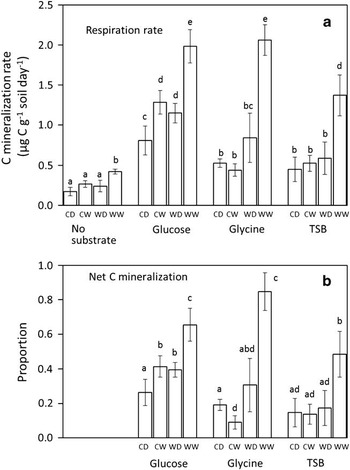
The addition of water to 20% and 80% WHC led to a significantly increased basal soil respiration rate. The effect of warming on the basal soil respiration rate was not significant. However, there was a significant positive interaction between water addition and warming, i.e. water and warming operated additively to increase the basal respiration rate (Fig. 1a).
Carbon (C) mineralization/soil respiration for soil from Wynn Knolls, Signy Island after treatment with no substrate, glucose, glycine or tryptone soy broth (TSB) incubated under cold and dry (CD) conditions (5°C and 20% water-holding capacity, WHC), cold and wet (CW) conditions (5°C and 80% WHC), warm and dry (WD) conditions (15°C and 20% WHC), or warm and wet (WW) conditions (15°C and 80% WHC) for 175 days. Each value is the mean of four replicates and the bars are±standard error. a. The respiration rate. b. The net C mineralization expressed as the proportion of substrate C mineralized (i.e. the additional CO2 produced over 175 days above that produced in the no-substrate control) with no allowance for priming. Columns with the same letter are not significantly different (P<0.05).

Addition of glucose, glycine or TSB led to increased respiration rate for all warming and moisture combinations relative to the no-substrate control (Fig. 1a). In the presence of glucose, both water addition and warming increased respiration rate when applied singly, and there was a positive interaction between water addition and warming (Fig. 1a). Contrasting with the glucose treatment, addition of water or warming alone had no significant effect on respiration in the presence of either glycine or TSB (Fig. 1a). However, both treatments demonstrated significant positive interactions between water addition and warming.
The total C mineralized to CO2, expressed as the proportion of the substrate C, followed the same pattern as the respiration rate (Fig. 1b). Under optimal conditions of water and warming, the total C mineralized was equivalent to 66% for glucose, 85% for glycine and 48% for TSB (Fig. 1b).
Extractable organic carbon
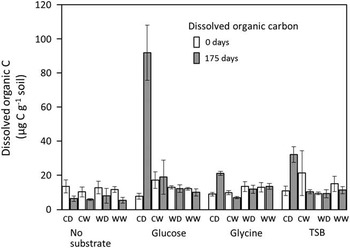
In the no-substrate controls, the extractable organic C concentrations declined with time (Fig. 2). Addition of glucose, glycine or TSB led to significantly increased extractable organic C concentrations after 175 days compared with the no-substrate control (Fig. 2). For the cold and dry conditions, the concentration of extractable organic C was greater after 175 days compared with day 0, but for all other water addition and warming combinations the extractable organic C concentration after 175 days was the same as at day 0 (Fig. 2).
Extractable organic carbon (C) concentrations for soil from Wynn Knolls, Signy Island after treatment with no substrate, glucose, glycine or tryptone soy broth (TSB) incubated under cold and dry (CD) conditions (5°C and 20% water-holding capacity, WHC), cold and wet (CW) conditions (5°C and 80% WHC), warm and dry (WD) conditions (15°C and 20% WHC), or warm and wet (WW) conditions (15°C and 80% WHC) at day 0 and day 175. Each value is the mean of four replicates and the bars are±standard error.

Nitrogen mineralization/immobilization
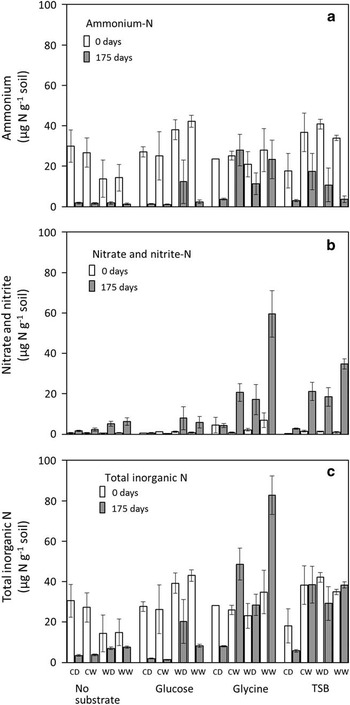
For both the no-substrate control and the glucose treatment, the NH4 + concentration declined significantly with time for all water addition and warming combinations (Fig. 3a). For the glycine treatment, the NH4 + concentration after 175 days was significantly less than at day 0 for the cold and dry treatment, but there were no significant differences for the other combinations (Fig. 3a). For the TSB treatments, the NH4 + concentrations all declined significantly with time (Fig. 3a). For both the glycine and TSB treatments, the NH4 + concentration was significantly greater than the no-substrate control after 175 days, except under cold and dry conditions (Fig. 3a).
Inorganic nitrogen (N) concentrations for soil from Wynn Knolls, Signy Island after treatment with no substrate, glucose, glycine or tryptone soy broth (TSB) incubated under cold and dry (CD) conditions (5°C and 20% water-holding capacity, WHC), cold and wet (CW) conditions (5°C and 80% WHC), warm and dry (WD) conditions (15°C and 20% WHC), or warm and wet (WW) conditions (15°C and 80% WHC) at day 0 and day 175. Each value is the mean of four replicates and the bars are±standard error. a. Ammonium (NH4 +) concentration. b. Sum of the nitrate (NO3 -) and nitrite (NO2 -) concentrations (NO2 - was present in trace concentrations or undetectable). c. Combined inorganic N concentrations (sum of NH4 +, NO3 - and NO2 - concentrations).

In all cases, the NO2 - concentrations were very small (often undetectable), thus they are described alongside the NO3 - data. In the no-substrate control, NO2 - and NO3 --N concentrations increased with time, there were positive effects of water addition and warming, and a significant interaction between these factors (Fig. 3b). In the presence of glucose, warming led to a significant increase in NO2 - and NO3 --N concentrations (Fig. 3b). For the glycine and TSB treatments, there were significant increases in NO2 - and NO3 --N concentrations for both water addition and warming treatments, with a significant interaction between these two factors with glycine (Fig. 3b).
Significant declines in total inorganic N concentration (sum of NH4 +, NO3 - and NO2 -) were observed over time for all of the water addition and warming combinations for the no-substrate control and glucose treatment (Fig. 3c). For the glycine and TSB treatments, the total inorganic N concentration increased with time in all cases, except under the cold and dry conditions (Fig. 3c).
Discussion
Carbon mineralization/soil respiration
The addition of an organic substrate increased C mineralization, but the respiratory response to water addition and warming differed according to the substrate. The proportion of C mineralized was consistent with previous studies, where the total amount of C mineralized was equivalent to c. 80% of the C added as glucose or amino acids, these studies were comparatively short-term and had warmer incubation temperatures (Hopkins et al. Reference Hopkins, O’Dowd and Shiel1997, Meli et al. Reference Meli, Badalucco, English and Hopkins2003). Mineralization of the indigenous soil organic C increased significantly with water addition alone but not warming alone. By contrast, in the presence of glucose mineralization of C responded positively to both water addition and warming. This observation is supported by the higher concentration of extractable organic C in cold and dry conditions in the presence of glucose. The organic substrates that supplied both organic C and N (glycine and TSB) only responded to water addition and increased temperature when these factors were combined. These results may be the consequence of differential responses within the soil microbial community, with some organisms able to utilize glucose at low temperatures provided water is not limiting, and other organisms able to utilize glucose when water availability is low provided the temperature is high enough (Newsham et al. Reference Newsham, Pearce and Bridge2010).
The positive effect of water addition could be due to more rapid diffusion of the substrate, thus under wetter conditions substrates are more readily available to a larger proportion of the soil microbial community. Such effects have been observed for other organic substrates, the mineralization of which is influenced by the antecedent water content (Zak et al. Reference Zak, Holmes, MacDonald and Pregitzer1999, Newsham et al. Reference Newsham, Pearce and Bridge2010).
Mineralization of C from glucose and the basal respiration rate were more sensitive to temperature than mineralization from the N-rich substrates. Mineralization of C from the N-rich substrates only responded positively to temperature in the presence of additional water. The variable temperature sensitivity of C mineralization in soils is associated with substrate complexity; mineralization of more complex substrates shows a stronger temperature response than is seen with simple substrates based on thermodynamic theory (Hartley & Ineson Reference Hartley and Ineson2008, Hartley et al. Reference Hartley, Hopkins, Garnett, Sommerkorn and Wookey2008, Allison et al. Reference Allison, Wallenstein and Bradford2010). This probably applies to TSB, which contains an undefined mixture of peptides, possibly requiring several different catabolic enzymes for complete mineralization. However, glycine is a relatively simple molecule which deaminates to ethanoate (acetate), a precursor in the tricarboxylic acid pathway. It would appear that there is either a thermodynamic constraint on glycine catabolism or that this amino acid is not being mineralized but being used in anabolic metabolism incorporated into microbial biosynthetic processes. Hill et al. (Reference Hill, Farrar, Roberts, Farrell, Grant, Newsham, Hopkins, Bardgett and Jones2011) identified plants in the Maritime Antarctic with a high affinity for amino acids as an N source, thus it is possible that at least some of the soil microorganisms in this environment do the same.
Irrespective of the mechanism, it is clear that C mineralization is limited by both water and temperature to a greater extent in the presence of the N-rich substrates than C-rich substrates.
Nitrogen mineralization/immobilization
The decline in NH4 + and total inorganic N over time in the no-substrate control and with glucose treatment is evidence for net N immobilization, the result of the soil microbial community being more limited by N supply than C supply, thus N is immobilized from the external environment (Harmsen & van Schreven Reference Harmsen and van Schreven1955). Such a response in soils is not uncommon, especially following the addition of a C-rich substrate such as glucose (Dungait et al. Reference Dungait, Kemmitt, Michallon, Guo, Wen, Brookes and Evershed2013). Total inorganic N also declined over time in response to water addition and warming in the no-substrate control, a finding consistent with an N limitation to microbial activity.
With the glycine and TSB treatments, the effect of the organic N in the added substrate on net N mineralization is evident. Total inorganic N concentration increased over time in nearly all cases for the glycine treatments and did not decline over time in nearly all cases for TSB, with the exception of cold and dry conditions for both treatments. This is broadly consistent with the C mineralization responses. Constraints on microbial activity probably explain the decline in total inorganic N concentration under cold and dry conditions. Fraser et al. (Reference Fraser, Hallett, Wookey, Hartley and Hopkins2013) demonstrated a clear temperature sensitivity for enzymes that contribute to N mineralization in soils.
The increases in NO3 - concentrations in nearly all cases coincide with the C mineralization responses to water addition and warming for the different treatments. This indicates that nitrification was constrained by the same factors as both C mineralization and net N mineralization/immobilization. Net nitrification (i.e. accumulation of NO3 -) in closed soil incubation is frequently observed (e.g. Hopkins et al. Reference Hopkins, O’Donnell and Shiel1988), particularly in soils with near neutral pH, because leaching losses are absent and oxygen diffusion in soil is rarely limited over the small distances that occur in laboratory microcosms. Nitrate accumulation suggests that N losses from the soil to the gaseous phase were minor, consistent with the lack of anoxic conditions, and that chemoautotrophic nitrifying bacteria are active in these soils, an observation consistent with an earlier report (Wilson et al. Reference Wilson, Sprent and Hopkins1997). The amount of CO2 fixed by nitrifying bacteria is usually small by comparison with the amount of CO2 released by heterotrophic microorganisms and, therefore, probably does not influence the interpretation of the C mineralization data, not least because nitrification rates can be temporarily suppressed by high CO2 concentrations that could occur in closed incubation vessels (Keeney et al. Reference Keeney, Sahrawat and Adams1985, Kinsbursky & Saltzman Reference Kinsbursky and Saltzman1990).
Relation to field conditions
Water fluctuations in the field are highly variable depending upon melting and precipitation, both of which can be sudden and lead to rapid changes. During establishment of the field work, the liquid water content of the soil increased to approximately 100% WHC as a result of a rapid rise in temperature leading to snow melt followed by rain (Dennis et al. Reference Dennis, Newsham, Rushton, Ord, O’Donnell and Hopkins2013a). For these reasons, the contrast between 20% and 80% WHC can be regarded as representative of field conditions.
The incubation temperatures selected for the laboratory study reflect the difference between mean soil temperatures on a warm day in summer (3.6°C; Dennis et al. Reference Dennis, Newsham, Rushton, Ord, O’Donnell and Hopkins2013a) and extreme warming events during which the surface temperature may rise to more than 20°C (Convey Reference Convey2013).
The additional C and N supplied by the substrates (2 mg C g-1 soil and 0.58 mg N g-1 soil or c. 0.2 mg N g-1 soil for glycine and TSB, respectively) represent an approximate doubling in the organic C and total N contents (the soil organic C content was 1.4 mg C g-1 soil and the total N content was 0.4 mg N g-1 soil). Although this is a large increment, it is not unrealistic for discrete sites of nutrient deposition in an otherwise resource-poor environment, such as at the sites of guano deposition or directly beneath and surrounding plants (Hopkins et al. Reference Hopkins, Sparrow, Novis, Gregorich, Elberling and Greenfield2006). For these reasons, the laboratory conditions are considered to be representative of the field conditions.
Comparison with other Antarctic studies
Positive responses to warming have been reported for microorganisms (Yergeau et al. Reference Yergeau, Bokhorst, Kang, Zhou, Greer, Aerts and Kowalchuk2012) and nematodes (Simmons et al. Reference Simmons, Wall, Adams, Ayres, Barrett and Virginia2009) in Antarctic soils. The field-based research with analogous treatments reported by Dennis et al. (Reference Dennis, Newsham, Rushton, Ord, O’Donnell and Hopkins2013a) demonstrated microbial responses in terms of concentration of lipid biomarkers, i.e. growth, rather than physiological responses, over approximately one year. They showed a positive response to organic substrate additions, but no responses were observed with either water addition or warming and no interactions between factors were identified (Dennis et al. Reference Dennis, Newsham, Rushton, Ord, O’Donnell and Hopkins2013a). Soil saturation early in the experiment may account for the lack of any measured effect of water addition in the field. The passive warming method (open-top chambers) employed by Dennis et al. (Reference Dennis, Newsham, Rushton, Ord, O’Donnell and Hopkins2013a) had a significant effect on temperature by increasing the monthly minimum, mean and maximum temperatures by 0.3, 0.6 and 0.7°C, respectively. However, by comparison with the incubation temperatures in the laboratory, warming in the field was relatively modest. Furthermore, passive warming did not have a significant effect on the number of freeze-thaw cycles in the soil (i.e. the periods when the soil was above 0°C were no more frequent with warming than for the control). This may explain the absence of a microbial response to warming in the field.
An analogous substrate-addition study in the more environmentally extreme Dry Valleys region of Antarctica showed increases in microbial activity (respiration and enzyme activities) over several years (Hopkins et al. Reference Hopkins, Sparrow, Shillam, English, Dennis, Novis, Elberling, Gregorich and Greenfield2008, Sparrow et al. Reference Sparrow, Gregorich, Hopkins, Novis, Elberling and Greenfield2011, Dennis et al. Reference Dennis, Sparrow, Gregorich, Novis, Elberling, Greenfield and Hopkins2013b). The study included addition of inorganic N (NH4Cl) and reported microbial responses to inorganic N when glucose was added, this is consistent with our observations of net N immobilization when a C-rich substrate was added, but net N mineralization when N-rich substrates were added (Hopkins et al. Reference Hopkins, Sparrow, Shillam, English, Dennis, Novis, Elberling, Gregorich and Greenfield2008, Sparrow et al. Reference Sparrow, Gregorich, Hopkins, Novis, Elberling and Greenfield2011). Thus, the availability of N in these soils influences microbial activity alongside other factors, including organic C supply. These results are consistent with our findings and those of Dennis et al. (Reference Dennis, Newsham, Rushton, Ord, O’Donnell and Hopkins2013a). This study did not include warming or effective water addition (temperatures in the Dry Valleys are often too low for meaningful water manipulations except over very short periods), thus there are no results from other water addition or warming experiments with which to compare our results.
Conclusions
In a soil from the northern Maritime Antarctic, soil respiration and N mineralization/immobilization in the presence of a C-rich substrate (glucose) are positively affected by increases in water and temperature. These factors were influential individually and had an additive effect when applied together. For N-rich substrates (glycine and TSB), microbial responses to increased water or temperature alone were weak or not significant, but these factors interacted to give significantly positive increases when applied together. These data indicate that under the expected changes in environmental conditions in the Maritime Antarctic, where temperature and the availability of water and organic substrates will probably increase, soil microbial activity will lead to more rapid C and N cycling and have a positive feedback on these biogeochemical processes, particularly where or when these factors increase concurrently.
Acknowledgements
Funding was supplied by the UK Natural Environment Research Council through the Antarctic Funding Initiative (AFI 7/05; NE/D00893X/1). Logistical support was provided by the British Antarctic Survey. Sun Benhua was supported by the Chinese 111 Project (No. B12007). We would like to thank the reviewers for their constructive comments.