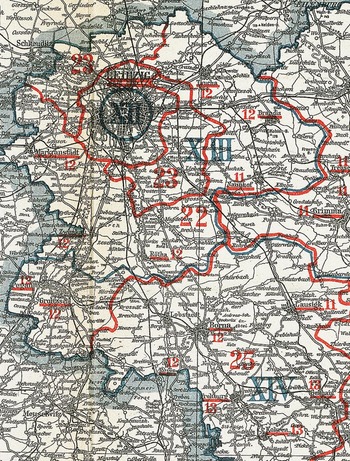
“The Ministry of the Interior has no use for the map you are offering.”Footnote 1 This was the dismissive reply that Saxony's suffrage expert Georg Heink sent to Richard Liesche, owner of the Graser Verlag in March 1909. On a base map showing the smallest towns and villages in the Kingdom of Saxony—Imperial Germany's third-largest federal state after Prussia and Bavaria—Liesche's publishing house had superimposed two sets of colored lines (fig. 1). The first set was in blue, depicting the borders of Saxony's twenty-three Reichstag districts.Footnote 2 Each district was marked with a Roman numeral, also in blue, including XII for Leipzig-City and XIII for Leipzig-County.Footnote 3 The second set of lines was in red, depicting the ninety-one Landtag districts that Heink had just drawn, or redrawn, as part of Saxony's suffrage reform passed earlier in 1909. Each of Saxony's forty-eight rural Landtag districts was designated by a large Arabic numeral in red, including the twenty-second and twenty-third rural districts outside Leipzig. Each of the kingdom's urban Landtag districts was underlined in red and had a smaller Arabic numeral.Footnote 4 Because the use of colored ink added significantly to the cost of producing this map, Liesche hoped the Saxon government would agree to buy three hundred copies. No deal, replied Heink. But in the margin of Liesche's begging letter, Heink wondered what Graser's print run would be.Footnote 5
Grasers Karte von Sachsen mit Angabe der Landtags- u. Reichstagswahlkreise (Annaberg: Graser Verlag, n.d. [ca. 1911]), detail. 1:320,000.

Heink had reason to worry about a popular outcry should Graser's map reach working-class voters or be used in socialist efforts to enlighten them about their voting rights. Those voters had just been subjected to an audacious gerrymander of Saxony's Landtag districts.Footnote 6 The architect and draftsman of that gerrymander was Georg Heink himself. But Leipzig voters had been subject to gerrymanders before. As readers will learn below, suffrage reformers had sought to minimize Social Democratic gains in Leipzig's municipal assembly in 1894 and in the Saxon Landtag in 1896. Such antisocialists pursued a strategy similar to the one Republicans deployed against their Democratic Party rivals in the United States starting in 2010: identify local legislatures where a majority can be obtained or safeguarded; use that majority to redraw the geographical boundaries of electoral districts in a partisan way; then secure more victories and initiate more gerrymanders, to sap the opponent's strength for the foreseeable future.Footnote 7 The manipulation of voting laws in Germany before 1914 depended more on what the British called “fancy franchises”—class-based and plural voting systems—than on the redrawing of district boundaries. But usually suffrage reform and redistricting occurred at the same time and with the same antisocialist intent.Footnote 8
The likelihood that working-class voters in 1909 would compare the size and shape of Saxony's Reichstag and Landtag districts was small. Socialist functionaries in Saxony, however, did have the time and inclination to think about what those intersecting blue and red lines really meant. Some veterans of election battles in Saxony also saw the opportunity to explain to their followers how the outcome of elections fought under the Reichstag's universal manhood suffrage differed so fundamentally from elections fought under the more complicated voting systems for Saxon Landtag elections and for Leipzig's municipal assembly.Footnote 9
Grasers Karte offered contemporaries—and now offers historians—an opportunity to consider the ramifications of German battles for influence and power in three different political cultures. The balance of this article argues that local, regional, and national suffrages need to be considered together and in terms of their reciprocal effects to get at certain developments central to the processes of political modernization. Examining overlaps and spillovers between electoral politics at different tiers of governance can illuminate the perceptions and attitudes that are constitutive of electoral culture.Footnote 10 Moreover, supplementing statistical analysis of election returns with maps (such as Graser's) that depict changing district boundaries can make election battles—over suffrage laws and during election campaigns—more accessible to nonspecialist audiences. Focusing on Leipzig, its powerful Social Democratic organization, and the attempts of bourgeois elites to defend “their” city from the “red threat” is only one way to explore these larger issues—but it provides a new perspective on how Germans conceived questions of political fairness in a democratizing age.
Bismarck's unexpected decision in 1866–1867 to introduce universal manhood suffrage for Reichstag elections has been well studied as a prerequisite for a genuinely national electorate and for the development of mass parties.Footnote 11 By contrast, historians have only recently turned their attention to three other concurrent developments that, like the mass press, helped establish “the circuitry of national knowledge.”Footnote 12 In the last third of the nineteenth century, statistics emerged as a “science of nationality.” Mapping made the cultural nation visible for the first time. And radical nationalists sought to define the location of Germany itself, its language frontiers, and ethnic groups that belonged to the cultural nation or lay beyond it. As shown by later efforts to map German population policy in the Weimar and Nazi eras, neither statistics nor mapping was politically neutral: scientific legitimacy served political legitimacy, and democratized access to information went hand in hand with efforts to impose a particular ideological reading on results.Footnote 13 This article does not pursue these particular lines of inquiry; but census results were crucial to the biologization of the nation and to the construction—not just the tallying—of election results.Footnote 14 By studying election returns and cartography together, one gains a better sense of the social, ideological, and spatial categories in which Germans understood and endorsed lines of solidarity and exclusion.
Among the best studies of Imperial German elections, scarcely a map is to be found.Footnote 15 The same is true of the most important works on subnational suffrage laws (for the parliaments of Germany's federal states) and for recent studies of Leipzig's working classes and its bourgeoisie.Footnote 16 Cartography cannot illuminate everything that historians find interesting about “the ambiguities of place,”Footnote 17 but contributions to the Historischer Atlas von Sachsen project show how much can be done.Footnote 18 For example, by mapping “party bastions” from one election to the next, and by mapping the size of electorates in Saxony's most urbanized and industrialized districts, Wolfgang Schröder and Simone Lässig have shown how certain groups of voters came into political proximity with other groups and how electoral unfairness was distributed.Footnote 19 No multiple regression analysis and no cartographic expertise is needed to read from this atlas how social differentiation and political polarization shaped battles for power.Footnote 20
If interest in German elections peaked around 2000, scholarly attention to Germany's working classes and its labor movement had already begun to decline in the 1980s, victim to new interest in the Bürgertum.Footnote 21 Relations between working-class and bourgeois Germans remains a worthy object of study. Before 1914 many German burghers saw the German Social Democratic Party (SPD) as a revolutionary party, in theory and in practice.Footnote 22 The “red threat” was considered to be both existential and territorial: socialists were closing in on social, political, and cultural terrain that had to be defended. Such bourgeois fears were especially visible in Leipzig. As the city expanded with the incorporation of working-class suburbs, the possibility of socialists sitting in Leipzig's municipal assembly, or representing the city in the Saxon Landtag and the German Reichstag, was perceived by Leipzig burghers as a challenge: it required a hardheaded response. The degree to which Social Democratic incursions endangered the politics of notables depended on Leipzigers' “space of experience” and their “horizon of expectation.”Footnote 23 The SPD's steady accretion of élan and electoral success evoked reactions that could be dramatic (as in calls for a coup d’état) or pragmatic (as in careful administrative reform). Responses to the rise of Social Democracy sometimes felt like the collision of tectonic plates, whose geological outlines bear a resemblance to the jagged boundaries of electoral districts,Footnote 24 but the subterranean movement of large masses was the underlying cause of change. As I have argued elsewhere, the course of Germany's political democratization could be slowed, stopped, and even reversed on a local scale, whereas “social democratization”—the fundamental politicization of society—was relentless.Footnote 25
The Advance of Social Democracy, 1866–1890
Leipzig and Saxony were cradles of Germany's Social Democratic movement in the 1860s. August Bebel and Wilhelm Liebknecht made Saxony their early lobbying ground, not just in the mid-1860s but extending through the next twenty-five years, until, as SPD chairman Paul Singer put it, they had to leave the Saxon “frog pond” in 1890 and lead their party from Berlin.Footnote 26 The year 1890, however, represented no caesura in the processes of industrialization and urbanization that had made Saxony particularly fertile ground for Social Democracy.
In Imperial Germany and in Saxony, the SPD fared very differently in national, regional, and local elections.Footnote 27 The moment at which Social Democracy came to be seen as a serious electoral threat depended largely on the breadth of the suffrage for parliaments at each tier of governance.Footnote 28 Between 1867 and 1890, German burghers first took notice of SPD successes in Reichstag elections, which were fought on the basis of universal manhood suffrage. From the late 1870s onward, the party achieved breakthroughs in Saxon Landtag elections, for which a three-mark tax threshold was the principal impediment to the enfranchisement of workers. And by 1890, Social Democrats were finding ways to gain the local citizenship (Bürgerrecht) needed to vote in Leipzig municipal elections. The balance of this section compares the growth of Saxon Social Democracy in national, state, and local elections up to 1890. It aims to show why Leipzig's city fathers and other burghers felt a growing sense of unease about the “red threat” and why they were ready, after 1890, to gerrymander Leipzig's districts for both Landtag and municipal elections.
National Elections
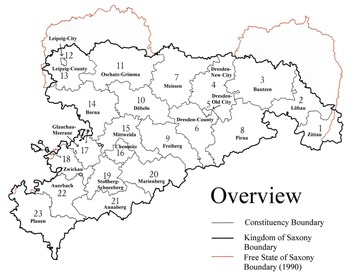
Elections to the North German Reichstag were first held in February and August 1867. At this time—in fact, until the empire's collapse in 1918—Saxony was allocated twenty-three Reichstag mandates. In the February election, Bebel and Liebknecht won the Reichstag districts of Glauchau-Meerane and Stollberg-Schneeberg-Lößnitz.Footnote 29 They were the only socialists Saxon voters sent to Berlin. After August 1867, a total of five Saxon Social Democrats sat in the Reichstag, among a national delegation (Fraktion) of only six deputies. In March 1871, under the influence of German victories over France, the Social Democratic delegation was reduced to two deputies again (both from Saxony). This setback was soon reversed. In the Reichstag elections of January 1874, Saxon socialists won six of twenty-three Reichstag seats in the kingdom, with over 35 percent of the popular vote (compared to 7 percent in the Reich). All six seats were clustered in the densely populated region around Chemnitz, where industry had spilled out into towns and villages (see fig. 2). August Bebel tallied an astounding 80 percent of the vote in the district of Glauchau-Meerane.
Reichstag districts in Saxony, 1867–1918. Adapted from Philologisch-historische Klasse der Sächsischen Akademie der Wissenschaften zu Leipzig in cooperation with the Landesvermessungsamt Sachsen, eds., Reichstagswahlen im Königreich Sachsen 1871–1912. Karte D IV 2, Atlas zur Geschichte und Landeskunde von Sachsen (Dresden: Landesvermessungsamt Sachsen, 1997). Used by permission.

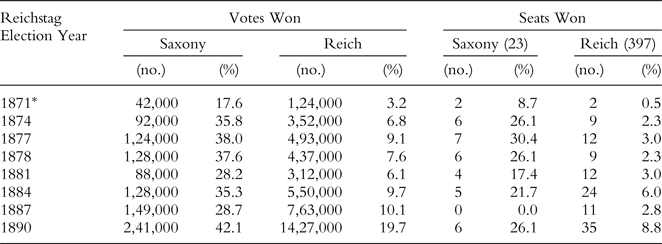
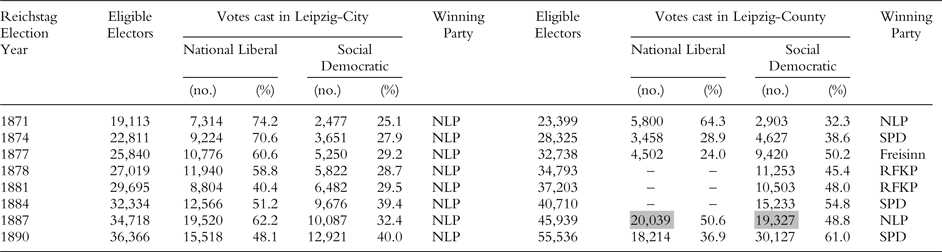
Even under the Anti-Socialist Law (1878–1890), Saxon SPD fortunes in Reichstag elections continued to rise, as table 1 shows.Footnote 30 By 1884, in the Reich as a whole, the party had largely recouped its losses in the elections of 1878 and 1881. In and around Leipzig, the party's showing in Reichstag elections was mixed. The electoral district of Leipzig-City was consistently won by a National Liberal notable.Footnote 31 By contrast, Social Democratic candidates gradually came to dominate Reichstag elections in the surrounding district of Leipzig-County. Table 2 shows the dominance of the National Liberals and Social Democrats in these two Reichstag districts.
Social Democratic votes and seats won, Saxony and the Reich, 1871–1890

Notes: Vote totals have been rounded. *In 1871, without Alsace-Lorraine, 382 seats were contested; thereafter, 397 seats.
Sources: [Eugen Würzburger], “Die Wahlen zum Deutschen Reichstag im Königreich Sachsen von 1871 bis 1907,” Zeitschrift des K. Sächsischen Statistischen Landesamtes 54, no. 2 (1908): 171–80, 173; Gerhard A. Ritter, “Das Wahlrecht und die Wählerschaft der Sozialdemokratie im Königreich Sachsen 1867–1914,” in Der Aufstieg der deutschen Arbeiterbewegung, ed. Gerhard A. Ritter (Munich: R. Oldenbourg, 1990), 49–101, 63. Some figures calculated by the author.
National Liberal and Social Democratic strength in Leipzig-City and Leipzig-County, 1871–1890

Notes: Votes cast in main election only, not in runoff ballots or in by-elections. Percentages shown are percentages of actual valid votes cast. NLP: National Liberal Party. RFKP: Imperial and Free Conservative Party. The winner labeled “Freisinn” in 1877 was a candidate of the left-liberal Radical Party. Highlighted cells refer to the contest between Ferdinand Goetz and Louis Viereck in 1887.
Source: [Eugen Würzburger], “Die Wahlen zum Deutschen Reichstag im Königreich Sachsen von 1871 bis 1907,” Zeitschrift des K. Sächsischen Statistischen Landesamtes 54, no. 2 (1908): 176–77.
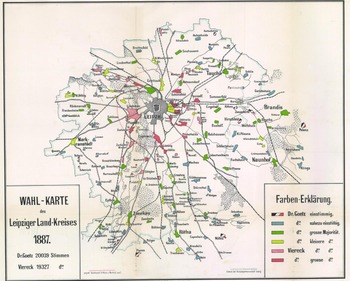
The Saxon SPD suffered a rout in the elections of 1887, when the Conservatives, Free Conservatives, and National Liberals rallied to Bismarck's national Kartell of “state-supporting parties”—also known in Saxony as the “parties of order.” Bismarck used a war scare against France to whip up the electorate, and high turnout benefited these right-wing parties. The Kartell reduced the number of Saxon SPD seats from five to zero. In the Reichstag constituency of Leipzig-County, a National Liberal victory in 1887 bucked the trend of growing SPD strength. Figure 3 shows areas of SPD strength (in red) in the parts of Leipzig-County that lay closest to Leipzig's city center. Most red patches are within the red circle that marks a distance of five kilometers from Leipzig's central market square.Footnote 32 The socialist incumbent in February 1887 was Louis Viereck, an editor of Social Democratic newspapers and journals (most of which were banned in the 1880s).Footnote 33 Viereck almost carried the day. On the first ballot he won 19,327 Reichstag votes. The National Liberal candidate was Ferdinand Goetz, a popular physician in Leipzig. He polled strongly in areas beyond those working-class suburbs, which are shown in blue and green. This gave him a total of 20,039 votes and a narrow victory.
National Liberalism and Social Democracy in Leipzig-County, 1887. Das Wahl-Comité der vereinigten Ordnungs-Parteien für Leipzig-Land, Wahl des Herrn Dr. med. Ferdinand Goetz für den 13. sächsischen Wahlkreis (Leipzig-Land) betr. (Leipzig, n.d. [May 1887]), back matter.

Leipzig's burghers were worried by the narrowness of Goetz's victory and what it portended. Among those suburbs in Leipzig-County that were soon to be incorporated into Leipzig-City, Viereck outpolled Goetz in 1887 by 15,700 to 11,121 votes.Footnote 34 In 1890, the National Liberals in Saxony saw their share of the statewide vote shrink from over 31 percent in 1887 to less than 20 percent; their number of seats fell from ten to just three, though they held Leipzig-City. These losses shocked Saxon National Liberals: it made them even more willing than they were already to subordinate themselves to the dominant Conservatives in the kingdom. By contrast, in 1890 the Saxon SPD was again on the march. Its candidates won a far higher proportion of Reichstag ballots in Saxony (42 percent) than the party's average in the Reich (20 percent).Footnote 35 The SPD now held six Saxon seats in the Reichstag. These countervailing developments led Saxon National Liberals to consider how to defend their bastion of influence in Leipzig not only in Reichstag contests but also in Landtag and municipal elections.
State Elections
Social Democratic success came more slowly in Saxon Landtag elections than in Reichstag elections—but sooner than in other federal states. Saxony's three-mark tax threshold for enfranchisement was the principal impediment to Social Democratic voters.Footnote 36 It had been legislated as part of a major reform of the Saxon Landtag suffrage in 1868, which did away with representation according to social estate. But a tax threshold was not the only way the framers of Saxony's 1868 suffrage sought to contain the effects of social democratization.
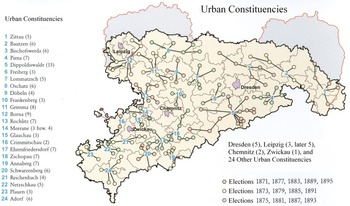
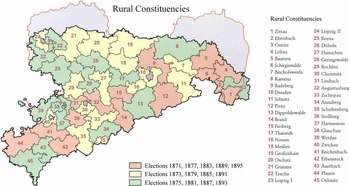
Some of these ways can best be appreciated by looking at maps (figs. 4–5). Since deputies were elected for six-year terms, only one-third of Landtag districts were contested every two years. For example, the twenty-six districts contested in 1871 were not contested again until 1877. Moreover, the districts in which elections were held in any given year were not contiguous but scattered randomly across the kingdom. These two stipulations contributed to the localization—and thus the containment—of political opposition. No electoral call to arms, however contentious or impassioned, could produce a groundswell of support in all parts of the kingdom, let alone an electoral landslide for one party. If a Landtag election heated up locally, voters in a neighboring district might have to wait four years for their turn to cast a ballot. Moreover, at least two-thirds of Landtag seats would always be held by incumbents: as the framers of the 1868 suffrage noted with satisfaction, incumbents could be counted on to smooth the business of legislation and ensure its cautious consideration.Footnote 37
Urban districts for Saxon Landtag elections, 1868–1909. The figures in parentheses after the name of each district indicate the number of towns in the district. Adapted from Philologisch-historische Klasse der Sächsischen Akademie der Wissenschaften zu Leipzig in cooperation with the Landesvermessungsamt Sachsen, eds., Landtagswahlen im Königreich Sachsen 1869–1895/1896. Karte D IV 3, Atlas zur Geschichte und Landeskunde von Sachsen (Dresden: Landesvermessungsamt Sachsen, 2002). Used by permission.

Rural districts for Saxon Landtag elections, 1868–1909. Adapted from Philologisch-historische Klasse der Sächsischen Akademie der Wissenschaften zu Leipzig in cooperation with the Landesvermessungsamt Sachsen, eds., Landtagswahlen im Königreich Sachsen 1869–1895/1896. Karte D IV 3, Atlas zur Geschichte und Landeskunde von Sachsen (Dresden: Landesvermessungsamt Sachsen, 2002). Used by permission. (The digits for the sixteenth and seventeenth districts were transposed in the original legend.)

Maps can also help illustrate how workers in Saxony's towns and cities were disadvantaged compared to farmers in the countryside. The 1868 suffrage reform did away with Saxony's estate-bound suffrage, but it differentiated between the thirty-five urban and forty-five rural districts. This distinction was muddied somewhat because urban districts were divided into two subgroups: big-city districts (eleven) and other urban districts (twenty-four). As a result, election returns were tabulated under three rubrics. Nevertheless, the language of the law and common parlance distinguished between urban (städtisch) districts and those “in the flat country” (auf dem platten Land). Each of the twenty-four urban districts (not counting the big-city ones) wrenched Saxon towns out of their geographical hinterland and linked them together as one electoral unit. The lines on figure 4 linking them together are historical abstractions: they only denote which cities constituted one electoral district. Because each urban district was to include about thirty thousand inhabitants (and thus about three thousand enfranchised electors), the number of towns and cities strung together to form a district varied according to the density of the local population.Footnote 38 The sixteenth urban district of Crimmitschau included just two cities—Crimmitschau and nearby Werdau—because population density in that region of southwestern Saxony was so high. The opposite extreme prevailed in the mountainous Erzgebirge region southwest of Dresden. In the fifth urban district of Dippoldiswalde, a population of 24,063 inhabitants (1867) lived in no fewer than fifteen towns: these stretched across an area fifty kilometers wide. Figure 4 shows the towns that comprised each urban district floating like islands in (or above) a sea of rural districts. Rural districts were constructed in a more familiar way, as shown in figure 5, but they could include as many as 132 localities.
Voters in both urban and rural Landtag districts proved susceptible to conservative administrators, police, and newspaper editors at the grass-roots level—just as the government intended—and they were difficult to mobilize for a particular cause. When notables in six or seven towns all sought to send a representative of their own locality to the Landtag—for example, to lobby for a branch railway line—and when candidates had to travel great distances to present themselves to voters, the development of integrated party organizations at the district level was slowed. This stipulation had its natural complement in the Landtag itself: seats were allocated by lot, so that members of a party delegation did not sit together. The government's goal was to hold back the development of cohesive party structures, especially for those parties likely to oppose the state and existing social relations.
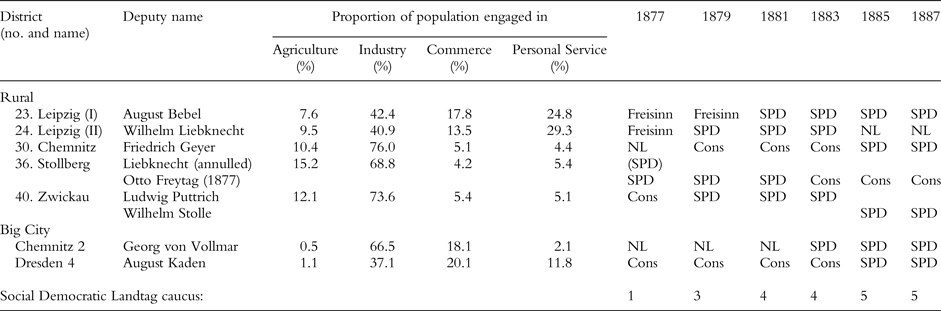
When the Social Democrats first broke through the tax threshold and other electoral barriers in the Landtag campaign of 1877, they won seats not in Saxony's big cities but in rural districts. Table 3 shows that socialist breakthroughs in Saxony's big cities came later.
Social Democratic deputies in the Saxon Landtag, 1877–1887

Notes: SPD: Socialist Workers' Party of Germany; NL: National Liberal Party. District occupational profiles as of 1871: agriculture includes agriculture and forestry; industry includes mining, industry, and construction; commerce includes trade and transportation; other categories (e.g., army) were not included. Occupational profiles for the electoral districts of Chemnitz 2 and Dresden 4 are for the entire city.
Sources: Elvira Döscher and Wolfgang Schröder, eds., Sächsische Parlamentarier 1869–1918 (Düsseldorf: Droste, 2001), 199–211; Wolfgang Schröder, Landtagswahlen im Königreich Sachsen 1869–1895/1896. Beiheft zur Karte D IV 3, Atlas zur Geschichte und Landeskunde von Sachsen (Leipzig: Verlag der Sächsischen Akademie der Wissenschaften zu Leipzig und Landesvermessungsamt Sachsen, 2004), tables 12, 20, 21.
Saxony's rural districts were not rural in the classic sense; they were dotted with industrial towns and villages that were inhabited by workers, miners, and other likely supporters of Social Democracy. In 1877 Wilhelm Liebknecht was elected in the thirty-sixth rural district that included the Lugau-Oelsnitz coal mining region.Footnote 39 It fell within the seventeenth Reichstag district of Stollberg-Schneeberg-Lößnitz, which Liebknecht had first won in 1867. Saxon burghers understood that Social Democrats elected in districts with similar socioeconomic profiles would be hard to defeat in future elections. The expansion of Saxony's Landtag electorate was worrying too.Footnote 40 Whereas barely 10 percent of the total Saxon population was eligible to vote in Landtag elections in 1869, this figure had risen to over 14 percent by 1895—though it was still less than the proportion of Germans eligible to vote in Reichstag elections (21 percent). Thanks to this expansion and rising turnout rates among workers, by the early 1890s about thirty thousand Saxons were casting their Landtag ballots for a Social Democrat every two years (see fig. 6.)
Social Democratic votes and seats in the Saxon Landtag, 1875–1895. Drawn from [Eugen Würzburger], “Die Wahlen für die Zweite Kammer der Ständeversammlung von 1869 bis 1896,” Zeitschrift des K. Sächsischen Statistischen Landesamtes 51 (1905): 1–12.

Local Elections
It remains to consider the advance of Social Democracy in local parliaments—in Leipzig and its environs. Social Democrats had been winning election to rural councils (Gemeinderäte) in Leipzig's hinterland since the late 1860s. Between 1869 and 1875, Social Democrats were elected to local councils in Pieschen, Plagwitz, Lindenau, Reudnitz, and Stötteritz. The first Social Democrat entered Schönefeld's local council in 1876. By 1880, seventy-six socialists sat in twenty-five such councils, and their number grew during the 1880s.Footnote 41 In his overviews of the socialist movement written in June and December 1880, Berlin Police Director Guido Madai referred to the SPD's “still undiminished strength” in Leipzig's suburbs and the future danger of renewed cooperation between left liberals and socialists.Footnote 42 Police directors in Leipzig and Berlin and Saxony's minister of the interior cited complaints about Social Democratic agitation lodged by members of rural councils outside Leipzig when they imposed the Lesser State of Siege on Leipzig in June 1881.Footnote 43
In the 1880s, leaders of Saxony's “parties of order” realized that local politics offered another opportunity to revise the electoral rules of the game. Citizens in the Leipzig suburbs of Lindenau and Gohlis set the ball rolling with petitions to the Saxon Landtag advocating suffrage reform for elections to rural councils. Authorities and councilors in other localities soon joined the chorus. They claimed that young adults in rural communities were exercising their right to vote in order to advance “special interests” contrary to the public welfare. In 1886, on the initiative of the Saxon government, Landtag legislation amended the rules for elections to rural councils: it raised the voting age from twenty-one to twenty-five, and it lengthened the local residency requirement from one year to two. At the same time an exhaustive questionnaire was introduced for those wishing to apply for local citizenship. August Bebel protested against these revisions, but the five Social Democrats in the Landtag could not prevent the bill from passing on April 24, 1886. Homeowners (Ansässige) already enjoyed special representation in local assemblies. By the early 1890s, Social Democrats who won a majority in a local Saxon election had learned to anticipate—though they could not avoid—the usual bourgeois response: between an election in November or December and the formal induction of new deputies in January, local suffrages were often revised to prevent Social Democratic victories in the future.
From 1867 until 1890, elections at the national, state, and municipal levels were mainly fought independently of one another. But gradually the SPD's successes began to resonate more broadly. By 1890, what might have been a purely administrative matter—the expansion of Leipzig's city limits—compelled Leipzig burghers to consider a coordinated political response to the socialist danger.
Creating “New Leipzig” and Gerrymandering its Landtag Representation
In the late 1880s, Leipzig's city fathers decided to incorporate seventeen suburbs into their city limits. The scale of these incorporations (Eingemeindungen) was unequaled in the Kaiserreich. Accomplished within a short period of time (1889–1892), the city's expansion had far-reaching social, economic, and political ramifications. Leipzig's population rose from about 170,000 in 1885 to 400,000 in 1895. This placed it among Germany's largest metropolises.Footnote 44 We know a good deal about the contentiousness of this decision, its impact on Leipzig's development, and its role in the history of the labor movement's three pillars (the party, the free trade unions, and cultural associations).Footnote 45 What remains unexplored is the political calculus that determined how Leipzig was gerrymandered and the electoral outcomes that illustrated the effects of exclusionary practices. In both cases, historical cartography offers illumination.
In the autumn of 1889, negotiations were still underway between representatives of the suburbs seeking incorporation into Leipzig and those authorities who would decide which lobbying efforts succeeded. Depending on which suburbs were still in play, Leipzig's chief statistician, Ernst Hasse, was asked to draw up a series of statistical tables that provided a political prognosis of future voting when Leipzig's three Landtag districts became five (see figs. 7 and 8). The boundaries of the three existing districts were to be revised substantially. At the same time, some electors from outside the city were to be allocated to one of the existing districts or to one of the new ones.Footnote 46 The long process of redistricting was not completed until an acrimonious debate had erupted on the floor of the Landtag in 1890 and enabling legislation was passed in 1892.
Saxon Landtag districts in Leipzig, 1869–1892. Adapted from Wolfgang Schröder, Landtagswahlen im Königreich Sachsen 1869–1895/1896. Beiheft zur Karte D IV 3, Atlas zur Geschichte und Landeskunde von Sachsen (Leipzig: Verlag der Sächsischen Adademie der Wissenschaften zu Leipzig und Landesvermessungsamt Sachsen, 2004), 21. Used by permission.

Saxon Landtag districts in Leipzig, 1892–1909. Adapted from Wolfgang Schröder, Landtagswahlen im Königreich Sachsen 1869–1895/1896. Beiheft zur Karte D IV 3, Atlas zur Geschichte und Landeskunde von Sachsen (Leipzig: Verlag der Sächsischen Adademie der Wissenschaften zu Leipzig und Landesvermessungsamt Sachsen, 2004), 22. Used by permission.

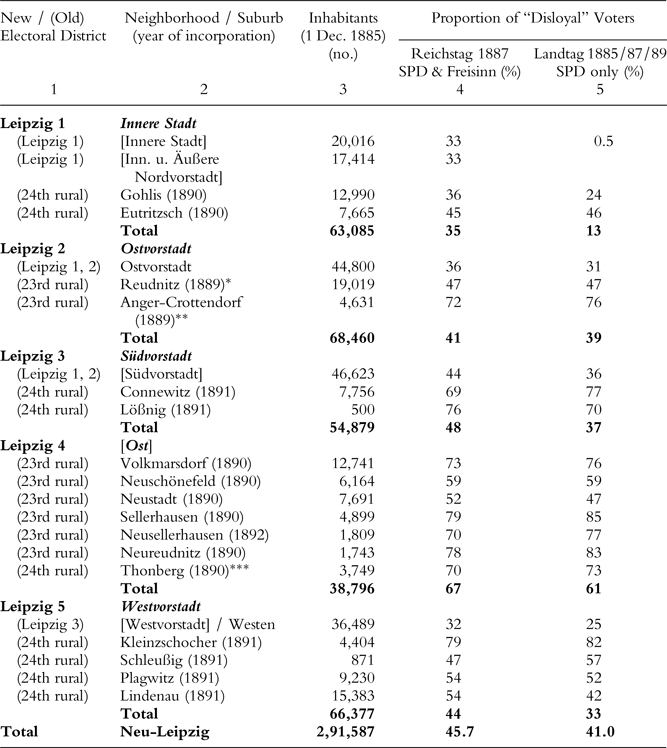
Ernst Hasse was well aware that members of Leipzig's city council would scrutinize his statistical forecasts with one question in mind: How would voters cast their ballots in the city's five electoral districts after 1892? (The ministry of the interior was interested in the same question.) For his forecast and his proposal for redrawing Leipzig's Landtag districts, Hasse examined the proportion of socialist and nonsocialist votes cast in each neighborhood and suburb for the Reichstag election of February 1887 and for the most recent Landtag elections (1885, 1887, 1889). Reflecting the dichotomous thinking that attended many discussions of Social Democracy, Hasse differentiated between voters “loyal to the Reich” (reichstreu) and those voters—implicitly disloyal—who supported Social Democrats or left liberals.Footnote 47 He then grouped the neighborhoods into five electoral districts according to what he felt was the most natural, the most equitable, and the most advantageous arrangement.Footnote 48 Table 4 provides a composite picture of Hasse's calculations and proposals. (It has been simplified and rearranged to correspond to the final allocation of neighborhoods in 1892.)
Ernst Hasse, “Proposal for creating five new urban Landtag districts” for Leipzig, 1889

Notes: Despite disparities, the proportions of “disloyal” voters in Reichstag and Landtag elections, shown in cols. 4 and 5, are similar. *After Hasse's tables were prepared in October 1889, Reudnitz oberen Teils was included in Leipzig 2 and Reudnitz unteren Teils in Leipzig 4. **Anger-Crottendorf was moved to Leipzig 4. ***Thonberg was also moved to Leipzig 4. See fig. 8 to locate each neighborhood among the districts redrawn as Leipzig 1–5 (1892–1909).
Sources: Sächsisches Hauptstaatsarchiv Dresden, Saxon Ministerium des Innern, Nr. 5413, Ernst Hasse, Direktor des Statistischen Amtes, to Rath der Stadt Leipzig, Oct. 17, 1889, table 19, “Der politische Character der Leipziger Stadttheile und Vororte,” and table 23, “Vorschlag zur Bildung von 5 neuen städtischen Landtagswahlkreisen auf Grund der Beschlüsse vom 5. Oktober 1889.” For column 5 only: Wolfgang Schröder, Landtagswahlen im Königreich Sachsen 1869–1895/1896. Beiheft zur Karte D IV 3, Atlas zur Geschichte und Landeskunde von Sachsen (Leipzig: Verlag der Sächsischen Akademie der Wissenschaften zu Leipzig und Landesvermessungsamt Sachsen, 2004), 80, table 9. Some figures calculated by the author. I am grateful to Gavin Wiens for scanning these tables for me.
Hasse was trying to draft a “safe” reform that would prevent Social Democrats from winning too many Leipzig seats. Much of his accompanying report hid the political fist in the administrative glove.Footnote 49 Passages such as the following make clear what Hasse intended to achieve with his gerrymander—and what he knew Leipzig's city fathers wanted to hear: “Concerning the likely political effect of leaving aside [the suburbs] of Stötteritz, Probstheida, Leutzsch, Möckern, Mockau, and Schönefeld, it can only be positive. … With [non-incorporation of] these localities, only 964 loyal [reichstreu] voters, but 2,127 Social Democratic and Radical voters, are omitted from the city's electoral districts—and [yet] not so many of the latter type that the future of the rural 21st, 22nd, and 25th electoral districts are endangered.”Footnote 50
By comparing table 4 with figure 8, one can see which neighborhoods—strongly socialist or not—were allocated to which electoral districts. Even without knowing how voters in Leipzig districts 1–5 would cast their ballots after redistricting, it is clear that Hasse performed the classic gerrymander trick of “packing” the enemy's voters into one district, which would then be sacrificed in order to win neighboring districts.
Based on 1887 Reichstag voting, Hasse's proposal foresaw that only 35 percent of voters in Leipzig 1 would vote socialist. Between 40 and 50 percent of voters in Leipzig 2, 3, and 5 would do the same. Hasse allocated working-class suburbs with a high proportion of socialist voters mainly (though not exclusively) to Leipzig 4. Because the number of inhabitants in the new district of Leipzig 4 was lower than in the other districts, Hasse theoretically could have packed even more working-class neighborhoods into it. He appears to have been undecided for some time how many such neighborhoods to include in Leipzig 2 and Leipzig 4. In any case, according to Reichstag and Landtag voting patterns, Hasse could expect that voters in Leipzig 4 would provide over 65 percent support to socialist candidates in the future. Overall, Hasse and members of Leipzig's city council hoped that, after redistricting, a candidate of the Saxon “parties of order” would win four of Leipzig's five Landtag districts—even though the total number of votes for socialist candidates across the newly enlarged city would likely exceed 45 percent. There is no evidence that this disparity troubled Hasse or Leipzig's bourgeois elite.Footnote 51
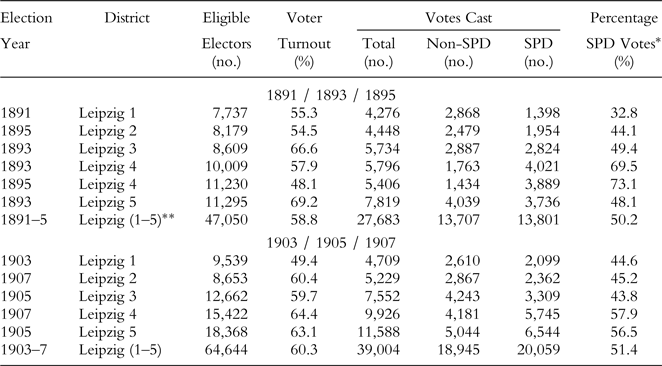
Hasse's plan worked. Only the two partial Landtag elections of 1893 and 1895 occurred before the introduction of Saxony's three-class Landtag suffrage in 1896, which reshuffled the deck (see below). In 1893, voters in Leipzig 3, 4, and 5 were called to the polls. In Leipzig 3 a Conservative eked out a victory over an SPD candidate (see table 5 for vote totals). In Leipzig 5 another Conservative beat another Social Democrat by a slightly larger margin. No candidate contested the heavily working-class district of Leipzig 4 for the Saxon “parties of order” that year. Such a candidate would have been a sacrificial lamb, given Social Democratic strength in this district. Instead, the Conservatives and National Liberals nominated a candidate of the antisemitic German Social Party. At this time both parties were engaged in a fierce battle with radical antisemites for the votes of lower-middle-class Saxons. The independent antisemites had just “stolen” six Reichstag seats from the Conservatives in the Reichstag election of June 1893. In the Leipzig Landtag vote later that year, the independent antisemite lost massively to a Social Democrat. More than two thousand of the SPD votes that Hasse had packed into Leipzig 4 were not needed to defeat the antisemite there. This pattern was repeated in 1895, when voters in Leipzig 2 and Leipzig 4 (again) went to the polls. Leipzig 2 produced a National Liberal victory over a socialist. Leipzig 4 again saw a Social Democrat defeat an antisemite—this time representing the German Reform Party—by over two thousand votes.
Socialist and nonsocialist votes won in Leipzig Landtag elections, 1891–1907

Notes: *Percentage of total valid votes cast, ignoring zersplittert votes. **This total for all elections in Leipzig (1891–95) includes the election in Leipzig 4 in 1895, when a special partial election was held to bring the new district into the six-year rhythm, but it does not include the election in Leipzig 4 in 1893.
Sources: [Eugen Würzburger], “Die Wahlen für die Zweite Kammer der Ständeversammlung von 1869 bis 1896,” Zeitschrift des K. Sächsischen Statistischen Landesamtes 51 (1905): 1–12, 2–4; [Eugen Würzburger], “Die Urwahlen für die zweite Kammer der Ständeversammlung in den Jahren 1903 bis 1907,” Zeitschrift des K. Sächsischen Statistischen Landesamtes 54 (1908): 168–71; “Die Ergänzungswahlen zur zweiten Ständekammer des Landtags in den Jahren 1903, 1905, und 1907,” Statistisches Jahrbuch für das Königreich Sachsen 36 (1908): 1–5. Some figures calculated by the author. Discrepancies in the sources have been reconciled as far as possible.
Looking ahead briefly to 1897–1907, when an indirect, three-class voting system prevailed for Saxon Landtag elections, Social Democrats stood almost no chance of getting elected: only one SPD candidate carried the day over the course of six partial elections.Footnote 52 Delegates (Wahlmänner) elected by the first and second voting classes always outvoted those elected by the third. But Saxony's statisticians continued to survey the proportion of socialist and nonsocialist votes cast by ordinary voters (Urwähler). Tellingly, they ignored distinctions among Saxony's “parties of order”: their published tables tallied only “social-democratic” and “non-social-democratic” votes. Table 5 compares the SPD's fortunes in Leipzig's five Landtag districts under two different suffrage regimes: the 1868 Landtag suffrage based on a tax threshold for enfranchisement (top) and the 1896 Landtag suffrage based on three-class voting (bottom).
The “Red Threat” and Leipzig's Municipal Assembly
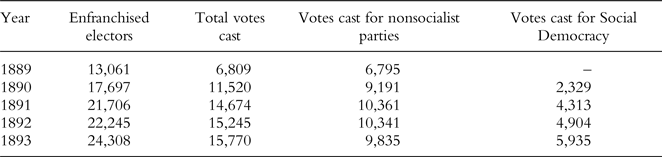
If growing Social Democratic strength in Reichstag and Landtag elections worried Leipzig burghers by the early 1890s, the possible entry of the “reds” into Leipzig's municipal assembly was a no less immediate concern. In Leipzig's municipal elections of 1890, Social Democrats received about 20 percent of the vote. The National Liberals' Leipziger Tageblatt claimed that the Social Democrats wanted to impose something akin to the Paris Commune on Leipzig.Footnote 53 The next four years were characterized by a concerted campaign to convince workers to apply for citizenship in Leipzig, even though local officials tried to make the application process as difficult as possible. The success of Social Democrats in elections to Leipzig's municipal assembly rose correspondingly (see table 6).
Elections to Leipzig's municipal assembly, 1889–1893

Source: Leo Ludwig-Wolf, “Leipzig,” in Verfassungs- und Verwaltungsorganisation der Städte, vol. 4, no. 1, Königreich Sachsen, Schriften des Vereins für Socialpolitik 120, no. 1 (Leipzig: Duncker & Humblot, 1905; repr., Vaduz: Topos Verlag, 1990), 137. Slightly different figures are given in Friedrich Seger, Dringliche Reformen. Einige Kapitel Leipziger Kommunalpolitik (Leipzig: Bezirksvorstand der sozialdemokratischen Partei, 1912), 12–14.
No socialists were actually elected to Leipzig's municipal assembly in these years: because electors could vote for as many candidates from a party list as there were positions open, the party (or coalition) that won the most votes held all seats in the assembly. But Leipzig burghers feared that if this trend continued, Social Democrats would win such a majority and then “terrorize” Leipzig's parliament. To preclude this possibility, Leipzig's city council and a special Suffrage Committee proposed a new three-class voting system. Because it had become “extremely easy” to win citizenship, Leipzigers faced “the danger … that the present election system will lead to a pure domination of the masses.”Footnote 54 Saxony's ministry of the interior approved this legislation on November 1, 1894, after it was whipped through Leipzig's assembly in the face of Social Democratic protest rallies just in time for that year's election.Footnote 55 Leipzigers copied the Prussian three-class suffrage, according to which electors' achievement (Leistung) and their contribution to the state (in the form of taxes) could be assessed and rewarded. In the first voting class were the small percentage of Leipzigers who collectively paid in annual taxes a sum equivalent to five-twelfths of the total tax roll (for Prussian Landtag elections it was one-third). The second class of voters included about 15 percent of taxpayers. Those remaining on the list, plus all eligible non-taxpayers, constituted the third voting class—roughly 80 percent of all electors.Footnote 56 This system reflected popular conceptions of the state as a kind of joint-stock company, whereby votes were allocated to citizen “shareholders” on the basis of each one's “investment” in the larger enterprise of the state.Footnote 57
By introducing a three-class suffrage with a direct voting procedure (unlike Prussia's indirect suffrage), the Leipzigers virtually guaranteed that some Social Democrats would enter the municipal parliament. It would be wrong, therefore, to suggest that Leipzig burghers were resolved to prevent any representation of working-class interests. And yet, when four Social Democrats were elected from Class III and the defenders of Leipzig's new municipal suffrage claimed that all three classes of voters at least had equal weight in choosing the seventy-two municipal parliamentarians, their argument was a sham. Each vote cast in Class I carried roughly sixteen times as much weight as each vote in Class III.Footnote 58
National Liberals dominated the first voting class, which included representatives of commerce, industry, and the upper reaches of the bureaucracy. Leipzig's conservative Homeowners' Association, allied with members of the lower-middle classes (Mittelstand) and antisemitic groups, dominated the second class. In the third class, the Social Democrats were expected to win all the seats. However, two stipulations of Leipzig's municipal suffrage reform of 1894 sought to postpone or prevent this outcome. First, seats would henceforth be contested on a two-year rhythm, not annually. Second, and more important, Leipzig was divided into four electoral districts, but only for the third voting class (fig. 9). These districts had to be drawn from scratch, and they reflected the same political calculus that had determined the boundaries of the five districts for Landtag elections drawn two years earlier.
Leipzig's four electoral districts for municipal elections (class III only). This map shows district boundaries after more suburbs (e.g., Probstheida) were incorporated into Leipzig on January 1, 1910. Friedrich Seger, Dringliche Reformen. Einige Kapitel Leipziger Kommunalpolitik (Leipzig, 1912), back matter.

As expected, when Leipzig's new suffrage was first tested in December 1894, candidates representing the “parties of order” won Districts I and II in Class III. Social Democrats won Districts III and IV, to the east and west, each of which sent two representatives to the municipal assembly. A cry of triumph emanated from Leipzig's bourgeois press and government organs—the worst had been averted. This outcome was deemed tolerable by Leipzig's suffrage expert on the city council, Leo Ludwig-Wolf, who had led the charge for suffrage revision in 1894. Even Prussia's envoy to Saxony expressed relief: he reported to Berlin that “the elections in the first two classes constitute a counterbalance to … the revolutionary ideal.”Footnote 59
To look ahead again for a moment: between 1895 and 1914, socialist candidates gradually increased their share of the vote in Districts I and II in Leipzig's third voting class. But they suffered setbacks from time to time (as in 1908), and their protests against the four-way geographical division of electors in Class III fell on deaf ears. When six more suburbs were incorporated into the city on January 1, 1910,Footnote 60 Districts I through IV in the third voting class were redrawn again in an attempt to prevent Social Democrats from winning all of them. By now Districts III and IV each had more electors than Districts I and II together. SPD protest meetings in favor of more equitable districting were denounced by groups of National Liberals, members of Leipzig's Homeowners' Association, and Mittelständler, each of which lobbied for their own preferred suffrage—including the regressive occupational suffrage. In fact, each group sought to disadvantage not only Social Democrats but also their own rivals in the first and second voting classes. When municipal elections were held in October 1910, Social Democrats won 65 percent of the votes in Class III and all eight seats. At that point the “party of revolution” held almost one-third of all seats in Leipzig's municipal assembly.Footnote 61
Where to Turn?
Municipal Affairs
In 1905, the Verein für Sozialpolitik (Association for Social Policy) published a new volume in its series on German municipal governance.Footnote 62 In the careful language of contemporary social science, this volume documented how the city fathers [sic] in Leipzig, Chemnitz, and Dresden introduced class-based suffrages.Footnote 63 All three suffrage reforms were meant to limit or exclude the participation of Social Democrats in local government.
Reformers in the industrial city of Chemnitz were the first to follow Leipzig's lead. They passed a new suffrage law in 1898 based on citizenship and occupational status.Footnote 64 Electors were divided into six classes, which elected fifty-seven members of the municipal assembly. All citizens who earned less than 2,500 marks annually belonged to Class A.Footnote 65 All citizens who were required to pay fees to the old age and invalid insurance schemes belonged to Class B. Civil servants, teachers, physicians, and clergy were gathered in Class C. Class D consisted of people who engaged in trade and manufacturing and who earned more than 2,500 marks annually. Class E included all owners and shareholders of manufacturing and joint-stock enterprises if their annual incomes exceeded 2,500 marks.Footnote 66
Dresden's municipal assembly followed suit in 1905. Its deputies, too, devised a voting scheme based on occupation. Electors were divided into five classes and elected a total of eighty-four representatives. Class A consisted of people without any profession (Beruf); Class B included those who paid fees to the old age and pension schemes; Class C comprised civil servants, priests, lawyers, physicians, and intellectuals; Class D included those who were engaged in trade and industry but were not members of the chamber of commerce, while those who did belong to the latter were included in Class E. Dresdeners added another wrinkle: their suffrage privileged those who had held local citizenship for more than ten years. Thus, every class contained two groups of electors: those who had been citizens of Dresden for more than a decade and those who had not.Footnote 67
The bourgeois character of these reforms deserves emphasis. In local as in state-level politics, many Saxon burghers believed that socialists were going to infiltrate, then dominate, then tyrannize municipal parliaments. This was part of their broader outlook on the state and its representative institutions.Footnote 68 When Leipzig burghers claimed for themselves positions of leadership in local society, they staked their claim to disproportionate influence in elections. A typical statement reflecting this viewpoint was offered by Dr. Johannes Hübschmann, who was a Chemnitz city counselor and who wrote the chapter on Chemnitz in the volume commissioned by the Verein für Sozialpolitik. As Hübschmann put it, Chemnitz burghers believed that property and intellect should not be “sacrificed to headcounts” or the possibility that “a single party would achieve domination in the municipal parliament.”Footnote 69 These phrases recurred often in debates about Landtag suffrage reform too. For Hübschmann, Chemnitz's occupational suffrage “enfranchise[d] the most diverse strata of the population according to the measure of their interest in the common good and of their importance to it; it also open[ed] up to the most insightful and talented men the prospect of being elected.” Writing in 1905, Hübschmann reported that Chemnitz's experience with the new suffrage had been “completely satisfactory.”Footnote 70
Landtag Reform
In the years 1905–1910, suffrage reform seemed to be on everyone's lips. Saxon Social Democrats took to the streets of Leipzig and Dresden to demand a new suffrage for their Landtag. Prussian socialists did the same, with mounting fervor, while a transnational conversation about expanding voting rights also gathered steam. The promise of another antisocialist suffrage reform in the Saxon Landtag contributed to Leipzigers' wait-and-see attitude at this juncture. The growth of radical nationalist associations such as the Imperial League against Social Democracy and the setback suffered by Social Democracy in the Reichstag elections of January 1907 convinced some German burghers that the “red threat” could be met by fine-tuning existing suffrage laws. Others were not so sure.
When the Saxon government announced new plans to reform the Landtag suffrage in July 1907, it faced an uphill struggle. The government's draft bill reverted to the same kind of hybrid system that had doomed an earlier proposal in 1903–1904. This time it proposed a Landtag of eighty-two members.Footnote 71 Forty-two deputies would be elected by secret and direct voting, incorporating proportional representation, and with a moderate system of plural ballots whereby no voter would be accorded more than two ballots. The remaining forty deputies would be elected through the organs of local government.Footnote 72 In proposing this system, which included a very modest increase in the number of urban districts, the government cited the arguments of Albert Schäffle, among others. A noted sociologist and political observer, in 1890 Schäffle had argued that the representation of local interests provided a counterweight to direct and equal voting.Footnote 73 The preamble to the government's proposal claimed that because municipal assemblymen and counselors had other public functions to fulfill, they were ipso facto too high-minded to indulge in partisan politics.Footnote 74
Chief defender of this complicated scheme was Saxony's government leader, Count Wilhelm von Hohenthal und Bergen. He was trying to convince National Liberals that their strength in Saxon city halls might translate into power in the Landtag. As a gesture to the Conservatives, the government offered the specious argument that the distribution of seats in a reformed Landtag should be determined not only by population (Recht des Menschen) but also by territory (Recht der Fläche). This terminology had been excoriated years earlier, in March 1890, when August Bebel spoke during a Landtag debate about adding two new Leipzig districts: he demanded that Saxony abandon the out-of-date electoral distinction between urban and rural districts, which—without geographical redistricting—had already rendered the weight of ballots cast by rural and urban voters grossly unequal.Footnote 75 Since 1900, the National Liberal Party in Saxony had focused on this disparity, even as its Landtag deputies moved closer to agreeing with Conservatives on plural balloting. In 1908, the government's endorsement of the principle of territoriality was a rhetorical gift to Conservative hardliners. It drew the scorn of the liberals, however. One left-liberal deputy wondered whether the Conservatives were “perhaps imagining that they were looking at the North African desert or the colony of South-West Africa. [Great amusement.] There, one could speak of a right of territoriality.” However, he added, “in an industrialized, densely populated state [such as Saxony], we cannot draw districts … according to the number of oxen that may be roaming around on them. [Great amusement.]”Footnote 76
Germany's Suffrage Reform Discourse
Space permits only a general comment about the contribution of Leipzigers to these suffrage debates. As they had in the years 1894–1896, when they helped prepare the way for the regressive three-class Landtag suffrage of 1896,Footnote 77 prominent Leipzigers such as former mayor Otto Georgi and Regional Governor Otto von Ehrenstein came forward in 1906 with their own suffrage proposals.Footnote 78 Like the government's proposal, these were calibrated according to each reformer's wish to limit Social Democratic gains in state elections and his willingness to state that goal explicitly. Other voices were also raised in these years, however. They objected to the idea of weighting votes at all, let alone doing so in ways that disadvantaged Social Democrats specifically.
Max Weber is known for his impassioned attacks on Prussia's three-class suffrage; but in 1907 he inveighed against those who, like Georgi and Ehrenstein, sought to limit or exclude Social Democrats from participating fully in municipal affairs. The occasion was the annual meeting of the Verein für Sozialpolititik, which that year had chosen as its theme the constitution and administrative organization of cities. Weber was frustrated by the arguments that the conservative political economist Adolph Wagner and others had put forward. In Wagner's comments, Weber claimed he had heard “nothing other than … the remark [that] we cannot allow the cities to fall under the influence of the lower classes.” Weber's rejoinder was blunt: “Alright, then, why not?” Whereas one could demand the highest qualifications of intellect and education in the selection of municipal civil servants, Weber could not see how it was possible to establish formal criteria for universally acceptable qualifications among urban electorates. “That holds for the city as for the state.” No suffrage, he declared, was capable of classifying electors in such a way that only the best informed and least partisan voters would have a voice and determine the outcome of elections. Germany's future, he implied, would be endangered if fear-mongering and the manipulation of municipal suffrage laws continued.Footnote 79
Georg Jellinek's General Theory of the State (1900) had cemented the author's international reputation as a constitutional scholar.Footnote 80 On March 18, 1905, Jellinek addressed Dresden's Gehe-Stiftung, where public lectures often treated issues of municipal reform from a liberal perspective. His topic was “The Plural Suffrage and its Effects.”Footnote 81 Jellinek seconded complaints from National Liberals that by preserving the distinction between electors in cities and the countryside, the “plural suffrage system can be described as a rural suffrage system.” Even more pointedly, he asked his audience how the achievements of an elector should be measured: “Even someone who is twenty times as clever as someone whose talents extend to simple understanding can hardly elect a parliamentary deputy who is twenty times better. … Just as no one can say that this girl is four times prettier than that one, so too it is impossible to convert the intellectual measure of one man into a multiple of mediocrities.” For Jellinek, an estate-bound suffrage, a plural suffrage, mandatory voting, and proportional representation were all too undemocratic—none of them should be considered for Saxony's Landtag. Jellinek urged his audience to reject all complicated suffrages: “either one is capable of exercising a public function, or one is not. … There is no half or one-third ability: either the voter is completely able to carry out the function conceived for him, or not at all.”Footnote 82 Neither Weber's argument nor Jellinek's, however, resonated among antisocialists in Saxony.
Gerrymandering Leipzig for Landtag Elections, 1908–1909
Among many thick files in Saxony's interior ministry documenting the path to Landtag suffrage reform in 1909, only two chronicled the redrawing of district boundaries as part of this reform. Conservatives successfully resisted National Liberal demands for roughly equal numbers of enfranchised electors in each urban and rural district. Only minor changes were made. Georg Heink added three new rural districts to the existing forty-five, and he shifted a few other rural boundaries as a housekeeping measure. The number of districts allocated to Dresden and Leipzig was increased from five to seven each. Those allocated to Chemnitz doubled from two to four, and Plauen was awarded its own big-city district to match Zwickau's. These changes did not come close to producing an equitable division of Landtag seats. Voters living in the Saxon countryside still carried much more electoral weight than voters in the big cities, as they had—increasingly—since 1868.Footnote 83
A more important aspect of Saxony's 1909 suffrage reform was the introduction of up to three supplementary ballots for privileged electors.Footnote 84 This plural ballot system has to be considered together with the redistricting of Saxony's big-city districts. Even though few civil servants besides Georg Heink were involved in both processes, these reforms were two sides of the same coin—complementary strategies to limit the number of Social Democrats in the Landtag. The property, income, education, and age thresholds that provided extra ballots were calculated and recalculated in the hope that no more than fifteen socialists would enter the new Landtag, which now comprised ninety-one seats. This goal was pursued by the National Liberal, Progressive, and Conservative parties, as it was by Heink and the director of Saxony's Royal Statistical Office, Eugen Würzburger. It was on Heink's and Würzburger's statistical forecasts that Landtag parliamentarians relied. Almost all individuals and parties privy to these negotiations knew that Social Democrats would win the support of more than 50 percent of Saxon Landtag voters. Their task, therefore, was to define criteria for awarding extra ballots and to draw up district boundaries that would transform a majority of SPD voters into a minority of SPD ballots and an even smaller minority of Landtag seats.Footnote 85
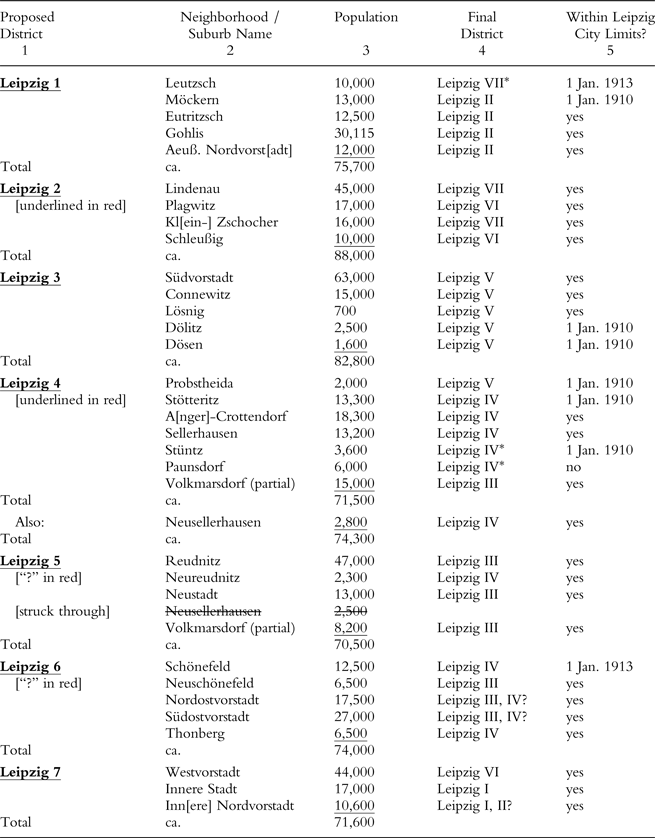
How did this process unfold in Leipzig? It was possible there to create two new Landtag districts and to reshuffle the old ones in a way designed to limit Social Democratic gains. This was easier than predicting how plural voting would affect the outcome. But neither undertaking was certain to succeed. In September 1908, when suffrage reform entered its final, critical stage, City Counselor Leo Ludwig-Wolf wrote to Heink: “Here is the district arrangement you requested. Things can be changed and moved around, of course, but no matter how one does it, a positive, favorable result cannot by any means be predicted, because the whole plural suffrage system is a leap in the dark, and one has no clue what its effect will actually be. I have noted my political weather forecast with red pencil on each district numeral; but correctly or not? Qui vivrà verrà! [Time will tell!]”Footnote 86 Ludwig-Wolf's red notations were on a tabular listing of his proposed electoral districts, not on a map.Footnote 87 Cartography was neither Ludwig-Wolf's nor Heink's principal tool for drawing up the new Landtag districts. Heink relied on his own travels around Saxony in 1908, as well as listening to Conservative whispers in his ear.Footnote 88 For his part, Ludwig-Wolf guessed correctly that his city might be allocated seven districts and on that basis drew up his redistricting proposal (see table 7).
Leo Ludwig-Wolf, proposal for Leipzig's seven Landtag districts, September 5, 1908

Notes: Cols. 1–3 from Leo Ludwig-Wolf to Georg Heink, cols. 4–5 added by the author. *These districts are included in Wolfgang Schröder, Landtagswahlen im Königreich Sachsen 1869–1895/1896. Beiheft zur Karte D IV 3, Atlas zur Geschichte und Landeskunde von Sachsen (Leipzig: Verlag der Sächsischen Akademie der Wissenschaften zu Leipzig und Landesvermessungsamt Sachsen, 2004), 108, table 30, and in official lists, but they are (erroneously) not included among the districts found on the map (Schröder, Landtagswahlen, 23) from which my figures 10–13 were derived.
Source: Sächsisches Hauptstaatsarchiv Dresden, Saxon Ministerium des Innern, Nr. 5489, Leo Ludwig-Wolf, Leipzig, to Georg Heink, Dresden, Sept. 5, 1908, appendix, “Wahlkreisbildung: II. Bei Zuweisung von 7 Wahlkreisen.”
Like Ernst Hasse before him, Ludwig-Wolf tried to redraw Leipzig's Landtag districts to minimize the number of seats Social Democrats would win. He succeeded in part. Three of Leipzig's seven districts went “red” in October 1909.Footnote 89 Counting voters who supported Social Democratic candidates rather than the total number of ballots they cast, the SPD's margin of victory was much higher in the districts they won than was their margin of defeat in the districts they lost. This suggests that Ludwig-Wolf was able, at least in a general way, to pack Social Democratic votes into districts the “parties of order” had no hope of winning.
Otherwise Ludwig-Wolf was not concerned to smooth out differences in the number of enfranchised electors in each district.Footnote 90 But one would like to understand why, with his tinkering, he chose one neighborhood over the other.Footnote 91 Ludwig-Wolf had underlined Leipzig 2 in red, indicating to Georg Heink that it would probably be won by the SPD. Did this suggest that some rethinking was necessary? Very possibly. Ludwig-Wolf would also have studied the effect that plural voting would have on the number of ballots cast in each district (the decisive factor in deciding winners and losers), and he likely rearranged his electoral districts accordingly.
But redistricting did not affect the outcome of Landtag voting in October 1909 as much as two other factors. The first was Würzburger's and Heink's faulty estimates about how many extra ballots workers would be entitled to. When the voting was finished, Saxons discovered that a much higher proportion of working-class electors had been entitled to cast two or even three ballots than their suffrage experts had expected. Workers were eligible to cast multiple ballots principally because their income exceeded the first tax threshold or because they had reached the age of fifty. Second, between final passage of Saxony's suffrage reform in January 1909 and the Landtag election that October, the demise of the Bülow Bloc in the Reichstag drove a wedge between Conservatives and National Liberals.Footnote 92 National Liberals successfully painted Conservatives as self-interested agrarians out of touch with public opinion. Because of new taxes and high prices, many Mittelstand voters were in a foul mood, and they were inclined to support a Social Democratic candidate in order to register a protest vote. Thus, workers were not as disadvantaged as the architects of Saxony's plural suffrage had intended, and the SPD's fellow travelers were more numerous than they had foreseen.
Landtag Voting in Leipzig under the Plural Suffrage, 1909
Maps can convey statistical information about the Saxon electorate to which Ludwig-Wolf and other suffrage experts had access before the 1909 suffrage reform. In conjunction with tabulated election returns, maps can also illuminate how—and where—Saxony's new plural voting system disadvantaged Leipzig's working classes most egregiously. It is not always possible to demonstrate linkages between the gerrymandering of electoral districts and the preferment of wealth, property, and status at the polls. Nevertheless, these factors tilted the playing field against Social Democrats in ways that do not align with the principles of democracy. According to democratic criteria, the Saxon suffrage of 1909 still stood far behind the Reichstag suffrage. Moreover, it was a step backward, not forward, when compared to the relatively equitable system that had prevailed from 1868 to 1896.Footnote 93 If “democracy” could be found in Saxony's new election law, as some scholars have argued, it was written in disappearing ink.
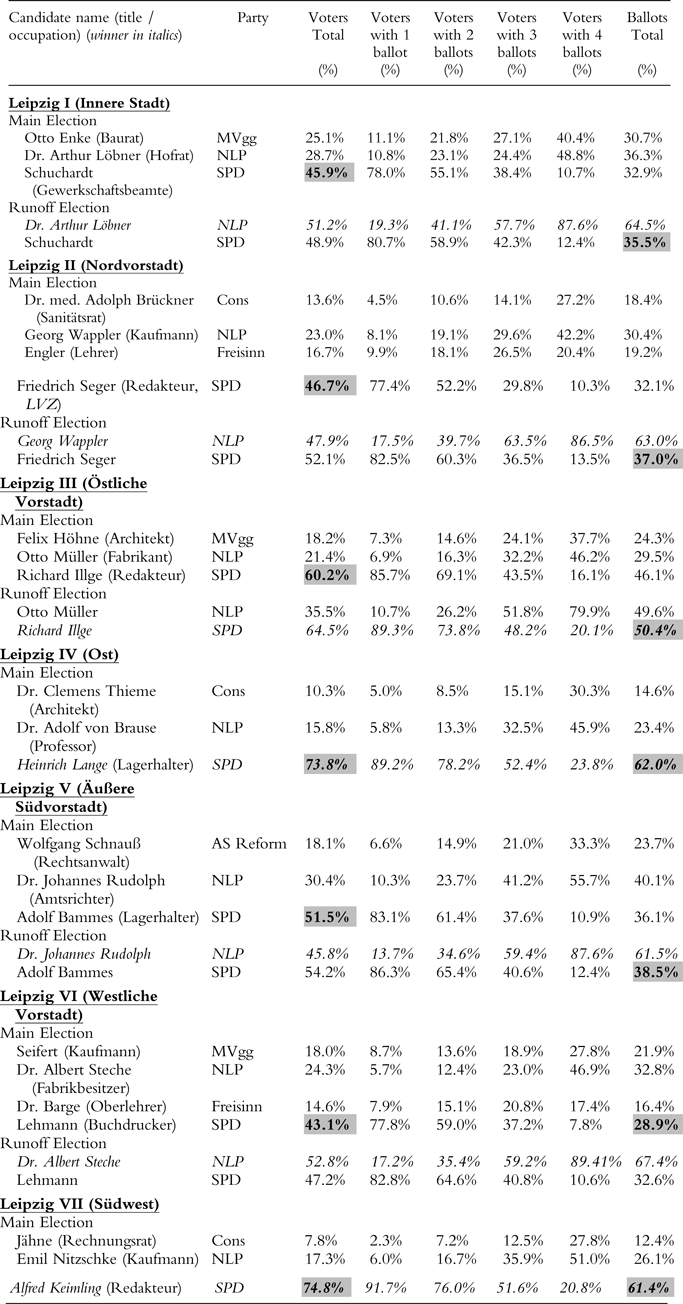
Table 8 demonstrates that in Leipzig, Social Democratic candidates often reached a runoff ballot in the Landtag elections of October 1909 because competing candidates mounted by the “state-supporting parties” split the nonsocialist vote.Footnote 94 Runoffs were necessary in five of seven Leipzig districts, invariably pitting a National Liberal against a Social Democrat.Footnote 95 The National Liberal candidate won in four of those five runoffs. Ludwig-Wolf left too many SPD supporters in the Östliche Vorstadt (Leipzig III), including some who might have been packed further east into Leipzig IV. The SPD editor Richard Illge won the close runoff contest with 50.4 percent of all ballots cast (though he won 64.5 percent of all voters). For all seven districts, highlighted cells in table 8 will help readers see how plural balloting transformed SPD majorities among voters into SPD minorities (losses) when total ballots were counted.
Landtag voting in Leipzig I-VII, voters and ballots cast, October 1909

Note: Percentages do not add up to 100 because of rounding and omission of splintered (zersplittert) votes. MVgg: Saxon Mittelstand Union. The antisemite in Leipzig V represented the German Reform Party. Titles and occupations were left in the original German to avoid ambiguity.
Sources: [Eugen Würzburger], “Die Wahlen für die Zweite Kammer der Ständeversammlung vom Oktober und November 1909, Erster Teil,” Zeitschrift des K. Sächsischen Statistischen Landesamtes 55 (1909): 220–43, 230–31; Sächsisches Hauptstaatsarchiv Dresden, Kreishauptmannschaft Leipzig, Nr. 250, Kriminal-Kommissar Förstenberg, “Uebersicht über die politische und gewerkschaftliche Bewegung im 12. und 13. Reichstagswahlkreise im Jahre 1909” [1910]; some biographical details from Elvira Döscher and Wolfgang Schröder, eds., Sächsische Parlamentarier 1869–1918 (Düsseldorf: Droste, 2001), passim.
Figure 10 shows information that Leo Ludwig-Wolf would have had access to: the proportion of workers among electors in each of Leipzig's Landtag districts. Statistical studies of Saxony's electorate under the three-class suffrage had been published before Ludwig-Wolf began the work of redistricting in 1908. Both Ernst Hasse in 1889 and Ludwig-Wolf in 1908 ruminated on the best possible allocation of working-class neighborhoods among new electoral districts, especially but not exclusively on Leipzig's eastern side. Yet these maps prompt conjecture that may or may not be answered by future researchers. Why, for example, were the working-class neighborhoods of Plagwitz and Schleußig included in Leipzig VI when they might have been packed into the unwinnable Leipzig VII? Is the answer that the proportion of workers in Leipzig VI overall, at 35 percent, was low enough to augur future victories for the “parties of order”?
Percentages of workers among enfranchised electors in Saxon Landtag elections in Leipzig, 1909. Adapted from Wolfgang Schröder, Landtagswahlen im Königreich Sachsen 1869–1895/1896. Beiheft zur Karte D IV 3, Atlas zur Geschichte und Landeskunde von Sachsen (Leipzig: Verlag der Sächsischen Adademie der Wissenschaften zu Leipzig und Landesvermessungsamt Sachsen, 2004), 23. Used by permission. Percentages from [Eugen Würzburger], “Die Wahlen für die Zweite Kammer der Ständeversammlung vom Oktober und November 1909, Zweiter Teil,” Zeitschrift des K. Sächsischen Statistischen Landesamtes 58, no. 2 (1912): 263–64.

Figures 11 and 12 should be considered in conjunction with table 8. Ignoring the percentage of ballots cast for Social Democratic candidates, figure 11 shows the percentage of voters who supported the SPD in each of Leipzig's districts in the Landtag elections of October 1909. (Recall that a single voter might cast one, two, three, or four ballots.) The proportion of voters who supported the SPD was under 50 percent in Leipzig I, II, and VI. It lay in the mid–70 percent range in the east and west, in Leipzig IV and VII. In Leipzig III, the SPD's 60 percent share of voters translated to only 46 percent of ballots on the main ballot, and a runoff was required. Most supporters of the Mittelstand candidate Felix Höhne on the main ballot switched their support to the NLP candidate Otto Müller in the runoff. The SPD's Richard Illge won anyway. The opposite situation prevailed in Leipzig V. On the main ballot, the SPD candidate won the support of 52 percent of voters: an antisemitic and a National Liberal candidate split the remaining 48 percent of voters. But the balance tipped to the National Liberal Johannes Rudolph in the runoff election. He won the support of only 46 percent of voters in that runoff, but they were more privileged voters and had more ballots to cast. This left him with almost 62 percent of total ballots in the runoff and an impressive victory in what might have been a toss-up district.
Percentages of Social Democratic voters in Saxon Landtag elections in Leipzig, 1909. Adapted from Wolfgang Schröder, Landtagswahlen im Königreich Sachsen 1869–1895/1896. Beiheft zur Karte D IV 3, Atlas zur Geschichte und Landeskunde von Sachsen (Leipzig: Verlag der Sächsischen Adademie der Wissenschaften zu Leipzig und Landesvermessungsamt Sachsen, 2004), 23. Used by permission. Percentages from [Eugen Würzburger], “Die Wahlen für die Zweite Kammer der Ständeversammlung vom Oktober und November 1909, Erster Teil,” Zeitschrift des K. Sächsischen Statistischen Landesamtes 55 (1909): 230-31.

Percentages of non-working-class Social Democrat voters in Saxon Landtag elections in Leipzig, 1909. Adapted from Wolfgang Schröder, Landtagswahlen im Königreich Sachsen 1869–1895/1896. Beiheft zur Karte D IV 3, Atlas zur Geschichte und Landeskunde von Sachsen (Leipzig: Verlag der Sächsischen Adademie der Wissenschaften zu Leipzig und Landesvermessungsamt Sachsen, 2004), 23. Used by permission. Percentages of voters (not ballots) calculated by the author from [Eugen Würzburger], “Die Wahlen für die Zweite Kammer der Ständeversammlung vom Oktober und November 1909, Erster Teil,” Zeitschrift des K. Sächsischen Statistischen Landesamtes (ZSSL) 55 (1909): 230–31, and [Eugen Würzburger], “Die Wahlen für die Zweite Kammer der Ständeversammlung vom Oktober und November 1909, Zweiter Teil,” ZSSL 58, no. 2 (1912): 263–64.

Figure 12 provides information that Ludwig-Wolf could not have known in 1908. To judge by others' reactions to unexpected Social Democratic strength among Mittelstand voters in October 1909, such a map would have upset him. It is possible to determine the proportion of SPD votes that were cast by non-working-class “fellow travelers” because Saxon statisticians tracked (a) the number of enfranchised workers in each district, (b) the number of actual voters who were workers, and (c) the number of actual voters who supported the SPD. Socialist victories in Leipzig's two eastern districts were facilitated by the support of significant proportions of voters who were not working class.Footnote 96 The SPD's ability to recruit fellow travelers did not ensure a victory under Saxony's plural suffrage, however.Footnote 97 At best, the SPD's ability to draw the support of non-working-class voters—who, in general, had more ballots to cast than workers did—only mitigated the exclusionary effect of the plural suffrage; it could not overcome it.
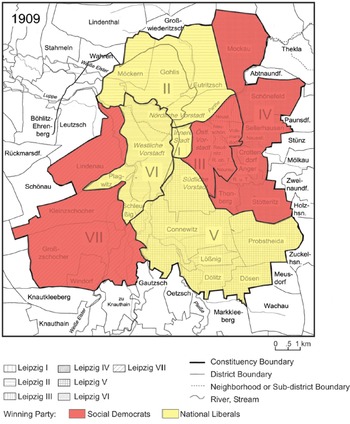
As figure 13 shows, the Landtag's plural suffrage in 1909, combined with artfully drawn electoral districts, provided National Liberals with four victories (shown in yellow) and only three defeats in what had been the cradle of German Social Democracy and remained one of its heartlands. Separating areas of overwhelming socialist strength (shown in red) in Leipzig's eastern and western neighborhoods, National Liberals could plausibly claim to represent Leipzig's political backbone. Whether they had won those four districts through a fair vote—that is another matter.
Saxon Landtag elections in Leipzig, 1909. Adapted from Wolfgang Schröder, Landtagswahlen im Königreich Sachsen 1869–1895/1896. Beiheft zur Karte D IV 3, Atlas zur Geschichte und Landeskunde von Sachsen (Leipzig: Verlag der Sächsischen Adademie der Wissenschaften zu Leipzig und Landesvermessungsamt Sachsen, 2004), 23. Used by permission.

Conclusion
It was not easy for German burghers to forge mental maps of how different suffrage regimes overlapped: the simultaneity of electoral cultures at the local, regional, and national levels was not evident in the quotidian routines of politics. But the redistricting exercises and copycat suffrage reforms examined in this article suggest that some burghers learned after 1890 how to make their influence felt—simultaneously or not—in interconnected political spheres. If statesmen and Reichstag deputies in Berlin appeared unable, as in the mid-1890s, to protect law-abiding burghers from “murderous ruffians” and other subversives—as municipal petitioners and Landtag deputies demanded—legislation to address these dangers could be enacted at lower tiers of governance. Whatever the level of politics at which such strategies were deployed, election battles over suffrage reform unfolded in German cities, states, and the Reich with ripple effects. A common denominator was the struggle to retain political legitimacy. It was waged by the authoritarian state and by social elites. Each sought to avoid drowning under the numerical weight of those who wanted a say in the exercise of power.
Local, regional, and national bastions of existing authority had to be defended with a coordinated response—or so it appeared to many German burghers before 1914. A National Liberal candidate of the “parties of order” who hoped to win election in the center of Leipzig could not rely exclusively on his local reputation: he had to seek the support of all voters “loyal to the Reich.” If there were not presently enough of them to carry the day or secure the future, then he had to strike an alliance with local antisemites, Mittelständler, and members of Leipzig's Homeowners' Association. Such alliances, based on complex political relationships and allegiances, usually rested on shifting sand. Social Democrats could not be dislodged from Leipzig's eastern and western neighborhoods: redistricting and the introduction of a plural suffrage could only put off the day of reckoning. But the suddenness with which Saxony's overlapping electoral cultures lurched forward (or backward)—when bourgeois civil servants redrew electoral districts or when bourgeois parliamentarians legislated unfair suffrages—ultimately had a destabilizing effect. Saxony's “state-supporting parties” successfully wrenched Reichstag districts back from the “reds” in 1907, whereupon Kaiser Wilhelm II singled them out for praise. But Wilhelm's chancellor, Bernhard von Bülow, wondered how much longer these parties could afford to bicker among themselves and risk competing antisocialist candidacies.Footnote 98 The unexpected, dismal outcome of plural Landtag voting in October 1909 and the “red” Reichstag elections of January 1912 provided an answer.Footnote 99
Maps can reflect the dynamic aspects of political territoriality only approximately. They inevitably depict a moment in time. The maps included in this article show that the urban-rural divide in Imperial Germany was “constructed”: it was permeable, in flux, negotiated. The Saxon state and the parties that supported it wanted to deny that permeability when they repeatedly endorsed the black-and-white distinction between urban and rural electoral districts. By doing so they left a rich statistical artifact, allowing historians to study the social profile of electorates and the distribution of votes they cast in statistically distinct categories. In Leipzig, the lines that divided and defined the city in opposition to its environs were under duress from the 1880s onward. The daily movement of peoples between Leipzig and its outlying districts, and the need for a modern urban infrastructure to address their needs, forced administrators to coordinate their policies. By 1900 at the latest, the myth that German cities were merely “administered” in a nonpartisan way had been exploded. Yet suffrage experts and other urban reformers continued to pretend that they were not, in effect, excluding certain categories of people from real influence in municipal and state-level politics.
The years 1890–1896 were transformative in this process. In Leipzig, each suffrage reform followed hard upon the last. Redistricting was necessary in 1892 to add two Landtag seats to Leipzig's previous complement. Prompt action was again needed, allegedly, to avert the possibility of socialists “conquering” Leipzig's municipal assembly in 1894. And two years later, the crisis unleashed by a wave of anarchist murders outside Germany did not go to waste: it was used to rush through a new suffrage law to prevent Social Democrats winning “too many” Landtag seats.Footnote 100 Then, in 1903, the disparity between SPD fortunes in national and regional electoral cultures became clear for all to see. SPD candidates triumphed in twenty-two of Saxony's twenty-three Reichstag districts. This bursting of the dam was described in territorial terms—as covering the land (flächendeckend). Such terminology underscored the fact that not a single socialist sat in the Saxon Landtag at that time.Footnote 101 The “frog pond” that had become the “pioneer land of reaction” in 1896 underwent metamorphosis again and emerged in 1903 as “Red Saxony.”
Yet, as we have seen, antidemocrats did not abandon the struggle to contain the “red threat” at the polls. Instead they tried harder to find “remedies” for universal manhood suffrage. At the national level, the Reichstag suffrage was never revised, but it was denounced often by right-wing politicians, and its fairness looked different depending on where you stood in the Kaiserreich. At the subnational level, gerrymandered districts and class-based voting were the norm, though they too were contested throughout the Kaiserreich. By mapping German electorates with careful attention to place and time, we can see that democracy was practiced and deferred at the same time.Footnote 102
This article has suggested, lastly, that the bourgeois architects of Leipzig's and Saxony's suffrage reforms mapped a way forward in ways that deserve further attention. Key sources are now more accessible than they were before the fall of the Berlin Wall. They will yield their secrets reluctantly, for the internal workings of Saxony's statistical offices and its ministry of the interior are not easy to penetrate. Privy counselors and professional statisticians such as Leo Ludwig-Wolf, Georg Heink, Ernst Hasse, and Eugen Würzburger rarely mused on the political objectives they sought. On the fairness of new suffrage regimes, they wasted not one word—at least not in print. We would like to know more about these individuals—not only as statisticians and city planners but also as members of associations with distinctively liberal reform agendas.Footnote 103 It is worth more than a passing note that these experts did not propose to reduce the overall size of the electorate. The principle of universal suffrage and the habit of casting a ballot in free elections had become deeply ingrained in Germany's electoral culture—so deeply that reformers did not dare disenfranchise voters outright. But they shaped electorates and counted ballots in particular ways, and when one means failed to achieve the desired outcome, they came up with another.Footnote 104 We still know too little about how these individuals, and the political masters they served, conceived the bundle of rights and exclusions that shaped democratic practices and undemocratic outcomes. But their determination to defeat the “red threat”—to limit Social Democrats to a “tolerable” share of parliamentary seats because their voters were disloyal to the Reich—was unshakeable.