John F. Kennedy’s New Frontier embraced the latest economic theories, promoted an empowered presidency, and reaffirmed the federal government’s responsibility for ensuring the nation’s economic prosperity. The 1962 Public Works Acceleration Act (PWAA) served as one of the administration’s most important new economic tools in its attempt to redefine American liberalism. Although the importance of this program has been often overlooked, its passage offers enduring insights into the institutional and political barriers faced by a liberal administration that sought to bring about a neo-Keynesian revolution.Footnote 1 The year-and-a-half-long debate over the structure and timing of the PWAA demonstrate that the president was committed to countercyclical deficit spending from the beginning of his presidency. Using documents housed in the Kennedy Presidential Library archives, we trace how Kennedy challenged the Congress—including his fellow Democrats—to pass a proactive $2.5 billion spending package to counter cyclical growth in unemployment. As designed, every dollar would be overseen by economists inside the White House, not the Congress. Using the methods of modern economic theory—the calculability of full-employment potential, the measure of consumer purchasing power, and the science of countercyclical deficit spending—Kennedy and his economic advisers constructed the PWAA as a major effort to meet simultaneously the government’s growing expectations to curb inflation, promote full employment, and expand the economy’s overall capacity.
We argue that the PWAA should be seen as an integral part of the Kennedy administration’s comprehensive plan to address economic instability and lower unemployment rates in the early 1960s. Kennedy signed the Public Works Acceleration Act into law on September 14, 1962, ending what was up to that point one of the hardest fought political battles of his administration. The eventual $900 million authorization for public works projects was an antirecessionary measure that predated the administration’s more well-known use of broad-based tax cuts to restructure the economy.Footnote 2 Because of the act, federal monies continued to flow to states and localities throughout the 1960s, adding hundreds of millions of manpower hours into the economy.Footnote 3
The fight over the PWAA clearly indicates that Kennedy relied upon and advanced post–World War II, neo-Keynesian fiscal policy through temporary, but massive, government spending. Kennedy and his economists combined these fiscal theories with a newly restored faith in presidential governance, one that claimed that only through the presidency could the federal government respond promptly and effectively to rebalance fluctuations in aggregate demand. This study of the PWAA therefore sheds light on a growing literature that recognizes Kennedy’s embrace of cutting taxes, but complicates this narrative by suggesting that it is was an embrace that followed from his neo-Keynesian faith in countercyclical deficit-spending.Footnote 4 Similarly, while Kennedy might have vacillated on his Keynesian commitments during the 1960 campaign, internal White House documents show that the “conversion” of Kennedy appears to be one within the Keynesian framework. Once elected, Kennedy did not need to learn to embrace budget deficits, but rather appreciate the type of deficit spending the New Economists wanted and what type of deficits the administration could politically muster.Footnote 5 Although the most controversial and potentially revolutionary element of the PWAA never became law—a “standby” provision giving the president authority to stop and start spending—Kennedy remained dedicated to the challenge of learning the politics of neo-Keynesian economics.
Kennedy’s “Big Five” and the Depressed Areas Bill
The optimism accompanying Kennedy’s 1960 electoral victory belied the deep economic anxieties that had been building throughout the previous decade, as well as the growing tension in liberal economic thought over government spending.Footnote 6 Many economists credited wartime spending with the economic recovery that occurred during the 1940s, not spending for New Deal jobs programs. After an extended period of Depression and war-induced deficit spending left the United States with unprecedented levels of debt, politicians in both parties fell back on the standard call for balanced budgets, fearful even of countercyclical deficits.Footnote 7
Before his inauguration and during the campaign, Kennedy also appeared hesitant to use deficit spending proactively to counter economic recession. Early on, he indicated that despite rising unemployment, he would pursue his predecessor’s course of maintaining a balanced budget, and the nomination of Douglas Dillon as Treasury Secretary seemed to portend further the administration’s more centrist policy outlook.Footnote 8 As Walter Lippmann observed, all Kennedy had managed to accomplish was “to carry on in all its essentials the Eisenhower economic philosophy. . . . It’s like the Eisenhower Administration 30 years younger.”Footnote 9 The well-known economics columnist Bernard Nossiter offered a similar assessment, writing that “to be sure, the language has changed. Mr. Eisenhower employed a conservative rhetoric to clothe liberal actions; Mr. Kennedy uses a liberal rhetoric for similar programs.”Footnote 10 These contemporaneous accounts of Kennedy’s economic moderation comport with modern historical arguments that Kennedy’s position on deficit spending and countercyclical fiscal policy evolved after a cautious first year in office.Footnote 11
However, Kennedy’s cautious approach upon entering office was principally the result of his adviser’s optimistic economic forecasts—forecasts that would turn out to be wrong as unemployment rose throughout the new president’s first few months in office. As Herbert Stein describes, at the start of Kennedy’s term “the whole edifice of New Frontier fiscal policy seemed to have melted in the rising sun of economic recovery.”Footnote 12 Consequently, the president did not call for immediate spending increases, but he did organize an administration staffed with experts who would spearhead the project of fundamentally reforming America’s political economy. Significantly, Kennedy chose one of the nation’s foremost Keynesians to be chair of his Council of Economic Advisers (CEA), Walter Heller. Heller was instrumental in implementing components of the 1947 Marshall Plan to rebuild war-torn Germany—and he was a foremost scholar on the relationship between fiscal stimulus and long-term multiplier effects. Heller advised Kennedy several times during the 1960 campaign, at a time when the Massachusetts senator refused to bind himself to a more revolutionary, proactive fiscal policy. Yet, it was during the campaign when Heller first broached the subject of “bypassing the Congressional process” to enact “properly timed tax cuts and deficits.” Kennedy, while intrigued, deliberately chose not to campaign on such an unfamiliar, potentially radical set of instruments, but promised to “make extensive use of the economic advice” once elected.Footnote 13 As Heller later explained, “The power of Keynesian ideas could not be harnessed to the nation’s lagging economy without putting them in forms and terms that could be understood. . . . Men’s minds had to be conditioned to accept new thinking, new symbols, and new and broader concepts of the public interest.”Footnote 14 During the election, that task seemed impossible, but the election of Kennedy brought this commitment to the White House from the start.Footnote 15
Soon after the selection of Heller and the rest of Kennedy’s New Economists in the winter of 1961, the president-elect announced a set of sweeping proposals to revive the American economy. A mix of old Democratic spending priorities and new Kennedy fiscal instruments, “The Big Five” would redefine the federal government’s role in managing the economy and would be, in the president’s words, the “most important domestic priority” of the new administration.Footnote 16 Four of the Big Five’s provisions were legislative leftovers from the previous decade, including proposals Eisenhower vetoed: a minimum-wage bill, an expanded affordable housing bill, Kennedy’s own previous bill to standardize unemployment benefits across state lines, and the Democrats’ 1958 public works plan—soon to become the administration’s first major legislative success as the 1961 Area Redevelopment Act.Footnote 17
The fifth component of the Big Five was something unique to Kennedy’s presidency, a $2.5 billion public works plan that amounted to approximately 3 percent of all proposed federal expenditures in FY1961. Although much of Kennedy’s early budgetary proposals for new government programs contained fiscal offsets that would have maintained a balanced budget, this proposal deliberately unbalanced the budget. Under the proposal, the president would have sole responsibility for creating this purposeful deficit through standby authority to allocate money for “off the shelf” public works projects either already underway, in the late stages of planning, or in progress. As soon as White House economists identified a sustained economic contraction, they would have the authority to spend up to the estimated loss in full-employment output. Kennedy’s proposal requested power to bypass the Congress when certain measures indicated an economic downturn. The goal was to turn the government’s management of the economy into an administrative and technical decision, not a political one.Footnote 18
Giving the presidency the capacity to make up for a 0.46-percent loss in GDP at an instant’s notice was a pure interpretation of Keynesian economic policy with an altered understanding of American separation of powers. Many Democrats, however, ridiculed the proposal as too experimental, declaring that such “strong medicine” was unnecessary, and Kennedy hesitated to push it further that year.Footnote 19 Heller later remarked that “there was a lot of discussion with the president at that time . . . as to what was the better political strategy: to go all out for something that would have created full employment and get slapped down by Congress . . . or to get a program that would in and of itself be thought to be fiscally prudent and within bounds that the public would accept.”Footnote 20
Behind the scenes, and within two weeks of taking office, Kennedy ordered Heller’s Council of Economic Advisers and the Bureau of the Budget (BoB) to begin collecting a list from every government agency to determine “which projects may be suitable for early initiation or acceleration as part of the recovery program.” The prepared inventory amounted to over $4.5 billion in applicable defense and civilian infrastructure improvements. While the Department of Defense opposed the idea of seeking additional appropriations to accelerate these programs, the BoB prepared to submit requests for the remaining $2.7 billion to complement its ongoing acceleration of highway improvements ($724 million in FY1961) and accelerated government procurements ($247 million).Footnote 21
The planning for an additional massive public works proposal was also to take on a decidedly public dimension. That January, at a meeting with Heller, Paul Samuelson, James Tobin, and Theodore Sorensen, Kennedy “stressed the need for educating the American people in order to set our record straight and in order to promote better understanding of the fiscal and monetary policy on the economy.” Moreover, according to Heller, the president further suggested “that the Council [of Economic Advisers] do some serious thinking about how to use the White House as a pulpit for public education.”Footnote 22 While the Cabinet and Executive Office of the Presidency (EOP) prepared a formalized plan, they demurred releasing it publicly, pending further consideration on how best to sell it to the American people.
Kennedy’s understanding about the limits of public opinion for deficit spending were soon confirmed as the nascent public works plan suffered its first defeat. When Congress passed the $394 million Area Redevelopment Act that April, Democrats who had initially supported Kennedy’s public works plans feared an electoral backlash over the size of the budget.Footnote 23 Yet, the administration believed it could overcome these fears by emphasizing that proposed public works spending would only be triggered by an increase in unemployment. They could therefore craft and propose parts of the administration’s “Second Stage Economic Recovery Plan” without abetting the public’s concern about deficits and increased inflation. As the draft report, written by Kermit Gordon (CEA), Robert Turner (BoB), and Lee White (EOP), hoped, “The request for authority on a standby rather than an immediate basis would be seen as a prudent and responsible strategy in view of the prevailing divergence of expectations concerning the rate of recovery and its effect on unemployment.”Footnote 24 Given a predictable level of uncertainty on how the economy would react to expenditure increases elsewhere in the government—mainly in defense and space programs—the CEA outlined several possibilities, tailored to different recovery scenarios. Complicating matters further was the fact that public works spending would not only have an immediate effect on slack in the economy, but it would multiply and expand the economy’s productive output; for example, the CEA estimated that a $2 billion publics work program would, over a twelve-month period, increase GNP by 6.4 percent, while a $5 billion program would increase GNP by 16.0 percent.Footnote 25
Disbursement of funds, therefore, needed to match precisely what economists determined was necessary, given preexisting stimulus, induced state and local expenditures, and incentivized private investment. To accomplish this delicate task, the White House attempted to modify public works legislation then pending before the Senate. Earlier that year, Senator Joseph Clark (D-Pa.) introduced a $1-billion public works package for immediate unemployment relief. However, Clark’s bill differed significantly from Kennedy’s proposed public works plan: it was substantially smaller, it relied on unemployment rates for disbursing funds rather than the rate of changing unemployment, and it failed to give the president complete discretion in disbursing funds. Clark viewed this spending as necessary given the state of the economy, while Kennedy’s economists viewed it as little more than a subtle alteration of Congress’s traditional pork-barrel politics. Moreover, economists in the Treasury, Treasury Secretary Douglas Dillon, and members of the Bureau of the Budget—including one of the drafters, Robert Turner—all opposed the proposal of a standby provision on grounds that such an unfamiliar instrument would not have the desired economic or political effect of galvanizing consumer sentiment.Footnote 26 Clark’s plan did emphasize the “off the shelf” nature of applicable projects so that spending could begin as soon as possible, and as such the administration recognized that altering Clark’s legislation represented their best strategy for producing a neo-Keynesian public works bill.Footnote 27
Nevertheless, the decision to modify the Clark proposal happened just as White House economists were forecasting an economic upturn, and although the CEA acknowledged that further stimulus was needed, the persistence of any economic slack would torpedo the administration’s attempts to make a standby “triggering mechanism” an enduring feature of federal public works spending. As Heller and the CEA described it in a confidential report to the president, “If we were starting at the beginning to write a stand-by program for the next recession, we would probably want the trigger to fire at an unemployment rate of about 5 percent, seasonally adjusted . . . [but] we are not starting at the beginning. This recession began with 5 percent unemployment.” It would be futile to push for and enact a standby provision that would kick in as soon as the president signed the authorizing legislation. Kennedy’s economic and political advisers recognized that it would counteract the administration’s optimistic forecasts of economic recovery, give the appearance of unnecessary economic experimentation, and jeopardize the primary goal of making a proactive triggering mechanism the “basis of a permanent formula” of public works spending.Footnote 28 Additionally, Labor Secretary Goldberg previously testified against the idea of increasing federal expenditures and Kennedy publically announced his own reticence to increase federal spending in a May 25 speech, despite the months-long intra–White House deliberations over the standby program. Summarizing a lengthy meeting of the CEA to discuss how to legislatively pursue the standby proposal, Heller disclosed in a memo to Kennedy that while it was “generally felt that it [the Clark plan with revisions] would be sound economic policy to enact legislation along these lines . . . most of the participants had serious doubts about the political wisdom of asking Congress to enact Clark-type legislation now.”Footnote 29
Working with Clark through the summer, Kennedy personally requested that he wait and press for standby authority in the next session.Footnote 30 “I intend to embody the principle of standby authority for capital improvements projects in my legislative program,” Kennedy wrote Clark, in a letter that was heavily and widely circulated within the White House.Footnote 31 While the president demurred on the need for additional stimulus given the current economic forecast, he agreed with Clark that unemployment “may exceed earlier expectations,” but that, in such an event, the president’s standby would ensure that Americans would not have to “learn to live with prolonged and severe unemployment.”Footnote 32 Yet, while praising the Clark bill, the president stated delicately what his advisers had more bluntly relayed to him weeks before: “In the face of brisk recovery, political vulnerability of a ‘public works’ type of program and recent Administration opposition to such a program, no attempt should be made to get such legislation now.”Footnote 33
“The Time to Repair the Roof Is When the Sun Is Shining”: Kennedy’s Standby Authority
December 1961’s sales receipts and unemployment estimates reignited fears of an economic slowdown, as the unemployment rate climbed from 5.5 percent in 1960 to 6.7 percent in 1961. While economic forecasting improved during the early 1960s, the economic-political agenda was still prepared with what Heller described as “guarded optimism.”Footnote 34 Following the decision to delay Clark’s bill until the following winter, Heller confided to Robert Turner in the BoB that the timeline for reconsidering the public works plan was still in flux because, “At the moment, all we can do is wait and see.” The changing forecast and perceived slowdown, though, confirmed what had been the administration’s plans all along—to return to the “big five” proposals (only one of which had passed Congress) during the 1962 legislative session and continue to emphasize the need for a standby public works bill.Footnote 35 However, the push now was even riskier than when Kennedy first came to office. Republicans were well poised to reduce the Democrat’s congressional majority in November’s midterm elections, and conservative Democrats grew increasingly hostile to the administration’s other New Frontier priorities. As one Democratic senator anonymously confessed to the Wall Street Journal, “We were looking forward to a honeymoon then at the beginning of the new Administration; now the honeymoon is over, and it wasn’t much of a honeymoon at that.”Footnote 36
Yet, in his 1962 State of the Union speech, Kennedy stood before the Congress asking the members to recommit themselves to the New Frontier. “Pleasant as it may be to bask in the warmth of recovery,” Kennedy reminded them, “let us not forget that we have suffered three recessions in the last seven years. The time to repair the roof is when the sun is shining—by filling three basic gaps in our anti-recession protection.”Footnote 37 Kennedy joined two additional “economic stabilizers” to the standby public works plan. One was Kennedy’s old-Senate plan to standardize unemployment insurance across state lines. The other stabilizer was a proposal to grant the president the authority to increase and decrease tax rates automatically. For the remainder of the year the pursuit of proactive, discretionary expenditures often was coupled with the automatic tax-rate adjustment plan, as both sought to give the president authority to bypass the normal appropriations process. Using modern economics to make good on an old proverb, Kennedy attempted to convince a Congress jealous of its traditional prerogatives that policymakers had finally developed the tools for measuring gross demand and consumer purchasing power; he remained adamant—legislative deliberation was the problem, executive authority was the solution.
The political backlash was fierce. The following day, Republican Senate leader Everett Dirksen (R-Ill.) lambasted the administration’s litany of proposals as “a Sears Roebuck catalog with the old prices marked up.”Footnote 38 Days later, when Kennedy submitted his first complete budget for FY 1963, deficit hawks felt vindicated by what they saw. Although it called for a $1.8 billion surplus, the budget proposed an all-time peacetime high for government spending of $92.5 billion. This amount exceeded Eisenhower’s final FY1960 proposal by $15.2 billion, a 19.7 percent increase in government outlays.
Kennedy’s proposal contained economic assumptions that enabled the budget to meet its targets. The budget’s surplus depended on growth rates of two percent per quarter, over the previous quarter—a figure that seemed highly optimistic in a country still reeling from two economic contractions in the previous five years. Yet, for Kennedy’s economists, optimism was not the right word—it was not optimistic if such gains in output were predictable, nor was it optimistic if the levers of government remained free and ready to respond to any negative signs in the economy. As Heller would soon testify before Congress’s Joint Economic Committee, “Such budgetary flexibility is part and parcel of the stabilization policy of this administration. . . . Economic policy has to be flexible and to be prepared for the unexpected. . . . If he [the President] had standby authority for well-timed and well-paced public capital improvements, which could be invoked upon the development of a recession—in that event we would certainly be much better buttressed against adverse economic developments.”Footnote 39
The standby authority and spending authorization bills, although ultimately considered outside the normal budgetary process, drew upon the government’s larger budgetary obligations. The administration proposed to transfer funds already appropriated in the budget for five agencies, but as of yet unobligated or unused, as a type of “interim financing” to accelerate approved public works plans.Footnote 40 David Bell, director of the Bureau of the Budget, quickly pointed out that this was not a simple mechanism of transfer authority but was deliberately designed to “unbalance” the budget and incur a fiscal deficit: “You see,” Bell explained, “any given time there are some tens of billions of dollars of unobligated authority . . . which may never be spent.” Although adding to the government’s budget deficit, spending these standby funds would stimulate the economy by accelerating public works.Footnote 41 So, though a small percentage of all government spending, the $2 billion standby authority Kennedy referred to in his State of the Union Address to initiate and accelerate spending on capital improvements played a critical role in Kennedy’s plans for the economy. “As the President has emphasized many times,” Arthur Goldberg testified, “when unemployment rises and other economic developments indicate a weakness in our economy, the Government must have the authority and funds to assure that sufficient jobs are created rapidly enough to put the unemployed back to work, thus creating necessary consumer purchasing power to reverse the trend.”Footnote 42
Both Democrats and Republicans, big business and organized labor,Footnote 43 criticized Kennedy’s insistence on standby authority. The disagreement ranged from issues over constitutional permissibility and the government’s ability to identify economic trends to a fundamental disagreement over the structure of the postwar economy. “The reason for the underutilization of resources and the suppression of growth,” George Hagedorn, director of Research of the National Association of Manufacturers argued, “is not a temporary cyclical one. It is a cumulative result of wage increases in excess of productivity eating into profits and reducing the incentives for growth, and for utilizing resources freely.”Footnote 44 Emerson P. Schmidt, Economic Consultant for the Chamber of Commerce, agreed, adding that “nearly every student who has closely examined the use of public works, as a contracyclical [sic] weapon has found it an awkward and largely unsuited weapon for this purpose. . . . Public works [are] not easily turned on and off to fit neatly in some valley of recession.”Footnote 45
While Congress debated the legislative proposals, Kennedy actively responded to congressional criticism—especially Everett Dirksen’s complaints—by trying to convince members that the issue was not one of politics or constitutionalism, but economic expertise.Footnote 46 In an open letter to Congress, the president wrote, “Experience has shown that the timing of these Federal actions, both Executive and Congressional, can make a substantial difference in severity and duration of any particular recession.” However, the president added, spending “implemented only after the normal legislative processes, may be too late to achieve an ameliorating effect on the recession sufficient to justify the increase in budget expenditures.”Footnote 47 In the face of intense opposition, the administration worked with Clark to modify the senator’s proposal, increasing Clark’s plan by $300 million, and dividing the now $1.2 billion bill into two parts. The first would authorize $600 million in immediate spending authority for area redevelopment in line with the spending requirements of the newly established Area Redevelopment Administration.Footnote 48 The remaining funds would be spent in accordance to growth targets set by White House economists under a standby authorization plan.Footnote 49
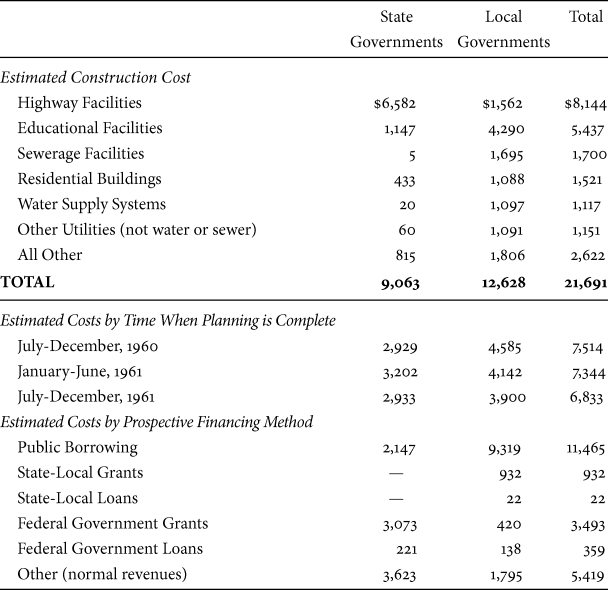
On March 26, the House Committee on Public Works followed Clark’s lead and began its open-door work on merging the president’s proposal with a public works plan targeting depressed areas. H.R. 10113 increased funding for public works and added a new administrative agency to oversee spending to become the “Public Works Coordination and Acceleration Act.” Congress treated the standby authority separately in H.R. 10318, the “Standby Capital Improvements Act of 1961.” Together, they colloquially formed the PWAA.Footnote 50 The revised bill served the president’s intent—it “enabled the President to take quick and effective action to stimulate the economy by inaugurating a program of needed capital improvements.”Footnote 51 The bill’s sponsor John Blatnik (D-Minn.) argued when introducing the bill that “the only item of budgetary expenditure that can be varied countercyclically, and that by its very nature calls for such variation, is a public works program.”Footnote 52 While the amount of money available for the president’s discretion was nearly cut in half, funds remained restricted for off-the-shelf projects, which would serve the intended countercyclical effect by pumping millions of dollars into the economy as fast as possible (see Table 1).
Summary of Plans of State and Local Governments for “On the Shelf” Construction Projects” (in millions of dollars)

Note: “On the Shelf” or “shovel ready” projects are defined as projects for which all planning actions necessary in advance of starting work or advertising for bids are scheduled to be completed prior to the estimated disbursement of funds (December 1961) under H.R. 10113, The Publics Works Coordination and Acceleration Act, an earlier version of the eventual 1962 PWAA.
Source: Tables are reproduced from House Hearings on the Standby Capital Improvement Act of 1962; data are drawn from a canvass-survey of public construction plans conducted by the Bureau of the Census, Governments Division. Tables are printed on page 127 of the hearing transcripts.
The justification for bypassing the normal appropriations process and giving the president this authority made sense in the language of neo-Keynesian stimulus—timing was everything. “The reason for [standby authority] is because of the difficulty of anticipating,” David Bell argued. “At the time the President wanted to use these funds it would be important to move quickly under the assumed conditions of the beginning of a recession.”Footnote 53 Secretary of Labor Arthur Goldberg similarly argued that “the proposal for authority to begin such programs now at the present level of unemployment is a recognition that, since we did not have standby authority when needed, we must take prompt and effective action now.”Footnote 54
Members grew noticeably agitated as the administration’s witnesses testified about the need to bypass Congress and the regular appropriations process. Representative Edwin Dooley (R-N.Y.) inquired whether the president “found the Congress to be derelict or slow in functioning.” Representative William Cramer (R-Fla.) condemned the plan as “one of the most brazen Presidential power grab proposals ever presented to the Congress.”Footnote 55 Likewise, after being told by Michigan governor John Swainson that in “periods of severe economic hardship, we cannot wait for the laborious congressional and legislative machinery to grind out a solution to the problem,” Representative James Harvey (R-Mich.) demanded to know when Congress had ever been so ineffective in responding to the needs of their shared constituents.Footnote 56 Republicans also worried that, even if staffed by experts, there existed the very real possibility that monies could flow to areas that were electorally vulnerable, tipping the scales toward the president’s party. Somewhat similarly, fellow Democrats began to realize that without exercising the power to appropriate funds following the authorization, there would be no guarantee that federal largesse flowed into their own districts. While the $600 million in immediate authority would go to those areas designated under the congressionally approved Area Redevelopment Act, none of standby authorization was predetermined; it was, after all, to remain deliberately underdetermined.
“Swift, Flexible, and Forceful Action”: Educating the Public About Keynesian Stimulus
The PWAA had up to this point been a tough battle the administration was willing to fight. Opposition from Republicans as well as fellow Democrats soured public opinion on the president’s “experiment.” As William Batt, the newly appointed head of the Area Redevelopment Administration, later recalled, “From the very beginning the committee members and the committee staff [of the Public Works Committee] told me that that standby proposal was sunk. We argued for it manfully.”Footnote 57 On April 17, after two days of closed hearings and five days of expert testimony, the Senate Public Works Committee approved the combined package on a party-line vote. Several weeks later, however, on May 1, the PWAA suffered its most severe setback when somebody leaked that the House Democratic leadership was scrapping the standby authority due to the objections from liberal Democrats. As a compromise, they proposed a $900 million one-time special appropriation, which would not draw on unobligated budgeted funds from federal agencies that Congress would fully oversee.Footnote 58
Keenly aware of the public relations battle he would have to win, Kennedy did not sit on the sidelines and leave the fight to the economics professors.Footnote 59 “We had to sell modern fiscal policy to an unbelieving and highly suspicious public,” Heller recalled shortly after stepping down as chairman of the CEA “Here we sold them deficit financing.”Footnote 60 Kennedy, who had already vigorously courted organized labor to back the plan, traveled to the AFL-CIO annual convention in Atlantic City to press the necessity of standby authority using as many different angles as possible—new economics, national security, anticorporatism. “Every year brings new problems that are unsolved,” the president proclaimed, but “our basic task here at home is to attempt to develop an economy which is not subject to the violent fluctuations where we saw the recession of 1958 and the recession of 60 and even today have too many people unemployed. We have suggested three programs to give us standby power . . . so that if we see the economy turning down we can move quickly without having to wait until it runs its course over a period of months.”Footnote 61
Even with the president’s added support, the Democratic leadership in the Senate feared that Republicans and southern Democrats would overcome the unenthusiastic coalition supporting the bill. By May, the administration grew increasingly concerned that time was running out as congressional midterms approached. Republicans labeled the plan as the Democrats’ “ski lifts, swimming pools, and golf courses” bill, and renewed their concern that any type of deficit spending was going to drive up inflation. The House Republican Policy Committee, chaired by John Byrnes (R-Wis.) solidified the party’s opposition to the bill, arguing that even without standby authority “billions of dollars already authorized for such use [were] going unspent.” Kennedy claimed that the new economics could precisely measure fiscal stimulus; conservatives responded that the technocrats could hardly count.Footnote 62
Ultimately, the administration’s efforts paid off in the Senate, but not without the help of a little intraparty wrangling. The Senate passed its $1.5 billion public works program by a vote of 44 to 32.Footnote 63 The standby provision given to Kennedy barely made it into the final bill. Clearly it was the most controversial element, and an amendment to scrap the standby authority would have passed if the Democratic leadership had not convinced two senators to vote “pairs,” or essentially abstain, at the last minute on the Senate floor. The amendment to remove presidential standby authority just narrowly failed, 36–37.Footnote 64
With the Senate bill passed, fiscal conservatives turned their attention to the House vote. If there were to be a public works program, they conceded, they would make their fight over Kennedy’s standby authority. Having lost the Senate vote, Barry Goldwater (R-Ariz.) penned several high-profile, reprinted letters in the national dailies lamenting how “an enormous extension of executive power for the President is wrapped up in the administration’s public works program.” “If adopted,” he warned, “it would hand the President more spending power than Congress has ever before delegated to a Chief Executive for such purposes.”Footnote 65 Former President Eisenhower, now working to help the Republicans in the upcoming midterms, made the public works bill—and the “pseudo-science” undergirding it—a central feature in his stump speeches. “Cheers, whistles, and hurrahs,” greeted Ike as he lambasted Kennedy’s plans, suggesting that the president was “floundering aimlessly and desperately” behind a front of “sophistication.” “It is always necessary to examine critically those appropriating,” Eisenhower said, “and to stop assuming that mere spending means increased strength. . . . [Sophistication is] a planned economy.”Footnote 66 Indeed, the attack on professional economics was central to the Republican message. In another letter, Goldwater joined Eisenhower’s critique of the New Economics, calling on voters to send a message to Kennedy to replace his “brain trusters” with “hard-headed business men” who actually understood the economy.Footnote 67 Dirksen and Halleck in their weekly press conference said that only a Republican Congress could successfully declare a moratorium on Kennedy’s “economic novelties,” return the country to “fiscal sanity,” and abandon this “old scheme to cover up extravagant government spending.”Footnote 68
Undeterred, the White House continued to press for public works spending and presidential authority to manage those funds, and, in a significant act of presidential leadership, Kennedy attempted to educate the public in the workings of the “new economics.” Again, the appeal for a discretionary public works bill was often coupled to a similar “triggered” countercyclical tax-rate proposal, which was less developed legislatively. Moreover, by that summer, Heller, the CEA, and Kennedy decided to push through a massive, permanent tax cut. As a result, the standby public works bill was often deprioritized—deliberately so—in favor of tax cuts, and the even more controversial discretionary tax-cut authority.Footnote 69
At a June White House press conference, Kennedy prodded Congress to give him standby authority, telling reporters that, specifically with regard to tax cuts, “there is surely more cause now than ever before for making such authority available.” Footnote 70 The president continued to seek the public works expenditures, and four days after the House Rules Committee barely released the public works bill for a full vote,Footnote 71 he once again took to the presidential “bully pulpit.” In one of the most iconic moments of the Kennedy administration, the president stood in front of a lectern during prime time, and, pointing to various graphs and charts, he described to the American people the status of the economy. Having already faced a tremendous challenge in convincing the public that sustained deficits could lower unemployment and increase the economy’s potential, the president nevertheless remained committed to explaining why his quest for additional federal funds was needed. He first explained why he would delay a tax cut until at least the upcoming year, but then the president argued that even if the economy was healthy, there was no need for the federal government to rest on its laurels. “Employment, income, profits, construction, and investment,” the president declared, “must all move up more quickly than they have been doing this summer; and the greater wages and profits which full capacity could bring to all our American citizens must soon replace the most extravagant waste—which is to have men searching for jobs which they cannot find and factories which have a percentage of their machines unused.” Educating the public in the logic of full-employment budgeting, Kennedy then called on the Congress to pass the legislation before it. After calling for an investment tax credit, the president turned full attention to the pending public works plan. “We need enactment of the bill to step up help to local and federal works,” he declared, “increasing the yearly building of those products in parts of our country which most urgently need them where many of our fellow countrymen are out of work and there is still a good deal to be done.” On the president’s reading copy, the words “this year” were underlined. Kennedy praised the Senate version, hoping that the same bill—the bill with standby authority—would soon pass the House.
To be sure, the president did not draw any sustained attention to the standby provision of the bill in this speech, and the public works proposal was one of many in a long list of interventions sought by the president. Significantly for the legacy of the PWAA, Kennedy already shifted the bulk of the rhetorical attention to the “most important fiscal weapon available to strength the national economic . . . Federal tax policy.” Indeed, the president did not read an entire paragraph typed out in his reading copy regarding the need for standby authority. Such authority, the president planned to say, would allow his administration “to be ready with swift, flexible and forceful action to cope with any future recession.”Footnote 72 At the last minute, he decided not to include the message in his address.
Yet, although the president did not bring the full force of his rhetorical powers to bear on the proposal, the administration, and especially Heller, continued to seek standby authority and to structure any authorized federal obligations in a way to ensure that they had a countercyclical effect. Leaving a breakfast meeting at the White House the morning following Kennedy’s televised speech, Senate Democratic leader Mike Mansfield (D-Minn.) told reporters that prospects for the public works bill looked brighter.Footnote 73 Despite this confidence, opposition stemming from the southern and western wings of the party forced House leadership to revise the bill further, scrapping plans for a coordinating central agency.Footnote 74 Even with these changes, Speaker McCormack was still forced to delay the full chamber’s consideration; ultimately, the final vote, 221–192, secured passage of the House plan.Footnote 75
As time ran out, the Democratic leadership agreed that it was best to pursue passage of the House bill, rather than seek standby authority in conference committee.Footnote 76 Coming so close to Election Day and devolving into partisan rancor, the new spending authorization seemed less like the New Economics promised and more like the old economics that predated even the New Deal. As the New York Times editorialized, “The Administration had sought a new flexible approach to public works . . . [but] Congress is against any change in the pork barrel system, which is aimed at producing votes rather than jobs.”Footnote 77 As such, while the PWAA would add a marginal amount of demand to the economy, the absence of a standby provision means that, at best, the bill was a partial success in Kennedy’s attempt to blend the competing elements of old and new liberal economic thought. Inside the White House, officials lamented changes to the standby provision and the proposed timeline for appropriations. Heller frequently grew dismayed by the markup of the PWAA in the Conference Committee, because increases in the authorization amount often were tied to increases or under specification of the authorization period. The original plan stipulated an acceleration period of twelve months, and required that all projects be complete within eighteen months after initiating the standby plan. The final bill—Public Law 87–658—gave the president an indefinite period to determine eligible projects and disburse the authorized amount; moreover, only a “substantial portion” of the accelerated project need be completed within a year after receiving federal monies.Footnote 78
Administering the PWAA
Even though the final law failed to include the standby provision, the White House still viewed the rapid disbursement of funds as an essential feature of its plan to solidify—both programmatically and in the public image—the veracity of the New Economics. Within months after the bill’s signing, internal memorandum in the CEA circulated on the need to “reiterate” the “desirability” of the standby proposal. Crafting several avenues in which to continue the uphill political struggle to convince Congress, the council recognized that any future attempt at getting standby authority would be dependent on the structure of the “tax reduction reform” and how well the council could study and document the success of the 1962 bill.Footnote 79
The 1962 Public Works Acceleration Act was a $900 million authorization bill. As such, Congress still needed to appropriate each of the president’s spending requests, giving the House and Senate Appropriations Committees one last say in directing the funds. Commerce Secretary Luther Hodges, who Kennedy placed in charge of coordinating the administration’s requests, estimated that twenty-six federal agencies produced a list of some $1.3 billion worth of projects ready for completion in 1963. William Batt, who as head of the Area Redevelopment Administration (ARA) would oversee the distribution of funds, later recalled that “on the public works side of the game our problem [was that] we always had more applications than we could possibly fund.”Footnote 80 Although the final bill restricted disbursement to areas with unemployment rates that qualified them under the 1961 Area Redevelopment Act guidelines, the administration still pushed for, and publicly called for, the authority to distribute the money as widely as possible.Footnote 81 Nevertheless, more than a month passed after the act became law before the appropriations committees began consideration of the White House’s spending requests. By that time, Congress had a much greater sense of the FY1963 economic imprint, and with $5.2 billion left to appropriate the release of PWAA funds was further delayed.
As the new congressional session began that January, administration officials were quickly revising their economic forecasts. The Bureau of the Budget earlier projected that there would be a $500 million surplus, driven in large part by a dramatic increase in GDP and government tax receipts. The new projections revealed the deficit would grow to $7.8 billion, driven by rising unemployment, a 6.4 percent increase in government expenditures, and only a 5.2 percent increase in revenues. Such a deficit would be the third largest since the end of World War II, surpassed only by the 1959 budget and government spending at the end of the Korean War. Yet, the bureau confidently stood by its previous assessments, stating that “if the economy in recent years had been operating closer to its potential, with an unemployment rate of about 4 percent, existing tax laws would produce an administrative budget surplus of about $2,000,000,000 this year.” Unemployment for 1962 stood at 5.5 percent, and the report stressed that “under current conditions of economic recovery, significantly slower than assumed in January, the present 1963 budget estimates reflect generally accepted fiscal requirements . . . [as] the deficit is neither inflationary nor dangerous to our balance-of-payments position.”Footnote 82
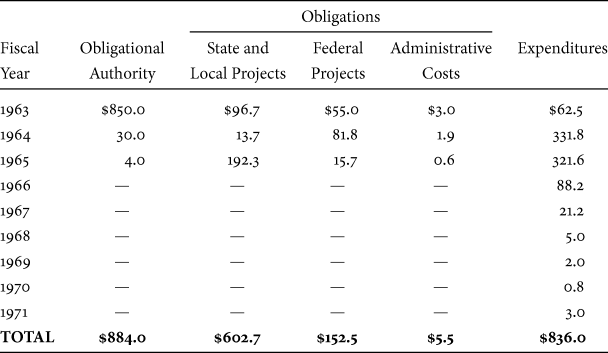
With such dire news, the Kennedy administration felt that the PWAA could still serve its countercyclical purpose by injecting much-needed stimulus into the economy. As the year ended, the White House allocated another $197.6 million for its list of “off the shelf” projects, but with only $55.4 million remaining under the appropriations bill, the president had to wait until the new Congress returned to Washington and ask them to appropriate the remaining $500 million.Footnote 83 Thus, as Table 2 shows, by the start of FY 1964—almost one year after the signing of the PWAA—Congress had appropriated $850 million for a variety of local, state, and federal projects, at the president’s request. Yet, in FY1963, government receipts indicated that only $62.5 million (7.35 percent) had been expended. Although Congress restricted the list of projects eligible for funding to shovel-ready improvements, and even some already under way, most of the spending, $653.4 million, took place in fiscal years 1964 and 1965. As intended by members of Congress, in part because of the large degree of involvement on behalf of state governors and administrators in promoting the legislation, the majority of the PWAA’s final obligations went to state and local infrastructure projects. Of the eventual $884 million eventually authorized by the Congress, state and local projects received $602.7 million in obligated funds, while federal projects received $152.5. By the end of 1971, just over $836 million dollars had finally been spent—less than one-third of Kennedy’s initial $2.5 billion proposal put forward ten years earlier.
Obligational Authority, Obligations, and Expenditures under the 1962 Public Works Acceleration Act, Fiscal Years 1963–1971 (in millions of dollars)

Note: Before 1976, the fiscal year began on July 1 and ended on June 30.
Source: Table is derived from Nancy H. Teeters, “The 1972 Budget: Where It Stands and Where It Might Go.” Brookings Papers on Economic Activity, 1. Washington, D.C.: Brookings Institution (1971), using data and figures from The Budget of the United States Government, FY 1963–71, printed on p. 233.
As a result of these adoption and implementation lags, policy analysts have difficulty in attributing specific, substantive effects to the PWAA as a fiscal stimulus. Nevertheless, the two years of largest PWAA spending, FY 1964 and FY 1965, witnessed lower rates of unemployment. The unemployment rates fell from 5.7 percent in 1963 to 5.2 in 1965 and 4.5 percent in 1965. Agencies across the Executive Branch administered the projects funded by the PWAA, but the Area Redevelopment Agency (ARA) served as the primary coordinating unit (along with Hodges) in organizing applications, assisting local governments in requesting funds, allocating lump-sum funding, and measuring total outlays.Footnote 84 The connection of the PWAA to the ARA was established, in part, by the limitations placed on eligible projects, but it was solidified further by Bureau of the Budget concerns about collecting data on the PWAA’s economic imprint. As Kermit Gordon recognized, “Should an acceleration program be effective in reducing the unemployment and increasing the level of economic activity of local communities, a new tool will be available to stimulate economic growth, both locally and nationally.” Yet, because the BoB did not collect any evaluation data on “local area impact,” the Democrats lacked some of the evidence they would need to promote another accelerated public works bill. Gordon, among others, hoped the ARA’s “field information reporting program” could serve their needs in the intermediate period until either the BoB or CEA could gather better statistics.Footnote 85
The ARA’s administrative responsibility for implementing the PWAA should not cloud the true intent of either distinct program, especially given the fact that total spending authority under the PWAA was three times greater than that for the ARA. The ARA was not an antirecessionary measure; it had preconceived developmental targets for chronically depressed areas throughout the country. The PWAA, by contrast, had a strict appropriations timeline pegged to economic indicators. Indeed, the coupling of these two programs within one administrative agency seriously hampered the structural improvement efforts of the ARA. As Gregory Wilson argues in his detailed account of the agency, the “quick success of the [PWAA] in providing funds and beginning public works construction upstaged the ARA’s other efforts” and solidified the idea that “the emphasis on redevelopment should be in public works.”Footnote 86
By 1966, most of the federal monies authorized by the PWAA had been expended and the Johnson administration pushed for an extension of the proposal. Heller—who remained chair of the CEA under President Johnson until after his election—informed the new president in May 1964 that the “high quality” effects of the PWAA confirmed in his mind that the administration should once again “see whether a sound and fast program can be worked out for future use.” Heller’s insistence on the standby provision suggests that the CEA thought the provision would have made the PWAA even more effective than it was. Nevertheless, the Economic Development Act of 1965 took the form of a congressionally dominated public works package. Moreover, Johnson’s bill contained the same provision that limited public works assistance for areas with a surplus labor problem—now identified as Title I areas.Footnote 87 The 1971 Extension Act further refined the scope of Title I, detailing that monies spent during recessionary times were to focus on short-term employment public works projects, not those related to long-term or structural growth issues. This new Public Works Impact Program (PWIP) stood apart from the larger goals of the renamed ARA, the Economic Redevelopment Administration. However, Blatnik—who continued to chair the House Public Works Committee throughout the 1960s and into the 1970s—routinely fought to give the presidency more discretion in managing PWIP funds.Footnote 88 Yet, In FY2015, the EDA allocated approximately $238 million in local-development projects and while the local-state-federal cooperative elements of the original PWAA remain prevalent features, the countercyclical functions are nonexistent.Footnote 89 As Seymour Harris lamented, while the PWAA and its legislative successors added millions of manpower hours into the economy, the novelty and promise of the new economics never fully took hold. “The critics gave the President little credit for the revolutionary change in his economic thinking and in his proposals,” Harris wrote.Footnote 90 While suggesting that “John F. Kennedy and Lyndon B. Johnson stand out, then, as the first modern economists in the American Presidency,” even Walter Heller emphasized the tax cuts that eventually passed Congress in 1964, while neglecting to mention that for the first two years of the new economics, the administration placed its trust, in part, in public works spending.Footnote 91
Conclusion
The political struggle to enact the PWAA and the law’s lasting influence on the structure and programmatic goals of federal agencies such as the Economic Development Administration provide several important lessons about the Kennedy administration and the history of Keynesian economic thought in American political development.
By studying how the Kennedy administration discussed this bill as a part of its larger economic philosophy, we can better understand the influence that the Kennedy presidency had on the “political discourse” of Keynesian budgetary politics.Footnote 92 If we take the Kennedy administration’s efforts to pass the PWAA seriously, then it is clear that despite the administration’s own retrospective evaluations, the Kennedy White House viewed public works as a necessary countercyclical fiscal instrument. To understand fully the intellectual influences that informed the Kennedy administration, including the president’s ultimate embrace of tax cuts as an expansionary mechanism, we must situate the entirety of his economic agenda alongside this early push for a $2.5 billion public works plan. The sequencing of the Kennedy tax cuts—following from a year-and-a-half-long attempt to pass a standby public works program—reveals much about why the administration ultimately relied on tax cuts, what political obstacles Kennedy faced in implementing the New Economics, and the degree to which Kennedy sought to redefine liberal governing responsibilities.
Furthermore, the PWAA reveals how the different political incentives that bear down on the legislative and executive branches lead to different fiscal goals. Both seemingly have a stake in the economic health of the country—both are at least penalized for rising unemployment rates—but the Congress strongly objected to the White House’s demands for a particular type of fiscal stimulus. Therefore, one of the major lessons of the PWAA is the disconnect between Keynesian countercyclical ideas and American political institutions. Under separate institutions sharing power, the type of rapid, flexible response needed for expenditure and receipt adjustments is difficult to achieve, although the reliance on “off the shelf” projects in the PWAA is an attempt to overcome this difficulty. Additionally, it is important to note that given how important governors who served “depressed areas” were in the design and implementation phases, a great deal of the political pressure to guard Congress’s taxing and spending authority emerged from the statehouses. Ultimately, the clear majority of federal funding for accelerated public works was funneled through the states, thereby reinforcing American federalism and local-state-federal interdependence in fiscal policy.
In the final analysis, the PWAA’s political legacy is notable for the road not traveled. If Franklin Roosevelt’s party eventually came to embrace an interventionist stance in America’s political economy, Kennedy sought to complete the “fiscal revolution” and equip the modern presidency with the power to transform economic issues into a nonpartisan science. It advanced Roosevelt’s ideal of “enlightened administration,” which sought to replace party politics with expert-negotiated, top-down policymaking.Footnote 93 Both Democrats and Republicans came to recognize the tremendous power of federal fiscal policy in the postwar era, but Kennedy wanted to distinguish the Democratic Party as the modern, expert-driven party that was not fearful of unbalanced-budgets or a little debt. Yet, as the CEA, led by Heller, even asked itself in June 1961, “Why did we slip so easily from possible consideration of increased government expenditures or reduced taxes to solve surplus, into only reduction of taxes as a mechanism?”Footnote 94 The history of the PWAA helps to reveal that much of the decision to embrace structural reform of the tax code over the implementation of a new countercyclical device had to do with changes in technical economic forecasts, and more subjective political assessments of fellow Democrats in the Congress and the Cabinet.
While Keynesian management of the economy struggled throughout the twentieth century to respond to energy price-shocks and stagflation, public works spending largely remained outside the Democratic fiscal toolkit. Since Kennedy, no president or presidential candidate has actively sought to establish a doctrinaire position on countercyclical expenditures in the way that Kennedy advocated and publicized in his attempts to pass the PWAA. Instead, variations in tax receipts dominate discussion of fiscal policy. Nevertheless, it is clear that such emphasis on tax-rate variation as a tool for countercyclical stabilization or economic expansion followed from the immediate aftermath of the PWAA political debates. Lyndon Johnson did not speak the same Keynesian language or attempt to teach the American people in the way Kennedy recognized as necessary. Indeed, as expenditures skyrocketed with both the Great Society and the Vietnam War, it became all too easy to lampoon the Johnson administration as one that had very little sense of fiscal restraint. President Carter’s zero-base budgeting was a return to the principles of efficiency and accountability, not countercyclical adjustment; President Clinton’s legacy stemmed not from public investments generated by an activist government’s deficit spending, but because he left office with a budget surplus; and President Obama’s stimulus was an emergency proposal grounded in pragmatism, a temporary economic quick-fix, not put into place “when the sun was shining.”Footnote 95
Kennedy and the new economists wanted to change the image that deficits were last-ditch responses to an unanticipated crisis, and they relied on a rather traditional instrument of public works to accomplish that goal. The young president took public works seriously and used the lessons of modern economics to transform the presidency in order to fulfill the promises of American liberalism.