Green and renewable energy resources, such as wind or solar energy, are usually intermittent and unstable. Therefore, large scale energy storage systems are needed for load-leveling. Rechargeable battery technology is promising to play a vital role in electric grid energy storage. Applications of lithium-ion batteries in electric vehicles or grid energy storage applications require long battery lifetimes.[Reference Dunn, Kamath and Tarascon1] Various approaches have been shown to improve the cycle life of lithium-ion batteries, such as the use of electrolyte additives or modification of cathode material composition.[Reference Zhang2, Reference Lu, MacNeil and Dahn3] Electrolyte deterioration is one of the causes of capacity fade.[Reference Buchberger, Seidlmayer, Pokharel, Piana, Hattendorff, Kudejova, Gilles and Gasteiger4] The aging of an electrolyte mainly occurs on electrode surfaces.[Reference Vetter, Novák, Wagner, Veit, Möller, Besenhard, Winter, Wohlfahrt-Mehrens, Vogler and Hammouche5] Therefore, surface chemistry plays a crucial role in cycling performance. As reported by many researchers, surface coating of cathode material particles is an effective way to improve long-term cycling performance.[Reference Chen and Dahn6, Reference Kim, Cho, Kim and Park7]
Metal oxides are the most commonly used materials to coat positive electrode material particles.[Reference Chen, Qin, Amine and Sun8, Reference Oh, Ahn, Nam and Park9] There are multiple possible mechanisms that lead to the improvement observed when cathode particles are coated with metal oxides. Xiong et al. showed that an Al2O3 coating suppresses impedance growth of layered Li[NixMnyCoz]O2 cathodes and improves coulombic efficiency and capacity retention.[Reference Xiong, Hynes, Ellis and Dahn10] Kim et al. compared the effect of different metal oxide coatings (ZrO2, Al2O3, TiO2, etc.) on LiCoO2 and concluded that oxide coatings can suppress cobalt dissolution, resulting in improved cycling behavior.[Reference Kim, Cho, Kim and Park7] Interestingly, Chen et al. compared the behavior of heated LiCoO2 and oxide-coated LiCoO2, and observed a similar cycling performance.[Reference Chen and Dahn11, Reference Chen and Dahn12] They proposed that it is the heat treatment, not the presence of the metal oxide, that is most important. Therefore, the processing steps may cause cycling improvement rather than the coating itself. For this reason, it is always important to compare coated materials with uncoated materials that have undergone the same processing steps.
Most of the coating methods reported so far are wet methods, which produce waste liquid and require filtering and additional drying/heating processes.[Reference Liu, Li, Xiong, Hao, Li, Kou, Yan, Li, Lu, Koo, Adair and Sun13] The environmental friendliness of these procedures is doubtful. Other common coating methods use deposition techniques, such as atomic layer deposition,[Reference Wise, Ban, Weker, Misra, Cavanagh, Wu, Li, Whittingham, Xu and George14–Reference Deng, Xiao, Wang, Li, Kaliyappan, Zhao, Lushington, Li, Sham, Wang and Sun16] which is expensive and difficult to scale up. Mechanofusion is a dry processing method that has been shown to coat small particles onto larger host particles.[Reference Pfeffer, Dave, Wei and Ramlakhan17] In this method, the particles are forced through a narrow gap, resulting in high shear and compression forces. As a result, the larger host particles can be coated with a dense layer composed of the fine coating particles.[Reference Pfeffer, Dave, Wei and Ramlakhan17] In this study, LiNi0.6Mn0.2Co0.2O2 (NMC622) was dry-processed with a nano-alumina powder using the mechanofusion process. NMC622 was also coated with nano-alumina using hand grinding for comparison. These materials were then characterized in Li cells. The mechanofusion method was shown to produce a robust, non-porous coating on the NMC622 surface, which significantly enhances its cycling performance. This method not only enables low-cost solvent-free particle coating, which can significantly reduce the cost and environmental impact of Li-ion cathode materials, but is also not limited by aqueous chemistry. In principle, any coating can be applied by this method. This work gives an example of the synthesis and characterization of a mechanofusion-coated cathode. We believe these results will open up a new research area in cathode material development.
Experimental
Commercial NMC622 powders (obtained from Umicore) and nano-Al2O3 (13 nm, from Sigma-Aldrich) were used in this study. Mechanofusion-coated NMC622 was prepared using a Hosokawa AM-15F mechanofusion system. NMC622 and nano-Al2O3 powders were added to the processing vessel in a weight ratio of 97:3 with a total tapped powder volume of ~50 mL. Mechanofusion was conducted for 30 min. with a press-head gap of 1 mm, a scraper gap of ~0.4 mm, and a rotation speed of ~1400 rpm. NMC622 was also coated with Al2O3 by hand-grinding NMC622 and 3% Al2O3 powders in a 97:3 weight ratio using a mortar and pestle until a homogeneous mixture was obtained (~30 min).
The morphology and elemental distribution of samples were measured using a field emission scanning electron microscope (FESEM, TESCAN MIRA 3). Cross-sections of samples were prepared using a cross-section polisher (JEOL, IB-19530CP). Single point BET measurements were conducted using a Micromeritics FlowSorb ΙΙ 2300 with a nitrogen/helium flow (28.6% N2). Samples were degassed at 150 °C for 30 min to remove moisture before the measurement. Densities were measured using a Micromeritics AccuPyc II 1340 Pycnometer. X-ray diffraction (XRD) patterns were recorded with a Rigaku Ultima IV x-ray diffractometer equipped with a Cu anode x-ray tube, a scintillation detector, and a diffracted beam monochromator.
Electrodes were made from slurries containing active materials, PVDF binder (polyvinylidene fluoride, Kynar HSV 900), carbon black (Super C65, Imerys Graphite and Carbon) at a ratio of 86:7:7, and an appropriate amount of N-methyl-2-pyrrolidone (Sigma Aldrich, anhydrous 99.5%). Slurries were mixed using a Mazerustar planetary mixer. The mixed slurries were coated onto aluminum foil using a coating bar with a 0.015 cm gap and dried at 120 °C in air. Circular electrode disks were punched from the coating and dried under vacuum at 120 °C overnight before cell assembly. Coin cells (2325-size) were assembled with 1 M LiPF6 in a solution of ethylene carbonate and diethyl-carbonate (volume ratio 1:2, from BASF) as an electrolyte, with two Celgard 2300 and one polypropylene blown microfiber separator (3M Company) as separators, and lithium foil as the counter/reference electrode. Cells were cycled at 30.0 ± 0.1 °C with a Maccor Series 4000 Automated Test System.
Results and discussion
Figure 1(a) shows scanning electron microscopy (SEM) image of the NMC622 powder used in this study. This material is in the form of ~10 µm spherical secondary particles composed of ~1 µm irregular polyhedral primary particles. Figure 1(b) shows an SEM image of the nano-Al2O3 powder used in this study. The Al2O3 particles (~13 nm) are much smaller than NMC622 and are even smaller than the resolution of the SEM itself. We have found that a small coating particle size is critical in ensuring a close-packed dense and uniform coating on the surface of the host particles by dry processing. The XRD patterns of NMC622 and nano-Al2O3 are shown in Figs. 1(c) and 1(d). Both materials are phase-pure. Compared with NMC622, which is highly crystalline, the XRD pattern of nano-Al2O3 powder has broad peaks, corresponding to a grain size that is <10 nm.
(a) SEM image of NMC622; (b) SEM image of Al2O3; (c) XRD pattern of NMC622; and (d) XRD pattern of nano-Al2O3.

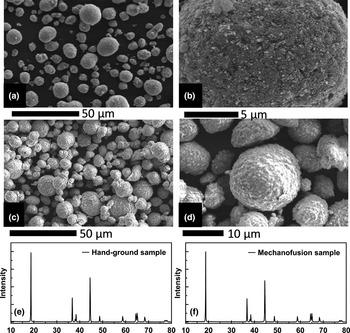
Figure 2 shows SEM images and XRD patterns of NMC622 particles coated with 3 wt% Al2O3 by hand-grinding or by mechanofusion, respectively. The primary particles of NMC622 can no longer be seen in these samples, suggesting both methods can produce a coating layer. However, the mechanofusion method produces a homogeneous and dense coating, while hand-grinding resulted in a much more diffuse and porous coating layer. The hand-ground sample also has some free Al2O3 particles present that are not closely attached to the NMC622, while very little free Al2O3 particles were observed in the sample coated by mechanofusion. The XRD patterns of both samples [Figs. 2(e) and 2(f)] are identical to pristine NMC622, showing that both methods do not affect the bulk NMC crystal structure.
SEM images of NMC622 coated with Al2O3 by (a, b) hand grinding and (c, d) mechanofusion. XRD patterns of these samples are shown in (e) and (f), respectively.

Table I shows the BET specific surface area (SSA) of all the samples. NMC622 has a SSA of ~0.3 m2/g, similar to previous reports.[Reference Jung, Metzger, Maglia, Stinner and Gasteiger18] Despite the Al2O3 having a very large surface area, the sample coated by mechanofusion has a smaller surface area (~0.23 m2/g), compared with pristine NMC622. This indicates that the Al2O3 coating formed must be very dense, so as to be impermeable to the N2 gas used in the BET measurement. Furthermore, as the secondary particle size did not change after the coating process, the reduced surface area is due to alumina filling the holes on the surface of the secondary particles, as shown in the SEM images in Figs. 2(b) and 2(c). On the other hand, the SSA of the sample coated by hand-grinding (1.61 m2/g) is higher than pristine NMC622, reflecting a less dense coating layer and the presence of loose Al2O3 powder, as observed in the SEM images discussed above. The coating formed by mechanofusion is not porous on a scale which can be observed by SEM. As further confirmation that the coating is non-porous, the densities of the pristine and mechanofusion-coated NMC622 were measured by He pycnometry and were found to be 4.78 and 4.34 g/cm3, respectively. It is believed that after the mechanofusion coating process, the Al2O3 coating makes the internal porosity of the NMC622 particles inaccessible to the helium of the pycnometer. Therefore, the measured volume of the coated sample is larger than the bulk volume, leading to a decrease in the measured density of the coated sample.
BET SSA measured for all samples.

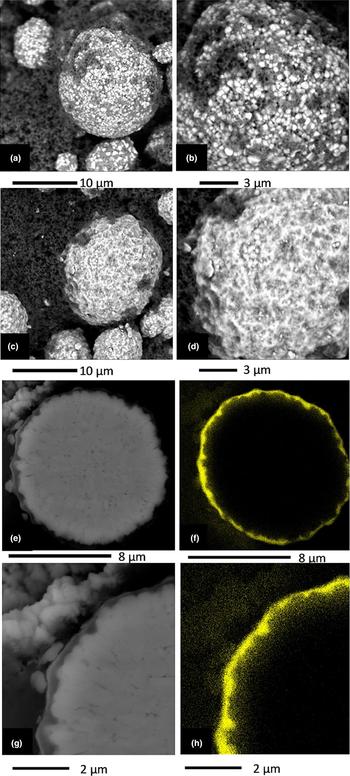
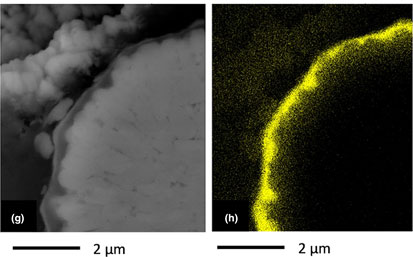
Figures 3(a,b) and 3(c,d) show SEM images of electrodes prepared from the hand-ground and mechanofusion Al2O3-coated NMC622, respectively. The Al2O3 coating is no longer present on the sample coated using hand-grinding. This indicates that the hand-ground coating was not robust enough to adhere onto the particle surface during the slurry making process. In contrast, the Al2O3 coating made by the mechanofusion process clearly remains intact and adhered to the coated electrode particles [Figs. 3(c) and 3(d)]. To further confirm that the Al2O3 coating is preserved on the surface of mechanofusion-coated NMC622, EDS mapping of a cross-section of this electrode was conducted. The results are shown in Fig. 3(f), where Al is shown in yellow. By comparing the shape of the enlarged SEM/EDS images of the mechanofusion-coated sample, shown in Figs. 3(g) and 3(h), the surface coating can be identified as the alumina coating. This coating is highly dense and completely coats the NMC622 surface, as shown in Fig. 3(g). This example also shows that for surface coating studies, it is important to characterize the composite electrode, instead of just the coated powders, to confirm that the particle coating can survive the slurry mixing process.
SEM images of composite electrodes of NMC622 coated with Al2O3 by (a, b) hand grinding and (c, d) mechanofusion. SEM (e, g) and corresponding EDS aluminum maps (f, h) of a cross-section of an electrode of mechanofusion-coated NMC622.

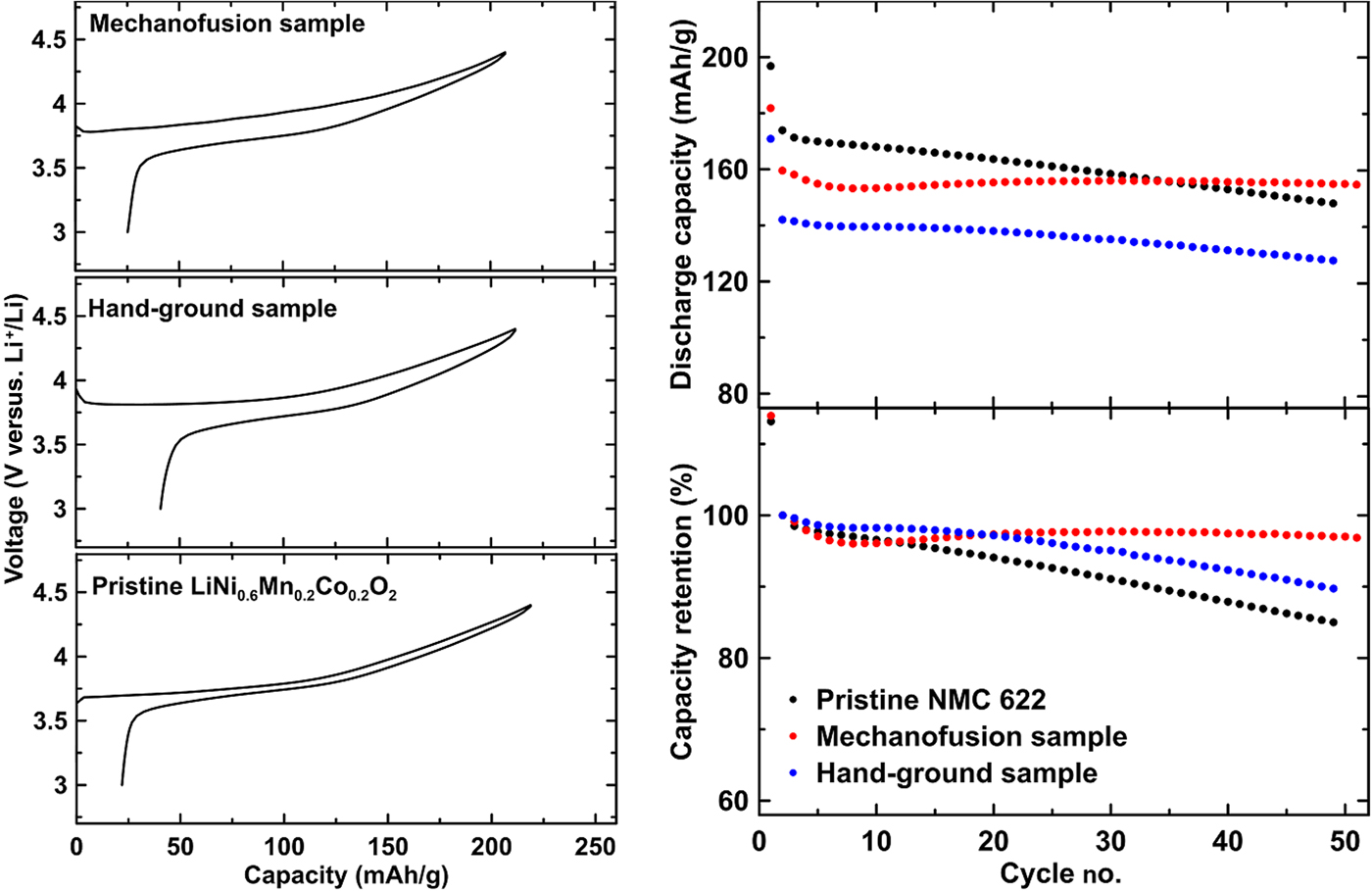
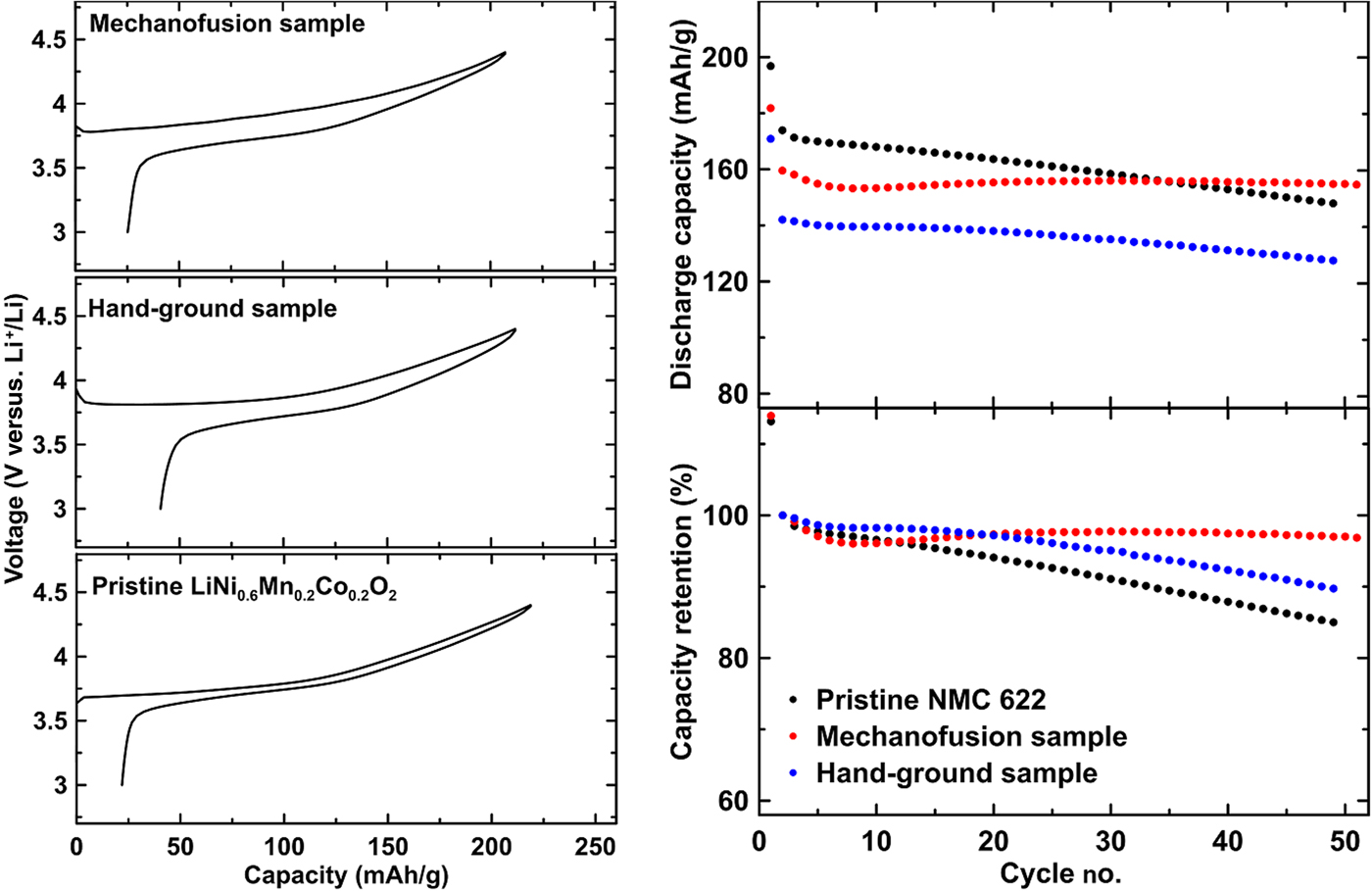
Figure 4 shows the voltage curves of pristine NMC622, and of NMC622 coated with Al2O3 by mechanofusion and hand-grinding. Compared with the pristine sample, the coated samples have lower capacities and larger hysteresis, due to the presence of non-conductive and inactive Al2O3. The hysteresis of the mechanofusion-coated sample is slightly larger than the one coated by hand-grinding. This is expected, since the dense Al2O3 coating produced by mechanofusion would tend to impede ion conduction. The cycling performance for all the materials cycled between 3 and 4.4 V is shown in Fig. 4. The uncoated NMC622 sample has significant capacity fade (~18% fade/50 cycles) when cycled in this voltage range, as has been previously observed by others.[Reference Liu, Li, Xiong, Hao, Li, Kou, Yan, Li, Lu, Koo, Adair and Sun13] The NMC622 sample that was hand-ground has only slightly better capacity retention (~15% fade/50 cycles). This is understandable, since, as shown above, the Al2O3 coating prepared by hand grinding came off the particles during the slurry making process. The slightly improved cycling of this sample can be attributed to the HF scavenging effect of the residual Al2O3 in the electrode.[Reference Chen, Qin, Amine and Sun8, Reference Liu, Liu, Liu, Bai, Shi, Wang, Chen, Hennige and Schuch19] LiPF6 reacts with water to form HF, which corrodes the active material and leads to poor cycling. The HF concentration in the electrolyte can be reduced in the presence of Al2O3, resulting in improved cycling.[Reference Chen, Qin, Amine and Sun8, Reference Liu, Liu, Liu, Bai, Shi, Wang, Chen, Hennige and Schuch19] The NMC622 sample coated by mechanofusion has significantly improved cycling performance, with little capacity fade in 50 cycles. It can therefore be concluded that the good cycling performance of the mechanofusion-coated sample results from a combination of the Al2O3 HF scavenger effect, and the protective layer formed by the dense Al2O3 coating that isolates the NMC surface from the electrolyte.
Voltage curve and cycling performance of pristine NMC622 and NMC622 coated with Al2O3 by mechanofusion and hand-grinding.
Summary
These results show that dense and stable coatings can be applied to cathode particles by the mechanofusion process. Such mechanofusion coatings are of high quality and can be used effectively to improve the cycling performance of Li-ion battery cathode materials at high voltages, enabling high energy densities, while offering an inexpensive, solvent-free, scalable, and environmentally friendly synthesis route compared with other coating methods.
Acknowledgments
The authors acknowledge funding from NSERC and 3M Canada, Co. under the auspices of the Industrial Research Chair and Discovery Grant Programs. The authors also thank Dr. Jeff Dahn for the use of his pycnometry equipment.