Introduction
As long as the global population ages, the prevalence of chronic kidney disease (CKD) will continue to rise. Glomerular filtration rate (GFR) declines with increasing age and CKD is likely to be a manifestation of systemic atherosclerosis, with diffuse vascular damage affecting a number of end organs in parallel.Reference El Nahas1 Older people are particularly susceptible to kidney damage due to their increased prevalence of co-morbidities. CKD is a progressive condition with a significant impact on morbidity and mortality of older people, increasing cardiovascular risk and the prevalence of geriatric syndromes such as cognitive and physical dysfunction.
The current definition and classification of CKD has resulted in a shift in the perception of kidney disease from an advanced condition affecting few people who require renal replacement therapy by nephrologists, to a common condition requiring early detection and management by non-nephrologists, particularly geriatricians, who will also manage end-stage renal disease (ESRD). Early recognition and intervention are essential to slowing disease progression, minimizing complications, maintaining quality of life and improving outcomes. In this review we summarize age-related renal function decline, epidemiology of CKD, renal function assessment, prognostic implications of CKD and its management in older people.
Definition and classification of CKD
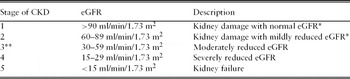
In 2002, the Kidney Disease Outcomes Quality Initiative (KDOQI) introduced a definition and classification of CKD.2 The definition was based on low estimated glomerular filtration rate (eGFR) <60 ml/min/1.73 m2, or normal eGFR with evidence of kidney damage, most commonly albuminuria, haematuria or abnormal renal ultrasound for three or more consecutive months, regardless of the aetiology or age. Five stages of CKD were introduced (Table 1). Stages 1 and 2 are defined as presence of renal damage, mostly albuminuria, with normal or slightly reduced eGFR. Stages 3–5 are based only on reduced eGFR (<60 ml/min/1.73 m2). Recently the Kidney Disease: Improving Global Outcomes (KDIGO)Reference Levey, de Jong and Coresh3 has recommended subdivision of stage 3, into stage 3a (GFR 59–45) and stage 3b (GFR 44–30), to reflect increased mortality when GFR is <45 ml/min/1.73 m2.
Stages of chronic kidney disease2, Reference Levey, de Jong and Coresh3

*There must be evidence of chronic (>3 months) kidney damage defined by structural or functional abnormalities, e.g. albuminuria or haematuria.
**Stage 3 was suggested to be sub-categorized into stage 3a with GFR = 59–45 ml/min/1.73 m2 and stage 3b with GFR = 44–30 ml/min/1.73 m2 to reflect the increased mortality and vascular risk when GFR is <45 ml/min/1.73 m2 by the Kidney Disease: Improving Global Outcomes (KDIGO).3
Although this definition has increased awareness of CKD, the staging system has led to exaggerated prevalence estimates, particularly in older people. For example, the clinical significance of stages 1 and 2 are uncertain and the mere presence of microalbuminuria in non-diabetic individuals does not necessarily reflect kidney damage. On the other hand, most healthy older people will receive a diagnosis of stage 3 CKD, although the decline in their eGFR could be physiological or age-related, and the vast majority of them will die before they reach ESRD with no therapeutic implications. Although the current staging system may not reflect accurate clinical relevance, reporting eGFR is useful in older people whose serum creatinine poorly reflects their renal function, in order to improve drug dosing and reduce exposure to nephrotoxic agents.Reference Bauer, Melamed and Hostetter4
Renal function decline with age: physiology, pathology or both?
Renal function declines gradually with increasing age at various rates among individuals. It is not yet clear whether this decline is physiological, as part of the normal ageing process, or pathological, secondary to co-morbidities, or due to a combination of both. Ageing is associated with vascular and renal changes, which may be responsible for decline in glomerular filtration.
Vascular changes
With increasing age, there is increased lipid and calcium deposition in the arterial intima, and increased deposition of collagen and smooth muscle cells in the media. These result in increased intimal thickening, arterial wall stiffness and loss of compliance of major arteries.Reference Franklin, Gustin and Wong5 A combination of age-related vascular changes occurring in different proportions could determine the overall vascular ageing of the individual. Mild combinations could result in successful or healthy vascular ageing, while severe combinations, in addition to exposure to traditional cardiovascular risk factors, could lead to unsuccessful or pathological vascular ageing.
Renal changes
Histological renal changes include glomerulosclerosis, tubular atrophy, and interstitial and arterial intimal fibrosis.Reference Zhou, Rakheja and Yu6 There is loss of renal mass with increasing age (32% reduction in renal autopsy weight of individuals >80 years compared with those <39 years old).Reference Tauchi, Tsuboi and Okutomi7 There is a simultaneous increase in vascular thickness, arterial and arteriolar hyalinosis and sclerosis. These age-related glomerular and vascular changes result in reduced renal blood flow, reduced tubular excretory and reabsorptive function and progressive decline in GFR.
GFR decline
The controversial issue of whether GFR decline is age-related or a disease in itself remains unclear. If reduction in GFR does not reflect kidney disease, but rather a normal physiological ageing process, then reduced GFR would not be associated with the metabolic complications recognized with CKD. Data from the National Health and Nutrition Evaluation Survey (NHANES) showed that, for older people ≥80 years old, the metabolic complications associated with CKD such as anaemia, metabolic acidosis, hyperphosphataemia and hyperparathyroidism were more common when eGFR was low, <60 ml/min/1.73 m2, compared with those with eGFR >60 ml/min/1.73 m2.Reference Bowling, Inker and Gutiérrez8 This may suggest that GFR decline with age is not physiological. However, similar to the variation in vascular ageing, GFR decline with old age is also variable. The Baltimore Longitudinal Study on Ageing reported a slow decline in creatinine clearance (0.75 ml/min/year after the third decade of life), with approximately one-third of subjects demonstrating stable kidney function over 20 years of follow-up.Reference Lindeman, Tobin and Shock9 Another study showed a modest decline in GFR (1.05 ml/min/year in the very elderly aged 70–110 years),Reference Fehrman-Ekholm and Skeppholm10 and the Cardiovascular Health Study showed little or no progression of CKD in the majority of older people (>26.5 μmol/l increase in serum creatinine in only 3% of the subjects, mean age 73 years) over 3 years of follow-up.Reference Bleyer, Shemanski and Burke11
Recently, age-related nephrosclerosis was found to be common, affecting three-quarters of subjects (≥75 years old), but it was not correlated with eGFR decline.Reference Rule, Amer and Cornell12 Therefore, it might be that age-related vascular changes, in varying degrees of severity, combined with cumulative exposure to cardiovascular risk factors, in genetically predisposed individuals, are linked to the decline in renal function from mild (physiological or successful ageing) to severe (pathological or unhealthy ageing) observed with increasing age. In other words, age-related vascular changes may provide suitable substrate for the traditional cardiovascular risk factors to promote atherosclerosis, leading to CKD as a manifestation of widespread cardiovascular disease.Reference Abdelhafiz, Brown, Bello and El Nahas13
Prevalence of CKD
Prevalence of CKD in older people (≥75 years old) in the British community is 56.1% (95% confidence interval (CI) 55.3–57.0) for eGFR < 60, 17.7% (95% CI 17.1–18.4) for eGFR < 45 and 2.7% (95% CI 2.4–2.9) for eGFR <30 ml/min/1.73 m2.Reference Roderick, Atkins and Smeeth14 In the health survey of England in 2009, 75% of individuals with CKD (stages 3–5) were above the age of 65 years.Reference Roth, Roderick and Mindell15 In the NHANES study 1999–2004, the prevalence of CKD was 46.8% in people ≥70 years old, compared with only 6.7% in those between the ages of 40 and 59 years.Reference Levey, Stevens and Schmid16
The prevalence of CKD increases with age largely due to increased prevalence of stage 3 CKD. The prevalence of advanced stages of CKD remains limited in older people, even in the very elderly. In a Flemish study of 34,642 patients in general practice, mean age (SD) 69 (11.3) years, the prevalence of eGFR ≤ 60 ml/min/1.73 m2 was 5% in males and 9% in females for those aged 50–59 years, and 24% in males and 33% in females for those aged 70–79 years. For patients aged ≥90 years the prevalence was 54 and 67% for males and females, respectively. The prevalence of advanced stages of CKD (stages 4 and 5) increased from 0.5% in males and females at age 50–59 years to 10% for males and 12% for females at the age of 90 years.Reference Van Pottelbergh, Bartholomeeusen and Buntinx17
In care homes, the prevalence of CKD is higher and tends to be less recognized and associated with higher co-morbidity burden. In a cross-sectional study of 155 residential care homes in the UK, the prevalence of CKD (eGFR <60ml/min/1.73 m2) was 82% among 250 residents, median age 86 years (range 67–100 years). Increasing age and higher body mass index were predictive of decreased renal function. However, only 5% of this cohort were known to have kidney disease.Reference Carter, O'Riordan and Eaglestone18 In another cross-sectional study of 82 geographically representative nursing homes across the United States, 794 residents had complete baseline data collected. CKD (eGFR <60 ml/min/1.73 m2) was prevalent in approximately 50% of residents. Of those residents with CKD, 47.6% were in stage 3a, (eGFR 45–59), 39.27% in stage 3b (eGFR 30–44), and 13.2% in stage 4/5 (eGFR <30). The mean (SD) number of co-morbidities was 5.3 (2.2). The number of co-morbidities, particularly cardiovascular conditions, was proportional to the severity of CKD. Approximately 57% of those without CKD had five or more co-morbidities, in comparison with 87% of those with stage 4/5 CKD.Reference McClellan, Resnick and Lei19
GFR estimation
Serum creatinine is an insensitive marker of renal function because its value is affected by muscle mass, diet and renal tubular secretion. This may be exaggerated in older people, due to loss of muscle mass with increasing age. Serum creatinine begins to rise above normal range only after loss of at least 50% of renal function. The term ‘concealed renal failure’ has been used to describe elderly patients with normal serum creatinine but low GFR.Reference Corsonello, Pedone and Corica20 Calculating creatinine clearance using 24-hour urine collections is troublesome, difficult and inaccurate. Therefore, estimation of GFR is now recommended. Several formulae to estimate GFR have been developed.
Cockcroft–Gault and the Modification of Diet in Renal Disease
The Cockcroft–Gault (CG) formula uses three variables (age, weight and serum creatinine) and the Modification of Diet in Renal Disease (MDRD) uses four variables (age, weight, serum creatinine and race) to estimate GFR. They are the most commonly used formulae and both are reasonable measures of GFR. However, in younger people, the CG formula scores relatively well at higher GFR (77.9% true positive rate for GFR <60 ml/min), but less well at lower GFR values (67.7% true positives rate for GFR <30 ml/min). In contrast, the MDRD formula scores similarly well at both ends of GFR (78.1 and 78.8%, respectively).Reference Van Pottelbergh, Van Heden, Mathei and Degryse21 However, GFR <60 ml/min/1.73 m2 estimated by the MDRD formula is very common in older people; therefore some healthy people may be erroneously classified as having CKD.
The Mayo Clinic Quadratic equation
The Mayo Clinic Quadratic equation (MCQ) uses three variables (age, serum creatinine and sex) to estimate GFR. It identifies smaller numbers of older people with stage 3 CKD, but similar numbers of advanced CKD (stages 4–5) compared with MDRD. In a cross-sectional study of 1634 out-patients ≥75 years old (range 75–91 years), the prevalence of subjects with eGFR< 60 ml/min/1.73 m2 was remarkably lower when estimated by the MCQ compared with the MDRD formula (9.2 vs 21.1%, P <0.001), whereas the prevalence of subjects with eGFR either <45 or <30 ml/min/1.73 m2 did not differ statistically (4.6 vs 6.3%, P = 0.42 and 2.3 vs 1.7%, P = 0.69, respectively).Reference Lippi, Targher and Salvagno22
CKD epidemiology collaboration equation
The introduction of the new CKD epidemiology collaboration (CKD-EPI) equation, which applies different coefficients to the same four variables used in the MDRD equation, has led to higher estimates of GFR in younger people and lower estimates (GFR< 60 ml/min/1.73 m2) in older people. Therefore, in clinical practice where most CKD patients are elderly, the use of CKD-EPI may indicate increased prevalence of CKD.Reference van den Brand, van Boekel and Willems23 However, in a meta-analysis of data from 1.1 million adults (aged ≥18 years) from 25 general population cohorts, seven high-cardiovascular risk cohorts and 13 CKD cohorts residing in 40 different countries, the CKD-EPI equation had a better risk prediction with more accurate categorization of risk for mortality and ESRD than the MDRD equation. Compared with the MDRD equation, 24.4 and 0.6% of the participants were reclassified to a higher and lower eGFR category, respectively, by the CKD-EPI equation, and the prevalence of CKD (eGFR <60) was reduced from 8.7 to 6.3%. Of those with an eGFR of 45–59 by the MDRD equation, 34.7% of participants were reclassified to eGFR of 60–89 by the CKD-EPI equation and had lower incidence rates (per 1000 person years) for the outcomes of interest (9.9 vs 34.5 for all-cause mortality, 2.7 vs 13.0 for cardiovascular mortality, and 0.5 vs 0.8 for ESRD), compared with those not reclassified. The authors concluded that, given the lower CKD prevalence estimates and better risk categorization, the implementation of the CKD-EPI equation would contribute to a more efficient prediction of CKD-related outcomes.Reference Matsushita, Mahmoodi and Woodward24 Similarly, in a British community-based population of 174,448 subjects, CKD-EPI produced lower CKD estimates among the 18- to 59-year-old group compared with the MDRD equation. The difference in CKD prevalence between the two equations was mainly attributable to a decrease in the prevalence of stage 3a CKD when the CKD-EPI equation was applied. However, in older people (>70 years) there was very little difference between the two equations, and among the very elderly (≥90 years) CKD-EPI increased CKD prevalence estimates.Reference Carter, Stevens, Irving and Lamb25
Cystatin C-based formula
Cystatin C (Cys-C) is a marker of kidney disease and is more sensitive than serum creatinine at measuring kidney function. In older people, the prevalence of CKD assessed by various equations remains variable. In a total of 1471 older subjects, mean (SD) age 75.6 (6.6) and range from 65 to 91 years, the prevalence of CKD (eGFR <60) was 34.3% by MDRD, 33.0% by CKD-EPI and 14.6% by Cys-C-based eGFR equations. Females had a higher risk for CKD stages 3–5 with MDRD (odds ratio (OR) 1.63; 95% CI 1.23–2.16), less risk (1.23, 95% CI 0.92–1.65) with the CKD-EPI and least risk (0.89, 95% CI 0.58–1.34) with the Cys-C-based equation.Reference Rothenbacher, Klenk and Denkinger26 Newer equations have been reported using cystatin C concentration, either alone (CKD-EPIcys), or in combination with creatinine concentration (CKD-EPIcr-cys). In a study to test accuracy of MDRD, CKD-EPI, CKD-EPIcys or CKD-EPIcr-cys in 394 older people ≥74 years old (median age 80 years, range 74–97) compared with GFR measured by iohexol clearance, the CKD-EPIcr equation appeared less biased and was more accurate than the MDRD equation. Median iohexol clearance was 53.4 ml/min/1.73 m2. The MDRD, CKD-EPIcr and CKD-EPIcr-cys equations overestimated the GFR, with a median difference of 3.5 (P <0.001), 1.7 (P <0.001) and 0.8 ml/min/1.73 m2 (P <0.02), respectively. The CKD-EPIcys equation was unbiased. No equation has achieved ideal accuracy compared with the measured GFR. Accuracy defined as percentage of estimates within 30% of measured GFR was 81, 83, 86 and 86% for the MDRD, CKD-EPIcr, CKD-EPIcys and CKD-EPIcr-cys equations, respectively. Accuracy of MDRD was inferior (P <0.004) to the CKD-EPIcr equation at GFR >60 ml/min/1.73 m2. The authors concluded that they found no evidence that the MDRD equation was underestimating GFR, irrespective of the level of GFR. The CKD-EPI equations performed marginally better than the MDRD equation, particularly at GFR >60 ml/min/1.73 m2.27 Therefore, more work is needed to evaluate the various estimating equations in older people, to better understand the practical consequences of the observed differences.
Prognostic implications of CKD. Why is CKD important?
Although CKD is associated with known disease-specific complications attributable to a decline in renal function and adverse outcomes such as cardiovascular risk, in older people CKD is also associated with non-disease-specific complications, including cognitive impairment and frailty.
Cardiovascular risk
It has been shown that even mild renal dysfunction predicts atherosclerotic vascular disease-related outcomes, independently of the Framingham risk score. In a prospective study of 1239 female subjects, mean (SD) age 75.2 (2.7) years, from the Calcium Intake Fracture Outcome Study (CAIFOS), the odds ratio (OR) for atherosclerotic vascular disease hospitalization and deaths increased by 1.34 (95% CI 1.18–1.53, P <0.001) and 1.31 (1.14–1.50, P <0.001) for every standard deviation reduction in eGFR, from a mean (SD) of 65.2 ml/min/1.73 m2 after 10 years of follow-up. This suggests an elderly woman with eGFR of 60ml/min/1.73 m2 would be at 60% increased risk of long-term atherosclerosis-related hospitalization or death, compared with an elderly woman with eGFR of 90 ml/min/1.73 m2, independent of Framingham risk score. These results may support the concept that renal dysfunction may have its deleterious effect via pathways independent of traditional cardiovascular risk factors.Reference Lewis, Lim and Dhaliwal28
The clinical implication of CKD-associated atherosclerosis has been shown as a graded increased risk of cardiovascular disease with GFR progression. In a community-based study of 16,958 Icelandic subjects aged 33–81 years without manifest vascular disease, hazard ratios (HR) for coronary heart disease were 1.55 (95% CI 1.02–2.35) for CKD stage 1, 1.72 (95% CI 1.30–2.24) for CKD stage 2, 1.39 (95% CI 1.22–1.58) for CKD stage 3a, 1.90 (95% CI 1.22–2.96) for CKD stage 3b, and 4.29 (95% CI 1.78–10.32) for CKD stage 4, adjusted for conventional cardiovascular risk factors, after a median follow-up of 24 years.Reference Di Angelantonio, Chowdhury and Sarwar29 The same trend was shown in a British community-dwelling cohort of 15,336 participants (≥75 years old), with a graded increase in all-cause and cardiovascular mortality as eGFR decreased. HRs for all-cause mortality in eGFR bands of 45–59, 30–44, and <30 compared with eGFR >60 ml/min/1.73 m2 were 1.13 (95% CI 0.93–1.37), 1.69 (95% CI 1.26–2.28) and 3.87 (95% CI 2.78–5.38) in men, and 1.14 (95% CI 0.93–1.40), 1.33 (95% CI 1.06–1.68) and 2.44 (95% CI 1.68–3.56) in women, respectively.Reference Roderick, Atkins and Smeeth30
Although the decline in GFR is associated with increased cardiovascular mortality, this association seems to be slightly attenuated in the very elderly. In the REGARDS (REasons for Geographic and Racial Differences in Stroke) study, the HRs for mortality associated with eGFR 45–59 and <45 ml/min/1.73 m2, versus ≥60 ml/min/1.73 m2, in participants aged 70–79 years, were 1.3 (95% CI 1.1–1.6) and 3.1 (2.5–3.8), respectively, after adjusting for traditional CVD risk factors. In the oldest old participants ≥80 years of age, the adjusted HRs for mortality were 1.6 (1.3–2.1) and 2.2 (1.7–2.9), respectively.Reference Muntner, Bowling and Gao31
Although the increased cardiovascular risk is linearly proportional to the severity of GFR decline, in older people higher than normal GFR is also associated with increased cardiovascular risk, describing a U-shaped relationship. For example, in patients hospitalized with acute ischaemic stroke, mortality rate was lowest at eGFR of 85 ml/min/1.73 m2, but increased sharply at higher and lower levels of eGFR. Compared with patients with an eGFR between 75 and 125 ml/min/1.73 m2, the all-cause mortality rate was 21% higher among patients with an eGFR between 60.0 and 74.9 ml/min/1.73 m2, 48% higher among those with an eGFR <60 ml/min/1.73 m2 and 66% higher among patients with an eGFR >125 ml/min/1.73 m2 (P for quadratic trend = 0.01), independent of age, sex, race and major co-morbidities.Reference Mostofsky, Wellenius and Noheria32 Also, in the Hypertension in the Very Elderly Trial (HYVET), which included 3845 very elderly (aged ≥80 years) participants with hypertension, both low and high GFR increased mortality risk. The lowest risk was GFR category between ≥60 and <75 ml/min/1.73 m2. Using this as a comparator, the cardiovascular mortality increased with eGFR <45 and ≥75 ml/min/1.73 m2, showing HRs of 1.88 (95% CI 1.2–2.96) and 1.36 (0.94–1.98), respectively. The increased risk with high GFR is not clear, but in the very elderly, low creatinine and high GFR may reflect sarcopenia, malnutrition and frailty, increasing the risk of mortality.Reference Peters, Beckett and Poulter33
Geriatric syndromes
In older people, CKD is associated with increased prevalence of syndromes of old age, which may suggest that CKD is a new geriatric giant.Reference Abdfelhafiz, Ahmed, Flint and El Nahas34 In a Taiwanese study of 37,049 adults newly diagnosed with CKD, and 74,098 people free from CKD matched for age and sex, the dementia incidence was higher in the CKD cohort than in the non-CKD cohort (9.30 vs 5.55 per 1000 person-years), with an overall HR of 1.41 (95% CI 1.32–1.50), controlling for age, sex, co-morbidities and medications.Reference Cheng, Chen and Lai35
Severity of CKD is proportional to the clinical decline in cognitive function. In the Intervention Project on Cerebrovascular Diseases and Dementia in the Community of Ebersberg (INVADE) study of 3679 participants with baseline categories of renal function divided into normal, mild and moderate to severe renal impairment (eGFR ≥60, 45–59 and <45 ml/min/1.73 m2, respectively), new cognitive impairment had developed at a rate of 5.8, 9.9 and 21.5%, respectively, in the three groups, after 2 years of follow-up. Patients with moderate to severe kidney disease were more at risk of developing new cognitive impairment (OR 2.14, 95% CI 1.18–3.87, P = 0.01).Reference Etgen, Sander and Chonchol36
In 357 community-dwelling participants, mean (SD) age 77.4 (5.8) years, as part of the prospective observational University of Alabama at Birmingham Study of Aging, eGFR <60 ml/min/1.73 m2 was independently associated with a decline in instrumental (OR 1.83, 95% CI 1.06–3.17, P = 0.030) and basal activities of daily living (2.46, 95% CI 1.19–5.12, P = 0.016). EGFR <45 ml/min/1.73 m2 was associated with higher odds of decline in activities of daily living (3.12, 95% CI 1.38–7.06, P = 0.006 and 3.78, 95% CI 1.36–9.77, P = 0.006, respectively) after 2 years of follow-up.Reference Bowling, Sawyer and Campbell37 This suggests that severity of CKD is proportionally related to physical functional decline. An eGFR <45 ml/min/1.73 m2 was associated with a 2-fold increase in hip fracture-related mortality compared with eGFR ≥60 ml/min/1.73 m2 (HR 1.81, 95% CI 1.11–2.96), adjusted for age and sex, in a British community cohort of 13,177 subjects (≥75 years old) after a median follow-up of 7.3 years.Reference Nitsch, Mylne and Roderick38 Using data from the NHANES III study, the OR for frailty for CKD stages 1 or 2, stage 3a and CKD stage 3b–5 were 2.21 (95% CI 1.49–3.28), 2.48 (1.57–3.93), and 5.88 (3.40–10.16), respectively, compared with people without CKD.Reference Wilhelm-Leen, Hall, KM and Chertow39
The decline in physical function associated with CKD will eventually lead to disability, which is proportional in severity to the degree of renal function decline. For example, in NHANES (1999–2006), difficulty in activities of daily living was reported by 17.6, 24.7 and 23.9% of older people (≥65 years) and by only 6.8, 11.9 and 11.0% of younger people (20–64 years) with no CKD, stages 1 and 2, and stages 3 and 4, respectively. The association of CKD with measures of disability was no longer statistically significant in younger people after adjustment for co-morbid conditions, whereas some associations remained not attenuated by these conditions in older people, suggesting that CKD exerts a stronger independent effect on disability in these individuals.Reference Plantinga, Johansen and Crews40
The association between CKD and functional decline is likely to be multifactorial. CKD is associated with metabolic complications such as acidosis, anaemia, bone dystrophy, hyperphosphataemia and neuropathy, which may contribute to physical functional decline. Also, severity of CKD may reflect severity of underlying conditions such as cardiovascular disease, hypertension and diabetes. Therefore, a lower eGFR may be a marker for overall co-morbidities leading to functional decline, rather than a diagnosis of single organ disease.
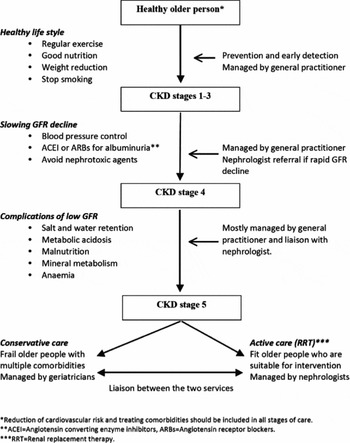
Management (Fig. 1)
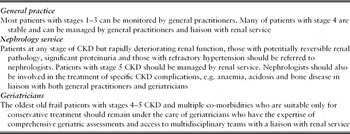
Management priorities of CKD should be prevention and early detection, in order to slow progression, treat and reduce complications associated with low GFR, treat cardiovascular risk factors, prolong survival with renal replacement therapy and improve quality of life. Therapeutic goals should be set at the outset with patients and their carers. Most patients will be managed under care of general practitioners or geriatricians, with specialist input from nephrologists (Table 2).
Care and referral for older people with CKD

Stages of CKD in older people and recommended action

CKD prevention
Lifestyle modifications including weight reduction, exercise and healthy diet may have a renoprotective effect. Individual dietary parameters such as high cereal fibres, long-chain omega-3 fatty acids and fish intake have been shown to reduce incidence, prevalence and progression of CKD.Reference Gopinath, Harris and Flood41, Reference Gopinath, Harris and Flood42 Quality of diet may also be related to development and progression of CKD. In an Australian community study of 1952 participants aged ≥50 years at baseline, dietary data were collected using a semi-quantitative food frequency questionnaire to determine the total diet scores (TDS). Participants in the highest quartile of the mean TDS, compared with those in the first quartile, had a 41% reduced risk of having eGFR <60 ml/min/1.73 m2, (OR 0.59, 95% CI 0.41–0.85, P <0.005). The odds of prevalent CKD were reduced by 15% for every unit increase in TDS (OR 0.85, 95% CI 0.74–0.97).Reference Gopinath, Harris and Flood43
Slow CKD progression
Rate of progression of kidney disease varies depending on the underlying disease and presence or absence of albuminuria. Angiotensin converting enzyme inhibitors (ACEI) and angiotensin receptor blockers (ARBs) are useful in reducing albuminuria. Treatment that reduces albuminuria is expected to slow the decline in GFR, as the relation between albuminuria and subsequent GFR decline is strong.Reference Levey and Coresh44 Renal function may rapidly deteriorate after the use of any potentially nephrotoxic agent, for example, elderly patients with CKD are at greater risk for decline in renal function after the use of contrast agents. Adequate patient hydration and using limited quantities of contrast agents may reduce this risk. Patients with CKD on non-steroidal anti-inflammatory drugs must be carefully monitored to avoid rapid deterioration in renal function. Transient cessation of ACEI and/or ARBs in conditions that may lead to dehydration may reduce risk of further renal function decline.
Complications due to low GFR
Decline in renal function is associated with metabolic disorders, salt and water retention and hormonal abnormalities leading to increased prevalence of hypertension, anaemia, hyperparathyroidism, hyperphosphataemia, metabolic acidosis and renal bone disease.Reference Meyer and Hostetter45 It is suggested that blood pressure should be reduced to a low target of 130/80 mmHg, although no robust evidence is available.Reference Shastri and Sarnak46 In addition to dietary salt restriction, all antihypertensive medications can be used to achieve the target, with a preference for ACEI or ARBs in patients with significant albuminuria.
Anaemia in CKD is caused by diminished renal erythropoietin secretion, reduced bone marrow response to erythropoietin and decreased iron availability for erythropoiesis.Reference Babitt and Lin47 Anaemia should be corrected to target haemoglobin of 11–12 g/dl. Iron supplements should be given to patients with low plasma ferritin. Erythropoietin therapy should be administered to CKD patients with a haemoglobin concentration <11 g/dl and not responding to iron therapy. However, erythropoietin treatment to target haemoglobin >11 g/dl is associated with high rates of cardiovascular disease.Reference Palmer, Navaneethan and Craig48
In CKD, 1,25-dihydroxycholecalciferol deficiency results in hyperparathyroidism, hypocalcaemia and hyperphosphataemia, leading to renal osteodystrophy and vascular calcification. This can be treated with decreased dietary phosphorus and administration of phosphate binding drugs such as calcium carbonate. Hyperparathyroidism can be treated by exogenous 1,25-dihydroxycholecalciferol and vitamin D analogues.
Malnutrition and inflammation is common in CKD and may contribute, with retained toxins, to cognitive dysfunction. Good nutrition is indicated in CKD patients but no specific therapy is available to reverse these complications.
Reduction of cardiovascular risk
CVD and CKD share common risk factors of hypertension, diabetes, obesity and smoking. CKD is a risk factor for cardiovascular disease. Factors common in CKD that lead to CVD are acidosis, volume overload, anaemia, dyslipidaemia, mineral disorders, inflammation, increased oxidative stress and prothrombotic state.Reference Tonelli and Pfeffer49 Interventions for reducing CV risk are likely to be more beneficial in CKD patients than in the general population due to their higher baseline risk.Reference Mann, Gerstein and Pogue50
Renal replacement therapy
In the USA, the ratios of prevalence of CKD to incidence and prevalence of treated kidney failure are 200 to 1 and 50 to 1, respectively. This is explained by the high competing cardiovascular mortality risk in older patients with CKD.Reference Levey and Coresh44 Early referral to nephrologists, before onset of kidney failure, enables informed decision making by patients about modality of renal replacement therapy (RRT), establishing vascular access for haemodialysis and identification of living donors for transplantation. With the increased prevalence of CKD and ESRD, the use of RRT by older people will continue to increase. In recent years the incidence rate of ESRD in older people (≥75 years old) grew by 10% in comparison with only 3% for younger age groups, with almost half of all patients starting dialysis in the USA being elderly (median age >64 years).51
The most important challenge to ESRD care is to apply clinical evidence to a population with multiple co-morbidities and limitations in life expectancy and determine the best RRT modality. For example, RRT offered to patients who are care home residents may not have a good outcome. Residents in nursing homes initiating dialysis in the USA experienced a marked decline in functional status during the period surrounding the initiation of dialysis, and only one-eighth had functional capacity after 1 year of dialysis similar to pre-dialysis level.Reference Kurella Tamura, Covinsky and Chertow52 In another study of 206 older people with ESRD requiring dialysis who were discharged to a long-term care hospital, only 31% were able to return home.Reference Thakar, Quate-Operacz, Leonard and Eckman53
Goals of therapy
An individualized approach of management to focus on patient goals is likely to be more appropriate for older people with CKD than a disease-oriented approach. For example, in the individualized care model, labelling patients with a diagnosis of CKD will be less important than it might be under a disease-oriented model. Instead, clinical decisions will be focused on priorities and preferences of individual patients, assessing their risk for a particular outcome and alleviating modifiable factors that impede their health goals, taking into consideration patient views and wishes. Goals of therapy will depend on patient choice:
Active care. For patients choosing active care, aims of therapy should focus on cardiovascular risk reduction. In addition, outcomes more relevant to older people such as physical and cognitive function should be taken into account. Maintaining active physical exercise and adequate nutrition are key in reducing sarcopenia and delaying disability. RRT should be considered when indicated.
Supportive care. For patients who choose supportive care, three major issues should be considered: shared decision-making, quality of life perception and the role of educational resources. Shared decision-making ensures that patients fully understand the possible course of the disease until death and the available support that will be provided, and can therefore make their own independent decision with the clinicians as neutral observers. Enhancing quality of life is an issue to be determined by patients themselves, rather than subjective conclusions by clinicians. For patients to be actively involved in decision-making, they should have access to educational materials suitable for their literacy levels, including information designed for those with cognitive impairment which is common in advanced CKD patients.Reference Moustakas, Bennett, Nicholson and Tranter54
Conclusion
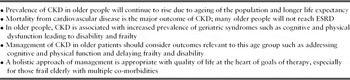
Key points are listed in Table 3. As with specific diseases, CKD caused by age-related decline in GFR is associated with changes in the structure and function of the kidney. Due to vascularity of the kidney, CKD may be a renal manifestation of a generalized vascular disease. As competing risks for death at older age are high, the majority of older people with CKD will not progress to ESRD. CKD is not only associated with the traditional disease-specific outcomes, such as metabolic and cardiovascular complications, but in older people is associated with increased prevalence of geriatric syndromes leading to increased disability and frailty.
Key points

Management of CKD in older people is complex and needs to be individualized, taking into account functional status, cognitive impairment, multiple co-morbidities and social factors, particularly for the very elderly groups, in whom weighing risks of competing multiple co-morbidities and benefits of therapy is challenging.
Conflicts of interest
The authors declared no conflicts of interest.