INTRODUCTION
Each lion (Panthera leo) in Kenya annually attracts an estimated US$ 17000 in tourist revenue (Lange Reference Lange2010) and kills livestock worth US$ 290 (Patterson et al. Reference Patterson, Kasiki, Selempo and Kays2004). On average, wildlife tourism in Kenya generates roughly US$ 400 million yr−1 (Barnes et al. Reference Barnes, Burgess, Pearce, Swanson and Barbier1992). In semi-arid regions, where most wildlife is found, this represents a land-use value five times higher than the next most productive land use, namely livestock rearing (Elliot & Mwangi Reference Elliott and Mwangi1998). Whereas wildlife's economic benefits are captured at national or international levels, the cost of living with wildlife is mostly felt at the local level (Nelson et al. Reference Nelson, Foley, Foley, Leposo, Loure, Peterson, Peterson, Peterson, Sachedina and Williams2009). Local incentives to conserve wildlife are minimal. Lion attacks on cattle have a significant impact on the local communities’ main source of livelihood, which leads to retaliatory killings. In 2003, the Maasailand Preservation Trust initiated the Predator Compensation Fund (hereafter, the ‘fund’) at the Mbirikani Group Ranch in Kenya, in order to compensate the local population (the Maasai) for livestock lost to predators. From the outset, the fund has been framed as a success story that will provide important lessons and insights to the rest of the Amboseli ecosystem and beyond. During the present study, efforts to implement the fund in other areas were at various stages of development: in Olgulului Ranch, the Amboseli Trust for Elephants (ATE) was working with the Maasailand Preservation Trust (hereafter, the ‘Trust’), and the African Wildlife Foundation (AWF) was discussing a similar scheme with a group in northern Tanzania (AWF-Kilimanjaro Heartlands 2011).
However, the literature shows mixed results for compensation schemes (Bulte & Rondeau Reference Bulte and Rondeau2005; Ogra & Badola Reference Ogra and Badola2008; Hazzah et al. Reference Hazzah, Mulder and Frank2009; Maclennan et al. Reference Maclennan, Groom, Macdonald and Frank2009; Treves et al. Reference Treves, Jurewicz, Naughton-Treves and Wilcove2009; Agarwala et al. Reference Agarwala, Kumar, Treves and Naughton-Treves2010; Dickman Reference Dickman2010; Milheiras & Hodge Reference Milheiras and Hodge2011; Redpath et al. Reference Redpath, Young, Evely, Adams, Sutherland, Whitehouse, Amar, Lambert, Linnell, Watt and Gutierrez2013). According to Dickman et al. (Reference Dickman, Macdonald and Macdonald2011), the compensation fund should be considered one of three forms of ‘payments to encourage coexistence’, along with revenue-sharing initiatives (see for example Ahebwa et al. Reference Ahebwa, Van der Duim and Sandbrook2012) and conservation payments, as in the case of the AWF's experiments with conservation enterprises (Lamers et al. Reference Lamers, Nthiga, Van der Duim and Van Wijk2013). In terms of conservation impacts, there is mixed evidence for compensation schemes substantially reducing human–carnivore conflicts. Although compensation schemes may potentially be useful tools for reducing the direct economic impact of predators on people, according to Dickman et al. (Reference Dickman, Macdonald and Macdonald2011) they fail to provide any real incentive for local people to actually deliver conservation. Redpath et al. (Reference Redpath, Young, Evely, Adams, Sutherland, Whitehouse, Amar, Lambert, Linnell, Watt and Gutierrez2013) argued that financial incentives can be successful in the resolution of human–wildlife conflicts, but if designed incorrectly, they can also lead to bankruptcy, dependency and poverty traps. According to Bulte and Rondeau (Reference Bulte and Rondeau2005), compensating pastoralists and farmers for damage caused by wildlife reduces hunting pressure on wild animal populations, but can also lead to a decrease in efforts to prevent damage and exacerbate conflicts with wildlife. Therefore, according to these authors, direct payments based on predator abundance, not damages, may be preferable. Furthermore, Dickman (Reference Dickman2010) argued that human–wildlife conflicts are often manifestations of underlying human–human conflicts between, for example, authorities and local people. Reducing wildlife damage alone will therefore often fail to produce long-term conflict resolution.
To grasp some of these complexities, we apply not only the usual criteria set for a payment for environmental services (PES) scheme, but also the policy arrangement approach (PAA). The idea behind PES is that those who benefit from environmental services (ES buyers) should pay those who deliver them (ES providers). An important prerequisite in the definition of PES is that the environmental service should be under threat (Wunder Reference Wunder2007). Wunder (Reference Wunder2005) distinguished five other criteria that define a PES: (1) a voluntary transaction where a (2) well-defined environmental service (ES) is (3) conditionally bought by (4) at least one ES buyer from (5) at least one ES provider who must secure its provision. Biodiversity protection, landscape beauty, carbon sequestration and storage, and watershed protection are the main environmental services. Proponents of PES argue that the market principle underlying PES makes it more effective than the often inefficient, corruption-prone conservation policies that rely heavily on state subsidies (McAfee & Shapiro Reference McAfee and Shapiro2010).
The challenges faced by PES include difficulties in determining the economic value of an ES, identifying and paying all ES providers, attracting buyers who are willing to take responsibility for payments (especially where there is a multiplicity of beneficiaries), and high transaction costs (Wunder Reference Wunder2005). These difficulties are exacerbated in developing countries by insecure land tenure (White & Martin Reference White and Martin2002). While proponents of PES argue that it is a promising innovation in conservation (Wunder Reference Wunder2005), critics argue that the discourse on environmental services resonates with the neoliberal rhetoric that pervades international environmental policymaking. By structuring aspects of nature as tradable commodities, PES discourse and practices spread commodity relations into realms that had been regarded as distinct from ‘the economy’ (McAfee & Shapiro Reference McAfee and Shapiro2010). Proponents are therefore criticized for ignoring sociopolitical contexts, using an overly optimistic rhetoric, and creating and cementing environmental, economic and social problems (Wunder Reference Wunder2007; Brockington & Duffy Reference Brockington and Duffy2010; Büscher Reference Büscher2012). According to opponents, PES becomes ‘a new means of resource enclosure at the expense of those with weaker bargaining power’ (McAfee & Shapiro Reference McAfee and Shapiro2010, p. 6).
The PAA provides a four-dimensional analysis, and has been applied especially in the environmental policy domain (Arts et al. Reference Arts, Leroy and Van Tatenhove2006; Arts & Goverde Reference Arts, Goverde, Arts and Leroy2006; Liefferink Reference Liefferink, Arts and Leroy2006). The four dimensions are: (1) actors, (2) discourses, (3) resources and (4) rules.
The actor dimension identifies the organizations and individuals involved, showing their roles, positions, relations and/or influence (Liefferink Reference Liefferink, Arts and Leroy2006). The discourse dimension detects discourses among actors and how these affect relations. Discourse is defined here as ‘an ensemble of ideas, concepts and categories through which meaning is given to social and physical phenomena, and which is produced and reproduced through an identifiable set of practices’ (Hajer & Versteeg Reference Hajer and Versteeg2005, p. 175). The third dimension traces resource dependencies and power relations (Liefferink Reference Liefferink, Arts and Leroy2006). Resource and power are intrinsically related, because actors need to mobilize resources in order to exercise power (Arts & Tatenhove Reference Arts and Tatenhove2005). The fourth dimension points at the rules of conduct, or sets of working rules (Langlois Reference Langlois, Caldwell and Böhm1993; Landell-Mills & Porras Reference Landell-Mills and Porras2002). The four dimensions of PAA are indissolubly interrelated (Liefferink Reference Liefferink, Arts and Leroy2006), whereby changes to one dimension may cause changes to the other dimensions (Arts et al. Reference Arts, Leroy and Van Tatenhove2006).
By using the PAA, we acknowledge that PES arrangements and decisions are discussed in complex, multilevel arenas of actors, and important criteria and decisions are negotiated between groups and individuals with different degrees of power (Dickman Reference Dickman2010; Büscher Reference Büscher2012). Secondly, PES agreements are often determined at a specific point in time, but require on-going negotiation over time, with changes in legal, political, cultural or social conditions (Milne & Niesten Reference Milne and Niesten2009). Since the PAA refers to the temporary stabilization of policy processes (Arts et al. Reference Arts, Leroy and Van Tatenhove2006), it allows analyses of these dynamics. Finally, the PAA points to both the organization and the substance of PES, with organization referring to actors, rules and resources, and substance to discourses (Van Tatenhove et al. Reference Van Tatenhove, Arts and Leroy2000, p. 55).
The aim of this study was to examine to what extent the fund can be considered a PES solution in terms of the PAA. We therefore studied the fund in terms of its actors, discourses, resources and rules, and evaluated the fund as a PES arrangement, making use of the five criteria given by Wunder (Reference Wunder2005). Based on this, we discuss some of the drawbacks of the arrangement and make a plea for a careful examination and comparison of various kinds of experiments with compensation payments, benefit-sharing initiatives and conservation payments.
METHODS
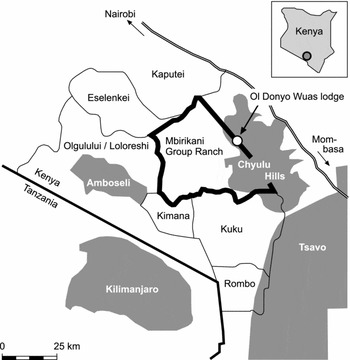
The research focused on the Mbirikani Group Ranch. Group ranches are usually defined as livestock production systems where a group of people jointly own freehold title to land. They were formed in Kenya in 1968 to transfer the ownership of Maasai lands from common to private group property, in order to improve herding and ecological management (Sindiga Reference Sindiga1984). The Mbirikani Group Ranch (hereafter, ‘the Ranch’) lies in a 1215 km2 wildlife dispersal area surrounded by the Amboseli, Tsavo and Kilimanjaro national parks (Fig. 1). Seventy per cent of the wildlife in Kenya is found in such dispersal areas outside protected areas, and conflicts between humans and wildlife are therefore inevitable (Ogeto Reference Ogeto2007). Other problems facing the area include agricultural expansion, water scarcity, droughts, depletion of plant resources, subdivision of land and erection of barriers interfering with wildlife movements. The Ranch is one of the larger of the six group ranches in the Amboseli ecosystem (the others are Kimana, Kuku, Eselenkei, Olgulului-Loloreshi and Rombo group ranches). Most of the population in the area is Maasai, practising pastoralism as their main occupation.
Study area: boundaries of the Mbirikani Group Ranch delineated by the heavy black line. Grey shaded areas = National Parks.

Field research was carried out in October–December 2011, and included 28 semi-structured interviews and observations of an advisory meeting, a pay-out day (when compensation is paid to Ranch members) and a local livestock market. The semi-structured interviews comprised pre-determined and follow-up questions such as the respondent's role in the agreement, the contribution of the actors to the fund, how the agreement is implemented on a day-to-day basis and their opinion on the sustainability of the fund. The interviews were conducted in English and Kiswahili, languages in which the first author is conversant; a translator was used for two interviews in which Maa, the Maasai language, was used. All interviews were face-to-face and were recorded both electronically and on paper.
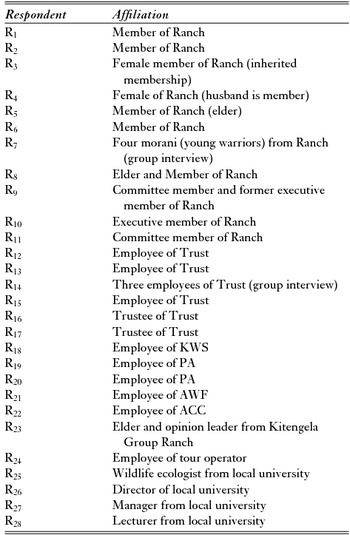
We selected potential interviewees through a preliminary study of relevant documents, websites and literature, and an interview with an international conservation organization, and we adjusted the list in the field using snowball sampling. Interviews were conducted until no new information was obtained. The interviewees ranged from individuals in the Ranch community, current and former Ranch committee members, employees of the Trust, local and international NGOs and Kenyan government officials (Table 1). To enhance data validation and verification, further interviews were conducted with local academics and a tour operator; secondary data were collected through document and literature review that included official letters, minutes of meetings, proposals, policy documents, written agreements, research papers, websites and brochures. In analysing the data, we built a conceptual framework, combining sensitizing concepts from PAA and PES to create a list of codes under which all data were classified. We identified our main findings by analysing the classified data. Key respondents commented on a draft paper for validation of our results. In the results section, we refer to respondents by their respondent number (namely R1, R2, and so on; see Table 1).
Identification of respondents to our survey. Ranch = Mbirikani Group Ranch, Trust = Maasailand Preservation Trust, PA = Ministry of State for Provincial Administration and Internal Security, KWS = Kenyan Wildlife Service, AWF = African Wildlife Foundation, and ACC = African Conservation Centre.

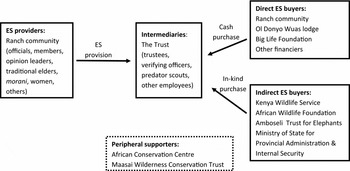
Overview of fund actors, in terms of ecosystem service (ES) buyers and providers. Ranch = Mbirikani Group Ranch, The Trust = Maasailand Preservation Trust.

RESULTS
To assess the extent to which the fund can be considered a PES solution in terms of PAA, we examined its actors, discourses, resources and rules.
Actors
We identified five types of actors: an ES provider, an intermediary, direct ES buyers, indirect ES buyers and peripheral supporters (Fig. 2). The ES provider comprised the whole Ranch community (families and dependents and those who visit them) responsible for providing services, although only livestock owners with formal membership received compensation payments. As confirmed by various respondents (R1, R7, R9, R11), the Ranch had 4625 registered members (only men aged 18 years or older were eligible for registration) at the time of the last registration (in the 1980s). It was run by three Ranch officials (chairman, secretary and treasurer), all of whom had been elected into office by the Ranch members for a tenure of three years, and a supporting management committee (25 members, including the officials and two ex-officio members from government) (R9, R11).
Two main direct ES buyers provided income to the fund: the Trust (70%) and the Ranch community (30%). The Trust received most donations from international conservation organizations and from tourists who visited the Ol Donyo Wuas lodge located on the Ranch (the lodge was owned and managed by the Trust's founders until 2008). However, these contributions were typically ad hoc, inconsistent or short term (R17). The Trust attributed the single largest financial contribution to the Big Life Foundation (R16; MPT [Maasailand Preservation Trust] 2010b ), which was founded in 2010, at least seven years after predator compensation funding began and almost 20 years after the Trust was founded, to address what was regarded as escalated poaching of wildlife in the area. The Trust was the only actor with access to these financers, and also determined how donations were administered. This created a perception among group ranch members that the funds came from the trustees’ personal assets (R1, R2, R3, R6). The Ranch community made its contribution from bed–night fees (US$ 20 per bed–night) paid by lodge guests, amounting to about US$ 40000 yr−1 from its 22 beds (R17). The Ranch community and the lodge remained the fund's most consistent financiers, although from time to time the Ranch's contributions were incomplete or late. The Ranch also received income through grants, subsidies, charity donations, bird shooting fees, revenue from the sale of wood and sand harvesting, cropping fees, campsite fees and conservation fees (R9, R11; Mbirikani Group Ranch 2008).
Indirect buyers were all key stakeholders in the wider Amboseli ecosystem, and they contributed their expertise in order to reduce transaction costs. Kenya Wildlife Service (KWS) is the governmental body mandated to conserve and manage Kenya's wildlife and to deal with all cases of human or wildlife injury or death involving predators. It trains the Trust's game scouts and carries out wildlife research in the region (Kenana & Mwinzi Reference Kenana and Mwinzi2010). The Ministry of State for Provincial Administration and Internal Security (PA) is responsible for public administration and internal security, and is represented by the local government chief and police force. The Trust had an unofficial cooperation with KWS and PA, which made the fund politically possible. AWF facilitated meetings and other fund-related activities, such as training local youths, producing documentaries and working with local fundis (semi-skilled labourers) in making predator-proof bomas (fences around homesteads) (R21). As mentioned, ATE participated in order to replicate a similar fund in a neighbouring ranch. Both AWF and ATE were and still are involved in other conservation activities at Amboseli.
The Trust was the initiator, administrator and self-appointed intermediary between the buyers and the providers. It had 30 employees and three trustees: Richard Bonham (chairman), Tom Hill (chief fundraiser) and Noah ole Ntiati (local trustee) (R15, R16, R5, R11). Mr Bonham first arrived in Kenya as a tourist and gradually leased more and more land from the community, based on ‘friendship’ (R16), to set aside a conservancy and lodge. Over the years he attracted development projects to the Ranch, including a health centre, scholarship programmes and a reforestation project. He was later joined by Mr Hill, a former American business entrepreneur. Mr ole Ntiati is a Ranch member and previously held the position of Ranch official for 11 years.
Peripheral actors include other conservation NGOs, for example the African Conservation Centre (ACC) and the Maasai Wilderness Conservation Trust (MWCT), with which the Trust collaborated in the ‘spirit of sisterhood’ (R17). The MWCT ran a similar predator compensation project at the neighbouring Kuku Game Ranch (Rodriguez Reference Rodriguez2007; Amboseli Ecosystem Workshop 2009).
Our analysis of actors also incorporated excluded parties. The fund agreement concerned livestock owners, and therefore excluded non-owners as potential beneficiaries, although they could be penalized for killing wildlife. These non-owners are locally considered the poorest inhabitants, as wealth is traditionally measured by the number of cattle a man owns (Galaty Reference Galaty1982). The fund used social pressure for enforcement: all residents of a zone (the Ranch is divided into seven zones) were expected to meet the conditions of the agreement, otherwise the whole zone was penalized. Therefore, although the privileges were only available to livestock owners, the obligations were shared by all. In other words, everyone in the Ranch community was an ES provider, but not everyone was a beneficiary.
Non-Ranch members were also excluded. While almost all interviewees from the community said they were members, most women were not registered (R3, R4). In addition, non-indigenous people were excluded, and although the population of Mbirikani was still largely Maasai, there was a marked and growing presence of non-Maasai communities, especially in towns like Imbirikani and Isinet (R5). The morani (young warriors), who are notorious for killing lions, were also excluded from the arrangement, as ranch registration was last done in the 1980s, when most of today's morani were either infants or not yet born (R1, R9, R11); individuals had to be at least 18 years old at the time of ranch registration. The morani also own livestock only in name (R7). They hold no ownership rights, although through inheritance morani are future livestock owners and Ranch members. At the time of the research, the Trust was intending to reach out to this group through targeted training, employment and the introduction of a new warrior initiation project (Menye Layiok) in an attempt to prevent lion killings (R9, R14, R17).
Rules
The compensation scheme was formalized through a written agreement between the Trust (formerly known as Ol Donyo Wuas Trust [ODWT]) and Ranch members (MPT 2010a ). It divided the Ranch into seven zones (Loosikitok, Orgosua, Chyulu, Kalesama, Lichalai, Nazipa and Isinet). It applied to claims for livestock predation up to one kilometre outside the Ranch, except where it borders Kimana sanctuary. Predators were listed as ‘lions, spotted and striped hyenas, leopards, cheetahs, jackals, wild dogs, servals, caracals and other small wild cats . . . and also buffalos and elephants’. They did not include ‘snakes, baboons, crocodiles, hippos and eagles’.
When predation occurred in a zone, the zone's predator scout was called in. The scout reported the claim to the fund, which sent a verifying officer to the site. If a claim was considered valid, the officer issued a credit note that was redeemable for cash on the next pay-out day. When there was a dispute, the claimant could appeal to the Trust's advisory committee, which consisted of elected representatives of zones and others ‘who must be agreed to by ODWT’ (MPT 2010a ).
Conditions
The agreement stipulated six conditions that had to be met for a claim to be valid. They included reporting a predation within 24 hours, preserving the carcass and the site until verification had been carried out, and avoiding zones where grazing was prohibited. The highest amount of compensation (around US$ 230) was paid when a cow was killed by a lion, amounting to ‘. . . less than 50% of the market value of the animals’ (R17). If it was killed by a hyena or buffalo, the amount was reduced by half. Attacks on sheep or goats attracted the lowest compensation (around US$ 35). Compensation was also reduced if a case was labelled ‘bad boma’ or ‘lost.’ When predation occurred on a homestead that was not properly fenced against predators, a claim was referred to as ‘bad boma’ and reduced by 30%. The agreement stated that the minimum acceptable standard of a predator-proof fence should be ‘four-foot high and four-foot thick.’ Bad boma cases included livestock killed 100 metres outside the protected homestead at night. ‘Lost’ referred to livestock killed outside the homestead during herding, which reduced compensation by 50%. If total valid claims (including ‘bad boma’ and ‘lost’ claims) exceeded the total maximum limit per pay-out day (around US$ 9000), claims for ‘lost’ cases were further reduced on a pro rata basis of up to 100%.
Penalties
Penalties applied anywhere on or off the Ranch, and affected the individual, his family and zone according to clause 26 of the agreement (MPT 2010a ). No compensation was issued to a zone if any of the prescribed predators were attacked or poisoned. Breaching the agreement resulted in the freezing of payments and the imposition of fines on the culprit (or his hosts, in the case of visitors) of up to US$ 1600 for each dead lion, calculated at the value of seven cows at full compensation. Fines were also imposed in other situations, including when a non-resident killed a predator in a zone (around US$ 500) or a false claim was made (around US$ 104).
Challenges with working rules
The working rules have changed over time. After only three months of operation, the agreement was suspended as one zone strongly resisted (R11, R22). There was also resistance to the agreement in 2009, when predator and livestock attacks and deaths increased following a severe drought, leading to the retaliatory killings of lions and refusal to accept payments (R6, R15, R21, R22). Over the years, additional key livestock and predators have been included in the arrangement. Following attacks on lions by Ranch members in neighbouring Tanzania, penalties were extended to cover lion killings anywhere in the world (R17). Larger zones were also subdivided (R9). A lack of clarity persisted about the one-kilometre limit (observations during the fund pay-out day, 3 December 2011). Following protests, the amount of compensation has been increased (R1, R6, R11).
The fund faced three key challenges regarding rules. The first was dissatisfaction with the rules on how to determine the categories ‘bad boma’ and ‘lost.’ The second was legal pluralism, as there were multiple rules that prescribed conservation and environmental matters in Mbirikani: the national Wildlife Act (GoK [Government of Kenya] Wildlife Act 2010), Ranch regulations, Maasai customary laws and a memorandum of understanding between KWS and Amboseli group ranches (KWS 2006). The different legal systems at Mbirikani created confusion (for example about hunting, the definition of protected animals, and the coverage of compensation), defiance and double penalties (R5, R7, R18, R26, R28). The third challenge was that the community had developed ways of circumventing the rules (R6, R14, R15, R17, R25). There had been multiple claims for compensation for the same carcass, after it had been transported from one site to another behind the verifying officer's back. To address this issue, the Trust required verifying officers to write the GPS details (which include date, time and location) on a piece of paper, place it on the dead carcass and take photographs as evidence. There had also been incidents of community members colluding with Trust staff to register a different type of livestock or predator, type of claim or number of cattle killed. Trust staff had also been threatened, forcing them to make false claims (R14).
Resources and power relations
The fund has created new relations of power between ES buyers and providers. In the following, we discuss the unequal distribution of finances, positions and expertise, which caused power imbalances.
Restricted access to financial resources
Very few individuals understood the fund's financing (R11, R5, R17, R21). Access to and comprehension of the fund were limited to the trustees and Ranch's top three officials. This limited transparency in group ranches is a wider, structural problem in Kenya (Lamers et al. Reference Lamers, Nthiga, Van der Duim and Van Wijk2013). However, financial power was restricted by a scarcity of funds. The situation was described as follows by some Trust interviewees: ‘The lowest moments have been when we were facing the inability to raise the money to keep going. We’ve had a number of those moments’ (R17), and ‘We see money is running out. . .. we are running into trouble as it is’ (R12). Interviewees from the community and AWF predicted that the killing of lions might accelerate at an alarming rate if compensation ceases (see also Hazzah et al. Reference Hazzah, Mulder and Frank2009).
The conditions for compensation further disempowered providers who were excluded from the fund as they were too poor to own livestock, reinforcing existing social structures. They not only could not access the fund, but were also underprivileged when it came to other possibilities for income generation, like agriculture (R5, R20, R26).
Restricted access to positional power
Power was also wielded among the actors by holding strategic positions or being associated with those holding these positions. We found power relations most visible in three key positions. Firstly, the top three Ranch officials exerted power in the community, although this had to be sustained through continual canvassing and repositioning (R7, R11, R13, R15). The authority of the three was recognized by the Trust and the Ranch because they were the signatories to the agreement. Secondly, the trustees were powerful (R1, R14). Ranch interviewees said that they regarded Mr Bonham as the most influential person in Mbirikani, partly because of his charisma and long and close interactions with members of the community and other development projects he initiated or attracted to the area. However, as one community interviewee remarked, ‘Richard has helped us, but we have helped him even more!’ (R14), indicating an awareness within the Ranch that the Trust's powerful position was gained from and sustained by the community. Thirdly, power was accessed by relating to governmental bodies (R9, R11, R17, R18, R19, R21). Backing of the fund by governmental bodies provided the fund with credibility and made it politically viable.
Restricted access to expertise
Most of the expertise was found with the indirect ES buyers, who were professionals and experts in a specific field. KWS's research expertise was used by the Trust to validate the fund (R17). The Trust used this validation to strengthen its appeal to potential donors (MPT 2010b ). The Trust's main areas of expertise were its organizational skills and ability to develop new ventures, and as the community lacked both of these skills (R17, R21), this created heavy reliance on the Trust.
Underlying discourses
Our research revealed three areas of contesting discourses underlying the fund, which showed a clear disjoint between ES providers and ES buyers in the manners in which they conceptualized the fund.
Compensation versus consolation
The discussion on compensation versus consolation reflects broader discussions on the way local communities should be compensated or consoled when they lose livestock (GoK Wildlife Bill 2010). In the case of the fund, ES providers preferred the term ‘compensation’ to the term ‘consolation,’ while the latter was preferred by the buyers, partly because the term ‘compensation’ for wildlife damages was not recognized by law. Although many ES providers appreciated being compensated for the loss of their livestock, others complained that the payment was not ‘real compensation’ because it was lower than the market value of the livestock. One respondent described this discrepancy as ‘an insult’ (R6) and the morani interviewed mentioned that it was ‘painful if we are paid less’.
Value of wildlife versus value of livestock
The second area of contesting discourses links to discourses on the economic valuation of nature, of which PES is a clear example. The fund set the maximum fine for a lion at US$ 1600 and the maximum compensation for livestock at US$ 230. However, ES providers clearly expressed the cultural, economic and emotional value of livestock, and showed neutral or negative attitudes towards wildlife. Responses included: ‘Is a lion more valuable than a cow?’ (R5); ‘We desire to kill lions but are fearful of the law’ (R7); and ‘The government cares more for wildlife than for people’ (R8). Although there had been a reduction in the number of lions killed at Mbirikani, at least partly as a result of the fund (Kenana & Mwinzi Reference Kenana and Mwinzi2010), it had not necessarily resulted in more positive views towards wildlife or conservation in general (see also Hazzah et al. Reference Hazzah, Mulder and Frank2009; Maclennan et al. Reference Maclennan, Groom, Macdonald and Frank2009). This finding corresponds to incidents in other areas in Kenya. For example, in 2012, the media reported six lions killed in just one night in the area of a compensation project in Kitengela, near Nairobi (Odongo Reference Odongo2012), with other protest killings taking place around Amboseli national park near Mbirikani due to a conflict between the Maasai and KWS over benefit sharing. Conversely, ES buyers stressed environmental, economic and emotional values of wildlife, and considered livestock a ‘nuisance’ or ‘necessary evil.’ The Trust's discourse coincided with that of ES buyers, as the latter linked the value of wildlife, especially lions, to the tourism revenue earned during safaris, as exemplified by this comment: ‘We came here not to see you raise goats and sheep and cows, and attractive as you are as a people, we are not here because of that. We are here because of the lions and the elephants and giraffes and the wildlife of East Africa (R17).’ According to Mr Hill, the extinction of lions in Amboseli would decrease tourism by 80–90%.
Specific species versus entire ecosystem
The third issue reflects broader conservation discourses focusing on the protection of species versus the protection of ecosystems. The use of terms such as ‘heartlands’ by AWF, ‘global ecoregions’ by WWF or more broadly ‘ecosystems’ by others, emanates from wider global discussions in the conservation community (see for example Visseren-Hamakers et al. Reference Visseren-Hamakers, Leroy and Glasbergen2012). In the case of the fund, the ES provider (the Ranch community) typically framed the fund in terms of protecting specific species, notably the lion, whereas the ES buyers framed it in terms of protecting the entire ecosystem. Although the Trust's focus was on the lion, it claimed that this had a positive ripple effect on the protection of other predators, without requiring extra funds (MPT 2010b ). The Trust's ambition to protect not just wildlife but the entire habitat in which it lives, is shared by other conservation organizations working in the region, like ACC (R17, R22).
DISCUSSION AND CONCLUSIONS
We used the policy arrangement approach (PAA) to examine the Predator Compensation Fund for two reasons. Firstly, our step-by-step analysis of the four PAA dimensions allowed us to establish the extent to which the fund can be considered a PES. Secondly, it placed the analysis into broader contexts and processes, thereby capturing the complexity and messiness of the social, cultural and political environments in which PES normally operates.
Based on the five criteria given by Wunder (Reference Wunder2005), we found that the fund has an ES provider, several (indirect and direct) ES buyers, and intermediary and peripheral actors. Further, the findings show that the fund was a strongly negotiated transaction that was neither fully voluntary nor fully mandatory. The Trust collaborated with Ranch officials and other actors to both coax and force the Ranch community to comply with fund regulations. However, when deemed necessary, the community vehemently resisted, by either killing lions in protest or rejecting payments. In terms of the PES criteria, the best understood ES was protection of the lion, due to the fear of its imminent extinction. This is because it was the only predator covered in the initial stages of the fund, and special attention was given to lions in the agreement. Lions attracted the highest compensation amount and were the only predator whose attacks worldwide were penalized. Finally, the conditionality of payment was strongly evident in the fund, as found in the written and practised rules. For example, in order for payments to be made, a zone was to have no recorded predator killings over a two-month period, and full payment was contingent on good livestock husbandry (namely having a good boma based on proper fences and thwarting predator attacks while herding away from home).
Our research also revealed that the distinction between ES providers and ES buyers is not straightforward: the providers were also key buyers, since the Ranch's financial contribution to the fund was substantial, and penalties included fines that were several times greater than the compensation amounts. The fund also cannot be considered to be purely voluntary, since the implementation of penalties depended on command-and-control mechanisms. Based on our analysis, the fund can best be characterized as a ‘PES-like initiative’ (Wunder Reference Wunder2005).
Our PAA analysis highlighted some of the drawbacks of PES arrangements, and illustrated the complexity and messiness of the social, cultural and political environments in which PES normally operate. Firstly, although the number of lions killed dropped from 24 in 2002, to 8 in 2003, and to 2 in 2010 (Kenana & Muteti Reference Kenana and Muteti2011), at least partly as a result of the compensation fund (see Hazzah et al. Reference Hazzah, Mulder and Frank2009, Reference Hazzah, Dolrenry, Naughton, Edwards, Mwebi, Kierney and Frank2014; Maclennan et al. Reference Maclennan, Groom, Macdonald and Frank2009), the fund may be difficult to sustain in the long term. It is highly contingent on continuous external financing, relying heavily on a significant willingness and ability in the developed world to pay for such schemes (see Dickman et al. Reference Dickman, Macdonald and Macdonald2011). The drying up of funds could lead to renewed animosity towards wildlife. The challenge of maintaining continuous funding is not unique to the fund, but is ubiquitous in PES schemes, especially in developing countries (see Dickman et al. Reference Dickman, Macdonald and Macdonald2011; Redpath et al. Reference Redpath, Young, Evely, Adams, Sutherland, Whitehouse, Amar, Lambert, Linnell, Watt and Gutierrez2013). PES schemes require consistent and indefinite funding, a fact that is often not taken into consideration at the start.
Secondly, the fund has created a new cycle of dependency. Because the compensation amount is much lower than the market value, the scheme induces the continuation of the use of poor-breed cattle that yield low returns. Lee et al. (Reference Lee, Leimona, van Noordwijk, Agarwal and Mahanty2007) also found this poverty trap a key characteristic of potential ES providers in Asia, who typically live from harvest to harvest. Our findings show that ES buyers preferred to use the term ‘consolation’ rather than ‘compensation’ to keep payment amounts low and dissuade the local community from negotiating for market rate values. This confirms criticism that PES might introduce unfairness and inequity by under-pricing and underpaying communities, luring local people into agreements that later become difficult for them to get out of, and subsequently trapping them in poverty (Wunder Reference Wunder2007).
Thirdly, the fund has widened the gap between different groups within the community. The fund cemented the marginalization of the poorest of the poor by privileging livestock owners, who now have a form of insurance against livestock killings by predators, while disadvantaging non-livestock owners, who must adhere to fund conditions without enjoying its benefits. Our findings also show that it was difficult for poorer people with only a few heads of livestock to access full compensation, because they often lived in ‘bad bomas’ and could not afford good herders, and therefore had children doing the work instead. A lack of equity was evinced by preventing the poorest from receiving fund benefits, even though they were equal owners of the Ranch property, which contributed 30% of its income to the fund. They received minimal to no benefits, but were fully responsible for penalties that they could hardly afford. This resonates with a study on perceptions and attitudes towards the fund by Rodriguez (Reference Rodriguez2007), in which the Ranch community felt the project was ‘unfair, inequitable and non-transparent’.
As for where our findings fit in the broader literature on PES-like schemes, Dickman et al. (Reference Dickman, Macdonald and Macdonald2011, p. 13942) argued that an ‘ideal’ ‘payments to encourage coexistence’ (PEC) approach ‘would: (1) minimize conflict by specifically targeting payments to those most directly affected by carnivores, (2) reduce the direct costs of human–carnivore coexistence, (3) provide local people with additional revenue directly linked to carnivores, (4) avoid moral hazard and perverse incentives, (5) not require significant additional external revenue, (6) specifically link payments to desired conservation outcomes, and (7) be likely to have a positive impact on human poverty’. As we have seen, the Mbirikani Predator Compensation Fund, and other compensation funds, achieve only the first two criteria. Dickman et al. (Reference Dickman, Macdonald and Macdonald2011, p. 13942) therefore pleaded for so-called ‘conservation payments’, which achieve goals 3, 4, 6 and 7, although ‘they fail to target individuals most affected by wildlife damage, do not actively reduce that damage, and are, just as compensation schemes, heavily dependent on external funding’. For greatest success, these authors suggested that a PEC scheme may have to combine compensation funds with conservation payments. Working with conservation payments is the only approach that directly incentivizes human–carnivore coexistence, as payments are linked specifically to the production of the desired environmental output (in this case, the conservation of predators). However, as none of these approaches specifically targets those most affected by depredation, a portion of the fund could be paid out as compensation to those who directly suffer from losses to carnivores (Dickman et al. Reference Dickman, Macdonald and Macdonald2011). This kind of combined approach would achieve all of the criteria of an ideal PEC scheme, apart from the fifth criterion, as it still would need substantial external funding. Interestingly, in this respect, Hazzah et al. (Reference Hazzah, Dolrenry, Naughton, Edwards, Mwebi, Kierney and Frank2014) pointed at another innovative model that has been developed in the same region in Kenya: the Lion Guardians (LGs) programme. Drawing on local cultural values and knowledge to mitigate livestock–carnivore conflict and monitor carnivores, LGs were associated with the near-total cessation of lion killings in each area where the programme was implemented.
Finally, should our findings induce complete rejection of PES-like arrangements, like the Mbirikani Predator Compensation Fund? No, we argue, but suggest a careful examination and comparison of different kinds of experiments with compensation payments, sharing initiatives and conservation payments. Obviously, as Dickman et al. (Reference Dickman, Macdonald and Macdonald2011, p. 13943) argued, valuable lessons can and must be learned from implementing PES approaches to address human–wildlife conflicts, and combining compensation funds with conservation payments, ‘could help translate the external values associated with carnivores down to the local level, with important potential benefits for people and predators’.
Such careful examination should incorporate the fundamental concerns flagged by several authors (such as Brockington & Duffy Reference Brockington and Duffy2010; McAfee & Shapiro Reference McAfee and Shapiro2010; Büscher Reference Büscher2012), and not ignore the structural and discursive power underlying the current hegemonic market-based approaches towards conservation. In this manner, the research would inform practitioners and policymakers in the choices on the fundamental and political trade-offs between different conservation approaches. The research would thus also contribute to the on-going debates in the political and policy sciences (see for example Visseren-Hamakers Reference Visseren-Hamakers2013) on the potential and different contributions of public and private, market-based, policies in biodiversity governance.
ACKNOWLEDGEMENTS
We express sincere gratitude to all the interviewees. Special thanks go to the Mbirikani Group Ranch community. We are also very thankful to the journal editors and three anonymous reviewers for their very useful comments and suggestions.