1. Introduction
This article explores the premise of an affective relationship between South American composers, the places and territories they inhabit and how this connection manifests in musical creation. We understand the term ‘place’ as a space charged with meaning through personal, cultural or emotional experiences. It is lived, remembered and felt rather than merely located (Harvey, Reference Harvey1969, p. 316; Hegel, Reference Hegel2005, p. 280; Tuan, Reference Tuan1974, p. 223). We believe that it often emerges as a source of identity in the compositional process and an important part of the artist’s poetics (Mendívil, Reference Mendívil2016, p. 84–85), a complex process that Canclini (Reference Canclini1995, p. 47) characterises as a ‘multitemporal heterogeneity’, something that he explains as ‘the result of the sedimentation, juxtaposition, and interweaving of indigenous traditions (…), of Catholic colonial hispanism, and of modern political, educational, and communicational actions’. Territory, on the other hand, refers not only to a physical or geographical space but also to the social, political and symbolic relationships that people establish with that space. It involves control, belonging and meaning, often shaped by historical and cultural processes (Segato, Reference Segato2007, p. 71–72). In this regard, electroacoustic composition seems to capture and represent the singularities of the geographical environments to which it belongs, in more or less explicit ways. The following questions arise: to what extent can music remain ‘absolute’ while engaging with specific geographies? Or does it even make sense to assume that music can be detached from the space the artist inhabits? As Attali argues, ‘all music, any organisation of sounds is then a tool for the creation or consolidation of a community, of a totality’ (Attali apud, p. 31). So, how does electroacoustic music shape cultural landscapes – initially as compositional material – and how can these forms be seen on the surface of the composition as delimiting the artist’s territory?
Twenty-seven composers from South America were interviewed for this study. Although the initial expectation was to confirm the existence of an affective relationship between the composer and the space they inhabit, the interviews also illuminated a broader relationship between the artists and their land. The particular aspects of South America’s identity, linked to its culture, geographical and social characteristics, are highlighted within the framework of current decolonial debates (Quijano, Reference Quijano1992; Dussel, Reference Dussel1995; Mignolo, Reference Mignolo2013; Canclini, Reference Canclini1995). By affirming the importance of music as a vehicle for cultural expression and proposing new lines of analysis that challenge hegemonic narratives, South American composers reveal shared aspects of identity. This article presents a systematisation of such features provided by the interviews, namely: a) academic migration, b) the precariousness of artistic conditions and c) decolonial thinking, as well as d) the outcome of mestizaje and the colonial legacy on the construction of musical identity in the field of electroacoustic.
2. Methodology
The selection of composers was made using the non-probability snowball sampling method. According to Martínez - Mesa et al. (Reference Martínez-Mesa, González Pereira, Rangel and Bastos2016), this procedure is employed when the target population is not fully identified or defined, making it difficult to construct a sampling frame. In such cases, as Voicu and Babonea (Reference Voicu and Babonea2011) point out, snowball sampling allows access to hidden, rare or hard-to-reach populations, proving especially useful in studies of specific communities – for example, musicians or artists with specialised training – who can offer valuable qualitative information. Furthermore, this method allows the researcher to determine when the sample size is sufficient for the research.
The selection criteria for the composers were as follows: they had to be creators of music for technological media, originating from South America, with an active academic and/or artistic presence, and a significant trajectory and body of work in their field. In addition, consideration was given to the diversity of aesthetic and technical approaches present in their works, their geographical representativeness within the South American context, their availability to participate in interviews or reflective processes about their creative practice and the relevance of their work in relation to contemporary issues concerning space and spatialisation in music with technological media.
A mixed-methods approach was employed for the interview analysis, combining Grounded Theory and Narrative Analysis. Grounded Theory (Strauss and Corbin, Reference Strauss and Corbin1990; Charmaz, Reference Charmaz2006) enabled the construction of theory directly from empirical data, ideal for studying emerging phenomena and identifying patterns in how South American composers conceive electroacoustic music. Narrative Analysis (Bruner, Reference Bruner1990; Riessman, Reference Riessman2008; cf. Campesato and Bonafé, Reference Campesato and Bonafé2019) focused on how composers narrate their trajectories, aesthetic evolution and cultural influences, highlighting meanings built through personal stories and offering a situated understanding of creative processes.
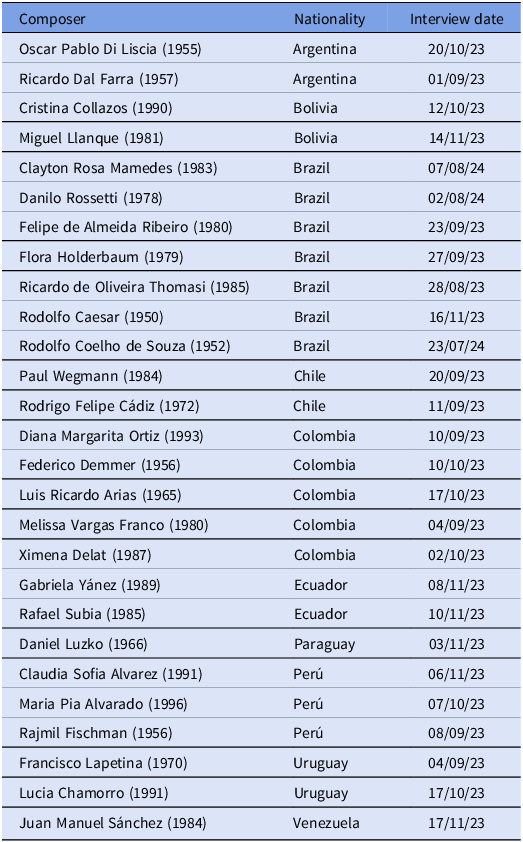
The study included 27 composers (Table 1) from Argentina, Bolivia, Brazil, Chile, Colombia, Ecuador, Paraguay, Peru, Uruguay and Venezuela, selected via Snowball Technique. Semi-structured interviews (Díaz et al., 2013; Tejero González, Reference Tejero González2021) were used for their flexibility and depth, facilitating reflection on creative practices, environments and identities. Conversation itself was considered a methodological tool for accessing subjectivities (Campesato and Bonafé, Reference Campesato and Bonafé2019).
The selection of interview topics stemmed from the interest in understanding how musical creation with technological media relates to territory, personal experience and cultural identity. The questions were formulated based on the idea that a musical work arises not only from technical or aesthetic decisions but also from the composer’s relationship with their environment and sociocultural context.
The topics concerning territory, environmental sounds and affective bonds with place sought to explore how physical and symbolic environments influence creative processes. Likewise, the themes addressing motivations, materials, tools and techniques aimed to analyse the articulation between subjective experience and technological means.
Interview topics covered:
-
• Relation between musical creation and place/territory;
-
• References to territory in works;
-
• Origins and motivations of compositions;
-
• Use of materials, tools and techniques;
-
• Incorporation of environmental sounds;
-
• Affective bonds with place;
-
• Nationalist or cultural influences on production.
Evaluation parameters were grouped into three interrelated dimensions:
-
1. Creative-aesthetic – motivations, materials, tools and techniques;
-
2. Spatial-territorial – interaction with place, territory and environmental sounds;
-
3. Sociocultural-identity – emotional and cultural belonging, nationalist elements and Latin American identity.
Together, these dimensions reveal how territory, technique and identity converge in the electroacoustic creation of South American composers.
3. Identity perspectives and definitions: Insights from composers’ interviews
The concept of identity, especially in the South American context, has been the subject of constant debate. Uruguayan composer and researcher Coriúm Aharonián (Reference Aharonián1994) analyses Latin American musical identity as a construct influenced by the interaction between diverse populations and the vastness of its territory. In this sense, he emphasises that the inherent plurality of the region makes it difficult to identify unifying features, although he recognises common factors such as imperialist expansion, cultural diversity, mestizaje and revolutions. These elements are reflected in political, historical and sociocultural phenomena that have shaped the region, giving rise to artistic expressions – including music – that capture both its diverse richness and the shared ties between its communities. On the other hand, when referring to Latin American identity in modernity, García Canclini (Reference Canclini1990, pp. 13–25) points out that, while modern identities were closely tied to a specific territory and were generally expressed in a single language, postmodern identities are distinguished by the loss of territorial roots and linguistic plurality. These emerge from industrial-scale cultural production, its circulation through communication technologies and fragmented and non-simultaneous cultural consumption. Canclini (Reference Canclini2001, p. 145) warns that, currently, the constant and growing flow of people, capital and information between cultures makes it impossible to define identity solely based on national affiliation. Even among popular sectors, these identities are constituted as heterogeneous combinations shaped by the influence of diverse cultures, languages and migratory experiences. In short, Latin American identity is profoundly influenced by shared historical processes and, at the same time, by the vast differences derived from cultural, ethnic and social diversity, a result of population movements such as colonisation, diasporas and migrations. Interviews with South American composers suggest that South American identity in music cannot be understood as a fixed essence, given that it is shaped by the intersections of diverse cultures and the dynamics inherent in the processes of acculturation, transculturation and syncretism. The multicultural dimension derived from mestizaje, which characterises the region’s identity dynamics, is constantly mentioned in the testimonies.
In the case of Brazil, for instance, national identity emerged as a cultural project tied to the search for distinction from European models, rooted in the recognition of the country’s racial and cultural hybridity. According to Reily (Reference Reily2000), scholars such as Romero, Freyre and Mário de Andrade identified dependency on Europe as an obstacle to self-definition, and instead emphasised miscegenation and the conscious agency of artists as the foundation for an autonomous Brazilian identity. These same characteristics are partially found in other South American countries.
In this sense, Ecuadorian composer Rafael Subía (2023) echoes the ideas of Argentine composer and theorist Carmelo Saitta, renowned for his critical reflections on Latin American musical identity. Saitta (Reference Saitta2014, p. 210) argues that embracing European heritage implies confronting the void generated by accepting that culture’s musical history without having been part of it. He also emphasises the need to recognise the antecedents linked to music created at the national level as a fundamental part of our legacy. The author associates the concept of cultural identity with multiple factors: artistic production in underdeveloped contexts, personal worldview, the creator’s integration with their time and space, as well as the context that nourishes their symbolic imagery. Saitta questioned the dependence on external compositional models and advocated for an organic evolution of musical structures, grounded in the cultural and sonic elements of the region.
According to Palomino (Reference Palomino2021, p. 20), Latin American music became established as an aesthetic symbol of the region, appropriated by various projects, from the anti-imperialist movements of the 1960s, through the integrationist initiatives of the 1990s and 2000s, to multiple organisations that incorporated it as something natural, just as the public did. In line with this idea, Arellano (Reference Arellano2019, p. 1) points out that, in Latin America, there was a long debate about how to relate to European and popular traditions while avoiding falling into simple, empty stylisations, devoid of content and lacking depth.
Subía (2023) emphasises that contemporary composers seek not only to represent their surroundings but also to engage in an aesthetic dialogue that resists dependence on foreign paradigms and revalues local roots. Colombian composer Federico Demmer (Reference Demmer2023) links these ideas to ‘decolonial epistemology’, which proposes generating alternatives to the hegemonic capitalist system through autonomous processes of economic, political and cultural organisation. These forms of resistance are also reflected in music, where creators explore and reclaim Latin American identity through artistic creation. Based on Demmer’s ideas, it is inferred that these processes can materialise in the incorporation of indigenous instruments, alternative tuning systems or field recordings of urban and rural environments to make sociopolitical realities visible. In many cases, Demmer affirms that these practices depart from standardised Western formal models – consciously or intuitively – favouring hybrid formats, collaborative authorship or in situ works that prioritise place-based knowledge and memory.
This approach coincides with the thinking of Uruguayan composer Francisco Lapetina (Reference Lapetina2023), who argues that Latin American culture is constantly being constructed and transformed, in contrast to the apparent stability of European cultures. From his perspective, Latin American musical identity does not always conform to the conventional parameters of ‘Latin Americanism’ but rather responds to diverse influences that reflect the region’s cultural struggles. Ribeiro (Reference Ribeiro2023) recognises the difficulty of identifying a unified identity due to diversity, although he notes a shared concern among composers to reflect the common Latin American history, where cultural syncretism constitutes a distinctive feature. This is interpreted as a form of resistance and identity affirmation that allows for the integration of multiple cultural elements.
Composers from different regions seem to share recurring historical and contemporary processes. They question the idea of coherence to weave a network that enables a common identity in electroacoustic musical creation. As Maiguashca (apud Subía, 2023) asserts, the expression of ‘Latin American identity’ in music should not be limited to explicit nationalism, but rather reflect a broader vision of South American identity. Along the same lines, Peruvian composer Claudia Sofía Álvarez (2023) argues that Latin American musical identity is not defined exclusively by stylistic traits, but by a shared energy and sensitivity among the region’s creators.
Peruvian composer Rajmil Fischman (Reference Fischman2023) highlights the work of RedASLA (Red Latinoamericana de Arte Sonoro), which has played a key role in consolidating Latin American musical identity. According to Edson Zampronha (apud Rodrigo Sigal, 2025), ‘[Red ASLA] is the result of the efforts of a group of composers who believe that by opening doors to each other, many more will open for us all to share our music and ideas, as well as to learn about each other’s’. This belief demonstrates how collaboration and mutual support are fundamental values among Latin American artists. Fischman (Reference Fischman2023) emphasises that this network has allowed composers to appropriate electronic and electroacoustic music, originally developed in foreign contexts, to express their cultural realities, demonstrating the region’s capacity to adapt and transform external influences, often Euro-American.
Despite differences, Álvarez (2023) emphasises that there is a strong sense of kinship in Latin America, perceptible even among composers from different countries when they meet in international contexts. This connection reinforces Latin American identity and is reflected in music. She also points out that we share similar historical experiences, such as the coups d’état in Argentina, which were mirrored in other South American countries. ‘Many composers, especially artists – who tend to be quite sensitive to such changes – inevitably adopt a somewhat more reactive spirit’ (Álvarez, 2023). From this perspective, the melting pot of influences in Latin American electroacoustic music helps to consolidate certain common traits. Melisa Vargas (2023) advocates for stronger regional connections and for the recognition of the continent’s musical achievements, stating that we must learn about and teach our own music rather than relying on external validation:
It should be a duty to know each other, to know our music, to teach our music, to listen to one another, to analyze each other. Because this music has been present since we were colonized. But there has also been a deliberate, original development since then. It is not a replica. (Vargas, 2023)
Chilean composer Rodrigo Cádiz (Reference Cádiz2023, pp. 175–191) points out that cultural diversity is not exclusive to Latin America but is also found in societies like the United States, where people from different parts of the world coexist and redefine their identities. This observation coincides with Aharonián (Reference Aharonián1994, pp. 189–225), who maintains that ‘cultural diversity is not a particular characteristic of Latin American peoples’.
The following sections address key themes that surfaced in the interviews: the significance of miscegenation, narratives on decoloniality, political activism through composition, the tension between belonging and displacement in artistic mobility, and precarity articulated through the workaround aesthetic. Although the questionnaire sought reflections on identity, these concepts emerged organically in participants’ responses.
3.1. The relevance of miscegenation
Coriún Aharonián (Reference Aharonián1994) examines the impact of European imperialist expansion and the use of music as a tool of power. He notes that although mestizaje (racial and cultural mixing) can occur spontaneously and equally (Reference Aharonián1994, p. 200), Latin American musical identity is largely shaped by multiculturalism, racial blending, and population movements – both voluntary and forced. In the mixture of Native American, European and African peoples, the third group was referred to as ‘aguisimbia’, meaning those who arrived under conditions of slavery.
Wade (Reference Wade2003) states that ‘we are all mestizos’, emphasising mestizaje not as a merely biological or cultural concept but also involves economic, political and religious dimensions. On the other hand, Irarrázaval (Reference Irarrázaval2009, p. 213) critiques the glorification of mestizaje, arguing that it can encourage ethnocentrism by sacralising particularism. These discussions give rise to related concepts such as hybridisation, transculturation and acculturation, which attempt to account for the complexity of Latin American identity.
Many composers addressed this topic during our interviews. Claudia Sofía Álvarez (2023) observes that this identity is the result of the fusion between Hispanic and pre-existing cultures, later influenced by African and Asian traditions. This combination produces a rich cultural heritage reflected in the region’s musical creativity. Ribeiro (Reference Ribeiro2023), in turn, examines the situation in southern Brazil, particularly in the state of Santa Catarina, where many residents identify more strongly with their European ancestry than with a Latin American identity. This reflects a particular identity tension, marked by a form of racial unconformity and a self-perception as being ‘European’ outside of Europe, thus presenting a paradox: ‘when an audience identifies more with Beethoven than with a contemporary Brazilian composer’ (Ribeiro, Reference Ribeiro2023). While Beethoven has become a universal symbol of classical music, this preference reveals a curious disconnection from local artistic production. Finally, southern Brazilian composer Flora Holderbaum (Reference Holderbaum2023) shows how racial mixing has influenced her sense of identity. She prefers to identify as mestiza rather than ‘Latina’, highlighting the diversity of her genealogy and the difficulty of defining her racial identity within fixed categories.
This case illustrates that cultural mixture in Latin America is not limited to the colonial period but continues through new waves of population movement. Peruvian composer Rajmil Fischman also identifies with his Jewish heritage and highlights the influence of Palestinian and Arab music in his work. For him, cultural diversity is fundamental: ‘This does not mean that we are uniform, but rather that we possess a cultural diversity that I find wonderful’ (Fischman, Reference Fischman2023).
Various thinkers, including Aharonián (Reference Aharonián1994, pp. 189–225), Espinoza Apolo (Reference Espinosa Apolo2000, p. 33), Bernand (Reference Bernand, Zúñiga and Bernand2007, p. 21), Araya and Valenzuela (2010, pp. 315–316) and Recondo (Reference Recondo2008), attribute a direct connection to South American identity with mestizaje. According to Juan Acha (Reference Acha1996), mestizaje has been a central element in the construction of regional identity, an idea that dates back even to the words of Simón Bolívar, who stated:
We are not Europeans, we are not Indians, but a kind of median between the aborigines and the Spaniards. Americans by birth and Europeans by right, we find ourselves in the conflict of disputing the titles of possession with the natives and of remaining in the country of our birth, against the opposition of the invaders, and thus our case is the most extraordinary and complex (Bolívar apud Acha, Reference Acha1996, p. 13).
This approach reveals the implicit racist connotation in the concept of mestizaje, not only because of the binary opposition between ‘the Indian’ and ‘the European’, but also because of Bolívar’s omission of other racial identities, such as the Black, in the equation of what he perceived as ‘Latin American’. This gap in the recognition of diversity highlights how historical notions of identity have been shaped by colonial hierarchies and exclusions, perpetuating an incomplete and biased view of South American identity. It is important to add that not all ‘mixings’ happen on equal grounds, thus avoiding the notion of mestizaje as a homogeneous concept. In this regard, Canclini invokes the concept of hybridisation to challenge and move beyond the binary framework of identity:
The emphasis on hybridization not only puts an end to the pretense of establishing ‘pure’ or ‘authentic’ identities; in addition, it demonstrates the risk of delimiting local, self-contained identities or those that attempt to assert themselves as radically opposed to national society or globalization. When an identity is defined through a process of abstraction of traits (language, traditions, certain stereotyped behaviors), there is often a tendency to remove those practices from the history of mixing in which they were formed. Consequently, one mode of understanding the identity becomes absolute, and heterodox ways of speaking the language, making music, or interpreting the traditions are rejected. One winds up, in short, sealing off the possibility of modifying culture and politics. (Canclini, Reference Canclini1995, p. xxviii)
Bolívar’s historical erasure mirrors current challenges, as exclusionary narratives continue shaping notions of Latin American identity and belonging. In U.S. politics, the resurgence of restrictive immigration policies under Trump’s second administration (2025–2028) risks deepening the criminalisation and racialisation of Latin American migrants (WOLA, 2024). This reflects Arellano’s (Reference Arellano2019) reading of Mignolo’s ‘colonial wound’, highlighting how racism and reliance on external references hinder regional identity formation.
At the same time, identity in Latin America is marked by diversity and cultural hybridity, also visible in music. Cáceres (Reference Cáceres2001, pp. 83–86) notes that no single influence has dominated musicians’ identities, while Ramírez Uribe (Reference Ramírez Uribe2020, p. 133) emphasises their emergence from the tension between popular traditions and European high-culture models.
3.2. Composer narratives on decoloniality
The concept of decoloniality emerges from the analysis of the coloniality of power, a structure of domination imposed by European colonisers, beginning in the late fifteenth century. According to Quijano (apud Castro-Gómez, Reference Castro-Gómez2005, p. 61), this power relationship involved not only military conquest but also a process of cultural transformation, in which Indigenous peoples were forced to adopt the cognitive frameworks of the colonisers. Enrique Dussel (Reference Dussel1995) notes that this colonial mindset is intrinsically linked to modernity and Eurocentrism – a myth that originated with the ‘discovery’ of the Americas and has since influenced the very conception of modernity. According to Castro-Gómez (Reference Castro-Gómez2005, p. 48), Eurocentrism has been a fundamental pillar of Western domination, reflected in the imposition of a supposedly universal scientific and cultural knowledge, while the knowledge of Indigenous peoples was devalued.
Aníbal Quijano (Reference Quijano1992) and Johan Galtung (Reference Galtung2003, p. 7) discuss the cultural violence that resulted from the colonial process, in which the knowledge of colonised peoples was systematically dismissed and replaced by Eurocentric knowledge. This phenomenon has also affected contemporary social sciences, which continue to value Western knowledge as objective and bias-free, while disqualifying local epistemologies. Lander (Reference Lander2000, p. 14) emphasises how this logic has permeated the fields of education and research, where traditional forms of knowledge are viewed as obstacles to development. This reveals how the cultural traditions of Latin American peoples were displaced, leading to the disappearance of their knowledge systems and practices.
Decoloniality seeks to dismantle these hierarchical structures of domination and promote greater freedom to choose and produce culture and society, as Quijano (Reference Quijano1992, p. 20) explains. In the South and Latin American context, this idea of cultural freedom is reflected in the rejection of hegemonies imposed by colonial powers and in the struggle to build an identity that is not subordinate to Eurocentric structures. Mignolo (Reference Mignolo2013, p. 9) argues that the process of decoloniality began in the Americas, driven by Indigenous and Afro-Caribbean movements, as a response to European colonialism and the rising dominance of the United States. These decolonial movements are also connected to the efforts of Asian and African countries that, beginning with the Bandung Conference (1955) and the Non-Aligned Movement (1961), fought for a future free from alignment with either capitalist or communist power blocs.
In the field of contemporary South American music, decolonial thought is reflected in the tensions between Eurocentric influence and the need to affirm distinct musical identities. Composer Paul Wegmann (2023) illustrates how European music has deeply permeated musical practices in Latin America, citing examples of Latin American composers who were trained in Europe. However, Wegmann also emphasises the importance of acknowledging Latin American cultures – not as a form of opposition to Europe, but as a way to highlight the richness and depth of local traditions that were systematically ignored during the colonial period. This reflection connects with the analysis of Rodrigo Cádiz (Reference Cádiz2023), who acknowledges an ambivalent relationship between Latin America and Europe: on the one hand, Europe is seen as a reference point in the training of Latin American composers, but on the other, there is a growing recognition of the need to move beyond this dependency.
Several South American composers, such as Ricardo Thomasi (Reference Thomasi2023) and Luis Ricardo Arias (2023), also critique the perpetuation of a Eurocentric focus in musical education, pointing out that many composers in South America continue to reproduce European musical practices, often without questioning them. Arias (Reference Arias2023) emphasises that although European music can be valuable, there is a disconnection from one’s own cultural identity – especially when it is adopted without critical reflection. This critique is not a rejection of foreign influences, but rather a resistance to the cultural hegemony that has shaped education and musical creation in the region.
On the other hand, composers like Gabriela Yánez (Reference Yánez2023) acknowledge that despite the influence of North American music in Ecuador, academic migration has allowed for a diversification of musical practices. Nonetheless, the dominance of North American thought remains noticeable in the structure of contemporary music in Ecuador. Felipe de Almeida Ribeiro (Reference Ribeiro2023) also highlights how Latin American composers benefit from studying abroad, but warns against blindly adopting European or North American musical practices, as this may lead to a weakening of connections with their cultural and musical identities.
Resistance to cultural domination or excessive foreign influence is also evident in the position of composers such as Ricardo Thomasi (Reference Thomasi2023), who expresses reluctance toward migrating to Europe in search of new musical references, preferring instead to value Brazil’s local musical production. Other composers, such as Fischman (Reference Fischman2023), recognise that although electronic music has European roots, Latin America has developed its own distinctive approach within this field.
Oscar Pablo Di Liscia (Reference Di Liscia2023) highlights the Eurocentric bias of his training while recognising his interest in Latin American popular music, noting the predominance of European models in regional education. Similarly, Luis Ricardo Arias (Reference Arias2023) argues that Europeanised training has fostered a disconnection from local traditions, producing fragmented identities.
For Rafael Subia (Reference Subia2023), however, the challenge lies in asserting a personal voice capable of resisting colonial narratives. Overall, the interviews reveal that South American composers navigate the tension between foreign influences and cultural traditions, often inherited indirectly. Their pursuit of decolonial perspectives reflects an ongoing effort to balance belonging with modernity, situating music within broader struggles to redefine South American culture and art.
3.3. Political activism through composition
Political art becomes a distinctive aspect of electroacoustic music when composers seek to reflect on and question the political realities of their territories through sound. This practice can be understood as a form of symbolic action that seeks to repair and preserve, in the collective memory, both the victims and perpetrators of situations that impact the political structures of a region.
In South America, politics has often served as a powerful catalyst for electroacoustic music composers, provoking artistic responses that critique the dynamics of public administration – such as corruption, neglect and authoritarianism – denounce the appropriation or exploitation of cultural musical elements, and incorporate sound materials charged with political or symbolic meaning. Some of these provocations are explicit, as can be seen in Felipe de Almeida Ribeiro’s ‘Quarto de Despejo’ for guitar and electronics, which engages issues of social injustice through marginalised sounds, or in Lilian Nakahodo and Flora Holderbaum’s acousmatic work ‘Coração de Bananeira II’, in which questions of the feminine are addressed from the perspective of sonic politics. This approach positions art as a means of social critique, aligning with Yoli Rojas’s (íúúéèè2015, p. 217) conceptualisation and Rancière’s (2004, p. 56) assertion that aesthetics is not only linked to perceptual forms but also embedded in social and political structures. On the other hand, the cosmopolitan and universal aspects of electroacoustic music cannot be ignored. They appear to be a prominent part of many compositional expressions in South America. Examples include Danilo Rossetti’s ‘Estudo sobre Texturas No. 2’, Rodrigo F. Cádiz’s ‘String Spells II’ and Rodolfo Coelho de Souza’s ‘Concerto for Computer and Orchestra’. In these cases, the direct influence of South American culture seems either absent or veiled.
Despite his preference for the sensorial over the conceptual, composer Rodrigo Cádiz (Reference Cádiz2023) explained during our series of interviews that he created an electroacoustic work based on sounds recorded during the 2019 social uprising in Chile, which was sparked by a metro fare increase in Santiago and lasted from October 2019 to March 2020. The piece reflects both the events of that period and their repercussions on the Chilean territorial context. A similar approach is taken by Demmer Colmenares, who works with sounds from the demonstrations of the 2021 Colombian social uprising, with the work Bogotá 9S: A Sound Chronicle from the Window. Another example is Rafael Subía, who incorporates sound elements from his social environment with the intention of being ‘cruel and critical’ (Subía, 2023), as demonstrated in his work Sueños (Dreams).
In Sueños (2016), Subía combines the Ecuadorian national anthem with León Roldós’s final speech before his death in a plane crash, subtly alluding to the CIA’s possible involvement in Operation Condor. Aware of the potential conservative backlash, Subía seeks to offer a direct critique of Ecuadorian reality through the spectral transformation of the anthem, evoking a circus soundscape (Subía, 2023). The piece explores the tension between Roldós and the national anthem, which the composer perceives as a symbol of the lack of political ideals in Ecuador. In Tumbar estatuas (To Remove Statues, 2023), Diana Margarita Ortiz addresses the political frontier through a piece for snare drum and tape. She uses audio recordings of the 2020 protests in Popayán and Cali, during which the statues of Sebastián de Belalcázar were knocked down, to construct a reflection on historical memory (Ortiz, Reference Ortiz2023). Her intention was to create a work with a more direct political stance, employing interviews with conservative politicians contrasted with percussion and electroacoustic sounds.
Ricardo Thomasi, in Avessos (2023), incorporates excerpts from interviews from Brazil’s Truth Commission on the military regime. The torturers’ testimonies – and their silences – became the raw material for the composition, resulting in a ‘mosaic of noise’ that intensifies the piece’s impact (Thomasi, Reference Thomasi2023). The result is a punk-influenced work that denounces the harsh reality of torture.
In Quemando los ojos de agua (2017), Melissa Vargas creates an experimental electroacoustic work in response to Colombia’s peace plebiscite. Using a melody by Marcos Veintes based on the word ‘peace’, Vargas reflects on the lack of understanding in political debate (Vargas, 2023). Her piece seeks to confront the polarisation and inability of voters to understand and reconcile during the plebiscite.
Shared political processes across South America – such as colonisation, dictatorships, interventionism, and structural violence – have shaped common social dynamics. Within this context, electroacoustic composition often serves as a form of denunciation, where the use of materials like recorded speeches, demonstrations and hymns underscores political art as a marker of identity.
3.4. Identity between places: The tension between belonging and displacement in artistic mobility
At the beginning of 2024, the European Parliament published the article ‘Exploring the Causes of Migration: Why Do People Migrate?’, which defines migration as the movement of people from one place to another for the purpose of settlement. It identifies three fundamental factors that drive migration: sociopolitical (persecution, conflict and wars), demographic and economic (population growth or ageing), and environmental (natural disasters). However, Aruj (Reference Aruj2008) adds additional motivations such as personal and professional development, as well as access to education and employment.
In particular, migration for educational purposes has grown exponentially. According to UNESCO (2022), in 1963, there were 300,000 international students, a number that rose to 6 million in 2019 – still only 2.6% of the global student population. Despite being a minority, within this research on Latin American EAMT composers, 23 of the 27 participants had some form of international academic mobility.
Notable examples include Brazilian composers Rodolfo Caesar, who studied in France and the United Kingdom; Rodolfo Coelho de Souza, who earned a doctorate in composition from the University of Texas at Austin; and Felipe de Almeida Ribeiro, who pursued studies in Canada, the United States, and Germany. Among Colombians, there are Federico Demmer, who studied in France and the United States; Ricardo Arias in Spain and the Netherlands and Diana Margarita Ortiz, currently based in Germany. In Argentina, Ricardo Dal Farra obtained his doctorate in Canada, while Peruvian composer Rajmil Fischman studied in Israel and the United Kingdom. Other examples include Ecuadorian composer Gabriela Yánez at the University of Edinburgh (Scotland) and Venezuelan Juan Manuel Sánchez in France. Composers such as Llanque and Delat emphasise that experiences abroad helped them overcome local limitations and, in some cases, motivated them to return to their countries to contribute what they have learned. Our research also includes composers who have migrated within their own countries, such as Brazilians Ricardo de Oliveira Thomasi and Flora Holderbaum, Argentine Oscar Pablo Di Liscia and Uruguayan Francisco Lapetina. Whether national or international, mobility has a significant impact on artistic production.
Overview of interview participants by country and interview date

The environment has a significant influence on a composer’s creative process. Margarita Ortiz (Reference Ortiz2023) notes that her arrival in Germany provided her with unique creative stimuli. Claudia Sofía Álvarez highlights that her studies abroad allowed her to adopt broader perspectives. Paul Wegmann, a Chilean composer residing in Brazil, mentions how his exposure to Brazilian music challenged his artistic identity. Lucía Chamorro, based in Spain, found new interdisciplinary opportunities. Gabriela Yánez, for her part, affirms that her experience in Europe changed the way she listens and relates to sound.
Luis Fernando Arias emphasises the influence of international references in his education, while Ximena Delat points out that studying abroad enabled her to acquire knowledge unavailable in her home country. Overall, the composers are aware that migration affects both their conceptual frameworks and compositional techniques.
Flora Holderbaum, although she did not migrate internationally, acknowledges the challenges of adapting to different regions within Brazil. In a poem titled ‘Todos migram’ (everyone migrates), she reflects on the feeling of estrangement – even upon returning to one’s place of origin, which reminds us of bell hook’s beautiful experience of belonging and sense of homecoming (hooks, 2011). Cristina Collazos, speaking from Argentina, describes how her change of environment transformed her approach, shifting from pure experimentation in Bolivia to a more reflective process. Similarly, Paul Wegmann reflects on the vulnerability of being a foreigner, highlighting the absence of a support network and the challenges of linguistic and cultural adaptation.
3.5. Scavenging for sound: Precarity and the workaround aesthetic
Composer Jorge Antunes often playfully evokes the idea of an ‘aesthetics of precarity’ as a common practice in South and Latin American electroacoustic music – though it also reflects an unfortunate collateral effect of broader structural challenges. According to Jorge Antunes (Reference Antunes2000, p. 12), Brazilian composers from the 1960s and 1970s sought technical excellence by judging the quality of their compositions through the presence of background noise, which resulted in ‘constant paranoias in the composer’. Also, Antunes was known for building his own Theremin and oscillators, since buying them at the time was expensive or unavailable in Brazil (Antunes, Reference Antunes2000, p. 12; Ribeiro and Thomasi, Reference Ribeiro and Thomasi2022, p. 95).
Rodolfo Caesar (Reference Caesar2023) explains that the background noise in many recordings was due to the reuse of magnetic tapes – a common practice due to the high cost of the material in South American countries. Over time, some composers decided to embrace this limitation, forming what Antunes called the ‘Revox Generation’. These artists ‘bravely abandoned the prejudice against background noise’, recognising technological precarity and the lack of governmental support (Antunes, Reference Antunes2000, p. 13). However, Caesar (Reference Caesar2023) criticises this stance and argues that the composers of the Revox Generation belonged to the middle class and had access to education and technology. According to him, ‘buying a Revox was very expensive; we had three, and some marvelous microphones – how could I see that as precarity? I see it as a kind of emotional blackmail’ (Caesar, Reference Caesar2023). Despite Caesar and Antunes’ differing perspectives, it becomes clear that the idea of a Revox Generation primarily reflects the broader conditions faced by artists in Brazil – a lack of support for the professionalisation of new music and the absence of institutions equipped to support such work. Many composers acted as pioneers: working with limited resources and improvised solutions, they found ways to move the scene forward (Miranda, Reference Miranda1995; Ribeiro and Thomasi, Reference Ribeiro and Thomasi2022).
On the other hand, Rodolfo Coelho de Souza (Reference Coelho de Souza2024) supports the idea of precarity as a real working condition. He recounts his experience with Conrado Silva in 1979, when they recorded a folkloric performance using a ‘manual recorder so precarious and monophonic’, and later improved the sound quality in studios in Belgium. This illustrates that limitations were not only related to access to Revox recorders or the reuse of tapes, but also to the availability of technology through institutional support.
With current technological advancements such as digital sound and editing software, one might assume that technical difficulties have been overcome. However, the aesthetics of precarity remain present in South American electroacoustic music, as material limitations continue to shape artistic creation – without necessarily compromising the quality of the work. But the issue at stake is not merely access to equipment, but rather access to studios (Ribeiro and Thomasi, Reference Ribeiro and Thomasi2022). The availability of studios implies the existence of dedicated spaces for production, and where production takes place, one can infer the presence of an active scene. In this sense, the technical challenge extends far beyond the question of possessing equipment – it encompasses spatial and territorial dimensions. This brings us to a broader conclusion: the apparent lack of equipment, as mentioned by Antunes, points to a deeper structural issue – the difficulty of establishing a robust new music scene in the country.
The composers’ awareness of this precarious context is evident in testimonies about difficulties in funding and resource access. Francisco Lapetina (Reference Lapetina2023) raises a recurring dilemma: whether to remain in Latin America or migrate to countries with better conditions for artistic work. Although he considers the possibility of working abroad, he identifies strongly with his homeland: ‘I feel connected to this place, and it’s here where I feel most myself – where my work can be understood, or may one day make some kind of contribution’ (Lapetina, Reference Lapetina2023).
Rodrigo Cádiz (Reference Cádiz2023) confirms that Latin American composers are used to working with limited resources, and that Europe and the U.S. would not accept such conditions: ‘In Latin America, things are done in ways that are not understood in other countries – and we are like that because we live here’. For Ecuadorian composer Gabriela Yánez (Reference Yánez2023), access to tools shapes the composer’s working methods: ‘I don’t need the most expensive software – I need software that works for me’.
Uruguayan composer Lucía Chamorro (Reference Chamorro2023), now living in Bilbao, perceives greater opportunities in Europe for sustaining an artistic career. Nonetheless, she values Latin American self-management: ‘When there is motivation to carry something forward, it gets done no matter what – even if there’s no money, even if there are difficulties’. This reflection resonates with the critique offered by Clayton Mamedes (Reference Mamedes2024) regarding bureaucracy in Brazil, which hinders the acquisition of equipment for teaching technology in the arts.
In Bolivia, Miguel Llanque (Reference Llanque2023) points out a different problem. He describes the lack of composition programmes and the resulting forced migration of musicians who wish to study electroacoustic music. However, he also emphasises that artists learn to adapt and make the most of the resources available: ‘one adapts to the context and decides to do the best possible with the resources at hand’. While it is possible to achieve high-quality results, certain advanced technologies remain inaccessible and are still available only in well-funded studios and specialised laboratories. Concerning this issue, Brazilian composer Danilo Rossetti, who visited renowned institutions, such as Institut de Recherche et Coordination Acoustique/Musique in France, describes the overwhelming differences in terms of equipment: ‘This is a fact, and it’s an economic, financial issue – when it comes to resources, people in South America are always at a disadvantage when acquiring any type of gear to work with’ (Rossetti, Reference Rossetti2024). This technological gap is echoed in the experiences of other composers, such as Clayton Mamedes, who faced technical challenges due to equipment limitations in Brazil until he was able to resolve them through an academic exchange fellowship programme between Brazil and Canada, and was finally able to access more advanced technologies (Mamedes, Reference Mamedes2024). In addition, Margarita Ortiz, who studied in Germany, encountered a high-level infrastructure that allowed her to expand her creative interests and experiment with multichannel music. However, the absence of such conditions in Latin America poses a significant challenge, as multichannel speaker array – such as those needed for Ambisonic spatialization – are extremely rare in the region. Rossetti remarks: ‘How many places in Brazil have this? You can count them on one hand across Latin America too’ (Rossetti, Reference Rossetti2024), highlighting the resource limitations compared to countries in Europe and the United States.
Beyond the challenges of acquiring equipment, these difficulties also impact the overall financial viability of experimental projects. Ricardo Thomasi (Reference Thomasi2023) highlights the difficulty composers face in sustaining themselves economically through experimental art, which often leads them to seek income in commercial music. To this, we would add that many composers turn to full-time teaching positions, as the new music scene remains fragile and largely informal. This reality is supported by Chilean composer Paul Wegmann, who reflects on inequality in access to resources, noting that import taxes in Brazil are extremely high, which significantly increases the cost of equipment needed for musical creation (Wegmann, Reference Wegmann2023).
Despite these challenges, some composers find alternative solutions to cope with the lack of resources. Rafael Subia, for instance, uses free software and discarded hardware, allowing him to continue his artistic practice despite limitations (Subia, Reference Subia2023). This practice of reusing and repurposing technology has become a common form of self-management in Latin America. Subia emphasises how using outdated and obsolete equipment has been central to his work, stating: ‘One person’s trash is another’s treasure’ (Subia, Reference Subia2023). Similarly, Miranda (Reference Miranda1995) was actively seeking financial support for his projects, reaching out to colleagues and international institutions in hopes of securing equipment necessary to develop an electronic and recording music studio at Federal University of Rio Grande do Sul. To this, we would add a recent trend: the growing use of low-cost new equipment produced by lesser-known manufacturers, often based in China, informally known as ‘Chi-Fi’ gear (McManus, Reference McManus2023). These companies frequently replicate the design of high-end, proprietary devices, allowing artists to purchase cheap gear that mimics the functionality – and sometimes even the appearance – of professional models.
Technological scarcity in Latin America has fostered practices of gambiarra (make do, workaround), – creative improvisation and reuse of materials to solve immediate problems (Obici, Reference Obici2014, p. 25) – and gambioluteria, the construction of instruments from repurposed resources that expand artistic possibilities (Obici, Reference Obici2014, p. 52). Such strategies allow composers to continue experimenting despite economic constraints. For example, Cristina Collazos employs handcrafted loudspeakers in her performances (Collazos, Reference Collazos2023), while Antunes and Caesar reuse old tapes as a workaround.
Luis Ricardo Arias designs affordable spatialization systems with small speakers, showing how everyday sounds can be effectively explored without advanced gear (Arias, Reference Arias2023). Similarly, Ximena Delat builds analogue synthesisers to sustain and expand sonic creation in Colombia (Delat, Reference Delat2023). In Brazil, Wegmann notes the rise of a handcrafted instrument-making market in Curitiba, where he has also constructed a plate reverb for his studio (Wegmann, Reference Wegmann2023).
4. Final remarks
This article examined how South American electroacoustic composers reflect on the ideas of identity, politics, and territory through their creative practices. Based on 27 interviews, it is evident that political concerns often inspire artistic responses, with composers addressing issues such as corruption, inequality, ecology, and cultural appropriation. Mestizaje is a key regional characteristic in South American electroacoustic music, but the interviews reveal that composers are much more attached to a critical awareness of colonial legacies and the marginalisation of ancestral knowledge by Eurocentric frameworks. Rather than rejecting European influence, these composers seek to reinterpret it within their own cultural contexts – an approach aligned with current decolonial thinking.
However aware these composers may be of foreign influence, academic migration plays a central role in this process. Many composers studied in Europe or North America, experiences that broadened their creative horizons and gave them access to technologies and knowledge often unavailable in their home countries. These migrations, while not in conflict with decolonial positions, expose structural limitations in South America, such as the lack of institutional support for experimental music. Ribeiro and Thomasi (Reference Ribeiro and Thomasi2022) note that some composers brought equipment back informally, contributing to the development of local scenes – often supported by donations from figures like Rodolfo Caesar and Vania Dantas Leite. This fragile infrastructure is not only a logistical challenge but also a defining aesthetic condition. Composers emphasise concept and emotional resonance over technical complexity, contrasting with what Subia (Reference Subia2023) describes as ‘technological fetishism’. Practices like gambiarra and gambiolutería – creative adaptations using obsolete or improvised tools – are emblematic of a context in which scarcity fosters ingenuity.
Migration also introduces emotional and cultural tensions: feelings of disconnection, nostalgia, and the challenge of integrating into new environments – experiences not exclusive to South America, but to any foreigner. Yet, these experiences contribute to a hybrid artistic identity that blends global influences with local roots. Composers who remained abroad, such as Fischman and Luzko, often do not reference regional limitations, in contrast to those who returned and continue to navigate them. There is an interesting relationship between the exploration of regional culture and the universal, cosmopolitan dimension in the work of electroacoustic composers.
In conclusion, the research reveals common cultural and identity traits among the interviewed 27 South American composers. While each artistic path is unique, shared experiences – precarity, migration, decolonial critique and creative adaptation – emerge as defining elements of electroacoustic music in the region. These findings suggest a peculiar strength in the creative potential of environments marked by intense tensions. Economic necessity and the fragility of cultural institutions may influence artistic practices, making sonic responses almost inevitable in such contexts. What emerges is a dialectic between fragility and potency. Composers who respond to environmental issues, denounce corruption or engage with threatened ethnic groups demonstrate artistic practices deeply connected to territory – and to reality. This became evident in the interviews. We are not speaking of the creation of a ‘better’ or ‘more beautiful’ music, but of a form of engagement that reveals important aspects of the creative process in specific regions. Despite the negative conditions, there is a powerful relationship between belonging and creation. This bond appears as a distinctive trait: composing is, in many cases, a way of affirming existence in the face of instability. This is not to claim that South America is inherently more engaged than other regions of the globe, but to recognise that where there is space and necessity, engagement emerges as a creative force. Our findings do not suggest South American exclusivity, but rather highlight how contexts of instability develop singular forms of engagement in artistic creation. In this sense, creativity arises as a form of resistance, a way of ‘making things happen no matter what’, as Lucía Chamorro observed.