Introduction
Rechargeable organic batteries have attracted much attention owing to their potentially high-energy density and environmental friendliness. In particular, organic electrode compounds that undergo multi-electron transfer redox reactions are promising as active materials of next-generation rechargeable batteries with high energy density. In the 1980s, a rechargeable organic battery using polyaniline as the cathode and metallic lithium as the anode was proposed, but the proposal was far from practical application.[Reference Nakajima and Kawagoe1] Around the 2000s, radical polymer batteries with high power performance attracted much attention,[Reference Nakahara, Iwasa, Satoh, Morioka, Iriyama, Suguro and Hasegawa2] but they did not come into widespread use, probably because of their low capacity. In recent years, a series of low-molecular-weight compounds that undergo multi-electron transfer redox reactions have been intensively studied because they potentially have the potential for high capacity. In particular, many papers described the battery performance of quinone derivatives.[Reference Lee, Kim and Park3–Reference Kato, Masese, Yao, Takeichi and Kiyobayashi10] However, two major problems must be solved to enable the practical application of organic batteries: one is the short cycle life and the other is that their low electronic conductivity necessitates a large amount of conductive additives, resulting in a low net energy density of the electrode.
The short cycle life is due to the dissolution of the active material into the electrolyte solution, which can be suppressed by introducing polar groups,[Reference Yao, Araki, Senoh, Yamazaki, Sakai and Yasuda8] oligomerization, and polymerization.[Reference Muench, Wild, Friebe, Häupler, Janoschka and Schubent11] On the other hand, the low active material content of the electrode composite has been hardly addressed.[Reference Fujihara, Kobayashi, Takaishi, Yamashita and Honma12] This problem is often overlooked when evaluating the capacity of the active material per unit mass of the material, and the experimental content in the electrode is often <20 wt% and occasionally as low as 10 wt%. Hence, increasing the active material content of the electrode is important to achieve the practical application of organic batteries.
Although an organic monolayer electrode has been shown to deliver a capacity close to the theoretical value without conductive additives,[Reference Ito, Nakayama, Nakanishi, Morita, Tsuji, Murata and Morita13] it would be challenging to realize a similar situation in the bulk electrode. Therefore, the molecular design alone cannot simultaneously circumvent the problems of short cycle life and the low content of organic active compounds in the electrode. With regard to the inorganic electrode, the active material powder has been coated and composited with carbon materials such as carbon nanotubes, porous carbon, and graphite to enhance the conductivity of the electrode and the cycle life.[Reference Das, Komsiyska, Osters and Wittstock14–Reference Wang, Cheng, Ni, Gao, Yang, Razal and Wang18] While this technique works for inorganic materials, it may not for their organic counterparts, since the calcination process, which is generally required for the carbon coating, is performed at elevated temperatures, which would damage the organic substances. Although carbon nanotubes have been reported to improve the cycle performance and mechanical properties of organic active materials, their content in the electrode has not been discussed yet.[Reference Lu, Zhao, Miao, Tao, Niu and Chen19,Reference Chen, Wu, Huang, Yang, Li, Yu, Zeng, Luo and Chou20]
Instead of conventional carbon powders, a conductive polymer could serve as the binder and conductive additive, i.e., as the conductive binder, for the organic active materials. Poly(3,4-ethylenedioxythiophene)/polystyrene sulfonic acid (PEDOT/PSS) [Fig. 1(a)] is known to show excellent performance as a conductive binder for Si-negative electrodes.[Reference Wang, Liu, Peng, Zeng, Jin, Tian, Gao, Zhou, Chu and Huo21] The electronic conductivity of PEDOT/PSS ranks among the highest for conductive polymers. Unlike conventional carbon powders, PEDOT/PSS is available as an aqueous dispersion, with which we can easily ensure good contact between the additive and active material. In addition, the availability of an aqueous system would significantly reduce the environmental impact of the current manufacturing process, in which N-methylpyrrolidone (NMP) and fluorine-containing binders such as polyvinylidene fluoride (PVDF) are often used as the dispersion solvent and binder, respectively. Another benefit of PEDOT/PSS is that it can prevent the organic active material from eluting or migrating into the electrolyte solution. For instance, Wang et al.,[Reference Wang, Jiang, Xu, Liang, Zhou, Jiang, Singh, Zhao, Schober and Lei22] Oyama et al.,[Reference Oyama, Kiya, Hatozaki, Morioka and Abruña23] and Kiya et al.[Reference Kiya, Iwata, Sarukawa, Henderson and Abruña24] showed that a conductive thin film consisting of PEDOT/PSS on a positive electrode surface or on a glass filter is effective in improving the cycle life. A film consisting of PEDOT/PSS alone has two major problems: one is that it is prone to embrittlement during charging and discharging, and the other is that, in a practical scenario, it hardly achieves the conductivity that is expected under the ideal condition (>102 S/cm). In a different context, the conductivity of PEDOT/PSS was reported to be improved on adding a high boiling point solvent or sugar alcohol.[Reference Sun, Yang, Du, Yan, Qu, Zhu, Zuo and Zhang25–Reference Jönsson, Birgerson, Crispin, Greczynski, Osikowicz, Denier van der Gon, Salaneck and Fahlman29]
(a) Structure of PEDOT/PSS, D-sorbitol, and QTTFQ molecules. (b) Schematic of a coin cell using the SOR-PEDOT separator. Manufacturing process of the (c) SOR-PEDOT separator and (d) electrode.

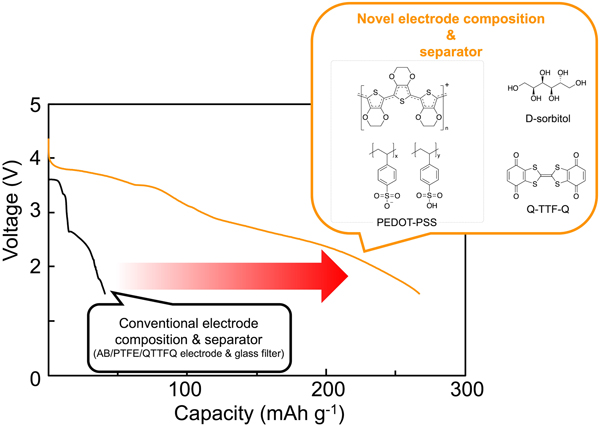
In the present study, PEDOT/PSS containing a small amount of sugar alcohol [D-sorbitol, Fig. 1(a)] and ethylene glycol was used as the binder and separator to increase the active material content in the electrode and improve the cycle performance. The effect of treating the separator with PEDOT/PSS was also examined. As the test organic active material, we used a quinone-tetrathiafulvalene triad (QTTFQ)[Reference Dumur, Gautier, Gallego-Planas, Sahin, Levillain, Mercier, Hudhomme, Masino, Girlando, Lloveras, Vidal-Gancedo, Veciana and Rovira30] [Fig. 1(a)], which has a high capacity and high energy density.[Reference Kato, Masese, Yao, Takeichi and Kiyobayashi10] The measurement results of cells constructed using the proposed materials demonstrate that the content of active organic material can be increased to 80 wt% without impairing the utilization ratio and cycle life.
Experimental
Materials
An aqueous solution containing 0.5 wt% PEDOT and 0.8 wt% PSS (1.3 wt% PEDOT/PSS solution) and D-sorbitol (>97%) were, respectively, purchased from Sigma-Aldrich (USA) and Tokyo Chemical Industry (Japan), and they were used as received. QTTFQ was synthesized in seven steps according to a previous report[Reference Kato, Masese, Yao, Takeichi and Kiyobayashi10] (melting point: approximately 390 °C (dec.), 1H-NMR (CDCl3): δ 6.78 (s, 4H), FTIR (ν/cm−1): 1649 (C=O), 1541 (C=C), MS [m/z: 363.9 (M+)]. The electrolyte solution was prepared by dissolving lithium bis(trifluoromethanesulfonyl)imide (LiTFSI, Kishida Chemical, Japan, 99.9%) in propylene carbonate (PC, Kishida Chemical, >99.5%). The concentration of these solutions was adjusted to 2.5 mol/L.
Electrode preparation
PEDOT-type electrode
The electrode was prepared by mixing QTTFQ powder (the active material), PEDOT/PSS solution, and D-sorbitol at a solid weight ratio of 78:20:2. The organic active material (40.2 mg), ethylene glycol (EG, 9.2 mg), and sorbitol (1.2 mg) were added to the 1.3 wt% PEDOT/PSS aqueous dispersion (0.791 g), and the mixture was sonicated for 50 min and heated moderately on a hot plate (110 °C) to obtain a slurry having an appropriate viscosity. The resulting slurry was coated on an aluminum foil current collector by using a doctor blade with a 150-μm gap and dried first at 80°C for 1 h and then at 100°C for 2 h in vacuum.
PTFE-type electrode
QTTFQ, acetylene black (AB; the conductive additive), and polytetrafluoroethylene (PTFE; the binder) were mixed at a weight ratio of 80:10:10 by using a mortar. The composite was pressed on an Al mesh and dried at 120°C in vacuum for 1 h.
PVDF-type electrode
QTTFQ and AB were added to the solution of PVDF as the binder in NMP to produce a slurry. A QTTFQ:AB:PVDF solid weight ratio of 80:15:5 was applied. The resultant slurry was coated on an Al foil by using a doctor blade and dried first at 80 °C for 1 h and then at 100 °C for 2 h in vacuum.
PEDOT/PSS–sorbitol separator (SOR-PEDOT separator)
The conductive polymer-coated separator (SOR-PEDOT separator) was prepared by dropping the mixed solution on one side of a glass filter (0.44 mm, GA-100, Toyo Roshi Kaisha, Japan). For the mixed solution, the weight ratio of PEDOT/PSS solution to D-sorbitol was 250:1. The separator was prepared by dropping 300 µL of the aqueous dispersion and drying, first at 120 °C for 1 h and then at 100 °C for 2 h in vacuum. For comparison, a glass filter using only PEDOT/PSS without sorbitol was also prepared in the same manner without sorbitol addition (PEDOT separator).[Reference Wang, Jiang, Xu, Liang, Zhou, Jiang, Singh, Zhao, Schober and Lei22]
Cell construction (coin-type cell) and charge/discharge test
The prepared electrode, separator (glass filter, SOR-PEDOT separator, or PEDOT separator), and lithium metal-negative electrode were placed in an IEC R2032 coin-type cell in a dry chamber (D.P. less than −70 °C). The cells were sealed after filling the electrolyte solution. In the battery test, the prepared cells were first discharged, during which the active material undergoes lithiation (lithium-ion insertion) and then charged at a given condition. The current density was set to 20 mA/g, and the cut-off voltage was set to 1.5 and 4.6 V by using a battery evaluation system (Electrofield ABE system) in a thermostat maintained at 25 °C. A current density of 20 mA/g corresponds to 0.045 C based on the theoretical capacity of QTTFQ, 441 mAh/g, under the assumption of a redox reaction with the six-electron transfer.
Results
Fabrication of SOR-PEDOT separator and PEDOT-type electrode
Figures 1(c) and 1(d) show the fabrication procedures of the SOR-PEDOT separator and the PEDOT-type electrode. While many cracks can be observed in the separator treated only with PEDOT (PEDOT separator, Supplementary Fig. S1), no crack is noticeable when sorbitol was added (SOR-PEDOT separator). As reported previously,[Reference Otero, Martinez, Hosaka and Okuzaki27–Reference Jönsson, Birgerson, Crispin, Greczynski, Osikowicz, Denier van der Gon, Salaneck and Fahlman29] sorbitol helps in dispersing the polymer well by weakening the hydrogen bond between PEDOT and PSS, enabling the formation of a homogeneous flexible film. A similar effect can be expected for the electrode. Without any additional binder, we successfully formed a smooth-surface electrode composite of QTTFQ and PEDOT/PSS, which is firmly bound to the current collector.
Effect of SOR-PEDOT separator on the conventional PTFE electrode
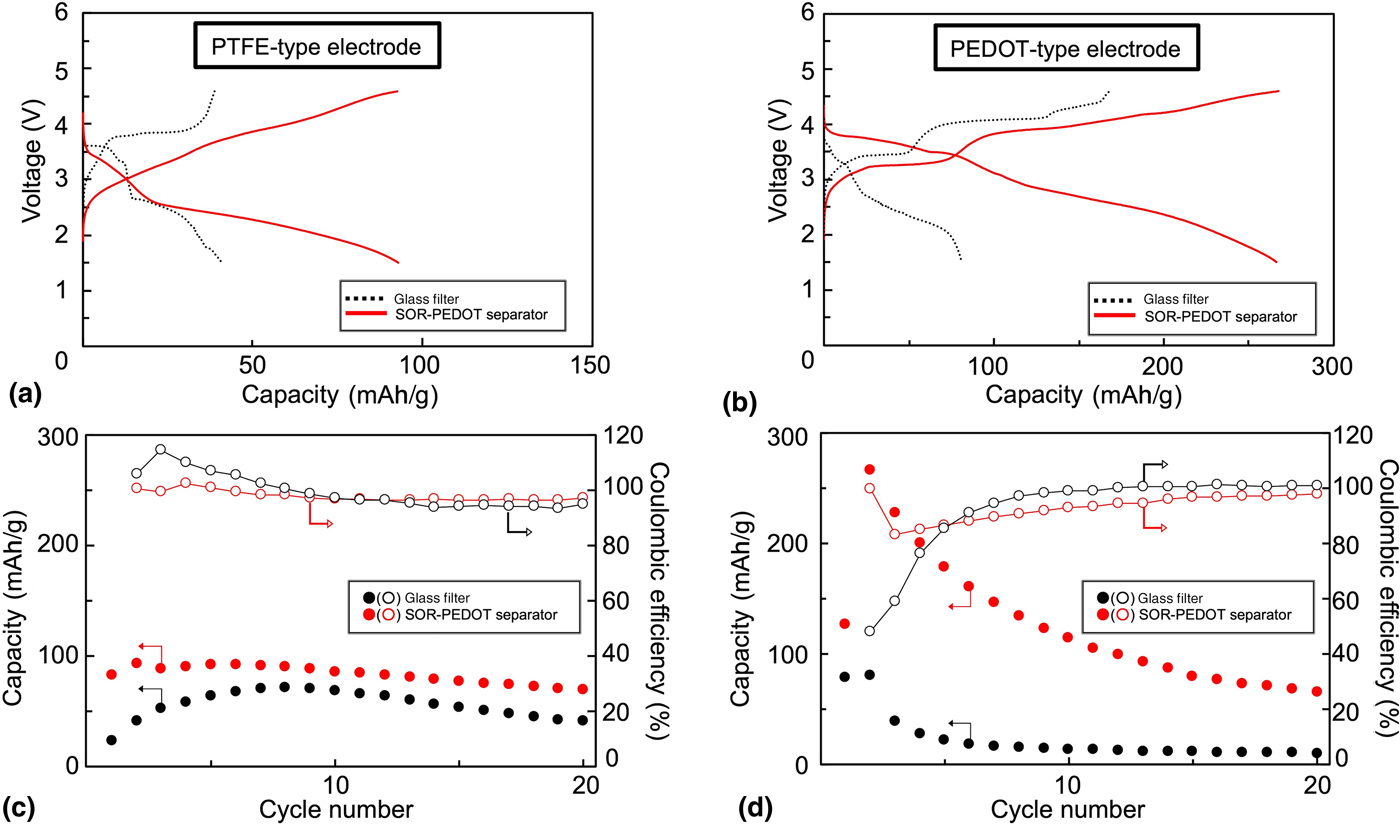
First, we examined the effect of the SOR-PEDOT treatment of the separator on the electrochemical properties of the conventional electrode, i.e., with the PTFE binder and AB conductive additive. The cell was initially discharged (the initial state of QTTFQ is 4/6-charged). Figure 2(a) compares the subsequent charge and discharge profiles of the two PTFE cells: one is with a pristine glass filter and the other is with SOR-PEDOT treatment. The observed discharge capacities during this second cycle, 40.9 (glass filter) and 93.0 (SOR-PEDOT separator) mAh/g, are far below the theoretical value (441 mAh/g), where the six-electron transfer reaction of QTTFQ is assumed. In our previous study, the QTTFQ electrode, which contains 20 wt% AB and 10 wt% PTFE, delivered a significantly higher discharge capacity of 230 mAh/g.[Reference Kato, Masese, Yao, Takeichi and Kiyobayashi10] As we discuss below, the ratio AB/QTTFQ has a considerable impact on the extent to which we can extract electrochemical capacity from the organic active material. Throughout the cycle test, shown in Fig. 2(c), the discharge capacity of the cell with the SOR-PEDOT separator exceeded that with the pristine glass filter. After 20 cycles, the former retained 69 mAh/g, while the latter retained 41 mAh/g. Although the SOR-PEDOT treatment of the separator is effective in improving the capacity of the electrode using the organic active material, the conventional preparation method (i.e., with AB and PTFE) is not suitable for increasing the active material content of the electrode.
Charge and subsequent discharge potential profile after the initial discharge for (a) PTFE-type cell and (b) PEDOT-type cell. Cycle trend of the discharge capacity for (c) PTFE-type cell and (d) PEDOT-type cell.

Effect of PEDOT on the electrode
The fact that the density of organic substances is generally less than that of their inorganic counterparts suggests that the total surface area of the former is greater than that of the latter, even if the particle size and content in the electrode are equal. Although the primary particle size of carbon black is as small as 25 nm, it tends to aggregate in a dry state. Hence, it should be difficult to cover the organic active material with carbon black uniformly in a dry process. The slurry method using the conductive colloidal particles of PEDOT/PSS, which is smaller than AB, in the aqueous dispersion can be more effective in forming a uniform contact with the organic active material.
Figure 2(b) compares the charge and discharge profiles, after initial discharging, of the two PEDOT-type electrodes: one is with the pristine glass filter and the other is with the SOR-PEDOT-treated one. The results for the cell using a separator treated only with PEDOT/PSS without sorbitol are shown in Supplementary Figs. S2 and S3. The cell with the SOR-PEDOT separator has a charge capacity of 267 mAh/g, which exceeds that of the cell with the pristine glass filter (168 mAh/g) by 59%. These values are significantly greater than those observed in the cells made with AB and PTFE, as described in the section above, demonstrating that the PEDOT/PSS additive is effective in extracting the capacity of the organic active material. The effect of the SOR-PEDOT separator is also remarkable in that the cell with the SOR-PEDOT separator delivered 267 mAh/g with an average voltage of 2.9 V during the subsequent discharge process (namely, a Coulombic efficiency of 100%), whereas the cell with the pristine glass filter delivered only 81 mAh/g with an average voltage of 2.6 V. Although the capacities of both cells decreased upon cycling [Fig. 2(d)], the cell using the SOR-PEDOT separator retains a higher capacity compared to that with the pristine separator throughout the cycles. In order to observe the effect of treating the separator with PEDOT/PSS, the separators were taken out of the cells after the charge–discharge cycles and examined. While the separator without the treatment was pale brown after cycling, the one coated with PEDOT/PSS did not show a discernible color change, suggesting that the migration of QTTFQ is suppressed by the treatment.
Discussion
The present study demonstrates two effects of PEDOT/PSS that improve the battery performance of the organic active material: one is the effect of including it in the separator and the other is its effect as the conductive binder in the electrode. The PEDOT/PSS additive in the separator substantially increases the capacity and extends the cycle life, as evidenced by the comparative experiments shown in Fig. 2; i.e., the cell with the SOR-PEDOT separator is superior to that with the pristine glass filter in terms of both the capacity and cycle life. The PEDOT/PSS film reportedly inhibits the migration of anionic molecules.[Reference Oyama, Kiya, Hatozaki, Morioka and Abruña23,Reference Kiya, Iwata, Sarukawa, Henderson and Abruña24] Currently, although it is unclear whether PEDOT/PSS can block cationic as well as anionic molecules, either of which QTTFQ becomes during charging and discharging, respectively, the present study alludes to the role of PEDOT/PSS in the suppression of migration of organic active materials. For the practical application of this system, a method for further preventing the organic molecules from dissolving in the electrolyte solution must be pursued. Apart from optimizing the slurry composition, forming a PEDOT/PSS film directly on the electrode surface, instead of in the separator, may further improve the cycle life of the organic battery.
The electrode in our previous study, in which the weight ratio was QTTFQ:AB:PTFE = 70:20:10, delivered 236 mAh/g during the second discharge process,[Reference Kato, Masese, Yao, Takeichi and Kiyobayashi10] while the present electrode containing 80 wt% QTTFQ delivered only 41 mAh/g when prepared using the conventional method. The 10% difference in the active material content seems to be marginal at a glance. However, the weight ratio of the conductive additive to the active material in our previous study, 0.29, is twice that in the present study, 0.13. The low electron conductivity of the organic active material may necessitate a ratio of at least 0.2 to form a sufficient conduction path between the active material powders. Mixing the electrode composite in a dispersed slurry may be an option to form a better conduction path between the active material powders via conductive materials. In fact, as shown in Supplementary Figs. S4 and S5, the electrode prepared using a common slurry with PVDF/AB/NMP performed better than the one prepared with a dry process.
A recent study revealed that the colloid in an aqueous dispersion has a core–shell structure with the PSS moiety surrounding a 2–5 nm nucleus consisting of PEDOT,[Reference Takano, Masunaga, Fujiwara, Okuzaki and Sasaki26] which is less than one-fifth of the primary particle diameter of carbon black (approximately 25 nm), a conventional conductive additive. The dispersion of this colloidal conductive additive is considered to permeate the narrow cracks in the active material particles. In addition, the total surface area provided by PEDOT/PSS should be much larger than that provided by AB, as inferred from the following considerations. Suppose the particle diameter of AB and PEDOT/PSS are 25 and 5 nm and their true densities are 2.0 and 1.0 g cm−3, respectively. Given that their masses in the electrode are equal, the surface area of PEDOT/PSS available for contact with the active material is estimated to be ten times that of AB. Another important characteristic of PEDOT/PSS is that it functions as the binder as well, which allows us to eliminate the additional binder that is required when AB is used as the conductive additive. In this manner, despite the 80 wt% active material content, we were able to maintain a ratio of 0.25 between the conductive additive and active material. These characteristics of PEDOT/PSS enabled the achievement of a high content of organic active material in the electrode without sacrificing its capacity.
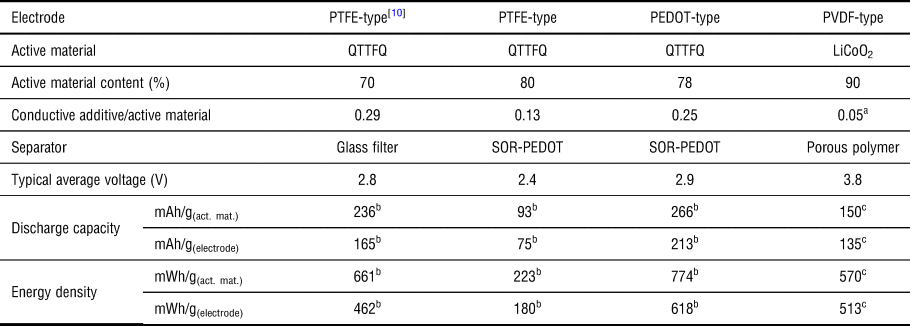
Table I summarizes the discharge capacity and energy density of the electrodes in the previous[Reference Kato, Masese, Yao, Takeichi and Kiyobayashi10] and present studies. In the PTFE electrode, the increase in the active material content from 70 to 80 wt% significantly reduced the discharge capacity per unit mass of QTTFQ. The PEDOT/PSS additive in both the electrode and the separator recovered the discharge capacity. The discharge capacity per unit mass of QTTFQ of the PEDOT electrode exceeds that of the PTFE electrode by 13%, notwithstanding the higher content of QTTFQ in the electrode of the former, resulting in an increase of the mass energy density by 17%. Per unit electrode mass, the discharge capacity of the present electrode reached 213 mAh/g (the control test performed using a cell without QTTFQ indicates that PEDOT/PSS contributes at most 6% to the observed capacity), which translates into a mass energy density of 618 mWh/g, surpassing the value for the conventional LiCoO2-based electrode. Because organic and inorganic compounds have fundamentally different properties, it is necessary to provide a suitable environment for the organic material to achieve the optimal performance of the organic electrode. The methodology proposed in the present study, i.e., the use of the conductive polymer in the electrode and the separator, is effective to make full use of organic active materials.
Comparison of QTTFQ cells in the previous[Reference Kato, Masese, Yao, Takeichi and Kiyobayashi10] and present studies together with the conventional Li battery.

a LCO:AB:PVDF = 90:5:5.
b After initial discharge.
c Typical value.
Conclusions
The present study demonstrated that the conductive polymer PEDOT/PSS doped with D-sorbitol functions as both the conductive additive and binder, enabling a high content of organic active material in the electrode while maintaining its capacity. This polymer also has a favorable effect of increasing the cycle life when the separator was treated with it. The aqueous slurry of PEDOT/PSS eliminates the need for an organic solvent such as NMP, which is used in PVDF-based slurry preparation in the electrode fabrication process. The use of such an aqueous slurry should reduce the manufacturing cost and environmental burden. Optimizing the present scheme would enable a further increase in the active material content beyond 80 wt%. We believe that the present method would pave the way for the progress of long cycle life and high density organic batteries.
Supplementary Material
The supplementary material for this article can be found at https://doi.org/10.1557/mrc.2019.111.
Acknowledgments
Partial funding for this work was supported by JSPS KAKENHI Grant No. JP19K15689.