Introduction
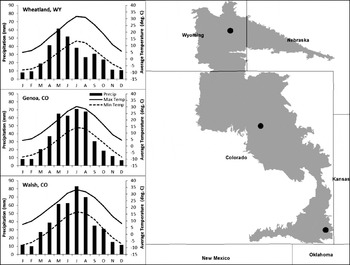
Escalating prices of agricultural commodities and increasing climatic variability are pressing producers to adopt agricultural systems that meet food and fiber requirements and are economically and ecologically resilient1. Semi-arid agro-ecosystems near the lower limit of rain-fed crop production are especially vulnerable to changes in climate, input costs and prices, yet they cover vast areas of the western USA and the world. Integrated crop–livestock farming can optimize use of available resources by increasing the diversity of crops grown, while minimizing economic risks and negative environmental effects of more specialized systemsReference Van Keulen and Schiere2. In many other regions, long-term systems-focused research shows positive results from diverse, integrated farming systems that are risk-averse and resilientReference Robertson, Allen, Boody, Boose, Creamer, Drinkwater, Gosz, Lynch, Havlin, Jackson, Pickett, Pitelka, Randall, Reed, Seastedt, Waide and Wall3. Therefore, whole-system, integrated research may become increasingly valuable to facilitate adaptation to changing climatic and economic conditions in the landscapes of mixed rangelands, crops and forages of the central High Plains, including parts of Wyoming, Nebraska and Colorado4 (Fig. 1).

Long-term agricultural systems research can reveal relationships among economic, social and biological parameters at the core of landscape-scale environmental problems, such as erosion, pollution, and habitat lossReference Mueller, Barbercheck, Bell, Brownie, Creamer, Hitt, Hu, King, Linker, Louws, Marlow, Marra, Raczkowski, Susko and Wagger5, while also indicating economic viability of alternative, lower impact or value-added production approaches. To accomplish this, systems research requires broad frames of reference that integrate crop, range, livestock and other production components over at least one rotation period. But the most meaningful information about agricultural system resiliency and economic viability comes from very long-term projects in which technologies change to reflect changing production practices, and in which short-term research on particular innovations is often embedded. Moreover, such long-term systems research projects provide excellent settings for integrating multiple scientific objectives with education, and extension that truly engages producers, researchers and educatorsReference Robertson, Allen, Boody, Boose, Creamer, Drinkwater, Gosz, Lynch, Havlin, Jackson, Pickett, Pitelka, Randall, Reed, Seastedt, Waide and Wall3.
As concerns about a globalizing food economy, a warming climate, emerging pest and disease problems, human health and the environment, and the quality of life in rural areas converge7, a consistent, multivariate evaluation system that makes the most of long-term research becomes ever more crucial. Although multidisciplinary in approach, the results of systems research are not often evaluated in terms of economic and ecological efficiency and interrelationships among system componentsReference Lyon, Monz, Brown, Metherell, Paul, Paustian, Elliott and Cole8 as individual researchers rush to publish results in their own disciplines. Our objective for this review was to develop an inventory of knowledge about agricultural systems management gained from long-term, integrated research, especially as it pertains to three broad production approaches toward management of crop–range–livestock systems in the central High Plains Major Land Resource Area4: conventional or typical management, reduced-input management, and certified organic management. We discuss the need, not only for interdisciplinary project implementation and data collection but also for integrated, multivariate data analysis so that system-level conclusions can be drawn about sustainability and economic profitability.
Study Approach
To establish an understanding of knowledge gained from systems-level agricultural research, we reviewed the literature in peer-reviewed scientific journals reporting results from long-term cropping systems or integrated crop–range–livestock systems projects. We used key words emphasizing components of conventional, reduced-input and certified organic production, long-term farming systems in the USA, integrated crop–range–livestock systems, central High Plains agriculture, agricultural system experiments, cropping systems studies in the central High Plains, and crop and livestock components in both irrigated and dryland conditions.
Agroecosystems of the central High Plains represent a broad swath of the semi-arid Western USA, generally too dry and cold for cultivation of many crops (Fig. 1). The region is suitable for integrated crop–range–livestock systems, often including irrigated rotations of alfalfa (Medicago sativa L.) and commodity crops such as corn (Zea mays L.), dry beans (Phaseolus vulgaris L.), sugar beets (Beta vulgaris L.), and others, or dryland rotations centered on winter wheat (Triticum aestivum L.) and often including millet (Panicum spp.), sunflowers (Helianthus annuus L.), corn and other grain crops; and rangelands for summer forage.
Under conventional management typical in this region, producers use inputs and technology as needed to maximize production. They rely chiefly on synthetic fertilizers for soil-fertility renewal and on combinations of herbicides and tillage for weed control. For this paper, the reduced-input approach is defined as management that offsets fertilizer use by building soil organic matter (SOM), mainly through reduced disturbance. Weed control in the reduced-input approach relies mostly on herbicides in conjunction with herbicide-resistant crop varieties. In the organic production approach, soil, crop and livestock management are based on practices allowed by the United States Department of Agriculture (USDA) National Organic Program standards. Soil-fertility renewal relies on inputs of organic materials along with legumes and cover crops in rotation. Weed control relies heavily on tillage.
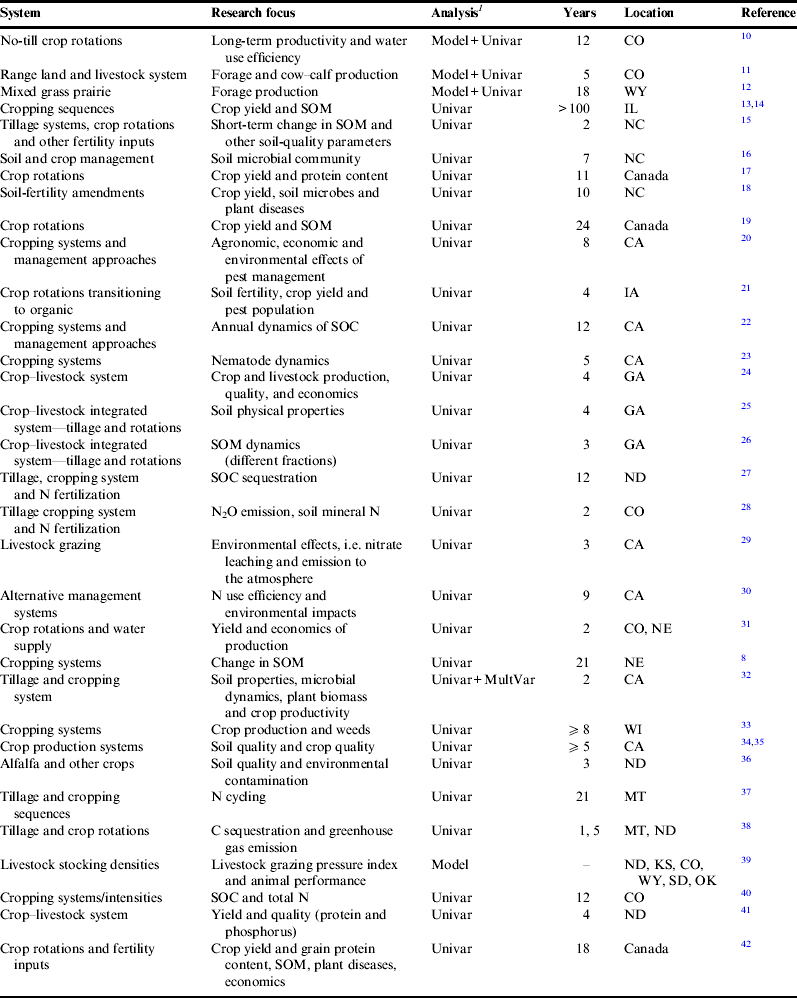
Research results from USDA-Agricultural Research Service9 stations in the central High Plains are a main source of literature in this review. To develop wider understanding of the components of integrated farming systems research, including statistical approaches used to interpret results, we also reviewed research activities and results from the Wisconsin Integrated Cropping Systems Trial (WICST), the Long-Term Research on Agricultural Systems (LTRAS) and Sustainable Agriculture Farming System (SAFS) trials in California, the Center for Environmental Farming Systems (CEFS) in North Carolina, and other relevant studies (Table 1)Reference Andales, Ahuja and Peterson10–Reference Zentner, Campbell, Biederbeck, Miller, Selles and Fernandez42.
Production systems, major focus and evaluation (statistical analysis) approaches for existing long-term and short-term integrated farming system studies in North America.
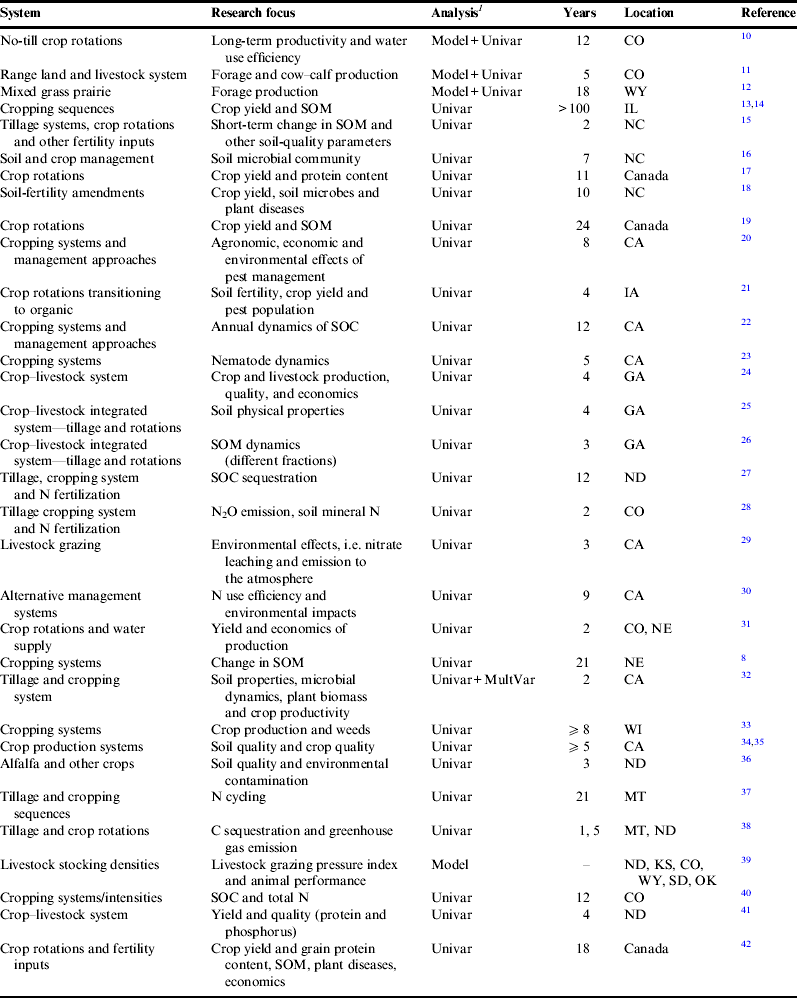
1 Univar, univariate statistical approach; MultVar, multivariate statistical approach.
Review of System Components
Irrigated cash crop production
Conversion of dry croplands to irrigated production in the central High Plains in the past 150 yearsReference Parton, Gutmann, Williams, Easter and Ojima43 diversified opportunities to incorporate a variety of crop rotations, many of which include annual and perennial forages. There is little research, however, that reports on the relative efficiency of conventional, reduced-input and certified organic production approaches in irrigated systems of the central High Plains. Systems research in irrigated or rain-fed rotations has been documented from the WICST in Wisconsin, the LTRAS and SAFS trials in California, and other projects in California, Colorado, Iowa and North Carolina. Within these systems research frameworks, experiments on long-term agronomic and economic sustainability revealed that alternative production strategies such as minimum-till, no-till and organic farming are more efficient than, or at least as efficient as, conventional practices, especially, in terms of crop production and soil-quality improvement (e.g.,Reference Bossio, Scow, Gunapala and Graham16, Reference Clark, Ferris, Klonsky, Lanini, van Bruggen and Zalom20, Reference Doane and Horwath22, Reference Ferris, Venette and Lau23, Reference Kramer, Doane, Horwath and van Kessel30, Reference Minoshima, Jackson, Cavagnaro, Sanchez-Moreno, Ferris, Temple, Goyal and Mitchell32, Reference Posner, Baldock and Hedtcke33).
Cropping system experiments indicate that crop rotations and reduced tillage increase soil organic carbon (SOC) stocks and augment SOC sequestrationReference Doane and Horwath22, Reference Minoshima, Jackson, Cavagnaro, Sanchez-Moreno, Ferris, Temple, Goyal and Mitchell32, Reference Reganold, Andrews, Reeve, Carpenter-Boggs, Schadt, Alldredge, Ross, Davies and Zhou34, Reference Reganold, Glover, Andrews and Hinman35. In most cases, researchers found higher SOC contents in surface layers of soils under no-tillage systems than soils under standard tillage practices. Higher SOC contents were attributed to changes in the size of microbial communitiesReference Minoshima, Jackson, Cavagnaro, Sanchez-Moreno, Ferris, Temple, Goyal and Mitchell32 along with C inputs from crop residuesReference Halvorson, Wienhold and Black27. Reganold et al.Reference Reganold, Andrews, Reeve, Carpenter-Boggs, Schadt, Alldredge, Ross, Davies and Zhou34 reported more soil N, greater microbial biomass, activity and diversity in organically managed soils than conventionally managed soils. In organic and reduced-input systems, alternative soil-fertility inputs such as legumes and organic manures supplied N sufficient to produce yields equivalent to those from conventional systems. However, the timing of N release from organic sources in alternative production systems was different than timing of N release from chemical sourcesReference Kramer, Doane, Horwath and van Kessel30. Alternative management approaches coupled with the application of slow-release N fertilizer are efficient in mitigating greenhouse gas (GHG) emissions from irrigated rotations. For instance, Halvorson et al.Reference Halvorson, Del Grosso and Alluvione28 found that soils under conventionally tilled corn in eastern Colorado fertilized with standard urea or a polymer-coated enhanced efficiency urea product emitted equivalent amounts of nitrous oxide (N2O), while soils under no-till corn emitted 49% less N2O when fertilized with polymer-coated urea than standard urea.
Systems research results show that no-tillage and organic approaches not only improve soil quality and environmental parameters, but also have comparable or higher yields than the conventional production approach. Comparable or higher yields of forage and grains have been observed in organic plots compared to the conventional plotsReference Delate and Cambardella21, Reference Kramer, Doane, Horwath and van Kessel30, Reference Posner, Baldock and Hedtcke33, with the only constraints on organicReference Posner, Baldock and Hedtcke33, Reference Sanford, Cook, Posner, Hedtcke, Hall and Baldock44 and reduced-inputReference Clark, Ferris, Klonsky, Lanini, van Bruggen and Zalom20 approaches of crop production being increased weeds, insect pests and diseases. High costs of equipment and facilities for higher productivity are characteristic of irrigated systems, and are even more pronounced in organic and reduced-input approaches because weed and insect pest management are more difficult than in conventional production. Soils beneath organic and reduced-input management practices typically have higher microbial biomass and activityReference Bossio, Scow, Gunapala and Graham16, Reference Reganold, Andrews, Reeve, Carpenter-Boggs, Schadt, Alldredge, Ross, Davies and Zhou34, leading to the possibility of developing opportunistic beneficial or pathogenic associations and, therefore, more frequent disease outbreak if the ecological balance in the soil system changes. Yield reduction and economic loss due to weeds, insect pests and diseases, however, were negligible in organic corn–soybean–oat–alfalfa rotations as compared to conventional rotationsReference Delate and Cambardella21. Similarly, higher nematode and arthropod populations, as well as more disease-causing organisms, observed in alternative production approaches did not negatively affect yield or farm incomeReference Clark, Ferris, Klonsky, Lanini, van Bruggen and Zalom20. These positive effects might be because highly diverse microbial communities interact through complex food webs to support better growth and productivity of crops compared to the limited microbial diversity in conventional systems. Increased microbial diversity in soils may benefit crops as a result of (i) teamwork between plant-growth-promoting rhizobacteria and Rhizobium for improving N2 fixation; (ii) microbial antagonism for control of plant pathogenic micro-organisms; and (iii) interactions between rhizosphere microbes and arbuscular mycorrhizal fungi to establish a functional mycorrhizosphereReference Barea, Pozo, Azcon and Azcon-Aguilar45, all of which ultimately enhance sustainability of agroecosystems.
Transitioning to organic and reduced-input management, however, might affect productivity, and thereby short-term profitability. As the soil environment and microbial processes need to adjust to altered farm inputs and management practices, some researchers have determined that it takes at least 4 years to obtain comparable yields from the alternative management practicesReference Delate and Cambardella21, Reference Tu, Louws, Creamer, Mueller, Brownie, Fager, Bell and Hu46. Similarly, sugar beet is the basis of profitability on many farms in central High Plains region because its high value offsets high cost of irrigation, but there is currently no market that offers premium prices for certified organic sugar beets. These barriers can thwart transition to alternative management, but they also underscore the need for research into complex, system-scale interactionsReference Aref and Wander13, Reference Nafziger and Dunker14.
Integrating livestock in crop production
In central High Plains integrated crop–livestock production systems, maintenance of stock–cow herds for annual production of beef feeder calves for sale to feed lots is the most prevalent practiceReference Padbury, Waltman, Caprio, Coen, McGinn, Mortensen, Nielsen and Sinclair47. Irrigated land produces forage for stock–cow herds that produce calves for sale in the fall and utilize rangelands for summer grazing. Backgrounding, or feeding grain plus corn silage and/or alfalfa hay for several weeks after weaning, is a common practice on farms with irrigated grain/forage crop rotations. Cattle typically utilize cover crops in spring before turnout on rangelands, and forage and grain stubble, supplemented with hay or silage, in the fall and winter.
Integrating livestock into cropping systems benefits agroecosystems through positive effects on soil quality, crop production and environmental services. Integrated crop–livestock system studies across the USA6, Reference Bell and Raczkowski15, Reference Bulluck and Ristaino18, Reference Franzluebbers and Stuedemann24, Reference Russelle, Lamb, Montgomery, Elsenheimer, Miller and Vance36, 48–Reference Sydorovych, Raczkowski, Wossink, Mueller, Creamer, Hu, Bell and Tu51 show that integrated production systems benefit producers by (i) more efficiently utilizing farm resources, (ii) exploiting natural pest control processes and/or decreasing the need for synthetic pesticides, (iii) reducing the amount of chemical fertilizer per unit land and minimizing the consequent environmental risks, and (iv) improving soil quality and productivity. For example, comparing tillage systems that included grazing stubbles, Franzluebbers and StuedemannReference Franzluebbers and Stuedemann26 reported that grazing on no-till croplands increased soil microbial biomass up to 8%, positively affecting nutrient cycling processes and increasing protection of SOC within soil aggregates. In addition, livestock-based systems increase soil biodiversity, reducing occurrence of soil-borne diseasesReference Bulluck and Ristaino18, Reference de Freitas, Schoenau, Boyetchko and Cyrenne52. Larger populations of higher trophic level organisms, including macro-fauna such as tunneling dung beetle [Onthophagus gazella (Fabricius) and Onthophagus taurus (Schreber)], mix crop residues with soilReference Bertone, Green, Washburn, Poore and Watson53. Increased diversity of soil organisms may also contribute to higher productivity by enhancing mineralization of nutrients from organic resources and increasing the resiliency of agroecological functions and processes (e.g., against drought)Reference Giller, Beare, Lavelle, Izac and Swift54.
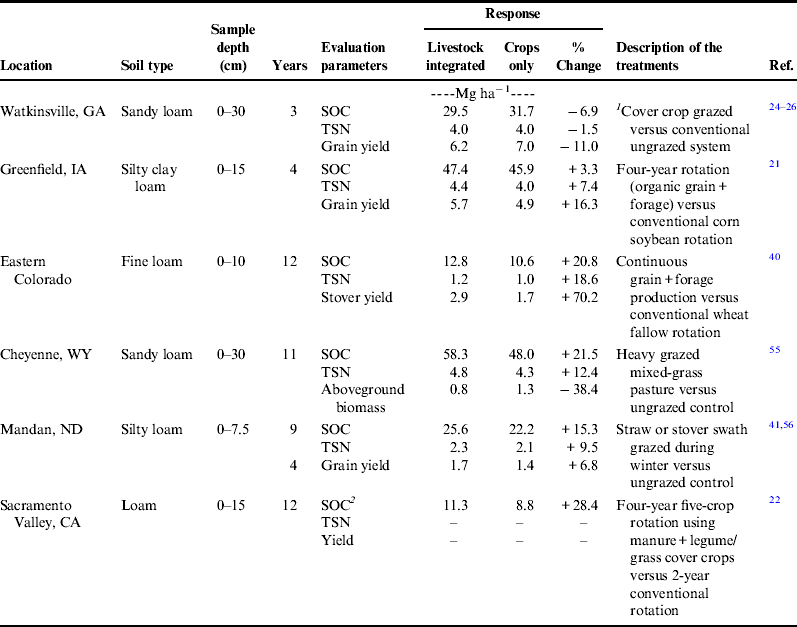
Studies reviewed for this paper consistently show significant benefits of integrating livestock in cropping systems (Table 2), especially in terms of SOC and total soil nitrogen (TSN) enrichment in surface soils. Overall, soils under crop–livestock integrated management had 17.9±9.4% higher SOC and 12.0±4.9% higher TSN than soils under conventional, specialized cash-crop productionReference Delate and Cambardella21, Reference Doane and Horwath22, Reference Sherrod, Peterson, Westfall and Ahuja40, Reference Schuman, Reeder, Manley, Hart and Manley55, Reference Liebig, Tanaka, Kronberg, Scholljegerdes and Karn56; although rates of accumulation varied with geographic location, temperature and precipitation. Similarly, there was 16.6±0.4% increase in grain yieldReference Delate and Cambardella21, Reference Tanaka, Karn, Liebig, Kronberg and Hanson41 and up to 70.2% increase in stover yieldReference Sherrod, Peterson, Westfall and Ahuja40 when livestock were part of the system compared to crop-only production systems. The crop–livestock integrated treatments include a range of practices, from in-field livestock grazing to forage production without direct livestock impact. In grazed versus non-grazed treatments, grazing intensity has a strong influence on soil qualityReference Liebig, Tanaka, Kronberg, Scholljegerdes and Karn56. Moreover, integrated treatments responded more effectively to SOC and TSN accrual in the central High Plains than in the southern High Plains and southern Piedmont USA, likely due to lower mean annual soil temperature and slower SOM turnover rates. Soil organic C and TSN decreased by 6% and 1%, respectively, following 2 years of livestock grazing on Cecil sandy loam and sandy clay loam soils with moderately acidic (pH 6) soil conditions of GeorgiaReference Franzluebbers and Stuedemann26. This decrease in SOC, although statistically insignificant, might be due to the relatively short time period of the study, a relatively warm (16.5 °C mean annual temperature) and moist (1250mm mean annual precipitation) environment, or high livestock pressure (90% of available forage was consumed in grazed fields). Grain yield decreased by 11% and total aboveground biomass production by 38.4% after these grazing intensity treatmentsReference Franzluebbers and Stuedemann26, Reference Schuman, Reeder, Manley, Hart and Manley55. Studies including grazing treatments where SOC, TSN and crop yield responded positively to the livestock-integrated treatment occurred in cooler, drier climates than that of Georgia, and alternative production approaches were evaluated for more than 2 yearsReference Schuman, Reeder, Manley, Hart and Manley55, Reference Liebig, Tanaka, Kronberg, Scholljegerdes and Karn56. Moreover, biomass production from pasture varied with grazing intensity: moderate grazing pressure decreased forage yield by only 8.0% compared to ungrazed rotations, but SOC increased significantly under both moderately and heavily grazed conditions compared to ungrazed rotations. The studies reported here indicate that crop–livestock integrated systems support economic and environmental sustainability of agriculture in the central High Plains, but wide heterogeneity in evaluation parameters, along with the limited number of studies that make such comparisons, limit our ability to draw region-wide conclusions and indicate the need for systems research.
Effect of livestock-integrated treatments on SOC, nitrogen and crop performance in different ecosystems across the USA.
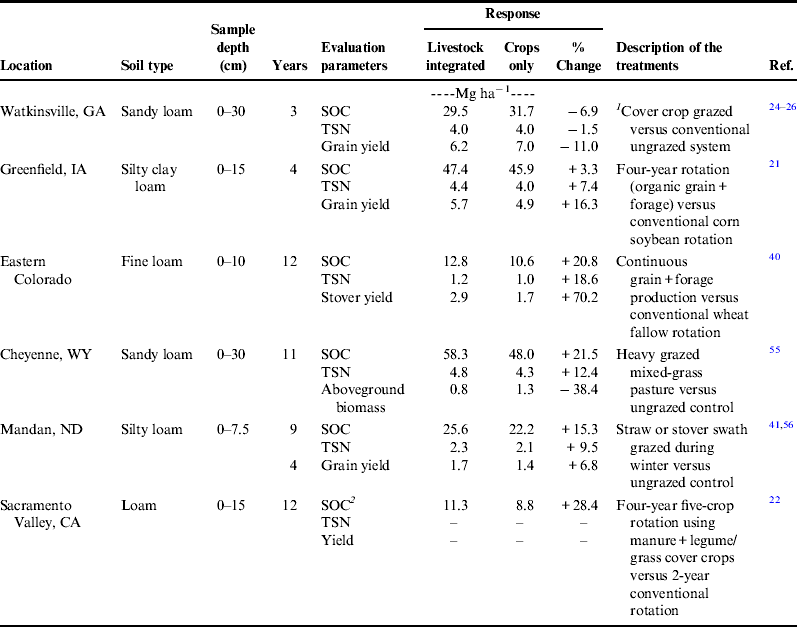
1 SOC measured from 0 to 6cm at the end of second year.
2 SOC in gkg−1. Text stated that bulk density was equivalent but did not report bulk density or mass per areaReference Doane and Horwath22.
Crop–range–livestock systems have been a research priority not only because of their benefits to the soil but also because of their positive effects on crop productivity, farm economy, and ultimately the sustainability and resiliency of farming systems. Integrating livestock in cropping systems increases grain and forage productionReference Tanaka, Karn, Liebig, Kronberg and Hanson41, and also positively affects yield of subsequent crops (Table 2). For example, grazing forage crops rather than allowing them to accumulate as surface residue was found to increase dry matter production of succeeding crops in rotationReference Franzluebbers and Stuedemann24. In a review, FranzluebbersReference Franzluebbers50 demonstrated that grazing cover crops may or may not increase crop productivity, but does increase net farm income through benefits such as increasing livestock production and increasing quality of cover crops. The practice benefits farmers and ranchers by increasing efficiency in grazing and manure management, minimizing disease risk by disrupting pest cycles, reducing pressure on natural resources, reducing irrigation water use, increasing crop diversity and diversifying income compared to systems that do not include livestockReference Allen, Baker, Segarra and Brown57–Reference Altieri and Nicholls59. Similarly, integrating livestock in a wheat–sorghum–fallow rotation on clay loam soils of northern Texas increased productivity of the entire cropping systemReference Baumhardt, Schwartz, MacDonald and Tolk60. In California, removing livestock increased nitrate-N load in downstream spring-fed wetlandsReference Jackson, Allen-Diaz, Oates and Tate29.
Despite the need for solid data on crop–livestock integrated systems and their common occurrence on farms of the central High Plains, inclusion of livestock in long-term agricultural system studies is rare. This might be due to logistical challenges associated with integrated research, which requires large areas, many animals, considerable labor and substantial financial resources. Systems research also demands strong interdisciplinary linkage and long-term funding commitmentsReference Tanaka, Karn, Liebig, Kronberg and Hanson41, Reference Tanaka, Karn and Scholljegerdes61, Reference Krall and Schuman62. Such integrated crop–livestock research is needed, however, in order to improve understanding of environmental impacts and economic trade-offs.
A crucial factor in crop–livestock systems is proper use of nutrients contained in livestock manure for sustainability of concentrated animal feeding operations. Research from other regions shows that continued application of manure nutrients in excess of crop requirements leads to nutrient accumulation, leaching and negative environmental impactReference Cole, Schwartz and Todd63. As small- and large-scale animal feeding facilities become more common in the central High Plains, research on manure utilization in dryland and irrigated cropping systems is needed.
A second potentially negative impact of integrated systems that include grazing of forage or crop regrowth, is potential for trampling that can lead to hoof-induced soil compactionReference Smart, Derner, Hendrickson, Gillen, Dunn, Mousel, Johnson, Gates, Sedivec, Harmoney, Volesky and Olson39, Reference Sanjari, Ghadiri, Ciesiolka and Yu64. Several researchers working in the eastern USA have found that hoof-induced soil compaction in integrated crop–livestock systems negatively affected larger macroaggregates, penetration resistance and water infiltration ability of soils, but did not affect productivity of subsequent cropsReference Franzluebbers and Stuedemann24–Reference Franzluebbers and Stuedemann26, Reference Sydorovych, Raczkowski, Wossink, Mueller, Creamer, Hu, Bell and Tu51. Consistent crop production with or without animal grazing might be because addition of SOM and augmentation of soil microbial activity facilitates mineralization of nutrients and offsets negative effects of compaction. Similar research is needed in irrigated crop–livestock systems of the central High Plains.
An important environmental question about crop–range–livestock systems that needs additional regional research is their effect on C sequestration and their potential to contribute to or mitigate GHG emissions and related effects on climate forcing. Sainju et al.Reference Sainju, Jabro and Stevens38, Reference Sainju, Stevens, Caesar-TonThat and Jabro65, Reference Sainju, Jabro and Caesar-TonThat66 and Halvorson et al.Reference Halvorson, Del Grosso and Alluvione28 evaluated GHG emission from dryland and irrigated rotations, respectively, and demonstrated that reducing tillage intensity and increasing N use efficiency help to minimize GHG emissions. Similar research is needed in crop–range–livestock systems, and also in organic and reduced-input management systems, which are becoming more prevalent throughout the USA67. Evaluation of CO2 emissions during manufacture and transport of fertilizer and inputs is important for systems-level evaluation of environmental efficiency of croppingReference Zentner, Campbell, Biederbeck, Miller, Selles and Fernandez42 and crop–livestock systems. Liebig et al.Reference Liebig, Morgan, Reeder, Ellert, Gollany and Schuman68 emphasized the fundamental role of livestock management in SOC balance in fragile ecosystems of northwestern USA and Canada. However, they found no data on C balance in systems where livestock graze crop residues. They also cautioned that increased N2O emissions from grazed or manured lands, along with increased CH4 emission from ruminant livestock, could offset lower net CO2 emissions from grasslands, possibly resulting in a negative balance on GHG mitigation from integrated systems. Additional systems research should address these questions to help determine practices that optimize synergies in integrated crop–livestock systems. However, maximizing the outputs of such expensive and complex multi-factor systems research requires the ability to evaluate short- and long-term economic and environmental trade-offs with respect to both on-farm sustainability and off-farm ecosystem services.
An Appropriate Evaluation Approach for Agricultural Systems Research
In contrast to reductionistic approaches, research on integrated crop–livestock systems requires evaluation methods that consider all components and interactions, and that draw system-level conclusions with respect to production, environment and economics. Although some agricultural systems studies have compared cropping systems and management approaches in diverse environmentsReference Robertson, Allen, Boody, Boose, Creamer, Drinkwater, Gosz, Lynch, Havlin, Jackson, Pickett, Pitelka, Randall, Reed, Seastedt, Waide and Wall3, 6, Reference Aref and Wander13, Reference Brandt and Zentner17, Reference Campbell, Zentner, Paul, Paustian, Elliott and Cole19–Reference Delate and Cambardella21, Reference Sainju, Caesar-Tonthat, Lenssen, Evans and Kolberg37, Reference Sherrod, Peterson, Westfall and Ahuja40, they typically focus on specific components through reductionistic analyses using univariate evaluation models. But this type of reductionist evaluation system might be insufficient to fully tap information about farming system level problems, complexities, resiliencies and opportunities from systems research projects. A multivariate evaluation system would integrate crop and livestock performance with economic and environmental efficiency variables on whole-farm or agroecosystem scalesReference Drinkwater69. Multivariate approaches for whole-system evaluation could help to define production, logistical, and environmental limitations and benefits of integrated crop–livestock production systemsReference Franzluebbers50.
Several researchersReference Andales, Ahuja and Peterson10–Reference Andales, Derner, Ahuja and Hart12, Reference Saseendran, Nielsen, Ma, Ahuja and Vigil70 have developed decision support tools for evaluating sustainability of such cropping systems in the central High Plains. Similarly, the Great Plains Framework for Agricultural Resource Management (GPFARM) forage growth modelReference Andales, Derner, Ahuja and Hart12 was developed to predict stocking rates for both strategic (long-term) and tactical (within-season) grazing management in northern mixed-grass prairies. Integrating cropping system models with forage and livestock production models might provide opportunities to develop decision support tools in integrated settings. Several other studiesReference Smart, Derner, Hendrickson, Gillen, Dunn, Mousel, Johnson, Gates, Sedivec, Harmoney, Volesky and Olson39, Reference Hendrickson, Liebig and Sassenrath71, Reference Tanaka, Krupinsky, Liebig, Merrill, Ries, Hendrickson, Johnson and Hanson72 have reviewed the performance of integrated crop–livestock systems in the central High Plains and revealed interactions among farming system and environmental components. For example, Hendrickson et al.Reference Hendrickson, Liebig and Sassenrath71 evaluated the interaction among cropping systems and environment in North Dakota, South Dakota, Nebraska and Kansas, and was able to draw broad conclusions about how environment shapes, and is shaped by, integrated farming practices. In such studies, models are mainly used as decision support tools for adjusting various parts of multicomponent systems. As such, they are important for optimizing management activities, but do not serve to evaluate system performance and interactions among many different variables.
Performance of complex integrated agricultural systems can be evaluated through multivariate, multifunctional evaluation models that might maximize return on investment in expensive and complicated long-term systems research. Tanaka et al.Reference Tanaka, Krupinsky, Liebig, Merrill, Ries, Hendrickson, Johnson and Hanson72 presented a framework for dynamic cropping systems that utilizes a variety of soil and plant management practices with a diversity of crop species to reduce risks of disease, weed and insect pest outbreaks in the central High Plains. Reganold et al.Reference Reganold, Andrews, Reeve, Carpenter-Boggs, Schadt, Alldredge, Ross, Davies and Zhou34, Reference Reganold, Glover, Andrews and Hinman35 evaluated productivity, economics and environmental sustainability of apple production in Washington State and strawberry production in California, and demonstrated the benefits of using interdisciplinary methodologies that comprehensively and quantitatively compare indices of crop performance and soil quality from multiple farms, multiple varieties and soils, and multiple sampling times. Robertson et al.Reference Robertson, Allen, Boody, Boose, Creamer, Drinkwater, Gosz, Lynch, Havlin, Jackson, Pickett, Pitelka, Randall, Reed, Seastedt, Waide and Wall3 called for creation of a national network of long-term agricultural systems research sites with standardized monitoring and multivariate evaluation procedures across many agroecosystems. This system would be modeled on the successful National Science Foundation Long-Term Ecological Research (LTER)73 network and could pool resources to optimize information that could be realized from expensive research efforts. Creation of such a network, along with development of suitable statistical evaluation models to evaluate existing long-term integrated experiments, could raise our understanding of complex agricultural systems just as the LTER network has elucidated many complex, multifactor ecological questions.
Implementing Agricultural Systems Research in the Central High Plains
Soil properties typically respond slowly to management changes in the central High Plains because cool, dry conditions limit rates of chemical and biological processesReference Ryan74, Reference Wienhold, Pikul, Liebig, Mikha, Varvel, Doran and Andrews75, plant productivity and associated SOM processesReference Franzluebbers50, Reference Wienhold, Pikul, Liebig, Mikha, Varvel, Doran and Andrews75. West and PostReference West and Post76 indicated that improved management practices such as reduced fallow, reduced tillage intensity, increased crop diversity and application of integrated agricultural practices support farmers by improving economic and environmental sustainability. While some of these practices show promise in the central High Plains, relatively low productivity, harsh and highly variable climate, and long distances to markets for both inputs and products create unique challenges in this region. Integrated crop–livestock systems include promising options to improve economic and environmental sustainability of central High Plains agroecosystems, but there is much yet to learn to fully understand how management of system components might improve efficiency and environmental services in integrated crop–range–livestock systemsReference Liebig, Tanaka, Krupinsky, Merrill and Hanson77. Long-term integrated agricultural research could support development of resilient systems in the context of pressing need for higher profitability and stability of farm income, growing concerns about environmental change and increasing regulationsReference Russelle, Entz and Franzluebbers49. Most of the holdings in central High Plains are small to medium sized, with annual sales of less than US $500,000Reference Russelle, Entz and Franzluebbers49, Reference Peterson, Westfall and Cole78. Diverse, integrated operations can reduce risk in the face of increasingly unpredictable climate, prices and costsReference Liebig, Morgan, Reeder, Ellert, Gollany and Schuman68, Reference Hendrickson, Sassenrath, Archer, Hanson and Halloran79.
Integrating livestock into cropping systems may represent an important option for crop production specialists in the face of changing climate in the central High Plains, as rising temperatures and limiting moisture shift the best choice of crops toward perennial foragesReference Cox, Glover, Van Tassel, Cox and DeHaan80. Soils of the central High Plains region are regularly subjected to wind erosion, and there is relatively little crop residue recycling. Perennial forage crops, with deep roots and more efficient water and nutrient use, are better adapted than annual crops to projected climate changes in this region. Systems that include livestock include options such as cutting grain early for use as forage if water runs short, weeds are too prevalent, frosts force late planting, or other problems affect grain development and maturity of crops. Similarly, more efficient feed and manure use reduces manure oversupply through improved internal cycling of nutrients, ultimately reducing GHG emissionsReference Smith, Martino, Cai, Gwary, Janzen, Kumar, McCarl, Ogle, O'Mara, Rice, Scholes, Sirotenko, Metz, Davidson, Bosch, Dave and Meyer81. Eagle et al.Reference Eagle, Henry, Olander, Haugen-Kozyra, Millar and Robertson82 discussed the potential of US agricultural lands to mitigate GHG emissions through adoption of alternative management options. Evaluation of GHG emissions are, however, lacking from central High Plains agricultural systems83.
Conclusions
In this review, we evaluated agricultural systems research in the central High Plains and revealed distinct impacts of alternative management practices that include reduced tillage, certified organic management and integrating livestock into cropping systems on SOC, nutrients and crop production. Building of SOM, however, is a slow process in this region because of the cool, dry climate and limited biomass recyclingReference Ryan74. In this scenario, implementing integrated crop–livestock systems may represent an important option toward enhancing agricultural resiliency in changing climatic and economic conditions. Most interdisciplinary studies, however, focus on specific aspects rather than whole systems, and there is a need for integrating productivity, profitability and environmental sustainability variables in a single evaluation frame in order to effectively generate information toward enhancing the adaptability of farming systems. Similarly, there is a need for a suitable multivariate evaluation system to reveal primary variables that drive the strengths and weaknesses of alternative production systems, especially in the highly variable environment of the central High Plains.