Introduction
Monochorionicity is characterized by a shared placental circulation in genetically identical individuals resulting in inter-twin transfusion that remains balanced in most pregnancies. Imbalance resulting in twin-to-twin transfusion syndrome (TTTS) occurs in about 15% of monochorionic pregnancies producing donor and recipient twin phenotypes and is fatal if untreated.Reference Denbow, Cox and Taylor 1 , Reference Mari, Roberts and Detti 2 Fetal responses include local vascular adaptation and activation of neuro-hormonal responses such as the renin–angiotensin system in the donor.Reference Mahieu-Caputo, Dommergues and Delezoide 3 , Reference Bajoria, Sullivan and Fisk 4 Our group has previously reported within-pair twin discordance in pulse wave velocity (PWV) of the arm (a measure of muscular arterial stiffness) in survivors of TTTS in early childhood. The direction of discordance was in opposite directions according to the fetal therapy of TTTS. In contrast, uncomplicated monochorionic diamniotic (MCDA) pregnancies showed no within-pair differences in PWV in early childhood. The smaller ex-donor twin from pregnancies treated symptomatically by serial removal of amniotic fluid (amnioreduction) showed higher PWV than its co-twin, the ex-recipient, after birth implying increased arterial stiffness with the degree of discordance related to severity of disease and its duration.Reference Cheung, Taylor and Fisk 5 , Reference Moise, Dorman and Lamvu 6 We subsequently reported the opposite pattern of PWV discordance in a contemporary cohort treated by laser photocoagulation of the superficial inter-twin placental anastomoses,Reference Hecher, Plath and Bregenzer 7 – Reference Senat, Deprest and Boulvain 9 thought to prevent further unbalanced inter-twin transfusion and therefore to treat the condition.Reference Gardiner, Taylor and Karatza 10 This within-twin pair pattern of PWV was similar to the dichorionic diamniotic (DCDA) non-identical controls that develop with separate circulations suggesting that different fetal therapeutic strategies influence arterial stiffness in early childhood.Reference Gardiner, Taylor and Karatza 10 We did not know whether these early changes, which we considered possible indicators of fetal programming, would persist and report here the results of a 10-year follow-up study of arterial stiffness, blood pressure (BP) measurements and include microcirculatory responses to local heating and cuff occlusion in this cohort.
Hypothesis
-
(1) within-pair twin patterns of vascular stiffness induced in fetal life and described in early childhood will persist;
-
(2) BP and microvascular responses may differ in monochorionic twins treated differently before birth.
Methods
This study complies with the Declaration of Helsinki, approval from the local ethics committee of Imperial College, London (08/H0707/189) and the University of Hamburg (no. PV 3190). The family physicians of previous participants, and subsequently families, were approached for consent. Of the original 50 twin pairs, 33 could be traced and agreed to return for review. In all, 20 out of 27 original TTTS and 13 out of 23 control twin pairs were studied. Three TTTS pairs had migrated, one pair had died and one twin of another TTTS pair had cerebral palsy and declined. Two TTTS pairs agreed to participate but did not attend.
Twins were allocated a random number, ensuring measurements were performed blinded by the investigators to ex-recipient/larger or ex-donor/lighter fetal status and treatment group, except TTTS treated by laser (studied in Germany) and four pairs discordant for gender were obviously DCDA.
Study groups
We studied 65 children in pairs, except one volunteer (TTTS-laser group) whose blind co-twin was in a residential school. The cohort comprised nine pairs of TTTS twins managed symptomatically by amniodrainage for a median of 10.5 weeks (TTTS-amnio), 11 pairs treated by laser photocoagulation after a short duration of disease estimated as <2 weeks (TTTS-laser), seven pairs of MCDA control twins without TTTS and six pairs of DCDA control twins. The TTTS-laser group were studied in Hamburg University Hospital; the remainder in Queen Charlotte's and Chelsea Hospital, London. Two investigators (H.M. and A.B.) made the vascular measurements and a trained anthropometrist (J.P.) performed biometry. Weight was measured to the nearest 100 g, using a Salter model 9000 electronic scale and height to the nearest mm, using a Leicester Seca portable height measure. Z-scores were calculated using the least mean square method of ColeReference Cole 11 http://www.healthforallchildren.co.uk.
PWV
The children were studied in a temperature-controlled room (21–23°C) and had not eaten within the previous 4 h. They were supine for PWV measurement and seated for 15 min before BP and laser Doppler flow measurements. Arterial stiffness was estimated by measuring PWV in the arm (designated PWV2)Reference Kontis and Gosling 12 , Reference Loukogeorgakis, Dawson and Phillips 13 using a 4 MHz probe with a Doppler flow velocimeter (MDII, Huntleigh Healthcare, Cardiff, UK) at the proximal site (supraclavicular fossa). To detect the pulse at the distal site, a standard pulse oximeter finger sensor (Nelcor) was placed on the middle finger of the left hand. Signals were sampled at a rate of 1 kHz and recorded for 1 min and the recording repeated. The ‘foot to foot’ pulse transit time between the two probes was estimated off-line by detecting the rising edge of the systolic part of the wave using a second derivative algorithm. PWV2 was calculated as the distance between the probes (measured to the nearest mm with a flexible tape), divided by the foot-to-foot transit time. We validated this in 10 children showing an intraobserver repeatability coefficient of 0.35 m/s and a coefficient of variation of 8.3%.
BP and laser Doppler measurements
BP was measured in the right arm using a Dinamap (Model XL, Critikon, Inc.) with appropriately sized cuff following American Heart Association guidelinesReference Pickering, Hall and Appel 14 and the mean of three readings taken. Skin temperature was recorded in both hands, warmed until similar, before baseline peripheral microcirculation (Flux) was recorded in the dorsum of each hand simultaneously at 40 Hz for 1 min using a laser Doppler perfusion monitor (MoorVMS-LDF2, Moor Instruments, Devon, UK) equipped with a 785 nm laser probe. Flux response to local heating to 42°C (Flux-heat) was tested in the left hand using a skin probe (VP12). Once flux reached a plateau, the right arm was occluded by the BP cuff for 1 min at 30 mmHg above systolic BP (SBP). After occlusion, the signal was recorded using the skin probe (VP1T) for 3 more minutes to obtain the post-occlusive reactive hyperaemic response (PORH). Resting flux measured in arbitrary perfusion units was calculated from the longest part of the trace showing no artefact. The maximum flux and time to peak flux for the post-occlusive response was determined by the highest point of the curve after cuff deflation. Maximum hyperaemia at the site of heating was calculated from data averaged over 15 s from the plateau of the flux curve. Within-subject reproducibility of Flux measurements was tested by recording resting Flux in both hands simultaneously and there were no significant differences. The traces were produced automatically by the software and were not user dependent, other than the selection of artefact-free segments of the trace.
Statistical analysis
Twin type refers to TTTS status (ex-recipient or ex-donor) or birthweight: Twin 1 the recipient or heavier (at birth) twin from each pair, with its donor (or lighter) co-twin designated Twin 2. Failure to achieve growth potential is linked to increased cardiovascular morbidity and mortalityReference Barker, Gluckman and Godfrey 15 and growth restriction is common in monochorionic pregnancies where twins have an unequal share of a single placenta. Therefore, data from the first study (designated with suffix 1) were incorporated to analyse effects on BP, PWV2 and Flux of the following measurements: twin type and treatment group (TTTS-laser, TTTS-amnio, MCDA and DCDA), an individual's weight gain since the first study and current measures of height and heart rate (HR). This was analysed using mixed models methodology to account for correlated measurements and the different variability across groups and twin type. The modelling and estimation of the effects of interest was carried out by SAS 9.1 software with a P-value of <0.05 considered significant.
Results
Sixty-five of the original 100 children (74% TTTS pairs) were tested in this study. Although both TTTS cohorts showed within-pair twin discordance in birthweight of at least 20%, all but two had normal birthweight Z-scores and current Z-scores lay between ±2 in all but three, with none outside ±3. Four DCDA pairs were discordant for sex, with the lighter twin male in all.
PWV
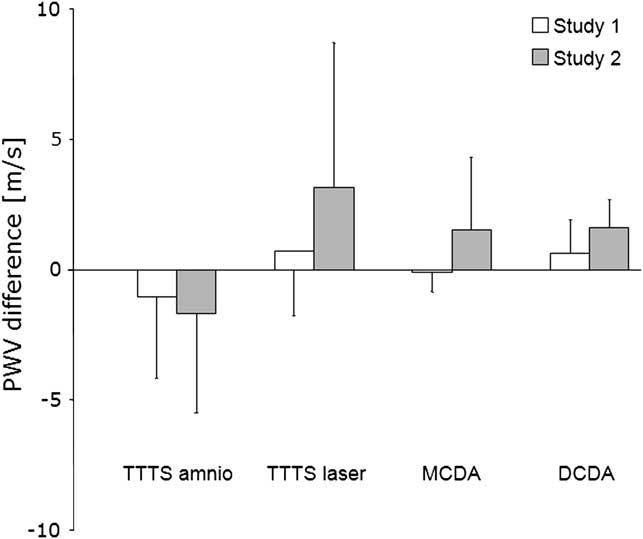
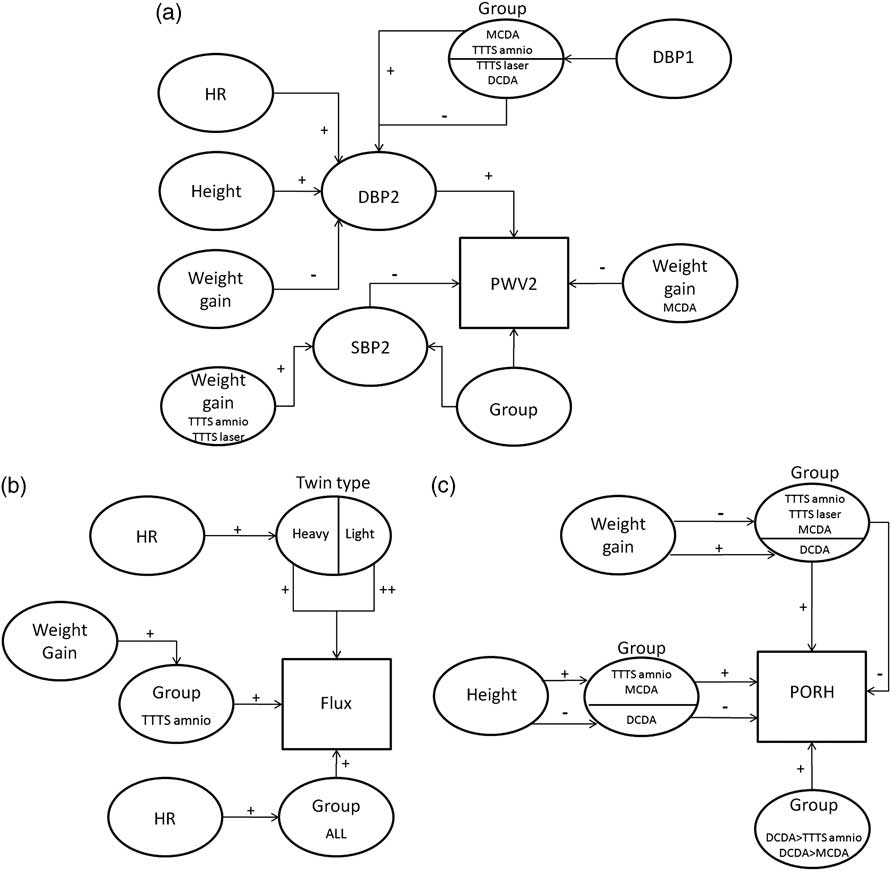
Figure 1 shows within-pair twin discordance of PWV1 and 2 in the four study groups. The pattern of discordance was similar to our first study; in TTTS-amnio the ex-donors had higher PWV2 than their ex-recipient co-twins with the reverse seen in TTTS-laser a pattern similar to DCDA. However, after adjusting for significant effects on PWV2 [group, current diastolic BP (DBP2) and SBP2 and weight gain shown in Fig. 2a] the differences between ex-recipient and ex-donor twins were not statistically significant (Tables 1 and 2). PWV2 was significantly greater in DCDA than MCDA controls (P = 0.024).
Within-pair twin differences in pulse wave velocity by group displayed as mean differences (recipient/heavier–donor/lighter twin) and 95% confidence intervals in the first (open box) and current study (shaded box). TTTS-amnio, twin-to-twin transfusion syndrome managed by serial amnioreduction; TTTS-laser, twin-to-twin transfusion syndrome managed by laser photocoagulation of placental arterio-venous anastomoses; MCDA, monochorionic diamniotic twins; DCDA, dichorionic diamniotic twins; PWV, pulse wave velocity.

Three dependency diagrams showing the nature and direction of measured variables or patient characteristics with significant effects on (a) current pulse wave velocity, (b) resting Flux measurements and (c) PORH flux response. DBP1, diastolic blood pressure measured in first study at median 11 months of age; DBP2, current diastolic blood pressure; DCDA, dichorionic diamniotic twins; HR, current heart rate; MCDA, monochorionic diamniotic twins; PWV2, current pulse wave velocity; SBP2, current systolic blood pressure; TTTS-amnio, twin-to-twin transfusion syndrome managed by serial amnioreduction; TTTS-laser, twin-to-twin transfusion syndrome managed by laser photocoagulation of placental arterio-venous anastomoses.

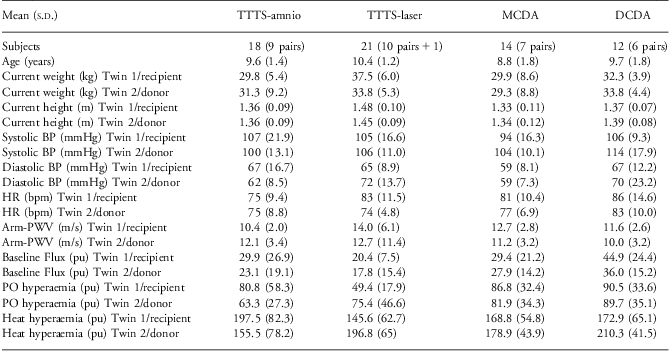
Biometric and cardiovascular variables

TTTS, twin-to-twin transfusion syndrome; MCDA, monochorionic controls; DCDA, dichorionic controls; BP, blood pressure; HR, heart rate; PWV, pulse wave velocity; PO, post occlusion.
BP
DBP
There was significant association between DBP1 measured at first study at median 11 (range 1–66) months and DBP2 in all groups. The direction of this relationship differed by group and fetal therapy: a positive association in TTTS-amnio and MCDA controls (P = 0.012) and negative in TTTS-laser and DCDA controls (P = 0.015 and P = 0.03, respectively). DBP2 was significantly lower in all three monochorionic twin groups than DCDA controls (P = 0.013). Table 2 documents the significant positive effect of HR on DBP2 (P = 0.0117) and of height on DBP2 (P = 0.003) and negative effect of weight gain on DBP2 (P = 0.016).
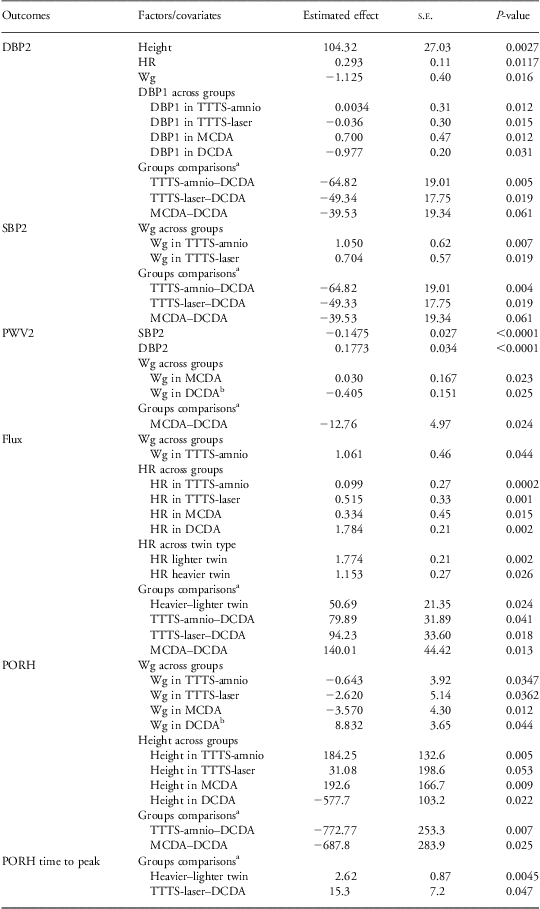
Results of mixed models methodology

DBP, diastolic blood pressure; HR, heart rate; Wg, weight gain; TTTS, twin-to-twin transfusion syndrome; MCDA, monochorionic diamniotic; DCDA, dichorionic diamniotic; SBP, systolic blood pressure; PWV, pulse wave velocity; PORH, post-occlusive reactive hyperaemic.
aAdjusting for factors and covariates in the model/only significant comparisons are shown.
bThis effect is non-significant in the other groups.
SBP
Significant effects on SBP2 are group (P < 0.0001) and weight gain since first studied (Table 2). SBP2 was significantly lower in both TTTS treatment groups than DCDA (TTTS-amnio, P = 0.004 and TTTS-laser, P = 0.02). The effect of weight gain on SBP2 was positive in both TTTS-amnio, P = 0.007 and TTTS-laser, P = 0.019 (Fig. 2a) with higher magnitude in TTTS-amnio (Table 2).
Flux
Baseline flux was comparable in the dorsum of both hands. Significant effects on resting flux were group, twin type, HR and weight gain in childhood. Flux was significantly higher in the heavier than lighter born twins (P = 0.024) and was higher in all monochorionic subjects, regardless of disease status than DCDA (TTTS-amnio, P = 0.041, TTTS-laser, P = 0.018 and MCDA, P = 0.013). The effect of HR on flux varied across twin types: positive in both (lighter-born, P = 0.002; heavier-born, P = 0.026; Table 2, Fig. 2b). Flux increases at a higher rate for the lighter twin. The effect of HR on flux was positive across groups: TTTS-amnio, P = 0.0002; TTTS-laser, P = 0.001; MCDA, P = 0.015 and DCDA, P = 0.002 (Table 2). In TTTS-amnio only, increased flux was associated with increased weight gain but this was of marginal significance (P = 0.044).
Post-occlusion hyperaemic responses
Significant effects on PORH are group, current height and weight gain in childhood. Peak flux was higher in DCDA controls than TTTS-amnio (P = 0.007) and MCDA (P = 0.025). The effect of current height and weight gain on PORH varied across groups. Current height had a positive effect for MCDA (P = 0.009) and TTTS-amnio (P = 0.005), whereas for the DCDA group it has a negative effect (P = 0.022; Fig. 2c, Table 2). For all monochorionic groups there was a negative association between weight gain and peak flux but a positive effect in DCDA of borderline significance (P = 0.044; Fig. 2c). From Table 2 PORH decreases at a higher rate as weight increases in MCDA (P = 0.012) compared with the TTTS groups (TTTS-amnio, P = 0.0347 and TTTS-laser, P = 0.0362).
Time to peak flux
The time to reach peak response was significantly higher in the heavier born twin in all groups than its lighter co-twin (P = 0.0045). TTTS-laser showed a borderline higher response than DCDA (P = 0.047).
Post-heating hyperaemic response
There were no significant inter-group or twin type effects in response to heating in the model.
Discussion
This 10-year follow-up study has shown persistence into childhood of similar patterns of within-pair twin discordance in muscular arterial stiffness, which we attribute to the effect of differing fetal therapies on the developing vascular system. Moreover, we report novel observations of the effect of monochorionicity and fetal therapy on BP and the microcirculation in childhood.
The design of this study permits us to examine vascular programming in four groups of twin pairs, each acting as its own case–control. Three groups were genetically identical monochorionic twin pairs with a single placenta whose fetal circulation was shared through placental anastomoses. The groups experienced different intrauterine haemodynamic stimuli; the controls (MCDA) had balanced within-twin pair transfusion, whereas the TTTS groups developed an imbalanceReference Mari, Roberts and Detti 2 , Reference Senat, Deprest and Boulvain 9 managed according to one of two fetal therapeutic strategies.Reference Cheung, Taylor and Fisk 5 , Reference Gardiner, Taylor and Karatza 10 Serial amnioreduction was performed throughout pregnancy to relieve symptoms in the TTTS-amnio group, but their circulations remained shared and the inter-twin transfusion continued for a median of almost 11 weeks. In contrast, the TTTS-laser group underwent laser photocoagulation of placental anastomoses at a mean of 22 weeks that halted the disease process and thereafter the twins developed with separated circulations.Reference Moise, Dorman and Lamvu 6 – Reference Senat, Deprest and Boulvain 9 The fourth study group were dichorionic controls that were dizygotic (not genetically identical), had separate placentas and some were discordant for sex.
Within-pair differences in PWV were not statistically significant when the interaction effects of current BP and size on PWV2 were considered in the model. The monochorionic twinning process is thought intrinsically pathological but the values of PWV in our study lie within expected ranges for children of similar age from singleton pregnanciesReference Cheung, Wong, Lam and Tsoi 16 and it is well established that PWV increases with age. The long-term cardiovascular consequences of twinning and their relation to birthweight were recently reported in a large cohort born between 1926 and 1958;Reference Oberg, Cnattingius, Sandin, Lichtenstein and Iliadou 17 within-pair discordance of morbidity and mortality from coronary artery disease and stroke was only related to birthweight in dichorionic pregnancies, but not in the (likely) uncomplicated monochorionic twin survivors. Although measurements of BP in our twins lie within the normal range described in children from singleton pregnancies, our results suggest that monochorionicity is associated with increased skin perfusion, lower SBP and DBP and a lower peripheral vascular resistance compared with dichorionic twinning. This implies an effect of even balanced inter-twin transfusion in fetal life on the developing vascular bed that has not been previously described. Fetal monochorionic placental anastomoses may result in a greater number of capillary vesselsReference Tapp, Williams and Witt 18 and/or increased resting vasodilatation with those sharing fetal circulations throughout pregnancy (MCDA and TTTS-amnio) having significantly reduced hyperaemic responses compared with those with either naturally separated circulations (DCDA) or those separated in mid-gestation by laser (TTTS-laser). This may be because the resting microcirculation of MCDA and TTTS-amnio is close to near maximal dilatation, perhaps because of the prolonged inter-twin transfusion during development.Reference Cheung, Taylor and Fisk 5 Whatever the cause, the apparently beneficial effects of decreased vascular resistance may be offset by a lack in the capacity of the system to respond sufficiently strongly to transient demands for greatly increased peripheral blood flow. Post-occlusion hyperaemia is a measure of the health of the cardiovascular systemReference Gardiner, Celemajer and Sorensen 19 and our results suggest that sharing a circulation may blunt vascular responses, perhaps because of impaired endothelial release of vasoactive substances such as nitric oxide or endothelin. Vascular flow, BP, oxygen availability, shear stress and tissue metabolites such as ATP, adenosine and potassium ions can stimulate production of local signals and hence determine vessel tone.Reference Ranjan, Pradhan and Chakravarthy 20 The donor fetus in TTTS shows a significant reduction of arterial, venous and atrioventricular blood flow velocitiesReference Hecher, Ville and Snijders 21 and the compensatory responses to prolonged fetal hypovolaemia include vasoconstriction to maintain cardiac outputReference Cheung, Taylor and Fisk 5 that may programme later resting vascular tone and responsiveness. In our original report, we described that PWV discordance in TTTS-amnio was similar in those with and without functional arterio-arterial anastomoses, which are thought to be protective against the development of TTTS. In this study, there was no correlation between current resting Flux levels and ratio of these vessels travelling into the opposite placental territory.
The three monochorionic groups were delivered prematurely compared with the DCDA controls and increased tortuosity and reduced vessel branching has been described in the retinal microcirculation in childhood and young adults who were born preterm and/or of low birthweight.Reference Tapp, Williams and Witt 18 However, the similarities between DCDA and TTTS-laser and the differences between the latter group and the two monochorionic groups suggest that they cannot be explained by early delivery alone and that fetal vascular programming may be altered by fetal therapy.
All monochorionic twin groups, independent of disease status, had lower SBP and DBP than DCDA controls and, unlike childhood population studies,Reference Chen and Wang 22 only DBP measured in the first study had a statistical association with current measurements – positive in MCDA and TTTS-amnio and negative in DCDA and TTTS-laser who had separated circulations. We cannot account for these findings by differing growth patterns alone, as in most same-sex pairs T1 remained heavier than T2 at 10 years and all biometry was normal. Within-pair PWV2 discordance in DCDA is less marked than we originally reported but four out of six T2 were males and were heavier and taller than their female co-twins, thus blunting within-twin pair differences.
Postnatal growth influences vascular programming.Reference Barker, Gluckman and Godfrey 15 , Reference Tapp, Williams and Witt 18 , Reference Barker, Bagby and Hanson 23 However, in our model only the control groups showed a significant effect of growth on PWV2, suggesting that the haemodynamic imbalance and fetal adaptive responses associated with TTTS may be a more potent determinant of arterial stiffness than subsequent growth, particularly in TTTS-amnio with longer disease duration. The only TTTS-laser twin pair to show a reverse pattern of PWV2 discordance (with the lighter twin at birth and at study showing higher values) was a pair with 5 kg weight discordance. This suggests postnatal differences in weight gain exerted a stronger influence on PWV2 in this pair than the disease process, perhaps because of effective fetal laser therapy.
SBP has a strong association with PWV in adultsReference Avolio, Chen and Wang 24 but DBP is an important determinant of PWV in young people because of its stronger relationship with mean arterial pressure.Reference Laogun and Gosling 25 – Reference Cruickshank, Riste and Anderson 27 In our statistical model, SBP had a negative effect on PWV and DBP a positive one. Lower BP, PWV and increased vasodilatation were associated with a shared, balanced, fetal circulation as in MCDA controls where the fetal vasculature is connected by large anastomotic vessels that provide a pressure ‘run-off’ between the two fetuses and their placental territories. In this setting, haemodynamic changes are not driven by the balance of placental and brain distal impedances as in singleton and DCDA pregnancies. Laser therapy works by dividing placental anastomoses, thus effectively creating a ‘dichorionic’ placenta, and provides a possible explanation for the similarities in vascular behaviour between TTTS-laser and DCDA cohorts.
Limitations
We used Doppler flow velocimetry at the upstream site to measure PWV2, thus detecting the flow pulse; whereas at the downstream site we used a photoplethysmographic finger probe, which detects fluctuations in blood vessel volume and diameter.Reference Kontis and Gosling 12 Usually, the flow phase precedes the pressure and diameter pulses,Reference Nichols, Conti and Walker 28 so PWV measured in this way would be higher than that derived from two pulses of the same type. However, at the high frequencies associated with the foot of the systolic wave this phase difference tends to zero.Reference Newman, Sipkema and Greenwald 29 Irrespective of the way in which the pulse is detected, any errors will be systematic with minimal effect on relative PWV values. The ability of oscillometric devices, such as the one used in this study, to measure true (i.e. intraarterial) SBP and DBP has been questioned.Reference Smulyan and Safar 30 However, in the absence of an up-to-date theoretical treatment of the interaction between the brachial artery and a BP cuff, we note that interpretations of SBP and DBP obtained non-invasively should be treated with caution.
Conclusions
This study supports the concept that inter-twin haemodynamics, growth and fetal therapy programme vascular behaviour, particularly of the microcirculation, in monochorionic pregnancies, even when apparently balanced. Although not statistically significant, a similar pattern of within-twin pair differences in arterial stiffness to that seen in infancy was found. This study raises important questions of the ability of the measurement of arterial stiffness and microcirculatory responses in early childhood to predict future cardiovascular disease.
Acknowledgements
This work was supported by the Richard and Jack Wiseman Trust (grant number WSCR-P32949 to H.M.); Tiny Tickers (grant number DPRSM-P00563 to H.M.); a Pathological Society intercalating student bursary (grant number 200808 to A.B.); the National Institutes of Health Research Biomedical Research Centre funding scheme and Genesis Research Trust. The funding sources had no involvement in the study design; in the collection, analysis and interpretation data; in the writing of the report; and in the decision to submit the paper for publication. Anthropometric equipment was loaned by the Child Growth Foundation.