Globalization in the 20th century has opened a window of opportunity for individuals to migrate across borders. As the world's biggest developing country, China is experiencing unprecedented population inflows and outflows, contributing 10 per cent of the total immigrants into OECD countries.Footnote 1 At the same time, the country has proven quite vulnerable to the outflow of human talent. Of the 2.24 million students and scholars that have gone overseas since 1978, only one-third have returned home.Footnote 2
Realizing the severity of the “brain drain,” the central government launched a global expert recruitment programme in 2008, known as the 1,000-Talents Plan, which aims to repatriate thousands of overseas experts in the next five to ten years. Each selected individual receives one-time subsidies and various welfare benefits from the government.Footnote 3
Provinces and cities have adopted their own initiatives and compete to attract overseas talent. By the end of 2011, over 3,000 preferential return migration policies had been implemented by different levels of government.Footnote 4 For example, in Shenzhen, returning experts may enjoy 80,000–150,000 yuan bonuses, as well as preferential treatment for spouse employment, child education, taxation and health care. Jiangsu plans to invest three billion yuan in the coming five years to recruit 1,000 leading scientists and 10,000 entrepreneurs. Beijing is building 10,000 apartments for returning experts.Footnote 5
These policies have given rise to heated societal debates. During the 2009–2010 annual meetings of the Chinese People's Political Consultative Conference, several members criticized the central government's policies as “giving up a son to get a son-in-law.”Footnote 6 Between 2009 and 2012, a total of 468,032 entries on Sina Weibo discussed return migration policies, and more than 2.7 million entries discussed returnees.Footnote 7 “No wonder people with money are crazy about sending their kids abroad,” writes one netizen. “Their families are rich in the first place, and they get even richer as returnees. How will those poor but hard-working kids survive?”Footnote 8
There is a rich scholarly literature that explains the determinants of attitudes towards immigration policies in the US and other developed democracies. Negative perceptions of immigrants likely stem from a combination of factors: concerns about competition in the labour market; fears that immigrants are a net fiscal burden because of their high demand for public goods and use of the welfare safety net; and cultural prejudice.Footnote 9 Yet, we know very little about the opposite side of this equation – how citizens in developing countries perceive efforts to bring talent home. Among Chinese citizens, what determines individual attitudes towards returning migrants and preferential return migration policies? What constraints does the CCP regime face as it seeks to stem the “brain drain?”
We answer these questions using an original survey experiment of Chinese netizens, supplemented with semi-structured interviews with citizens affected by return migration. In line with existing research on the US setting, our survey randomly exposes respondents to different types of preferential return migration policies, and then asks them about their level of policy support.Footnote 10 The results suggest that citizen attitudes are driven by two competing perceptions. On one hand, skilled migrants are widely thought to have a beneficial effect on the local economy. In line with the societal gains model from the immigration literature, respondents prefer policies that encourage the return of professors and entrepreneurs over policies that attract overseas students, which are thought to bring fewer benefits.Footnote 11 However, on the other hand, ordinary citizens exhibit inequity aversion and may be wary of policies that offer elite returnees exorbitant benefits.Footnote 12 Once the level of benefits exceeds a certain amount, policy support significantly decreases, as do perceptions of the returning migrants themselves.
The findings imply that stemming the “brain drain” presents the Chinese government with a key strategic trade-off. Although domestic support for preferential return migration policies is generally high, the regime may face a difficult choice between the benefits of skilled migrants and the costs of increasing inequality concerns. If concerns over inequality continue to rise, the CCP may be faced with hard constraints as to how much it can stem costly emigration.
The remainder of the paper is structured as follows. The next section summarizes the existing literature. We then highlight differences between the nature of immigration and return migration, and develop our own hypotheses on citizens' attitudes towards return migration. The following sections outline the research design and data-collection process. Next, we test our theory using data from the survey experiment, and supplement the analysis with citizen interviews. The paper concludes with a note on the implications of the findings.
Existing Literature and Hypothesis
Existing work offers several frameworks for considering the determinants of public opinion towards immigration. Citizen attitudes may originate from variations in competition in the labour market; the societal contributions of different groups; the fiscal burden imposed on the state; and ethnocentrism, racism and nationalism. Proponents of the labour market competition model argue that economic concerns drive anti-immigrant sentiment. Immigrants introduce competition into the domestic labour market, and locals will oppose the immigration of individuals with skill levels similar to their own. Studies by Scheve and Slaughter, and Mayda, find a strong positive correlation between respondents' skill levels and stated support for immigration.Footnote 13 The findings are interpreted as evidence that low-skilled natives fear being forced to compete with low-skilled immigrants. In their recent study, Malhotra, Margalit and Mo oversample areas with more IT workers, and find a significant association between perceived labour market competition and views on immigration.Footnote 14
Other scholars have argued in favour of a societal gains model, which emphasizes that citizens look more favourably on the immigration of groups that contribute most to the economy, regardless of whether they increase direct competition in the labour market. Hainmueller and Hiscox show that US citizens of all education and income levels display a clear general preference for high-skilled immigrants, which is taken as evidence against the labour market competition model.Footnote 15 Attitudes towards immigrants stem from perceptions of their impact on the nation as a whole, and high-skilled immigrants contribute more in terms of innovation and economic growth.Footnote 16
Proponents of the fiscal burden model argue that attitudes are driven by perceptions of immigrants' use of public services and their contribution to tax revenue. Low-skilled immigrants impose a substantial net burden on public coffers, whereas high-skilled immigrants are net contributors in terms of taxes. Survey data shows that high exposure to immigrant fiscal pressures reduces support for immigration.Footnote 17
Finally, a number of studies suggest that opposition to immigration is primarily driven by non-economic concerns including ethnocentrism, racism and nationalism.Footnote 18 Citizens are more inclined to support immigrants from their own ethnic groups, and negative perceptions may be fuelled by racial or nationalist sentiments.
To date, there has been no theoretical or empirical work that explores public opinion towards return migration. We are wary of exporting the immigration frameworks directly to return migration, as there are major substantive differences between these two processes. Immigration policy typically involves the regulation of non-citizens coming from a diverse array of cultural backgrounds and education levels. Return migration policy – in China and elsewhere – involves encouraging citizens to return to their country of origin, usually with the promise of some form of preferential treatment. In the Chinese context, the vast majority of returning migrants are highly skilled and are already considered elites by virtue of their experiences abroad.
These differences suggest that certain determinants of attitudes towards immigration are not central to understanding attitudes towards return migration. Because returning Chinese migrants are already citizens and do not need to assimilate, we do not expect that racial or ethnocentric concerns shape citizen attitudes. Similarly, highly skilled returning migrants tend to contribute more to government coffers than they consume, and so fiscal concerns should be minimal. Fear of labour competition should also be less relevant, as there tends to be a large skill gap between returning migrants and average citizens.Footnote 19 Returning experts and entrepreneurs are not in direct competition with most citizens, who work in entirely different industries and sectors.
Our core theoretical intuition hinges on the idea that returning migrants are generally highly skilled elites and that this brings competing influences on public opinion. On the one hand, these individuals are perceived to contribute to economic growth and development. The rise in preferential return migration policies in China speaks to the expected societal contributions of these highly skilled citizens. In line with the societal gains model, we believe that citizens in developed countries will generally be supportive of policies that promote return migration.
On the other hand, policies that confer benefits on highly educated elites can trigger resentment and heighten perceptions of inequality. Economic transitions are often accompanied by rising public concern over the distribution of wealth and opportunity, a concern that actively contributes to policy attitudes. Lu, Scheve and Slaughter argue that differences in trade protection can be understood through the lens of inequity aversion, that is, the tendency for individuals to dislike policies that exacerbate inequality. Survey experiments of respondents in both China and the US show that individuals are less supportive of trade protection for sectors with workers who have higher earnings.Footnote 20
It is important to note that we use the phrase “inequity aversion” in a broad sense to capture two closely related sentiments. The phrase refers both to citizens' antipathy towards economic inequality and disparities in income distribution, as well as antipathy towards unequal and unfair policies in general. In the Chinese case, domestic citizens, especially those with a lower income or social status, may oppose giving generous levels of benefits to returning migrants who are already high earners. Some citizens may also exhibit resentment not because of concerns about the income distribution, but because preferential return migration policies distribute benefits in an unfair way.Footnote 21 We consider both feelings to be part of the larger concept of inequity aversion.
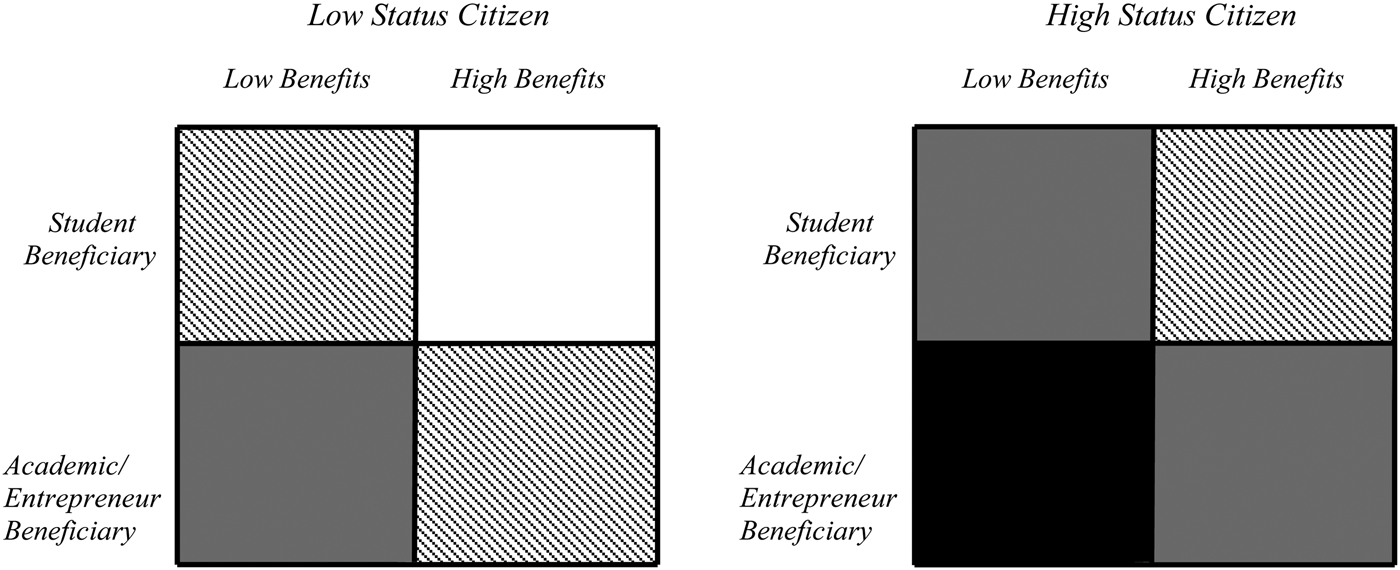
We expect these two competing influences – societal gains and inequity aversion – to drive variance in policy attitudes across three dimensions: the target beneficiary of the policy; the level of benefits conferred; and the socio-economic status of the citizen respondent. Figure 1 visualizes our core hypotheses. Black areas represent policy combinations where we expect high support levels. Grey, striped, and white areas signify progressively lower levels of support.
Theory Summary – Hypothesized Policy Support Levels
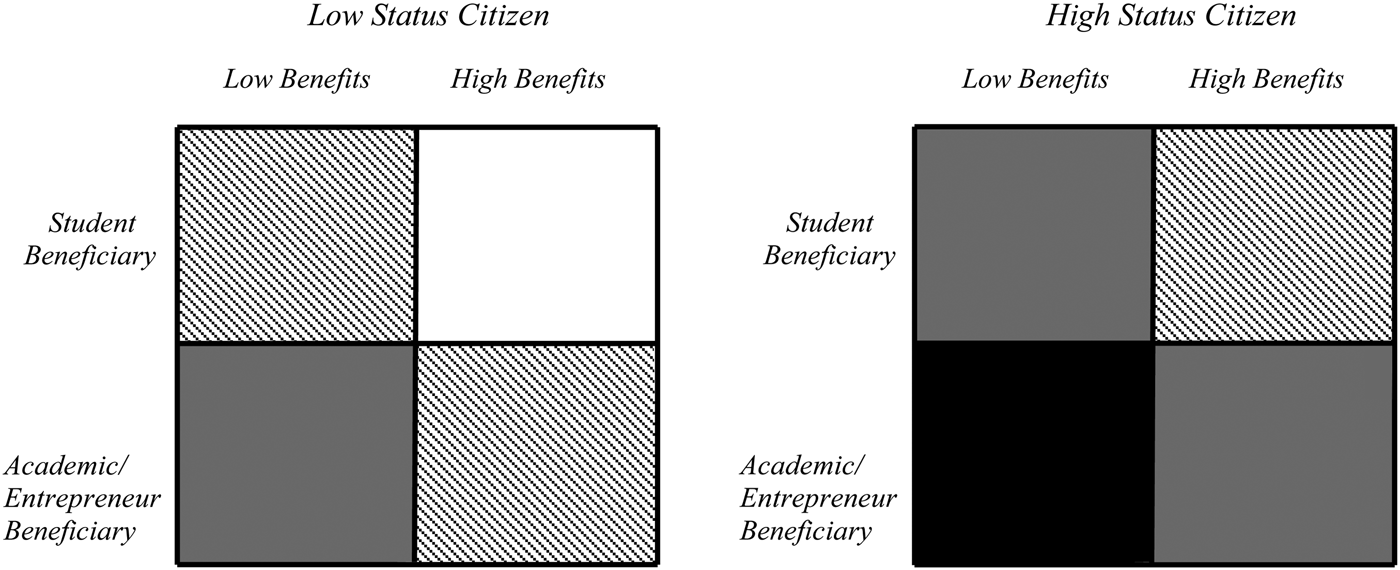
First, we expect to observe variance in attitudes to be driven by the identity of the target beneficiary. Tests of various theories in the US consider differences in the perceptions of high-skilled and low-skilled immigrants.Footnote 22 The high-skilled/low-skilled dichotomy proves less applicable in China, but migrants still vary in terms of their perceived societal contributions. Entrepreneurs, especially those with ties abroad, can create jobs and investment opportunities. Academic experts play an important role in policymaking and strengthen China's burgeoning tertiary education system. We expect to observe that respondents favour policies that encourage the return migration of entrepreneurs and professors, relative to students.
While the societal gains logic should boost general support, citizens may also be wary of policies that exacerbate income inequality and distribute benefits to this privileged group of new elites. Inequity aversion should produce two observable implications. First, those at the bottom of the income distribution should exhibit the lowest levels of support for preferential return migration policies. Second, support should be negatively associated with the level of recipient benefits. As policy benefits pass beyond a certain threshold, concerns about inequality should overwhelm the perceived gains of attracting overseas talent.
To summarize, we expect support will be highest for policies that target academics/entrepreneurs with relatively low benefit levels, and among high status respondents. Conversely, policies that give high levels of benefits to returning students will garner less support, especially from lower status citizens. In the following sections, we present evidence from the survey experiment and interviews used to test these hypotheses.
Data and Research Design
Sample
The data for this project comes from the China Policy Attitudes Survey (CPAS), an online survey conducted in October 2012 in partnership with China Online Marketing Research (COMR).Footnote 23 Like many marketing firms, COMR maintains an online panel of respondents who complete surveys in exchange for small cash payments and the opportunity to win larger prizes. COMR uses several methods to enrich their panel (print and television advertising, search engine marketing, member referrals, etc.) and currently has over two million respondents covering all elements of Chinese society.Footnote 24 Respondents for the sample are drawn randomly from this panel. In total, 10,000 survey solicitation links were sent out, yielding a sample of 2,270 responses.
It should be emphasized that the CPAS sample is by no means representative of the Chinese population – only 39.9 per cent of citizens (538 million) had internet access in June 2012 – but it can be considered loosely representative of the online population. These citizens tend to be younger, wealthier and more likely to live in urban areas. Our sample is also relatively highly educated, with roughly 70 per cent of respondents receiving some university education. Despite these differences, we believe it is particularly important to examine netizens' opinions on policy matters surrounding return migration. More urban and educated netizens are likely to be affected by preferential return migration policies, and their opinions serve as an important reference to policymakers evaluating the feasibility of different programmes. In addition, the majority of China's returning migrants choose to settle in big cities.Footnote 25
Survey questions
The CPAS uses a series of questions to measure opinions on politics and policy in China. Following Hainmueller and Hiscox, we asked respondents about their approval levels of different government return migration policies, but randomly varied the nature of those policies across different respondents. We then compared average approval levels across different policy attributes, which allows us to see what types of policies are more or less popular.Footnote 26
Survey Experiment Measures
E1. Suppose that your city government planned to implement policies to attract more overseas [students/professors/entrepreneurs] to settle here and work over the next three years. What is your degree of support for this policy?
5 - Completely support (wanquan zhichi 完全支持)
4 - Support (zhichi 支持)
3 - Difficult to say (hen nanshuo 很难说)
2 - Do not support (bu zhichi 不支持)
1 - Do not support at all (genben bu zhichi 根本不支持)
9 - No answer (bu huida 不回答)
E2. Suppose that the Chinese government adopted a new policy, if [students/professors/entrepreneurs] who are studying or working abroad return to work, they will receive [no special benefit/a 10% salary increase over their domestic counterparts/a 30% salary increase over their domestic counterparts/a 50% salary increase over their domestic counterparts]. What is your degree of support for this policy?
5 - Completely support (wanquan zhichi )
4 - Support (zhichi )
3 - Difficult to say (hen nanshuo)
2 - Do not support (bu zhichi )
1 - Do not support at all (genben bu zhichi )
9 - No answer (bu huida )
The theoretical arguments suggest we should consider how respondents view return migration policies targeting different recipients and with different benefit levels. We can also explore how policy dimensions interact with the demographic attributes of the respondents themselves in shaping their support. We used two questions to measure policy support. The first randomly assigned respondents to one of three groups, and showed them a policy designed to attract either overseas students, professors or entrepreneurs. The second question assigned respondents to one of eight groups, each with a different beneficiary and benefit level. We then asked for their degree of policy support on a five-point scale. The survey questions for these measures are displayed in Box 1.
After these questions, respondents answered additional questions on their attitudes towards returning migrants – for example, whether they are knowledgeable, easy to get along with, passionate about their jobs, and so forth. This allows us to investigate an additional set of outcomes as well as to observe whether respondents' attitudes towards migrants shift as a result of the policies they are exposed to.
Analysis
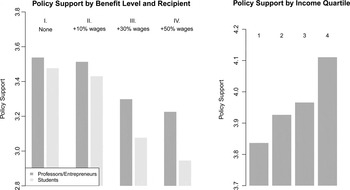
Figure 2 provides a visual summary of some of the main results. The left panel examines policy support for return migration policies at different benefit levels, for different types of returning migrants, using the responses from question E2. General policy support is high, and respondents express higher levels of support when exposed to a policy targeting professors/entrepreneurs compared to one with a student beneficiary. We observe a similar pattern when we examine support levels across the three different treatment groups to question E1. On average, respondents who viewed a policy encouraging the return of overseas students expressed a support level of 3.70 out of 5, compared with 4.01 for the “professors treatment” and 4.05 for the “entrepreneurs treatment.”
Summary of Key Empirical Results

Responses also show evidence of inequity aversion. Figure 2 shows that support for the return migration policy is generally high but it declines noticeably as wage benefits increase. Respondents generally tolerate a 10 per cent wage premium, but a 30 per cent premium brings a significant decline in support, and support for a 50 per cent premium further declines. The right panel shows how support varies (using question E1) across respondents of different income quartiles.Footnote 27
Low status respondents, as measured by income, prove less supportive of policies designed to promote return migration.Footnote 28
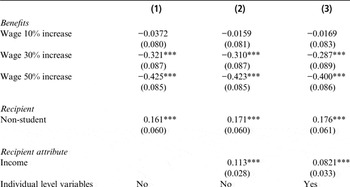
Table 1 illustrates the quantitative results more formally with linear regressions of policy support on the different characteristics of returning migrants (policy beneficiary) and policy benefit levels. Model 1 includes just the policy attributes, while Models 2 and 3 also include the respondent income quartile variable. Model 3 includes additional individual-level variables (indicators for low education level, rural/urban background, CCP membership, gender, minority, age, marriage status, and experience abroad).Footnote 29
Determinants of Policy Support

Note:
Table 1 shows linear regressions of policy support on different benefit levels. The baseline is the policy with no benefits targeting a student group. Model 3 includes individual-level variables. Robust standard errors in parentheses. *p < 0.1, **p < 0.05, ***p < 0.01.
The substantive story remains the same throughout and is consistent with the theory. Targeting a non-student beneficiary (professors/entrepreneurs) increases policy support. Lower status respondents are less likely to vocalize support. Increases in benefits for returning migrants seem to reduce support markedly.
After indicating their level of policy support to question E2, respondents were asked to provide assessments of the returning migrants themselves. We can see whether the nature of the policy in previous questions is related to how respondents perceive returning migrants in general.
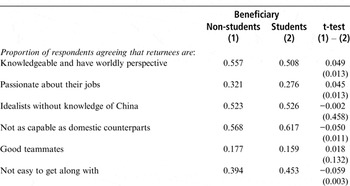
Table 2a illustrates the differences in how respondents assessed migrants by the beneficiary group of question E2. The data shows that when respondents were exposed to a policy that benefits professors/entrepreneurs in question E2, this resulted in more positive assessments of returning migrants as a whole in the following question E3. Conversely, observing a policy benefiting returning students made respondents more likely to agree that returnees were not easy to get along with, were not necessarily more capable than their domestic counterparts, and were less knowledgeable. These patterns suggest that respondents generally have more negative conceptions of returning students and more positive assessments of returning professors/entrepreneurs. This also gives support for the assumption that student returnees are perceived as making a smaller societal contribution.
Attitudes towards Returning Migrants by Policy Beneficiary

Note:
The table compares assessments of returning migrants according to the nature of the policy in the previous question, and whether the recipient beneficiaries were professors/entrepreneurs (non-students) or students (students). P-values from difference of means tests are shown in parentheses.
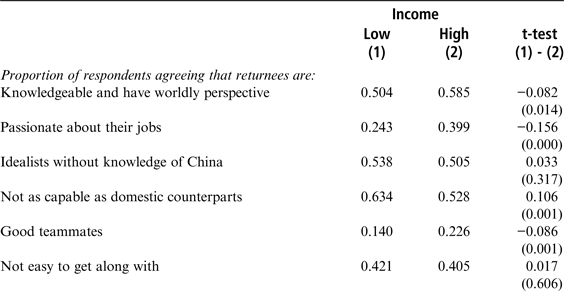
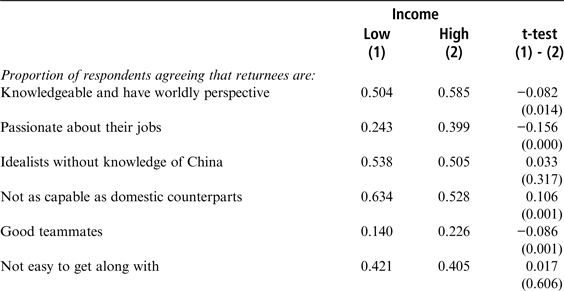
There is also evidence that low status citizens hold less favourable attitudes towards the migrants themselves, and that generous benefit packages heighten these tensions. Table 2b shows simple difference-of-means tests across income for the different assessment questions. The data shows that low- (bottom quartile) and high- (top quartile) income respondents have different perceptions of returnees. High-status respondents hold positive attitudes in general, and they are more likely to feel that returnees are knowledgeable, passionate and good teammates. Low-income respondents are more likely to believe that returnees are idealists who lack knowledge of the Chinese context.
Attitudes towards Returning Migrants by Respondent Income
Note:
Columns 1 and 2 compare assessments of returning migrants by the status level of the respondent, below average status (Low) versus above average status (High). P-values from difference of means tests are shown in parentheses.
Interview Evidence
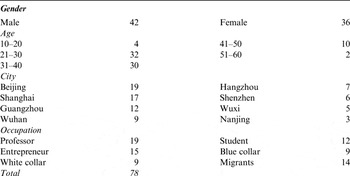
Results from the survey experiment illustrate how citizens' attitudes towards returning migrants change according to the type of returnees as well as the nature of preferential policies. To probe the argument further, we conducted 78 semi-structured interviews with domestic Chinese citizens between June and December 2013. The interview pool is not a representative sample. We purposefully focused on citizens who live in bigger cities, as most of China's returning migrants choose to settle there. We sampled heavily on university professors and entrepreneurs because they are relatively under-represented in the survey but may be in direct competition with many highly skilled returning migrants. We also interviewed migrant workers to learn whether low-income earners hold different attitudes towards returning migrants. Table A1 in the Appendix presents a summary profile of our interview subjects.
The interviews involved questions similar to those in the survey. We asked interviewees about their attitudes towards China's repatriation policies and their perceptions of the returning migrants, and encouraged them to express freely their interactions with returnees around them.
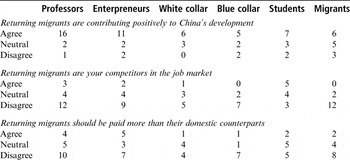
Table 3 provides a summary of the interviewees' responses to our more structured questions. Interviewees, especially those who are highly skilled, tended to recognize the contributions returning migrants made in Chinese society. Sixteen of the 19 professors and 11 of the 15 entrepreneurs we interviewed agreed with the claim that “returning migrants are contributing positively to China's development.” One associate professor from Hangzhou Normal University said, “Returning professors have connections with leading scholars overseas. They are a driving force in organizing international conferences that bring big names in the field to our departments, allowing us to talk to those people who we'll never meet otherwise.”
Summary of Interview Subject Attitudes

Note:
These responses are drawn from 78 semi-structured interviews with Chinese citizens conducted by the researchers between June and December 2013.
Many of our academic interviewees expressed excitement about the educational benefits of returning experts, but some noted material benefits as well. One professor from a university in Shanghai said, “we get referral benefits by successfully persuading overseas professors to work in our department.” His words accord with previous scholarly findings. According to Zweig and Wang, in some provinces, if a university brings in a candidate who is approved as a national-level expert, the school gets 12 million yuan ($2 million).Footnote 30 While the returnee gets the bulk of the funds for his own research, the dean redistributes some to other faculty, making the recruitment a positive event for the whole university.
The fact that the majority of professors welcome returning experts would suggest that competition for jobs is not a major concern. Indeed, when directly asked if they believe returning migrants compete with them, only three out of 19 professors gave a positive answer. One professor revealed that in many major Chinese universities, there are now two separate systems for domestic professors and returning experts. Returning experts are usually placed in newly created centres rather than in regular departments. These centres emulate a standard tenure-track system and incentivize returning scholars to publish as much as they can, which helps the department improve its academic reputation. Domestic professors, on the other hand, stay safely in the old administrative system, with lower pay but safer job prospects.Footnote 31
Entrepreneurs held similar positive attitudes towards returning migrants, but for very different reasons. Comments from one established entrepreneur in Wuhan are representative: “We can be partners because we have different comparative advantages. They [returning migrants] have technology and we have business experience and local connections. Both are crucial for business success.” Like professors, the majority of the entrepreneurs interviewed (nine out of 15) also did not see returnees as competitors. Other entrepreneurs pointed out that, owing to different comparative advantages, domestic and returning entrepreneurs often focus on different industries. Returnees gravitate towards high-tech industries while domestic businessmen concentrate on traditional ones and rely more on local connections.
Even though domestic citizens hold positive attitudes towards the return of skilled migrants in general, many expressed concerns about the nature of the preferential packages. Ten out of the 19 professors we interviewed disagreed that returnees should be paid more just because of their overseas experience. One dean from a university in Wuhan explained:
I admit those experts played a role in improving the ranking of my department, but I think they are overpriced. As a dean, my annual salary is 200,000 yuan, and we pay the returning expert, who rarely shows up in the department, 800,000 yuan a year. Does that mean his contribution to the department is bigger than mine? Even if so, is his contribution necessarily four times that of mine?
Entrepreneurs also voiced fairness concerns, but again, for different reasons. “The government gives them free office space, reduced tax rates, and starting funds even before the firms begin to operate,” said a businessmen in Wuxi, “but many of them don't know how to do business in China. Such policies are clearly against the principals of a market economy!”
Of the low-income respondents, who struggle to make their living in big cities, seven out of nine (78 per cent) blue-collar workers and eight out of 14 (57 per cent) low-skilled migrants interviewed held negative attitudes towards the preferential treatment returnees receive. Our interviews reveal that the main concerns of low-income citizens relate to the increased income inequality that these policies may induce. A waiter in a Shenzhen restaurant put it bluntly:
I work hard for 12 hours everyday, and my life-time salary won't allow me to buy an apartment in Shenzhen. They show up on TV and criticize things on Weibo as they like, yet the government gave them one million up front with various other benefits. If the government has money, why doesn't it increase our minimum wage? We need much more help than them!
Interestingly, while complaining about the widening wage gap between the rich and poor in China, many wage earners and migrant labourers expressed a desire to send their children abroad for education in the future so that they too could enjoy the benefits of becoming a returnee. “I will save every penny to send my son to study in the US, so that when he comes back, he'll be treated like a VIP,” said one taxi driver in Beijing.
Conclusion
Despite the relevance of the “brain drain” problem in China and elsewhere, to date, there have been no systematic empirical studies examining public opinion towards returning migrants and the policies that promote return migration. The results of our survey experiment and interviews show that respondents generally welcome the return of skilled migrants. In line with the societal gains model, netizens tend to support the return of those returnees they perceive as the most helpful to the nation, namely professors and entrepreneurs. In this regard, China's current return migration policies, which focus largely on these two groups, seem in accordance with public opinion.
Citizen support is not without reservation, however. Respondents also exhibit an aversion to policies that exacerbate inequality and provoke fairness concerns. Low-status respondents are less likely to support efforts to recruit skilled migrants and hold more negative attitudes towards returnees in general. Across all respondents, support for favourable return migration policies decreases once the level of benefits exceeds a certain threshold. These patterns were confirmed in our citizen interviews. Subjects simultaneously extolled the benefits of bringing back overseas talent while lamenting the lack of fairness in these policies. Combined, these findings imply that the Chinese government faces a clear trade-off between slowing reverse migration flows and exacerbating societal tensions.
Our results from the Chinese context contribute to several larger debates about citizen attitudes and skilled migration. Instead of economic competition or ethnocentric concerns, we believe return migration is best understood through the competing perceptions of societal benefits and inequity aversion. The current constellation of public opinion in China is the product of several forces: growing government and societal concern about the “brain drain” problem; the emergence of preferential return migration policies; dynamic economic growth and social change; and rising inequality concerns. Similar forces appear to be at work in many emerging economies. In Ghana, the government is currently developing the Diaspora Engagement Project, which aims to engage Ghanaians abroad in attractive work opportunities at home.Footnote 32 Beginning in the 1990s, the federal government in Mexico adopted a series of policies, entitled the Program for the Support of Science and Research, which was designed to encourage the return of young Mexican scientists through favourable employment conditions.Footnote 33 Pakistan's National Emigration Policy offers incentive packages and income generation opportunities for returning skilled migrants.Footnote 34 The societal gains and inequity aversion concepts appear to have explanatory power in the Chinese case, and future research should explore whether they help to account for citizen attitudes towards return migration in other contexts.
Appendix
Interview Subject Backgrounds