Introduction
Chemoradiation, in addition to surgery, with total mesorectal excision has been shown to improve local recurrence rates and overall survival for rectal cancer patients.Reference Krook, Moertel and Gunderson 1 , Reference MacFarlane, Ryall and Heald 2
Small bowel is the major dose-limiting organ in pelvic radiotherapy.Reference Gallagher, Brereton and Rostock 3 The relationship between irradiated small bowel volume and toxicity is well established.Reference Baglan, Frazier, Yan, Huang, Martinez and Robertson 4 The tolerance of small bowel to radiotherapy has been defined as 50 Gy in 1·8–2 Gy daily fractions to one-third of the small bowel producing grade 3 or 4 toxicity in 5% of patients at 5 years (TD 5/5).Reference Emami, Lyman and Brown 5 The dose–volume relationship of acute small bowel toxicity from concurrent chemoradiotherapy for rectal cancer has been investigated and the volume receiving at least 15 Gy (V15) was strongly associated with the degree of grade 3+ acute toxicity.Reference Baglan, Frazier, Yan, Huang, Martinez and Robertson 4
Of the methods investigated to reduce the volume of small bowel in the radiation field, prone positioning and bladder distension are the most widely used.Reference Cole 6 , Reference Gunderson, Russell, Llewellyn, Doppke and Tepper 7 The prone position is inherently non-reproducible compared with the supine position. Various immobilisation devices, including Belly Board, have been designed to overcome this and although median reduction in irradiated small bowel volume in rectal and gynaecological cancers ranges from 59–70%Reference Das, Lanciano, Movsas, Kagawa and Barnes 8 – Reference Huh, Lim and Ahn 10 , the Belly Board has not been widely accepted in clinical practice. There is very limited data that helps in investigating the effect of a Belly Board device on positioning accuracy and reproducibility. One non-randomised study that investigated the above found positioning errors of 0·6–1·8 mm with standard deviations (SD) of 4·4–6·8 mm and advised a clinical target volume (CTV) to planning target volume (PTV) margin of 1·5 cm.Reference Rudat, Flentje, Engenhart, Metzger and Wannenmacher 11
Three-dimensional conformal radiotherapy (3DCFRT) and intensity-modulated radiotherapy (IMRT) techniques have been shown to reduce the volume of irradiated small bowel.Reference Olofsen-van Acht, Quint and Seven 12 , Reference Portelance, Chao, Grigsby, Bennet and Low 13 Analysis of bowel exposure by using IMRT for rectal cancer by Nijkamp et al.Reference Nijkamp, Doodeman, Marijnen, Vincent and van Vliet-Vroegindeweij 14 showed reduced doses to the bowel when Belly Board has been used. In addition, recently published systematic review of the Belly Board device use in pelvic radiotherapy found reduction in small bowel volume irradiation in prone treatment position with the addition of Belly Board.Reference Wiesendanger-Wittmer, Sijtsema, Muijs and Beukema 15 Nevertheless, quantifying patient set-up reproducibility is a prerequisite for both 3DCFRT and IMRT for determination of CTV to PTV margins.Reference Bidmead, Coffey and Crellin 16 More accurate set-up reproducibility can provide evidence to reduce CTV to PTV margins, thereby reducing normal tissue toxicity.
The aim of this study was to evaluate the efficacy of a prototype Belly Board immobilisation device designed with both patient stability and comfort in mind. Patient set-up reproducibility, the volume of small bowel irradiated, patient comfort, ease of set-up and acute toxicity of treatment were investigated.
Methods and materials
Trial design
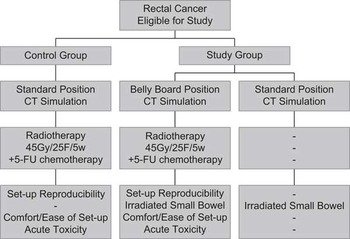
A randomised trial was established for which both R&D and ethics board approvals were gained. The trial schema is shown in Figure 1. Patients in the control arm were positioned according to our standard departmental protocol. Patients in the study arm were treated using a prototype Belly Board made of hollow core carbon fibre.
Trial schema.

Patient eligibility criteria
Patients with biopsy-confirmed rectal adenocarcinoma where the disease was considered at high risk of local recurrence by magnetic resonance imaging staging (and therefore neo-adjuvant chemoradiotherapy indicated) were eligible. Patients needed to be more than 18 years of age, of ECOG performance status 0–2 and able to give their informed consent. Patients had to be able to fit through the bore of the departmental Picker PQ5000V CT scanner (Picker Corporation, Colorado, USA) on the Belly Board and be independently mobile to get into either treatment position. Exclusion criteria included evidence of distant metastases by staging computed tomography (CT) scan, prior pelvic radiotherapy, neo-adjuvant chemotherapy and contraindication to 5 FU.
Patient positioning and virtual simulation
Patients in the control arm were positioned prone with their arms above their head. Patients in the study arm were positioned on the Belly Board with their head supported in a neutral position by a vented prone pillow. Both the board and the pillow were indexed to the treatment couch using an adapter plate. One of three different-sized inserts (small, large and solid) was used. All patients were asked to have their bladder comfortably full.
CT data acquisition was obtained from the superior aspect of the third lumbar vertebra to 5 cm below an anal marker using a slice thickness of 3 mm. Oral contrast was given 45 minutes before scanning to aid accurate small bowel delineation. The control group was scanned in the standard position only. Patients in the experimental arm were scanned in both the Belly Board and standard positions to allow comparison of irradiated small bowel volume. This was performed consecutively to avoid differences in bladder filling. Target volumes and field borders were defined using AcQSim virtual simulation software. CTV to PTV margin of 1·5 cm was added.Reference Rudat, Flentje, Engenhart, Metzger and Wannenmacher 11 Standard field borders (details in supplementary material) were placed on both CT planning scans for patients in the study arm by the same clinician. Individualised multileaf collimator shielding was used at the clinician’s discretion.
Radiotherapy planning and treatment schedule
All patients received the same chemoradiation schedule. Radiotherapy was delivered using a three-field beam arrangement (posterior and two wedged-lateral fields), 6 and/or 10 MV photons, to a dose of 45 Gy in 25 fractions delivered daily Monday to Friday over 5 weeks; 5 FU chemotherapy (weeks 1 and 5) was given as a radiosensitiser.
Patient set up and reproducibility
Set-up reproducibility was assessed using electronic portal imaging (EPI). Orthogonal posterior and lateral isocentric images were acquired weekly. EPIs were matched to digitally reconstructed radiographs (DRRs) according to departmental protocol by single investigator to eliminate inter-observer variability. Image Track software was used for image analysis and calculations of random and systematic set-up errors in anterior–posterior (AP), left–right (LR) and cranio–caudal (CC) directions.Reference Morgan and Greener 17 Separate measurements of CC displacement were possible from both the posterior and lateral images. This resulted in a total of 16 measured parameters from each group.
The number of intra-fraction interventions made by treatment radiographers was recorded. First-day in vivo entrance dose diode readings on the central axis of all treatment fields were recorded and compared to detect possible set-up variation. Difference in reading of >5% from expected was defined as ‘out of tolerance’.
Irradiated small bowel volume
Contrast-enhanced individual small bowel loops were outlined on both CT scans in the study arm by a single investigator and checked for consistency by a second investigator. The volume of small bowel receiving at least 15 Gy (V15) was determined and compared.
Patient comfort and ease of set up
To assess patient comfort a validated linear analogue scale questionnaire for comparisons of radiotherapy set-up positioning was adapted.Reference Greener 18 The ease of set up was assessed in the final week by a radiographer treating the patient. Details of questionnaires used can be found in the supplementary material.
Acute toxicity assessment
Acute toxicity was assessed each week using the National Cancer Institute Common Terminology Criteria for Adverse Events v3·0.Reference Trotti, Colevas and Setser 19
Trial endpoints
The two primary endpoints were reproducibility of patient positioning and small bowel volume within radiation field. Secondary endpoints included patient comfort, ease of set up and acute toxicity of radiotherapy.
Randomisation and statistical analysis
Subjects were selected at random from the eligible patients by using table of random numbers. Statistical analysis was performed on an intention-to-treat basis. The Altman nomogramReference Altman 20 validated by STATA version 8 was used to estimate the number of patients needed in each arm of the study to detect a significant difference in our primary endpoints. In order to have an 80% power and 5% significance level to detect a 5 mm difference in the CC, LR and AP directions we would need 25, 13 and 30 patients, respectively, in each arm of the study. To detect the smallest clinically important difference in small bowel volume receiving at least 15 Gy we would need 25 patients in each arm with a 90% power and 5% significance level. The trial was set up to recruit 25 patients in each arm of the study with a halfway interim analysis planned. The F-test and sign test were used to compare the reproducibility data for the two groups. The Bland–Altman method was used to compare differences in irradiated small bowel volume. The Wilcoxon rank sum test was used to compare patient comfort and quality of life results.
Results
Patient data
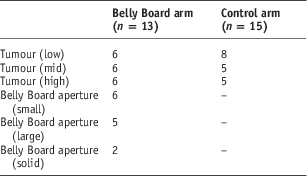
In all, thirty patients were randomised at the time of interim analysis: 17 into the control arm and 13 into the study arm. Median age was 64 years (range: 39–85). Details of the position of the rectal tumour and the Belly Board aperture (large, small or solid) used are shown in Table 1. Two patients in the control arm did not complete their prescribed treatment and were excluded from data analysis. One patient sustained a fracture of the neck of femur, which was unrelated to their diagnosis and treatment. The other patient declined all active treatment after completing consent process.
Patient characteristics

Patient set-up reproducibility
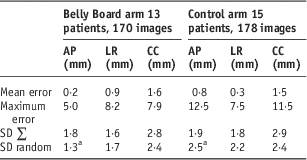
In all, 348 images were matched to the appropriate template DRRs. The mean and maximum displacements, the systematic and random error results of the two groups in the AP, LR and CC directions are shown in Table 2. A statistically significant result (95% CI; p≤0·05) for the random error results in the AP direction has been detected by applying the F-test. Additional analysis was performed using the sign test. Of the 12 set-up error results (shown in Table 2), eight were in favour of the Belly Board arm compared with the control arm, but statistical significance was only reached in the AP direction.
Reproducibility results

Note: aThe random error results in the AP direction were statistically significantly better in the Belly Board study arm than in the control arm (F-test 95% CI; p≤0·05).
Abbreviations: AP, anterior–posterior; LR, left–right; CC, cranio–caudal.
Intra-fraction interventions
The number of intra-fraction interventions was 67 (for seven patients) in the control arm and 0 in the study arm. The radiographer questionnaire was in favour of the Belly Board arm.
Diode readings
The diode readings of 12 out of the 13 patients in the Belly Board arm and all 15 patients in the standard arm were available for comparison. About 8% (3/36) of readings exceeded the tolerance of ±5% in the Belly Board arm compared with 22% (10/45) in the standard arm.
Irradiated small bowel volume
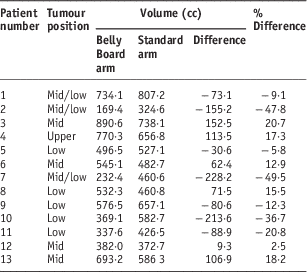
The mean difference in irradiated small bowel volume between the Belly Board position and standard position was −27 cm3±219·1 SD (no statistically significant difference detected). The individual results are shown in Table 3.
Irradiated small bowel volume

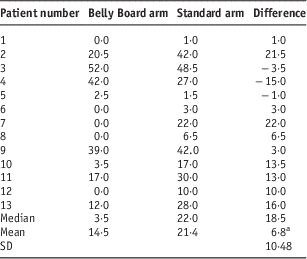
The V15 results of the two patient positions are shown in Table 4. The mean V15 was 14·5% for the Belly Board position and 21·4% for the standard position. A paired t-test showed a statistically significant difference between the two positions (95% CI; p=0·035) with smaller volume of irradiated small bowel in the Belly Board group.
Small bowel V15 dose volume histogram results
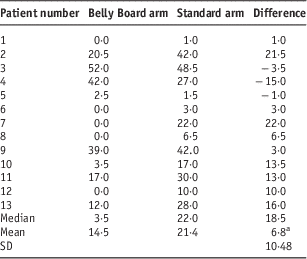
Note: aPaired t-test showed a statistically significant difference between the two positions in favour of the Belly Board arm (95% CI; p=0·035).
Patient comfort satisfaction and quality of life
Patient comfort satisfaction and quality of life were evaluated using the Wilcoxon rank sum test. Overall, 11 out of the 25 points assessed indicated that the distribution of scores for the Belly Board arm were significantly better than those for the standard arm (95% CI; p≤0·05). Details can be found in the supplementary report.
Acute toxicity assessment
No grade 4 toxicity was reported. In the Belly Board arm three patients developed the following grade 3 toxicities: proctitis, skin reaction, diarrhoea and pelvic pain. In the control arm grade 3 toxicities reported in two patients included pelvic pain and skin reaction.
Discussion
Systematic and random errors inevitably occur with any course of radiotherapy treatment and quantifying the errors is essential for accurate treatment delivery. In this study the inter-fraction reproducibility results were favourable when compared with other published results.Reference Rudat, Flentje, Engenhart, Metzger and Wannenmacher 11 A significant difference was found for the random error in the AP direction, which potentially has the greatest impact on bladder and rectal toxicities.
Significant difference in intra-fraction interventions in the control arm compared with the study arm (67 versus 0) suggests an improvement in stability of patient position. Increased number of first-day diode results failing in the standard arm (22 versus 8% in study arm) also demonstrates increased intra-fraction motion with the standard position. The majority of readings that failed were those of the right lateral field, which was the last field to be treated. Normal treatment beam arrangements require the lateral fields to be fully wedged and this makes the lateral diode readings particularly sensitive to patient rotation around the CC axis.
No significant difference was found, however, between the total volumes of small bowel in the radiation field in the two groups. This may be for two reasons. The Belly Board aperture location has been shown to influence the irradiated small bowel volumeReference Lee, Kim and Kim 21 and the reason why no difference was shown in our study may be because the suboptimal aperture was used at the time of CT data acquisition in some patients. This was identified in retrospect and addressed as an area for further radiographer training. The second reason was that in our study there were a high proportion of patients with low rectal tumours (Table 1). Less sparing of small bowel has been shown for lower third tumours compared with upper and middle third tumours.Reference Kim, Chie and Kim 22
The volume of small bowel receiving at least 15 Gy (V15) rather than total small bowel volume is known to be strongly associated with toxicity.Reference Baglan, Frazier, Yan, Huang, Martinez and Robertson 4 The mean V15 in our study was significantly lower (14·5%) for the Belly Board position compared with the standard position (21·4%). This compares favourably with other studies looking at the reduction of irradiated small bowel volume using Belly Board devices.Reference Das, Lanciano, Movsas, Kagawa and Barnes 8 , Reference Ghosh, Padilla, Murray, Downs, Carson and Dusenbery 23 , Reference Martin, Fitzpatrick and Horan 24
Our study was stopped after accrual of 30 patients. Once the data had been analysed at this planned interim stage it was felt unethical to continue in light of the findings of improved patient set-up reproducibility and increased patient comfort. A second reason for stopping the trial early was that our standard concomitant chemotherapy protocol had changed from 5 FU to oral capecitabine, which has a different side effect profile.
Improvement in prone set-up reproducibility with the Belly Board means more accurate treatment with potential reduction of CTV to PTV margins. This is especially important in the delivery of IMRT. Reduction in intra-fraction interventions by the treatment radiographers means shorter treatment time for the patients and increased patient throughput in the department. Importantly, there was improvement in patient comfort satisfaction with no detriment for quality of life measurement.
Acknowledgements
The prototype Belly Board and prone pillow were provided by Oncology Systems Limited and based on a design from Addenbrookes’ Hospital, Cambridge, UK. Image Track was developed by Steve Morgan, Sussex Cancer Centre, Brighton, UK. Statistical help was received from Ghasem Yadegarfar. The study was facilitated by the Radiotherapy Department’s Belly Board Multidisciplinary Working Party at Guy’s and St Thomas’ NHS Foundation Trust, London, UK.
Conflicts of Interest
None.
Ethical Standards
The authors assert that all procedures contributing to this work comply with the ethical standards of the relevant national guidelines and with the Helsinki Declaration of 1975, as revised in 2008, and has been approved by the institutional committees: both R&D and ethics board.
Supplementary material
To view supplementary material for this article, please visit http://dx.doi.org/10.1017/S1460396914000247