Some individuals tend to let their anger explode, very often finding it difficult to control their anger. Extant evidence suggests a robust positive association between the expression of anger (anger expression-out) and compromised health, particularly, cardiovascular morbidity and mortality (Chida & Steptoe, Reference Chida and Steptoe2009; Everson-Rose & Lewis, Reference Everson-Rose and Lewis2005; Schum, Jorgensen, Verhaeghen, Sauro, & Thibodeau, Reference Schum, Jorgensen, Verhaeghen, Sauro and Thibodeau2003; Smith, Glazer, Ruiz, & Gallo, Reference Smith, Glazer, Ruiz and Gallo2004) and self-reported health complaints (Martin et al., Reference Martin, Wan, David, Wegner, Olson and Watson1999). Moreover, suppression of anger expression (anger expression-in) has also been related to a high risk of develop atheroma, hypertension, coronary heart disease, elevated heart rate, high blood pressure and poor sleep quality (Caska et al., Reference Caska, Hendrickson, Wong, Ali, Neylan and Whooley2009; Matthews, Owens, Kuller, Sutton-Tyrrell, & Jansen-McWilliams, Reference Matthews, Owens, Kuller, Sutton-Tyrrell and Jansen-McWilliams1998). Although it has been reported that anger expression-out is a better predictor of general health than anger expression-in (Martin et al., Reference Martin, Wan, David, Wegner, Olson and Watson1999), both styles were observed to be good predictors of somatic symptoms (Vandervoort, Ragland, & Syme, Reference Vandervoort, Ragland and Syme1996).
Several studies have linked hypothalamic-pituitary-adrenocortical (HPA) dysregulation (low cortisol awakening response and high evening cortisol levels) with a high proneness to anger expression as well as chronically stressed populations (Barker, Greenberg, Seltzer, & Almeida, Reference Barker, Greenberg, Seltzer and Almeida2012; Pfattheicher & Keller, Reference Pfattheicher and Keller2014; Platje et al., Reference Platje, Vermeiren, Raine, Doreleijers, Keijsers, Branje and Jansen2013; Popma et al., Reference Popma, Vermeiren, Geluk, Rinne, van den Brink, Knol and Doreleijers2007; Révész et al., Reference Révész, Verhoeven, Milaneschi, de Geus, Wolkowitz and Penninx2014). To our knowledge, psychobiological underlying mechanisms which could explain the effects of anger on general health have not been consistently documented. However, HPA axis activity is an important mediator of stress-disease interactions (Henry, Reference Henry1992; Munck, Guyre, & Holbrook, Reference Munck, Guyre and Holbrook1984). Specifically, among teachers of both genders, highly stressed individuals (those with high job demands) with high anger expression-out levels had higher free cortisol levels early in the morning and a blunted cortisol awakening response (CAR) in comparison with those with low stress levels and anger expression-out (Steptoe, Cropley, Griffith, & Kirschbaum, Reference Steptoe, Cropley, Griffith and Kirschbaum2000). In line with this, a study with older adults of both genders reported that individuals who often show high anger feelings and anger expression-out presented high evening cortisol levels but a flattened CAR (Adam, Hawkley, Kudielka, & Cacioppo, Reference Adam, Hawkley, Kudielka and Cacioppo2006). Hence, it seems possible that, over time, individuals who often express their anger which is closely related to experience high anxiety and depression levels could present a persistent alteration in the diurnal cortisol slopes or CAR in ways that have consequences for their health.
Several factors such as gender, age, and educational level seem to moderate the association of anger expression style with health-compromising effects (Siegman, Anderson, Herbst, Boyle, & Wilkinson, Reference Siegman, Anderson, Herbst, Boyle and Wilkinson1992; Suarez & Williams, Reference Suarez and Williams1990). Although both anger expression-out and -in are associated with health problems in both men and women, the probability of increasing vulnerability to disease seems to be higher in the men (Vandervoort et al., Reference Vandervoort, Ragland and Syme1996). Regarding age, age-related decreases in the risk of expressing anger-in response to interpersonal tensions have been described in both genders (Birditt & Fingerman, Reference Birditt and Fingerman2003; Boylan & Ryff, Reference Boylan and Ryff2013; Carstensen, Fung, & Charles, Reference Carstensen, Fung and Charles2003; Gross et al., Reference Gross, Carstensen, Pasupathi, Tsai, Skorpen and Hsu1997). In relation to this, improvements in well-being and quality of life with age were explained by reductions in anger expression (Phillips, Henry, Hosie, & Milne, Reference Phillips, Henry, Hosie and Milne2006), especially in anger expression-out (Barefoot, Beckham, Haney, Siegler, & Lipkus Reference Barefoot, Beckham, Haney, Siegler and Lipkus1993). Regarding educational level, women as well as men with low educational levels tend to present high anger expression-in scores, whereas those with high educational levels showed high anger expression-out levels (Haukkala, Reference Haukkala2002). Hence, it is essential to control for potential effects of gender, age and educational level when analyzing the relationship between anger expression and health.
Given the complexity of this issue, as a first approach, we decided to investigate whether anger expression (-out and -in) is associated with self-reported health (emotional distress and possible psychiatric morbidity), CAR, and evening basal cortisol levels in a carefully selected sample of young adults of both genders. For this purpose, we divided the sample based on their self-reported anger expression levels employing cluster analysis resulting in two groups (high vs. low anger expression). Based on the fact that groups with high anger expression-out as well as anger expression-in have previously shown poorer health (Chida & Steptoe, Reference Chida and Steptoe2009; Everson-Rose & Lewis, Reference Everson-Rose and Lewis2005; Schum et al., Reference Schum, Jorgensen, Verhaeghen, Sauro and Thibodeau2003; Smith et al., Reference Smith, Glazer, Ruiz and Gallo2004), high cortisol levels and flattened CAR (Adam et al., Reference Adam, Hawkley, Kudielka and Cacioppo2006; Steptoe et al., Reference Steptoe, Cropley, Griffith and Kirschbaum2000) in comparison with groups with low anger expression levels, we expected that the high anger expression (HAE) group would present worse self-reported health, higher mean cortisol levels and a weaker CAR than the low anger expression (LAE) group. Moreover, we explored which type of anger expression was a better predictor of health and CAR in each group. As previous data suggested that both types of anger expression were good predictors of impaired health (Chida & Steptoe, Reference Chida and Steptoe2009; Everson-Rose & Lewis, Reference Everson-Rose and Lewis2005; Schum et al., Reference Schum, Jorgensen, Verhaeghen, Sauro and Thibodeau2003), we expected that both types of anger expression would predict impaired self-reported health equally well. On the other hand, we expected that CAR disturbances would be better predicted by anger expression-out, as described in a previous study (Steptoe et al., Reference Steptoe, Cropley, Griffith and Kirschbaum2000). Finally, due to the moderating role of gender, age, and educational levels in the relationship between anger expression and health (Birditt & Fingerman, Reference Birditt and Fingerman2003; Boylan & Ryff, Reference Boylan and Ryff2013; Carstensen, Fung, & Charles, Reference Carstensen, Fung and Charles2003; Gross et al., Reference Gross, Carstensen, Pasupathi, Tsai, Skorpen and Hsu1997), they were included as covariates in all the regression analyses.
Method
Participants
The final sample was composed of 156 adults (26.81±10.50 years old) of both genders (44 men and 112 women) from Valencia (Spain). We advertised in the city of Valencia for male and female adult volunteers to take part in the study, establishing contact by email and then screening applicants in interviews. In this preliminary session, all candidates were given a general questionnaire about habits and various aspects of their health. We selected young adults who did not smoke; did not take regular medications or have addictive habits (coffee, tea, drugs); did not have chronic, endocrine and/or cardiovascular diseases; and, in the case of women, had a regular menstrual cycle without using oral contraceptives. Moreover, only women whose regular cycle lasted between 21 and 35 days over the previous 3 months were included in the analyses concerning menstrual cycle phase (Bouma, Riese, Ormel, Verhulst, & Oldehinkel, Reference Bouma, Riese, Ormel, Verhulst and Oldehinkel2009). All the women completed questions about the regularity of their menstrual cycle, provided information on the first day of their last menstrual period and counted forward to the date they filled out the questionnaire, these questions being answered the same day as the saliva collection. While this forward-cycle method for assessing women’s menstrual status has some drawbacks, it is relatively widely used in studies based on surveys (Vermeersch, T’Sjoen, Kaufman, & Vincke, Reference Vermeersch, T’Sjoen, Kaufman and Vincke2008).
All participants were right-handed and healthy, and gave written informed consent. The experiment was performed in accordance with the Helsinki Declaration and approved by the Universidad de Valencia Ethics Committee.
Procedure
Participants were instructed to collect four saliva samples per day (upon awakening, and 30, 45 and 60 minutes later) over two consecutive working days. Participants were instructed to abstain from eating, drinking stimulants (such as tea, coffee, or alcohol), brushing their teeth, or smoking before taking saliva samples. Moreover, they were required to answer two questions about their sleep pattern (the number of hours they had slept the previous night and sleep quality, on a scale of 0, very bad, to 100, very good) and record any issues related to their general health, including medication use, waking and bedtimes, and saliva collection times in the daily diary each day. Finally, a session took place between 4:00 and 7:00 p.m. on a different day to CAR collection. After arriving at the laboratory, participants were taken to a room where a saliva sample was collected (for assessing evening basal cortisol levels), and they also completed a battery of questionnaires about anger expression and self-reported health. Participants were instructed to refrigerate all saliva samples at home from immediately after collection until delivery to the laboratory and were asked to take them to the laboratory within a week of collection.
Psychological trait profiles
Anger and its expression was measured by an adapted version (Miguel-Tobal, Casado, Cano-Vindel, & Spielberger, Reference Miguel-Tobal, Casado, Cano-Vindel and Spielberger2001) of the State-Trait Anger Expression Inventory-2’ (STAXI-2) (Spielberger, Gorusch, Lushene, Vagg, & Jacobs Reference Spielberger, Gorusch, Lushene, Vagg and Jacobs1983). This test is distributed into six subscales: two for evaluating trait anger (temperament and reaction) and four for anger expression (anger expression-out and -in, anger control-out and -in). The Cronbach’s alpha ranged from 0.67 to 0.89.
Self-reported health was measured by the General Health Questionnaire (GHQ-28), in which the respondent is asked to compare his recent psychological state with his usual state (Goldberg & Hillier, Reference Goldberg and Hillier1979). For each item, four response options are available (from 0, better than usual, to 3, worse than usual). The items are divided into four scales (somatic symptoms, anxiety and insomnia, social dysfunction, and severe depression) and results are given as a total score of perceived general health. The higher the score, the poorer the psychological well-being of the participant. Cronbach’s alpha was higher than 0.92 for all the subscales.
Cortisol awakening response (CAR)
Cortisol was collected using a Salivette (Sarstedt, Rommersdolf, Germany). On delivery to the laboratory, the samples were frozen at −20 C until analysis by radioimmunoassay. Salivary cortisol levels were measured using Cortisol Coat-A-Count kits (DPC, Siemens Medical Solutions Diagnostics). The samples were measured in duplicate and all those from the same participant were included in the same assay. The maximum for the inter-duplicate coefficient of variation for replicate measurements was set at 8%. The coefficients of intra- and inter-assay variation were 2.8 and 5.3% respectively. Assay sensitivity was 0.5 ng/dl and all values are expressed in nmol/L.
Data analysis
Cluster analysis includes a variety of multivariate statistical procedures used to classify individuals into relatively homogeneous groups (Aldenderfer & Blashfield, Reference Aldenderfer and Blashfield1984). K-means cluster analysis was conducted to determine the subgroups. This analysis focused on the following measures: (a) the STAXI-2 anger expression-out and (b) the STAXI-2 anger expression-in, and resulted in the formation of two groups. As participants did not present extremely high scores on the STAXI-2, being their scores relatively homogeneous with small variance in the anger expression scores, we decided to divide the sample in two groups avoiding artificial divisions. Fifty-nine participants were grouped in the HAE group, that is, those with higher than average scores on anger expression (-out and -in), and 97 participants were placed in the LAE group, that is, those participants with lower scores than average on anger expression-out and -in. The HAE and LAE scores were 15.21±3.95 and 9.71±2.21 for anger expression-out, respectively, and 12.91±3.25 and 10.66±2.21 for anger expression-in, respectively.
The Kolmogorov-Smirnov test was used for exploring whether the data were normally distributed. After checking the normality, t-Tests with Levene’s test for equality of variances and/or Chi-square tests were performed where appropriate to identify significant differences in demographic and anthropometric variables between groups. Effect sizes for the between-group differences were calculated using Cohen’s d (Cohen, Reference Cohen1988). After that, differences between groups were assessed in terms of the areas under the receiver operating characteristic curve (AUC) for CAR and cortisol level. Repeated measures ANOVAs were performed with ‘‘time’’ (awakening, 30, 45 and 60 minutes post-awakening) as the within-subject factor and ‘‘group’’ (high and low anger expression) as the between-subject factor. We applied Greenhouse–Geisser corrections for degrees of freedom and Bonferroni corrections for multiple comparisons.
The magnitude of the cortisol response was estimated by the AUC with respect to the increase (AUCi) and ground (AUCg), which were calculated using formulae derived from the trapezoidal rule as previously described (Pruessner, Kirschbaum, Meinlschmidt, & Hellhammer, Reference Pruessner, Kirschbaum, Meinlschmid and Hellhammer2003). The formulas are basically simple additions of areas consisting of triangles and rectangles. AUCi is calculated with reference to the baseline measurement, ignoring the distance from zero for all measurements. On the other hand, the AUCg is the total area under the curve of all measurements and assesses the distance of these measures from the ground. Regarding hormonal parameters, AUCi emphasizes changes over time and is more related to system sensitivity, whereas AUCg is more related to total hormonal output or levels (Fekedulegn et al., Reference Fekedulegn, Andrew, Burchfiel, Violanti, Hartley, Charles and Miller2007; Grice & Jackson, Reference Grice and Jackson2004; Romero-Martínez, Lila, Conchell, González-Bono, & Moya-Albiol, Reference Romero-Martínez, Lila, Conchell, González-Bono and Moya-Albiol2014).
Finally, Spearman’s or Pearson’s correlation coefficients were used to assess relationships between variables as appropriate. Moreover, linear regression models will be constructed to assess whether anger expression-out and -in predict the rest of variables for each group, controlling for gender, age and educational level in this analysis.
Results
Sample characteristics
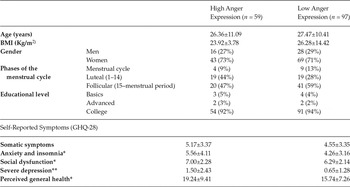
Groups did not differ in age, body mass index, or gender, or in the case of women, in phases of menstrual cycle. Additionally, no significant differences were found between HAE and LAE groups in hours of sleep (7.72±1.18 and 7.40±1.19, respectively), sleep quality (73.39±15.15 and 72.25±20.49, respectively) or basal cortisol levels (11.39±8.31 and 9.47±6.78 nmol/L, respectively). Hence, it was not considered necessary to include these variables as covariates in subsequent analysis.
Self-reported health (GHQ-28)
With respect to GHQ-28 scores, significant differences were found between groups in anxiety and insomnia (t(99.56) = –2.22, p = .028, d = .044), social dysfunction (t(154) = –1.93, p = .05, d = .03), severe depression (t(77.72) = –2.51, p = .01, d = .06) and perceived general health (t(99.61) = –2.44, p = .02, d = .05), with the HAE group presenting more symptoms or worse health than the LAE group.
Descriptive characteristics of the sample are summarized in Table 1. Mean±SD of anthropometric and demographic variables of participants **p < .01 *p < .05.
Cortisol awakening response (CAR) and evening basal cortisol levels
The effect of ‘time’ was found to be significant [ε = 0.56, (1.67, 269.33) = 30.92, p = .001, ηp 2 = .16]. Specifically, cortisol levels increased significantly from baseline to 30 minutes post-awakening. Afterwards, a significant decrease was observed from 30 to 45 minutes post-awakening and from this point to 60 minutes post-awakening (p < .001 for all). After dividing the sample by groups, the factor “time” was significant for HAE and LAE groups, ε = 0.59, (1.78, 103.18) = 11.56, p = .001, ηp 2 = .17; ε = 0.52, (1.57, 149.08) = 19.38, p = .001, ηp 2 = .17, respectively. Both groups followed a similar pattern with an initial increase from awakening to 30 minutes post-awakening. Then, cortisol levels decreased from this point to 60 minutes post-awakening (p < .001 for all).
In addition, a significant ‘group’ effect was found, F(1, 153) = 4.28 , p = .04, ηp 2 = .03, with the HAE group showing higher cortisol levels than the LAE group. Nevertheless, no significant ‘time x group’ interaction was detected. Concerning the magnitude of the response, a significant ‘group’ effect was observed in AUCg cortisol (t(153) = –1.97, p = .05, d =. 32), with AUCg being higher in the HAE (917.52±498.73) than the LAE group (760.00±472.12). However, there were no significant differences between HAE and LAE groups in AUCi (233.97±425.86 and 192.08±387.43, respectively). Finally, comparing the cortisol levels at baseline and 30 min later did not reveal significant differences between groups, t(153) = –0.704, p = .48, although levels were higher in the HAE (5.97±9.31) than the LAE (4.96±8.24) group.
Regarding evening basal cortisol levels, though levels were slightly higher in the HAE (2.35±1.73) than the LAE (2.11±1.36) group, the difference between groups was not significant, t(137) = –0.89, p = .38).
Relationships between variables within groups are summarized in Table 2.
Pearson correlations between anger expression-out, anger expression-in with self-reported symptoms, AUC and evening cortisol levels

*p < .05 **p < .01.
Predictive effects of anger expression in HAE participants
Anger expression-out and anger expression-in significantly predicted self-perceived health, adj R2 = .11, F(1, 58) = 8.28, p = .006; adj R2 = .05, F(1, 58) = 4.14, p = .046, respectively, the association being positive in both cases (β = .36, and β = .26, p < .01, respectively). After controlling for gender, age, and educational level, anger expression-out and anger expression-in remained significant in predicting self-perceived health (p < .05).
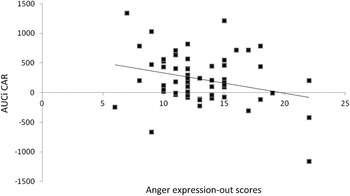
On the other hand, anger expression (out and in) did not significantly predict AUCg for cortisol, adj R2 = .02, F(1, 58) = .00, p = .97; adj R2 = .00, F(1, 58) = .79, p = .37, respectively. In contrast, anger expression-out significantly predicted AUCi for cortisol, adj R2 = .067, F(1, 58) = 3.19, p = .049, the association between these variables being negative (β = –.23, p < .01) (Figure 1). After controlling for gender, age, and educational level, anger expression-out remained significant in predicting the cortisol AUCi (β = –.23, p < .05). Further, anger expression (-out and -in) did not significantly predict evening basal cortisol levels, adj R2 = .02, F(1, 58) = 1.83, p = .13; adj R2 = .01, F(1, 58) =.33, p = .91, respectively.
Relationship between area under the curve with respect to the increase AUCi Cortisol awakening response (nmol/L) and anger expression-out scores for high anger expression group.

Predictive effects of anger expression in LAE participants
Anger expression-in significantly predicted self-perceived health, adj R2 = .13, F(1, 96) = 15.72, p = .001, these variables being significantly associated (β = .38, p < .001). After controlling for gender, age, and educational level, anger expression-in remained significant in predicting self-perceived health (β = .43, p < .05). However, anger expression-out did not significantly predict self-perceived health, adj R2 = .009, F(1, 96) = –.13, p = .72.
Anger expression (-out and -in) did not significantly predict the AUCg for cortisol, adj R2 = .009, F(1, 96) = .19, p = .67; adj R2 = .01, F(1, 96) =.49, p = .49, respectively; AUCi for cortisol, adj R2 = .002, F(1, 96) = .80, p = .37; adj R2 = .006, F(1, 96) = 1.48, p = .23, respectively; or evening basal cortisol, adj R2 = .00, F(1, 96) = .69, p = .73; adj R2 = .00, F(1, 96) = 1.14, p = .51, respectively.
Discussion
We expected that the HAE group would have poorer health, a flatter CAR and higher cortisol levels (morning and evening), than the LAE group. In relation to this, we found that the HAE group had worse self-reported health than the LAE group. Furthermore, the mean CAR (AUCg) was higher in the HAE than the LAE group. Nevertheless, the groups did not significantly differ in CAR response (AUCi) or evening basal cortisol levels, although the HAE group showed stronger CAR rises (from awake to 30 minutes later) and evening cortisol levels. In addition, as expected both types of anger expression were good predictors of worse self-reported health in both groups. Finally, we expected that CAR disturbances would only be predicted by anger expression-out. As expected high anger expression-out was associated with a lower AUC response (AUCi) but only in the HAE group. All the relationships were still significant even after controlling for the effects of gender, age and educational level.
Looking first at the impact of anger expression (out and in) on general health (emotional distress and possible psychiatric morbidity), we provide evidence that the population who tend to experience but not to express angry emotion (anger expression-in) as well as those who overtly, verbally and physically, express their anger (anger expression-out) presented worse self-reported health than the group with the lowest levels of anger expression and suppression (LAE). They not only differ in the total GHQ-28 score but also in anxiety and insomnia, social dysfunction and severe depression. This is in line with previous studies which have divided individuals based on their anger expression scores. Both Choi (Reference Choi2009) and Pérez-García, Sanjuán, Rueda, and Ruiz (Reference Pérez-García, Sanjuán, Rueda and Ruiz2011) found that the groups with high anger expression (-out and -in) scores presented worse health than the groups with low anger expression levels.
When examining the pattern of relationships between anger expressions (-out and -in) and health, we found that high anger expression-out as well as anger expression-in were good predictors of worse self-reported health (related to emotional distress and psychiatric morbidity) especially in the HAE group. Nevertheless, only anger expression-in was a good predictor of poor health in the LAE group. Furthermore, these results were still significant after controlling for the effects of gender, age and educational level. This observation partially agrees with a previous study which revealed that both styles are good predictors of health (Vandervoort et al., Reference Vandervoort, Ragland and Syme1996), but related to somatic complaints instead of their emotional consequences as in our study. Nonetheless, another study, which assessed emotional distress as a health indicator, revealed that only anger expression-out was a good predictor of this health domain (Martin et al., Reference Martin, Wan, David, Wegner, Olson and Watson1999). On the other hand, another study reported that anger expression-in was a good predictor of cardiovascular health, especially, in women (Pérez-García et al., Reference Pérez-García, Sanjuán, Rueda and Ruiz2011). These differences between studies could be explained by the different instruments employed to assess the general health and anger expression styles. Moreover, our research analyzed these variables in normative adults with no known psychiatric disorders while the other studies were based on college students or pathological samples. Another variable which could explain these results is that the majority of the participants in our study were women, gender being an important moderating variable. Moreover, considering the percentile scores on the STAXI-2, participants of our study presented only moderately high and low scores. That is, participants did not obtain extremely high anger expression scores. We conclude that future research should continue to examine multiple associations between the variables studied employing the similar instruments and populations.
We also hypothesized that the HAE group would present higher mean cortisol levels and a weaker CAR than the LAE group. In the present study, however, we showed that groups classified by their anger expression levels only differed in CAR levels (AUCg). In contrast, they did not significantly differ in CAR response (AUCi) or evening basal cortisol levels, although the HAE group showed higher CAR rises (from awake to 30 minutes after) and evening cortisol levels. In this sense, our data partially agree with the study of Steptoe et al. (Reference Steptoe, Cropley, Griffith and Kirschbaum2000) which reported higher cortisol levels early in the morning. The absence of significant differences in the majority of the cortisol measures could be explained by the fact that the sample is made of young and healthy population. In this sense, the majority of the previous scientific literature is based on psychiatric populations, which is usually related to cortisol disturbances.
When analyzing the pattern of relationships among variables, anger expression-out was a good predictor of weaker CAR response (AUCi), but only in the case of the HAE group. In sum, as expected, high anger expression-out was associated with a weaker CAR. Hence, our results agree with the previous research, which had demonstrated that anger expression-out was better predictor of weaker CAR than the anger expression-in (Adam et al., Reference Adam, Hawkley, Kudielka and Cacioppo2006; Keltikangas-Jarvinen, Räikkönen, Hautanen, & Adlercreutz, Reference Keltikangas-Järvinen, Räikkönen, Hautanen and Adlercreutz1996). We can speculate about the flattened CAR response showed by participants with high anger expression-out based on previous work of Fries, Dettenborn, and Kirschbaum (Reference Fries, Dettenborn and Kirschbaum2009). They hypothesized that the anticipation of upcoming demands may be essential in regulating the CAR magnitude. In this sense, we can conclude that people who tend to externalize their anger are less able to anticipate future events, and that this leads to a flattened CAR. Moreover, the HAE in comparison with the LAE group showed higher anxiety and depression symptoms, which have been associated to HPA disturbances (Barker et al., Reference Barker, Greenberg, Seltzer and Almeida2012; Pfattheicher & Keller, Reference Pfattheicher and Keller2014; Platje et al., Reference Platje, Vermeiren, Raine, Doreleijers, Keijsers, Branje and Jansen2013; Popma et al., Reference Popma, Vermeiren, Geluk, Rinne, van den Brink, Knol and Doreleijers2007; Révész et al., Reference Révész, Verhoeven, Milaneschi, de Geus, Wolkowitz and Penninx2014).
Although our study makes a valuable contribution to understanding the health damaging effects of anger expression (-out and -in), some limitations of the study should be taken into account in interpreting the results. Firstly, the cross-sectional and correlational nature of the study makes it difficult to establish causality in the results. Moreover, our data were derived from young and non-psychiatric populations. In contrast, the majority of the studies which reported CAR disturbances were conducted in psychiatric or chronically stressed populations. In line with this, the current study showed that cortisol levels increased by of 2.5 nmol/L or more from basal levels in both groups, their CAR response being normal (Wüst, Federenko, Hellhammer, & Kirschbaum, Reference Wüst, Federenko, Hellhammer and Kirschbaum2000). Regarding evening cortisol levels, they were only assessed a single measurement which could be influenced by anticipation of coming to the laboratory. Hence, this fact would limit the extrapolation of our findings directly to clinical settings. Thus, future research should examine the association between anger expression (-out and -in), general health and cortisol levels using different indicators of general health (e.g., mental health, somatic health, and blood pressure), cortisol levels (e.g., awakening response, evening basal, and/or day long) and anger expression (e.g., different self-reports) in other subpopulations (e.g., psychiatric, and/or normal populations) to increase the generalizability of the study findings.
In conclusion, as a population sample study, the present study increases the external validity of the previous research into the damaging health effects of the high anger expression (-out and -in). All this makes it very important to introduce the use of biological indicators such as CAR in health prevention and treatment programs. This study reinforces the need to develop effective strategies to provide mechanisms to regulate anger expression and suppression by promoting personal growth and the development of positive skills that enhance their well-being and quality of life and, in turn, their own health.
This work was supported by the Spanish Ministerio de Ciencia y Educación (PSI2008–04408/PSIC) and the Unidad de Política Científica, Conselleria d’Educació, Generalitat Valenciana (ACOMP/2010/250; PROMETEO/2011/048; APOSTD/2015/090). These funders had no further role in the study design; in the collection, analysis and interpretation of the data; in the writing of the report; and in the decision to submit the paper for publication.