Introduction
During the Neolithic and Bronze Age, networks of interaction connected communities in Central Asia with those in East Asia. These networks were instrumental in facilitating the movement of goods and technologies, including wheat, barley, sheep and goat (Flad et al. Reference Flad, Yuan, Li, Madsen, Chen and Gao2007, Reference Flad, Li, Wu and Zhao2010; Dong et al. Reference Dong, Morgan, Chinenov, Zhou, Fan, Ma and Pechenkina2017; Brunson et al. Reference Brunson, Lele, Xin, Xiaoling, Hui, Jing and Flad2020), metalworking (Zhang Reference Zhang1987; Li Reference Li2005) and, later, horses and chariots (Rawson Reference Rawson2017). Despite substantial research on this topic (Fitzgerald-Huber Reference Fitzgerald-Huber1995; Mei Reference Mei2003; Linduff & Mei Reference Linduff and Mei2009; Jaang Reference Jaang and von Falkenhausen2011, Reference Jaang2015), however, we still lack a detailed understanding of the motivations for and organisation of the interactions between these communities (Flad Reference Flad, Hein, Flad and Miller2023). One exception is the work of Jaang (Reference Jaang2015), which points to a key region of interaction in the Ejin River Transfer Zone (ERTZ; encompassing parts of modern Inner Mongolia and Gansu Province). Jaang (Reference Jaang2015: 207) suggests the networks in this zone developed from a local cultural setting that had “trade and exchange as an integral part of social life”. But the precise nature of local trade and exchange during the late Neolithic Majiayao (马家窑) and early Bronze Age Qijia (齐家) periods in the ERTZ remains unclear (Table 1). This is because previous typological and archaeometric studies of ceramics and metals have focused on interaction across broad regions, rather than the study of individual sites.
Approximate date ranges for cultural periods mentioned in the text based on a combination of radiocarbon dates taken from excavations by the Tao River Archaeological Project (Womack et al. Reference Womack, Flad, Zhou, Brunson, Toro, Su, Hein, d'Alpoim Guedes, Jin, Wu and Wang2021: 105–6) as well as other sites with Yangshao, Majiayao and Qijia-style ceramic remains (Wang Reference Wang2012; Cui et al. Reference Cui2015; Yang et al. Reference Yang2019).

Only a few theoretically informed interpretations of the role of exchange or other forms of interaction in Majiayao and Qijia societies have been put forward. Allard (Reference Allard2002) has suggested that some incipient elites at the late Majiayao site of Liuwan, eastern Qinghai Province, sought to build authority through the redistribution of grain to their followers, while Hung (Reference Hung2011, Reference Hung2021) has discussed Majiayao-period painted vessels as commodities that were exchanged through an early ‘market’ system. But precisely who participated in these networks, how these systems were structured and what goods, if any, were being exchanged for pottery, have not been discussed.
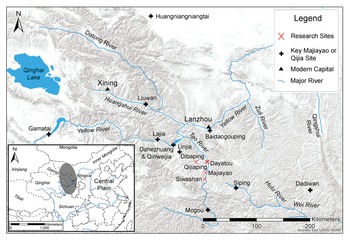
Here, we aim to answer some of these questions by building on previous research demonstrating the longevity of ceramic production traditions, and specifically of paste recipes, in the Tao River Valley of southern Gansu Province. Petrographic analyses, based on 10 sherds from the Majiayao-period site of Siwashan and 32 Qijia-period sherds from the Majiayao type-site, demonstrate regular inter-site interactions involving the circulation of ceramic vessels (Figure 1). We demonstrate that these circulation networks likely encompassed multiple sites within the northern Tao River Valley and beyond. The results validate the suggestion by Jaang (Reference Jaang2015) that it was these early local circulation networks among communities in the ERTZ that underlay the later long-distance transfer of goods and technologies between Central and East Asia. Our findings provide a case study for one way in which inter-community relations can develop and be maintained among small-scale societies.
Map of north-western China, centred on the Tao River Valley, showing new research sites (Siwashan and Majiayao), comparative sites from previous studies (after Womack et al. Reference Womack, Horsley, Wang, Zhou and Flad2019), and other important Majiayao and Qijia period sites in the region. Inset: map showing the approximate extent of Jaang's (Reference Jaang2015) Ejin River Transfer Zone (shaded grey oval) (figure by authors).

Late Neolithic interaction networks in north-western China
Research on trans-Eurasian interactions dates back to initial archaeological work undertaken in Gansu Province and surrounding areas in the 1920s (Andersson Reference Andersson1925; Fiskesjö & Chen Reference Fiskesjö and Chen2004; Hein et al. Reference Hein, Womack, Stilborg and Dammer2021; Myrdal Reference Myrdal2021). Studies of interaction between steppe-based societies and groups living in the river valleys of north-western China began in the 1980s and 90s. Archaeologists and art historians have noted many similarities between bronze objects, such as knives, from Erlitou (c. 1900–1500 BC) and Shang (c. 1600–1046 BC) period China and those produced by groups on the Central Asian steppe. These similarities have been seen as evidence that early bronze-working technology in China was imported from Central Asia, probably via the north-west during the Majiayao and Qijia periods, and then continuing east to the northern Central Plain (Lin Reference Lin, Chang and Goodrich1986; Fitzgerald-Huber Reference Fitzgerald-Huber1995). To evaluate the connections between these regions, scholars have looked to the analysis of both metal artefacts (Li Reference Li2005; Linduff & Mei Reference Linduff and Mei2009; Jaang Reference Jaang2015; Rawson Reference Rawson2017) and pottery (Hung Reference Hung2011, Reference Hung2021; Cui et al. Reference Cui2015; Womack et al. Reference Womack, Horsley, Wang, Zhou and Flad2019; Dammer Reference Dammer2021).
While it can prove challenging to identify direct connections between raw materials and finished ceramic products (Arnold et al. Reference Arnold, Neff and Bishop1991), careful petrographic analysis of paste recipes combined with a detailed understanding of local raw materials can help archaeologists understand topics ranging from production choices, the identities of producers, and the extent of exchange networks (Quinn et al. Reference Quinn, Day, Kilikoglou, Faber, Katsarou-Tzeveleki and Sampson2010; Druc Reference Druc2013; Michelaki et al. Reference Michelaki, Braun and Hancock2014; Eckert et al. Reference Eckert, Schleher and James2015; Stoner et al. Reference Stoner, Nichols, Alex and Crider2015; Druc et al. Reference Druc, Underhill, Wang, Luan and Lu2018; Burke et al. Reference Burke, Zavadil and Kordatzaki2021). The identification of paste recipes associated with particular communities of practice—defined as closely related producers who pass down shared knowledge of production as well as specialised motor skills through time—can allow us to track the circulation of products made by discrete groups of potters (Sassaman & Rudolphi Reference Sassaman and Rudolphi2001; Stark Reference Stark, Habicht-Mauche, Eckert and Huntley2006). These paste recipes are thought to be less easily copied by unrelated groups of producers than are surface treatments or vessel forms (Gosselain Reference Gosselain2000, Reference Gosselain, Stark, Bowser and Horne2008). Thus, identification of distinct, local clay recipes can provide insight into the presence of distinct communities of potters operating at specific sites.
In north-western China, several techniques have been used to examine ceramic exchange, with varied success. Hung's (Reference Hung2011, Reference Hung2021) large-scale application of LA-ICP-AES (laser ablation inductively coupled plasma atomic emission spectrometry) was unable to distinguish between the paste recipes of painted Majiayao-style vessels produced in Gansu Province due to similarities in clay chemistry, though did demonstrate that some Majiayao painted pottery from sites in northern Sichuan and eastern Qinghai Provinces were likely imported from Gansu. These results have recently been critiqued however, on the grounds that trace elements were not examined (Huan Reference Huan2021). A comparative X-ray fluorescence analysis of sherds from the Yangshao (3500–2900 BC), Majiayao and Qijia periods suggests that there was no exchange between groups in Qinghai and Gansu during the Majiayao period, subsequently commencing during the Qijia period (Cui et al. Reference Cui2015). Most recently, Dammer (Reference Dammer2021) has examined similarities in the technical knowledge needed to produce the Majiayao-style pottery found at sites in the Tao, Huangshui and Yellow River valleys. Dammer's study, which examines paste recipes, production techniques and firing practices concludes that a significant degree of technological know-how and experience was shared between groups in these different regions. Exactly how this knowledge was shared and how regularly these potters interacted, however, remains unclear.
To explore this topic on a local scale, we previously sampled 259 ceramic sherds from three contexts (two Majiayao and one Qijia) in the northern Tao River Valley for petrographic analysis (Womack Reference Womack2017; Womack et al. Reference Womack, Horsley, Wang, Zhou and Flad2019). The results demonstrated long-term continuity in paste recipes at these sites, including continuity between the two cultural periods, despite significant changes in vessel forms and surface treatments. Such long-term continuity in paste recipes has been documented in other parts of the world (D'Ercole et al. Reference D'Ercole, Budka, Sterba, Garcea and Mader2017; Ting Reference Ting2017) and is certainly possible in the Tao River Valley given the presence of clay deposits that are locally homogeneous and dozens of metres deep (Liu et al. Reference Liu, An, Rolph, Qiang, Hesse, Lu, Zhou and Cai2001). Additionally, we observed multiple paste recipes for identical vessel types, and even within the same stratigraphic layers; this indicates that paste recipes most likely represent different groups of producers working with distinct raw materials at different sites, to produce ceramic vessels of similar forms. The dominant paste recipes at the three study sites match locally available raw materials both in terms of qualitative analysis of mineral content and quantitative analysis of silt and sand inclusions (Womack Reference Womack2017; Womack et al. Reference Womack, Horsley, Wang, Zhou and Flad2019). Extensive ethnographic research shows that, in most cases, potters prefer to use clay resources available within 1km of their homes (Arnold Reference Arnold2000). Archaeological research has also shown that dominant paste recipes are most often produced locally (Stoltman Reference Stoltman, Goldberg, Holliday and Ferring2001). It could therefore be concluded that the dominant paste groups at each study site represent the result of local production, while ‘outlier’ paste groups signal vessels produced at other locales that were imported. At the time of our previous research, however, we were unable to identify the location of these other ‘outlier’ production locales. Expanding our sampling to other Majiayao- and Qijia-period sites would therefore broaden our understanding of the scale and complexity of the Neolithic and Bronze Age circulation networks of north-western China.
Materials and methods
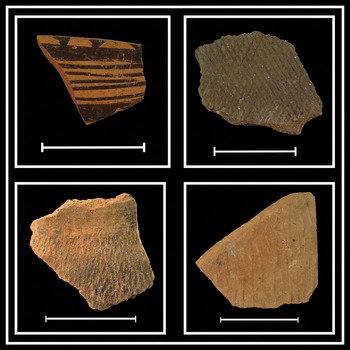
To expand upon our previously published ceramic sampling, here we work with material collected by the Tao River Archaeological Project (TRAP), as well as material excavated by the Institute of Archaeology at the Chinese Academy of Social Sciences (CASS) research project at the Majiayao type-site (see Online Supplementary Material (OSM) Table S1). During an initial visit in 2015 to the Majiayao- and Siwa-period (1350–650 BC) site of Siwashan, we collected 10 Majiayao-period sherds from archaeological rubbish pits that were in the process of being destroyed by mining (Figure 2).
Each bar on the images is 50mm long. Majiayao painted (top left) and cord-marked (top right) sherds from Siwashan. Qijia fiber-point, cord-marked (bottom left) and basket-marked (bottom right) sherds from Majiayao (figure by authors).

In 2017, we visited the CASS workstation in Lintao, where material from recent excavations of Majiayao- and Qijia-period contexts at the Majiayao type-site were being processed (Guo et al. Reference Guo, Li, Zhou, Wang and Chen2021). There, we selected a stratified random sample of 32 sherds (see Table S1). Sixteen of these sherds, from vessels typically used for cooking, are finished with fibre-point cord marking, a variation on cord marking where the marks overlap instead of running parallel or clearly crossing over one another (see Figure 2). The other 16 sherds are from basket-marked storage vessels known as trumpet-mouthed guan jars, typical of the Qijia period (Shen Reference Shen2021; see Womack & Wang Reference Womack and Wang2020 for a detailed discussion of vessel types and uses relevant to this study). These sherds come from two successive levels of a Qijia-period rubbish pit.
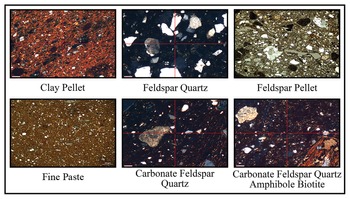
Qualitative and quantitative petrographic analyses were performed on the new 42 sherd samples and the results compared with earlier petrographic studies of pottery as well as clay and sand samples previously collected from deposits around Qijiaping and Dayatou (Womack Reference Womack2017; Womack et al. Reference Womack, Horsley, Wang, Zhou and Flad2019), and from Majiayao (Dammer Reference Dammer2021). These samples of raw materials, as well as the use of ethnographic comparison (Nicklin Reference Nicklin1979; Costin Reference Costin1991; Arnold Reference Arnold2000), allow us to assess which clay types are available locally at each site and therefore were most likely used by local communities of practice in the past to produce pottery at each site (Figure 3). For details on sample preparation and analysis techniques see the OSM.
Common paste types seen in samples discussed in this study. From top left to right: clay-pellet (MJY002, XPL); feldspar-quartz (MJY003, XPL); feldspar-pellet (SWS AB002, XPL); fine-paste (SWS AA001, XPL); carbonate-feldspar-quartz (MJY009 XPL); carbonate-feldspar-quartz-amphibole-biotite (MJY008 XPL) (figure by authors).

Results
Majiayao-period samples
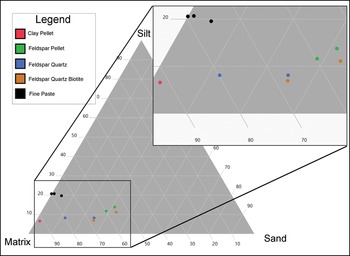
Among the 10 samples from a Majiayao context at Siwashan, four are slipped and/or painted fineware, likely indicating storage or serving functions, while six are cord marked and probably from cooking vessels. On a petrographic ternary chart, three of the four fineware sherds group closely together in relation to silt and sand percentages, perhaps even indicating that they come from the same individual vessel (Figure 4). The fourth fineware sherd has low silt content and contains clay pellets.
Ternary chart of all petrographic samples from a Majiayao context at Siwashan (figure by authors).

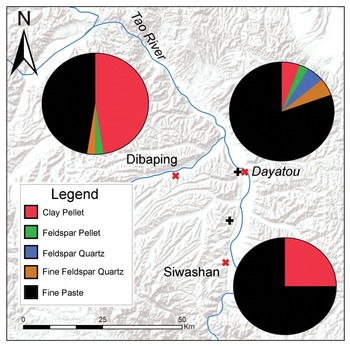
Comparable Majiayao finewares to those from Siwashan come from our previous analyses of sherds from Dayatou (n = 37) and Dibaping (n = 40; Womack et al. Reference Womack, Horsley, Wang, Zhou and Flad2019; Figure 5); full data are available from the China Ceramic Petrography Database (Womack & Hein Reference Womack and Hein2018). Three of four Siwashan fine-paste group sherds cluster with six high-silt fineware sherds from Dayatou and two from Dibaping. There is a noticeable difference in silt levels between all of these sherds and the majority of finewares from Dayatou and Dibaping, suggesting that a different clay or different refining process was used in the production of these high-silt vessels. The remaining Siwashan fineware sherd has a clay pellet paste. While only one sherd from Dayatou also has this fabric, nearly half (n = 19) of the Dibaping fineware sherds do and most cluster very closely with the Siwashan sherd, perhaps indicating that the clay pellet fineware sherd from Siwashan was produced by the same community of practice. One known source of clay with natural clay pellets of similar size and frequency to those identified in the Siwashan and Dibaping samples is found near the Majiayao type-site, making that a possible production location for these pots (Dammer Reference Dammer2021).
Pie charts showing proportions of Majiayao-period fineware fabric groups at each site (Dibaping n = 40; Dayatou n = 37; Siwashan n = 4) (figure by authors).

Among the six cord-marked sherds from Siwashan analysed, three different fabric groups are represented, each by two sherds: feldspar-pellet, feldspar-quartz and feldspar-quartz-biotite. All these samples have relatively low levels of silt (8–15%), while most have 20–30 per cent sand-sized inclusions. While feldspar and quartz are common local minerals, the presence of large biotite grains in some sherds, and clay pellets in others, indicates that more than one paste recipe was used to produce cord-marked vessels.
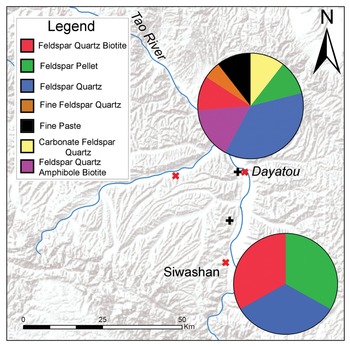
In our previous study, comparable Majiayao period cord-marked sherds were only recovered from Dayatou (n = 19; Figure 6). For the feldspar-quartz group, there are seven samples from Dayatou and two from Siwashan. These sherds’ silt and inclusion levels overlap, possibly indicating their production by the same community of practice. Sources of fine clay and sand with feldspar and quartz inclusions and similar silt levels are available near Dayatou, likely indicating that vessels with this type of paste were produced nearby (Womack et al. Reference Womack, Horsley, Wang, Zhou and Flad2019). The feldspar-quartz-biotite group is represented by two samples each from both Dayatou and Siwashan, with very similar silt levels among these sherds. The origin of this paste type is unclear, since this type of raw material is not represented in any of our sand or clay samples. Finished pots produced using this paste type may have been circulated from another, as yet unidentified, production site. The final group, feldspar pellet, is also represented by two samples from each site, however, the Siwashan samples do not closely group with the Dayatou samples. The remaining paste groups identified in the Dayatou sample have not yet been detected at Siwashan.
Pie charts showing proportions of Majiayao-period cord-marked sherd fabric groups at each site (Dayatou n = 17; Siwashan n = 6) (figure by authors).

Qijia-period samples
Five paste groups are represented within the 16 cord-marked sherds sampled from the Majiayao type-site (Figure 7). Three of these are characterised by the presence of occasional large carbonate inclusions, with numerous smaller carbonate inclusions. Clay with this type and size of inclusion has previously been observed at Majiayao (Dammer Reference Dammer2021). Smaller numbers of granitic lithics as well as individual fragments of feldspar, quartz and, in some cases, amphibole, biotite and/or calcite inclusions are also present (n = 13). The other two paste groups include a single feldspar-quartz tempered sherd and two sherds with dominant schist inclusions alongside carbonate, quartz and feldspar. Levels of sand-sized inclusions are between 15 and 30 per cent for most samples, which is typical when compared with cord-marked sherds from other sites in this region (Womack et al. Reference Womack, Horsley, Wang, Zhou and Flad2019).
Ternary chart of cord-marked petrographic samples from a Qijia-period context at Majiayao (figure by authors).

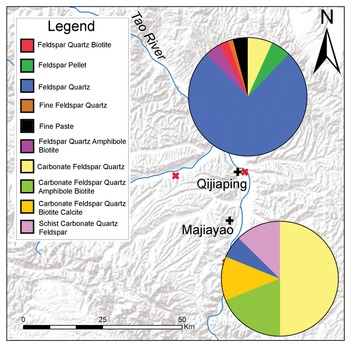
Our previous analysis of sherds from the late Qijia-period site of Qijiaping (Womack et al. Reference Womack, Horsley, Wang, Zhou and Flad2019) offers a point of comparison for the current sample from Majiayao (Figure 8). Of the cord-marked sherds at Qijiaping (n = 74), 76 per cent (n = 56) fall into the feldspar-quartz group, while only one cord-marked sherd from Majiayao has this paste type. The most common group at Majiayao, carbonate-feldspar-quartz (n = 8), is also found as a minor group at Qijiaping (n = 5). No other paste groups overlap between these sites. Since carbonate-feldspar-quartz fabric pottery was likely produced by potters at Majiayao (Dammer Reference Dammer2021), it is possible that vessels from that site were occasionally taken to Qijiaping; conversely, however, the movement of feldspar-quartz vessels from Qijiaping to Majiayao was rare.
Pie charts showing proportions of Qijia-period cord-marked sherd fabric groups at Qijiaping (n = 74) and Majiayao (n = 16) (figure by authors).

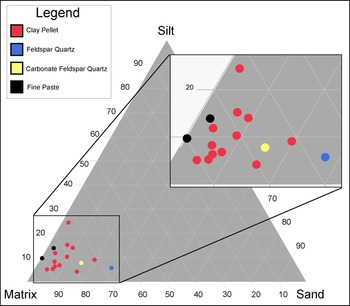
The 16 basket-marked sherds sampled at Majiayao are relatively homogeneous, with 12 of the 16 falling into the clay pellet group (Figure 9). This group is defined by the inclusion of 0.1–0.4mm pellets of clay that appear to be naturally occurring and which match a local clay source at Majiayao (Dammer Reference Dammer2021). Small amounts of other inclusions such as feldspar, quartz and micas are also present. While the number of pellets varies between samples, as reflected in the overall range of sand-sized inclusions of 2–20 per cent, most average around 5–10 per cent. The remaining sherds include a single carbonate-feldspar-quartz sherd and a single feldspar-quartz sherd, both of which have a relatively high sand content; there are also two fine-paste sherds.
Ternary chart of basket-marked petrographic samples from a Qijia-period context at Majiayao (figure by authors).

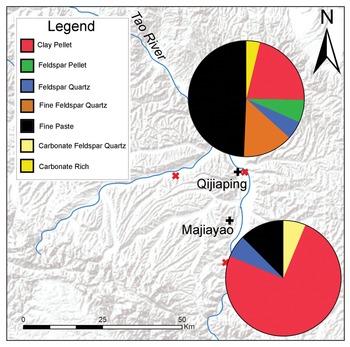
Basket-marked sherds from Qijiaping (n = 79) fall into six different paste groups (Figure 10), four of which overlap with Majiayao. The largest overlap is found in clay pellet sherds, with 12 coming from Majiayao and 17 from Qijiaping. Given that clay pellet-rich clay is available at Majiayao, but not currently known at Qijiaping (Womack et al. Reference Womack, Horsley, Wang, Zhou and Flad2019), it is likely that vessels of this fabric type were produced at Majiayao for both local consumption and were circulated to groups at other sites, including Qijiaping. Other overlap occurs with the fine-paste and feldspar-quartz groups. For the fine-paste sherds, at least, it is possible that these were circulated from Qijiaping—where this clay type is abundant—to Majiayao, but given the small sample size, more data are needed to confirm this suggestion. Other significant paste groups at Qijiaping, such as fine feldspar-quartz, were perhaps produced at Qijiaping or another site, but were not circulated to Majiayao.
Pie charts showing proportions of Qijia-period basket-marked sherd fabric groups at Qijiaping (n = 79) and Majiayao (n = 16) (figure by authors).

Discussion: ceramic circulation in the Tao River Valley and beyond
The picture that develops from this comparative analysis of ceramic paste recipes from three Majiayao- and two Qijia-period sites in the northern Tao River Valley is one of potentially regular interaction involving the transfer of ceramic vessels, and possibly their contents, between sites. In the Majiayao period, clay pellet and fine-paste vessels appear to have circulated between groups at Siwashan, Dibaping and Dayatou, while cooking vessels with three unique paste recipes also circulated to Dayatou and Siwashan. Additional recipes attested at Dayatou point to the circulation of other vessels from other currently unidentified locales.
These networks persisted into the Qijia period, with carbonate-feldspar-quartz and feldspar-quartz cooking vessels present at both Majiayao and Qijiaping. Clay-pellet, feldspar-quartz and fine-paste basket-marked vessels also appear at both sites. The dominance of clay-pellet and carbonate-feldspar-quartz paste recipes at Majiayao, alongside the availability of local clay with these inclusion types, points to Majiayao as the likely origin of these vessels, some of which were then taken to Qijiaping. Similarly, potters at Qijiaping probably produced the fine-paste and feldspar-quartz vessels excavated from Majiayao. This leads to the question: if potters at each site were capable of producing a variety of commonly used vessel forms, why bother transferring these products to other sites at all?
We suggest that this transfer of pottery vessels, and possibly their contents, was an important means of building inter-community ties throughout the Neolithic and early Bronze Age in the northern Tao River Valley, and potentially throughout the wider ERTZ and beyond. During the Majiayao period, evidence of pottery produced by multiple communities of practice is visible in individual mortuary contexts, such as Dibaping where fineware vessels demonstrate several distinct paste recipes (Womack et al. Reference Womack, Horsley, Wang, Zhou and Flad2019; Figure 5). This resonates with the findings of a previous study, which examined the use-alteration of ceramic vessels recovered from graves at Dibaping and Qijiaping, which showed that pots from even individual graves, vary substantially in their production techniques, surface treatments and/or life histories, likely indicating that they originated from diverse communities of practice (Womack & Wang Reference Womack and Wang2020).
Commensal politics and gift giving at funerary occasions are often key for building and negotiating relationships among the living (Blitz Reference Blitz1993; Parker Pearson Reference Parker Pearson1999; Fung Reference Fung2000; Dietler Reference Dietler, Dietler and Hayden2001; Underhill Reference Underhill2002; Hayden Reference Hayden2009). The use of pottery at funeral events for building prestige and power in the northern Tao River Valley, however, seems less likely. While at sites such as the late Majiayao cemetery at Liuwan and the Qijia cemetery of Mogou, there is some evidence of social competition and even incipient hierarchy (Allard Reference Allard2002; Dittmar et al. Reference Dittmar, Berger, Zhan, Mao, Wang and Yeh2019), at the sites included in the present study, graves and grave assemblages are all relatively similar in size and contents (see Womack et al. Reference Womack, Flad, Zhou, Brunson, Toro, Su, Hein, d'Alpoim Guedes, Jin, Wu and Wang2021 for details). Therefore, while it is possible that some funeral gifting or feasting at these sites may have been competitive in nature, it was at most small-scale, and thus it appears more likely that pottery transfers were important for tying together communities.
Ceramic circulation is also visible in the non-mortuary contexts of these sites. Regular interactions involving the transfer of pottery and other items can be a mechanism for building reciprocal relationships (Mauss Reference Mauss1950), buffering against environmental and political uncertainty (Halstead & O'Shea Reference Halstead and O'Shea1989), acquiring raw materials or finished products (Oka & Kusimba Reference Oka and Kusimba2008) and a variety of other reasons. Whether vessels and their contents were brought as gifts or were exchanged for other items is unclear, as are any assumptions of their relative value or meaning to Majiayao and Qijia-period peoples. Other goods, such as deer-antler tools in Majiayao deposits at Dayatou (Brunson et al. Reference Brunson, Lele, Xin, Xiaoling, Hui, Jing and Flad2020) and jade and bronze items during the Qijia-period (Jaang Reference Jaang2015; Womack et al. Reference Womack, Flad, Zhou, Brunson, Toro, Su, Hein, d'Alpoim Guedes, Jin, Wu and Wang2021), may also have circulated in these networks.
This web of interactions and relationships, observable through ceramic pastes, potentially spanned beyond the immediate vicinity of the Tao River Valley, connecting groups living at sites throughout the ERTZ. Shared technologies and cultural practices throughout this region during the Majiayao and Qijia periods support the ceramic evidence (Hu Reference Hu1980; Wang Reference Wang2012; Hung Reference Hung2021). Echoing Jaang's (Reference Jaang2015) hypothesis, we suggest that communities throughout the ERTZ were in regular contact with their neighbours, resulting in a social network spanning from the edge of the Gobi Desert in the Hexi Corridor across to eastern and southern Gansu, western Qinghai, northern Sichuan, and likely beyond. When metalworking, sheep, goats, wheat and barley arrived via the steppe (Jaang Reference Jaang2015), and jade working, lime plaster and pyromancy arrived from northern Central China (Womack et al. Reference Womack, Flad, Zhou, Brunson, Toro, Su, Hein, d'Alpoim Guedes, Jin, Wu and Wang2021), these novel goods and technologies worked their way through these well-established networks of circulation within the ERTZ. In aggregate, this resulted in the eventual long-distance movement of animals, crops, objects and ideas across Central and East Asia.
Conclusion
Petrographic analysis of ceramic sherds from the northern Tao River Valley have revealed the circulation of pottery vessels among Majiayao- and Qijia-period communities in this part of north-western China. The majority of the pottery appears to have been locally produced and consumed using locally available raw materials. A significant portion of the pottery vessels, however, appear to have been circulated between sites and used alongside locally produced vessels. During the Majiayao period multiple communities also appear to have contributed pottery for funerals at the site of Dibaping, while during both periods, pottery was also circulated for daily use. To our knowledge, this is the first study to demonstrate the localised transfers of pottery between specific Majiayao- and Qijia-period communities in this region.
We suggest that the local circulation of pottery vessels (and possibly their contents) and potentially a variety of other goods, between communities in the northern Tao River Valley was likely only a small portion of a much larger interaction network linking communities throughout the ERTZ, and beyond. We suggest that, beginning in the Majiayao period, the circulation of pottery between communities was used to build and maintain social relationships on a local scale. In turn, the sum of many local interactions likely constituted a much larger interaction network that connected communities spanning Central and East Asia in a web of relationships that facilitated the long-distance, down-the-line movement of people, goods and ideas.
Acknowledgements
Thank you to the TRAP team members as well as the CASS excavation team at Majiayao for making this project possible. Research facilities were generously provided by Stanford University and Shandong University. Thanks also to Daniela Wolin, Michelle Young and the anonymous reviewers for their feedback.
Funding statement
Funding for the collection of samples at Siwashan came from the National Science Foundation (Doctoral Dissertation Improvement Grant #1541275). Funding for the Tao River Archaeological Project, including sampling at Majiayao, was provided by the American School of Prehistoric Research, the Asia Center at Harvard University, and the Gansu Provincial Institute of Archaeology.
Supplementary material
To view supplementary material for this article, please visit https://doi.org/10.15184/aqy.2023.119.