Introduction
Complaints of poor cognitive function (generally concerning memory or concentration) are common at all ages, but most research has focused on older adults. Studies of subjective memory complaints (SMC) have included those of cross-sectional associations with mood and objective cognitive function (Barker et al. Reference Barker, Jones and Jennison1995; Comijs et al. Reference Comijs, Deeg, Dik, Twisk, Jonker, Deeg and Twisk2002; Dux et al. Reference Dux, Woodard, Calamari, Messina, Arora, Chik, Pontarelli, Dux, Woodard, Calamari, Messina, Arora, Chik and Pontarelli2008), longitudinal prediction of dementia (Jonker et al. Reference Jonker, Geerlings and Schmand2000) and help-seeking (Begum et al. Reference Begum, Morgan, Chiu, Tylee and Stewart2012). However, cognitive complaints are by no means confined to older age groups and the association with age is itself controversial, with some studies reporting no associations within older age ranges (Snitz et al. Reference Snitz, Morrow, Rodriguez, Huber, Saxton, Snitz, Morrow, Rodriguez, Huber and Saxton2008; Stewart et al. Reference Stewart, Dufouil, Godin, Ritchie, Maillard, Delcroix, Crivello, Mazoyer and Tzourio2008) or differences between older and younger adults (Derouesné et al. Reference Derouesné, Lacomblez, Thibault and Leponcin1999). In younger adults, research into cognitive complaints has tended to focus on clinical populations in the context of unexplained medical complaints (Verkuil et al. Reference Verkuil, Brosschot and Thayer2007), on symptoms in specific populations (e.g. during pregnancy; Brindle et al. Reference Brindle, Brown, Brown, Griffith and Turner1991) and in a range of conditions such as HIV (human immunodeficiency virus), epilepsy and cancer (Au et al. Reference Au, Cheng, Chan, Leung, Li and Heaton2008; Weis et al. Reference Weis, Poppelreuter and Bartsch2009; Rayner et al. Reference Rayner, Wrench and Wilson2010). In mental health research, cognitive complaints have received attention in schizophrenia and in the context of adverse side effects to pharmacological interventions (Homayoun et al. Reference Homayoun, Nadeau-Marcotte, Luck and Stip2011) as well as occupational studies of cognitive failures and accidents (Wadsworth et al. Reference Wadsworth, Simpson, Moss and Smith2003).
Despite attention within discrete research topics across a wide age range, little is known about whether cognitive complaints or their correlates differ between younger and older age groups. Equally important and under-researched is whether these complaints have changed in prevalence or aetiology over time. The specific objectives of the current study were therefore: (a) to investigate changes in the prevalence of both memory and concentration complaints over a 14-year period and between age groups; (b) to investigate associations between these complaints and demographic factors, mood and objective cognitive function and the extent to which these have changed over time.
Method
Study samples
The data for these analyses were drawn from three separate national surveys of psychiatric morbidity among adults living in private households: the British National Surveys of Psychiatric Morbidity of 1993, 2000 and 2007. The most recent 2007 survey was conducted by the National Centre for Social Research in collaboration with the University of Leicester while the two earlier surveys were carried out by the Office for National Statistics.
The 1993 and 2000 surveys were carried out in England, Wales and Scotland, whereas the 2007 survey was based in England only. The lower age limit for participation was 16 years for all three surveys, but the upper age limit varied: 64 years for the 1993 survey, 74 years for the 2000 survey, and no upper limit for the 2007 survey. The 1993 and 2000 surveys were carried out from January to April in their respective years, whereas the 2007 survey was conducted throughout the year. Another difference was that the 1993 survey was paper based, whereas the 2000 and 2007 surveys used computer-assisted interviewing. In other respects, the surveys sought to use identical methods so as to maximize the comparability of results, and trends across the three surveys have been previously reported (Spiers et al. Reference Spiers, Bebbington, McManus, Brugha, Jenkins and Meltzer2011).
The sampling methodology was comparable across all three surveys. All three employed independent random sampling across the geographic areas in question and none recruited previous participants or sampled from identical areas. In each, primary sampling units (postal sectors) were selected from the Small Users Postcode Address File, stratified for region and social-class composition to generate a nationally representative sample. Households were randomly selected from within each sampling unit, and in households containing at least one member in the age range for that survey, one person was randomly selected and invited to participate. Each person was only interviewed once. In 1993, 10108 participants were interviewed (79.4% of those approached); in 2000, 8580 (67.1%) participants were interviewed; in 2007, 7461 (56.6%) participants were interviewed, 58 of whom were proxy interviews that were dropped from the analysis, making the 2007 total sample 7403.
SMC and subjective concentration complaints (SCC)
The revised Clinical Interview Schedule – Revised (CIS-R), a widely used structured clinical interview for assessing psychiatric morbidity, was administered to all participants in all three surveys. This has been previously extensively evaluated regarding validity and reliability (Lewis et al. Reference Lewis, Pelosi, Araya and Dunn1992; Jordanova et al. Reference Jordanova, Wickramesinghe, Gerada and Prince2004). The CIS-R is designed to measure common mental disorder symptoms and employs a series of nine subscales focusing on each symptom in turn with stem and conditional items. One of these subscales focuses on cognitive complaints, and SMC and SCC were defined on the basis of questions within this subscale. Two questions ascertained the presence of complaints separately: ‘In the past month have you had any problems with concentrating on what you were doing?’, and ‘Have you noticed any problems with forgetting things in the past month?’, followed by ‘in the past week how many days have you noticed problems with your concentration/memory?’. Each of the two complaints was defined as a binary variable on the basis of affirmative responses both to the stem question ascertaining the presence of the complaint, and to noticing the problem for at least 1 day in the preceding week.
Measures
Data were included on age, gender, education, depression, generalized anxiety disorder (GAD) and cognitive function. Age was treated as a continuous variable, but was entered in 10-year rather than 1-year units in logistic regression analyses for ease of interpretation of the odds ratios (ORs). Birth cohort was calculated by subtracting age from the survey year. The highest level of education achieved was recoded into three groups: high [A-level (advanced level) or higher, implying education until the age of at least 18 years]; medium [O-level (ordinary level) or GCSE (General Certificate of Secondary Education), indicating having left school at the UK statutory school-leaving age of 16 years]; and low (implying having left school before the age of 16 years and/or with no educational qualifications). The International Statistical Classification of Diseases, 10th revision (ICD-10) diagnoses of depression and GAD were ascertained from CIS-R output using a standard algorithm. Cognitive function was assessed using the modified Telephone Interview for Cognitive Status (TICSm); however, this information was only collected during the 2000 and 2007 surveys and only for participants aged 60 years and over. The TICSm is a short cognitive screen incorporating a word list-learning task amongst other items and was designed to detect changes in cognitive function associated with neurodegenerative disorders (Seo et al. Reference Seo, Lee, Kim, Kim, Kim, Kim, Kim, Kim, Kim, Kim, Kim, Moon, Park, Ryu, Yoon, Lee, Lee, Jhoo, Choo and Woo2010). The version used in this survey comprised 13 items with a maximum score of 39 points and has advantages over other commonly used screens in having a symmetrical distribution in community populations with minimal ceiling effects.
In an attempt to investigate further observed increases in prevalence across working age groups, a secondary analysis was carried out on 2007 survey participants aged 16–54 years using additional covariates chosen as those that were both available in the dataset and potentially most likely to underlie age differences. For work stress, a binary agree/disagree variable was generated from responses to the following question on work stress: ‘My job has become more and more demanding (over the past few years)’. For alcohol problems, the total score on the Alcohol Use Disorders Identification Test (AUDIT) instrument was used (Babor et al. Reference Babor, Higgins-Biddle, Saunders and Monteiro2001). Current smoking was defined as a binary variable from the relevant question, and self-reported diabetes was ascertained from a checklist of common health conditions.
Statistical analysis
All analyses were undertaken using Stata version 10 (StataCorp LP, USA). For comparability of samples across the three surveys, the data were restricted to residents from England only. Initial descriptive analyses of each survey sample were carried out using standard weighting procedures specific to the survey in question, in order to account for the stratified clustered sampling and non-response. Weighted means and proportions were calculated for each demographic variable and for all analyses within individual surveys. All remaining analyses combining the surveys were unweighted. The prevalences for both types of complaints were estimated for 10-year age and birth cohorts for each survey, followed by associations for complaints and survey year in all three surveys combined. Wald's test was used to test for non-linearity. Logistic regression models were used to investigate age-adjusted associations between each complaint and demographic variable individually in each survey year (linear regressions for the TICSm) and then, for the combined data, age-adjusted interactions with survey year were assessed using likelihood ratio tests. Although cognitive function had been assessed in all participants aged 60 years and over in 2000 and 2007, analyses of TICSm data were restricted to ages 60–74 years where the data overlapped for the 2000 and 2007 surveys.
Results
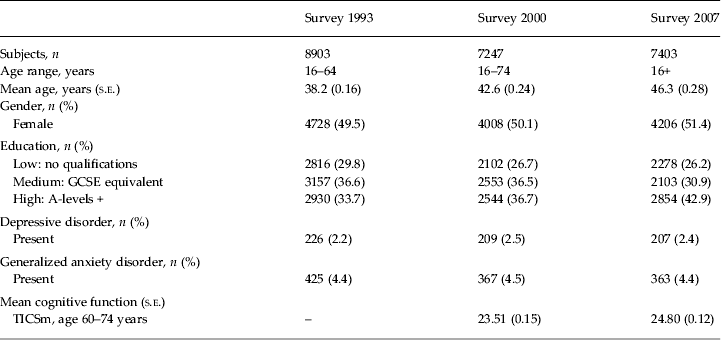
Of the 26 091 participants in the combined three surveys, 23 553 (90%) were resident in England, forming the analysed samples. Of these, 656 (2.8%) reported SMC only, 267 (1.1%) reported SCC only, 1591 (6.8%) reported having both complaints and 21 039 (89.3%) reported having no complaints. Of the 23 553 participants, 8903 were from the 1993 survey, 7247 from the 2000 survey and 7403 from the 2007 survey. Table 1 describes sociodemographic characteristics for each survey sample. Of the two surveys including participants aged 65+ years, 1072 (15%) in the 2000 survey were 65–74 years old and 1978 (27%) were 65+ years in the 2007 survey. There were no marked differences in the gender distribution across the three surveys. The prevalence of higher education levels increased across the surveys (χ 2 = 118.18, p < 0.001). Prevalences of ICD-10 depression and GAD remained reasonably constant, with a slight increase from the 1993 to the 2000 survey for depressive disorder and a very slightly higher proportion in the 2000 survey for GAD. There was no marked difference in age-restricted mean cognitive function scores between the two surveys in which this was measured.
Characteristics of the samples a

s.e., Standard error; GCSE, General Certificate of Secondary Education; A-levels, advanced levels; TICSm, modified Telephone Interview for Cognitive Status.
a All proportions and means are weighted.
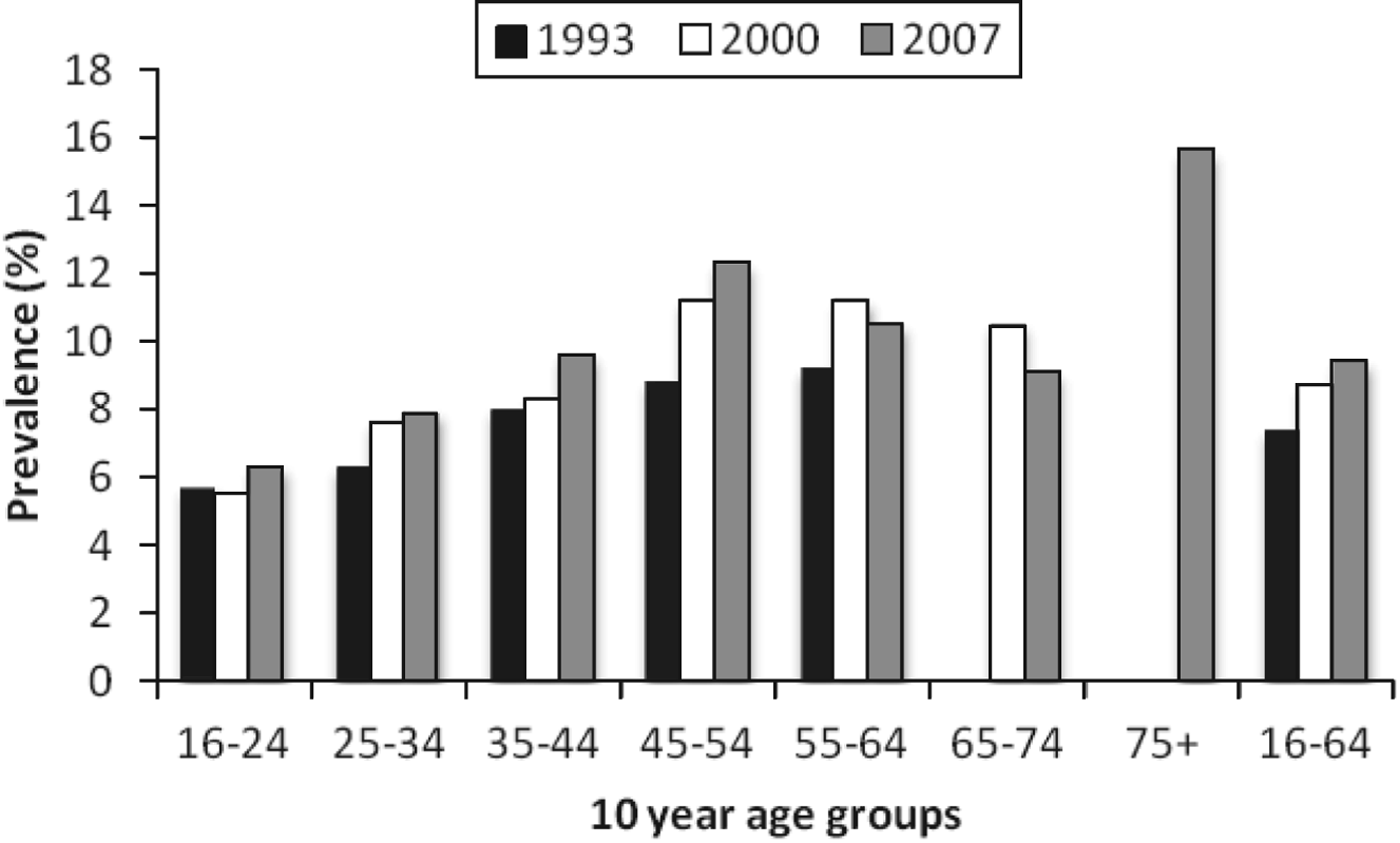
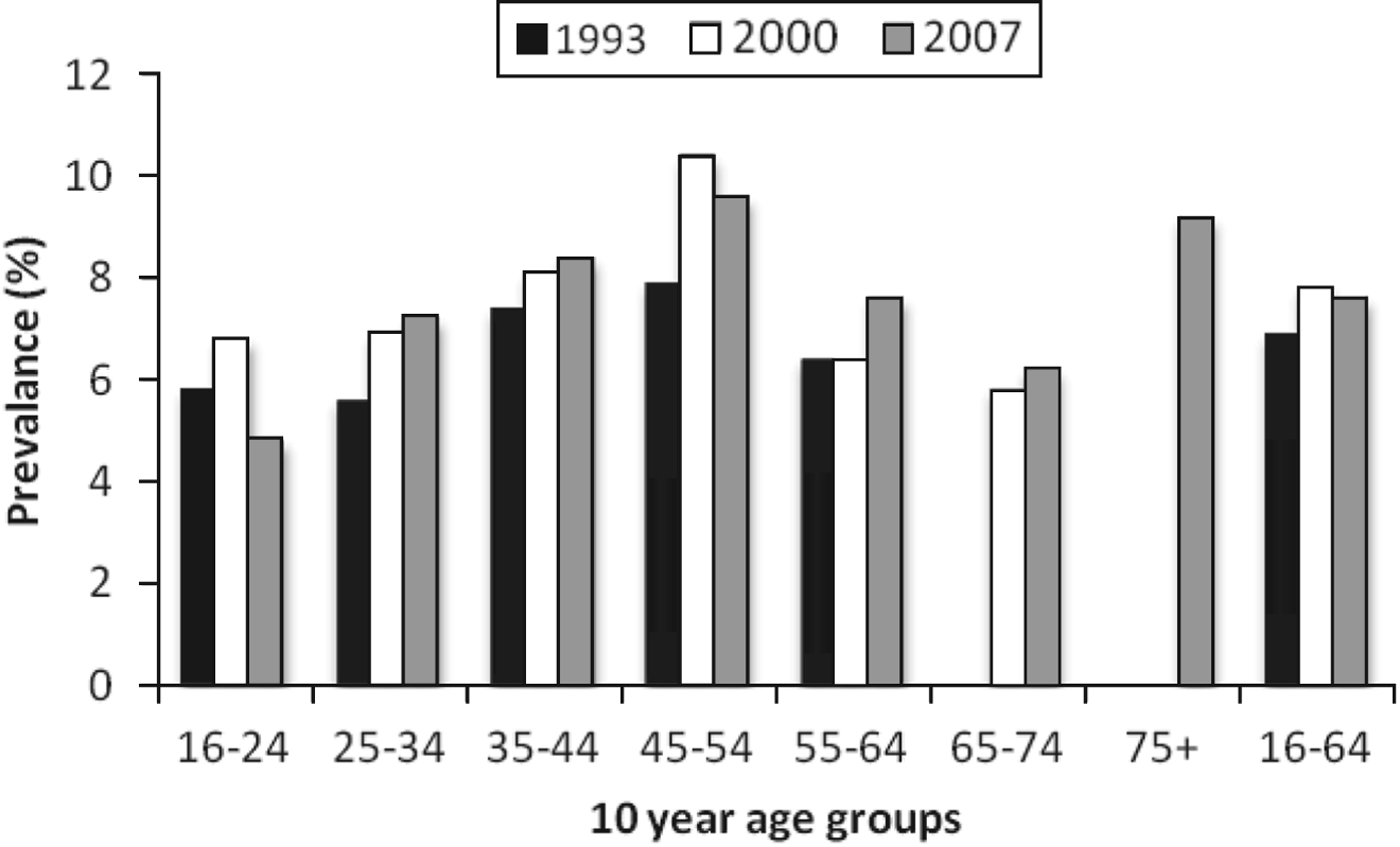
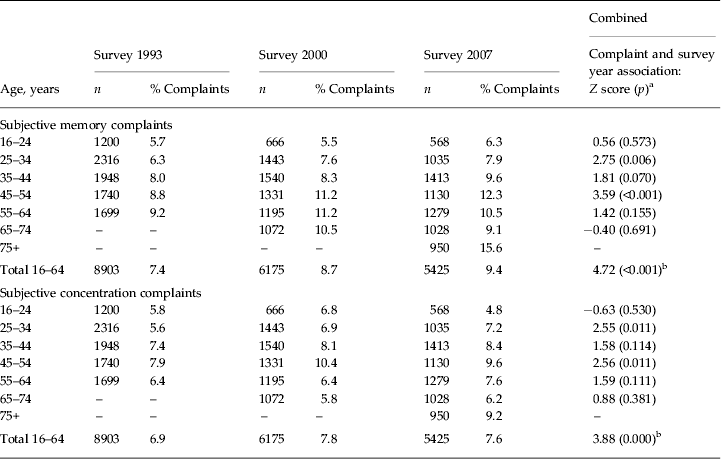
Table 2 and Figs. 1 and 2 display the prevalences of both cognitive complaints for each survey year in 10-year age groups, followed by associations between complaints and survey year in the surveys combined. For both complaints, the proportions reporting these increased with age within each survey up to age band 45–54 years (for the association between SMC and age decade from 16–54 years: p = 0.004, p < 0.001 and p < 0.001 in 1993, 2000 and 2007, respectively). For SCC these were weaker associations but still significant: (p = 0.019, p = 0.015 and p = 0.012, respectively). The prevalences then decreased into older age groups but increased again for the 75+ years cohort in the 2007 survey. Wald's tests, carried out for each complaint, indicated significant non-linear effects with the exception of SMC in the 2007 survey (p = 0.552).
Prevalence of subjective memory complaints in each age group and total.

Prevalence of subjective concentration complaints in each age group and total.

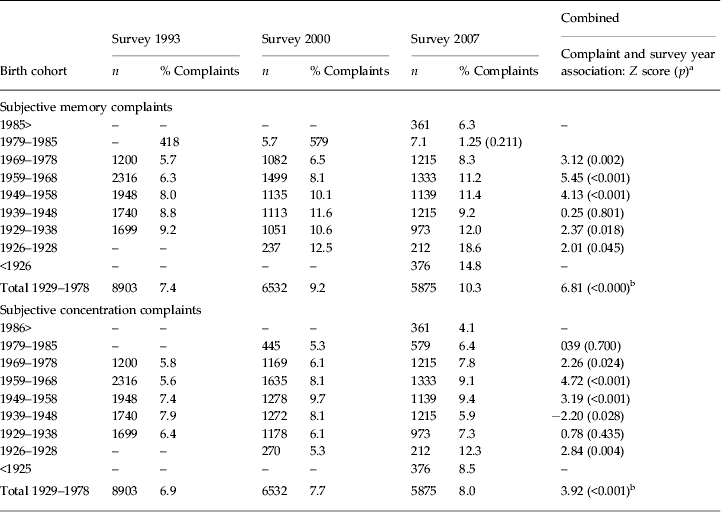
Prevalence of memory and concentration complaints by 10-year age cohorts

a Logistic regression model with Wald test, complaint and survey year association in each age cohort.
b Age-adjusted model for combined total.
As described, secondary analyses were carried out in 2007 survey participants aged 16–54 years to investigate potential explanations for working age trends in subjective cognition. In these participants, the unadjusted OR for the association between age (years) and SMC in this group was 1.27 [95% confidence interval (CI) 1.13–1.43], which changed to 1.17 (95% CI 0.99–1.38) following work stress adjustment. For SCC these ORs were 1.25 (95% CI 1.10–1.40) and 1.06 (95% CI 0.90–1.24), respectively. Further adjustment for AUDIT score, smoking and diabetes gave rise to ORs of 1.20 (95% CI 1.01–1.41) for SMC and 1.10 (95% CI 0.9–1.29) for SCC.
In the combined sample, significant increases in SMC and SCC prevalence across survey years were found within the 25–34 and 45–54 years age groups. Restricting the combined sample to ages 16–64 years (available for all surveys), age-adjusted associations between complaints and survey year remained significant. With the 1993 sample as the reference group, age-adjusted ORs for SMC were 1.22 (95% CI 1.09–1.37) for the 2000 sample participants and 1.31 (95% CI 1.17–1.47) for 2007 participants. The same ORs for SCC were 1.25 (95% CI 1.11–1.41) for 2000 and 1.26 (95% CI 1.11–1.42) for 2007, indicating an age-adjusted increase in the frequency of both complaints in more recent survey years.
Table 3 summarizes the same results for 10-year birth cohorts rather than age cohorts. Where all the three surveys overlapped there was a significant increase in SMC and SCC prevalences across the survey years except for those born between 1939 and 1948 in whom 2007 SMC prevalence was relatively low and those born between 1929 and 1938 in whom SCC prevalence did not change substantially between surveys. Restricting the combined sample to 1929–1978 (available for all surveys), both complaints significantly increased with survey year after adjusting for year of birth. Using 1993 as the reference, adjusted ORs for SMC were 1.29 (95% CI 1.15–1.44) for 2000 and 1.47 (95% CI 1.31–1.64) for 2007. The same ORs for SCC were 1.22 (95% CI 1.08–1.37) for 2000 and 1.27 (95% CI 1.12–1.43) for 2007.
Prevalence of memory and concentration complaints by 10-year birth cohorts

a Logistic regression model with Wald test, complaint and survey year association in each birth cohort.
b Year of birth-adjusted model for combined total.
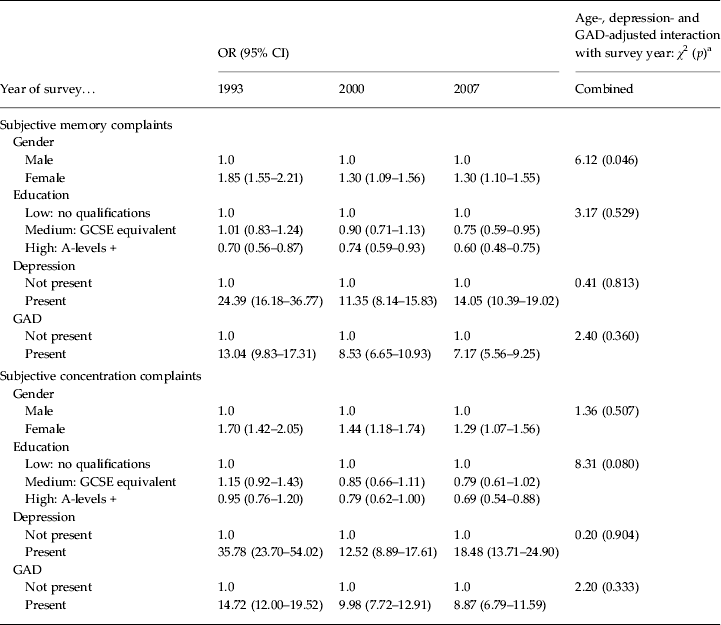
Table 4 shows the age-adjusted associations between the four exposures of interest (excluding cognitive function) and the two outcome variables for each survey year. Female gender, lower education level, depression and GAD were all significantly associated with SMC in each survey year. For SCC, however, only female gender, depression and GAD were significantly associated in each survey year. The final column displays the p values for age-adjusted interactions by survey year for the surveys combined. The association between female gender and SMC was significantly weaker in later survey years but otherwise there was no evidence for effect modification.
Age-adjusted associations with complaints and exposure variables, and age-adjusted interactions with survey year

OR, Odds ratio; CI, confidence interval; GAD, generalized anxiety disorder; GCSE, General Certificate of Secondary Education; A-levels, advanced levels.
a Likelihood ratio test for interaction between each demographic variable and survey year, adjusted by age.
Linear regression analyses were carried out to estimate the associations between SMC, SCC and cognitive function restricted to ages 60–74 years. In the 2000 survey for SMC, the unadjusted
 $\widehat \beta $
coefficient was −0.78 (95% CI −1.48 to −0.07), which remained significant after full adjustment by age, gender, education and depression:
$\widehat \beta $
= −0.67 (95% CI −1.28 to −0.06). For SCC the
$\widehat \beta $
coefficient was −1.32 (95% CI −2.23 to −0.40) unadjusted, and −1.18 (95% CI −1.97 to −0.38) after full adjustment. In the 2007 survey for SMC the unadjusted and adjusted
$\widehat \beta $
coefficients were −0.87 (95% CI −1.54 to −0.07) and −0.60 (95% CI −1.22 to −0.02), respectively. For SMC the unadjusted and adjusted
$\widehat \beta $
coefficients were −1.71 (95% CI −2.51 to −0.92) and −1.47 (95% CI −2.21 to −0.72), respectively. Both SMC and SCC were therefore significantly associated with worse cognitive function after full adjustment in both survey years. Tests of age-adjusted interactions with survey year yielded χ
2 = 0.85 (p = 0.04) for SMC and χ
2 = 0.52 (p = 0.41) for SCC.
Discussion
To the best of our knowledge this is the first study to investigate changes in prevalences of cognitive complaints, describing these over a 14-year time period using national data, and one of very few to have investigated and characterized cognitive complaints across adult life. The prevalences of both SMC and SCC increased with age; however, significant non-linear effects were found, indicating highest prevalences in middle rather than old age. After adjusting for age, both complaints had also become significantly more prevalent over the 14-year period covered by the three surveys, with greatest increases in the 45–54 years age group and more constant or decreasing prevalence in the 55–74 years group. The picture therefore appears to be one of both secular trends (cognitive complaints becoming more common, particularly in working-age adults) and non-linear age effects (cognitive complaints increasing across working ages, declining around retirement followed by a second increase in older age). Similar patterns were observed for both concentration and memory complaints and associations with demographic and mental health covariates were in general consistent in strength between the three survey years, although there was some evidence of an increase in the strength of association with cognitive function in old age.
Changes in prevalence with age
A study using only data from the 2007 survey found no significant association between subjective forgetfulness and age (Cooper et al. Reference Cooper, Bebbington, Lindesay, Meltzer, McManus, Jenkins and Livingston2011). Our findings suggest a more complex picture as described above. In the secondary analyses that we carried out on 2007 data, work-related stress appeared to account for a reasonable proportion of the increase in cognitive complaint (particularly SCC) prevalence across the working age range. Also, the diminishing prevalence into early retirement could be related to reduced work-related stress, as well as improvements in other aspects of life quality around the retirement age. It is also consistent with non-linear age patterns previously reported for common mental disorder prevalence (Melzer et al. Reference Melzer, Buxton and Villamil2004; Villamil et al. Reference Villamil, Huppert and Melzer2006) and may reflect a decline in depression and anxiety, which, as will be discussed further, were strongly associated with SCC. Disorders affecting cognition such as dementia do not become common until the mid-70s and beyond, which would be consistent with the apparent second increase that we observed in the 75+ years group in the 2007 survey. However, due to the upper age restrictions of the earlier surveys it was not possible to investigate this further. In our secondary analyses investigating the effects of work-related stress we also adjusted for alcohol use, current smoking and diabetes. For both SMC and SCC the results indicate that work-related stress accounted for much of the age-associated trends, with little evidence for further influence of other covariates. We found a similar trend in the birth cohort analyses, with complaints increasing up to a point and then beginning to decrease, followed by a potential second rise in the oldest 1926–1928 cohort. From both age and birth cohort analyses, the findings suggest an effect of ageing rather than belonging to a different or earlier birth cohort although, as will be discussed further below, it is not possible to differentiate these factors conclusively. In another study of a broad age range, stress and multi-tasking were the most common reported reasons for memory complaints below 65 years, and ageing the most common in those aged 65 years and above (Vestergren & Nilsson, Reference Vestergren and Nilsson2011). In the 45–54 years age group, work stress may be combined with wider family pressures that improve into retirement, consistent with this model.
Some researchers have suggested that memory problems in younger adults may be more frequently reported when asked about attention or concentration problems, as younger people tend to ascribe their complaints to extrinsic causes such as emotional problems and stress (Ponds et al. Reference Ponds, Commissaris and Jolles1997). However, it should be borne in mind that there are often conflicting results when younger and older age groups are compared (Welch & West, Reference Welch and West1995). One study found that younger people were more likely to make notes to remember things, and were more likely to report others as also noticing their memory problems, although no difference was found in that study between age groups in reported concentration problems (Gino et al. Reference Gino, Mendes, Maroco, Ribeiro, Schmand, De Mendonca and Guerreiro2009). However, differences in symptom interpretation across the age range are complex: for example, one study found that older people were more likely to acknowledge an external locus of control on intelligence and health dimensions, while preserving a sense of internal control in other respects (Lachman, Reference Lachman1986). It should also be borne in mind that, even though both age and birth cohort were analysed, the 14-year time frame for the study was relatively small and there may be substantial intergenerational differences in material advantage and life-style which might account at least in part for our observations.
Changes in prevalence over time
Prevalences of cognitive complaints were also found to have increased over time, most markedly the 40% increase in SMC for the 45–54 years age range. Two analyses of the same surveys found little evidence that common mental disorders were increasing in prevalence (Brugha et al. Reference Brugha, Bebbington, Singleton, Melzer, Jenkins, Lewis, Farrell, Bhugra, Lee and Meltzer2004; Spiers et al. Reference Spiers, Bebbington, McManus, Brugha, Jenkins and Meltzer2011), although sleep problems generally (Spiers et al. Reference Spiers, Bebbington, McManus, Brugha, Jenkins and Meltzer2011) and specific insomnia symptoms (Calem et al. Reference Calem, Bisla, Begum, Dewey, Bebbington, Brugha, Cooper, Jenkins, Lindesay, McManus, Meltzer, Spiers, Weich and Stewart2012) had increased. Wider social changes may underlie these observations. A major UK recession in 1991 was associated with an increased prevalence of sleep problems and worry (Dregan & Armstrong, Reference Dregan and Armstrong2009), and a longer-term impact of this recession might explain the increase in SCC to 2000. A recent military health study found an increase in non-specific symptoms over a 7-year period (Horn et al. Reference Horn, Sloggett, Ploubidis, Hull, Hotopf, Wessely and Rona2010) and suggested several explanations for this trend, including those highlighted by the ‘paradox of health’ literature (Barsky, Reference Barsky1988), for example, greater attention to health promoted by the media and greater awareness of certain medical conditions and their symptoms. Increasing cognitive complaints may also be due to concerns about phenomena such as pollution, food ingredients, radiation and technological advances (Petrie et al. Reference Petrie, Sivertsen, Hysing, Broadbent, Moss-Morris, Eriksen and Ursin2001).
Comparisons of ‘memory’ and ‘concentration’ complaints
Although SMC and SCC are related constructs, overlap was only partial. Both complaints were significantly associated with female gender, depression, GAD and worse cognitive function in all survey years. SMC, however, more consistently varied with education and varied in prevalence more substantially across age groups and survey years. Associations between SMC and female gender are broadly consistent with previous studies (Stewart et al. Reference Stewart, Dufouil, Godin, Ritchie, Maillard, Delcroix, Crivello, Mazoyer and Tzourio2008), potentially reflecting common mental disorder risk in women and/or a higher willingness to report symptoms (Jessen et al. Reference Jessen, Wiese, Bachmann, Eifflaender-Gorfer, Haller, Kolsch, Luck, Mosch, Van Den Bussche, Wagner, Wollny, Zimmermann, Pentzek, Riedel-Heller, Romberg, Weyerer, Kaduszkiewicz, Maier and Bickel2010). SMC and depression are often found to be strongly associated (Dux et al. Reference Dux, Woodard, Calamari, Messina, Arora, Chik, Pontarelli, Dux, Woodard, Calamari, Messina, Arora, Chik and Pontarelli2008), and poor concentration is a recognized symptom of the disorder. To our knowledge, associations with anxiety disorder have received little previous investigation. In part, associations with affective disorders may arise from a tendency to underrate function secondary to a low or anxious mood; however, they may also reflect a realistic appraisal of genuine, if reversible, cognitive deficits characteristic of the underlying disorders (Foland-Ross & Gotlib, Reference Foland-Ross and Gotlib2012). Finally, it is also possible that affective disorders may arise because of someone's concern over poor cognitive function, and there may be shared underlying risk factors such as acute or chronic stress. Of interest, SMC and SCC were both associated with affective disorders to a comparable degree, and were both more strongly associated with depression than with GAD. This suggests that the complaints may be interchangeable and potentially driven more by depressed than by anxious mood. Associations between education and cognitive complaints have been more inconsistent in previous research, with several studies finding no association; however, when associations have been reported at all (Dux et al. Reference Dux, Woodard, Calamari, Messina, Arora, Chik, Pontarelli, Dux, Woodard, Calamari, Messina, Arora, Chik and Pontarelli2008), they have tended to be with lower educational attainment (Jorm et al. Reference Jorm, Butterworth, Anstey, Christensen, Easteal, Maller, Mather, Turakulov, Wen and Sachdev2004), similar to our own findings. It should be borne in mind that educational attainment cannot be assumed to have the same meaning across the wide age range in these surveys.
Subjective and objective cognitive function
Our findings of associations between cognitive complaints and worse cognitive function in the older survey participants in whom these were both measured are consistent with some previous research (Dufouil et al. Reference Dufouil, Fuhrer, Alperovitch, Dufouil, Fuhrer and Alperovitch2005), although the focus has tended to be on older age and on memory rather than concentration as a subjective complaint. We found lower cognitive function to be more strongly associated with SCC than SMC, suggesting that a ‘memory’ focus in the young elderly might mask associations which could be picked up by asking about concentration instead. Participants were asked about their complaints before cognitive assessment, so perceived performance on the day was unlikely to give rise to the complaint. Although neurodegenerative disorders tend to have a later onset than the age ranges (predominantly 60–74 years) focused on here, it has become increasingly evident that age-associated cognitive decline and influences on this are detectable in mid-life (Cadar et al. Reference Cadar, Pikhart, Mishra, Stephen, Kuh and Richards2012) and therefore potentially relevant to the associations observed. The significantly stronger associations between subjective and objective cognitive function in 2007 than in 2000 should be viewed tentatively because only two time points could be analysed. However, it might reflect greater awareness of, and perhaps concern over, realistically appraised cognitive deficits in these age ranges in relation to increased dementia awareness, or might reflect life-styles becoming increasingly cognitively demanding due to technological advances and increased emphasis on self-sufficiency.
Strengths and limitations
Analyses of age and birth cohorts were carried out in three large representative samples spanning over 14 years. Influences of age on SMC/SCC prevalence were inferred from serial surveys rather than changes at an individual level. An alternative would be to follow a single cohort over time, such as has been used to investigate trajectories of affective symptoms and their influences in younger age groups (Wickrama et al. Reference Wickrama, Noh and Elder2009). However, this approach presents its own challenges of selective attrition and, to our knowledge, there are no long-standing cohort studies in which SCC have been serially evaluated. The surveys providing data for our analyses used standardized and near-identical sampling methodologies and mental health measures. Specifically, the two main outcome measures were drawn from an instrument administered in an identical manner at all time points. We used more than a single item to define SMC and SCC, and although there is debate over the best approach to define cognitive complaints, it is generally considered desirable to combine a single question on the presence of a symptom with supplementary data on its salience and duration, an approach followed here.
Despite having a large representative sample with consistent sampling methodology (and analyses restricted to comparable subsamples), falling response rates across the three surveys should be borne in mind. However, recent studies have suggested that there is very little non-response bias on physical and mental health indicators in large surveys (Korkeila et al. Reference Korkeila, Suominen, Ahvenainen, Ojanlatva, Rautava, Helenius and Koskenvuo2001; De Winter et al. Reference De Winter, Oldehinkel, Veenstra, Brunnekreef, Verhulst and Ormel2005). Furthermore, previous birth and cohort analyses using these data have not suggested any alterations in demographic or mental health profiles that would account for the findings described here (Spiers et al. Reference Spiers, Bebbington, McManus, Brugha, Jenkins and Meltzer2011). It is also unlikely that willingness to participate in the surveys would have been directly influenced by the presence of cognitive complaints, as the survey remit was broad and not focused on cognition. Finally, the consistency in strengths of associations of cognitive complaints with sociodemographic factors does not suggest alteration in the nature of the sample over the surveys.
The nature of the data under investigation should also be considered. Although age, period and birth cohort influences could be separately analysed using this approach, it is important to bear in mind that these are mutually dependent constructs that cannot be conclusively distinguished from each other. From the coinciding pattern of age associations (highest prevalence in late working age ranges) and period effects (strongest increases over time in late working age groups), we have inferred that these two factors are likely to be the most important. Underlying birth cohort differences cannot be absolutely excluded, although we feel that this would predict more evenly distributed temporal effects across age groups than are displayed in Table 2.
Given the focus of this study on cognitive complaints and age, there are some further potential limitations. Cognitive function was only measured in the two most recent surveys, limiting the extent to which temporal trends could be examined. Furthermore, the first two surveys had upper age restrictions and the TICSm was administered only in those aged 60 years or over in 2000 and 2007. Cognitive function measures were therefore only available for a subsample and temporal trends could not be investigated in the oldest age groups or in the younger population. The surveys were carried out in private households and findings cannot be generalized to people living in institutions. Selective survival cannot be ruled out as a potential explanation for age associations, although to our knowledge there is no evidence to date that subjective complaints are associated with higher mortality.
Finally, an important limitation concerns the nature of the epidemiological approach taken in this study that focused on prevalences of relatively broad constructs across large survey populations. This approach does not and cannot take into account the more precise experience of the individual and the meaning of the symptom that might be the focus for a more in-depth clinical study. There has been interest for some time in understanding the cognitive substructure of emotional symptoms in order to improve the understanding of how such symptoms occur (Andreasen, Reference Andreasen1997). At an individual level, this may include causal links from cognitive ability through to social knowledge structures, beliefs and competencies, with emotional symptoms arising as a result of ineffective use of social supports. In a wider context this might reflect the individual's exposure to, interpretation of, and relationship with wider influences such as media exposure, changes in prevailing attitudes and other secular effects that were not specifically measured in this study.
Implications
Cognitive complaints were common across the age ranges investigated, and it therefore seems appropriate to view these complaints not just in the context of older adults but as a symptom relevant to all age groups, albeit with potential variation in its aetiology. These population prevalences and trends need to be borne in mind when findings are interpreted from clinical studies in relation to observed prevalences of cognitive complaints and assumptions about the underlying disorder or pharmacotherapy as a cause for this. Increasing prevalence across the three surveys also suggests that further and ongoing investigations into temporal trends are necessary to monitor and provide explanations for these observations. The middle-aged group reported the highest prevalence of complaints and had the strongest increase in prevalences over time. Work-related stress was potentially implicated, although further in-depth evaluation would be helpful, as well as prospective research investigating the process of retirement and the extent to which it is universally or variably beneficial. This study provides national data against which observations within specific samples can be compared, as well as a base from which further trends in these important symptoms can be evaluated.
Acknowledgements
The National Psychiatric Morbidity Surveys (NPMS) were supported by the Department of Health, the Scottish Health Executive (formerly the Scottish Office), the Welsh Assembly Government (formerly the Welsh Office) and the National Health Service (NHS) Information Centre for health and social care. A.B. and R.S. are funded by the National Institute for Health Research (NIHR) Biomedical Research Centre at South London and Maudsley NHS Foundation Trust and King's College London. The authors thank the participants and interviewers of the NPMS.
Declaration of Interest
None.